
CHAPTER 3 National Income Where it Comes From




- Slides: 55
CHAPTER 3 National Income: Where it Comes From and Where it Goes MACROECONOMICS SIXTH EDITION N. GREGORY MANKIW Power. Point® Slides by Ron Cronovich © 2008 Worth Publishers, all rights reserved
In this chapter, you will learn… § what determines the economy’s total output/income § how the prices of the factors of production are determined § how total income is distributed § what determines the demand for goods and services § how equilibrium in the goods market is achieved CHAPTER 3 National Income slide 1
Outline of model A closed economy, market-clearing model Supply side § factor markets (supply, demand, price) § determination of output/income Demand side § determinants of C, I, and G Equilibrium § goods market § loanable funds market CHAPTER 3 National Income slide 2
Factors of production K = capital: tools, machines, and structures used in production L = labor: the physical and mental efforts of workers CHAPTER 3 National Income slide 3
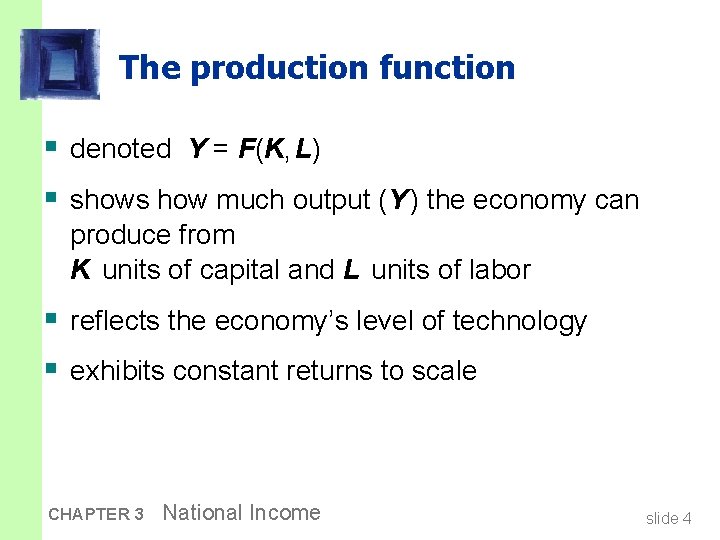
The production function § denoted Y = F(K, L) § shows how much output (Y ) the economy can produce from K units of capital and L units of labor § reflects the economy’s level of technology § exhibits constant returns to scale CHAPTER 3 National Income slide 4
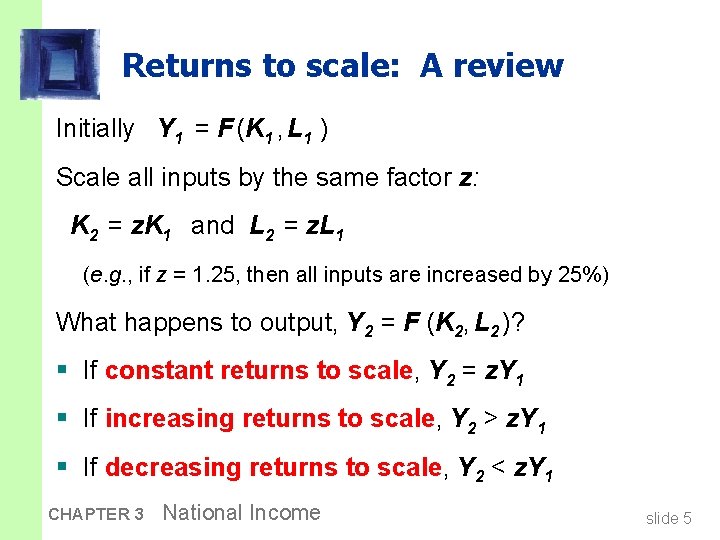
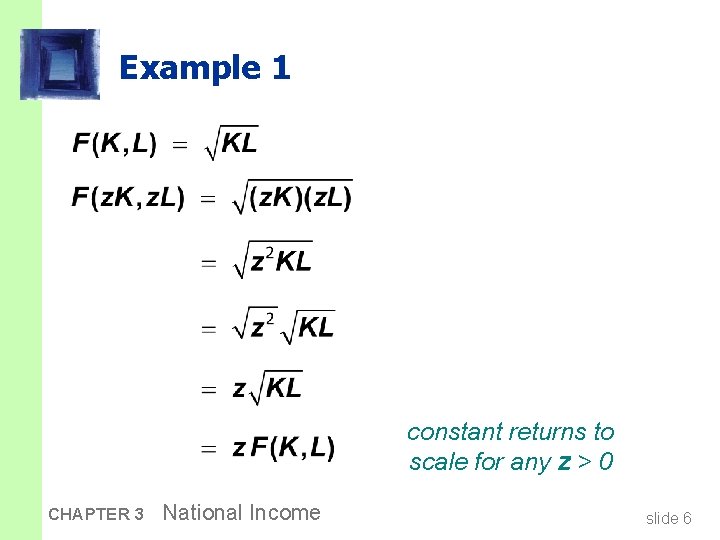
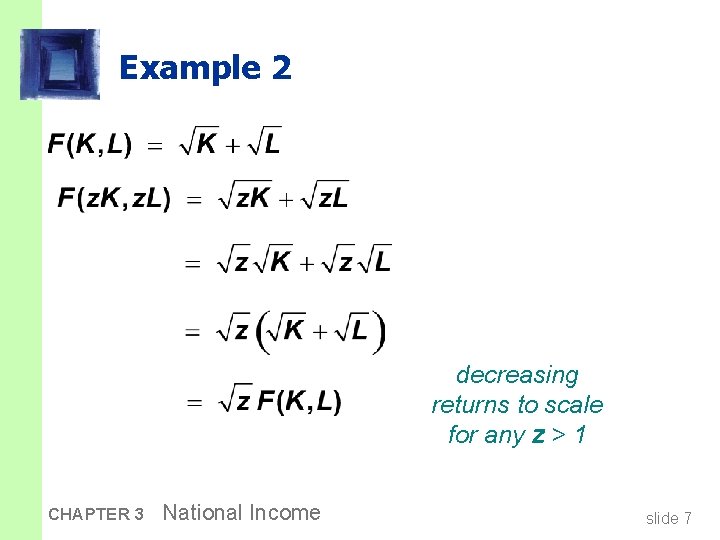
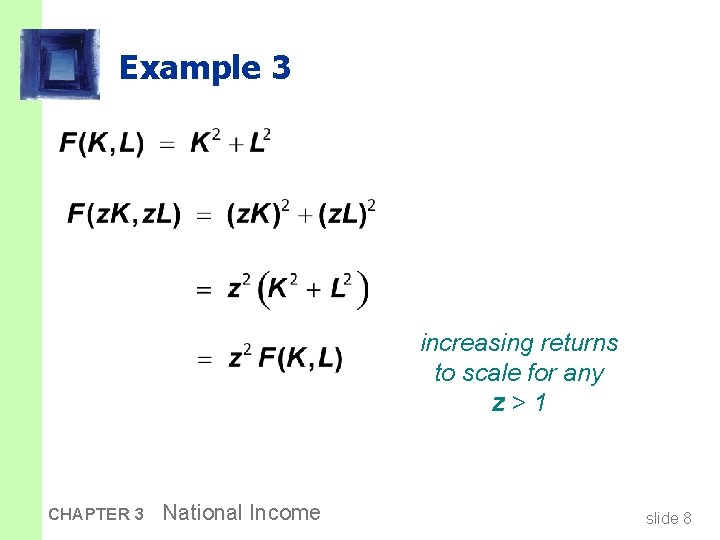
Returns to scale: A review Initially Y 1 = F (K 1 , L 1 ) Scale all inputs by the same factor z: K 2 = z. K 1 and L 2 = z. L 1 (e. g. , if z = 1. 25, then all inputs are increased by 25%) What happens to output, Y 2 = F (K 2, L 2 )? § If constant returns to scale, Y 2 = z. Y 1 § If increasing returns to scale, Y 2 > z. Y 1 § If decreasing returns to scale, Y 2 < z. Y 1 CHAPTER 3 National Income slide 5
Example 1 constant returns to scale for any z > 0 CHAPTER 3 National Income slide 6
Example 2 decreasing returns to scale for any z > 1 CHAPTER 3 National Income slide 7
Example 3 increasing returns to scale for any z>1 CHAPTER 3 National Income slide 8
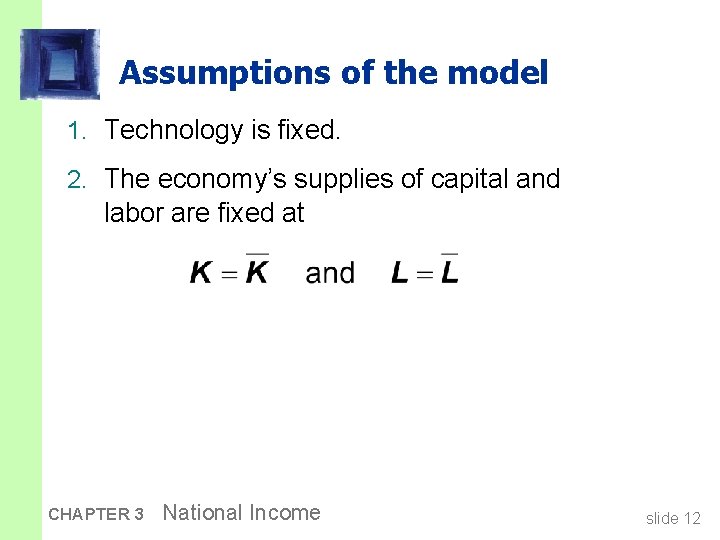
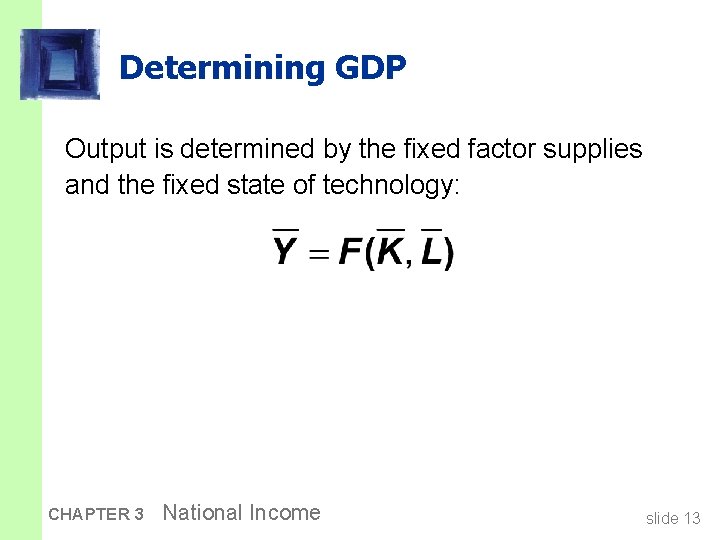
Assumptions of the model 1. Technology is fixed. 2. The economy’s supplies of capital and labor are fixed at CHAPTER 3 National Income slide 12
Determining GDP Output is determined by the fixed factor supplies and the fixed state of technology: CHAPTER 3 National Income slide 13
The distribution of national income § determined by factor prices, the prices per unit that firms pay for the factors of production § wage = price of L § rental rate = price of K CHAPTER 3 National Income slide 14
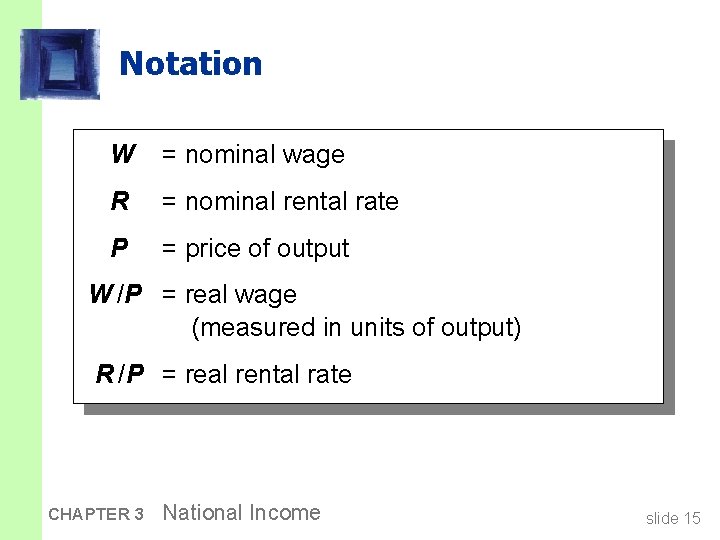
Notation W = nominal wage R = nominal rental rate P = price of output W /P = real wage (measured in units of output) R /P = real rental rate CHAPTER 3 National Income slide 15
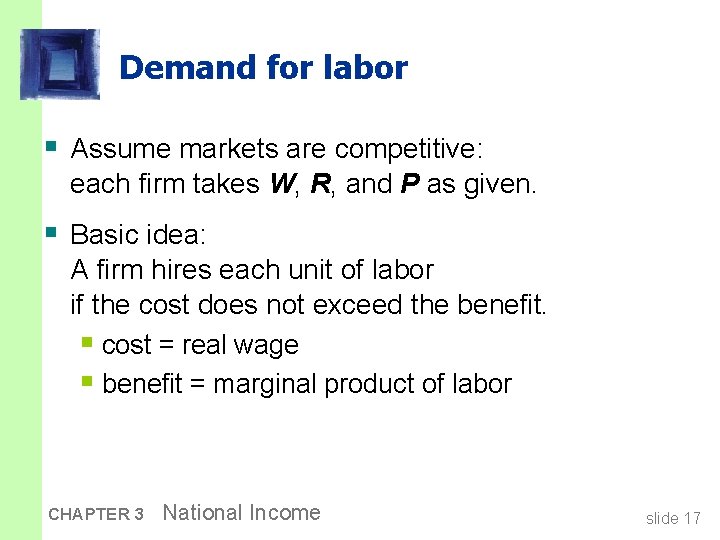
How factor prices are determined § Factor prices are determined by supply and demand in factor markets. § Recall: Supply of each factor is fixed. § What about demand? CHAPTER 3 National Income slide 16
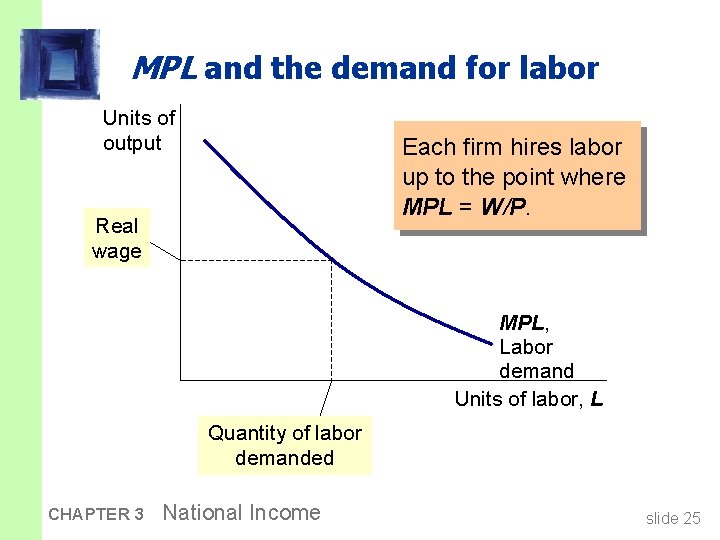
Demand for labor § Assume markets are competitive: each firm takes W, R, and P as given. § Basic idea: A firm hires each unit of labor if the cost does not exceed the benefit. § cost = real wage § benefit = marginal product of labor CHAPTER 3 National Income slide 17
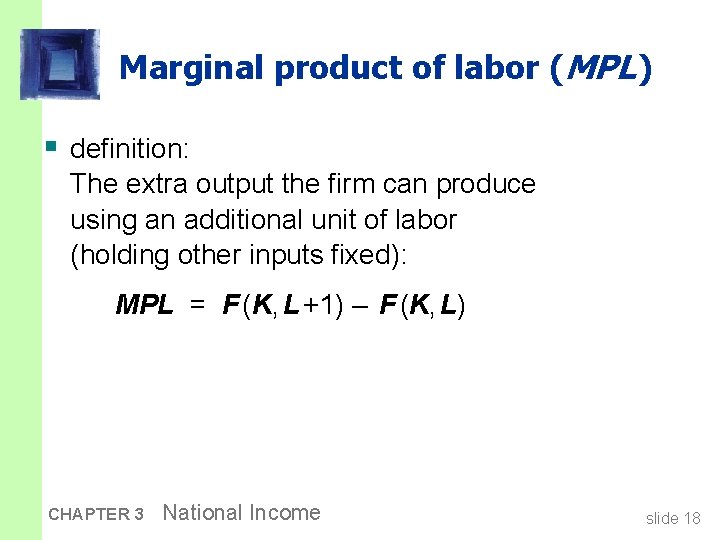
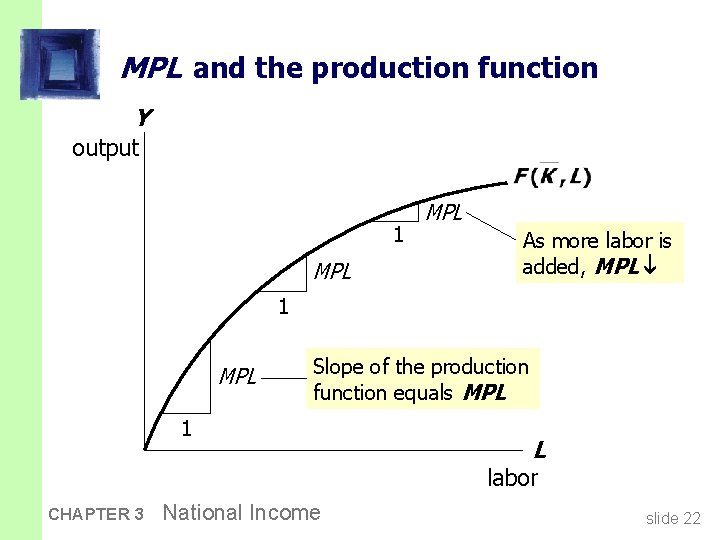
Marginal product of labor (MPL ) § definition: The extra output the firm can produce using an additional unit of labor (holding other inputs fixed): MPL = F (K, L +1) – F (K, L) CHAPTER 3 National Income slide 18
Diminishing marginal returns § As a factor input is increased, its marginal product falls (other things equal). § Intuition: Suppose L while holding K fixed fewer machines per worker lower worker productivity CHAPTER 3 National Income slide 21
MPL and the production function Y output 1 MPL As more labor is added, MPL 1 MPL Slope of the production function equals MPL 1 L labor CHAPTER 3 National Income slide 22
MPL and the demand for labor Units of output Each firm hires labor up to the point where MPL = W/P. Real wage MPL, Labor demand Units of labor, L Quantity of labor demanded CHAPTER 3 National Income slide 25
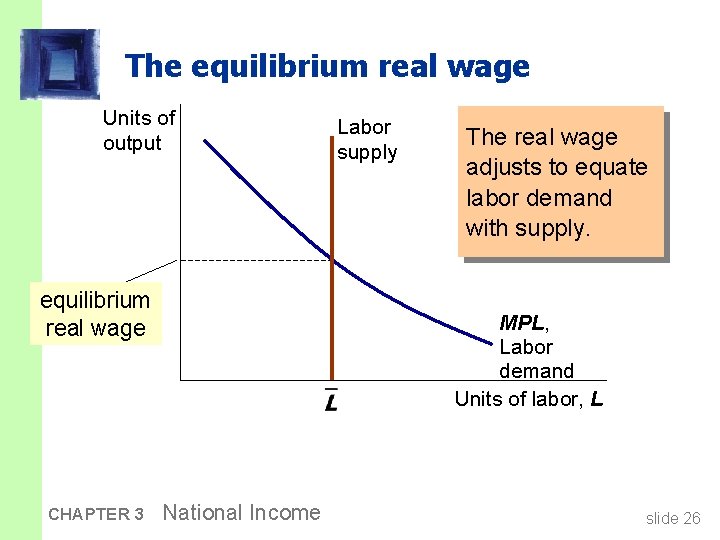
The equilibrium real wage Units of output equilibrium real wage CHAPTER 3 Labor supply The real wage adjusts to equate labor demand with supply. MPL, Labor demand Units of labor, L National Income slide 26
Determining the rental rate We have just seen that MPL = W/P. The same logic shows that MPK = R/P : § diminishing returns to capital: MPK as K § The MPK curve is the firm’s demand curve for renting capital. § Firms maximize profits by choosing K such that MPK = R/P. CHAPTER 3 National Income slide 27
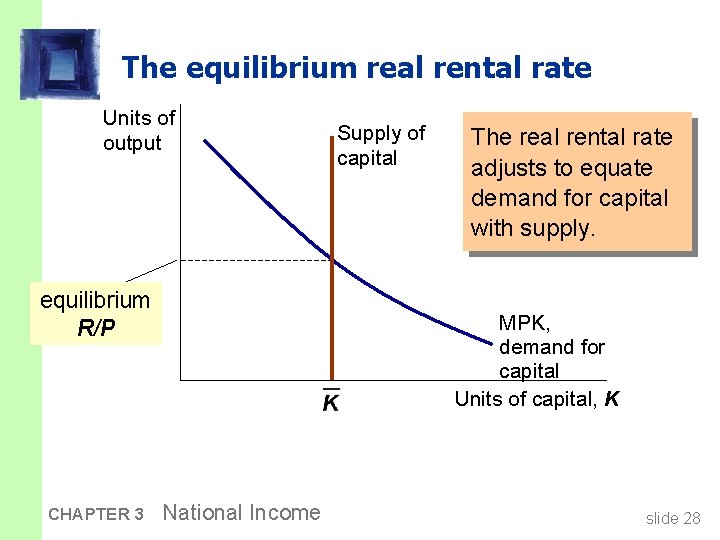
The equilibrium real rental rate Units of output equilibrium R/P CHAPTER 3 Supply of capital The real rental rate adjusts to equate demand for capital with supply. MPK, demand for capital Units of capital, K National Income slide 28
The Neoclassical Theory of Distribution § states that each factor input is paid its marginal product § is accepted by most economists CHAPTER 3 National Income slide 29
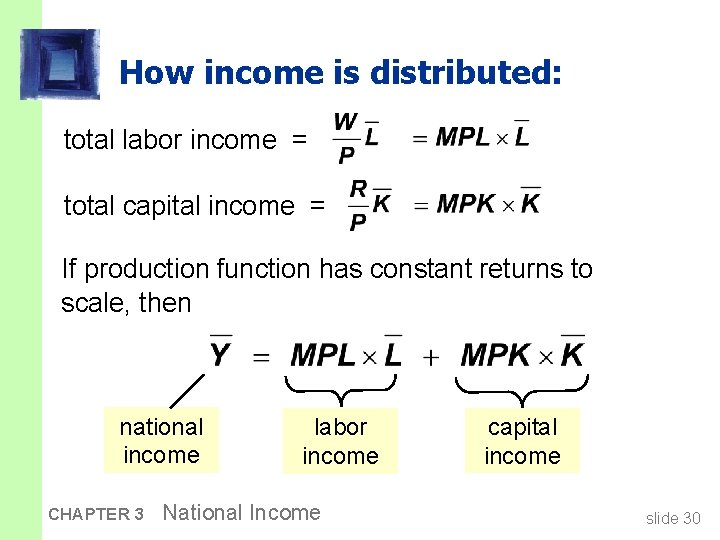
How income is distributed: total labor income = total capital income = If production function has constant returns to scale, then national income CHAPTER 3 labor income National Income capital income slide 30
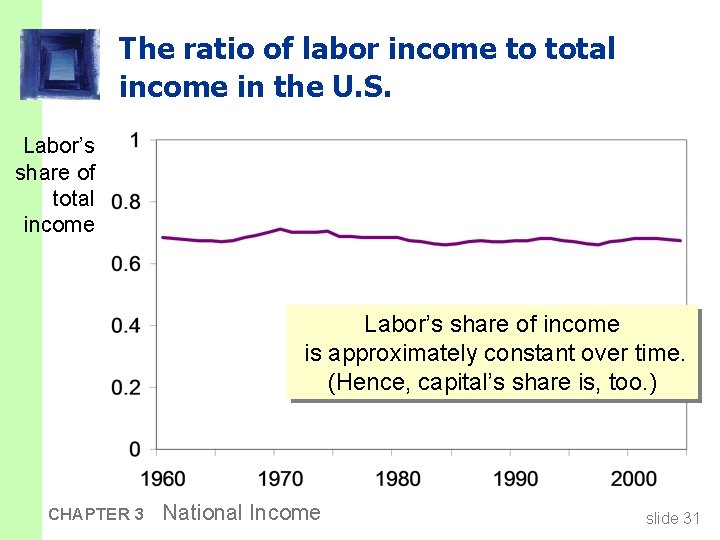
The ratio of labor income to total income in the U. S. Labor’s share of total income Labor’s share of income is approximately constant over time. (Hence, capital’s share is, too. ) CHAPTER 3 National Income slide 31
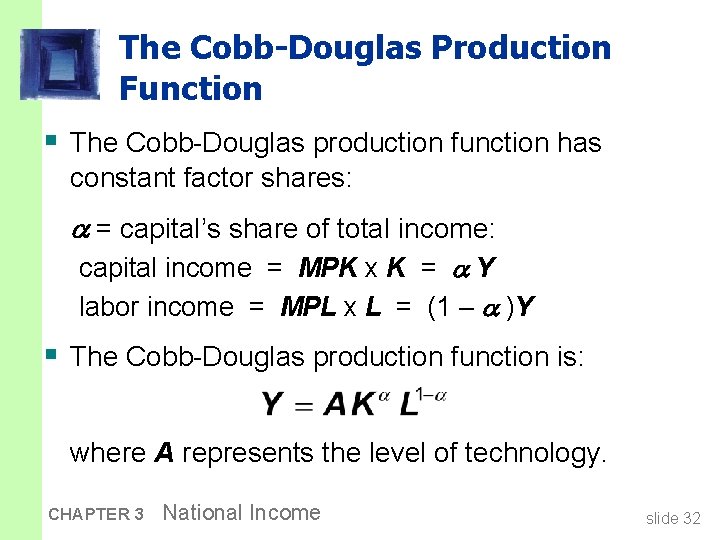
The Cobb-Douglas Production Function § The Cobb-Douglas production function has constant factor shares: = capital’s share of total income: capital income = MPK x K = Y labor income = MPL x L = (1 – )Y § The Cobb-Douglas production function is: where A represents the level of technology. CHAPTER 3 National Income slide 32
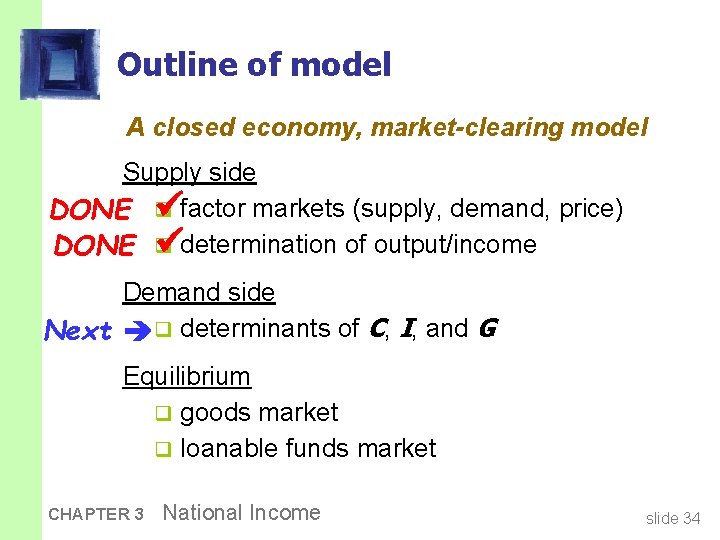
Outline of model A closed economy, market-clearing model Supply side DONE q factor markets (supply, demand, price) DONE q determination of output/income Demand side Next q determinants of C, I, and G Equilibrium q goods market q loanable funds market CHAPTER 3 National Income slide 34
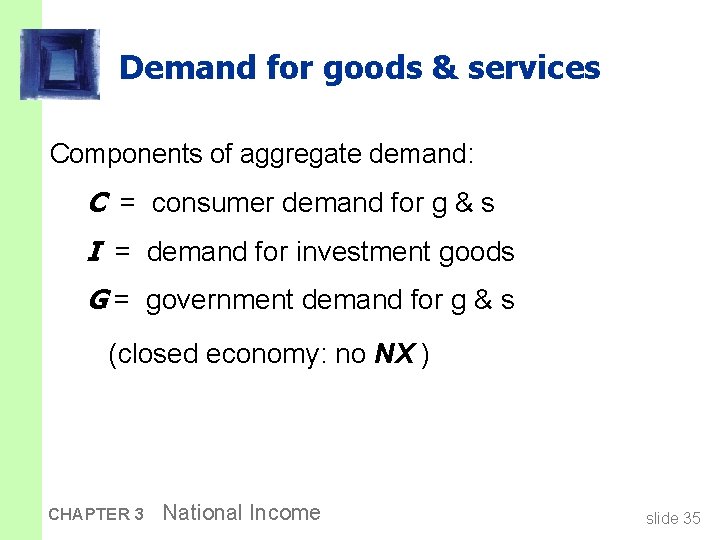
Demand for goods & services Components of aggregate demand: C = consumer demand for g & s I = demand for investment goods G = government demand for g & s (closed economy: no NX ) CHAPTER 3 National Income slide 35
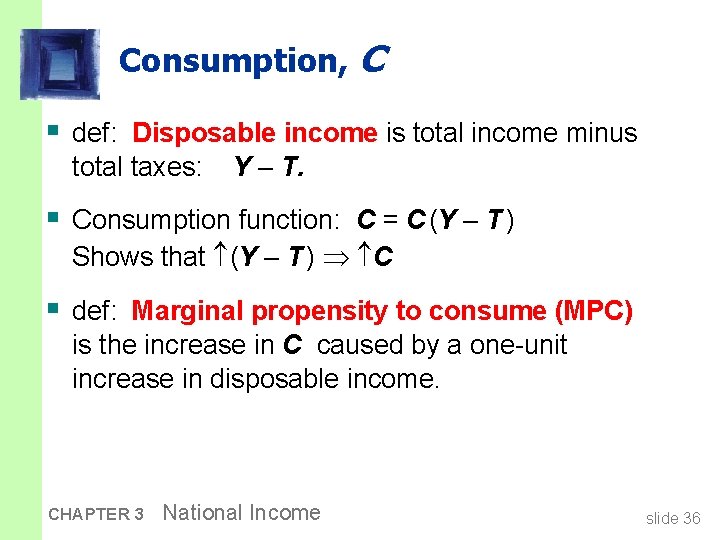
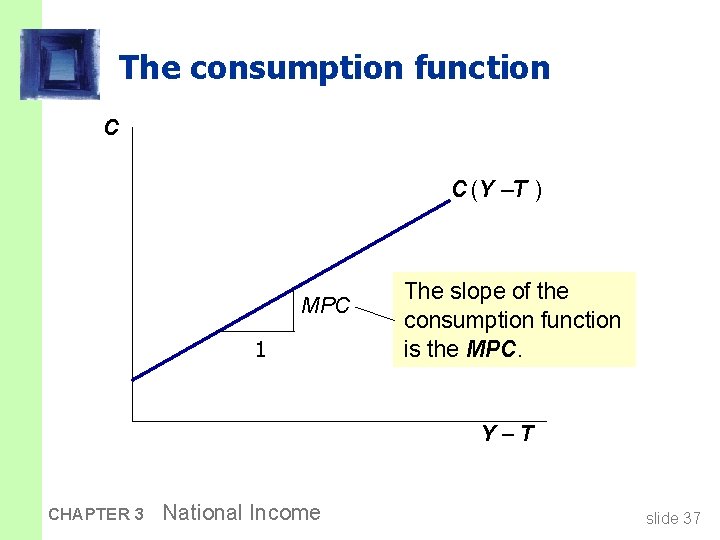
Consumption, C § def: Disposable income is total income minus total taxes: Y – T. § Consumption function: C = C (Y – T ) Shows that (Y – T ) C § def: Marginal propensity to consume (MPC) is the increase in C caused by a one-unit increase in disposable income. CHAPTER 3 National Income slide 36
The consumption function C C (Y –T ) MPC 1 The slope of the consumption function is the MPC. Y–T CHAPTER 3 National Income slide 37
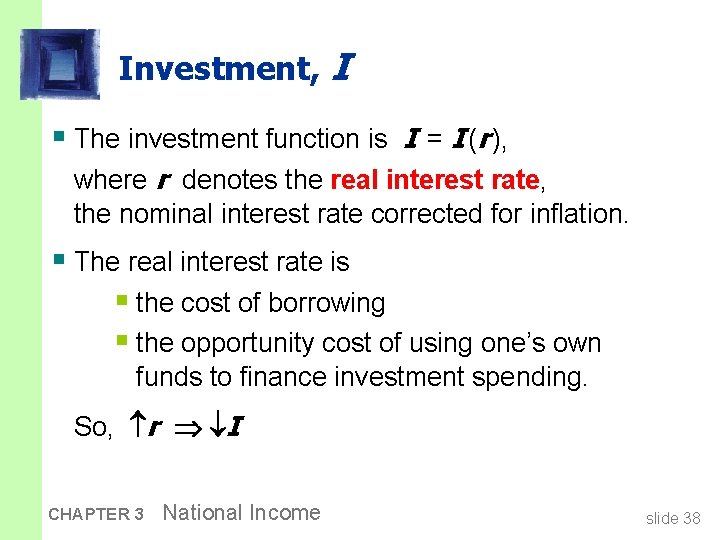
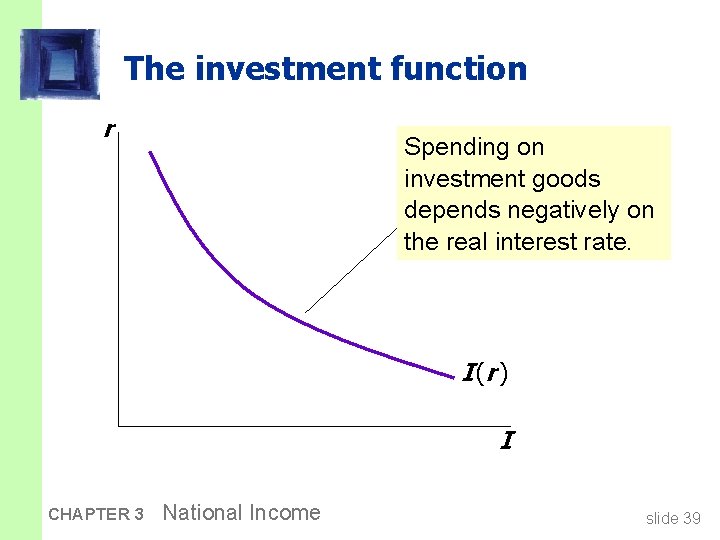
Investment, I § The investment function is I = I (r ), where r denotes the real interest rate, the nominal interest rate corrected for inflation. § The real interest rate is § the cost of borrowing § the opportunity cost of using one’s own funds to finance investment spending. So, r I CHAPTER 3 National Income slide 38
The investment function r Spending on investment goods depends negatively on the real interest rate. I (r ) I CHAPTER 3 National Income slide 39
Government spending, G § G = govt spending on goods and services. § G excludes transfer payments (e. g. , social security benefits, unemployment insurance benefits). § Assume government spending and total taxes are exogenous: CHAPTER 3 National Income slide 40
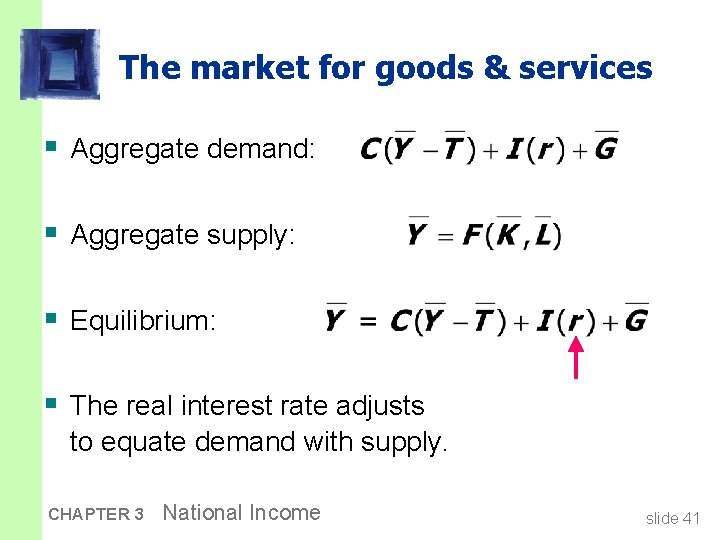
The market for goods & services § Aggregate demand: § Aggregate supply: § Equilibrium: § The real interest rate adjusts to equate demand with supply. CHAPTER 3 National Income slide 41
The loanable funds market § A simple supply-demand model of the financial system. § One asset: “loanable funds” § demand for funds: investment § supply of funds: saving § “price” of funds: real interest rate CHAPTER 3 National Income slide 42
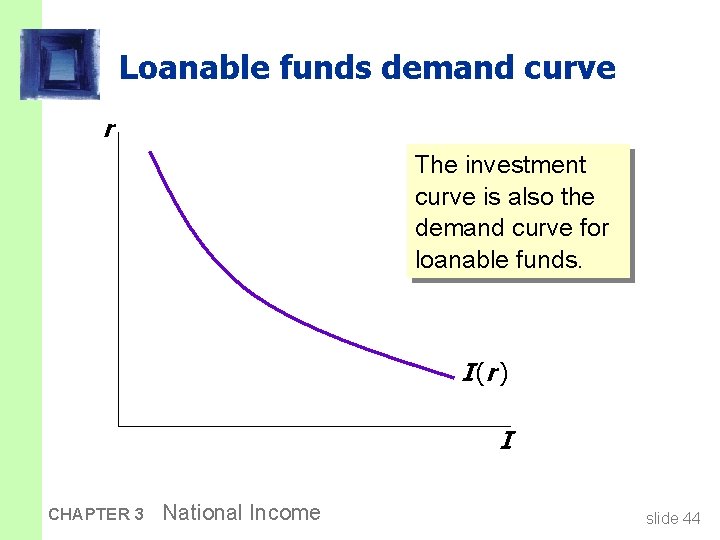
Demand for funds: Investment The demand for loanable funds… § comes from investment: Firms borrow to finance spending on plant & equipment, new office buildings, etc. Consumers borrow to buy new houses. § depends negatively on r, the “price” of loanable funds (cost of borrowing). CHAPTER 3 National Income slide 43
Loanable funds demand curve r The investment curve is also the demand curve for loanable funds. I (r ) I CHAPTER 3 National Income slide 44
Supply of funds: Saving § The supply of loanable funds comes from saving: § Households use their saving to make bank deposits, purchase bonds and other assets. These funds become available to firms to borrow to finance investment spending. § The government may also contribute to saving if it does not spend all the tax revenue it receives. CHAPTER 3 National Income slide 45
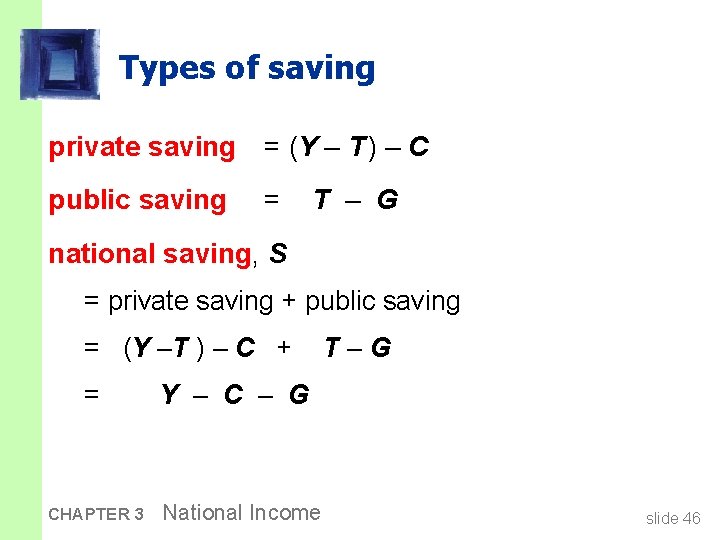
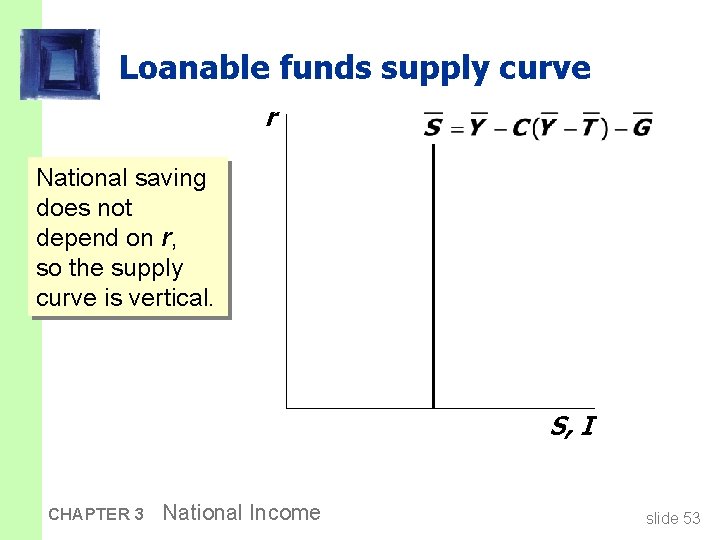
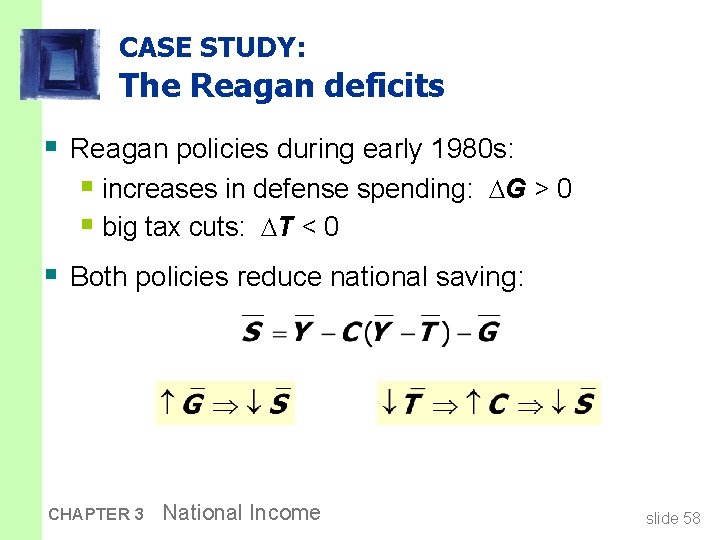
Types of saving private saving = (Y – T ) – C public saving = T – G national saving, S = private saving + public saving = (Y –T ) – C + = CHAPTER 3 T–G Y – C – G National Income slide 46
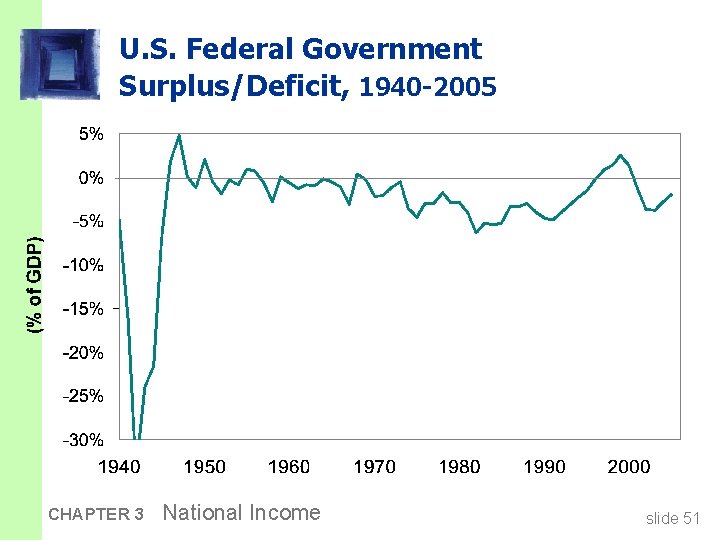
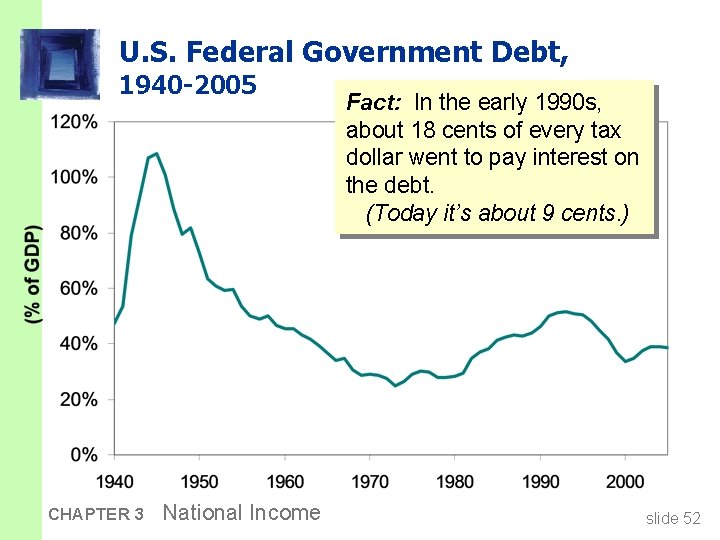
digression: Budget surpluses and deficits § If T > G, budget surplus = (T – G ) = public saving. § If T < G, budget deficit = (G – T ) and public saving is negative. § If T = G , “balanced budget, ” public saving = 0. § The U. S. government finances its deficit by issuing Treasury bonds – i. e. , borrowing. CHAPTER 3 National Income slide 50
U. S. Federal Government Surplus/Deficit, 1940 -2005 CHAPTER 3 National Income slide 51
U. S. Federal Government Debt, 1940 -2005 CHAPTER 3 National Income Fact: In the early 1990 s, about 18 cents of every tax dollar went to pay interest on the debt. (Today it’s about 9 cents. ) slide 52
Loanable funds supply curve r National saving does not depend on r, so the supply curve is vertical. S, I CHAPTER 3 National Income slide 53
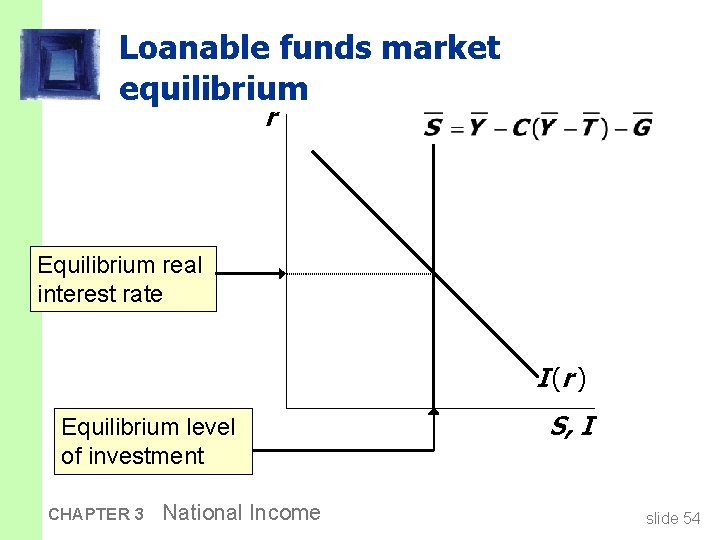
Loanable funds market equilibrium r Equilibrium real interest rate I (r ) Equilibrium level of investment CHAPTER 3 National Income S, I slide 54
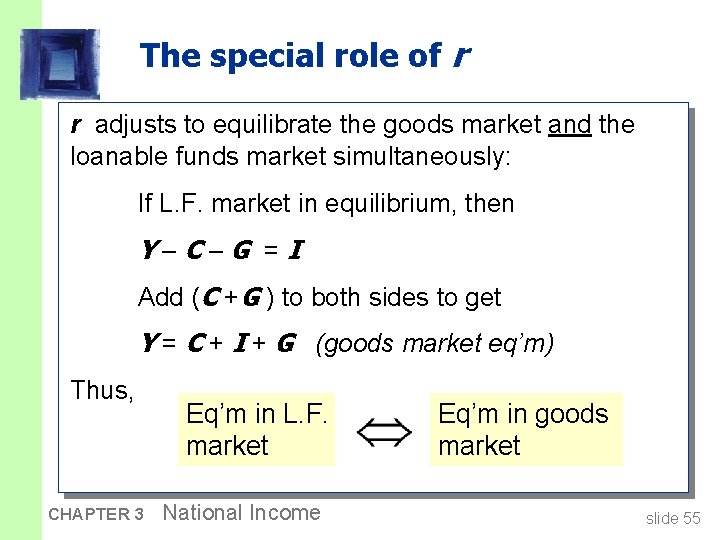
The special role of r r adjusts to equilibrate the goods market and the loanable funds market simultaneously: If L. F. market in equilibrium, then Y–C–G =I Add (C +G ) to both sides to get Y = C + I + G (goods market eq’m) Thus, CHAPTER 3 Eq’m in L. F. market National Income Eq’m in goods market slide 55
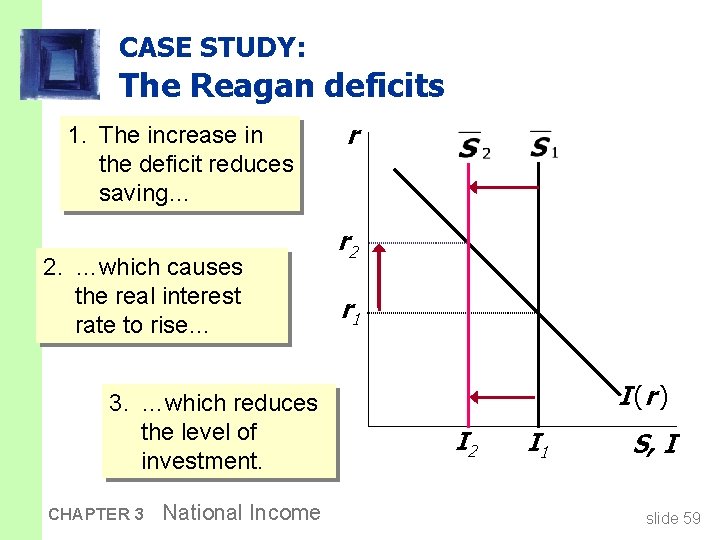
CASE STUDY: The Reagan deficits § Reagan policies during early 1980 s: § increases in defense spending: G > 0 § big tax cuts: T < 0 § Both policies reduce national saving: CHAPTER 3 National Income slide 58
CASE STUDY: The Reagan deficits 1. The increase in the deficit reduces saving… 2. …which causes the real interest rate to rise… 3. …which reduces the level of investment. CHAPTER 3 National Income r r 2 r 1 I (r ) I 2 I 1 S, I slide 59
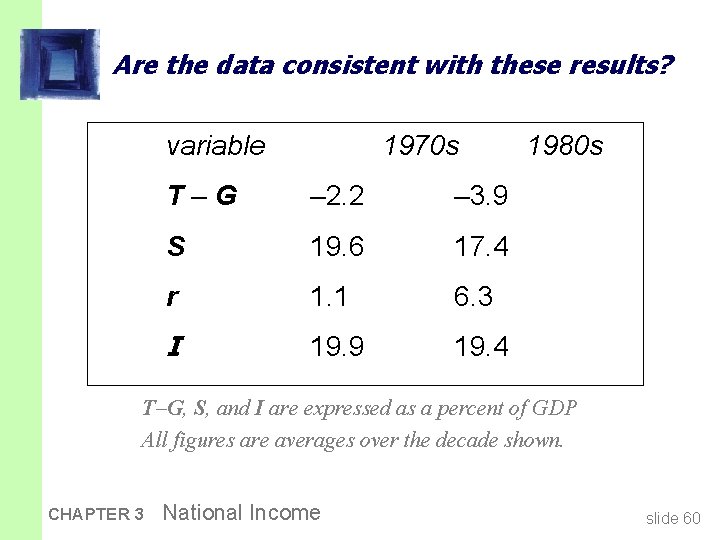
Are the data consistent with these results? variable 1970 s T–G – 2. 2 – 3. 9 S 19. 6 17. 4 r 1. 1 6. 3 I 19. 9 19. 4 1980 s T–G, S, and I are expressed as a percent of GDP All figures are averages over the decade shown. CHAPTER 3 National Income slide 60
Mastering the loanable funds model, continued Things that shift the investment curve § some technological innovations § to take advantage of the innovation, firms must buy new investment goods § tax laws that affect investment § investment tax credit CHAPTER 3 National Income slide 62
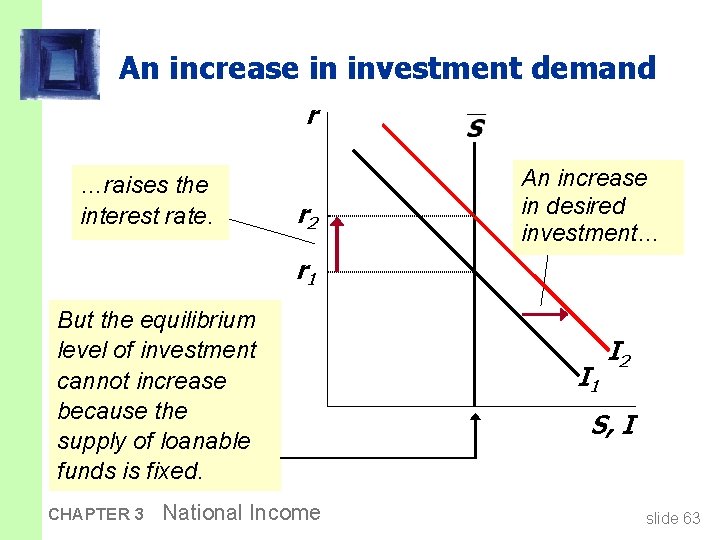
An increase in investment demand r …raises the interest rate. r 2 An increase in desired investment… r 1 But the equilibrium level of investment cannot increase because the supply of loanable funds is fixed. CHAPTER 3 National Income I 1 I 2 S, I slide 63
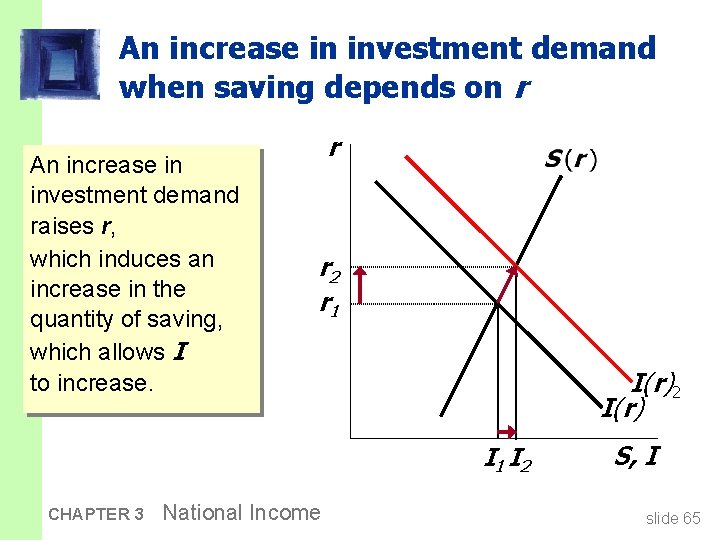
Saving and the interest rate § Why might saving depend on r ? § How would the results of an increase in investment demand be different? § Would r rise as much? § Would the equilibrium value of I change? CHAPTER 3 National Income slide 64
An increase in investment demand when saving depends on r An increase in investment demand raises r, which induces an increase in the quantity of saving, which allows I to increase. r r 2 r 1 I(r)2 I(r) I 1 I 2 CHAPTER 3 National Income S, I slide 65
Chapter Summary § Total output is determined by § the economy’s quantities of capital and labor § the level of technology § Competitive firms hire each factor until its marginal product equals its price. § If the production function has constant returns to scale, then labor income plus capital income equals total income (output). CHAPTER 3 National Income slide 66
Chapter Summary § A closed economy’s output is used for § consumption § investment § government spending § The real interest rate adjusts to equate the demand for and supply of § goods and services § loanable funds CHAPTER 3 National Income slide 67
Chapter Summary § A decrease in national saving causes the interest rate to rise and investment to fall. § An increase in investment demand causes the interest rate to rise, but does not affect the equilibrium level of investment if the supply of loanable funds is fixed. CHAPTER 3 National Income slide 68