
Chapter 3 MOTIVATION LEADERSHIP AND ENTREPRENEURSHIP Bikash Adhikari
Chapter 3 MOTIVATION, LEADERSHIP AND ENTREPRENEURSHIP Bikash Adhikari bikashadh 044@gmail. com Acknowledgement: Khem Gyawali Mechanical Engineer
Motivation -course outline ü Human needs ü Maslow’s Hierarchy of needs ü Motivation – Introduction ü Types of Motivation ü Attitude Motivation; Group Motivation; Executive Motivation ü Techniques of Motivation ü Motivation Theories 2
1. Motivation The term motivation is derived from the word ‘motive’ which may be defined as needs, wants, drives or impulses within an individual. ‘Motivation is a general term applying to the entire class of drives, desires, needs, wishes and similar forces that induce an individual or a group of people to work. ’ From the definitions, it is clear that motivation has two aspects: 1. The knowledge of human needs. 2. To inspire the employees to their best towards the goals of the enterprise. The employers use the finding of the study of motivation in making their employees’ work more and better in the accomplishment of the organization ‘s objectives through satisfaction of the employee’ needs. 3
I. Human Needs Expectation of the worker: 1. Certain goals to be fulfilled. 2. Right to choose a specific job. 3. Responsibility to fulfill his reasonable goals. Understanding human behavior: 1. Understand the behavior. 2. Integrate the interests and needs of the employers with the objectives of the organization. 3. Un co-operative, indifferent, unfriendly. 4. Have full knowledge of human behavior. 5. Know what satisfies the employee. 6. Co-operative working environment. 4
II. Maslow’s Hierarchy of Needs Maslow advanced three important propositions about human behavior. 1. Men are wanting being: Their needs are unlimited and continuous. As soon as one need is satisfied, another appears in its place. The process is unending. It continues from birth to death. It keeps man to work continuously. 2. Fresh needs can motivate persons to work: A satisfied need is not a motivator of behavior, only the needs which are not satisfied are capable of motivating individuals. 3. Man’s needs have a hierarchy of importance: According to Maslow man’s needs are arranged in a series of levels. He classified the needs into five ascending levels, in which each level must be satisfied before going on to the next. The lower level needs have priority over higher level needs. 5
II. Maslow’s Hierarchy of Needs 6
II. Maslow’s Hierarchy of Needs can be broadly classified into two categories as follows: 1. Primary needs: i. Physiological (basic): Satisfying basic needs for food, shelter, clothing, water, air, sleep, sex etc. ii. Safety: Safety from physical harm. Protection against deprivation, danger, threat etc. 2. Secondary needs: i. Social: Desire to be accepted, liked and loved. ii. Ego/esteem: Recognition and need for self-respect, status, independence etc. iii. Self-realization: Ability to realize one’s capabilities and to work for one’s interest (self-development, selfadvancement). 7
III. Motivation‐ Introduction Motivation—the forces within the individual that account for the level, direction, and persistence of effort expended at work. – Extrinsic rewards —valued outcomes given to someone by another person. – Intrinsic rewards —valued outcomes that occur naturally as a person works on a task. 1. 2. 3. 4. The following characteristics make the study of motivation very complicated: One type of need is different individuals produce different behaviors. Needs keep on changing absolutely and their intensity changes from time to time. People cannot express some of their needs in specific terms for social, cultural and other factors. In any situation more than one need may be operating. 8
III. Motivation‐ Introduction Outcomes & Inputs – Regardless of the source of motivation, people seek outcomes. • Outcome: anything a person gets from a job. – Examples include pay, autonomy, accomplishment. – Organizations hire workers to obtain inputs: • Input: anything a person contributes to their job. – Examples include skills, knowledge, work behavior. – Managers thus use outcomes to motivate workers to provide inputs. 9
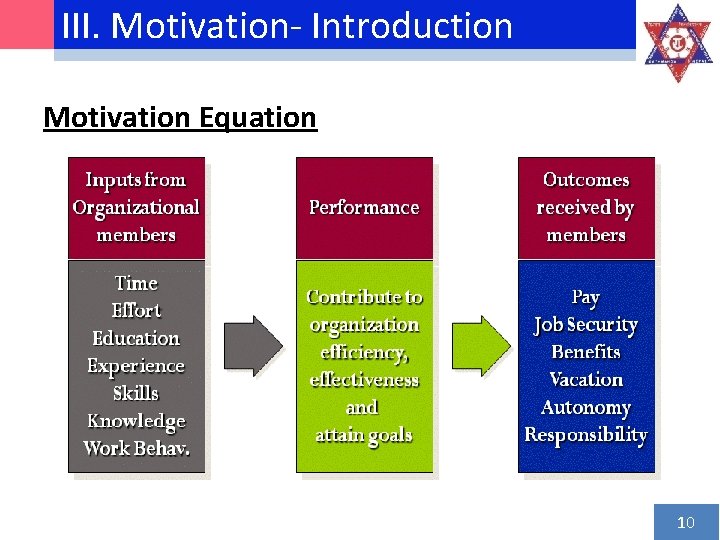
III. Motivation‐ Introduction Motivation Equation 10
IV. Types of Motivation There are many different forms of motivation. Each one influences behavior in its own unique way. No single type of motivation works for everyone. People’s personalities vary and so accordingly does the type of motivation, that is most effective at inspiring their conduct. • Incentive: A form of motivation that involves rewards, both monetary and nonmonetary is often called incentive motivation. Many people are driven by the knowledge that they will be rewarded in some manner for achieving a certain target or goal. Bonuses and promotions are good examples of the type of incentives that are used for motivation. • Fear: Fear motivation involves consequences. This type of motivation is often one that is utilized when incentive motivation fails. In a business style of motivation often referred to as the, “carrot and stick, ” incentive is the carrot and fear is the stick. 11
IV. Types of Motivation • Achievement: Achievement motivation is also commonly referred to as the drive for competency. We are driven to achieve goals and tackle new challenges. We desire to improve skills and prove our competency both to others and to ourselves. Generally, this feeling of accomplishment and achievement is intrinsic in nature. • Growth: The need for self-improvement is truly an internal motivation. A burning desire to increase our knowledge of ourselves and of the outside world can be a very strong form of motivation. We seek to learn and grow as individuals. • Power: The motivation of power can either take the form of a desire for autonomy or other desire to control others around us. We want to have choices and control over our own lives. We strive for the ability to direct the manner in which we live now and the way our lives will unfold in the future. • Social: Many people are motivated by social factors. This may be a desire to belong and to be accepted by a specific peer group or a desire to relate to the people in our sphere or in the larger world. We have an innate need to feel a connection with others. We also have the need for acceptance and affiliation. 12
V. Attitude Motivation, Group Motivation and Executive Motivation Attitude or self motivation: Being self-motivated means being ready for driven, focused discussion and behavior. It also means being sharp and smart enough not to be manipulated and to be open to positive learning. Being in this state of mind is the challenge! Causes of decrease in self-motivation. 1. Monotonous work. 2. Driven by boss. 3. Bad physical condition. 4. Does not get along with associates. 5. Financial problem. 13
V. Attitude Motivation, Group Motivation and Executive Motivation Effects of decrease in self-motivation. 1. Unwilling to work. 2. Creates sympathy. 3. Inferiority complex. Solutions to decrease in self-motivation. 1. Making the job more interesting. 2. Thinking constructively. 3. Making the best possible use of one’s strong points and not dwelling on weakness. 4. Adopting oneself to the situation. 5. Acquiring the sensible and worthwhile principle of life. 14
V. Attitude Motivation, Group Motivation and Executive Motivation Necessities of Group Motivation • Fairness • Truthfulness • Honesty • Loyalty • Stability • Tolerance • Ability to assume responsibility and co-operation • Constructive criticism • Compromise when necessary • Orderliness in mind action • A sense of humor 15
V. Attitude Motivation, Group Motivation and Executive Motivation • Greater degree of the need for achievement. • Concerned more about actualization, esteem and social needs. Techniques Ø They are doing something that they call their own. Ø They do tasks they have set for themselves. Ø They can see what they have done. Ø They feel that their job is important. Ø They are secure. Ø Challenge in work. Ø Belief in the value of the work. 16
V. Attitude Motivation, Group Motivation and Executive Motivation Reasons for low executive motivation. Ø Unsatisfactory bosses. Ø Advancement is limited. Ø Poor pay. Ø Security threatened. 17
VI. Techniques of Motivation 1. Financial Motivators. a. Money 2. Non-financial motivators. a. b. c. d. e. f. g. h. Appraisal, praise or recognition. Status and pride. Competition. Delegation of authority. Participation. Job security. Job enlargement. Quality of work life. 18
VII. Motivation Theories • • • Mc. Gregor’s Theory X - Y Fear and Punishment Theory Alderfer’s ERG Theory Mac. Clelland’s Theory of learned needs Herzberg’s Hygiene Maintenance Theory Vroom’s Expectancy/ Valency Theory 19
A. Mc. Gregor’s Theory X ‐ Y The concept of Theory X and Theory Y managers was first developed by Douglas Mc. Gregor. He was able to show that Theory Y managers are better able to create employee engagement. Theory X workers: • Don’t like working • Do as little as they can get away with • Don’t like things to change • Need to be told what to do • Cant be trusted to make a decision • Are only interested in MONEY • Must be closely watched • Cant be trusted or relied upon 20
Mc. Gregor’s Theory X ‐ Y Theory Y workers: • Enjoy their work • Will work hard to get rewards • Want to see new things happening • Will work independently • Can be trusted to make decisions • Are motivated by things other than money • Can work unsupervised 21
B. Fear and Punishment Theory Deterrence is a theory from behavioral psychology about preventing or controlling actions or behavior through fear of punishment or retribution. This theory of criminology is shaping the criminal justice system of the United States and various other countries. Deterrence can be divided into two separate categories. General deterrence manifests itself in policy whereby examples are made of deviants. The individual actor is not the focus of the attempt at behavioral change, but rather receives punishment in public view in order to deter other individuals from deviance in the future. For example, in the Islamic Crime & Punishment system (Hoodoo), applied 1400 years ago, the punishment for crimes was performed in public, and was aimed at general social deterrence. Specific deterrence focuses on the individual deviant and attempts to correct his or her behavior. Punishment is meant to discourage the individual from recidivating. At the military level, the principle is expressed in deterrence theory. There is some debate over whether deterrence is achieved through the higher probability of arrest and conviction, and/or, severity of punishment, or denunciation, and whether it is aimed at others or the offender themselves or both. 22
C. Alderfer's ERG theory Clayton Alderfer's ERG (Existence, Relatedness, Growth) theory is built upon Maslow's hierarchy of needs theory. To begin his theory, Alderfer collapses Maslow's five levels of needs into three categories. Existence needs are desires for physiological and material well‐being. (In terms of Maslow's model, existence needs include physiological and safety needs) Relatedness needs are desires for satisfying interpersonal relationships. (In terms of Maslow's model, relatedness correspondence to social needs) Growth needs are desires for continued psychological growth and development. (In terms of Maslow's model, growth needs include esteem and self‐realization needs) 23
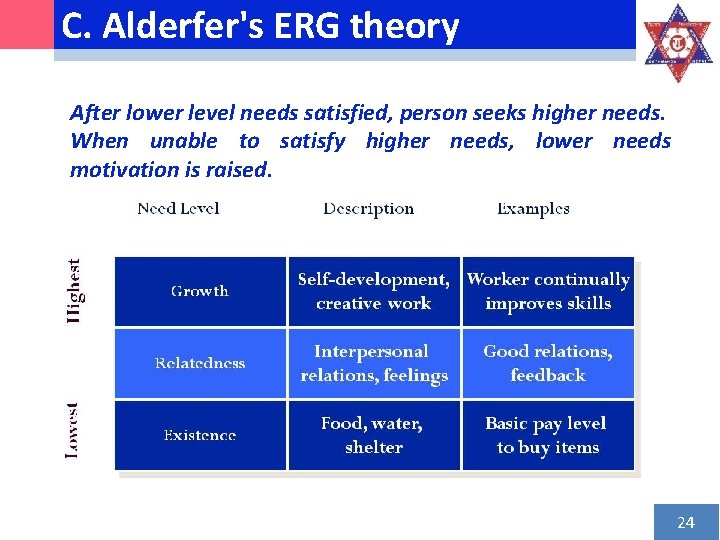
C. Alderfer's ERG theory After lower level needs satisfied, person seeks higher needs. When unable to satisfy higher needs, lower needs motivation is raised. 24
D. Mc. Clelland's Theory of learned needs David Mc. Clelland's acquired needs theory recognizes that everyone prioritizes needs differently. He also believes that individuals are not born with these needs, but that they are actually learned through life experiences. Mc. Clelland identifies three specific needs: • Need for achievement is the drive to excel. • Need for power is the desire to cause others to behave in a way that they would not have behaved otherwise. • Need for affiliation is the desire for friendly, close interpersonal relationships and conflict avoidance. Mc. Clelland associates each need with a distinct set of work preferences, and managers can help tailor the environment to meet these needs. High achievers differentiate themselves from others by their desires to do things better. These individuals are strongly motivated by job situations with personal responsibility, feedback, and an intermediate degree of risk. In addition, high achievers often exhibit the following behaviors. 25
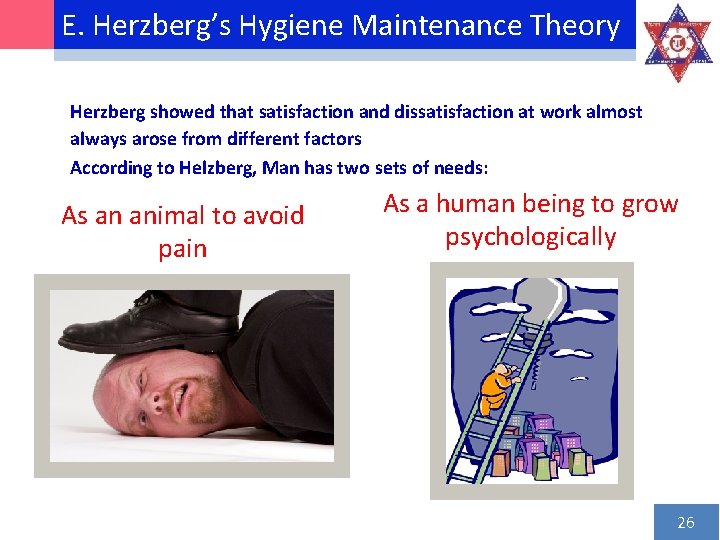
E. Herzberg’s Hygiene Maintenance Theory Herzberg showed that satisfaction and dissatisfaction at work almost always arose from different factors According to Helzberg, Man has two sets of needs: As an animal to avoid pain As a human being to grow psychologically 26
E. Herzberg’s Hygiene Maintenance Theory Focuses on outcomes that can lead to high motivation, job satisfaction, & those that can prevent dissatisfaction. • Motivator needs: related to nature of the work and how challenging it is. – Outcomes are autonomy, responsibility, interesting work. • Hygiene needs: relate to the physical & psychological context of the work. – Refers to a good work environment, pay, job security. – When hygiene needs not met, workers are dissatisfied. Note: when met, they will NOT lead to higher motivation, just will prevent low motivation. 27
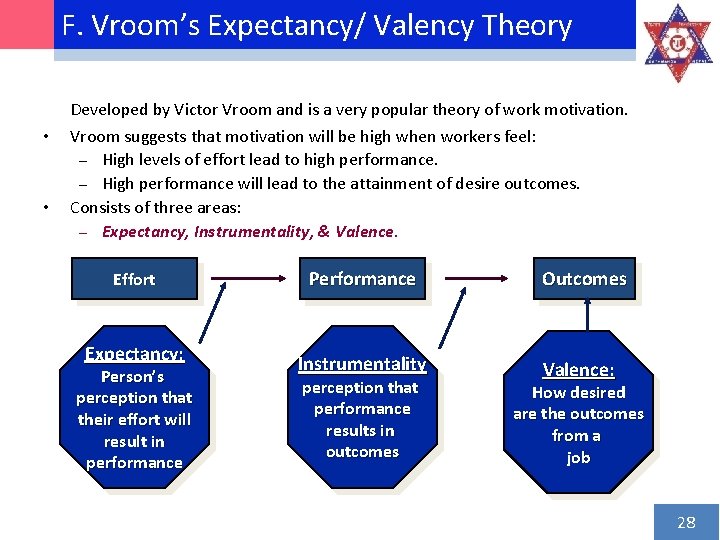
F. Vroom’s Expectancy/ Valency Theory Developed by Victor Vroom and is a very popular theory of work motivation. • • Vroom suggests that motivation will be high when workers feel: – High levels of effort lead to high performance. – High performance will lead to the attainment of desire outcomes. Consists of three areas: – Expectancy, Instrumentality, & Valence. Effort Expectancy: Person’s perception that their effort will result in performance Performance Outcomes Instrumentality Valence: perception that performance results in outcomes How desired are the outcomes from a job 28
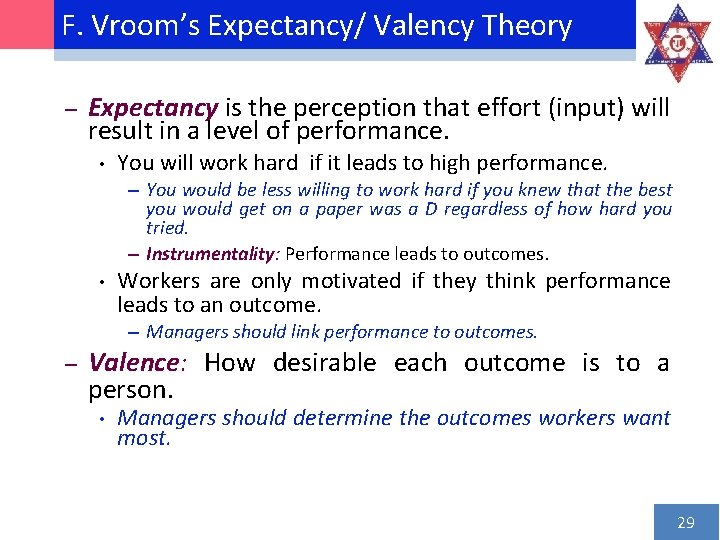
F. Vroom’s Expectancy/ Valency Theory – Expectancy is the perception that effort (input) will result in a level of performance. • You will work hard if it leads to high performance. – You would be less willing to work hard if you knew that the best you would get on a paper was a D regardless of how hard you tried. – Instrumentality: Performance leads to outcomes. • Workers are only motivated if they think performance leads to an outcome. – Managers should link performance to outcomes. – Valence: How desirable each outcome is to a person. • Managers should determine the outcomes workers want most. 29
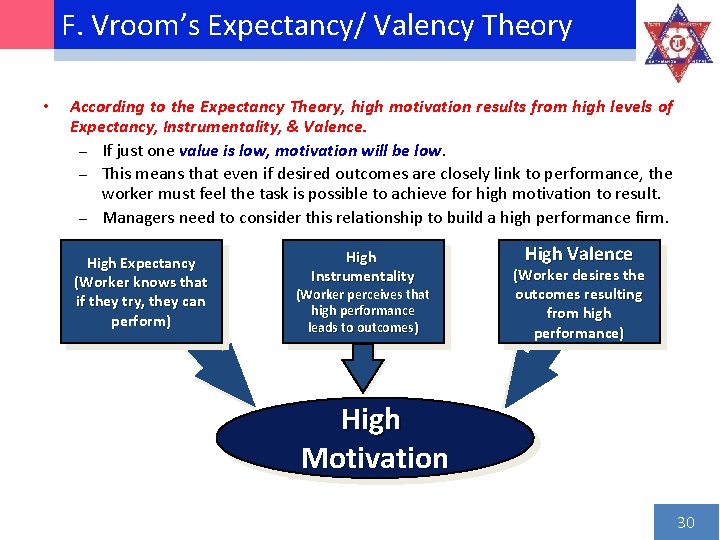
F. Vroom’s Expectancy/ Valency Theory • According to the Expectancy Theory, high motivation results from high levels of Expectancy, Instrumentality, & Valence. – If just one value is low, motivation will be low. – This means that even if desired outcomes are closely link to performance, the worker must feel the task is possible to achieve for high motivation to result. – Managers need to consider this relationship to build a high performance firm. High Expectancy (Worker knows that if they try, they can perform) High Instrumentality (Worker perceives that high performance leads to outcomes) High Valence (Worker desires the outcomes resulting from high performance) High Motivation 30

31
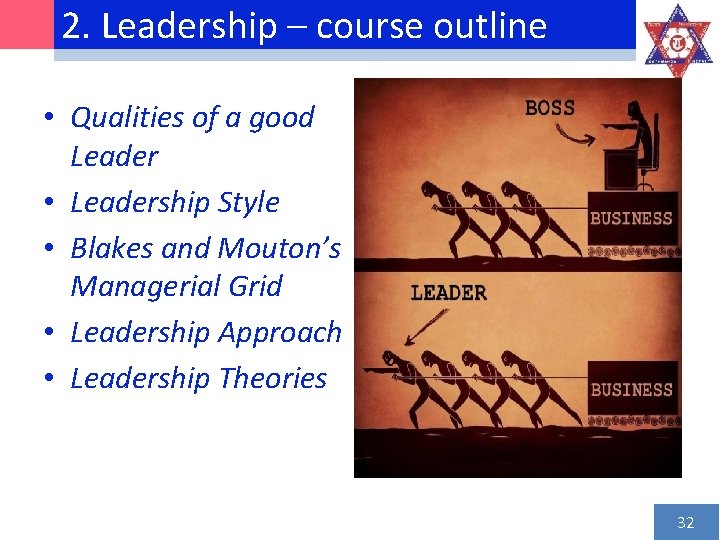
2. Leadership – course outline • Qualities of a good Leader • Leadership Style • Blakes and Mouton’s Managerial Grid • Leadership Approach • Leadership Theories 32
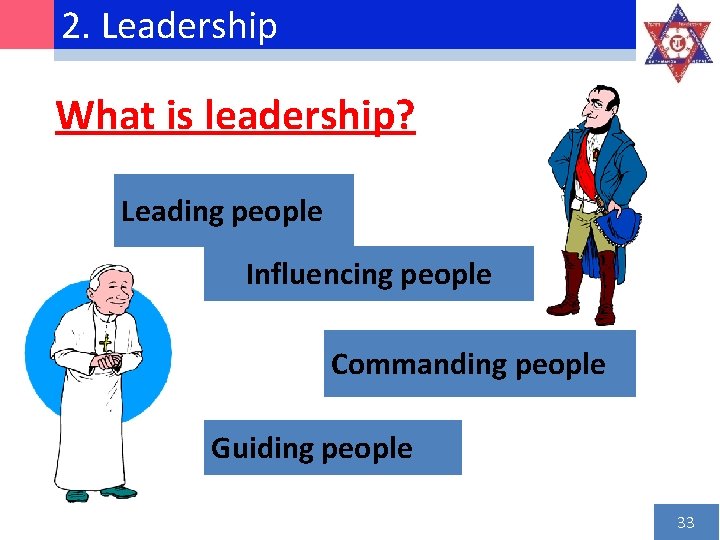
2. Leadership What is leadership? Leading people Influencing people Commanding people Guiding people 33
2. Leadership Types of Leaders • Leader by the position achieved • Leader by personality, charisma • Leader by moral example • Leader by power held • Intellectual leader • Leader because of ability to accomplish things 34
Managers vs. Leaders Managers • Focus on things • Do things right • Plan • Organize • Direct • Control • Follows the rules Leaders • Focus on people • Do the right things • Inspire • Influence • Motivate • Build • Shape entities 35
Managers vs. Leaders Common Activities • Planning • Organizing • Directing • Controlling 36
Managers vs. Leaders Planning Manager • Planning • Budgeting • Sets targets • Establishes detailed steps • Allocates resources Leader • Devises strategy • Sets direction • Creates vision 37
Managers vs. Leaders Organizing Manager • Creates structure • Job descriptions • Staffing • Hierarchy • Delegates • Training Leader • Gets people on board for strategy • Communication • Networks 38
Managers vs. Leaders Directing Work Manager • Solves problems • Negotiates • Brings to consensus Leader • Empowers people • Cheerleader 39
Managers vs. Leaders Controlling Manager • Implements control systems • Performance measures • Identifies variances • Fixes variances Leader • Motivate • Inspire • Gives sense of accomplishment 40
I. Qualities of Good Leader Guiding vision: Effective leaders know what they want to do, and have the strength of character to pursue their objectives in the face of opposition and in spite of failures. The effective leader establishes achievable goals. Passion: Effective leaders believe passionately in their goals. They have a positive outlook on who they are, and they love what they do. Their passion for life is a guiding star for others to follow, because they radiate promise! Integrity: Because they know who they are, effective leaders are also aware of their weaknesses. They only make promises they can follow through on. 41
I. Qualities of Good Leader Honesty: Leaders convey an aura of honesty in both their professional and their personal lives. Trust: Effective leaders earn the trust of their followers and act on behalf of their followers. Curiosity: Leaders are learners. They wonder about every aspect of their charge. They find out what they need to know in order to pursue their goals. Risk: Effective leaders take calculated risks when necessary to achieve their objectives. If a mistake is made, the effective leader will learn from the mistake and use it as an opportunity to explore other avenues. 42
I. Qualities of Good Leader Dedication: The effective leader is dedicated to his or her charge, and will work assiduously on behalf of those following. The leader gives himself or herself entirely to the task when it is necessary. Charisma: This may be the one attribute that is the most difficult to cultivate. It conveys maturity, respect for your followers, compassion, a fine sense of humor, and a love of humanity. The result is that leaders have the capability to motivate people to excel. Listening: Leaders Listen! This is the most important attribute of all, listen to your followers. 43
II. Leadership Style • Autocratic • A leadership style where the leader makes all decisions independently or without consulting with others. • Thinks that he is only the competent and capable individual. • When decision must be made & acted on quickly and without questions • Advantages: good in certain circumstances, such as urgent tasks or military actions • Disadvantages: poor decisions, poor level of employee motivation 44
II. Leadership Style • Democratic • A leadership style where a leader encourages employee participation in decision-making • Co-operation in attainment of goals. • Delegate as much responsibility as their experience & knowledge will permit. • Takes all the decisions and accepts full responsibility. • persuasive or consultative • Advantages: better decisions, employee motivation • Disadvantages: delayed decision, long consultation 45
II. Leadership Style • Laissez-faire • A leadership style where employees are encouraged to make their own decisions within limits. • Expects his sub-ordinates to assume responsibility for their own motivation guidance and control. • Discipline and control are not enforced. • Managers give employees almost total authority in all matters. • Advantages: more freedom for employees • Disadvantages: few guidelines, little incentive, poor motivation, maybe a mess 46
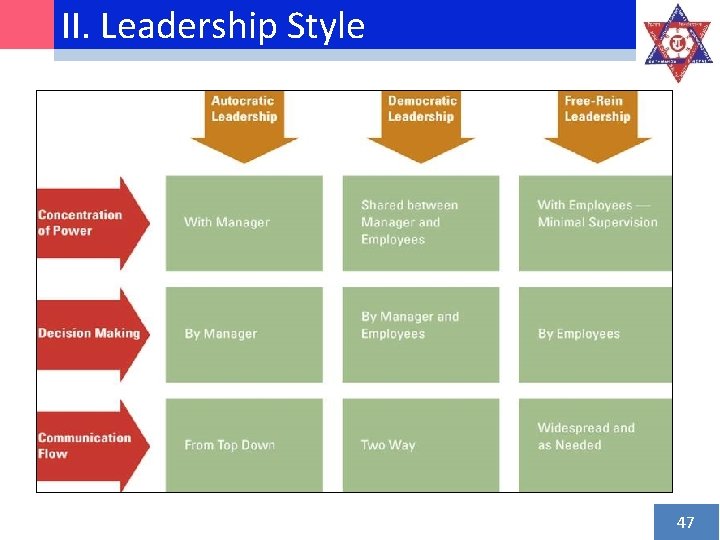
II. Leadership Style 47
II. Leadership Style Factors affecting leadership styles • The task • The tradition of an organization • The type of labor force • The leader’s personality • The time • Gender? 48
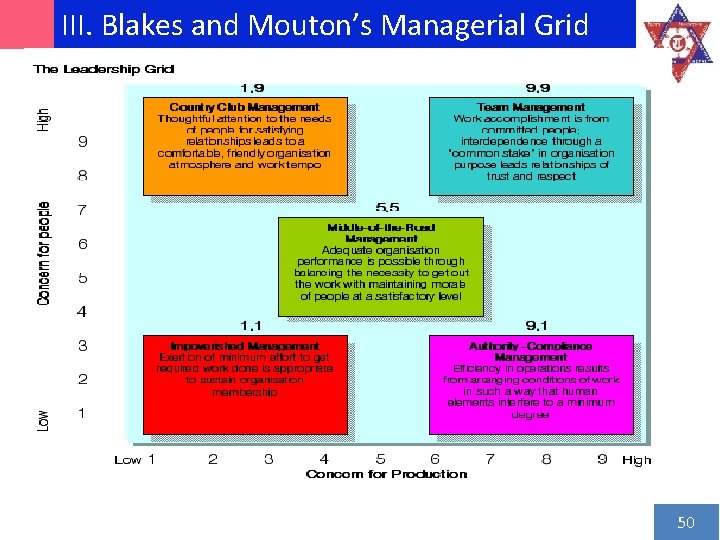
III. Blakes and Mouton’s Managerial Grid A popular framework for thinking about a leader’s ‘task versus person’ orientation was developed by Robert Blake and Jane Mouton in the early 1960 s. Called the Managerial Grid, or Leadership Grid, it plots the degree of task-centeredness versus person-centeredness and identifies five combinations as distinct leadership styles. Understanding the Model The Managerial Grid is based on two behavioral dimensions: Concern for People – This is the degree to which a leader considers the needs of team members, their interests, and areas of personal development when deciding how best to accomplish a task Concern for Production – This is the degree to which a leader emphasizes concrete objectives, organizational efficiency and high productivity when deciding how best to accomplish a task. Using the axis to plot leadership ‘concerns for production’ versus ‘concerns for people’, Blake and Mouton defined the following five leadership styles: 49
III. Blakes and Mouton’s Managerial Grid 50
IV. Leadership Approach 1. Trait-oriented approach: ‐ ‐ ‐ Leaders are born not made. Maximum intelligent, better educated, stronger power needs, independent activities, intense thought and some risks, high self actualization. Hard working, self confident. 2. Situational approach: ‐ ‐ Specific and always relative to particular situation. Leadership is a function of situation, the culture, the context and the customs of a group or an organization. 3. Functional approach: ‐ ‐ It considers both individual and situation. They most resolve the task problems. 51
V. Leadership Theories 1. "Great Man" Theories: Have you ever heard someone described as "born to lead? " According to this point of view, great leaders are simply born with the necessary internal characteristics such as charisma, confidence, intelligence, and social skills that make them natural‐born leaders. Great man theories assume that the capacity for leadership is inherent – that great leaders are born, not made. These theories often portray great leaders as heroic, mythic and destined to rise to leadership when needed. The term "Great Man" was used because, at the time, leadership was thought of primarily as a male quality, especially in terms of military leadership. 2. Trait Theories: Similar in some ways to Great Man theories, trait theories assume that people inherit certain qualities and traits that make them better suited to leadership. Trait theories often identify particular personality or behavioral characteristics shared by leaders. For example, traits like extraversion, self‐confidence, and courage are all traits that could potentially be linked to great leaders. 52
V. Leadership Theories 3. Contingency Theories: Contingency theories of leadership focus on particular variables related to the environment that might determine which particular style of leadership is best suited for the situation. According to this theory, no leadership style is best in all situations. Success depends upon a number of variables, including the leadership style, qualities of the followers and aspects of the situation. 4. Situational Theories: Situational theories propose that leaders choose the best course of action based upon situational variables. Different styles of leadership may be more appropriate for certain types of decision‐making. For example, in a situation where the leader is the most knowledgeable and experienced member of a group, an authoritarian style might be most appropriate. In other instances where group members are skilled experts, a democratic style would be more effective. 53
V. Leadership Theories 5. Behavioral Theories: Behavioral theories of leadership are based upon the belief that great leaders are made, not born. Consider it the flip‐side of the Great Man theories. Rooted in behaviorism, this leadership theory focuses on the actions of leaders not on mental qualities or internal states. According to this theory, people can learn to become leaders through teaching and observation. 6. Participative Theories: Participative leadership theories suggest that the ideal leadership style is one that takes the input of others into account. These leaders encourage participation and contributions from group members and help group members feel more relevant and committed to the decision‐making process. In participative theories, however, the leader retains the right to allow the input of others. 54
V. Leadership Theories 7. Management Theories: Management theories, also known as transactional theories, focus on the role of supervision, organization and group performance. These theories base leadership on a system of rewards and punishments. Managerial theories are often used in business; when employees are successful, they are rewarded; when they fail, they are reprimanded or punished. 8. Relationship Theories: Relationship theories, also known as transformational theories, focus upon the connections formed between leaders and followers. Transformational leaders motivate and inspire people by helping group members see the importance and higher good of the task. These leaders are focused on the performance of group members, but also want each person to fulfill his or her potential. Leaders with this style often have high ethical and moral standards. 55
56
Entrepreneurship – course outline • Entrepreneurship Development • Entrepreneurial Characteristics • Need for Promotion of Entrepreneurship • Steps for establishing small scale unit 57
1. Entrepreneurship Dr. D. C. Mc. Clelland, a noted psychologist from Horward University in U. S. A. , after extensive research has proved that the economic development of any nation does not depend much upon availability of natural resources and other such inputs but solely depends upon the inner desire and entrepreneurial inspiration of the people. Such inspired entrepreneurs utilize the resources and become instrumental to economic growth of the nation. The term entrepreneur is derived from French word originally meant for to designate an organizer of musical or other entertainments. But, in the beginning of the 18 th century the word was used to refer to business. There are many views in the concept of entrepreneur. ‘Entrepreneurs are business leaders and not simple owners of capital. They are men of vision, drive and talent, who spot out opportunities and promptly grasp them for exploration. ’ ‐ Schumpeter 58
1. Entrepreneurship is the function of 1. Seeing investment and production opportunity. 2. Organizing an enterprise. 3. Raising capital. 4. Hiring labor. 5. Arranging raw materials. 6. Selecting top managers and executives for the day to day operation of the enterprise. 59
I. Entrepreneurship development 1. 2. 3. 4. 5. The myth that entrepreneurs are born and not made no longer holds good. It has been proved that entrepreneurial characteristics can be developed through well‐structured Entrepreneurial Development Programs (EDPs). The task of developing entrepreneurship comprises of: Identify and carefully select those who could be developed as entrepreneurs. Develop their entrepreneurial capabilities. Ensure that they have selected viable industrial project. Equip them with basic administrative, financial and managerial capabilities; and Help them to secure necessary financial and other infrastructural assistance. 60
II. Entrepreneurial Characteristics 1. 2. 3. 4. 5. 6. 7. 8. 9. 10. 11. 12. Administrative capability. Creativity. Self-confidence. Human relations ability. Foresight. Clarity (clear objectives). Communication ability. Technical knowledge. Secrecy. Optimistic attitude. Decision making. Willingness to take risk. 61
II. Entrepreneurial Characteristics Factors influencing entrepreneurship 1. Components of creativity. 2. 3. 4. 5. a. b. c. d. High need for achievement. Need for independence. Need for power. Family background. Originality (creativity and innovative spirit). Flexibility. Fluency. Sensitivity to problems and problem redefinition ability etc. 62
III. Need for Promotion of Entrepreneurship 1. 2. 3. 4. 5. 6. 7. Entrepreneurship promotes business i. e. , small scale industries. The small scale industries play a dynamic role in accelerating the rate of industrial growth and economic prosperity of the developing nation. The small scale industries has played a significant role in achieving the following objectives. Employment generation. To meet increased demand. More equitable distribution of national income. Balanced economic development. Decentralization. Better utilization of resources. Self employment etc. 63
IV. Steps for establishing small scale unit Small scale industries have a large contribution in the growth of an economy. If we take example of India, the fastest growing economy in the world, the small scale ventures have gained a huge success quotient. Not only these enterprises produce export quality goods, they have also created thousands of job opportunities as well. Another advantage of small scale enterprises is that they are easy to set up and can fulfill one’s dream to become an entrepreneur. However, there are some important steps that you must follow to set up a small scale industrial unit. Learn about them from the following discussion. First of all, you need to prepare the description for the small scale industry you want to set up. You have to decide whether you wish to have a corporation, proprietorship or partnership. 64
IV. Steps for establishing small scale unit Next, you need to describe the product you wish to manufacture or the service you wish to offer. While choosing the product or service you want to offer, you must conduct a good market research and learn about the prevailing competition in the market. The next step is to choose a location to set up your small scale industry. Make sure you consider things like availability of raw materials, labor, transportation services and other such things while choosing the location. The next big step is to arrange for finance. If you don’t have enough finance, the best way is to borrow a loan. You may learn about financial aid offered by the government of your state or country. However, you must simultaneously plan on how you would repay the loan in future. 65
IV. Steps for establishing small scale unit Production management is the next step, once you are able to start your small scale industry. This includes allocating space for different operations and choosing your production methods. Make sure that you follow the practices for quality testing and keep on improving. You have to purchase required machinery and hire employees and workers for different departments. Marketing and business advertising form the next big step of setting up a small scale industry. Online business directories and various traditional forms of advertising can be used to gain exposure for your business. You have to decide prices for your products or services, keeping in mind the profit margin. Planning in advance is a useful aspect of setting up a small scale venture. Keep on assessing and improving your plan at every stage. All these steps are the integral parts of the process to start up a small scale unit 66

67
- Slides: 67