
Chapter 3 MOLECULAR SHAPE AND STRUCTURE THE VSEPR
![Ø Hybrid orbitals: produced by hybridizing orbitals of a central atom C [He]2 s](https://slidetodoc.com/presentation_image_h/e6d6213e9326ba5652a951f6a2776539/image-25.jpg "Ø Hybrid orbitals: produced by hybridizing orbitals of a central atom C [He]2 s")
- Slides: 56
Chapter 3. MOLECULAR SHAPE AND STRUCTURE THE VSEPR MODEL 3. 1 The Basic VSEPR Model 3. 2 Molecules with Lone Pairs on the Central Atom 3. 3 Polar Molecules VALENCE-BOND THEORY 3. 4 Sigma and Pi Bonds 3. 5 Electron Promotion and the Hybridization of Orbitals 3. 6 Other Common Types of Hybridization 3. 7 Characteristics of Multiple Bonds 2012 General Chemistry I 1
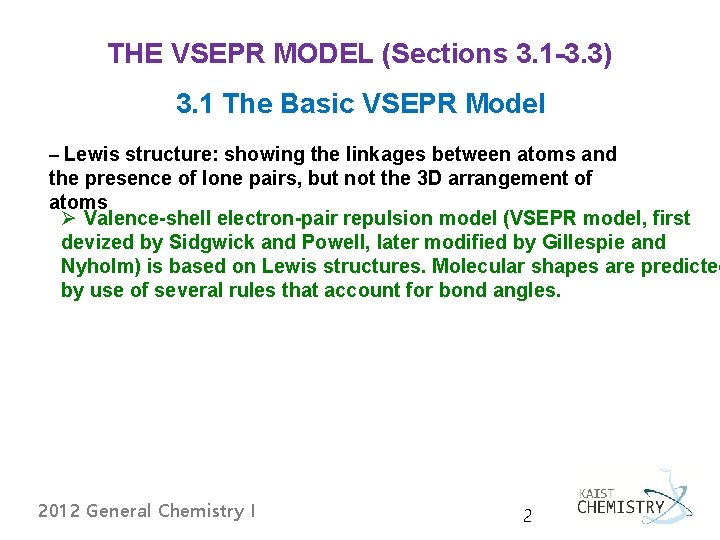
THE VSEPR MODEL (Sections 3. 1 -3. 3) 3. 1 The Basic VSEPR Model – Lewis structure: showing the linkages between atoms and the presence of lone pairs, but not the 3 D arrangement of atoms Ø Valence-shell electron-pair repulsion model (VSEPR model, first devized by Sidgwick and Powell, later modified by Gillespie and Nyholm) is based on Lewis structures. Molecular shapes are predicted by use of several rules that account for bond angles. 2012 General Chemistry I 2
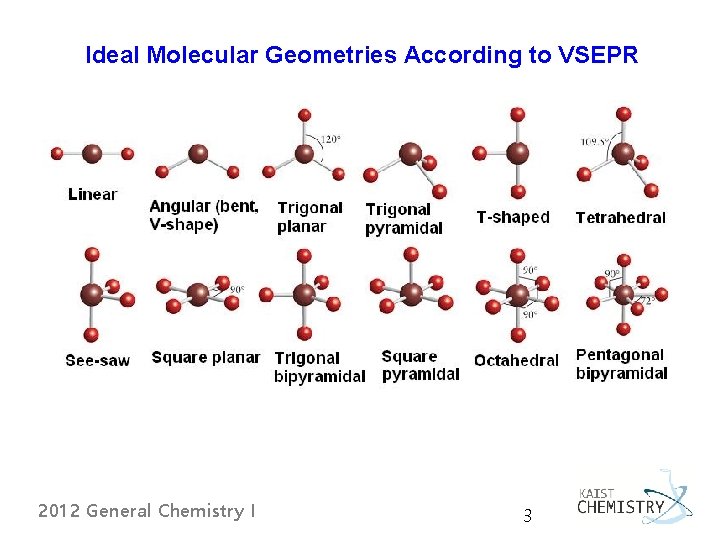
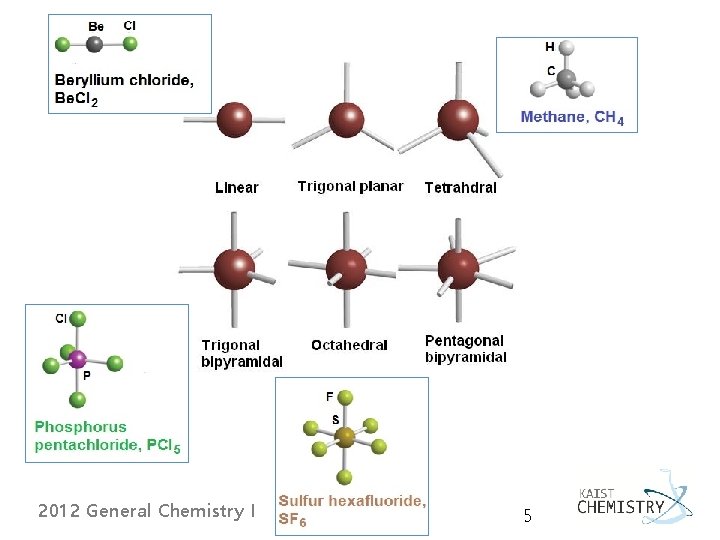
Ideal Molecular Geometries According to VSEPR 2012 General Chemistry I 3
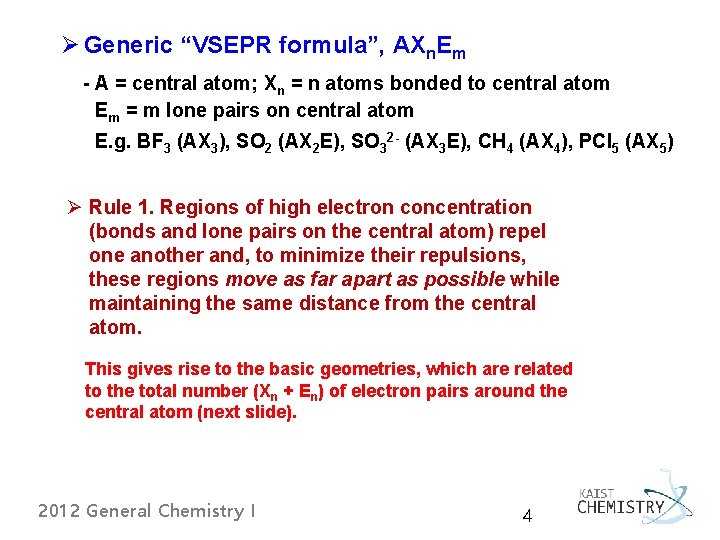
Ø Generic “VSEPR formula”, AXn. Em - A = central atom; Xn = n atoms bonded to central atom Em = m lone pairs on central atom E. g. BF 3 (AX 3), SO 2 (AX 2 E), SO 32 - (AX 3 E), CH 4 (AX 4), PCl 5 (AX 5) Ø Rule 1. Regions of high electron concentration (bonds and lone pairs on the central atom) repel one another and, to minimize their repulsions, these regions move as far apart as possible while maintaining the same distance from the central atom. This gives rise to the basic geometries, which are related to the total number (Xn + En) of electron pairs around the central atom (next slide). 2012 General Chemistry I 4
2012 General Chemistry I 5
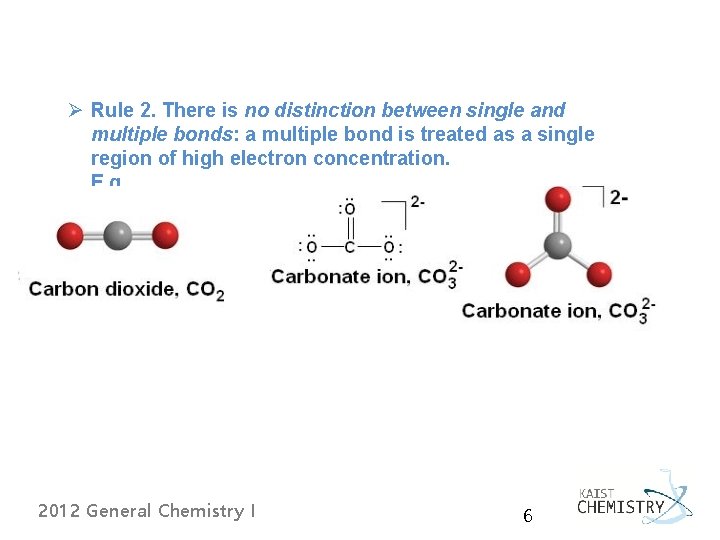
Ø Rule 2. There is no distinction between single and multiple bonds: a multiple bond is treated as a single region of high electron concentration. E. g. 2012 General Chemistry I 6
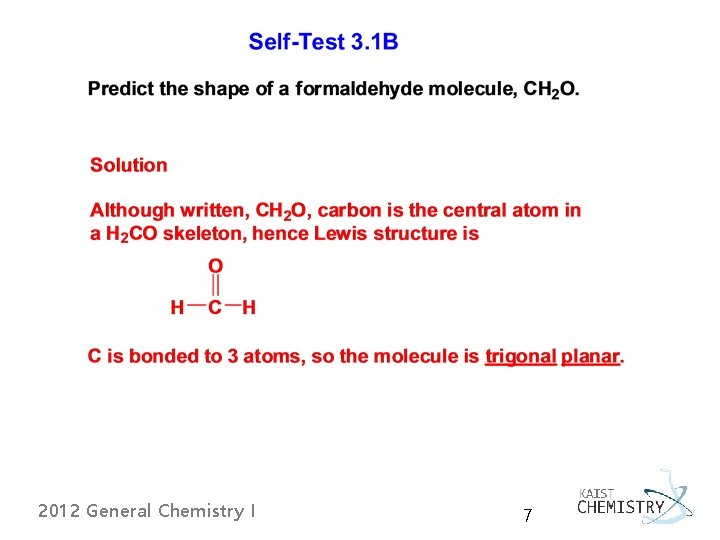
2012 General Chemistry I 7
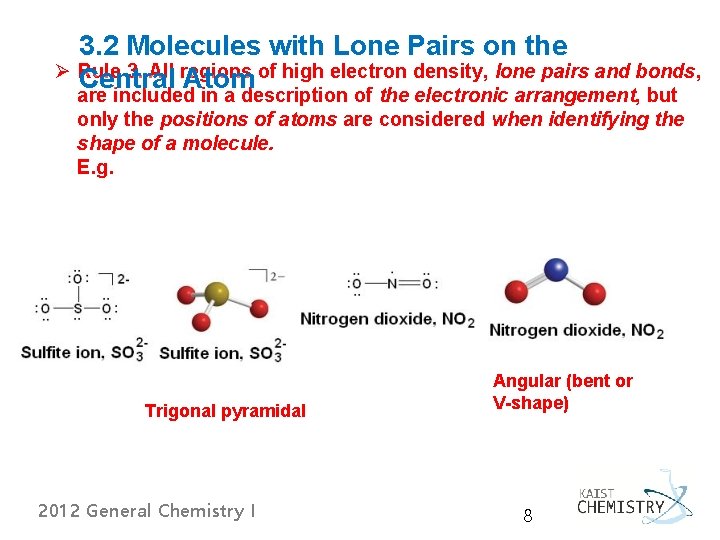
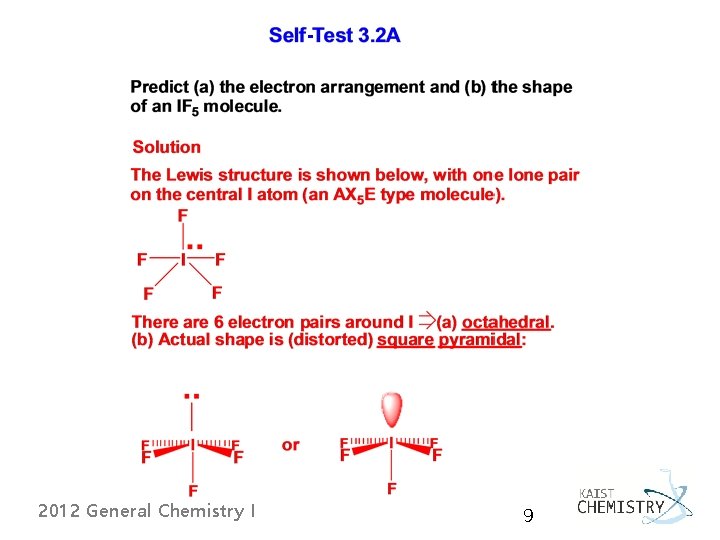
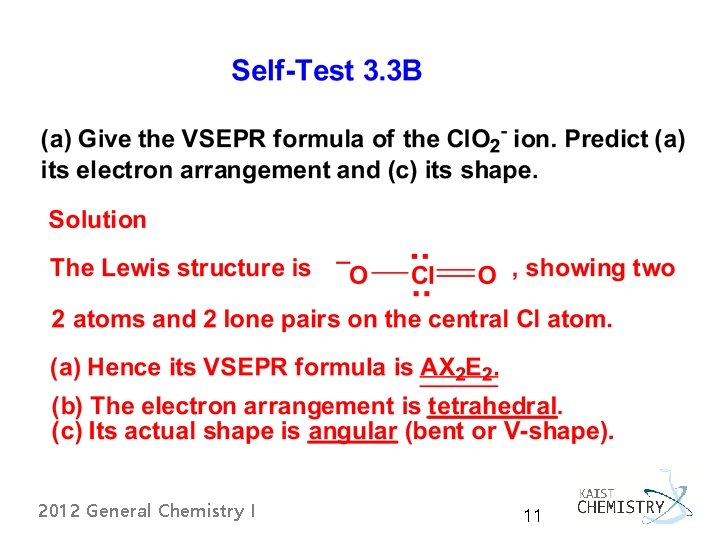
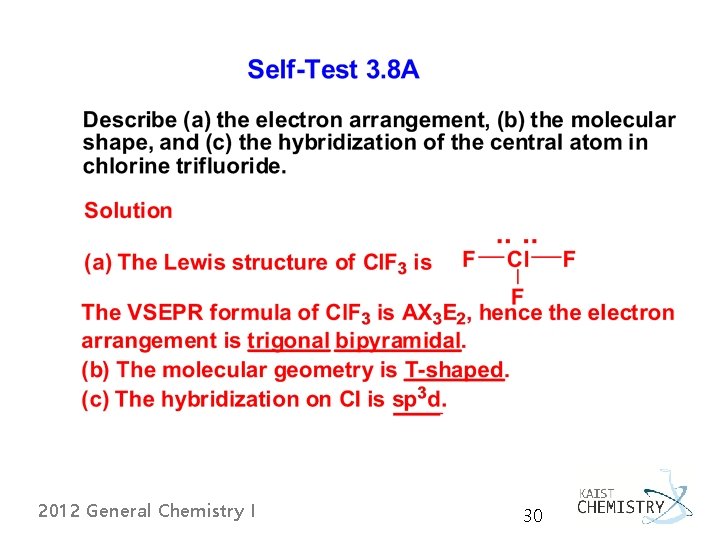
3. 2 Molecules with Lone Pairs on the Ø Rule 3. All regions of high electron density, lone pairs and bonds, Central Atom are included in a description of the electronic arrangement, but only the positions of atoms are considered when identifying the shape of a molecule. E. g. Trigonal pyramidal 2012 General Chemistry I Angular (bent or V-shape) 8
- 2012 General Chemistry I 9
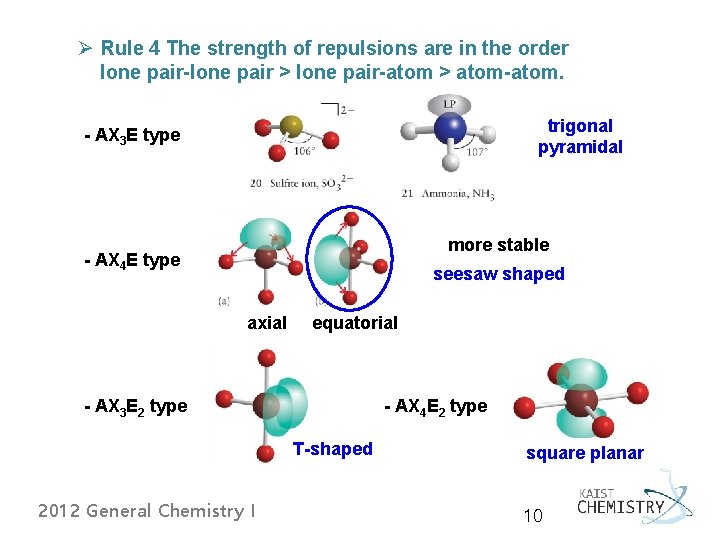
Ø Rule 4 The strength of repulsions are in the order lone pair-lone pair > lone pair-atom > atom-atom. trigonal pyramidal - AX 3 E type more stable - AX 4 E type seesaw shaped axial equatorial - AX 3 E 2 type - AX 4 E 2 type T-shaped 2012 General Chemistry I square planar 10
2012 General Chemistry I 11
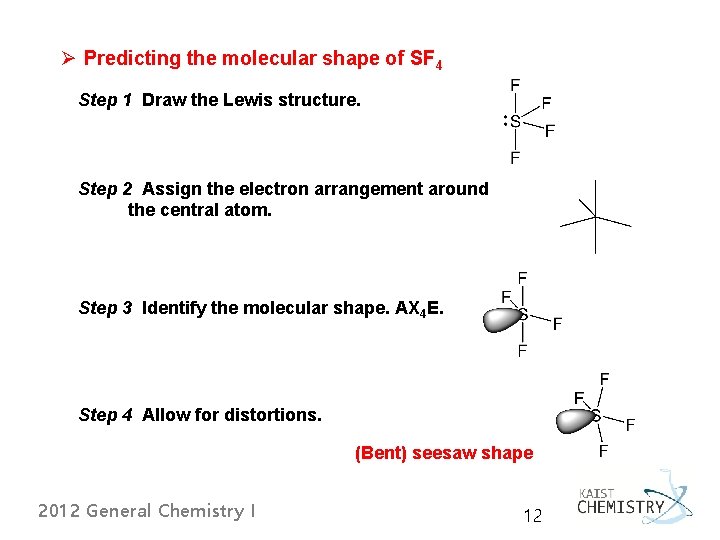
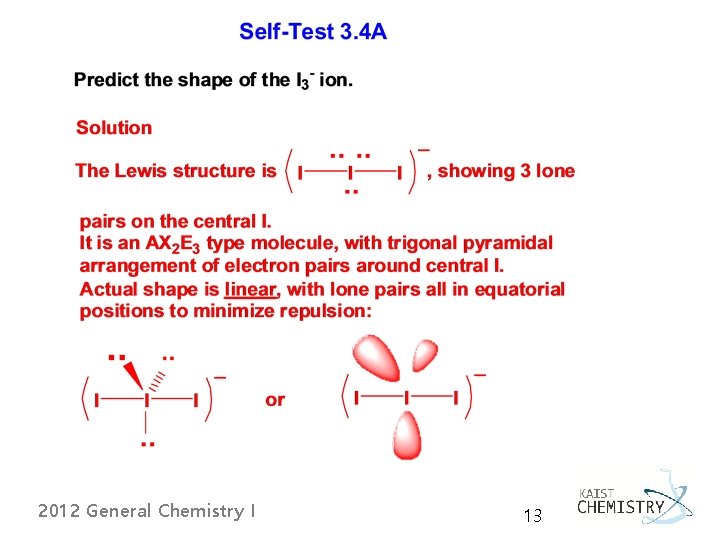
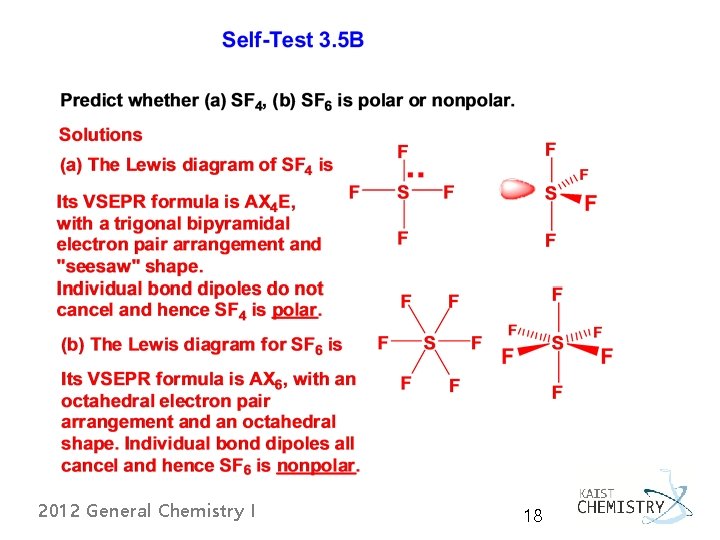
Ø Predicting the molecular shape of SF 4 Step 1 Draw the Lewis structure. Step 2 Assign the electron arrangement around the central atom. Step 3 Identify the molecular shape. AX 4 E. Step 4 Allow for distortions. (Bent) seesaw shape 2012 General Chemistry I 12
2012 General Chemistry I 13
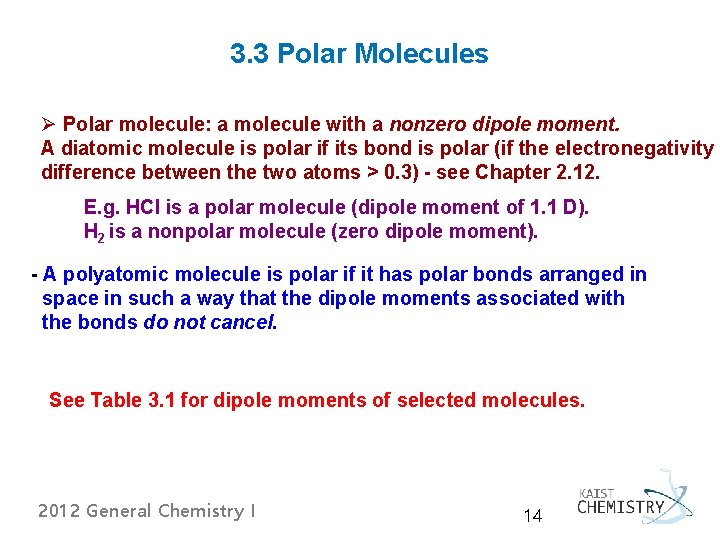
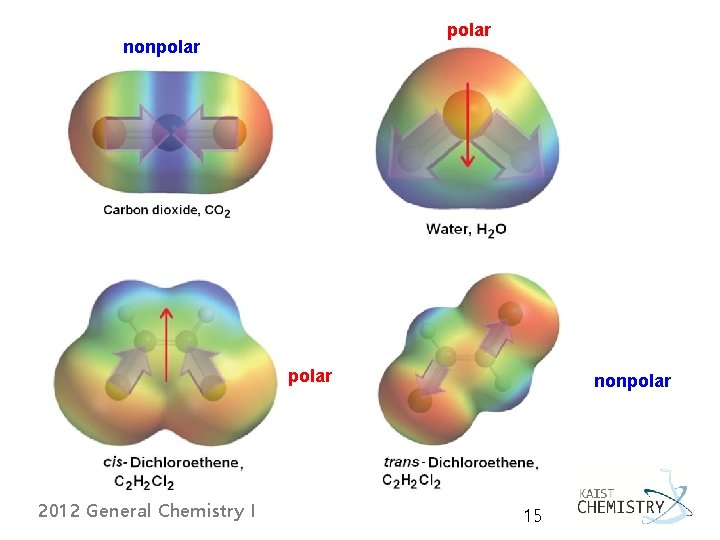
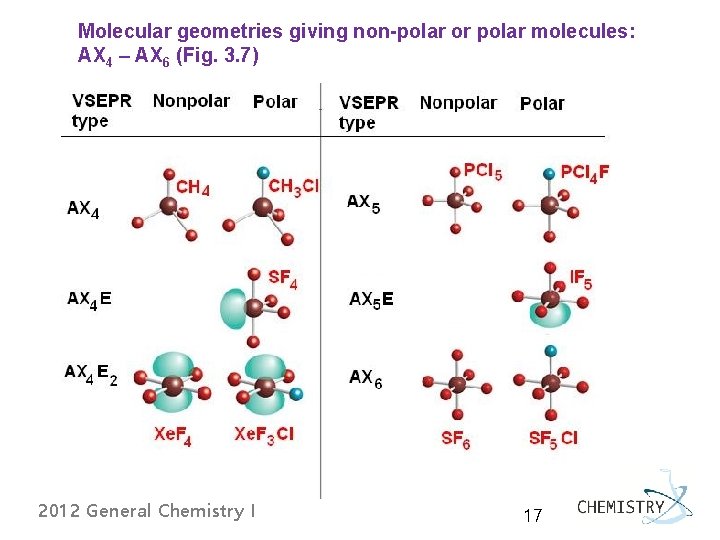
3. 3 Polar Molecules Ø Polar molecule: a molecule with a nonzero dipole moment. A diatomic molecule is polar if its bond is polar (if the electronegativity difference between the two atoms > 0. 3) - see Chapter 2. 12. E. g. HCl is a polar molecule (dipole moment of 1. 1 D). H 2 is a nonpolar molecule (zero dipole moment). - A polyatomic molecule is polar if it has polar bonds arranged in space in such a way that the dipole moments associated with the bonds do not cancel. See Table 3. 1 for dipole moments of selected molecules. 2012 General Chemistry I 14
polar nonpolar 2012 General Chemistry I nonpolar 15
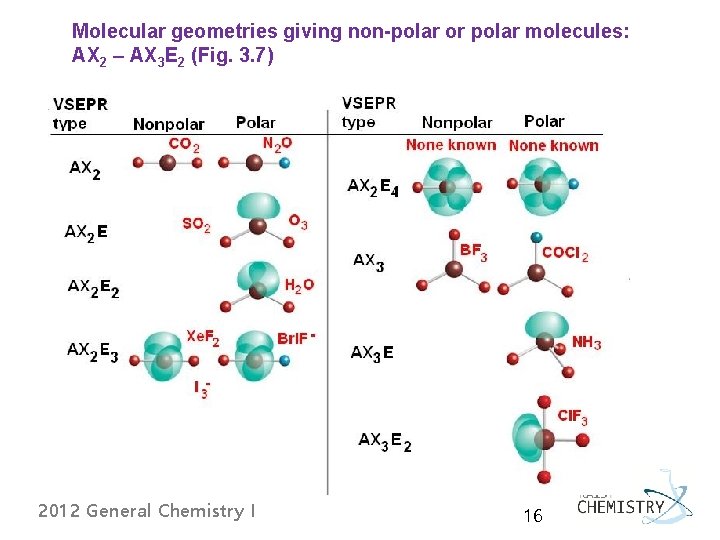
Molecular geometries giving non-polar or polar molecules: AX 2 – AX 3 E 2 (Fig. 3. 7) 2012 General Chemistry I 16
Molecular geometries giving non-polar or polar molecules: AX 4 – AX 6 (Fig. 3. 7) 2012 General Chemistry I 17
2012 General Chemistry I 18
VALENCE-BOND (VB)THEORY (Sections 3. 4 -3. 7) -The VB theory is based on the Lewis model: each bonding electron pair is localized between two bonded atoms. It is a localized electron model, devized originally by Heitler and London, and later modified by Pauling, Slater and others. 2012 General Chemistry I 19
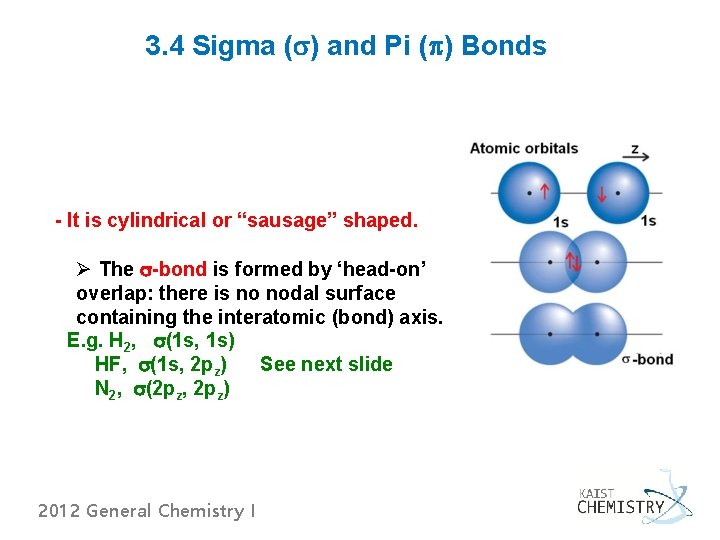
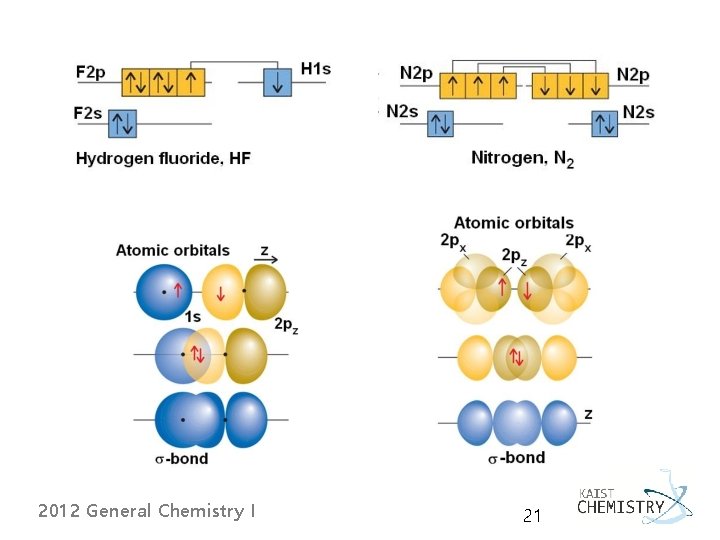
3. 4 Sigma (s) and Pi (p) Bonds - It is cylindrical or “sausage” shaped. Ø The s-bond is formed by ‘head-on’ overlap: there is no nodal surface containing the interatomic (bond) axis. E. g. H 2, s(1 s, 1 s) HF, s(1 s, 2 pz) See next slide N 2, s(2 pz, 2 pz) 2012 General Chemistry I
2012 General Chemistry I 21
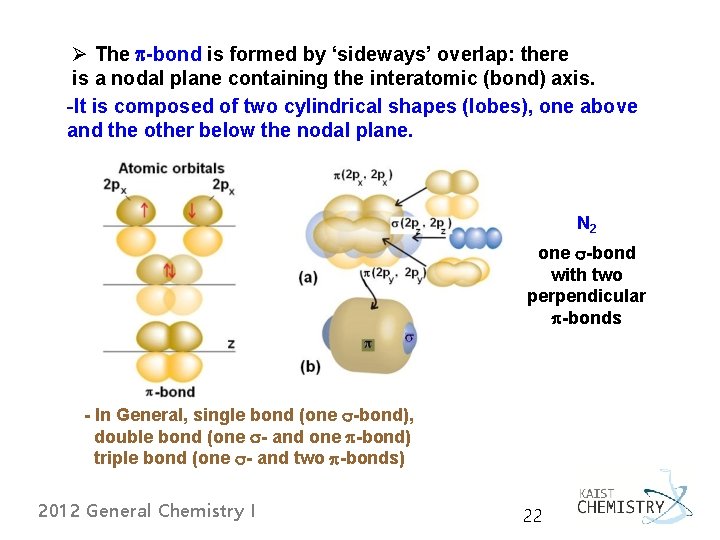
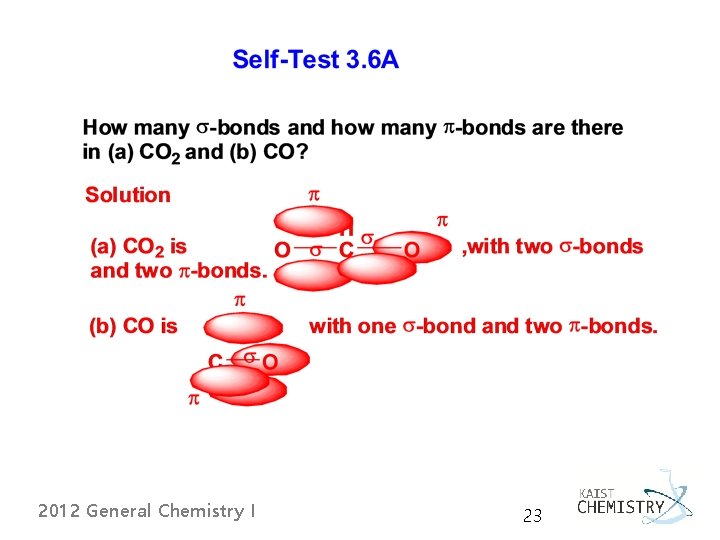
Ø The p-bond is formed by ‘sideways’ overlap: there is a nodal plane containing the interatomic (bond) axis. -It is composed of two cylindrical shapes (lobes), one above and the other below the nodal plane. N 2 one s-bond with two perpendicular p-bonds - In General, single bond (one s-bond), double bond (one s- and one p-bond) triple bond (one s- and two p-bonds) 2012 General Chemistry I 22
2012 General Chemistry I 23
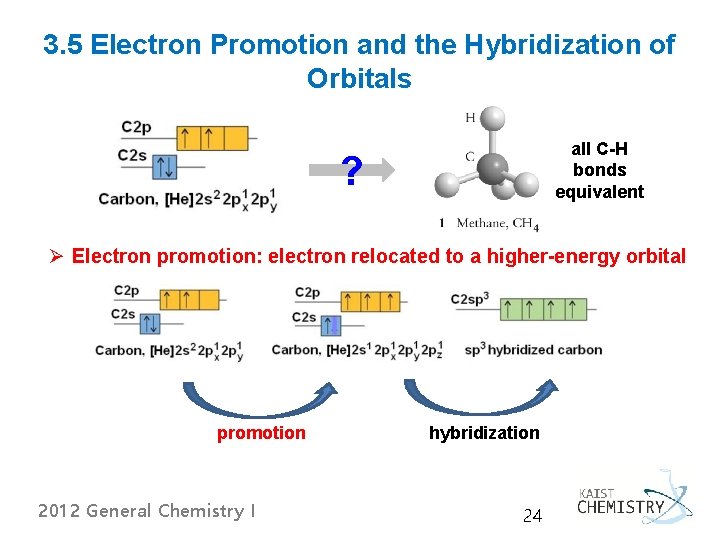
3. 5 Electron Promotion and the Hybridization of Orbitals all C-H bonds equivalent ? Ø Electron promotion: electron relocated to a higher-energy orbital promotion 2012 General Chemistry I hybridization 24
Ø Hybrid orbitals: produced by hybridizing orbitals of a central atom C [He]2 s 12 px 12 py 12 pz 1 4 sp 3 hybrids h 1 = s + px + py + pz h 2 = s - px - py + pz h 3 = s - px + py - pz h 4 = s + px - py - pz each C-H bond sp 3 hybrid orbital 2012 General Chemistry I 25
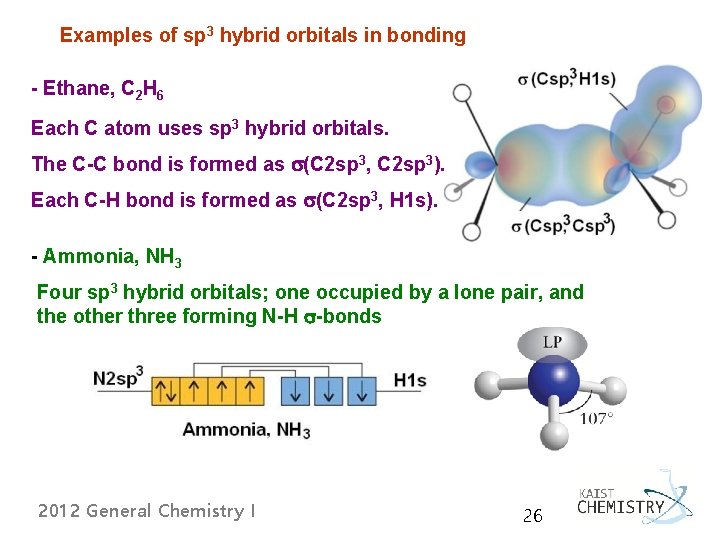
Examples of sp 3 hybrid orbitals in bonding - Ethane, C 2 H 6 Each C atom uses sp 3 hybrid orbitals. The C-C bond is formed as s(C 2 sp 3, C 2 sp 3). Each C-H bond is formed as s(C 2 sp 3, H 1 s). - Ammonia, NH 3 Four sp 3 hybrid orbitals; one occupied by a lone pair, and the other three forming N-H s-bonds 2012 General Chemistry I 26
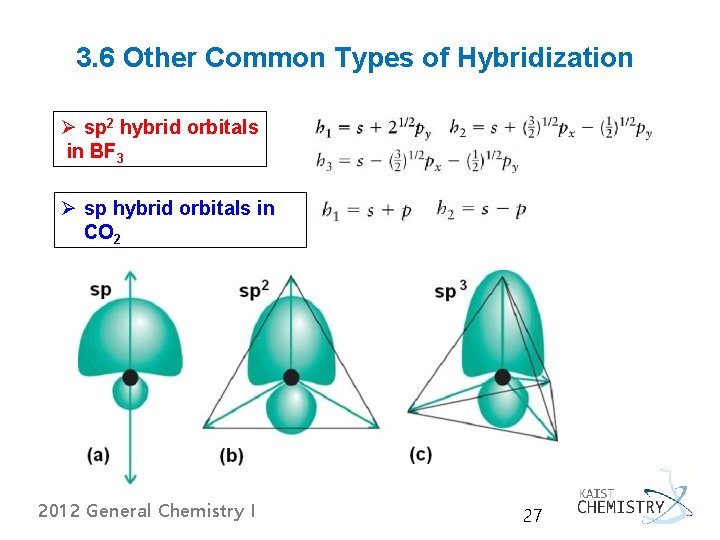
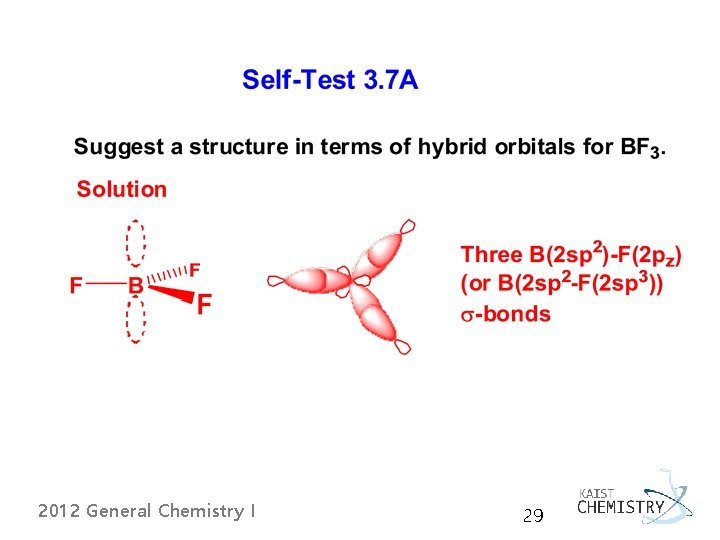
3. 6 Other Common Types of Hybridization Ø sp 2 hybrid orbitals in BF 3 Ø sp hybrid orbitals in CO 2 2012 General Chemistry I 27
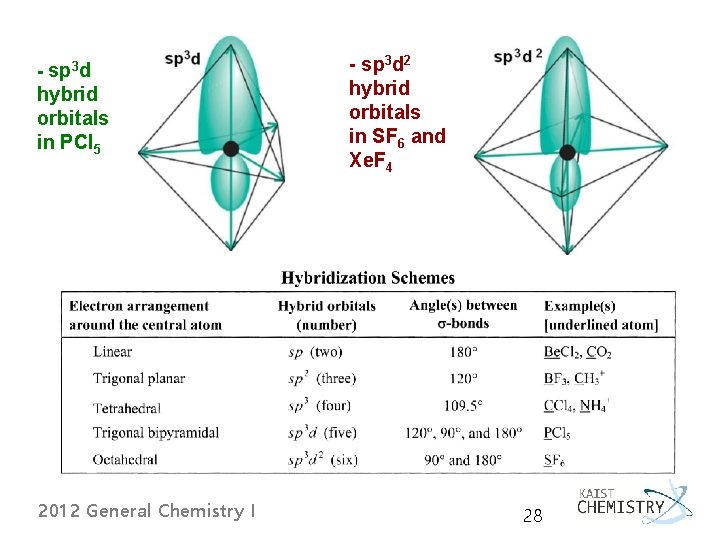
- sp 3 d hybrid orbitals in PCl 5 2012 General Chemistry I - sp 3 d 2 hybrid orbitals in SF 6 and Xe. F 4 28
2012 General Chemistry I 29
2012 General Chemistry I 30
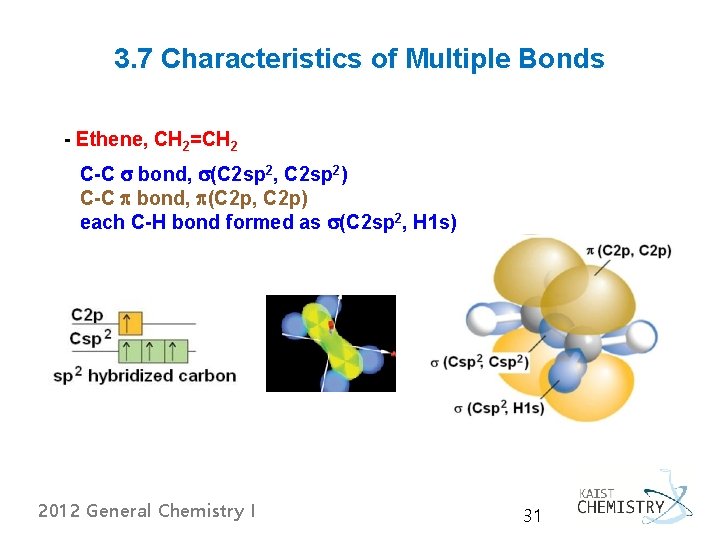
3. 7 Characteristics of Multiple Bonds - Ethene, CH 2=CH 2 C-C s bond, s(C 2 sp 2, C 2 sp 2) C-C p bond, p(C 2 p, C 2 p) each C-H bond formed as s(C 2 sp 2, H 1 s) 2012 General Chemistry I 31
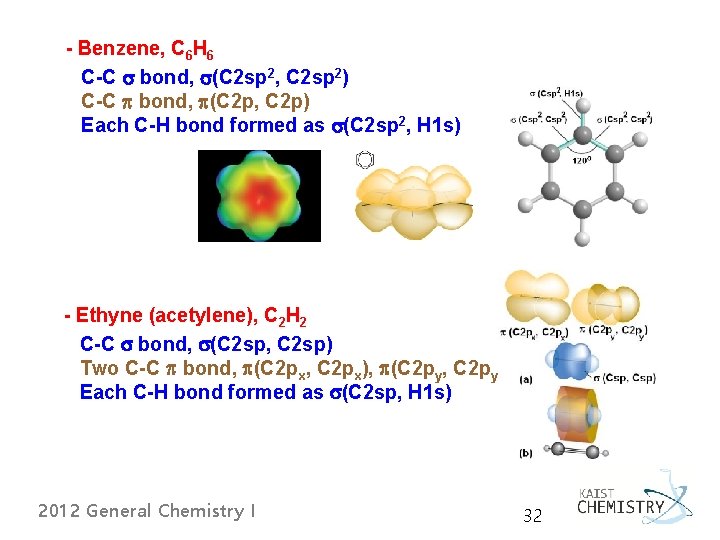
- Benzene, C 6 H 6 C-C s bond, s(C 2 sp 2, C 2 sp 2) C-C p bond, p(C 2 p, C 2 p) Each C-H bond formed as s(C 2 sp 2, H 1 s) - Ethyne (acetylene), C 2 H 2 C-C s bond, s(C 2 sp, C 2 sp) Two C-C p bond, p(C 2 px, C 2 px), p(C 2 py, C 2 py) Each C-H bond formed as s(C 2 sp, H 1 s) 2012 General Chemistry I 32
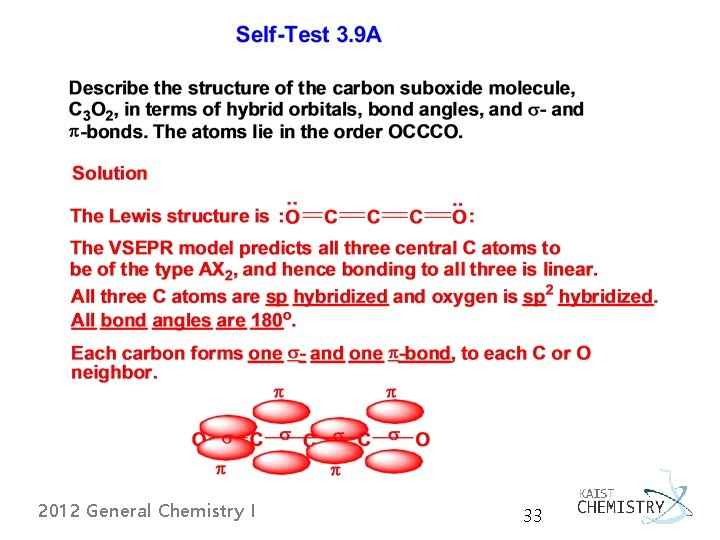
2012 General Chemistry I 33
Chapter 3. MOLECULAR SHAPE AND STRUCTURE MOLECULAR ORBITAL THEORY 3. 8 The Limitations of Lewis’s Theory 3. 9 Molecular Orbitals 3. 10 Electron Configurations of Diatomic Molecules 3. 11 Bonding in Heteronuclear Diatomic Molecules 3. 12 Orbitals in Polyatomic Molecules 2012 General Chemistry I 34
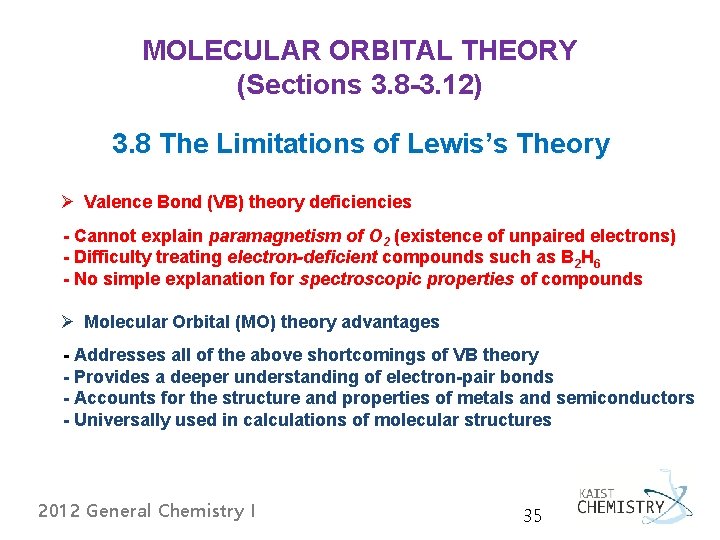
MOLECULAR ORBITAL THEORY (Sections 3. 8 -3. 12) 3. 8 The Limitations of Lewis’s Theory Ø Valence Bond (VB) theory deficiencies - Cannot explain paramagnetism of O 2 (existence of unpaired electrons) - Difficulty treating electron-deficient compounds such as B 2 H 6 - No simple explanation for spectroscopic properties of compounds Ø Molecular Orbital (MO) theory advantages - Addresses all of the above shortcomings of VB theory - Provides a deeper understanding of electron-pair bonds - Accounts for the structure and properties of metals and semiconductors - Universally used in calculations of molecular structures 2012 General Chemistry I 35
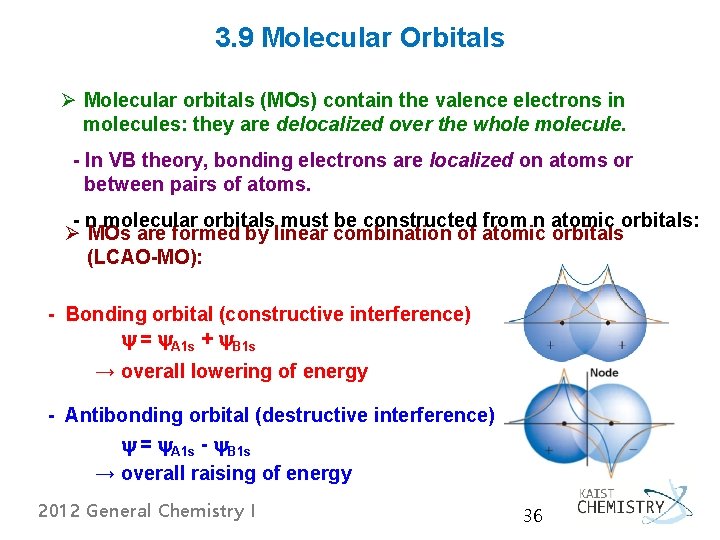
3. 9 Molecular Orbitals Ø Molecular orbitals (MOs) contain the valence electrons in molecules: they are delocalized over the whole molecule. - In VB theory, bonding electrons are localized on atoms or between pairs of atoms. - n molecular orbitals must be constructed from n atomic orbitals: Ø MOs are formed by linear combination of atomic orbitals (LCAO-MO): - Bonding orbital (constructive interference) y = y. A 1 s + y. B 1 s → overall lowering of energy - Antibonding orbital (destructive interference) y = y. A 1 s - y. B 1 s → overall raising of energy 2012 General Chemistry I 36
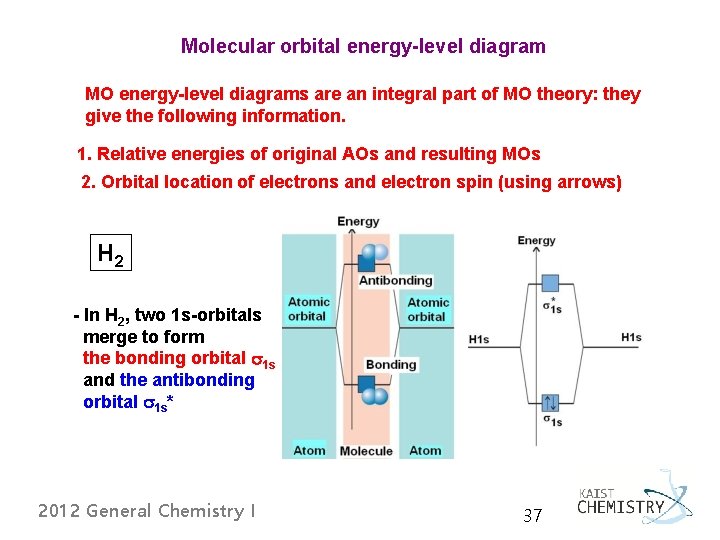
Molecular orbital energy-level diagram MO energy-level diagrams are an integral part of MO theory: they give the following information. 1. Relative energies of original AOs and resulting MOs 2. Orbital location of electrons and electron spin (using arrows) H 2 - In H 2, two 1 s-orbitals merge to form the bonding orbital s 1 s and the antibonding orbital s 1 s* 2012 General Chemistry I 37
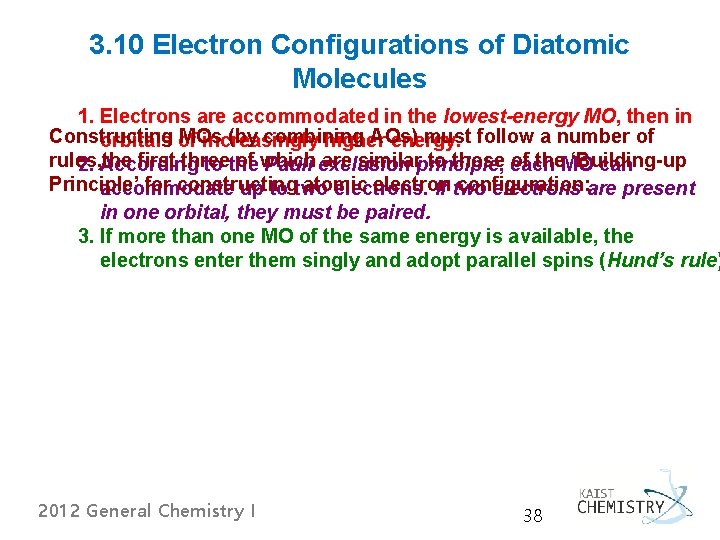
3. 10 Electron Configurations of Diatomic Molecules 1. Electrons are accommodated in the lowest-energy MO, then in Constructing MOs (by combining AOs) must follow a number of orbitals of increasingly higher energy. rules, the first three of which are similarprinciple, to those each of the. MO ‘Building-up 2. According to the Pauli exclusion can Principle’ for constructing atomic electron configuration: accommodate up to two electrons. If two electrons are present in one orbital, they must be paired. 3. If more than one MO of the same energy is available, the electrons enter them singly and adopt parallel spins (Hund’s rule) 2012 General Chemistry I 38
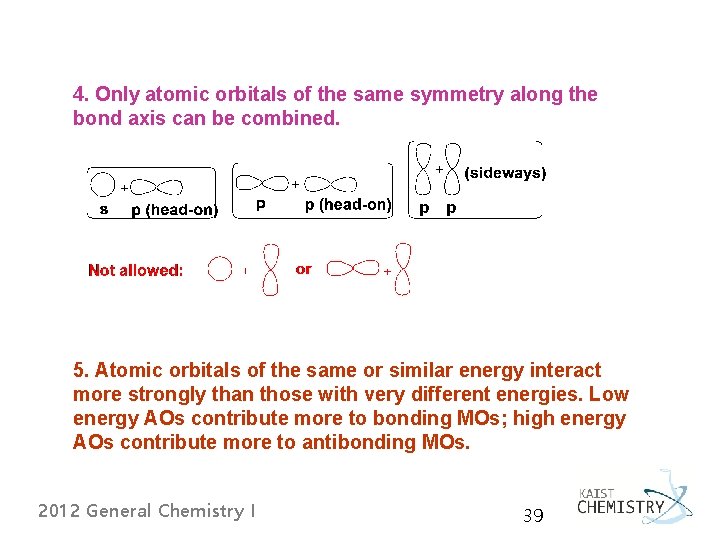
4. Only atomic orbitals of the same symmetry along the bond axis can be combined. 5. Atomic orbitals of the same or similar energy interact more strongly than those with very different energies. Low energy AOs contribute more to bonding MOs; high energy AOs contribute more to antibonding MOs. 2012 General Chemistry I 39
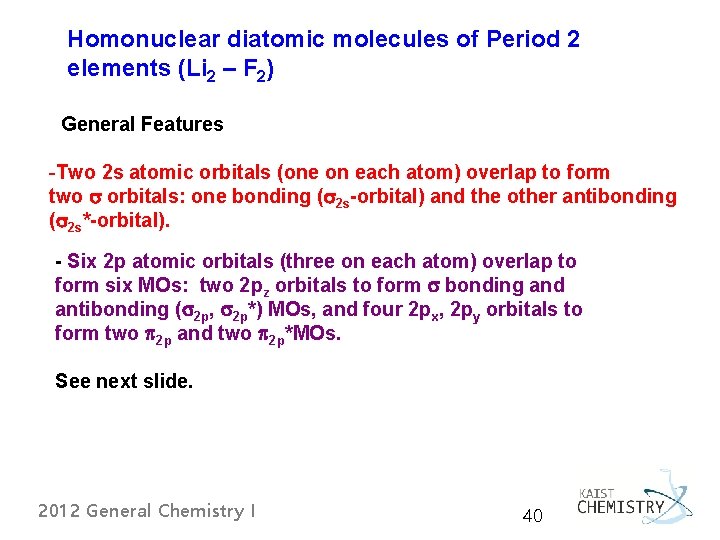
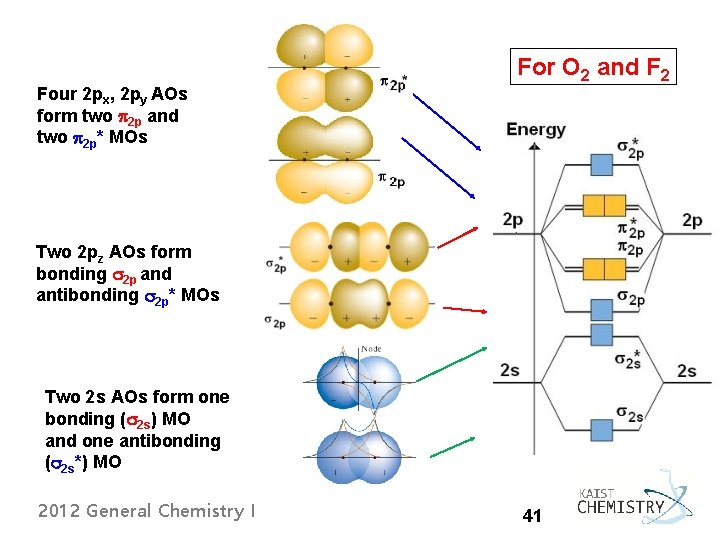
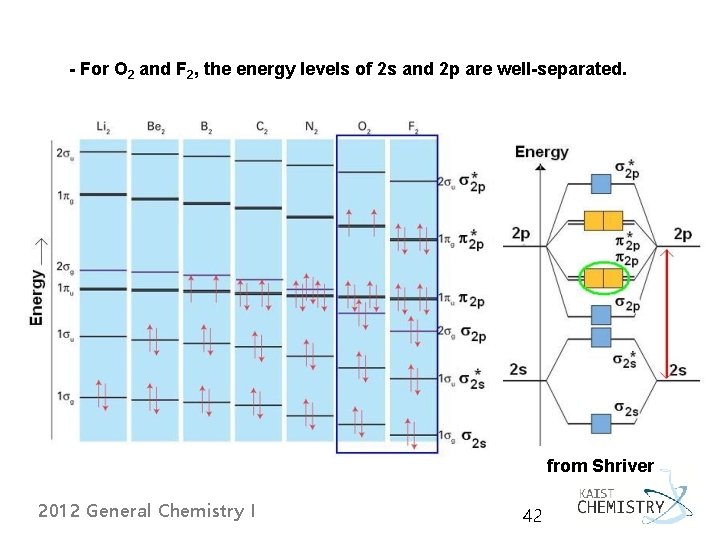
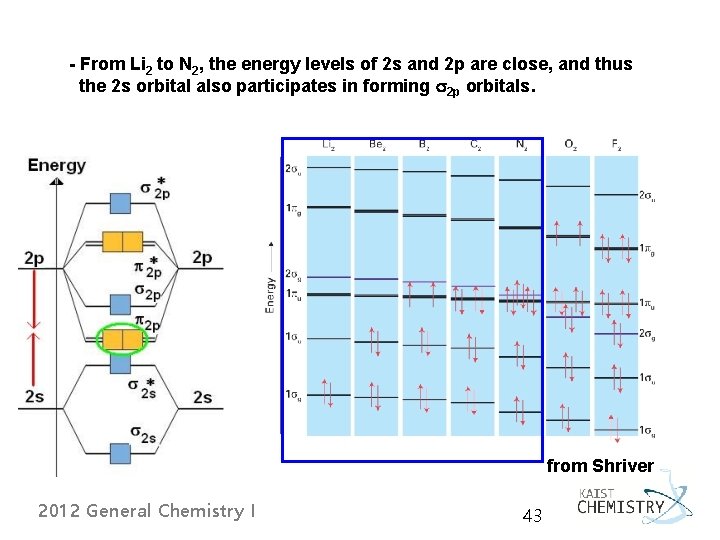
Homonuclear diatomic molecules of Period 2 elements (Li 2 – F 2) General Features -Two 2 s atomic orbitals (one on each atom) overlap to form two s orbitals: one bonding (s 2 s-orbital) and the other antibonding (s 2 s*-orbital). - Six 2 p atomic orbitals (three on each atom) overlap to form six MOs: two 2 pz orbitals to form s bonding and antibonding (s 2 p, s 2 p*) MOs, and four 2 px, 2 py orbitals to form two p 2 p and two p 2 p*MOs. See next slide. 2012 General Chemistry I 40
Four 2 px, 2 py AOs form two p 2 p and two p 2 p* MOs For O 2 and F 2 Two 2 pz AOs form bonding s 2 p and antibonding s 2 p* MOs Two 2 s AOs form one bonding (s 2 s) MO and one antibonding (s 2 s*) MO 2012 General Chemistry I 41
- For O 2 and F 2, the energy levels of 2 s and 2 p are well-separated. from Shriver 2012 General Chemistry I 42
- From Li 2 to N 2, the energy levels of 2 s and 2 p are close, and thus the 2 s orbital also participates in forming s 2 p orbitals. from Shriver 2012 General Chemistry I 43
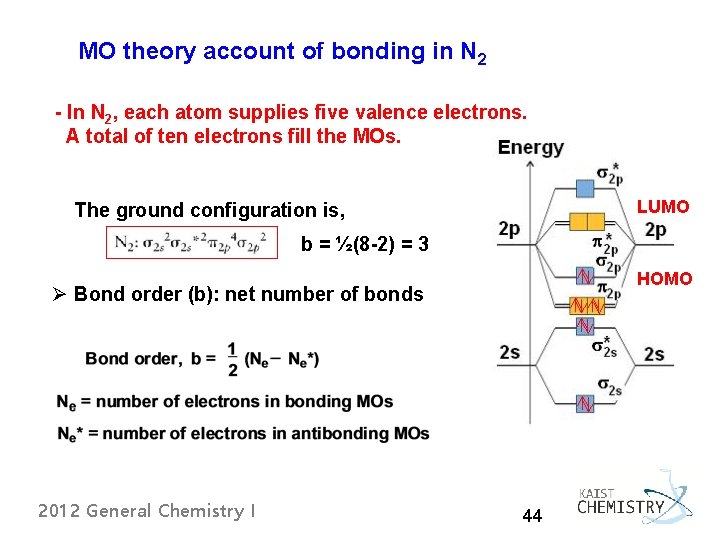
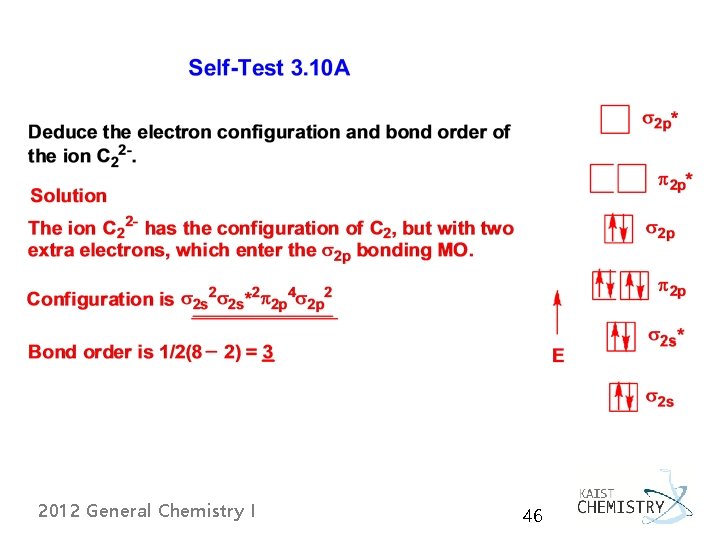
MO theory account of bonding in N 2 - In N 2, each atom supplies five valence electrons. A total of ten electrons fill the MOs. LUMO The ground configuration is, b = ½(8 -2) = 3 HOMO Ø Bond order (b): net number of bonds 2012 General Chemistry I 44
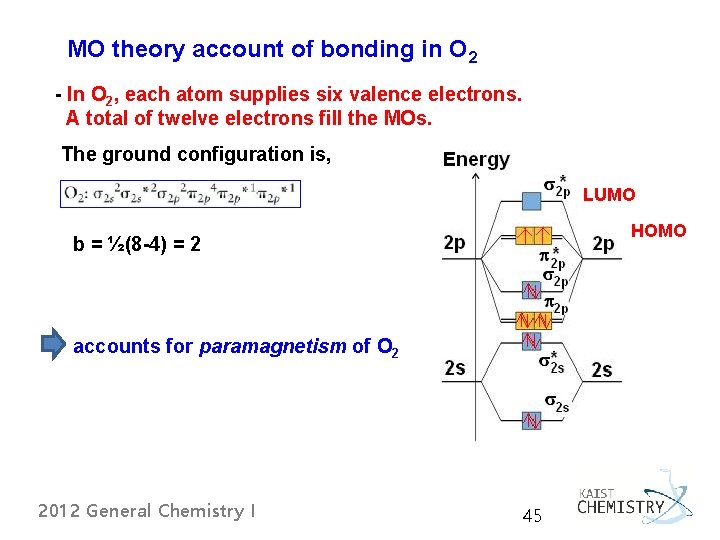
MO theory account of bonding in O 2 - In O 2, each atom supplies six valence electrons. A total of twelve electrons fill the MOs. The ground configuration is, LUMO HOMO b = ½(8 -4) = 2 accounts for paramagnetism of O 2 2012 General Chemistry I 45
2012 General Chemistry I 46
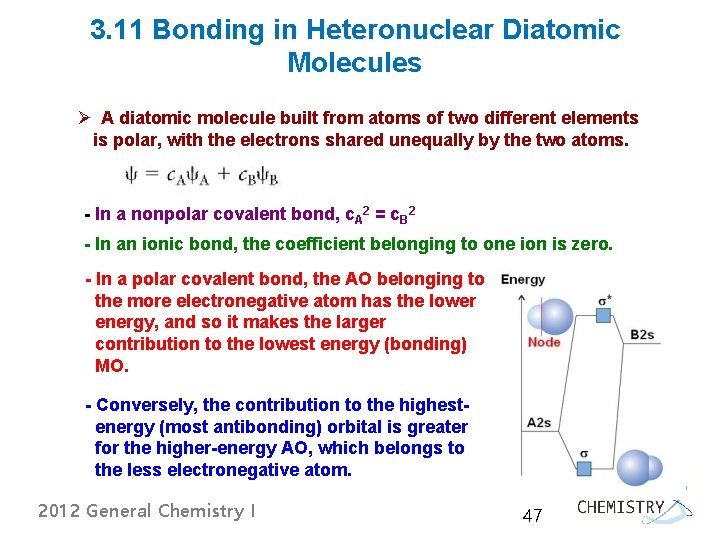
3. 11 Bonding in Heteronuclear Diatomic Molecules Ø A diatomic molecule built from atoms of two different elements is polar, with the electrons shared unequally by the two atoms. - In a nonpolar covalent bond, c. A 2 = c. B 2 - In an ionic bond, the coefficient belonging to one ion is zero. - In a polar covalent bond, the AO belonging to the more electronegative atom has the lower energy, and so it makes the larger contribution to the lowest energy (bonding) MO. - Conversely, the contribution to the highestenergy (most antibonding) orbital is greater for the higher-energy AO, which belongs to the less electronegative atom. 2012 General Chemistry I 47
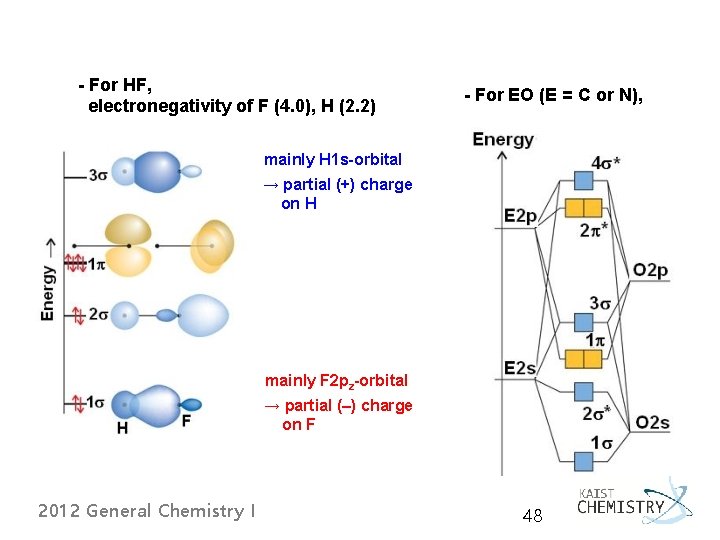
- For HF, electronegativity of F (4. 0), H (2. 2) - For EO (E = C or N), mainly H 1 s-orbital → partial (+) charge on H mainly F 2 pz-orbital → partial (–) charge on F 2012 General Chemistry I 48
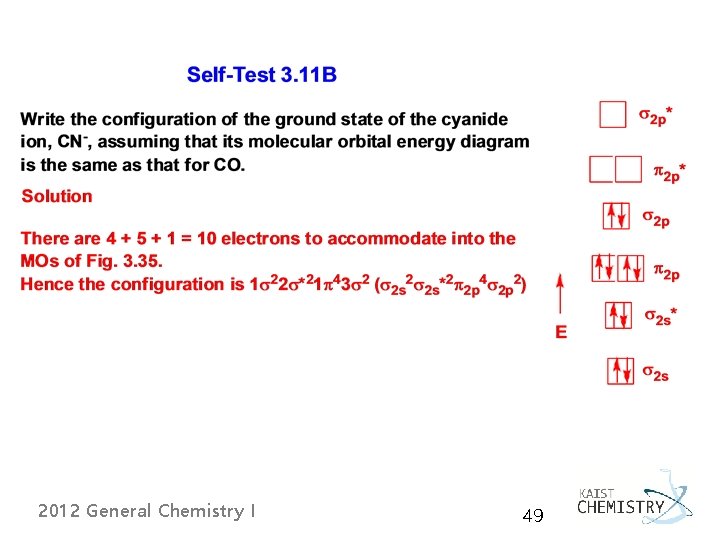
2012 General Chemistry I 49
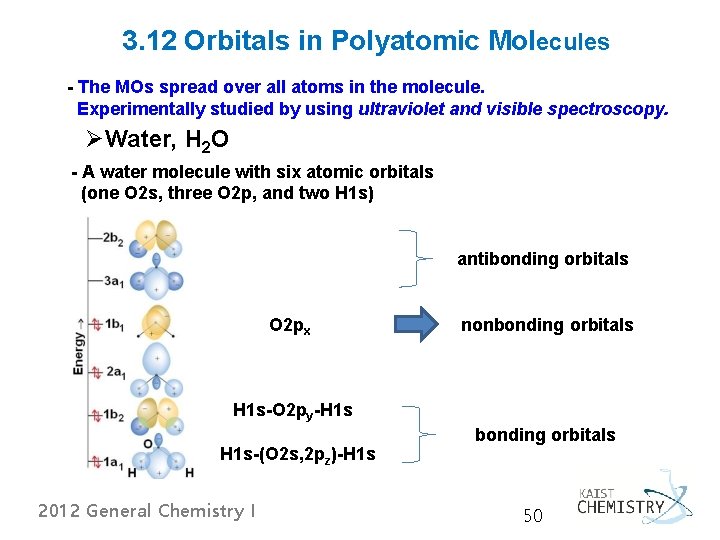
3. 12 Orbitals in Polyatomic Molecules - The MOs spread over all atoms in the molecule. Experimentally studied by using ultraviolet and visible spectroscopy. ØWater, H 2 O - A water molecule with six atomic orbitals (one O 2 s, three O 2 p, and two H 1 s) antibonding orbitals O 2 px nonbonding orbitals H 1 s-O 2 py-H 1 s-(O 2 s, 2 pz)-H 1 s 2012 General Chemistry I bonding orbitals 50
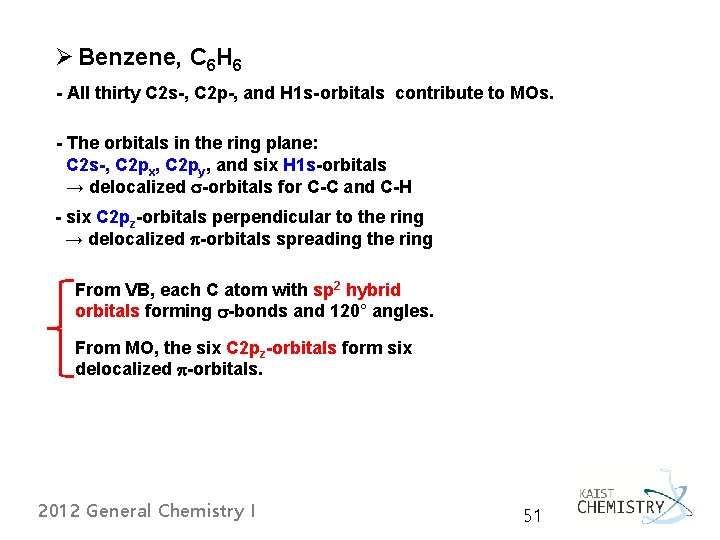
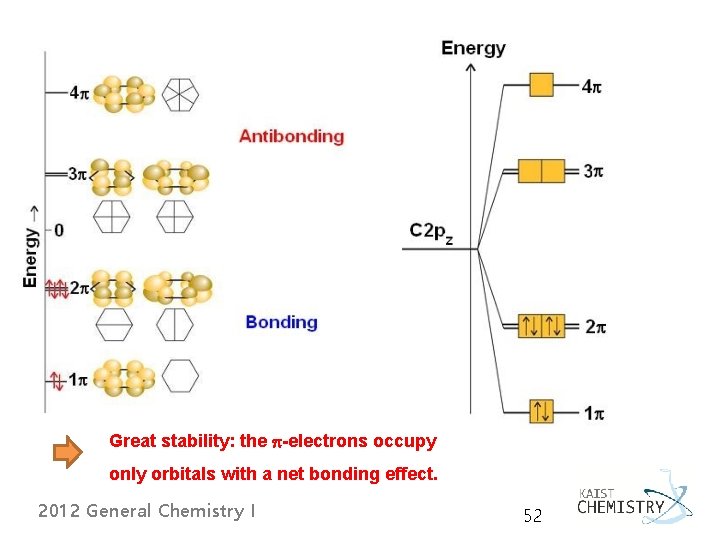
Ø Benzene, C 6 H 6 - All thirty C 2 s-, C 2 p-, and H 1 s-orbitals contribute to MOs. - The orbitals in the ring plane: C 2 s-, C 2 px, C 2 py, and six H 1 s-orbitals → delocalized s-orbitals for C-C and C-H - six C 2 pz-orbitals perpendicular to the ring → delocalized p-orbitals spreading the ring From VB, each C atom with sp 2 hybrid orbitals forming s-bonds and 120° angles. From MO, the six C 2 pz-orbitals form six delocalized p-orbitals. 2012 General Chemistry I 51
Great stability: the p-electrons occupy only orbitals with a net bonding effect. 2012 General Chemistry I 52
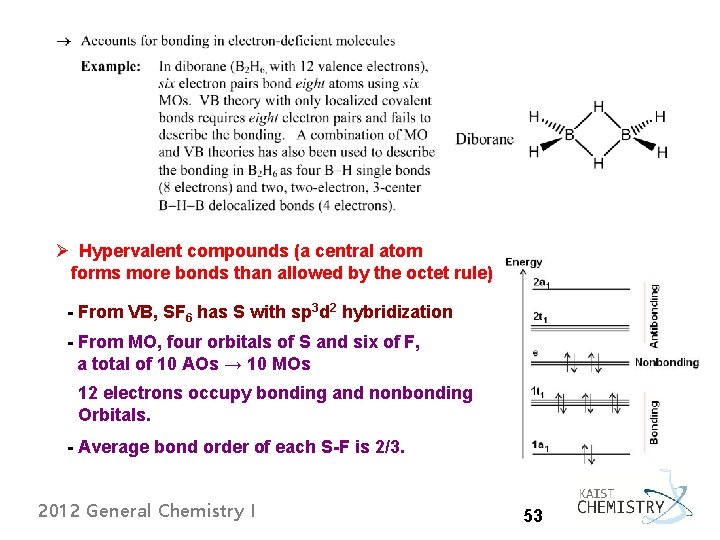
Ø Hypervalent compounds (a central atom forms more bonds than allowed by the octet rule) - From VB, SF 6 has S with sp 3 d 2 hybridization - From MO, four orbitals of S and six of F, a total of 10 AOs → 10 MOs 12 electrons occupy bonding and nonbonding Orbitals. - Average bond order of each S-F is 2/3. 2012 General Chemistry I 53
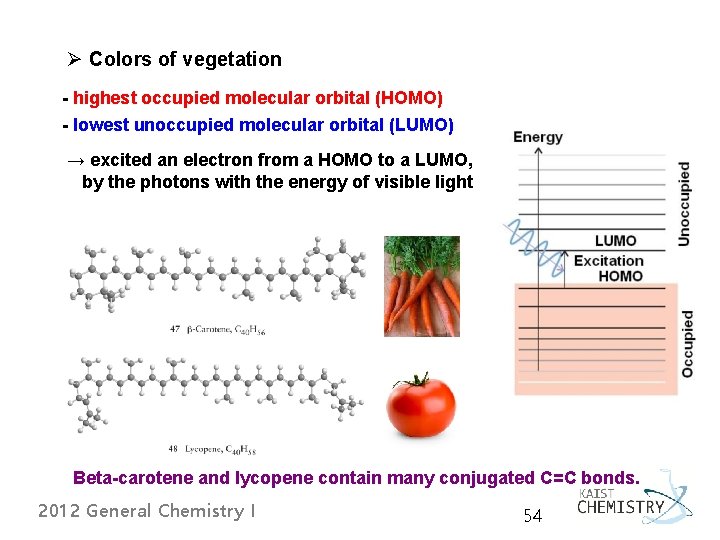
Ø Colors of vegetation - highest occupied molecular orbital (HOMO) - lowest unoccupied molecular orbital (LUMO) → excited an electron from a HOMO to a LUMO, by the photons with the energy of visible light Beta-carotene and lycopene contain many conjugated C=C bonds. 2012 General Chemistry I 54
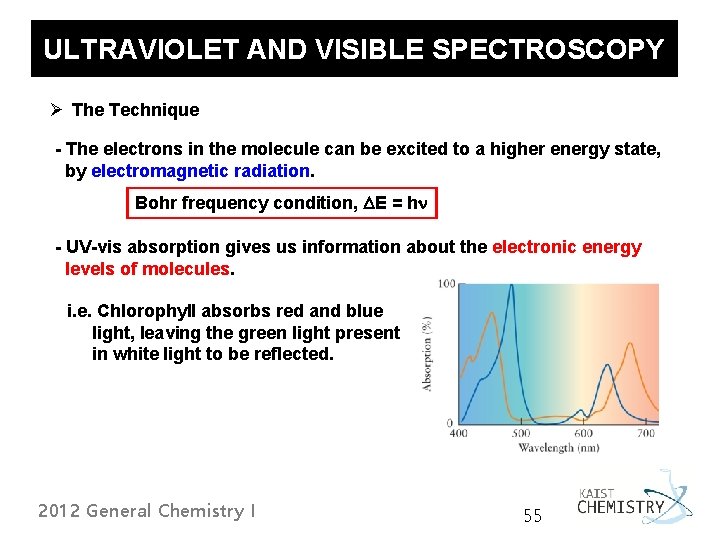
ULTRAVIOLET AND VISIBLE SPECTROSCOPY Ø The Technique - The electrons in the molecule can be excited to a higher energy state, by electromagnetic radiation. Bohr frequency condition, DE = hn - UV-vis absorption gives us information about the electronic energy levels of molecules. i. e. Chlorophyll absorbs red and blue light, leaving the green light present in white light to be reflected. 2012 General Chemistry I 55
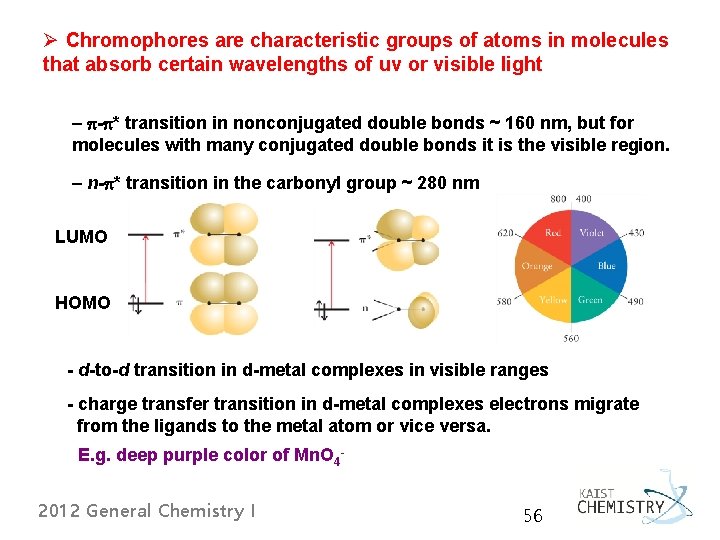
Ø Chromophores are characteristic groups of atoms in molecules that absorb certain wavelengths of uv or visible light – p-p* transition in nonconjugated double bonds ~ 160 nm, but for molecules with many conjugated double bonds it is the visible region. – n-p* transition in the carbonyl group ~ 280 nm LUMO HOMO - d-to-d transition in d-metal complexes in visible ranges - charge transfer transition in d-metal complexes electrons migrate from the ligands to the metal atom or vice versa. E. g. deep purple color of Mn. O 42012 General Chemistry I 56