
Chapter 3 Models of the Earth In order
- Slides: 16
Chapter 3. Models of the Earth In order to locate points on Earth, we use models. Two general types of models: Maps Globes 2 -Dimensional 3 -Dimensional More portable Less accurate More accurate To find points on a map/globe, we use coordinates.
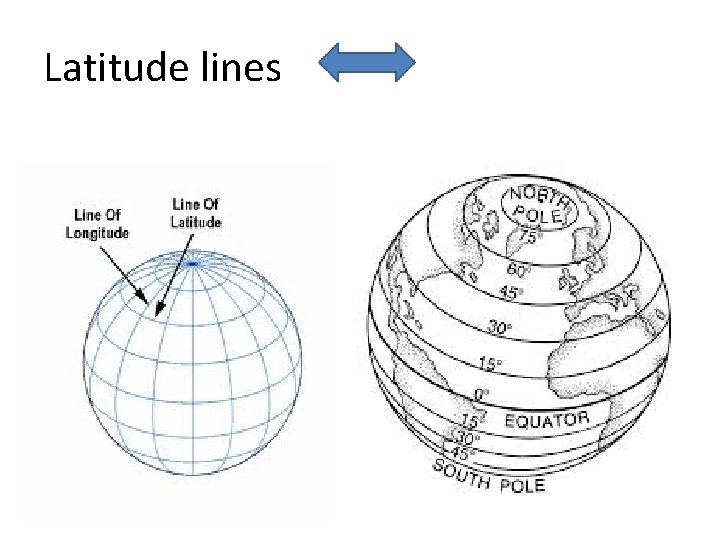
Latitude lines
Lines of Latitude or Parallels • A set of circles that run parallel • And describe positions North or South of the equator. • Equator = 0 o latitude • North and South poles are each 90 o N or 90 o S • Washington, D. C. Is 38 o 53’ 40” N. • Read as 38 degrees, 53 minutes, and 40 seconds North • Latitude is always written first when recording coordinates and is always North or South.
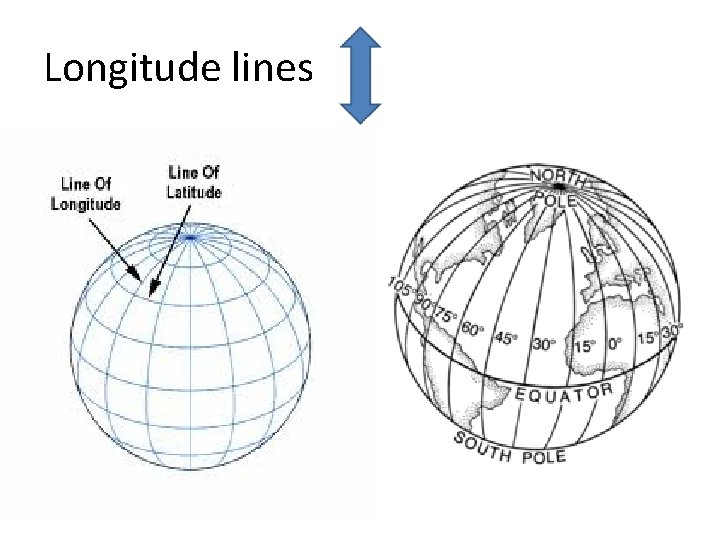
Longitude lines
Lines of Longitude or Meridians • A set of ½ circles that run vertically (up and down) • Lines of longitude meet at the poles. • And describe positions East or West of the Prime Meridian • Prime meridian = 0 o (runs through Greenwich, England) • West of the Prime meridian 0 to 180 o W • East of the Prime meridian 0 to 180 o E • International Date Line = 180 o, exactly ½ around the globe from the Prime Meridian – it marks the place where each new day officially begins at midnight. • (It would be noon on the previous day at the Prime Meridian) • Washington, D. C. 77 o 02’ 12” W – Read as 77 degrees, 02 minutes, and 12 seconds West Longitudes are always written second and have East or West coordinates.
Map Projections • A map is a flat representation of Earth’s curved surface. • A map projection is a method used to transfer features on a 3 D globe onto the flat surface of a 2 D map. • Results in a distorted image of the curved surface. • Distortions may occur in size, shape, direction, and distance. • The larger the area being shown, the greater the distortion.
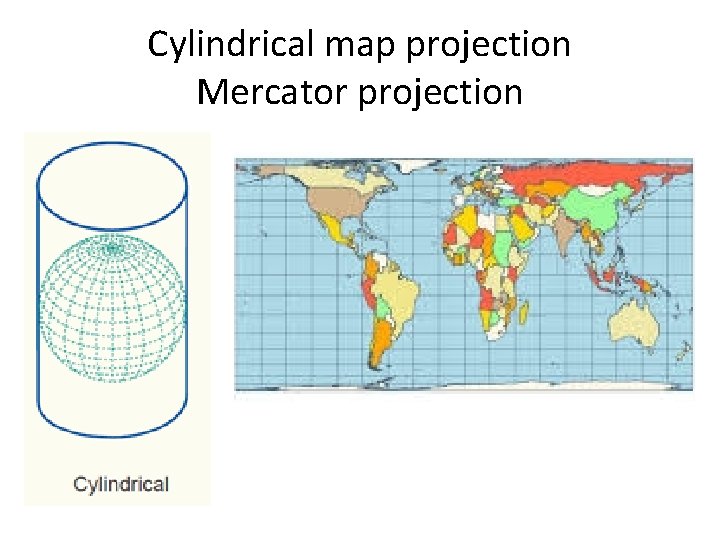
Cylindrical map projection Mercator projection
Cylindrical or Mercator Projections Created by forming a cylinder around the earth. Most common type; used for making world maps Advantage: Accurate at the equator Advantage: parallels and meridians form a grid which makes locating positions easier. • Advantage: The shapes of small areas are well preserved. Good for making maps of small areas. • Disadvantage: distorts distances near the poles • Disadvantage: distorts sizes near the poles • • • Greenland appears larger than South America.
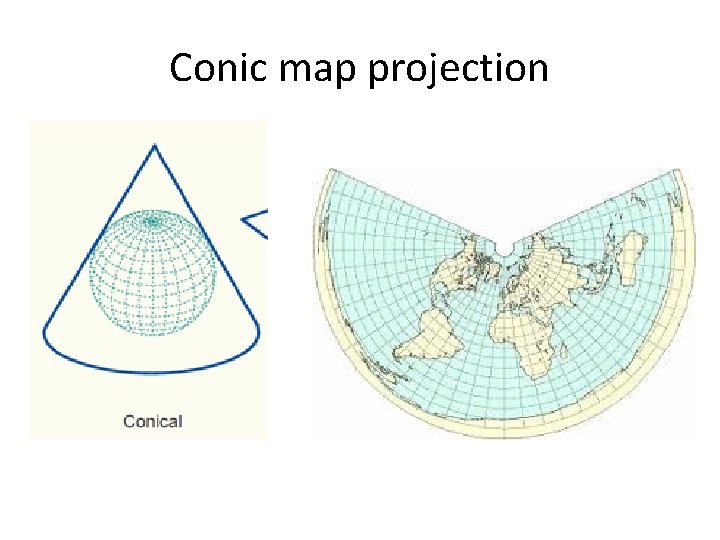
Conic map projection
Conic Projections • Created by forming a cone at any location on a globe. • Advantage: Can make a map of anywhere on the globe. • Advantage: Areas near the points of contact (parallels) are least distorted. • Advantage: The relative size and shape of small areas on the map are nearly the same as those on a globe. • Disadvantage: areas farthest from the points of contact show the most distortion.
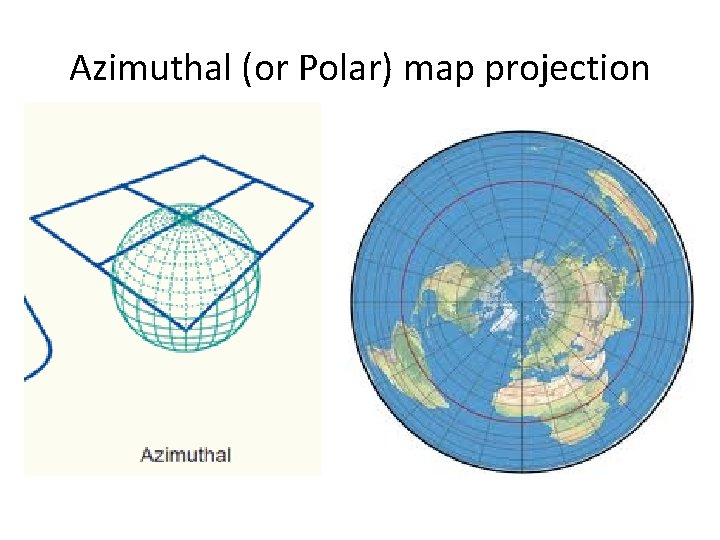
Azimuthal (or Polar) map projection
Azimuthal (or Polar) Projections • Created with only one point of contact. • Commonly the one point of contact is the north or south pole; this is known as a POLAR projection. • Advantage: Good to use for polar views. – Important in air travel in these areas. • Advantage: Little distortion at the point of contact • Disadvantage: unequal spacing between parallels that causes a distortion in both direction and distance. • Disadvantage: distortion increases as distance from the point of contact increases.
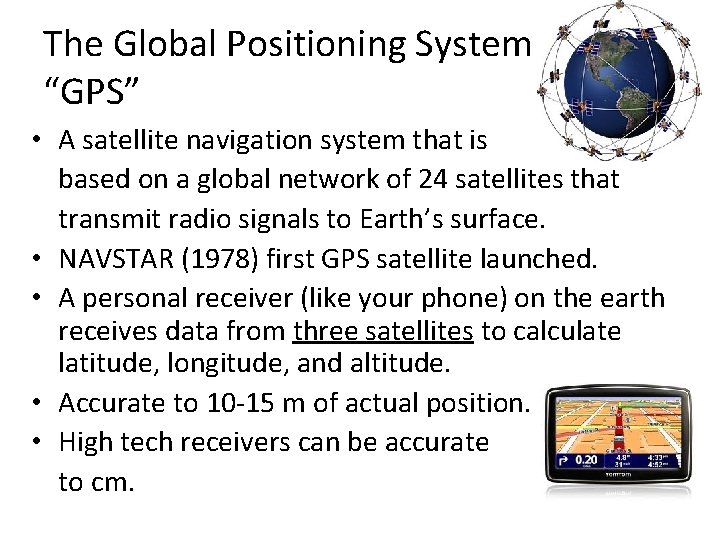
The Global Positioning System “GPS” • A satellite navigation system that is based on a global network of 24 satellites that transmit radio signals to Earth’s surface. • NAVSTAR (1978) first GPS satellite launched. • A personal receiver (like your phone) on the earth receives data from three satellites to calculate latitude, longitude, and altitude. • Accurate to 10 -15 m of actual position. • High tech receivers can be accurate to cm.
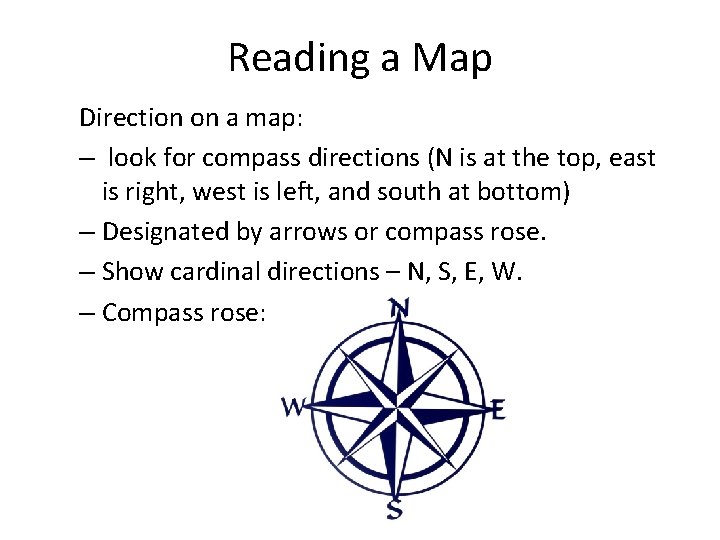
Reading a Map Direction on a map: – look for compass directions (N is at the top, east is right, west is left, and south at bottom) – Designated by arrows or compass rose. – Show cardinal directions – N, S, E, W. – Compass rose:
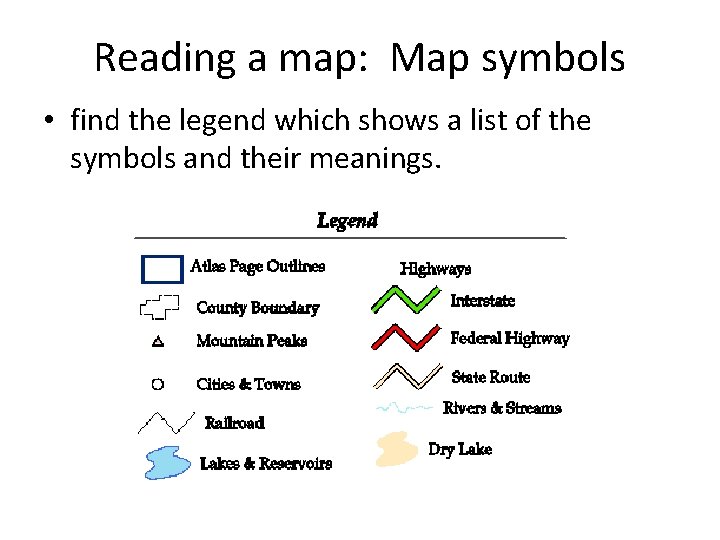
Reading a map: Map symbols • find the legend which shows a list of the symbols and their meanings.
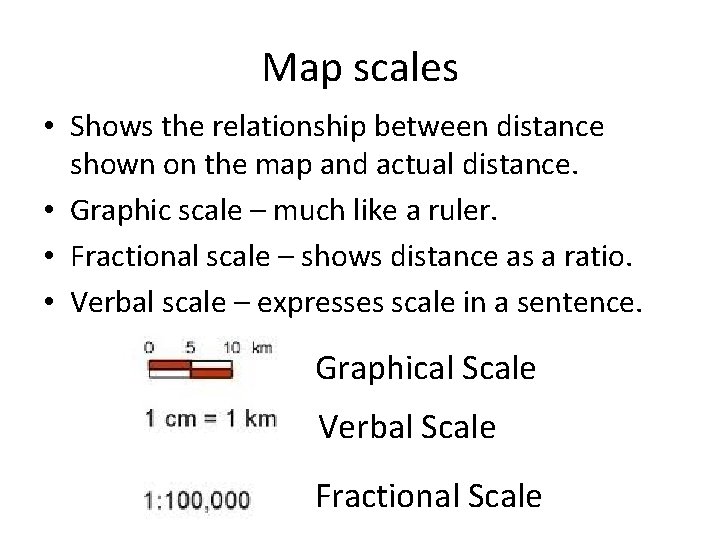
Map scales • Shows the relationship between distance shown on the map and actual distance. • Graphic scale – much like a ruler. • Fractional scale – shows distance as a ratio. • Verbal scale – expresses scale in a sentence. Graphical Scale Verbal Scale Fractional Scale