
Chapter 3 Methods of Instruction Knowledge Objectives 1
Chapter 3 Methods of Instruction
Knowledge Objectives (1 of 2) Instructor I • Describe motivational techniques. • Describe how to adjust the classroom presentation and still meet the objectives of the lesson plan. • Describe the laws and principles of adult learning. • Describe methods of instruction typically used in adult and fire service education.
Knowledge Objectives (2 of 2) Instructor I • Identify characteristics of Generation X, Generation Y, Generation Z, and the baby boomers. • Describe communication techniques that will improve your presentation. • Explain how to deal with disruptive and unsafe behaviors in the classroom.
Skills Objectives Instructor I • Demonstrate basic coaching and motivational techniques. • Deliver an instructional session utilizing prepared course material. • Demonstrate professionalism during the learning process. • Manage disruptive and unsafe behaviors in the classroom.
Knowledge Objectives Instructor II • Explain how to adjust the classroom presentation and still meet the objectives of the lesson plan. • Describe methods of instruction typically used in adult and fire service education. • Describe communication techniques that will improve your presentation

Skills Objectives Instructor II • Demonstrate basic coaching and motivational techniques. • Demonstrate professionalism during the learning process. • Demonstrate transitioning between methods of instruction to facilitate effective learning. • Manage disruptive and unsafe behaviors in the classroom.
How Can I Best Help My Students to Learn? • It is the instructor’s responsibility to: – Present accurate information – Understand course objectives • Instruction is a key factor in students’ success. – Teaching can have a greater impact on achievement than all other factors combined.
Starting Off Well • Students decide early whether they will like class, contents, instructor, other students • Remember, fire fighters are adults! – There are differences in the way adults and children learn.
Motivation and Learning (1 of 2) • Motivational factors make students enthusiastic and eager to learn. • Motivation affects: – How students practice – What they observe – What they do
Motivation and Learning (2 of 2) • Learning is the potential behavior. • Motivation is the behavior activator. • Learning and motivation combine to determine performance. • Without motivation, learning will not take place.
Motivation of Adult Learners • Three types of adult learners: – Learner-oriented – Goal-oriented – Activity-oriented • Each type has different motivational issues. – Affects how learning takes place – Adjusting learning style is not always successful or possible.
Factors That Influence Success (1 of 4) • Learner’s grasp of how material relates to real world and can be beneficial – Theory into practice can work to an instructor’s advantage in this sense. • Learner’s psychological state – Mild anxiety can help learner focus. – Intense negative emotions may detract. – Make your students feel welcome.
Factors That Influence Success (2 of 4) • Position of learners in the life cycle – Each phase of life requires certain behaviors and skills. – Adults want to be autonomous, independent. • Geographical changes • Physical changes
Factors That Influence Success (3 of 4) • Visual and auditory acuity • Intellectual functioning • Learner’s internal world of ideas, beliefs, goals, and expectations • Attitudes about ability to learn • Judgment as to whether learning is an important life goal
Factors That Influence Success (4 of 4) • Quality of thinking • Information processing • Learning environment
Motivation As a Factor in Class Design (1 of 2) • Motivation is the primary learning component for adult learning. – Why is the adult learner in the class? – Why does the adult learner want to take (or not want to take) this class? • Identify why to find out how. – The precise motivation and techniques that will help the adult learner learn
Motivation As a Factor in Class Design (2 of 2) • Find out why students are in your class and what they expect. • This information will allow you to: – Design lesson plans to meet every student’s needs. – Generate self-motivation in every student. – Use a variety of motivational techniques to stimulate students.
Motivated Instructors • Enthusiasm is contagious. • When you are dynamic, outgoing, charismatic, and interested in the topic, you will teach with energy. • Your personality serves as a motivational factor for your students.
Additional Motivational Factors • Additional factors include: – – Audiovisual aids Teaching strategies Teaching methods The classroom itself • Motivational factors are part of each level of instruction. • Take time to consider ways to engage your learners.
The Learning Process (1 of 3) • Learning is interactive. – Learner encounters and reacts to a specific learning environment. • Each adult learner has a learning style. – Distinct and preferred way of perceiving, organizing, and retaining experiences
The Learning Process (2 of 3) • Learning takes place in three domains: – Cognitive (knowledge) – Psychomotor (physical use of knowledge) – Affective (attitudes, emotions, or values)
The Learning Process (3 of 3) • Effective learning follows a process. – Learners begin with what they know, feel, or need. – Seeing how new information connects to real life prepares learners to learn. – Learners use new content, practicing for applying it to real life. – Learners apply material learned to the real world.
What Is Adult Learning? (1 of 2) • Fire service training is designed for the adult learner. • An adult learner is someone who has passed adolescence and is out of secondary school. • Self-motivation is rarely a problem. – Advance career – Better self
What Is Adult Learning? (2 of 2) • Adult learning is the integration of new information into existing values, beliefs, and behaviors. • Adult students need: – Realistic, practical, and informative lessons – Information delivered in a variety of ways to accommodate differing learning styles
Learning Process Realm • There are two general lines of thought in the realm of the learning process: – Pedagogy – Andragogy
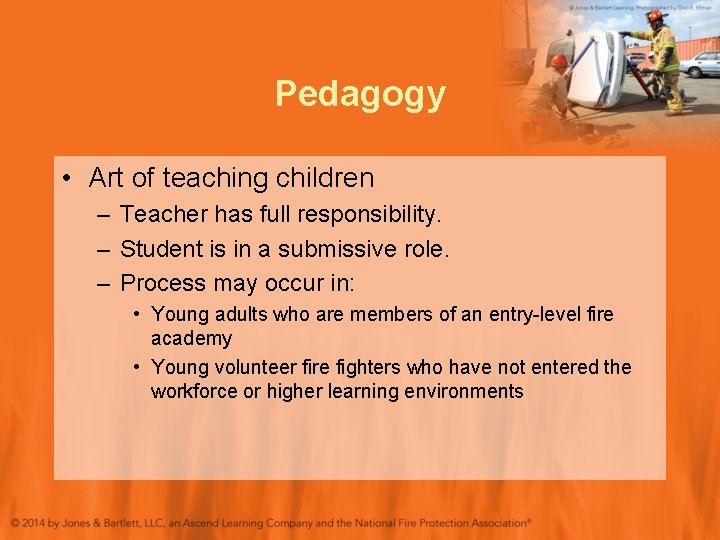
Pedagogy • Art of teaching children – Teacher has full responsibility. – Student is in a submissive role. – Process may occur in: • Young adults who are members of an entry-level fire academy • Young volunteer fire fighters who have not entered the workforce or higher learning environments
Similarities and Differences Among Adult Learners • The theory of andragogy attempts to identify how adults learn. – Although adult learners differ, there are some commonalities.
Similarities Among Adult Learners • Need to know why they need to know something • Need to know how they can use it • Focus on practical tasks and activities • Learn at their own pace • Use preferred learning style • Use rich history of life experiences
Differences Among Adult Learners (1 of 3) • Stage of life directly affects adult learner. • Young adults – – – Developing sense of identity Establishing a career Pursuing a life dream Having a relationship, getting married Achieving parenthood
Differences Among Adult Learners (2 of 3) • Middle-aged adults – – – Caregiving for children or older family members Career changes Physical and mental changes Role changes Planning for retirement
Differences Among Adult Learners (3 of 3) • Older adults face a series of upheavals. – – – Loss of their jobs (via retirement) Transition from parent to grandparent Age-related physical and mental changes Deaths of friends or spouses Acceptance of their own mortality
Three Types of Adult Learners • Learner-oriented adults – Content is less important than the act of learning. • Goal-oriented learners – Goal is improving job prospects or learning new skills. – Instructor is responsible for disseminating knowledge. • Activity-oriented learners – Learn by doing
Influences on Adult Learners (1 of 3) • Adult learning theories are based on the premise that: – Adults have had different experiences than children and adolescents. – These differences are relevant to learning.
Influences on Adult Learners (2 of 3) • • Motivation Prior knowledge Learning context Influences exerted by situational and social conditions • Information meaningful to life
Influences on Adult Learners (3 of 3) • Cope with life events – May affect behavior in the classroom • Social and cultural perspectives – Social roles – Race – Gender • Self-directed learners want to direct their own learning. – Instructor must keep on track.
Critical Reflection (1 of 2) • The ability to reflect back on prior learning to determine whether what was learned is justified under present circumstances. – Unique advantage with adult learners – Key asset for instructor
Critical Reflection (2 of 2) • Occurs when learners compare their ideas to those of mentors or classmates • May reflect critically on assumptions and attitudes that underlie their knowledge • As instructor, part of job is to motivate students to learn information presented.
Traditional Learning Skills As a Factor in Learning • Prior participation in formal educational programs or training programs will also affect adult learners’ ability to learn. • Traditional learning skills forgotten or never developed – Reading textbook, taking notes, studying • Challenge to learn or unlearn
Audience Analysis • Factors considered in an audience analysis include: – Age and experience in subject matter of students – Who the lesson is intended for and how students will use the material – Number of students in class – Level of previous knowledge of the class material
Lenny Laskowski’s “AUDIENCE” Analysis Acronym A – Analysis U – Understanding D – Demographics I – Interest E – Environment N – Needs C – Customization E – Expectations
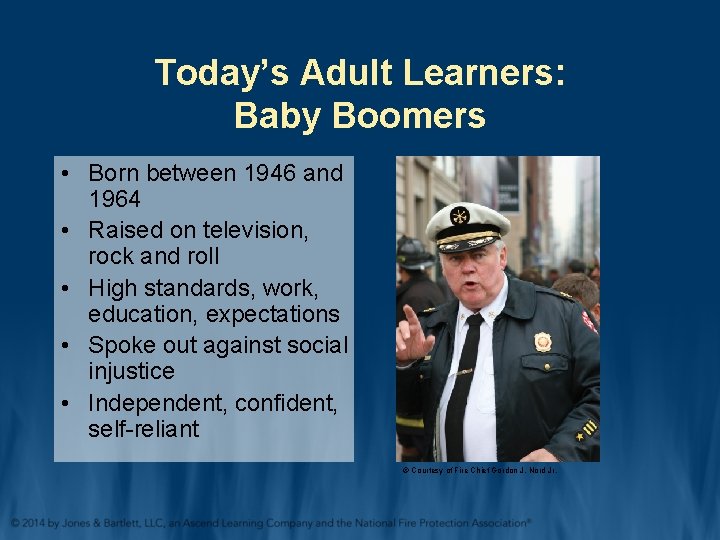
Today’s Adult Learners: Baby Boomers • Born between 1946 and 1964 • Raised on television, rock and roll • High standards, work, education, expectations • Spoke out against social injustice • Independent, confident, self-reliant © Courtesy of Fire Chief Gordon J. Nord Jr.
Teaching Baby Boomers • Earn their trust through demonstrated competence. • Show respect for their experiences. • Have them assist in teaching. – Have them share experiences and knowledge. • They are known for both accepting and resisting change. • Group activities can be effective.
Today’s Adult Learners: Generation X • Generation whose teenaged years were touched by the 1980 s • Both parents worked outside home. • Abandoned traditional family models – Divorce/single-parent families is norm. – Many stay childless. • Grew up with instant gratification
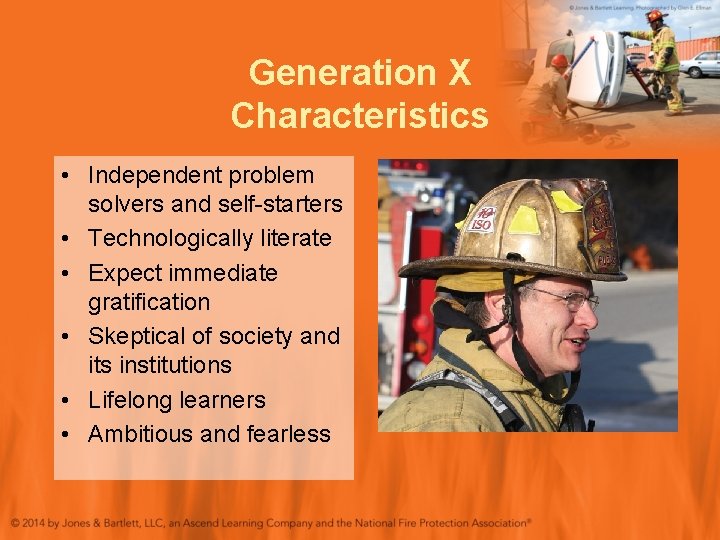
Generation X Characteristics • Independent problem solvers and self-starters • Technologically literate • Expect immediate gratification • Skeptical of society and its institutions • Lifelong learners • Ambitious and fearless
Teaching Generation X • Often clash with baby boomer or traditionalist instructors – Both generations place a high priority on learning and developing new skills. – Instructors must continually raise the bar and adapt to cross-generational training. • Promote learning that has applications in school, work, and community.
Today’s Adult Learners: Generation Y • Born immediately after Generation X • Wide-ranging opinions on political and social issues • More tolerant of alternative lifestyles and unconventional gender roles • More spiritual and religious • Disagreement common between liberal and conservative members
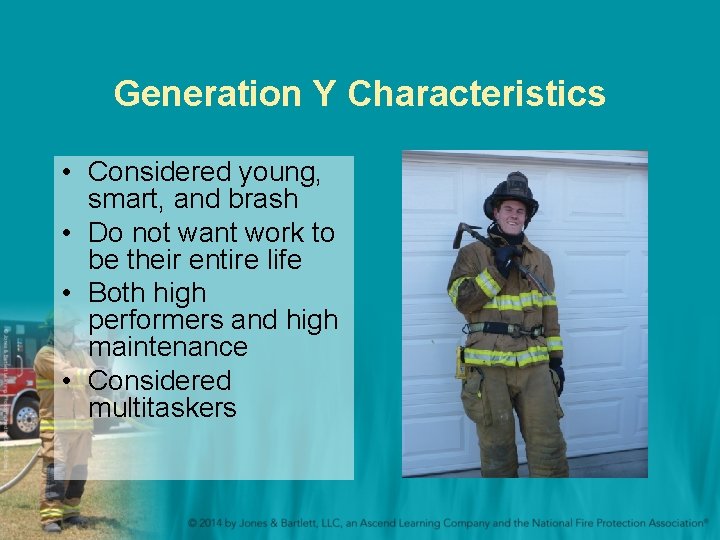
Generation Y Characteristics • Considered young, smart, and brash • Do not want work to be their entire life • Both high performers and high maintenance • Considered multitaskers
Teaching Generation Y • Ideal for learning in virtual classrooms • Like teaching by technical professionals – Hands-on experiences • Challenge boomer or Gen X instructors
Today’s Adult Learners: Generation Z • Also called Generation Next • May bring their own set of values and learning styles • Instructors will need to adjust and adapt to their needs as well.
Generation Z Characteristics • Many Generation Z students: – Have taken online classes – Have had computer access most of their academic life – Prefer quick and very visually-oriented types of learning – Prefer to work around their personal schedules – Would find a smart board and flat panel recognizable
Teaching Generation Z • Learning disconnects can occur when moving from a high-tech environment into a traditional fire service classroom. • May easily become bored and not engaged • Instructors will have to adapt the learning environment to varied generations of students.
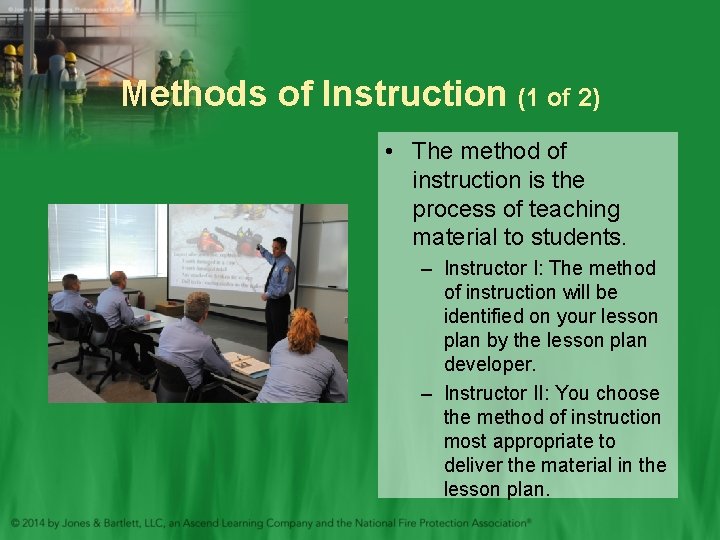
Methods of Instruction (1 of 2) • The method of instruction is the process of teaching material to students. – Instructor I: The method of instruction will be identified on your lesson plan by the lesson plan developer. – Instructor II: You choose the method of instruction most appropriate to deliver the material in the lesson plan.
Methods of Instruction (2 of 2) • Method of instruction determination factors: – The experience and educational level of the students – The classroom setting or training environment – The objectives of the material to be taught – The number of students to be taught
Audience Analysis • Review the demographics of the audience, including: – – Age Learning level Previous experience Other factors • Adapt the lesson plan accordingly.
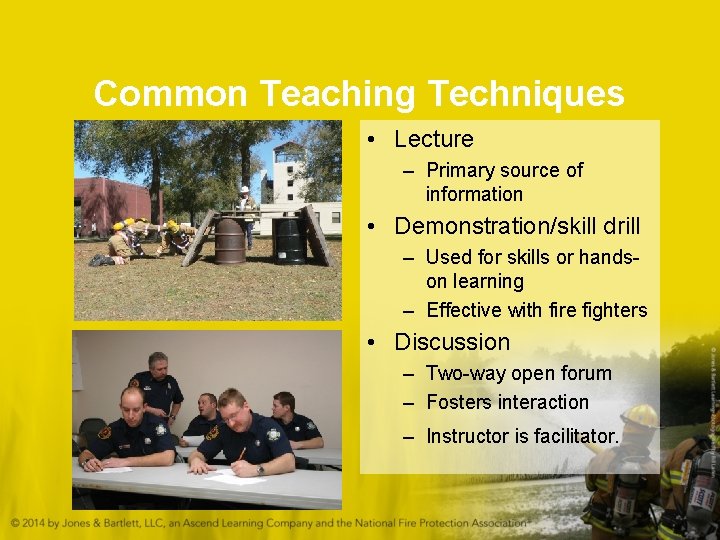
Common Teaching Techniques • Lecture – Primary source of information • Demonstration/skill drill – Used for skills or handson learning – Effective with fire fighters • Discussion – Two-way open forum – Fosters interaction – Instructor is facilitator.
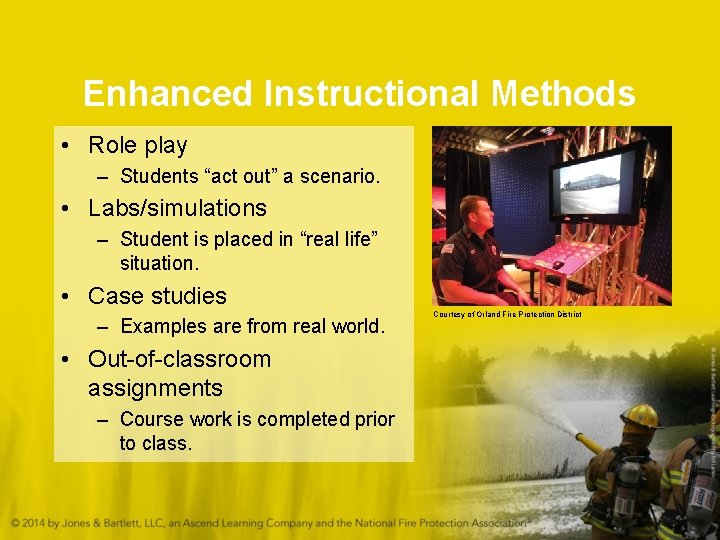
Enhanced Instructional Methods • Role play – Students “act out” a scenario. • Labs/simulations – Student is placed in “real life” situation. • Case studies – Examples are from real world. • Out-of-classroom assignments – Course work is completed prior to class. Courtesy of Orland Fire Protection District
Online Learning: Synchronous • The entire class meets at the same time. • Instructor delivers the course material in real time by voice and/or video. • Students interact with the instructor and class verbally or with instant messaging.
Online Learning: Asynchronous • The course material is provided in the online classroom. • Students enter and exit it on their own schedule. • Discussion boards are used to access discussion questions or assignments.
Independent Study • Entails registering for a course, receiving course material in the mail, completing assignments, and submitting them back to an instructor for evaluation.
Blended Learning • Combines online/independent study with a face-to-face meeting with the instructor.
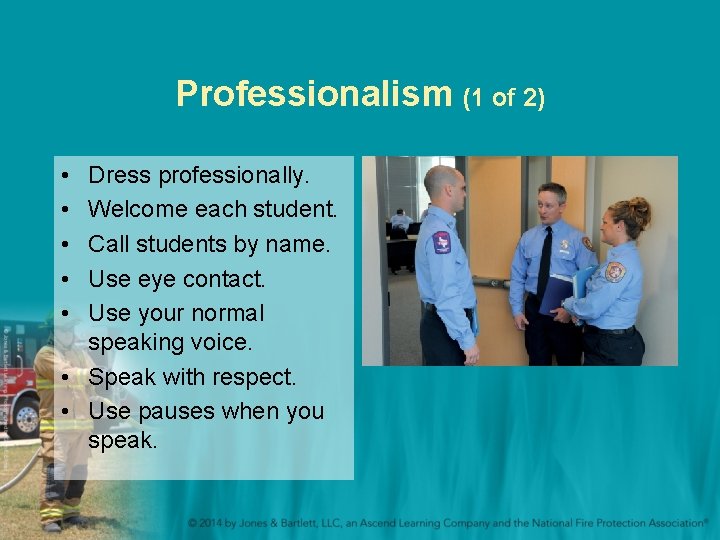
Professionalism (1 of 2) • • • Dress professionally. Welcome each student. Call students by name. Use eye contact. Use your normal speaking voice. • Speak with respect. • Use pauses when you speak.
Professionalism (2 of 2) • Communicate information appropriately. • Use gestures sparingly, for emphasis. • Use posture and movement to signal transitions. • Practice positive mannerisms. • Choose appropriate teaching aids. • Know how to use chosen teaching aids. • Utilize transition techniques during presentations.
Effective Communication Ensures Students Learn • We remember: – – – 10% of what we read 20% of what we hear 30% of what we see 50% of what we see and hear 70% of what we say 90% of what we say while doing
Questioning Techniques • Important to assess the learning process • Lesson plans will include questions. • It is important to ask the correct question at the correct time. • A question can be used to challenge a disruptive student.
Common Question Types • Direct – Who, What, Where, When, Why, How • Rhetorical – Stimulate discussion, new topic, no or multiple answers • Open-ended – Varying correct answers • Closed-ended – Seeks a specific answer
Question Basics (1 of 3) • Knowing which question to ask and when to ask the question is very important. • Dealing with a student’s response to a question is important.
Question Basics (2 of 3) • Instructors are there to teach students and to foster a positive learning environment, so responding to a student’s answer is critical to maintaining a good learning environment.
Question Basics (3 of 3) • For correct responses, the instructor can build on the response and move on with the lesson. • For any incorrect answers given, highlight the positive and downplay any negatives.
Disruptive and Unsafe Behaviors in the Classroom • You are in charge of the classroom. – If you don’t keep control, you may be perceived as less competent. • Disruption – Can reduce or limit learning time – Can lead to unsafe conditions and negative learning
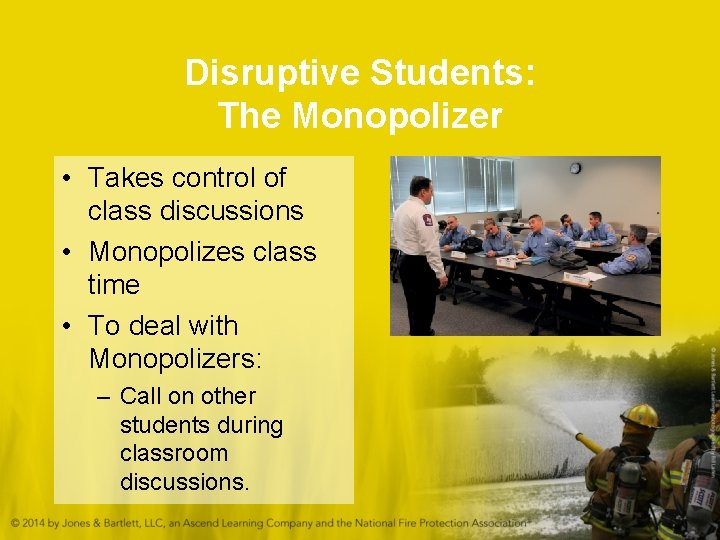
Disruptive Students: The Monopolizer • Takes control of class discussions • Monopolizes class time • To deal with Monopolizers: – Call on other students during classroom discussions.
Disruptive Students: The Historian (1 of 2) • Has experience and wants to make sure everyone is aware of it • Real Historians – Years of experience – Share experiences to help instructor – Can be disruptive if stories are distracting
Disruptive Students: The Historian (2 of 2) • Artificial Historians – Focus on themselves – Try to show much they know – Almost always distracting • To deal with Historians: – Guide discussion back to the main topic. – Pair with struggling students. – Speak to student individually.
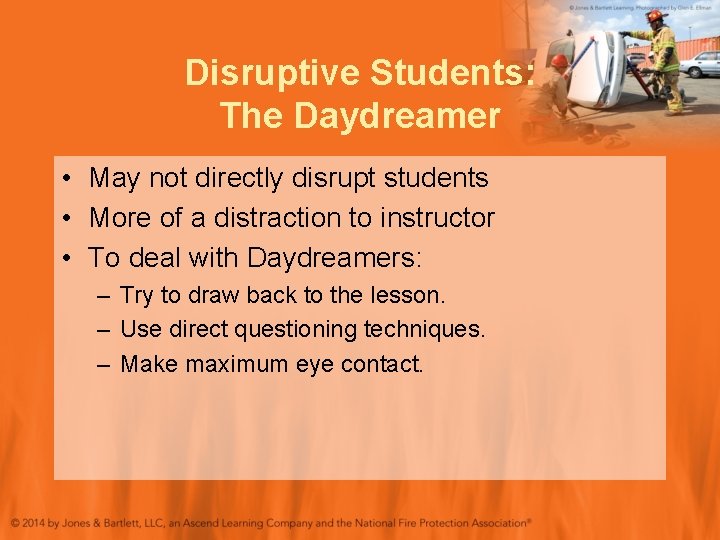
Disruptive Students: The Daydreamer • May not directly disrupt students • More of a distraction to instructor • To deal with Daydreamers: – Try to draw back to the lesson. – Use direct questioning techniques. – Make maximum eye contact.
Disruptive Students: The Expert • May become confrontational • Shows off brainpower, expertise • Provides information, factoids, applications, case information – May subvert instructor’s authority • To deal with Experts: – Discuss contributions privately.
Disruptive Students: The Class Clown • Seeks attention by acting out or making jokes • To deal with Class Clowns: – – Ignore the Class Clown. Engage him or her with a direct question. Use a stern look. During a break, • Engage the Class Clown in conversation. • Seek the individual’s help in setting an example for others in the class.
Disruptive Students: The Gifted Learner • May be a challenge in the classroom – Is usually not disruptive – May seem to be disengaged in the learning process – Might appear to be shy or daydreaming • Have the gifted learner assist you as an instructor during the course.
Unsafe or Illegal Behavior • Harassment • Discrimination • Actions or words – Threatening – Offensive – Create risks • Deal with inappropriate behavior immediately!
Dealing with Behavior Problems • Must deal with behaviors resulting from situations outside of the classroom • First priority is to create a positive learning environment for whole class. • Second priority is to create a positive learning environment for individual.
Behavior Problems and Causes • Seeking attention from class or instructor – Calling out – Asking irrelevant questions – Giving excessive examples
Transitioning Between Methods of Instruction • Problem-solving techniques are used to: – Facilitate and lead conferences – Employ discussion methods during presentations
Problem-Solving Techniques • These techniques are frequently used to conduct small-group sessions where: – Participants have advanced knowledge and experience in the subject matter – The goal is to reach a group solution to a problem or issue
Transitioning Between Methods of Instruction • When students become engaged and actively participate, the instructor can shift from a lecture format to a guided discussion. • When a student has adapted to a basic skill level in a hands-on training session, instructors can allow the student to perform simultaneous actions and progressive skills.
Building Your Lesson Plan (1 of 2) • The Instructor II will have to adjust certain elements of a lesson plan to accommodate students with special needs by: – Using different visual aids – Varying voice and tone inflections – Breaking class sessions down to smaller units
Building Your Lesson Plan (2 of 2) • What are the goals of the lesson? • How will you achieve those goals? • How will you know when those goals are achieved? – Use assessments. – Provide opportunities to practice skills.
Adjusting Lesson Plans • All students have unique needs. • Plan should be: – Detailed and complete to meet goals – Flexible to meet students’ needs • Repeat information in different ways.
Demonstrating a Skill • Perform demonstrations more than once in different ways. • Follow a detailed, sequential plan. • Explain and outline information. • Discuss the results.
Summary (1 of 3) • Students are motivated to learn in a variety of ways and for a variety of reasons. • Understanding how adult learning takes place and how different generations learn will help instructors. • Adult learners can be divided into three types. • Learning is an interactive process affected by the learning environment. • Effective learning requires the instructor to step outside the realm of personal experience.
Summary (2 of 3) • Students’ requirements differ because their experiences differ. • Instructors must behave professionally, control the classroom, and address problem behaviors. • Lesson plans should be detailed, complete, and flexible to meet all students’ needs. • Multiple factors are used to determine which method of instruction should be used to deliver information.
Summary (3 of 3) • Several types of questions are available to the instructor in assessing the student knowledge gained in the learning process. • Disruptive students can reduce learning time for the class and lead to unsafe conditions.
- Slides: 89