
Chapter 3 Methods for Recording Behaviors 2019 Cengage
Chapter 3 Methods for Recording Behaviors © 2019 Cengage. All rights reserved.
Learning Objectives (1 of 2) • • • 3 -1 Describe the importance of data collection on dependent variables and obtaining interobserver agreement. 3 -2 Differentiate among event-based methods including frequency, rate, interval recording, and evaluating permanent products. 3 -3 Differentiate among time-based methods, including duration and latency recording. © 2019 Cengage. All rights reserved.
Learning Objectives (2 of 2) • • • 3 -4 Describe specific methods for recording, including trials-to-criterion and cumulative recording. 3 -5 Identify the appropriate recording procedure based on the selected dependent variable (target behavior) 3 -6 Describe the use of data in the RTI, identification, and Individualized Education Program (IEP) processes. © 2019 Cengage. All rights reserved.
3 -1 The Importance of Observable, Measurable Behavior (1 of 2) • Interobserver Agreement – Two or more observers record the target behavior independently and simultaneously – Later, results are compared to determine if the target behavior is being measured reliably – Calculated differently depending on the method used for recording behavior © 2019 Cengage. All rights reserved.
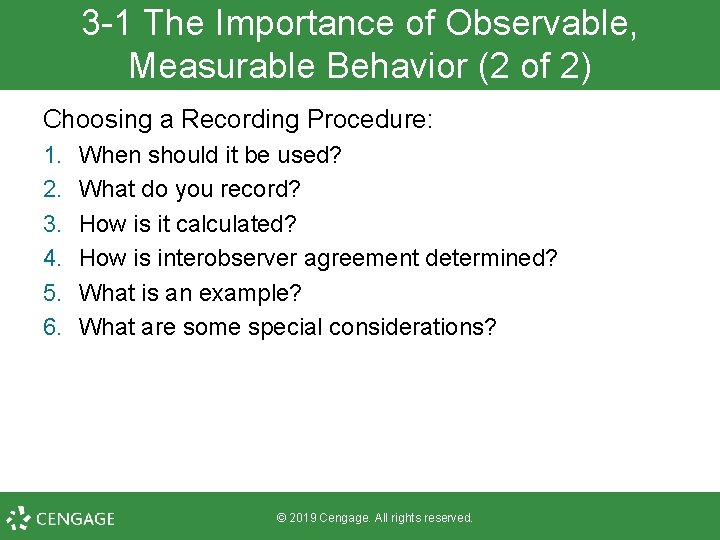
3 -1 The Importance of Observable, Measurable Behavior (2 of 2) Choosing a Recording Procedure: 1. 2. 3. 4. 5. 6. When should it be used? What do you record? How is it calculated? How is interobserver agreement determined? What is an example? What are some special considerations? © 2019 Cengage. All rights reserved.
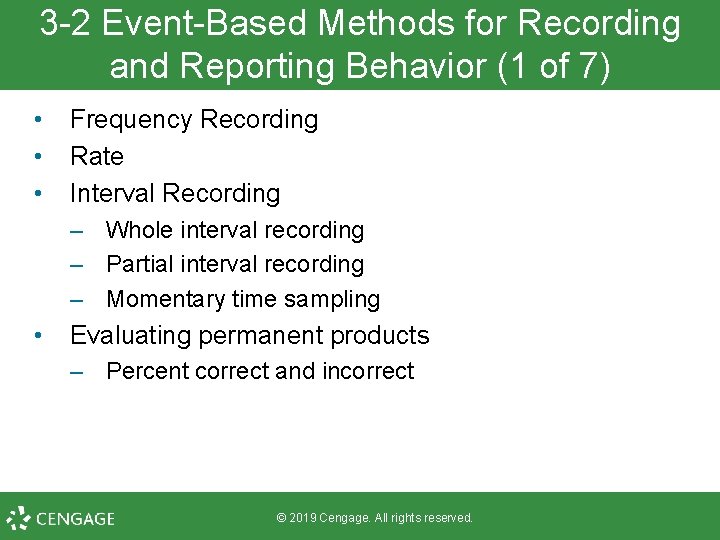
3 -2 Event-Based Methods for Recording and Reporting Behavior (1 of 7) • • • Frequency Recording Rate Interval Recording – Whole interval recording – Partial interval recording – Momentary time sampling • Evaluating permanent products – Percent correct and incorrect © 2019 Cengage. All rights reserved.
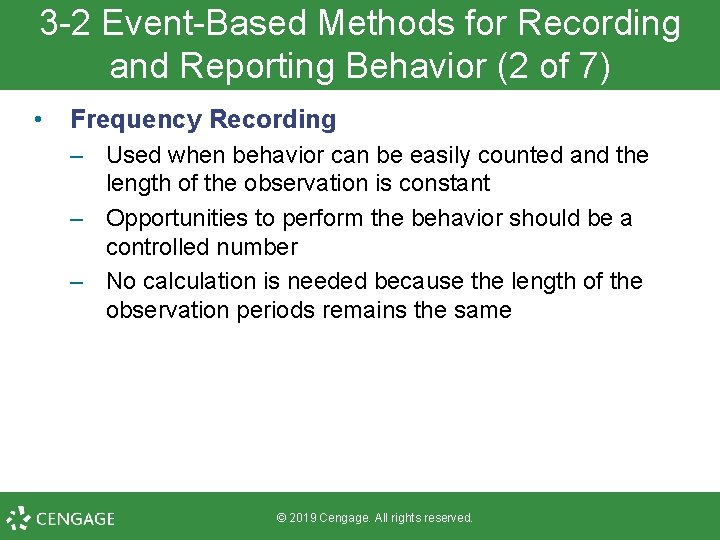
3 -2 Event-Based Methods for Recording and Reporting Behavior (2 of 7) • Frequency Recording – Used when behavior can be easily counted and the length of the observation is constant – Opportunities to perform the behavior should be a controlled number – No calculation is needed because the length of the observation periods remains the same © 2019 Cengage. All rights reserved.
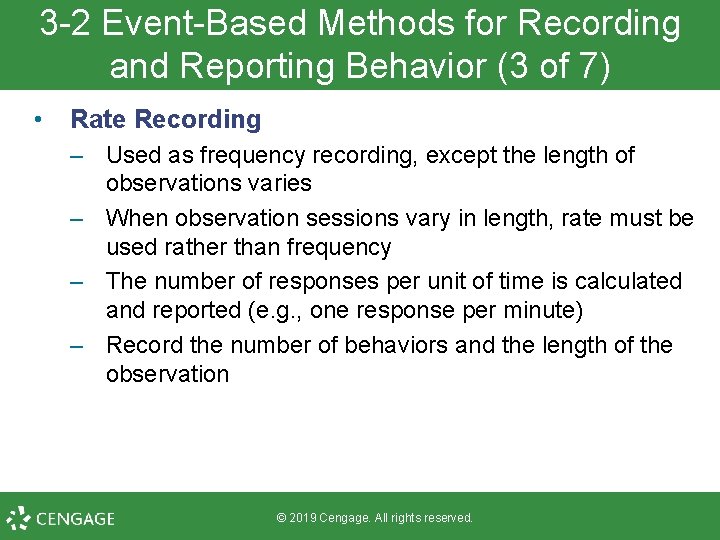
3 -2 Event-Based Methods for Recording and Reporting Behavior (3 of 7) • Rate Recording – Used as frequency recording, except the length of observations varies – When observation sessions vary in length, rate must be used rather than frequency – The number of responses per unit of time is calculated and reported (e. g. , one response per minute) – Record the number of behaviors and the length of the observation © 2019 Cengage. All rights reserved.
3 -2 Event-Based Methods for Recording and Reporting Behavior (4 of 7) • Interval Recording – – • Method of estimating the frequency of the target behavior using a period that has been divided into equal intervals of time for individual observations Not to be confused with interval schedules of reinforcement Whole Interval Recording – – – Provides a smaller estimate of frequency Selected when the target behavior has a degree of duration that such a measure would be sensitive Behavior is recorded only if it occurs throughout the interval § The observer divides the observation period into an equal number of intervals (e. g. , 10 -minute session divided into 60 10 second intervals) © 2019 Cengage. All rights reserved.
3 -2 Event-Based Methods for Recording and Reporting Behavior (5 of 7) • Partial Interval Recording – – – • Provides the greater estimate of frequency Should be selected when any instance of behavior during an interval should be scored by the observer Occurrences are scored if the target behavior is exhibited at any point during the interval Momentary Time Sampling – – – Provides the roughest estimate of frequency Observers looks at (or listens to) the student only at one time during each interval, usually at the end, and records whether the behavior is occurring May be used to record behavior of more than one individual simultaneously © 2019 Cengage. All rights reserved.
3 -2 Event-Based Methods for Recording and Reporting Behavior (6 of 7) • Evaluating Permanent Products – Permanent products: These are permanent data forms that may be reviewed repeatedly § For example: Paper-pencil products, videotapes, or audiotapes – Advantage: Can be paused and replayed to ensure accurate recording to allow for careful analysis of the relationship between independent variable and dependent variable – Disadvantage: Individual is not observed actually performing the target behavior © 2019 Cengage. All rights reserved.
3 -2 Event-Based Methods for Recording and Reporting Behavior (7 of 7) • Percent Correct/Incorrect – Used when the number of opportunities to perform the target behavior may vary from observation to observation – This method may be used when the number of opportunities to perform the target behavior is unchanging © 2019 Cengage. All rights reserved.
3 -3 Time-Based Methods for Recording and Reporting Behavior • Duration Recording – – Used when the length of the behavior emitted is the primary concern (length of time) Involves measuring the length of time from when a behavior begins to its termination • Latency Recording – – – Latency recording is used when the researcher is interested in the amount of time that elapses between the signaling of a stimulus (e. g. , school bell ringing) and the emission of a target behavior (e. g. , sitting in the desk) How long it takes for the behavior to occur following the antecedent The researcher may record and report latency per occurrence, average latency, or total latency © 2019 Cengage. All rights reserved.
3 -4 Recording Procedures for Specific Purposes • Trials to Criterion Recording – Used to measure events (occurrence of target behavior) when the researcher wishes to determine how many occurrences are required to achieve a criterion level of performance – Often used in task analysis, in which a goal or skill area is broken down into sequential, clearly defined steps • Cumulative Recording – Used when the aggregate number of emission is of primary importance – Record and report the total number of responses that occur across each observation session toward some goal or final level of achievement © 2019 Cengage. All rights reserved.
3 -5 A Few Words About These Methods • Choosing the Appropriate Recording Procedure – A variety of factors should be considered by researchers, including ability to analyze and tell the story of what happened to the individuals involved, objectivity, measuring what is important about the changes the individual is undergoing, and interobserver agreement, among others © 2019 Cengage. All rights reserved.
3 -6 Data in the Educational Process (1 of 4) • • • Response to Intervention (RTI) Progress Monitoring Data Additional Use of Data in Response to Intervention Using Data in Identification of Services Data Use in the Individualized Education Program © 2019 Cengage. All rights reserved.
3 -6 Data in the Educational Process (2 of 4) • Progress Monitoring Data – Data-based individualization (DBI) – Processes for intensive academic intervention programs: § Small steps, precise language, repeat language, student explanations, modeling, manipulatives, worked examples, repeated practice, error correction, fading support, and fluency © 2019 Cengage. All rights reserved.
3 -6 Data in the Educational Process (3 of 4) • Additional Use of Data in RTI – Tier 1 § Targets all students (80% plus are served here successfully) – Tier 2 § Targets students needing remediation, can be small group or individual (5%– 10% of students typically) – Tier 3 § Individualized services provided when Tier 2 strategies are not enough. Evaluation of need for exceptional education services (1%– 5% of students typically) © 2019 Cengage. All rights reserved.
3 -6 Data in the Educational Process (4 of 4) • Using Data in Identification of Services – In evaluating Tier 3 needs, a specialized team carefully examines data to determine the student’s strengths and deficit areas – Evaluation of work samples, curriculum-based measurement probes, and test scores are reviewed – Behavioral considerations are assessed § Functional Behavior Assessment (FBA) © 2019 Cengage. All rights reserved.
- Slides: 19