
Chapter 3 Mental Health Assessment The nursing process






- Slides: 36
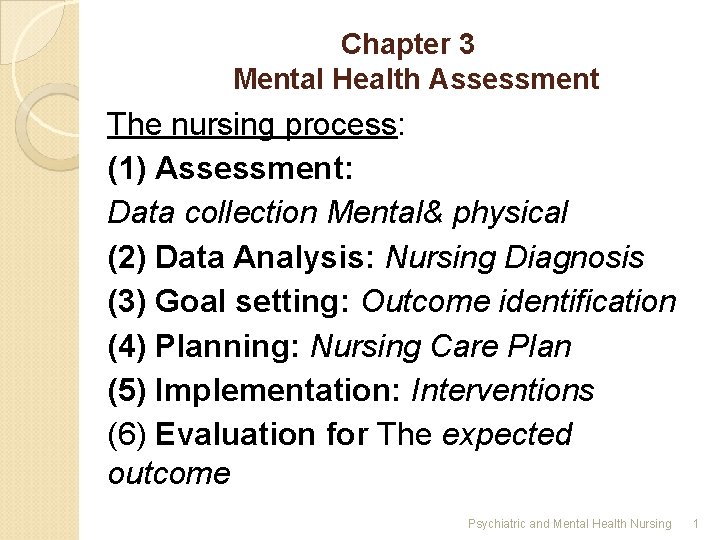
Chapter 3 Mental Health Assessment The nursing process: (1) Assessment: Data collection Mental& physical (2) Data Analysis: Nursing Diagnosis (3) Goal setting: Outcome identification (4) Planning: Nursing Care Plan (5) Implementation: Interventions (6) Evaluation for The expected outcome Psychiatric and Mental Health Nursing 1
Client Assessment: - Collection of data about a person, family, or group by observing, examining, and interviewing. - Data included are about the medical and mental health status of the client. Clinical interview: - It is a meeting between the client and professional mental health team member as psychiatric nurse. Psychiatric and Mental Health Nursing 2
Purposes of clinical interview: 1 - Gathering information about the client. 2 - To establish a therapeutic relationship with the client. 3 - To conduct therapeutic intervention as counseling or psychotherapy Psychiatric and Mental Health Nursing 3
Clinical interview skills: Active listening: psychiatric nurse should be a good listener. - Reflection: mirroring hidden painful feelings and thoughts - Paraphrasing: to assure accuracy of client words. - Summarizing: to give positive feedback that all data provided by client was completely understood well. - Psychiatric and Mental Health Nursing 4
Clinical interview skills: … cont. Clarification: by ask client to explain ambiguity. - Confrontation: to direct the client toward his real problems - Probing: to explore deep unconscious feelings and desires. - Rapport: to convey complete attendance, empathy and willingness of psychiatric nurse to help the client by verbal and nonverbal communication - Psychiatric and Mental Health Nursing 5
Mental State Examination (MSE) An assessment tool of the brain functions that helps mental health professionals to reach a tentative psychiatric diagnosis. An experienced nurse can complete all the components of (MSE) that include: (1) General appearance: - Involves important information that can be taken from the first sight objectively without asking the client Psychiatric and Mental Health Nursing 6
Mental State Examination (MSE). . Cont. A- Dress, grooming, &hygiene (selfcare) - Good and suitable in healthy or mentally stable clients, delusional disorder, and most neurotic disorders. * Schizophrenia may have strange style of dressing. * Mania dressing is usually bright, multicolored, mismatched & excessive use of cosmetics. Psychiatric and Mental Health Nursing 7
Mental State Examination (MSE). . Cont. B- Facial expression: - Anxious in anxiety, sad in depression, euphoric or excited in mania, & apathic in schizophrenia. C- Eye contact: - Lost in shyness, schizophrenia & depression - Intermittent in anxiety - Good in mania. Psychiatric and Mental Health Nursing 8
Mental State Examination (MSE). . Cont. D- Nutritional Status: - Thin client and emaciated in anorexia nervosa. Weight gain or loss in depression. *(2) Psychomotor behavior: A- Hyperactivity: -Agitation, aggression or restlessness as in mania, schizophrenia and mental retardation. B- Hypoactivity: -Rigidity or retardation as in depression, catatonic schizophrenia or some forms of Psychiatric and Mental Health Nursing 9
Mental State Examination (MSE). . Cont. C- Posture: how client sits, walks, and behaves. - Catatonic p: Waxy flexibility, bizarre and maintained for a long time as in catatonia. - Restless or agitated p: as in mania. - Anxious p: as in anxiety disorders. -Depressed p: Leaning forward, looking at the ground, non responsive. Psychiatric and Mental Health Nursing 10
Mental State Examination (MSE). . Cont. D- Stereotypy: Repetitive fixed pattern of action & speech (schizophrenia & mental retardation. E- Bizarre behavior: un acceptable Culturally & socially as in schizophrenia. F- Mannerism: Involuntary, Unusual bizarre behavior, stylized ﻣﺒﺴﻄﺔ movements. Clearly uncomfortable or inappropriate as rocking, nodding, rubbing, or grimacing, smearing������ �� ������� ����� Psychiatric and Mental Health Nursing 11
Mental State Examination (MSE). . Cont. (3) Attitude: - Client's interaction with mental health team may be: A- Cooperative: in anxiety disorders & residual schizophrenia. B- Resistive: As in acute psychosis and personality disorders. C- Aggressive: As in mania and schizophrenia. Psychiatric and Mental Health Nursing 12
Mental State Examination (MSE). . Cont. (4) Speech: A- Quantity: -Poverty as in depression and catatonia. B- Quality: -Monotonous, soft, & slow in depression. -Talkative, stereotyped, pressured & loud in mania - Incoherent in schizophrenia. - Stuttered and dysrythmic in anxiety disorders. - Repetitious as in dementia & organic brain disorder. Psychiatric and Mental Health Nursing 13
Mental State Examination (MSE). . Cont. (5) Mood and affect: A- Mood: Subjective emotional state reported by client. - Mood Variations involve: *Euthymic mood: Normal range(absence elevated) *Dysphoric mood: Feeling unpleasant as in dysthymia. *Depressed mood: feeling of sadness as in depression. Psychiatric and Mental Health Nursing 14
Mental State Examination (MSE). . Cont. *Irritable mood: Easily annoyed provoked to anger as in mania. * Euphoric mood: Intense elation with feeling of grandeur as in mania. * Anxious mood: feeling of fear of unknown, tension, and expecting the worst. * Mood swings: euphoria and depression as in bipolar disorder. * Anhedonia: Loss of interest in all pleasurable activities as in depression. Psychiatric and Mental Health Nursing 15
Mental State Examination (MSE). . Cont. B: Affect: External expression of feelings as observed by others. * Appropriate affect: emotional tone is in harmony with the idea. * Inappropriate affect: Disharmony between the emotional tone and the idea. Psychiatric and Mental Health Nursing 16
Mental State Examination (MSE). . Cont. *Flat affect: Absence of any sings of affective expression as in schizophrenia. *Blunt affect: Sever reduction in the external feeling tone as in schizophrenia. * Labile affect: Rapid and abrupt changes in the external emotional tone, unrelated to external stimuli as in senile dementia. Psychiatric and Mental Health Nursing 17
Mental State Examination (MSE). . Cont. (6) Perception: disturbances include: a. Hallucination: False sensory perception not associated with a real external stimuli. Types of hallucinations according to the affected sense: * Auditory: False perception of sound usually voice. * Visual: False perception of sight of people or flashes of light. *Olfactory: False perception in smell. Psychiatric and Mental Health Nursing 18
Mental State Examination (MSE). . Cont. • Gustatory: client taste something that is not present *Tactile: client senses that he is being touched when he is not. One of the most common complaints is the sensation of bugs crawling over the skin, and (phantom sign ) after amputation of limb. * General somatic hallucination: client experiences a feeling of their body being seriously hurt through mutilation ﺗﺸﻮﻩ ﺍﻷﻌﻀﺎﺀ such as snakes crawling into their stomach. Psychiatric and Mental Health Nursing 19
Mental State Examination (MSE). . Cont. b. Illusions: Misperception or misinterpretation of real external stimuli. c. Depersonalization: Subjective sense of being unreal, strange or unfamiliar to oneself as in panic disorder. d. Derealization: Subjective sense that the environment is changed or unreal as Psychiatric and Mental Health Nursing 20
Mental State Examination (MSE). . Cont. 7 - Thinking: A- disturbance in the form of thought: * Neologism: New word created by the client, as in schizophrenia. *Word salad: Incoherent mixture of words (extreme neologism) as in schizophrenia. *Perseveration: repetition of the same word or idea in response to different questions as in dementia. Psychiatric and Mental Health Nursing 21
Mental State Examination (MSE). . Cont. *Loosing of association: ideas shift from one subject to another in unrelated way as in schizophrenia. *Flights of ideas: Rapid constant shifting from one idea to another, ideas tend to be connected, some followed by listener as in mania. *Clang association: Association of words similar in sound not meaning as in mania. * Blocking: Abrupt interruption train of thinking before finishing the idea (depression and schizophrenia) Psychiatric and Mental Health Nursing 22
Mental State Examination (MSE). . Cont. B: Disturbance in content of thought: 1. Delusion: False fixed belief, not consistent with client intelligence or cultural background. - Different forms of delusion: -Bizarre delusion: Very strange false belief " e. g. Invaders from space have implanted electrodes in the client brain. -Delusion of control: " Thought insertion, withdrawal, broadcasting" - Nihilistic delusion: belief that self, others or the world is not existent. Psychiatric and Mental Health Nursing 23
Mental State Examination (MSE). . Cont. - Delusion of poverty: belief of loss of all material possessions. - Somatic delusion: belief involving the functioning of one's body. e. g. belief that one's brain is melting"�. Paranoid delusion: includes persecutory, reference, grandeur. Psychiatric and Mental Health Nursing 24
Mental State Examination (MSE). . Cont. Mood congruent delusion: e. g. Depressed client believe that he is responsible about destruction of the world". - Mood incongruent delusion: not associated to mood " as delusion of grandeur with a depressed client". * Overvalued ideas: Unreasonable sustained false beliefs less firmly than delusion. Psychiatric and Mental Health Nursing 25
Mental State Examination (MSE). . Cont. 2. Obsession: Pathological persistent of an irresistible thought cannot eliminated from consciousness by logical efforts. 3. Hypochondriasis: Exaggerated health concern based on false interpretation of physical signs and not supported by realistic pathology. 4. Phobia: Persistent, irrational, &exaggerated pathological dread ﻓﺰﻉ of stimulus lead to a pressing desire to avoid it. Psychiatric and Mental Health Nursing 26
Mental State Examination (MSE). . Cont. Abstract thinking: The ability to deal with concepts. E. g. ability to explain similarity between orange and apple are fruit. Concrete thinking client says both orange and apple are round, as in schizophrenia and organic brain disease. Psychiatric and Mental Health Nursing 27
Mental State Examination (MSE). . Cont. 8 -Sensorium and cognition: A: Disturbance of orientation: Disorientation to time, person, and place. B: Disturbance in consciousness: -Somnolence: Abnormal drowsiness. -Stupor: Lack of reaction and awareness to the surroundings. -Coma: Profound degree of unconsciousness Psychiatric and Mental Health Nursing 28
Mental State Examination (MSE). . Cont. C: Attention: disturbances include: *Distractibility: Inability to concentrate attention, it is drawn to unimportant external stimuli as in anxiety and mania. *Selective inattention: Blocking out things generate anxiety as in malinger. *Hypervigilance : Excessive attention as in post traumatic stress disorder and paranoid state Psychiatric and Mental Health Nursing 29
Mental State Examination (MSE). . Cont. D- Memory: ability to recall information. divided into: * Immediate memory: recall perceived objects within seconds. * Recent (short term) memory: recall events in the past few days. * Remote (long term) memory: recall of the events in the distant past. * Amnesia: Partial or total inability to recall past experiences may be organic or emotional as in PTSD Psychiatric and Mental Health Nursing 30
Mental State Examination (MSE). . Cont. E: Intelligence: ability to understand, recall previous learning in meeting new situation. Mental retardation: Lack of intelligence classified as: -Mild retardation: IQ from 50 -70, educable in special classes. - Moderate retardation: IQ from 40 -50, trainable simple crafts. - Severe retardation: IQ from 20 -40, maintain activity of daily living. - Profound retardation: IQ below 20 Psychiatric and Mental Health Nursing 31
Mental State Examination (MSE). . Cont. 9 - Judgment: ability to assess and evaluate situation, make rational decision, and take responsibility for actions. A-Critical judgment: ability to assess situation and choose decision among different options. B: Automatic judgment: Reflex performance of action as in impulse control disorder. C: Impaired judgment: Diminished ability to understand a situation and act properly Psychiatric and Mental Health Nursing 32
Mental State Examination (MSE). . Cont. 10 - Insight: client's awareness that he is mentally ill. A- Complete insight: client is aware that he has mental illness, and recognize the precipitating and relieving causes, and the importance of treatment program as in neurosis. B- Partial insight: client realize he has mental health problem, but explain it as a result of somatic or social cause, and not committed to his therapeutic program. Psychiatric and Mental Health Nursing 33
Mental State Examination (MSE). . Cont. C- Loss of insight: client completely deny that he has mental health problem. As in psychosis. 11 - Reliability: The interviewer impression that the client give information accurately and completely. - It is good in personality disorders and neurosis and impaired in psychosis Psychiatric and Mental Health Nursing 34
Mental State Examination (MSE). . Cont. 12 - Spirituality: Involves the client's beliefs, values, and religious culture. - these beliefs helping or hindering (preventing) the client. - For example, does hospitalized client exhibit spiritual anxiety and verbalize a need to connect with his own spiritual support system? Psychiatric and Mental Health Nursing 35
Mental State Examination (MSE). . Cont. 13 - Sexuality: Client may be impotent, hermaphrodite, may have lost a sexual partner, or may have been a victim of sexual abuse. 14. Final conclusion: Summarize the information obtained from the interview with the client and get an overview of the client's status professionally Psychiatric and Mental Health Nursing 36