
Chapter 3 Measuring Business Income Belverd E Needles
Chapter 3 Measuring Business Income Belverd E. Needles, Jr. Marian Powers -----Multimedia Slides by: Dr. Howard A. Kanter, CPA De. Paul University Milton M. Pressley University of New Orleans Copyright Houghton Mifflin Company. All rights reserved. 3 -1
LEARNING OBJECTIVES 1. Define net income and its two major components, revenues and expenses. 2. Explain the difficulties of income measurement caused by: (a) the accounting period issue, (b) the continuity issue, (c) the matching issue. 3. Define accrual accounting and explain two broad ways of accomplishing it. Copyright Houghton Mifflin Company. All rights reserved. 3 -2
LEARNING OBJECTIVES (continued) 4. State four principal situations that require adjusting entries. 5. Prepare typical adjusting entries. 6. Prepare financial statements from an adjusted trial balance. 7. Analyze cash flows from accrual-based information. Copyright Houghton Mifflin Company. All rights reserved. 3 -3
Profitability Measurement: The Role of Business Income Objective 1 Define net income and its two major components, revenues and expenses. Copyright Houghton Mifflin Company. All rights reserved. 3 -4
Profitability Measurement: The Role of Business Income u Profitability and liquidity are the two major goals of a business. u To survive, a business must earn a profit. u Profit, as a word, may be ambiguous. u Net income is the preferred term because it can be defined more precisely from an accounting point of view. Copyright Houghton Mifflin Company. All rights reserved. 3 -5
Net Income 4 Net income is the net increase in stockholders’ equity that results from the operations of a company. 4 Net income is accumulated in the Retained Earnings account. 4 Net Income = Revenues - Expenses. R > E, net profit. R < E, net loss. n n Copyright Houghton Mifflin Company. All rights reserved. 3 -6
Revenues u Revenues are increases in SE resulting from selling goods or providing services. u Revenue for a given period equals: Cash + Receivables from goods and services provided. u Liabilities are generally not affected by revenues. u Stockholders’ investments increase SE but are not revenues. Copyright Houghton Mifflin Company. All rights reserved. 3 -7
Expenses u Expenses are decreases in SE resulting from the costs of selling goods, rendering services, or performing other business activities. u Expenses are the costs of doing business. u Not all cash payments are expenses. u Prepaid expenses are recorded as assets. As they expire, they become expenses. u Not all decreases in SE arise from expenses. u Dividends are not expenses. Copyright Houghton Mifflin Company. All rights reserved. 3 -8
The Accounting Period Issue Objective 2 a Explain the difficulties of income measurement caused by the accounting period issue. Copyright Houghton Mifflin Company. All rights reserved. 3 -9
The Accounting Period Issue The difficulty of assigning revenues and expenses to a short period of time. 4 Not all transactions can easily be assigned to a time period. 4 The accountant makes an assumption about periodicity. The net income for any period of time less than the life of the business, although tentative, is still a useful estimate of the net income for the period. Time periods are usually of equal length for comparability. 4 n n Copyright Houghton Mifflin Company. All rights reserved. 3 -10
The Measurement of Business Income Financial statements may be prepared for any time period, usually a calendar year. 4 Accounting periods of less than one year are called interim periods. 4 The fiscal year is the twelve-month accounting period used by a company. Can be the same as the calendar year. Can be different from the calendar year as the needs of the business dictate. 4 n n Copyright Houghton Mifflin Company. All rights reserved. 3 -11
The Continuity Issue Objective 2 b Explain the difficulties of income measurement caused by the continuity issue. Copyright Houghton Mifflin Company. All rights reserved. 3 -12
The Continuity Issue The measurement of business income requires that certain expenses and revenues be allocated over several accounting periods. u The continuity issue relates to the estimated number of accounting periods in the business entity’s life. u The accountant assumes that an entity is a going concern, that the entity will continue indefinitely. u If a firm is not a going concern, financial statements may be prepared on the basis of the liquidation value of the assets -- that is, what they will bring in cash. u Copyright Houghton Mifflin Company. All rights reserved. 3 -13
The Matching Issue Objective 2 c Explain the difficulties of income measurement caused by the matching issue. Copyright Houghton Mifflin Company. All rights reserved. 3 -14
The Matching Issue The cash basis of accounting recognizes revenues when received in cash and expenses when paid in cash. u Cash basis accounting has matching problems. u To adequately measure net income, revenues and expenses must be assigned to the appropriate accounting period. u The matching rule states that: 4 Revenues must be assigned to the accounting period in which the goods are sold or services performed. 4 Expenses must be assigned to the accounting period in which they are used to produce revenue. u Copyright Houghton Mifflin Company. All rights reserved. 3 -15
Accrual Accounting Objective 3 Define accrual accounting and explain two broad ways of accomplishing it. Copyright Houghton Mifflin Company. All rights reserved. 3 -16
Accrual Accounting u Accrual accounting “attempts to record the financial effects on an enterprise of transactions and other events and circumstances. . . in the periods in which those transactions, events, and circumstances occur rather than only in the periods in which cash is received or paid by the enterprise. ” u Accrual accounting is an application of the matching rule. Copyright Houghton Mifflin Company. All rights reserved. 3 -17
Implementation of Accrual Accounting u Accrual accounting is done in two ways. 1. By recording revenues when earned and expenses when incurred. When a sale is made on credit, revenue is recorded before the cash is received in the Accounts Receivable account. 4 When an expense is incurred on credit, an expense is recorded before the cash is paid in the Accounts Payable account. 4 Copyright Houghton Mifflin Company. All rights reserved. 3 -18
2. By adjusting the accounts. Those transactions that span the cutoff period must be allocated to the proper accounting period. 4 A prepayment of 6 months’ office rent must be adjusted on a monthly basis if accurate monthly financial statements are to be prepared. 4 Copyright Houghton Mifflin Company. All rights reserved. 3 -19
The Adjustment Process Objective 4 State four principal situations that require adjusting entries. Copyright Houghton Mifflin Company. All rights reserved. 3 -20
The Adjustment Process u Adjusting entries are used to apply accrual accounting to transactions that span more than one accounting period. u Adjusting entries involve at least one balance sheet account and at least one income statement account. u Adjusting entries never involve the Cash account. Copyright Houghton Mifflin Company. All rights reserved. 3 -21
Four Types of Adjusting Entries 1. Costs have been recorded that must be allocated between two or more accounting periods. 2. Expenses have been incurred but are not yet recorded. 3. Revenues have been recorded that must be allocated between two or more accounting periods. 4. Revenues have been earned but not yet recorded. Copyright Houghton Mifflin Company. All rights reserved. 3 -22
Deferrals u A deferral is the postponement of: The recognition of an expense already paid (Type 1 adjustment), or 4 A revenue received in advance (Type 3 adjustment). 4 Copyright Houghton Mifflin Company. All rights reserved. 3 -23
Accruals u An accrual is the recognition of a revenue (Type 4 adjustment) or expense (Type 2 adjustment) that has arisen but has not yet been recorded. Copyright Houghton Mifflin Company. All rights reserved. 3 -24
Allocating Recorded Costs Between Two or More Accounting Periods Objective 5 Prepare typical adjusting entries. Copyright Houghton Mifflin Company. All rights reserved. 3 -25
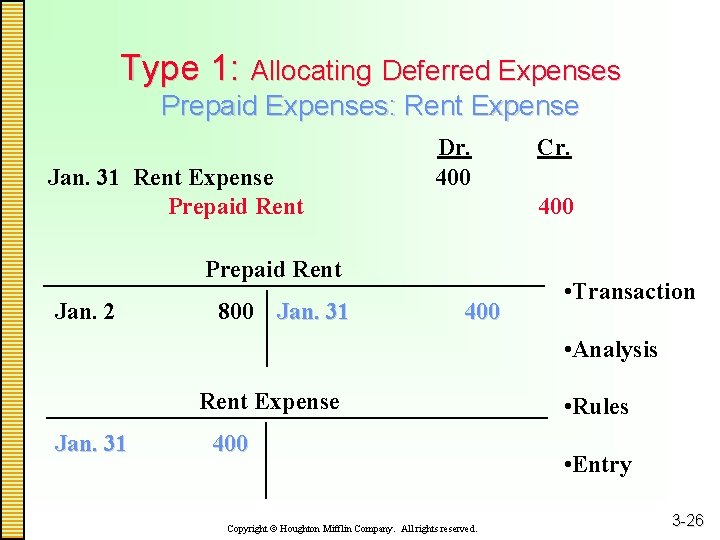
Type 1: Allocating Deferred Expenses Prepaid Expenses: Rent Expense Jan. 31 Rent Expense Prepaid Rent Dr. 400 Prepaid Rent Jan. 2 800 Jan. 31 Cr. 400 • Transaction • Analysis Rent Expense Jan. 31 400 Copyright Houghton Mifflin Company. All rights reserved. • Rules • Entry 3 -26
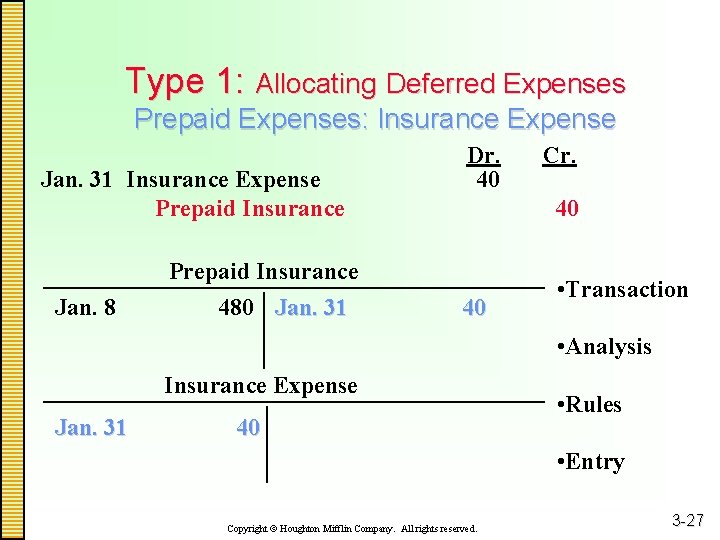
Type 1: Allocating Deferred Expenses Prepaid Expenses: Insurance Expense Jan. 31 Insurance Expense Prepaid Insurance Jan. 8 Prepaid Insurance 480 Jan. 31 Dr. 40 Cr. 40 40 • Transaction • Analysis Insurance Expense Jan. 31 40 • Rules • Entry Copyright Houghton Mifflin Company. All rights reserved. 3 -27
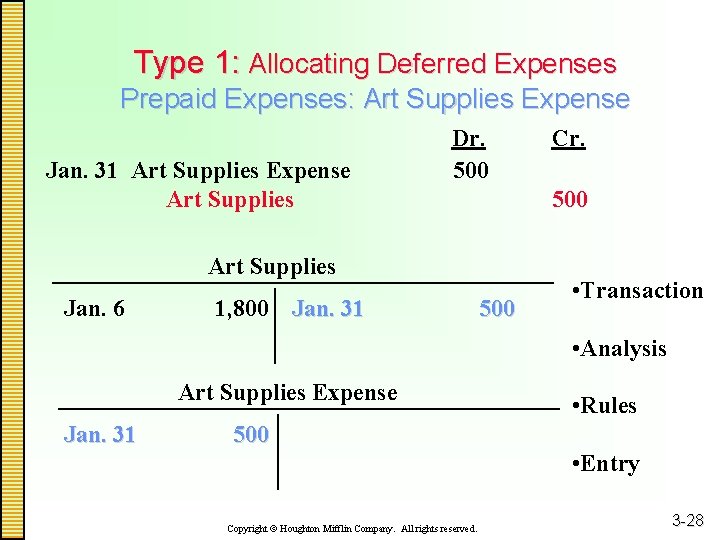
Type 1: Allocating Deferred Expenses Prepaid Expenses: Art Supplies Expense Jan. 31 Art Supplies Expense Art Supplies Dr. 500 Art Supplies Jan. 6 1, 800 Jan. 31 Cr. 500 • Transaction • Analysis Art Supplies Expense Jan. 31 • Rules 500 • Entry Copyright Houghton Mifflin Company. All rights reserved. 3 -28
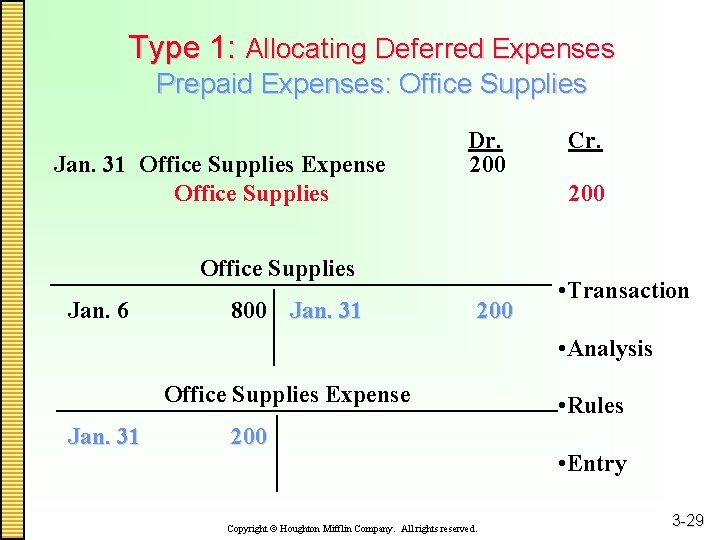
Type 1: Allocating Deferred Expenses Prepaid Expenses: Office Supplies Jan. 31 Office Supplies Expense Office Supplies Dr. 200 Office Supplies Jan. 6 800 Jan. 31 Cr. 200 • Transaction • Analysis Office Supplies Expense Jan. 31 200 Copyright Houghton Mifflin Company. All rights reserved. • Rules • Entry 3 -29
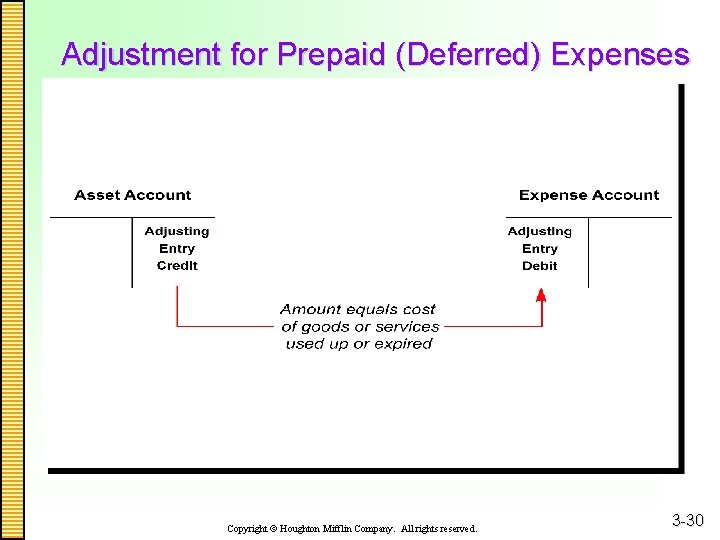
Adjustment for Prepaid (Deferred) Expenses Copyright Houghton Mifflin Company. All rights reserved. 3 -30
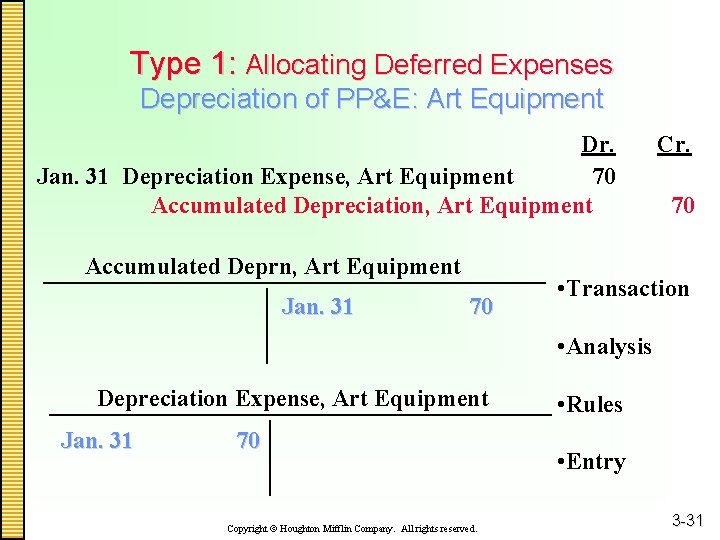
Type 1: Allocating Deferred Expenses Depreciation of PP&E: Art Equipment Dr. Jan. 31 Depreciation Expense, Art Equipment 70 Accumulated Depreciation, Art Equipment Accumulated Deprn, Art Equipment Jan. 31 70 Cr. 70 • Transaction • Analysis Depreciation Expense, Art Equipment Jan. 31 70 Copyright Houghton Mifflin Company. All rights reserved. • Rules • Entry 3 -31
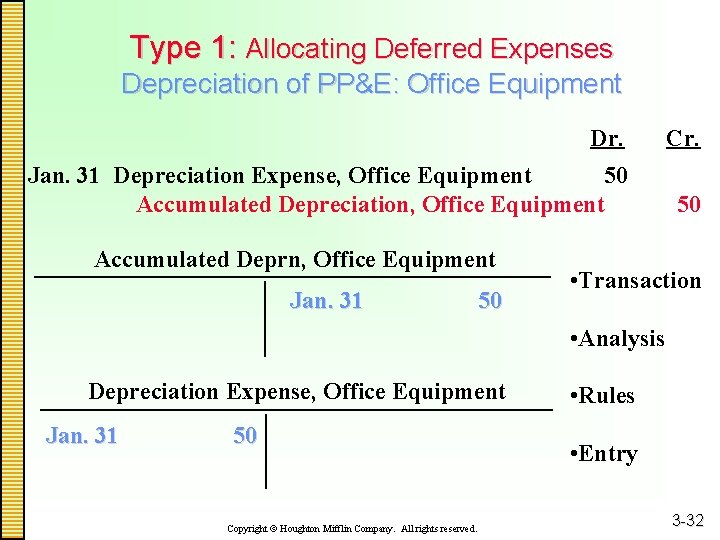
Type 1: Allocating Deferred Expenses Depreciation of PP&E: Office Equipment Dr. Cr. Jan. 31 Depreciation Expense, Office Equipment 50 Accumulated Depreciation, Office Equipment 50 Accumulated Deprn, Office Equipment Jan. 31 50 • Transaction • Analysis Depreciation Expense, Office Equipment Jan. 31 50 Copyright Houghton Mifflin Company. All rights reserved. • Rules • Entry 3 -32
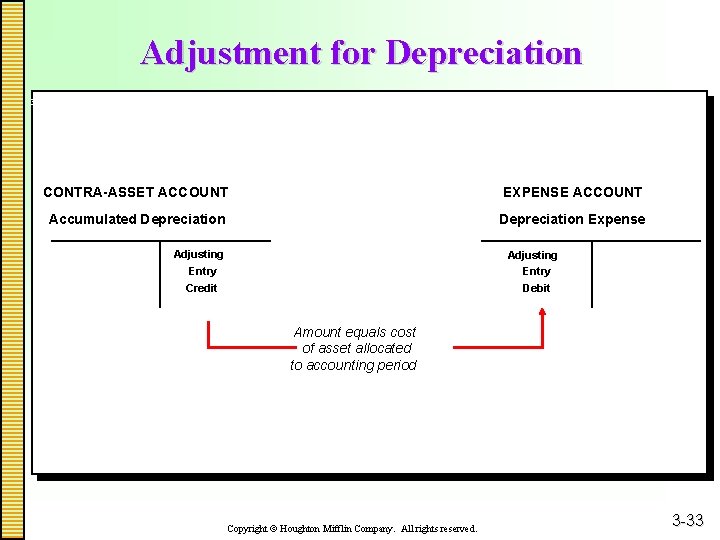
Adjustment for Depreciation 3 -2 CONTRA-ASSET ACCOUNT EXPENSE ACCOUNT Accumulated Depreciation Expense Adjusting Entry Credit Debit Amount equals cost of asset allocated to accounting period Copyright Houghton Mifflin Company. All rights reserved. 3 -33
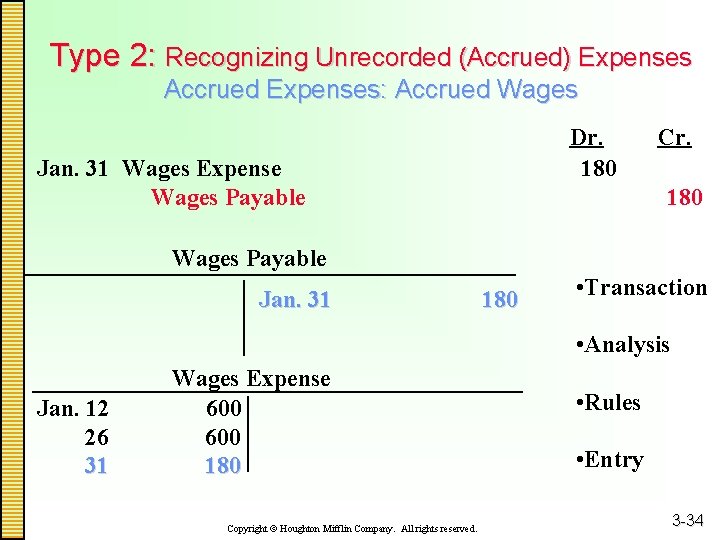
Type 2: Recognizing Unrecorded (Accrued) Expenses Accrued Expenses: Accrued Wages Dr. 180 Jan. 31 Wages Expense Wages Payable Cr. 180 Wages Payable Jan. 31 180 • Transaction • Analysis Jan. 12 26 31 Wages Expense 600 180 Copyright Houghton Mifflin Company. All rights reserved. • Rules • Entry 3 -34
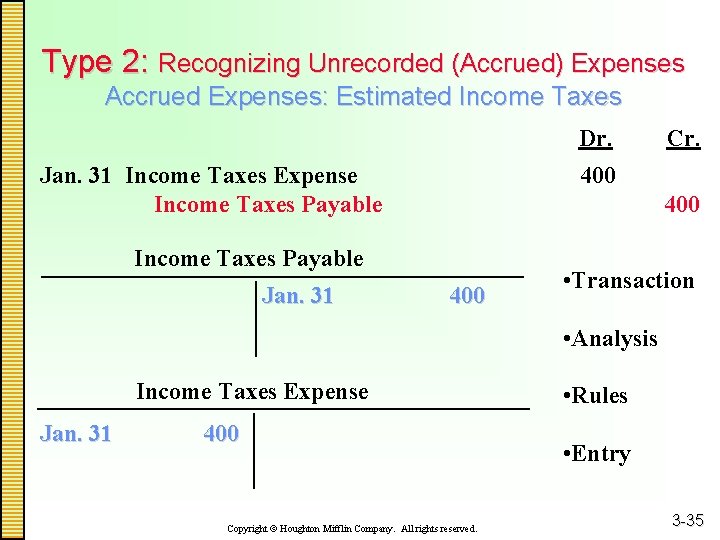
Type 2: Recognizing Unrecorded (Accrued) Expenses Accrued Expenses: Estimated Income Taxes Dr. Jan. 31 Income Taxes Expense Income Taxes Payable 400 Income Taxes Payable Jan. 31 Cr. 400 • Transaction • Analysis Income Taxes Expense Jan. 31 400 Copyright Houghton Mifflin Company. All rights reserved. • Rules • Entry 3 -35
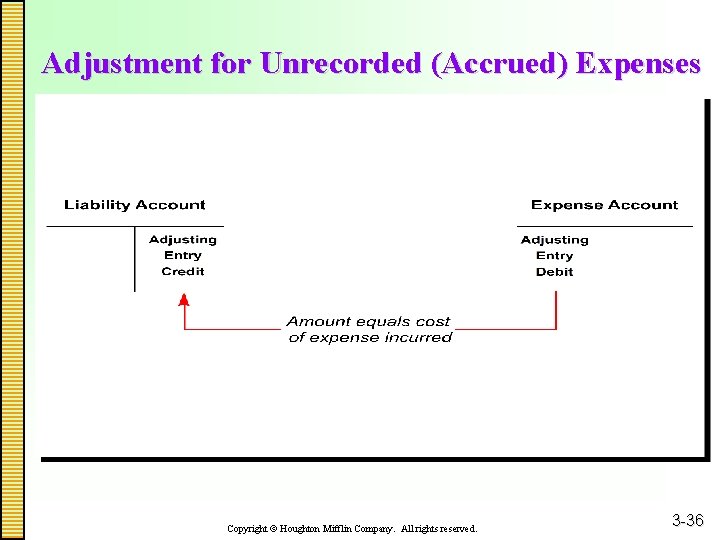
Adjustment for Unrecorded (Accrued) Expenses Copyright Houghton Mifflin Company. All rights reserved. 3 -36
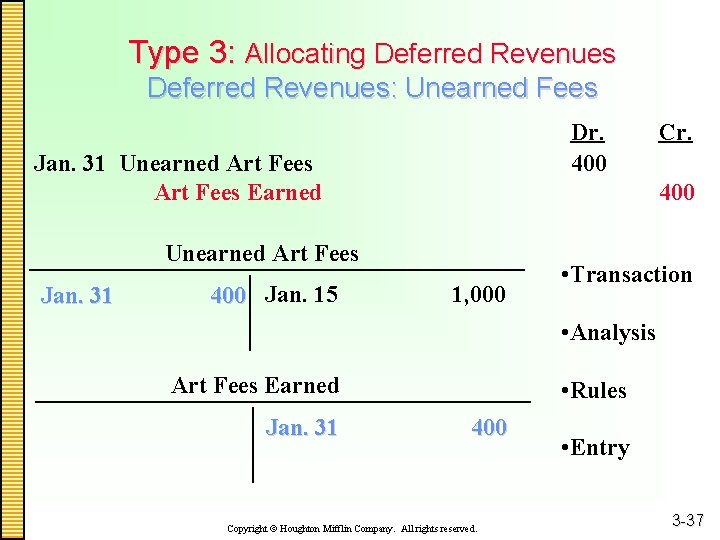
Type 3: Allocating Deferred Revenues: Unearned Fees Dr. 400 Jan. 31 Unearned Art Fees Earned 400 Unearned Art Fees Jan. 31 400 Jan. 15 Cr. 1, 000 • Transaction • Analysis Art Fees Earned Jan. 31 • Rules 400 Copyright Houghton Mifflin Company. All rights reserved. • Entry 3 -37
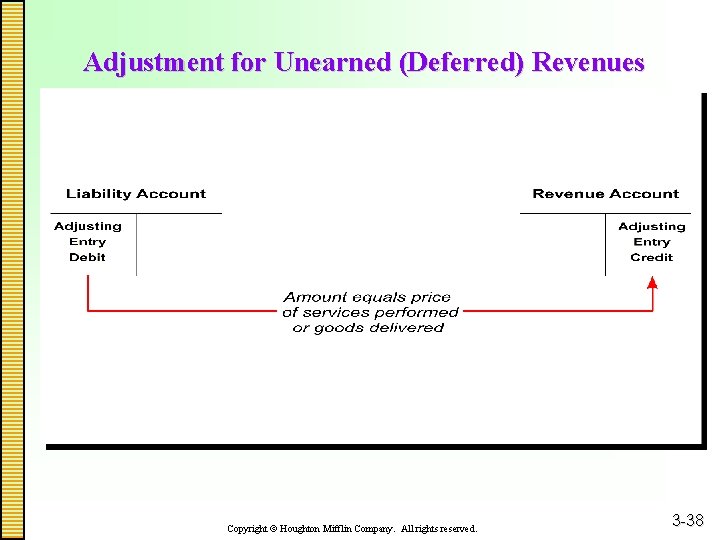
Adjustment for Unearned (Deferred) Revenues Copyright Houghton Mifflin Company. All rights reserved. 3 -38
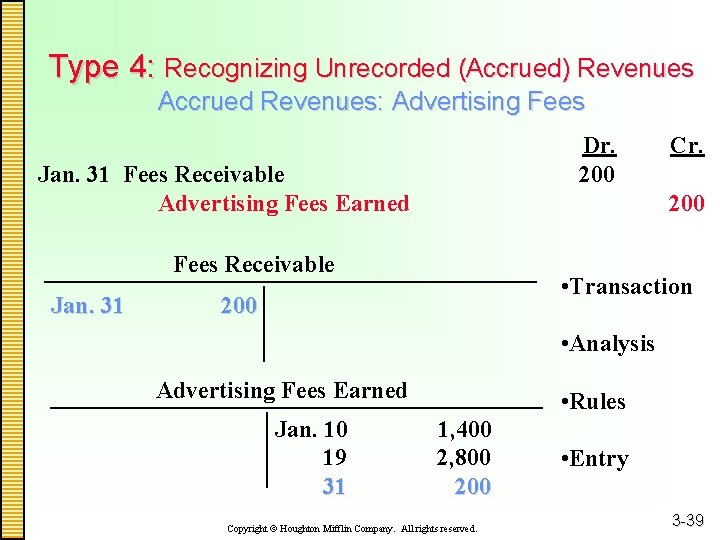
Type 4: Recognizing Unrecorded (Accrued) Revenues Accrued Revenues: Advertising Fees Dr. 200 Jan. 31 Fees Receivable Advertising Fees Earned 200 Fees Receivable Jan. 31 Cr. • Transaction 200 • Analysis Advertising Fees Earned Jan. 10 19 31 • Rules 1, 400 2, 800 200 Copyright Houghton Mifflin Company. All rights reserved. • Entry 3 -39
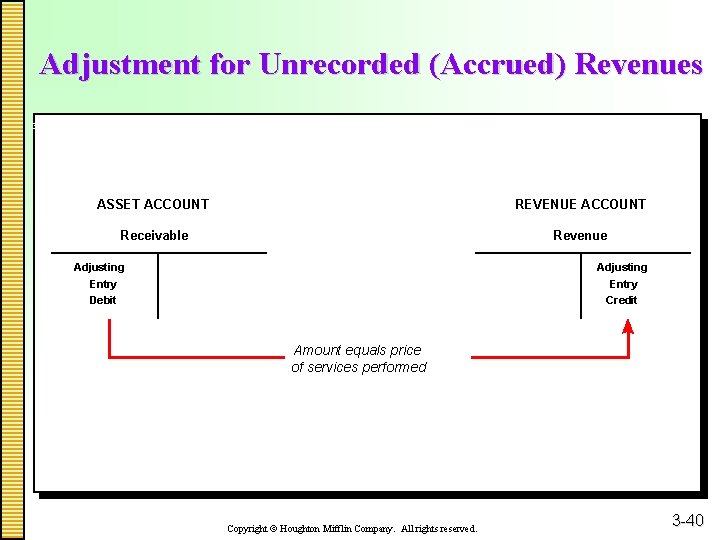
Adjustment for Unrecorded (Accrued) Revenues 3 -4 ASSET ACCOUNT REVENUE ACCOUNT Receivable Revenue Adjusting Entry Credit Debit Amount equals price of services performed Copyright Houghton Mifflin Company. All rights reserved. 3 -40
Using the Adjusted Trial Balance to Prepare Financial Statements Objective 6 Prepare financial statements from an adjusted trial balance. Copyright Houghton Mifflin Company. All rights reserved. 3 -41
The Adjusted Trial Balance (ATB) u The ATB is prepared after adjusting entries have been recorded and posted. u The ATB is a listing of all accounts and their balances. u The ATB should have equal debits and credits. u Financial statements are prepared from the ATB by copying the appropriate accounts to the appropriate financial statement. Copyright Houghton Mifflin Company. All rights reserved. 3 -42
Cash Flows, Accrual Accounting, and Management Objectives Supplemental Objective 7 Analyze cash flows from accrual-based information. Copyright Houghton Mifflin Company. All rights reserved. 3 -43
Cash Flows, Accrual Accounting, and Management Objectives 1. The purpose of accrual accounting is to measure the earnings of a business during an accounting period. 2. The measurement of net income is related to management’s profitability goal. 3. Management also has a liquidity goal, which is measured by cash flow. 4. Cash flow is the inflows and outflows of cash during an accounting period and the resulting availability of cash. Copyright Houghton Mifflin Company. All rights reserved. 3 -44
5. Every revenue or expense account on the income statement has one or more related accounts on the balance sheet. 3 3 Supplies is related to Supplies Expense. Wages Expense is related to Wages Payable. 6. Cash flows generated or paid by company operations may also be determined by analyzing these relationships. 7. The following rules may be applied to determine cash flow. Copyright Houghton Mifflin Company. All rights reserved. 3 -45
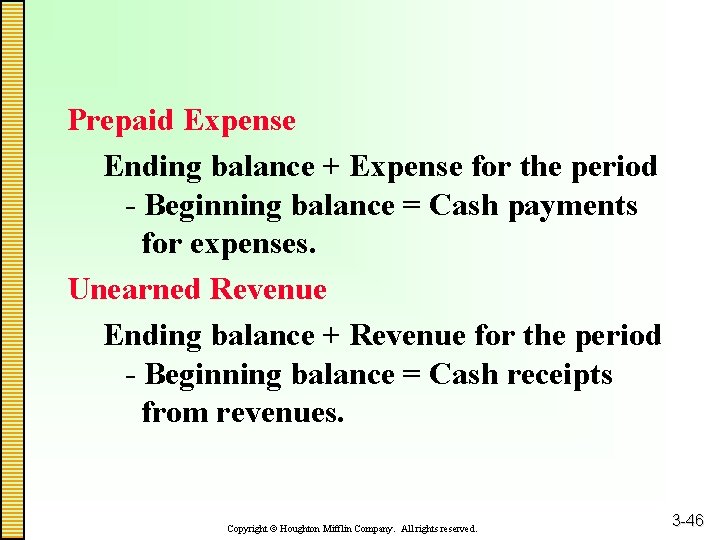
Prepaid Expense Ending balance + Expense for the period - Beginning balance = Cash payments for expenses. Unearned Revenue Ending balance + Revenue for the period - Beginning balance = Cash receipts from revenues. Copyright Houghton Mifflin Company. All rights reserved. 3 -46
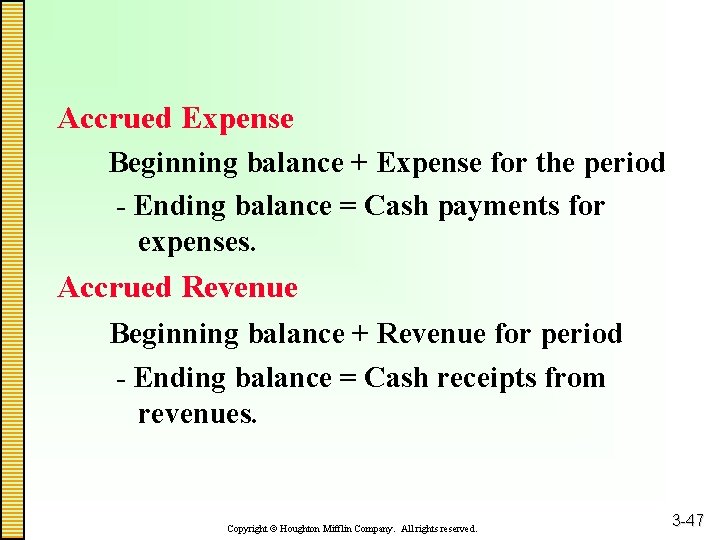
Accrued Expense Beginning balance + Expense for the period - Ending balance = Cash payments for expenses. Accrued Revenue Beginning balance + Revenue for period - Ending balance = Cash receipts from revenues. Copyright Houghton Mifflin Company. All rights reserved. 3 -47
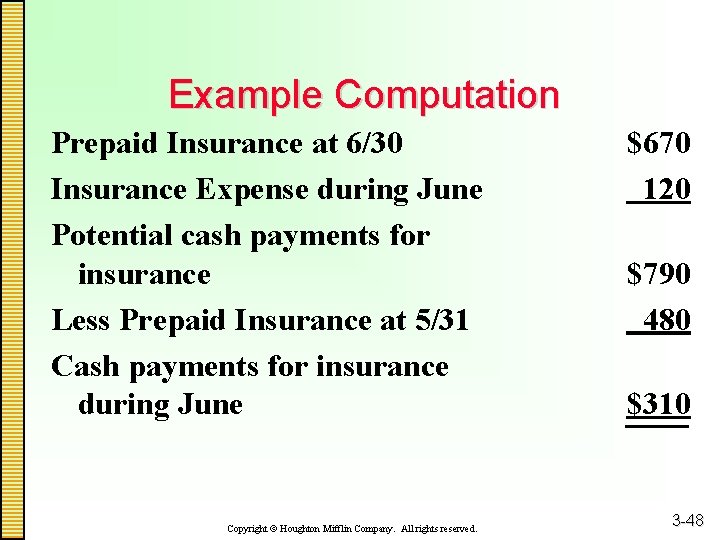
Example Computation Prepaid Insurance at 6/30 Insurance Expense during June Potential cash payments for insurance Less Prepaid Insurance at 5/31 Cash payments for insurance during June Copyright Houghton Mifflin Company. All rights reserved. $670 120 $790 480 $310 3 -48
OK, LET’S REVIEW. . . 1. Define net income and its two major components, revenues and expenses. 2. Explain the difficulties of income measurement caused by: (a) the accounting period issue, (b) the continuity issue, (c) the matching issue. 3. Define accrual accounting and explain two broad ways of accomplishing it. Copyright Houghton Mifflin Company. All rights reserved. 3 -49
AND FINALLY. . . 4. State four principal situations that require adjusting entries. 5. Prepare typical adjusting entries. 6. Prepare financial statements from an adjusted trial balance. 7. Analyze cash flows from accrualbased information. Copyright Houghton Mifflin Company. All rights reserved. 3 -50
- Slides: 50