
CHAPTER 3 Measurement concepts and the balance sheet
CHAPTER 3 Measurement concepts and the balance sheet equation
Contents q q q q Introduction Company characteristics affecting financial reporting behaviour Content of financial statements The basics of accounting measurement Generally accepted accounting principles Conventional measurement bases Accounting for transactions The IASB definition and recognition criteria of elements of the balance sheet and the income statement
Introduction –Annual financial statements q q q Single public source of economic company data Prime external communication tool and of interest to all main business partners Subject to verification by external experts Starting point for tax assessment Important device to monitor contracts Public through mandatory filing and voluntary disclosure
Key financial statements q Balance sheet and income statement are the key financial statements v v q q Balance sheet: shows, at a given date, the company’s financial position: the economic resources (assets) it controls and where its finance comes from (liabilities and equity) Income statement: sets out the performance (result) of a company’s operations for the accounting period They provide specific, but partial, economic information about a company’s past activities, drawn up according to a fairly flexible set of rules Effective use necessitates knowledge of: a) b) c) What are the rules? To what extent are they flexible? How this impacts upon interpretation of the information.
Company characteristics affecting financial reporting behaviour q q Financial reporting is deeply embedded in a country’s culture and traditions =>national accounting rules tend to vary significantly Additionally, company characteristics will impact its reporting behaviour, e. g. Nature of ownership v Managerial objectives v Nature of activity v Legal form v Company size v
Content of financial statements q The core financial reporting process involves preparing an annual income statement and balance sheet v v q q Income statement: brings together aggregated information about a company’s performance during a fiscal year Balance sheet: shows the state of the company’s financial position at the end of the fiscal year The income statement presents ‘flow’-data (covering a period), while the balance sheet is a status report (a ‘snapshot’ at a specific moment in time) They are usually published with comparative data of the previous year.
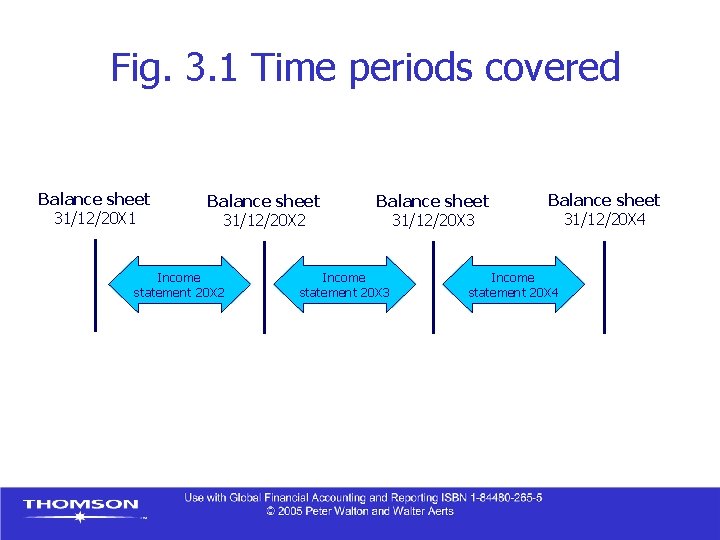
Fig. 3. 1 Time periods covered Balance sheet 31/12/20 X 1 Balance sheet 31/12/20 X 2 Income statement 20 X 2 Balance sheet 31/12/20 X 3 Income statement 20 X 3 Balance sheet 31/12/20 X 4 Income statement 20 X 4
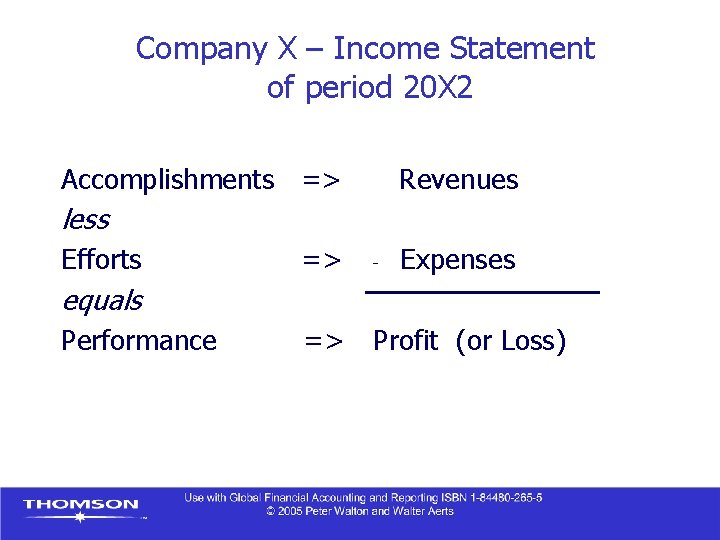
Company X – Income Statement of period 20 X 2 Accomplishments => Revenues less Efforts => - Expenses => Profit (or Loss) equals Performance
Income statement structure q The income statement can be split into two different sections: v v Operating result (or ‘profit before interest and tax’): result from the company’s operating activities, irrespective of the financial structure of the company Returns to interested parties others than the owners: § § q Income taxes due to government Interest on loan finance ‘Profit available for shareholders’ is the residual return to equity providers v v It is the wealth generated by the company during the period To pay dividend to shareholders or to finance future growth (auto-financing)
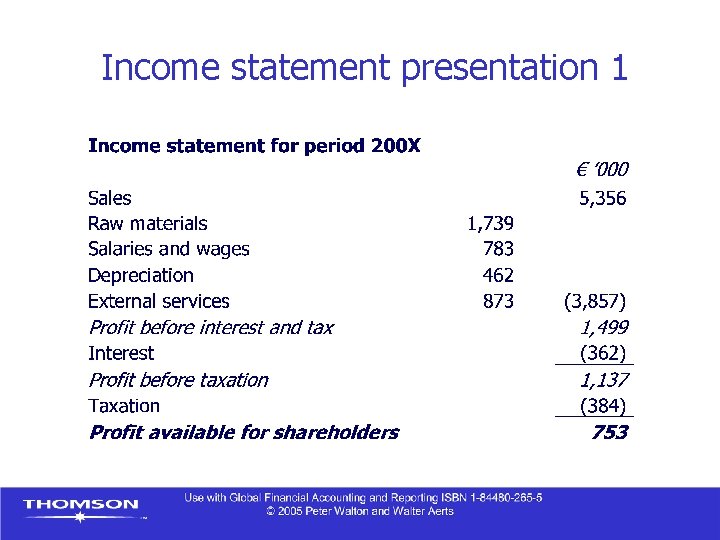
Income statement presentation 1
Operating expenses q Two formats to present operating expenses: v Value-added approach Shows inputs and outputs and enables one to calculate the value added by the company § Operating expenses are presented by their nature § Most common in Europe § v Functional approach Presentation by type of activity to which the operating expense was assigned § More common in UK and US §
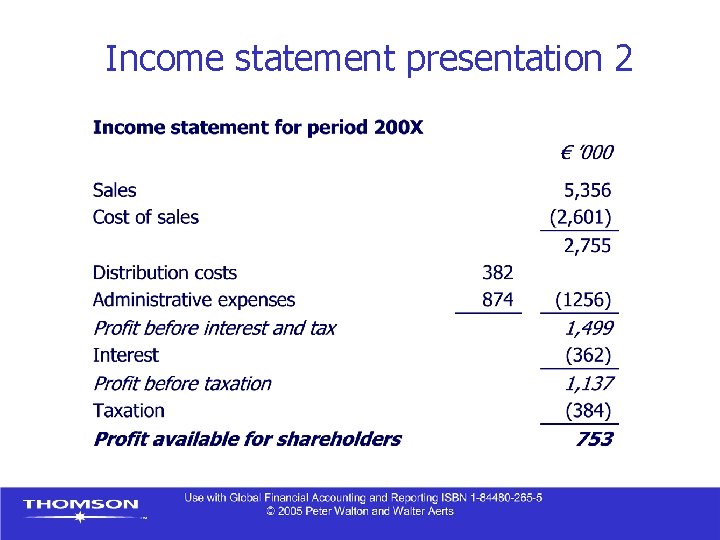
Income statement presentation 2
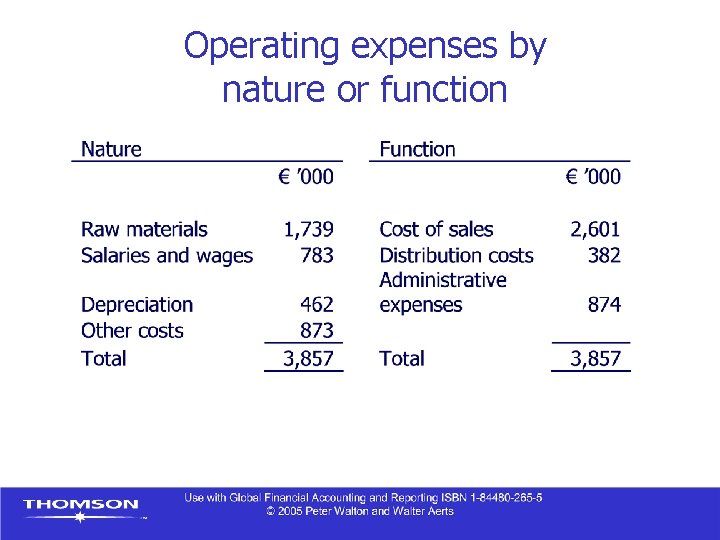
Operating expenses by nature or function
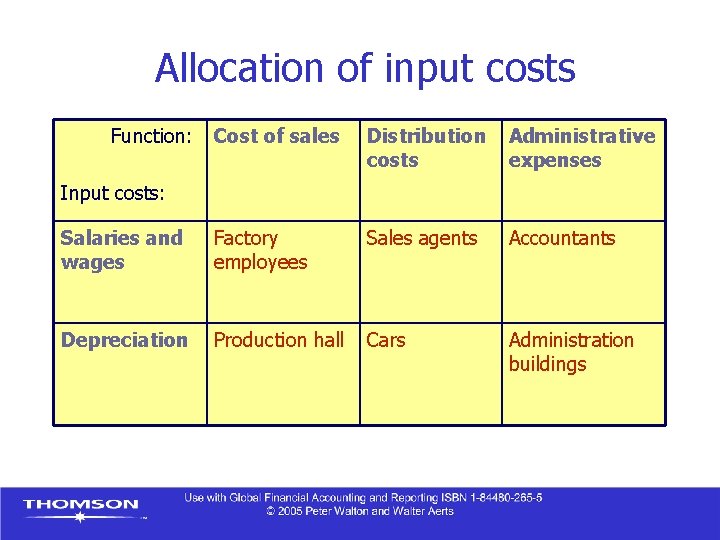
Allocation of input costs Function: Cost of sales Distribution costs Administrative expenses Salaries and wages Factory employees Sales agents Accountants Depreciation Production hall Cars Administration buildings Input costs:
Balance sheet structure q q A balance sheet presents a picture of the company’s finances at the end of the financial year, and the assets which it has acquired and which have not yet been consumed within the business A balance sheet can be presented according to two basic formats: Horizontal balance sheet v Vertical balance sheet v
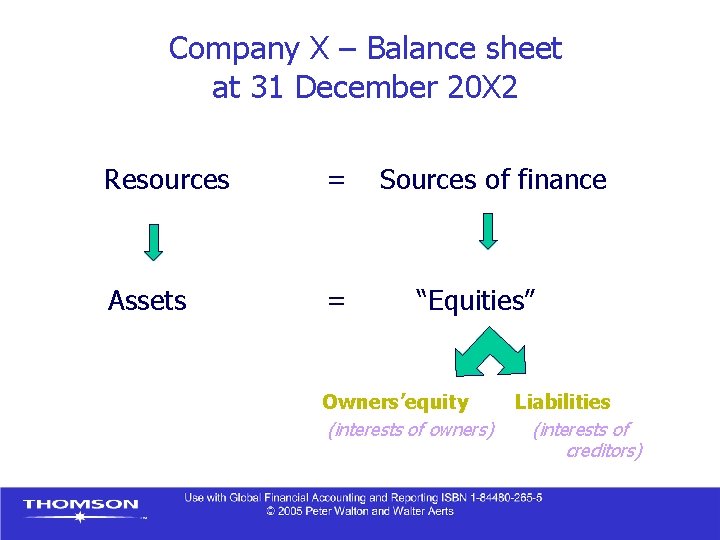
Company X – Balance sheet at 31 December 20 X 2 Resources = Assets = Sources of finance “Equities” Owners’equity (interests of owners) Liabilities (interests of creditors)
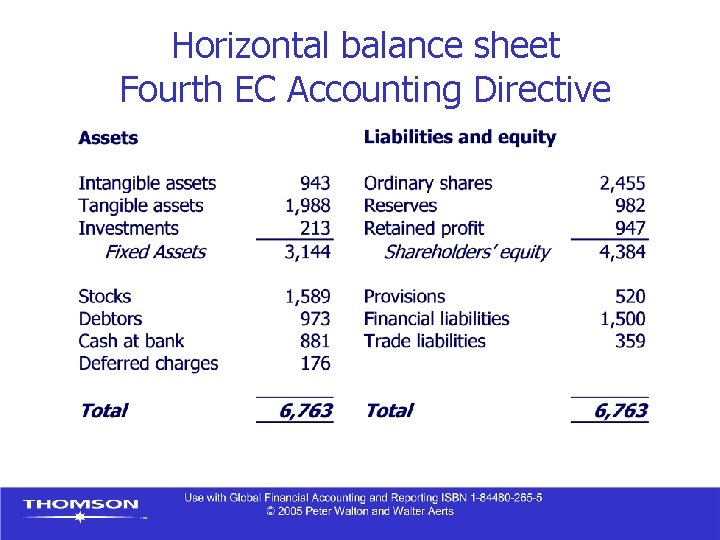
Horizontal balance sheet Fourth EC Accounting Directive
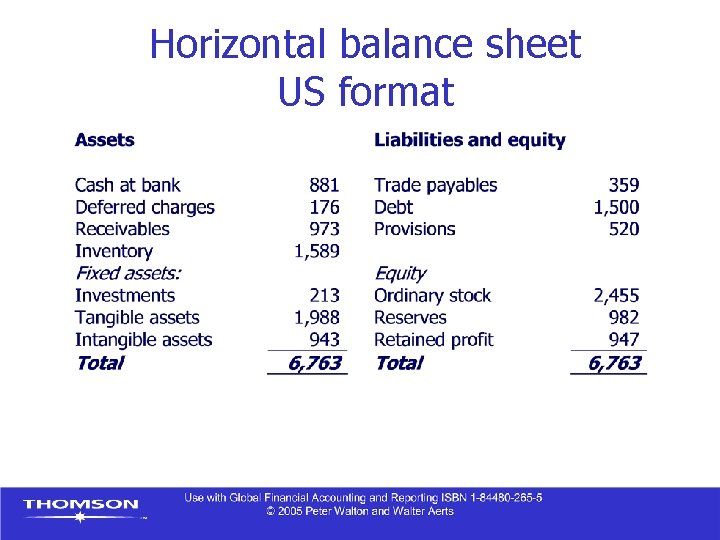
Horizontal balance sheet US format
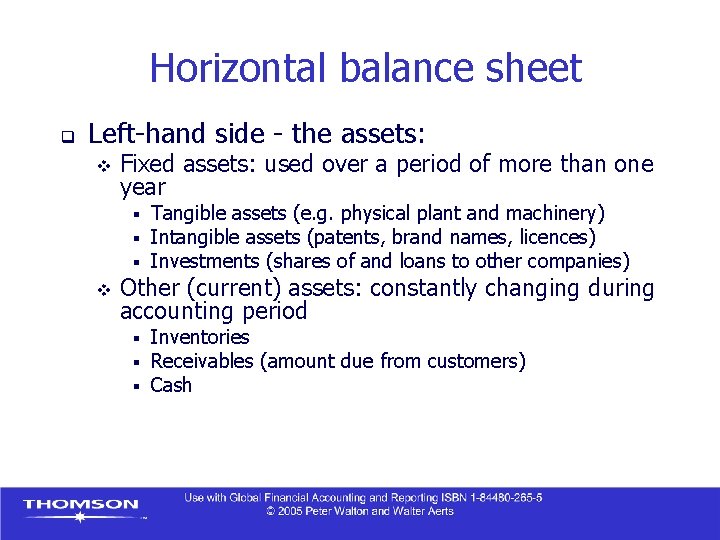
Horizontal balance sheet q Left-hand side - the assets: v Fixed assets: used over a period of more than one year § § § v Tangible assets (e. g. physical plant and machinery) Intangible assets (patents, brand names, licences) Investments (shares of and loans to other companies) Other (current) assets: constantly changing during accounting period § § § Inventories Receivables (amount due from customers) Cash
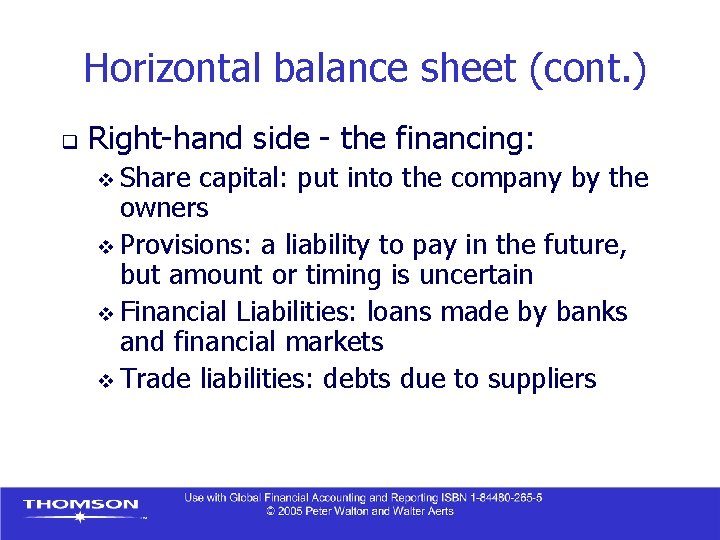
Horizontal balance sheet (cont. ) q Right-hand side - the financing: v Share capital: put into the company by the owners v Provisions: a liability to pay in the future, but amount or timing is uncertain v Financial Liabilities: loans made by banks and financial markets v Trade liabilities: debts due to suppliers
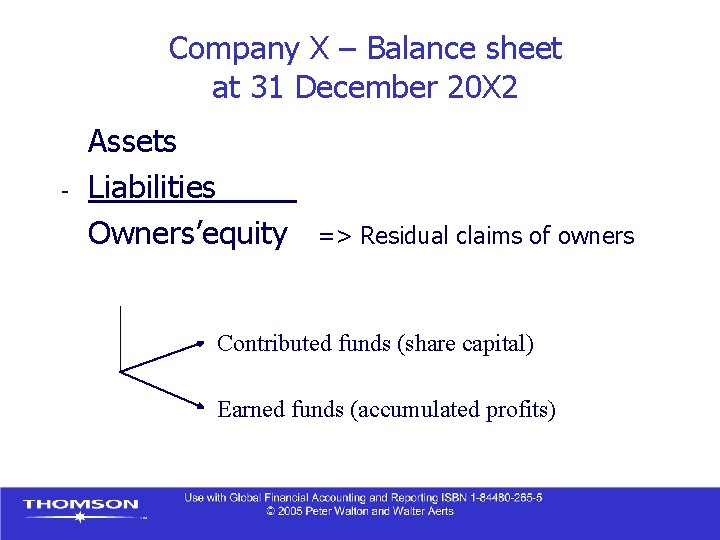
Company X – Balance sheet at 31 December 20 X 2 - Assets Liabilities Owners’equity => Residual claims of owners Contributed funds (share capital) Earned funds (accumulated profits)
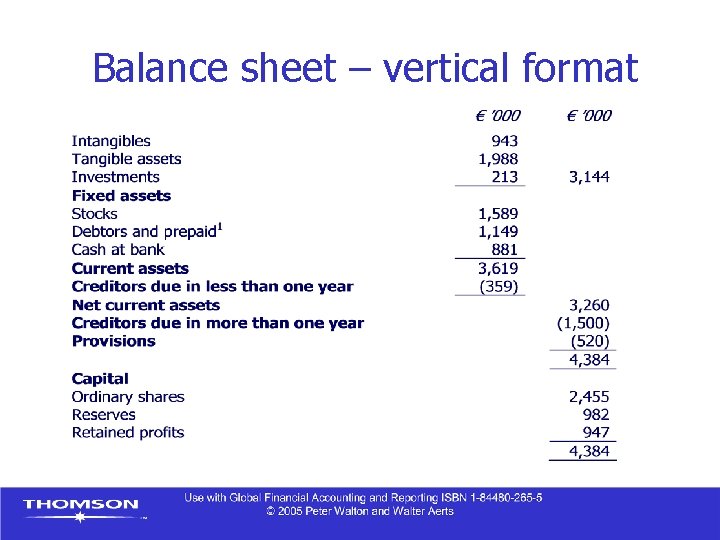
Balance sheet – vertical format
Vertical balance sheet q q Same content but different presentation Liabilities are shown as a deduction from assets Liabilities are split according to when they are due for payment, with current liabilities deducted from current assets Capital (or equity) is shown as the residual: it is more a proprietary approach (focusing on the interests of the owners) while the horizontal presentation follows an entity approach (company presented as an economic whole)
The basics of accounting measurement q Accounting measurement is based on a set of assumptions and conventions which automatically limit the information content Generally accepted accounting principles v Conventional measurement bases v q Accounting measurement necessitates extensive use of estimates, which make it a subjective process
Generally accepted accounting principles q q q A set of assumptions, conventions and rules underlying financial accounting, necessary to make financial statements comparable and useful, but introducing significant constraints on their content Different Generally Accepted Accounting Principles (GAAP)-sets exist, such as European GAAP and related national GAAP, US GAAP, IFRS GAAP, . . . The ‘true and fair view principle’ (or fair presentation) of financial statements is pragmatically linked to the proper application of ‘generally accepted accounting principles’
True and fair view / Fair presentation ‘Financial statements are frequently described as showing a true and fair view of, or as presenting fairly, the financial position, performance and changes in financial position of an entity. Although this Framework does not deal directly with such concepts, the application of the principal qualitative characteristics and appropriate accounting standards normally results in financial statements that convey what is generally understood as a true and fair view of, or as presenting fairly such information. ’ Source: IASB-Framework for the Preparation and Presentation of Financial Statements
Consistency q q Consistency of measurement and presentation principles Consistency in time and space v v q Same accounting principles should be applied from one year to another And, within the same year, in relation to similar transactions. If changes are necessary, they should be explained in the notes to the accounts, together with disclosure of extra information to enable external observers to make a knowledgeable evaluation of the effects of the change
Accrual basis q Financial accounting aims to measure business transactions at the time they take place, rather than when cash changes hands v q This approach distinguishes financial accounting from a simple record of cash transactions ‘Matching’: all costs and revenues associated with a particular sale should be recognized together in the income statement when the sale takes place
Accruals “In order to meet their objectives, financial statements are prepared on the accrual basis of accounting. Under this basis, the effects of transactions and other events are recognised when they occur (and not as cash or its equivalent is received or paid) and they are recorded in the accounting records and reported in the financial statements of the periods to which they relate. Financial statements prepared on the accrual basis inform users not only of past transactions involving the payment and receipt of cash but also of obligations to pay cash in the future and of resources that represent cash to be received in the future. Hence, they provide the type of information about past transactions and other events that is most useful to users in making economic decisions. ” Source: IASB, Framework, par. 22
Accrual versus Cash Basis q Cash basis: v v q Revenue recognized when incoming cash flows occur Expenses recognized when outgoing cash flows occur No mutual link of expenses and revenues No measure of profitability feasible Accrual basis: v v v Expenses and revenue regarding a sale should be recognized simultaneously (irrespective of time of payment) Matching principle Measure of profitability of economic activities during an accounting period
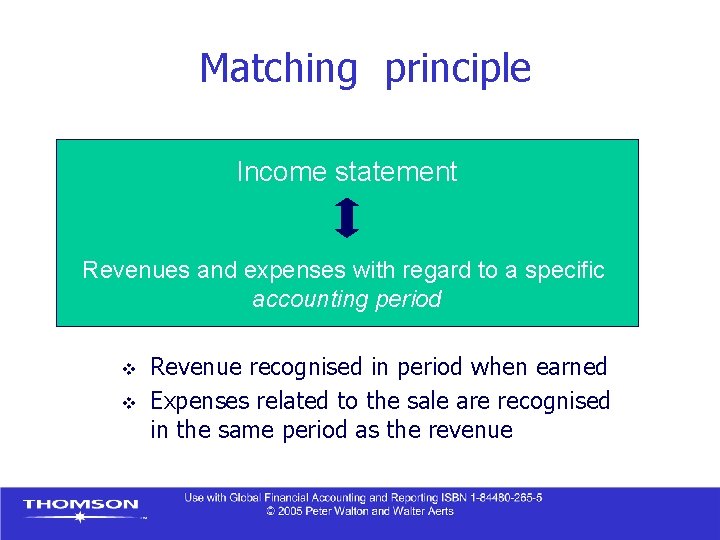
Matching principle Income statement Revenues and expenses with regard to a specific accounting period v v Revenue recognised in period when earned Expenses related to the sale are recognised in the same period as the revenue
Prudence q Principle v v v Revenues should only be recognised when they are certain Expenses are recognised when they become probable Unrecoverable expenses should be recognized even if not yet realized
Prudence (cont. ) q Controversial v v q Conflict with principle of matching Tax driven / Could lead to hidden reserves IFRS: no priority for the prudence principle v Meaning of prudence is restrained to an attitude of caution in the exercise of judgements when these are needed to arrive at estimates under conditions of uncertainty such that assets/income are not overstated and liabilities/expenses understated
Going concern q In preparing financial statements it is assumed that the company will continue in business for the foreseeable future v q q Assumption is necessary to apply accrual principle If no longer realistic: other set of measurement rules needed (probably based on short-term liquidation values) IAS 1 Presentation of Financial Statements requires management to make an assessment of the company’s ability to continue as a going concern, when it prepares the financial statements
Conventional measurement bases Historical cost principle q Monetary measurement unit convention q
Historical cost q q Financial accounting is still largely based on historical cost accounting Historical cost = acquisition cost of the item v v q Historical consideration given Past cost needed to acquire an asset on the date of acquisition (the cash-equivalent acquisition cost) Pros and cons v v Advantage: historical cost is relatively easy to determine and can be verified Disadvantage: subsequent to the date of acquisition, the continued reporting of historical cost based values does not reflect any changes in market value
Monetary measurement unit q A/L/I/E are measured in monetary units v q Money provides a common denominator by means of which heterogeneous facts and relationships can be expressed as numbers that can be added and substracted. Pros and cons v If nothing has been paid, no recognition of values in the balance sheet, e. g. Trade mark loyalty § Human capital § v What if the value of monetary units changes ? § Changes in purchasing power are not taken into account
Accounting for transactions Balance sheet equation q Constructing a balance sheet q
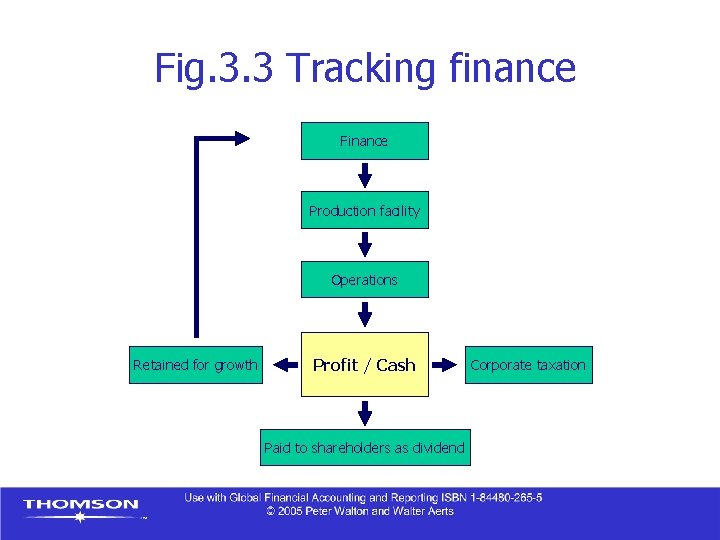
Fig. 3. 3 Tracking finance Finance Production facility Operations Retained for growth Profit / Cash Paid to shareholders as dividend Corporate taxation

Balance sheet equation The balance sheet equation is usually stated as: Assets = Debt (liabilities) + Equity (uses of finance = sources of finance)
Double-entry accounting q q q Any business transaction that will be recognized in the accounting system (‘accounting transaction’), will have a dual impact on the numbers in the company’s accounting records The balance sheet equation is in fact the formal expression of the duality of accounting transactions Double-entry accounting: any accounting transaction must be reflected in (at least) two accounts
Double-entry accounting (cont. ) q q Any accounting transaction must preserve the equilibrium between sources and uses of funds, and will involve either a change in both, or a reallocation within one side of the balance sheet equation Accounting transactions with impact on revenues and expenses fit into this fundamental equation approach v v v If profit is generated, it adds to the ‘equity’ part of the equation Revenues have a positive impact on profit and, thus, on equity Expenses have a negative impact on profit and, thus, on equity
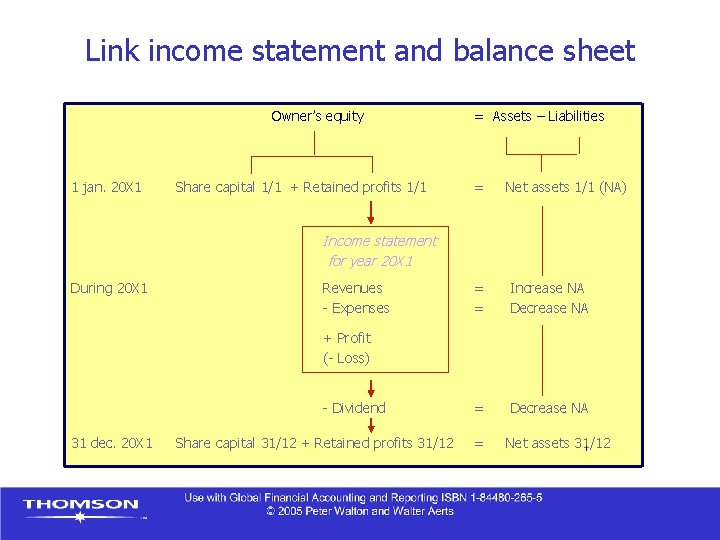
Link income statement and balance sheet Owner’s equity 1 jan. 20 X 1 Share capital 1/1 + Retained profits 1/1 = Assets – Liabilities = Net assets 1/1 (NA) Income statement for year 20 X 1 During 20 X 1 Revenues - Expenses = = Increase NA Decrease NA = Decrease NA + Profit (- Loss) - Dividend 31 dec. 20 X 1 Share capital 31/12 + Retained profits 31/12 = Net assets 31/12
Constructing a balance sheet q q Every accounting transaction can be analysed according to its dual impact on the balance sheet We will follow a spreadsheet approach for analysing accounting transactions v v q Rows represent accounts (upper part = asset rows; lower part = equity and liability rows) and can be extended if needed Columns represent the impact of accounting transactions on the balances (net amounts) of the accounts – this impact should be such that the balance sheet equation is preserved at all times The spreadsheet represents the accounting database v v Each row (or account) = a data file Balance sheet = a highly aggregated summary of these data files
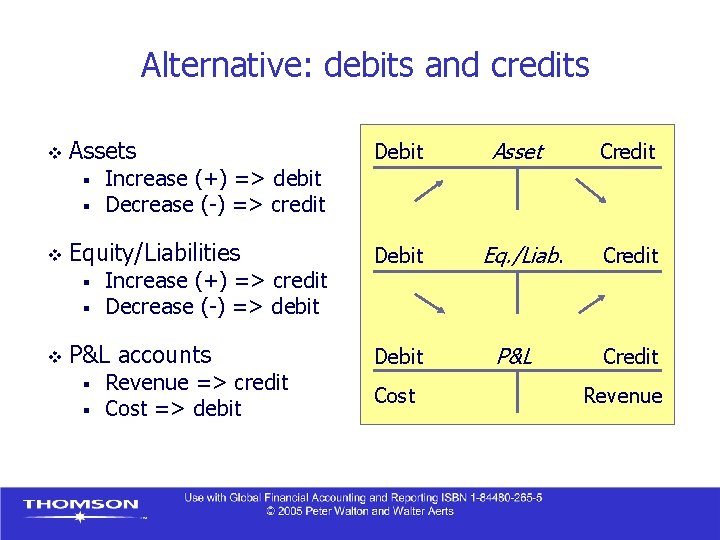
Alternative: debits and credits v Assets § § v Increase (+) => credit Decrease (-) => debit P&L accounts § § Asset Credit Increase (+) => debit Decrease (-) => credit Equity/Liabilities § Debit Revenue => credit Cost => debit Debit Cost Eq. /Liab. P&L Credit Revenue
Constructing a balance sheet Illustration q q We will follow a sequence of accounting transactions up to the construction of a balance sheet Initially, equity represents the finance put into the company by the shareholders; equity changes regularly as a result of operating activities The net change in equity over a period is the profit which has been made by the company during that period - it is analysed in the income statement A balance sheet can, potentially, be drawn up after each transaction
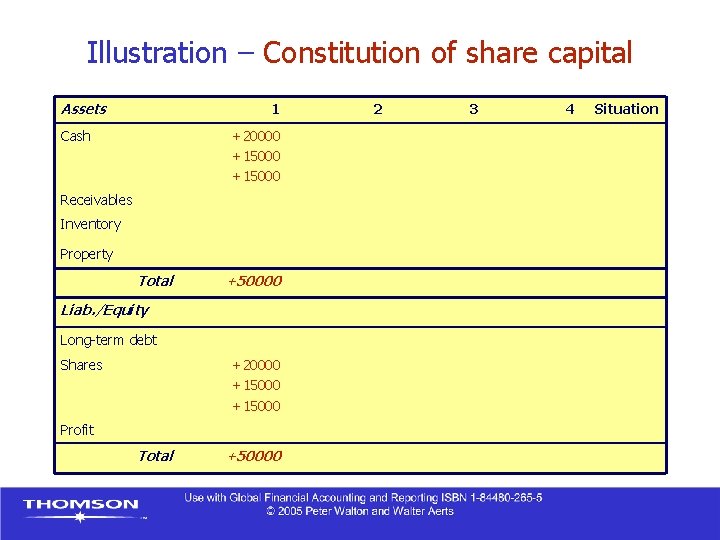
Illustration – Constitution of share capital Assets 1 Cash +20000 +15000 Receivables Inventory Property Total +50000 Liab. /Equity Long-term debt Shares +20000 +15000 Profit Total +50000 2 3 4 Situation
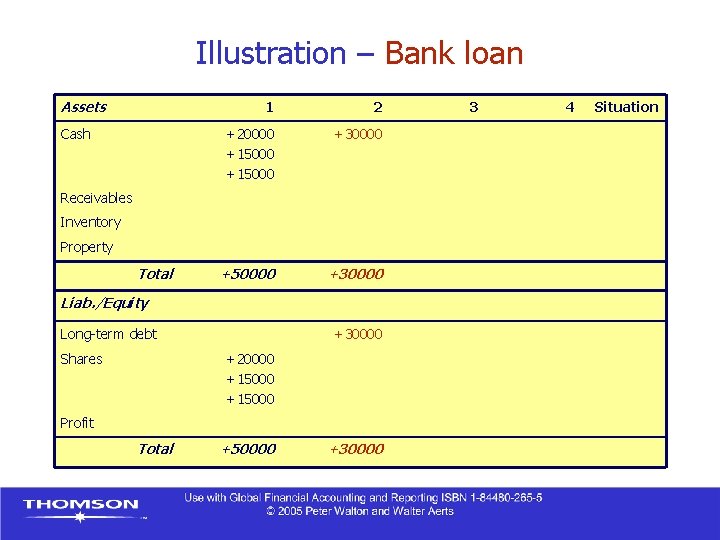
Illustration – Bank loan Assets Cash 1 2 +20000 +15000 +30000 +50000 +30000 Receivables Inventory Property Total Liab. /Equity Long-term debt Shares +30000 +20000 +15000 Profit Total +50000 +30000 3 4 Situation
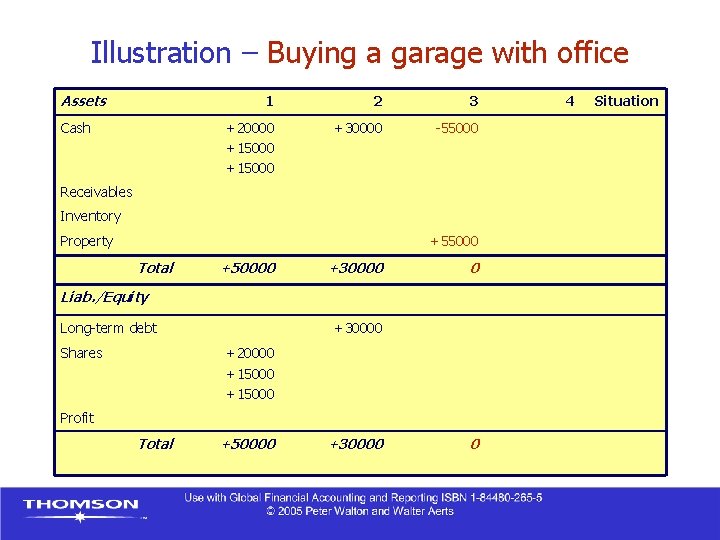
Illustration – Buying a garage with office Assets Cash 1 2 3 +20000 +15000 +30000 -55000 Receivables Inventory Property +55000 Total +50000 +30000 0 Liab. /Equity Long-term debt Shares +30000 +20000 +15000 Profit Total +50000 +30000 0 4 Situation
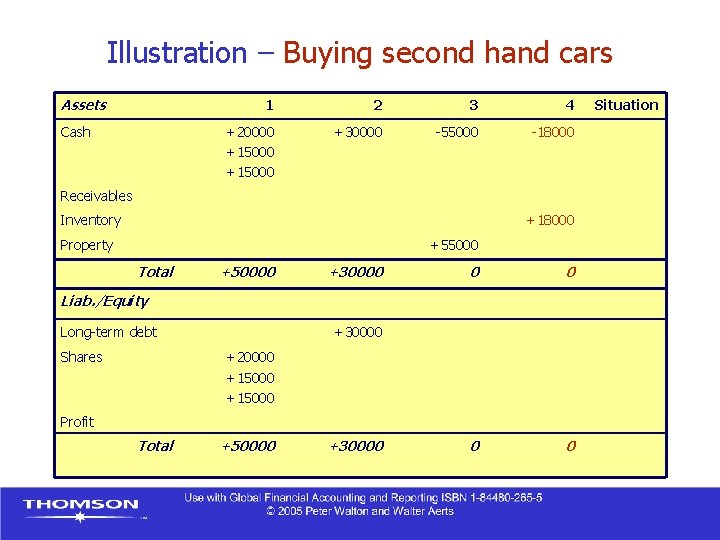
Illustration – Buying second hand cars Assets Cash 1 2 3 4 +20000 +15000 +30000 -55000 -18000 Receivables Inventory +18000 Property +55000 Total +50000 +30000 0 0 Liab. /Equity Long-term debt Shares +30000 +20000 +15000 Profit Total +50000 +30000 Situation
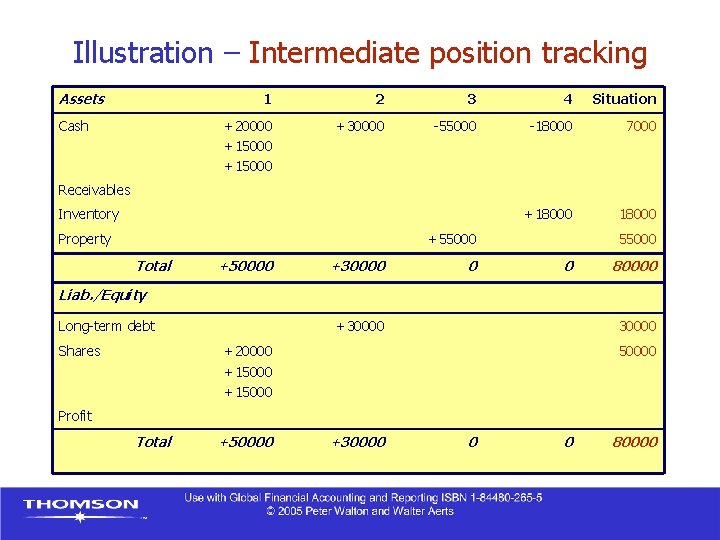
Illustration – Intermediate position tracking Assets Cash 1 2 3 4 Situation +20000 +15000 +30000 -55000 -18000 7000 +18000 Receivables Inventory Property +55000 Total +50000 +30000 0 55000 0 80000 Liab. /Equity Long-term debt Shares +30000 +20000 +150000 Profit Total +50000 +30000 0 0 80000
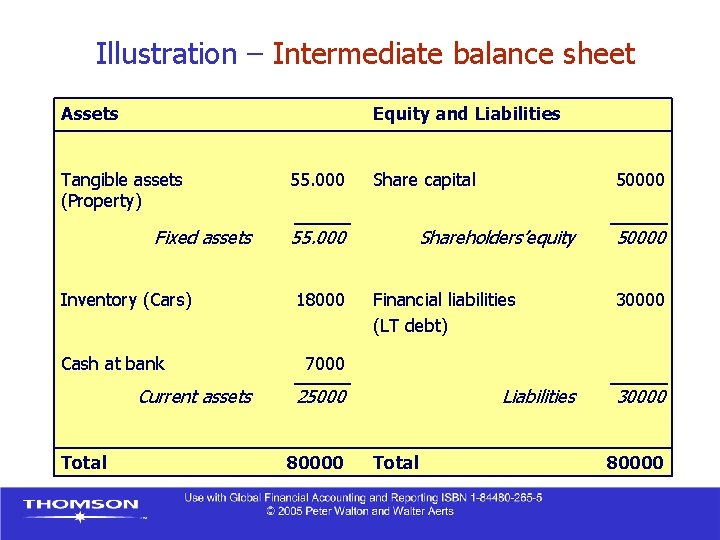
Illustration – Intermediate balance sheet Assets Equity and Liabilities Tangible assets (Property) Fixed assets Inventory (Cars) Cash at bank Current assets Total 55. 000 18000 Share capital 50000 Shareholders’equity Financial liabilities (LT debt) 50000 30000 7000 25000 80000 Liabilities Total 30000 80000
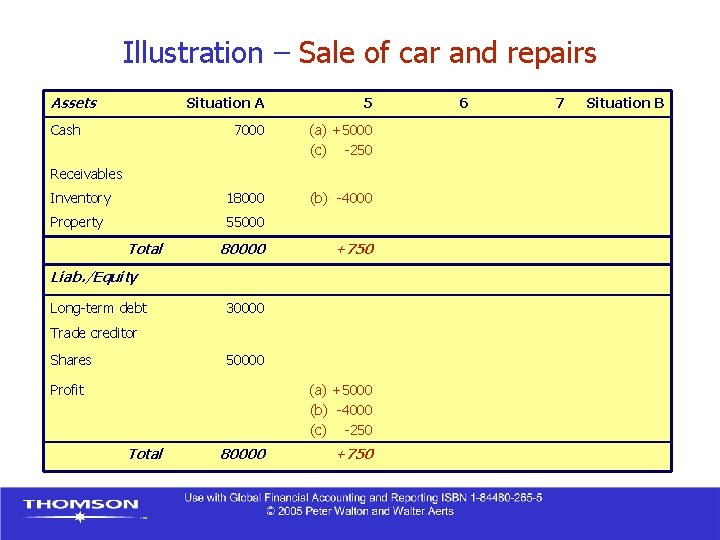
Illustration – Sale of car and repairs Assets Situation A 5 7000 (a) +5000 (c) -250 Inventory 18000 (b) -4000 Property 55000 Cash Receivables Total 80000 +750 Liab. /Equity Long-term debt 30000 Trade creditor Shares 50000 Profit (a) +5000 (b) -4000 (c) -250 Total 80000 +750 6 7 Situation B
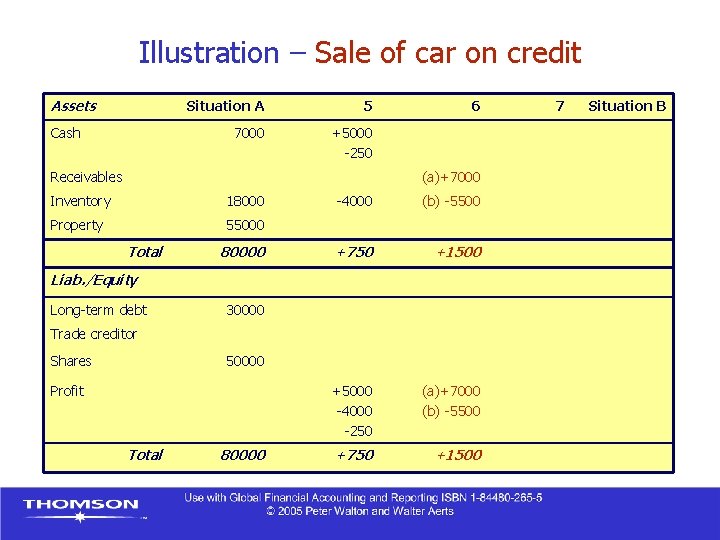
Illustration – Sale of car on credit Assets Cash Situation A 5 7000 +5000 -250 Receivables 6 (a)+7000 Inventory 18000 Property 55000 Total 80000 -4000 (b) -5500 +750 +1500 +5000 -4000 -250 (a)+7000 (b) -5500 +750 +1500 Liab. /Equity Long-term debt 30000 Trade creditor Shares 50000 Profit Total 80000 7 Situation B
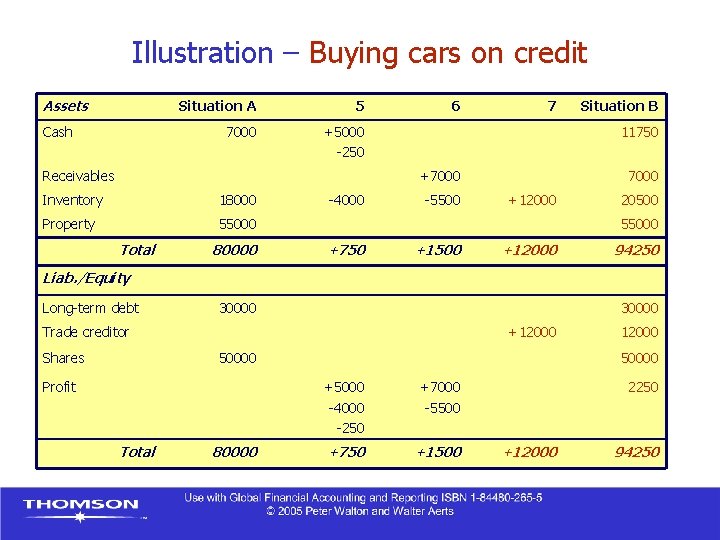
Illustration – Buying cars on credit Assets Cash Situation A 5 7000 +5000 -250 Receivables 6 7 11750 +7000 Inventory 18000 Property 55000 Total 80000 -4000 Situation B -5500 7000 +12000 20500 55000 +750 +1500 +12000 94250 Liab. /Equity Long-term debt 30000 Trade creditor Shares +12000 50000 Profit Total 80000 12000 50000 +5000 -4000 -250 +7000 -5500 +750 +1500 2250 +12000 94250
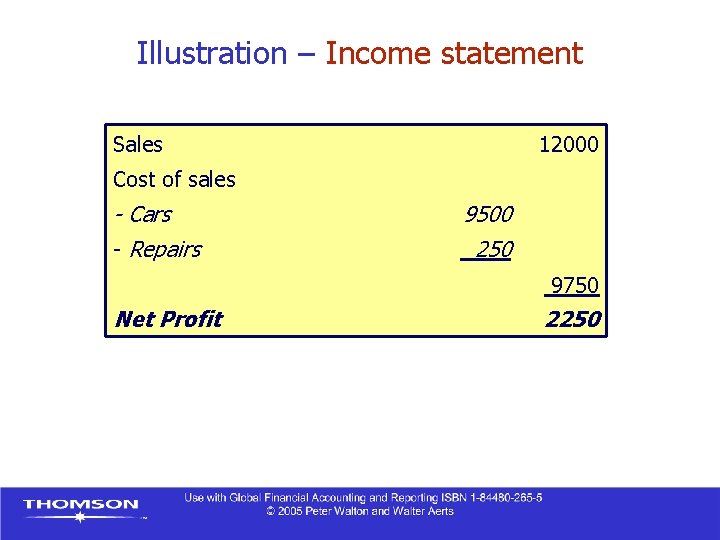
Illustration – Income statement Sales 12000 Cost of sales - Cars - Repairs 9500 250 9750 Net Profit 2250
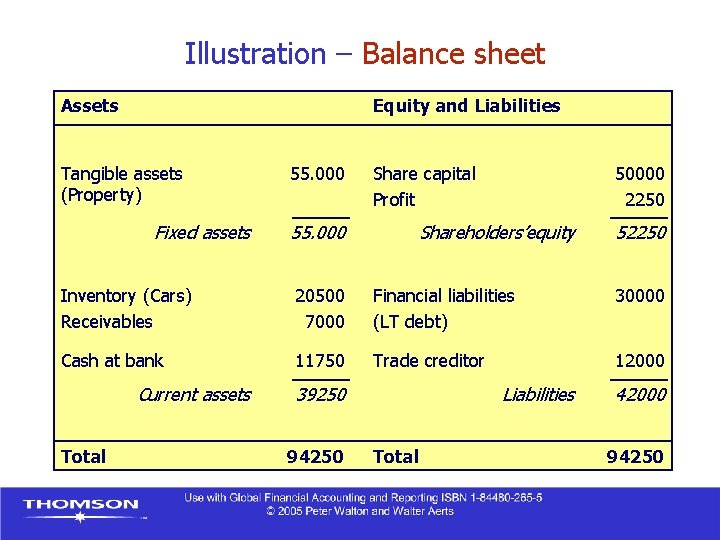
Illustration – Balance sheet Assets Equity and Liabilities Tangible assets (Property) Fixed assets 55. 000 Share capital Profit 50000 2250 Shareholders’equity 52250 Inventory (Cars) Receivables 20500 7000 Financial liabilities (LT debt) 30000 Cash at bank 11750 Trade creditor 12000 Current assets Total 39250 94250 Liabilities Total 42000 94250
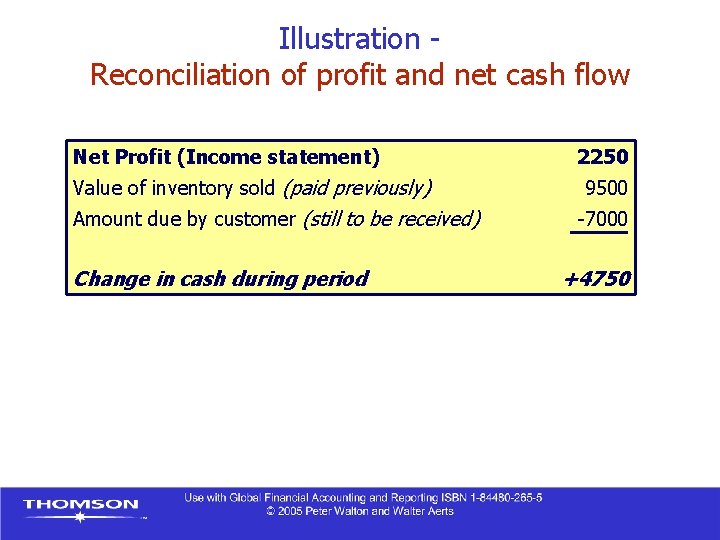
Illustration Reconciliation of profit and net cash flow Net Profit (Income statement) Value of inventory sold (paid previously) Amount due by customer (still to be received) Change in cash during period 2250 9500 -7000 +4750
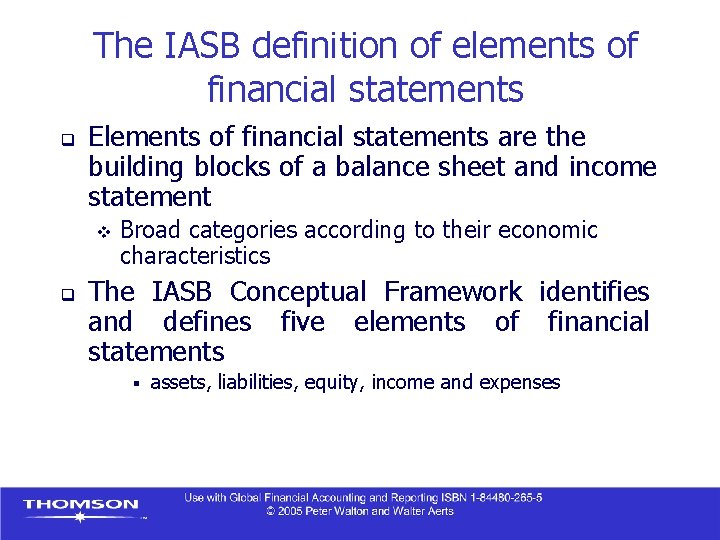
The IASB definition of elements of financial statements q Elements of financial statements are the building blocks of a balance sheet and income statement v q Broad categories according to their economic characteristics The IASB Conceptual Framework identifies and defines five elements of financial statements § assets, liabilities, equity, income and expenses
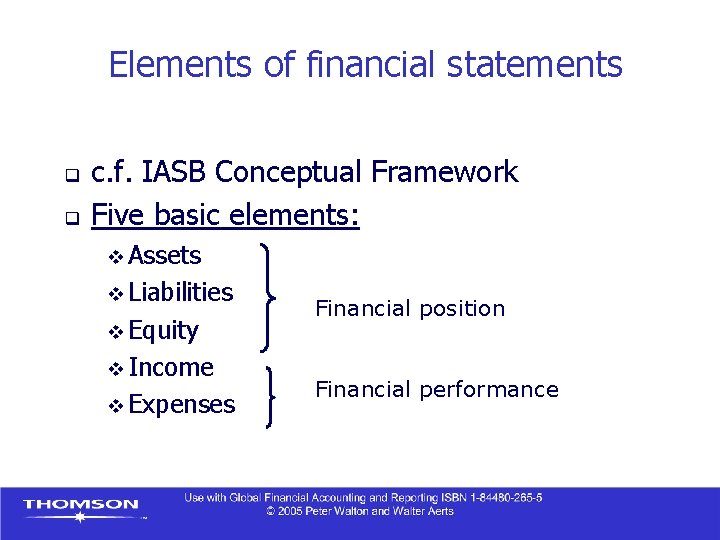
Elements of financial statements q q c. f. IASB Conceptual Framework Five basic elements: v Assets v Liabilities v Equity v Income v Expenses Financial position Financial performance
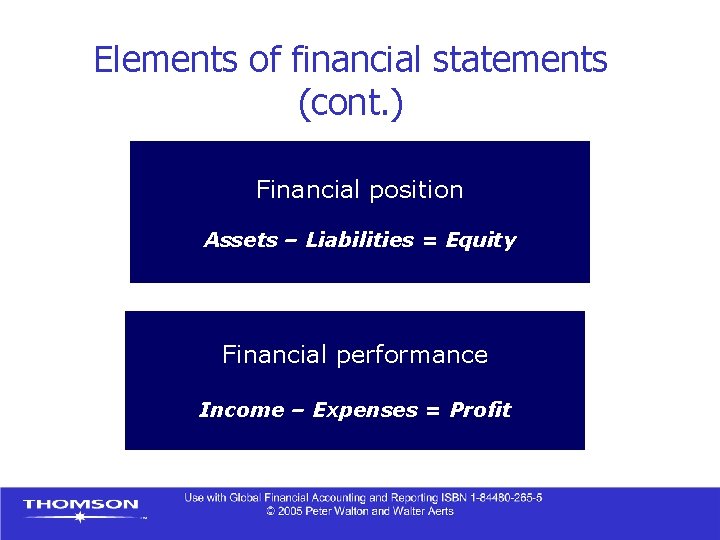
Elements of financial statements (cont. ) Financial position Assets – Liabilities = Equity Financial performance Income – Expenses = Profit
IASB - Asset q q ‘A resource controlled by an entity as a result of past events from which future economic benefits are expected to flow to the entity’ Key elements: a) b) c) Assets are resources, arising from past transactions or past events They embody future economic benefits: the capacity to contribute directly or indirectly to future net cash inflows Control: one has the capacity to benefit exclusively from these economic benefits
Future economic benefits q Economic benefits may result from: v v v the productive capacity of the asset § plant and equipment the ability of the asset to reduce future cash outflows § renewal expenditure on equipment that results in future production cost savings the rights incorporated in the asset to receive services in the future § prepayments direct claims to cash inflows § receivables and short-term investments cash in hand § can be exchanged for goods and services (economic benefits )
IASB - Liability q ‘A present obligation of an entity arising from past events, the settlement of which is expected to result in an outflow from the entity of resources embodying economic benefits’ q Key elements: a) b) c) Present (at balance sheet date) responsibility obligating the company to act or perform in a certain way (towards third parties) Arising from an obligating event in the past Leading to a sacrifice of economic benefits (transfer of cash or other assets, rendering of services, replacement by another obligation, . . . )
IASB - Equity q q ‘The residual interest in the assets of an entity after deducting all liabilities’ Key elements: v v q The residual interest is the ownership interest Representing a claim to the company’s net assets Equity will be usually sub-divided: Funds contributed by shareholders § Retained profits § Reserves representing appropriation of retained profits §
IASB - Income q q ‘Increases in economic benefits during the accounting period in the form of inflows or enhancements of assets or decreases of liabilities that result in increases in equity, other than those relating to contributions from equity participants’ Key elements: v v Defined in terms of changes in assets and liabilities Results in increases of equity Must not come from capital contributions of owners Encompasses both revenue and gains
IASB - Expenses q q ‘Decreases in economic benefits during the period in the form of outflows or depletions of assets or incurrences of liabilities that result in decreases of equity, other than those relating to distributions to equity participants’ Key elements: v v Defined in terms of changes in assets and liabilities Results in decreases of equity May not relate to distributions to owners Encompasses both expenses and losses
Additional IFRS specifications q q The IASB standards contain additional rules with respect to specific occurrences of elements of financial statements In addition to more detailed definitions, the IASB standards typically focus on three aspects of financial statement elements: v v v Recognition: process of incorporating an item (meeting one of the definitions) in the financial statements Measurement: process of determining the monetary units at which they are to be recognised and carried in the financial statements Disclosure: process of additional information dissemination in the notes to the accounts
Generic recognition criteria An item meeting one of the definitions will only be recognised in the financial statements, if: It is probable that any future economic benefit associated with the item will flow to or from the entity, and 2) The item has a cost or value than can be measured with reliability 1)
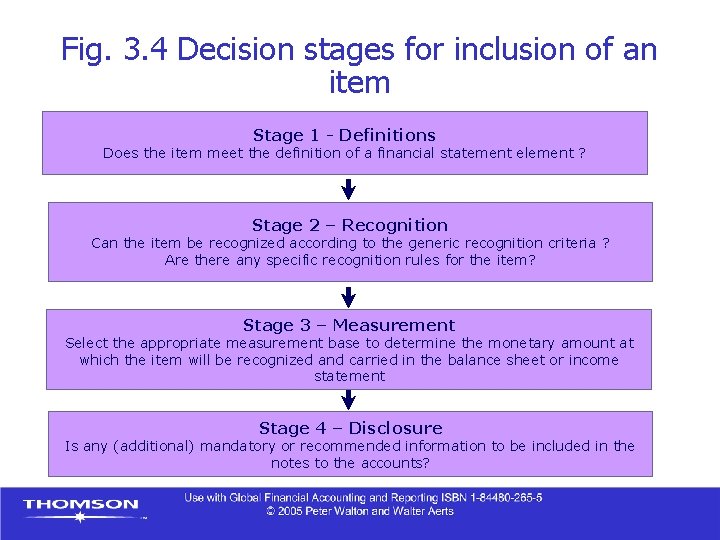
Fig. 3. 4 Decision stages for inclusion of an item Stage 1 - Definitions Does the item meet the definition of a financial statement element ? Stage 2 – Recognition Can the item be recognized according to the generic recognition criteria ? Are there any specific recognition rules for the item? Stage 3 – Measurement Select the appropriate measurement base to determine the monetary amount at which the item will be recognized and carried in the balance sheet or income statement Stage 4 – Disclosure Is any (additional) mandatory or recommended information to be included in the notes to the accounts?
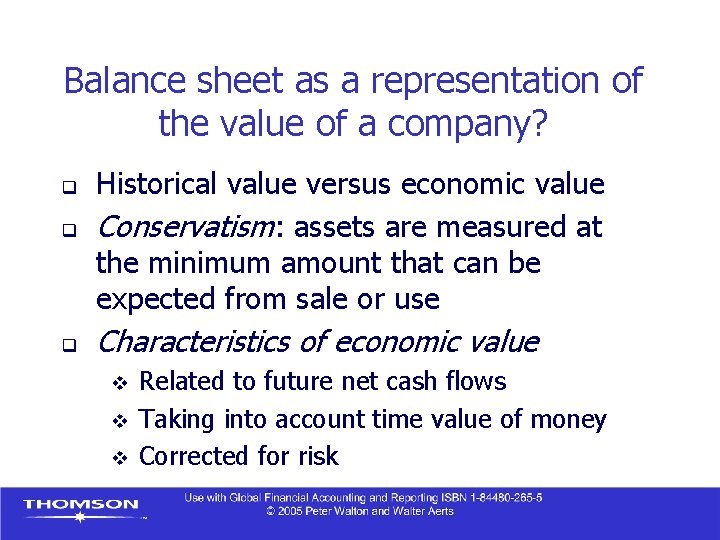
Balance sheet as a representation of the value of a company? q Historical value versus economic value Conservatism: assets are measured at the minimum amount that can be expected from sale or use q Characteristics of economic value q v v v Related to future net cash flows Taking into account time value of money Corrected for risk
- Slides: 71