
Chapter 3 Linear Algebra I Solving sets of
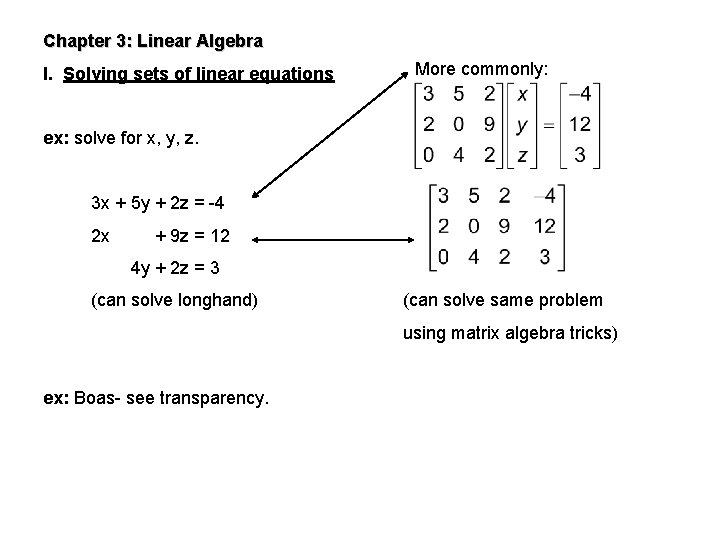
Chapter 3: Linear Algebra I. Solving sets of linear equations More commonly: ex: solve for x, y, z. 3 x + 5 y + 2 z = -4 2 x + 9 z = 12 4 y + 2 z = 3 (can solve longhand) (can solve same problem using matrix algebra tricks) ex: Boas- see transparency.
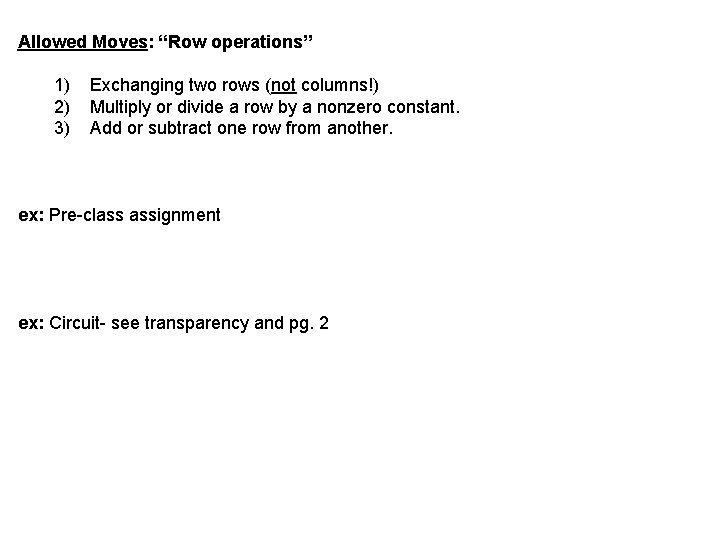
Allowed Moves: “Row operations” 1) 2) 3) Exchanging two rows (not columns!) Multiply or divide a row by a nonzero constant. Add or subtract one row from another. ex: Pre-class assignment ex: Circuit- see transparency and pg. 2
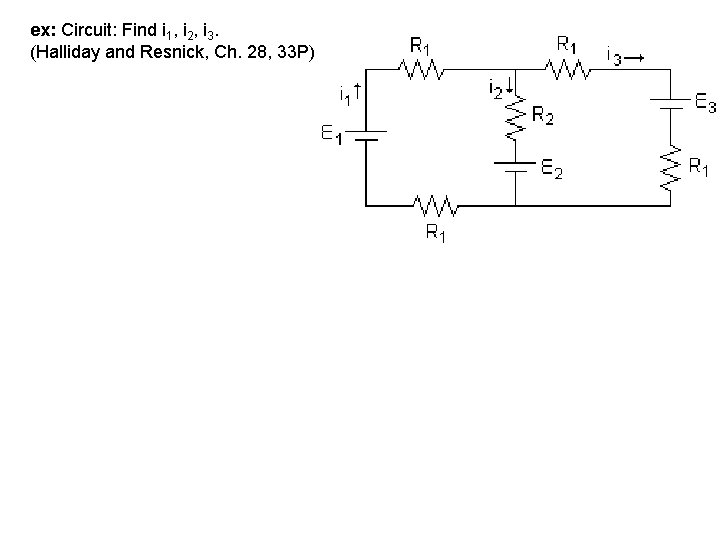
ex: Circuit: Find i 1, i 2, i 3. (Halliday and Resnick, Ch. 28, 33 P)

ex: Circuit (continued)
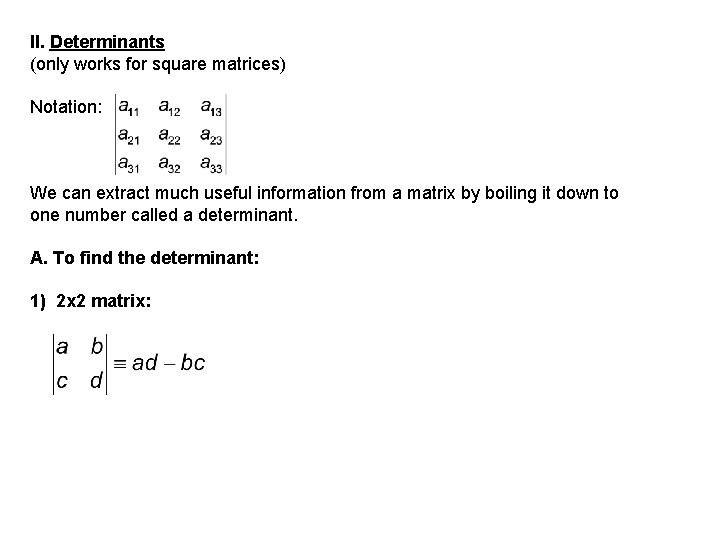
II. Determinants (only works for square matrices) Notation: We can extract much useful information from a matrix by boiling it down to one number called a determinant. A. To find the determinant: 1) 2 x 2 matrix:
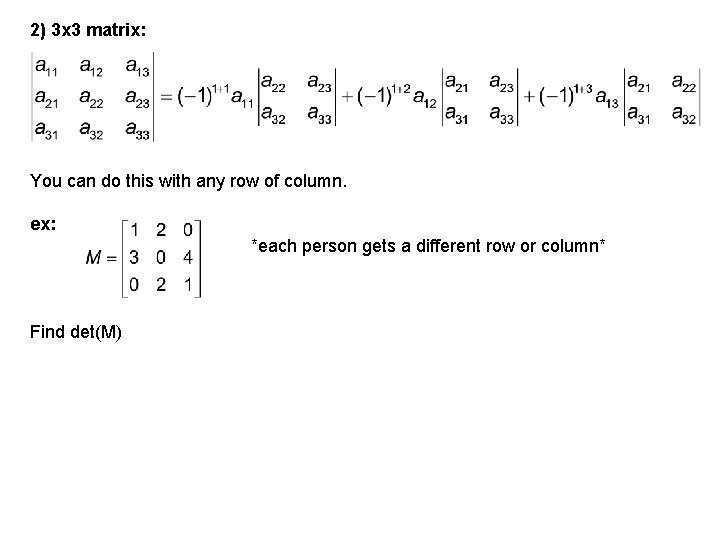
2) 3 x 3 matrix: You can do this with any row of column. ex: *each person gets a different row or column* Find det(M)
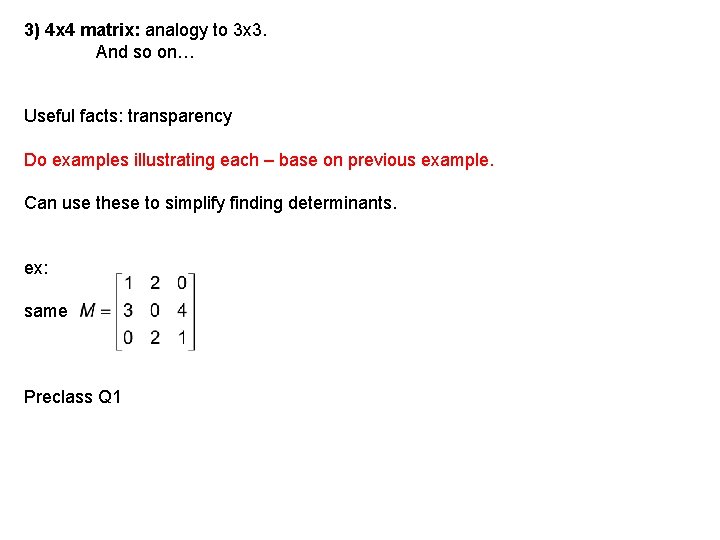
3) 4 x 4 matrix: analogy to 3 x 3. And so on… Useful facts: transparency Do examples illustrating each – base on previous example. Can use these to simplify finding determinants. ex: same Preclass Q 1
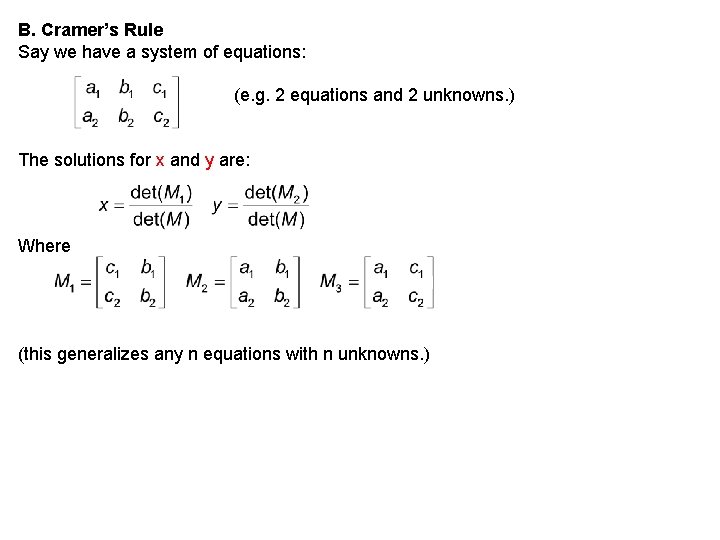
B. Cramer’s Rule Say we have a system of equations: (e. g. 2 equations and 2 unknowns. ) The solutions for x and y are: Where (this generalizes any n equations with n unknowns. )
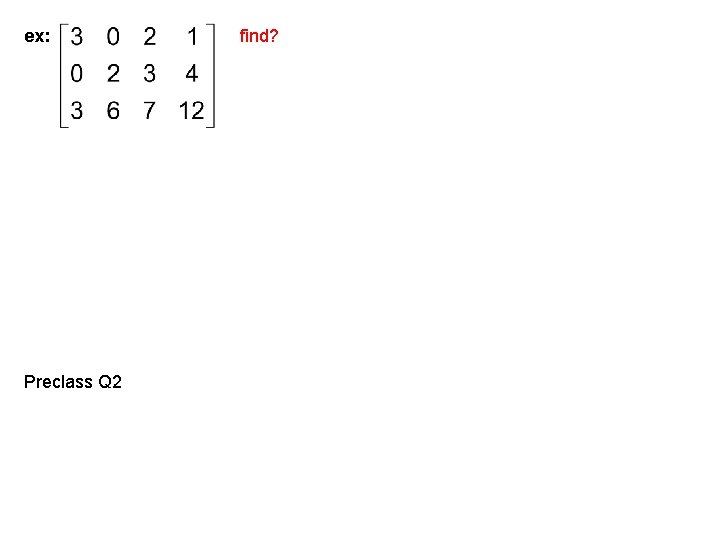
ex: Preclass Q 2 find?
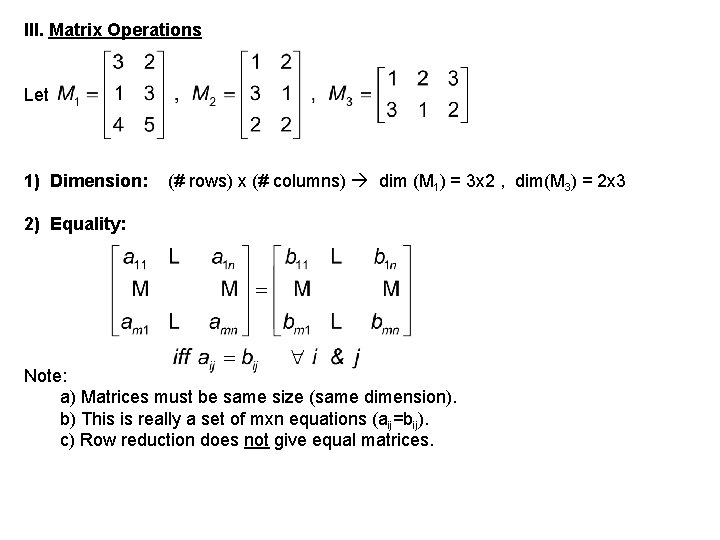
III. Matrix Operations Let 1) Dimension: (# rows) x (# columns) dim (M 1) = 3 x 2 , dim(M 3) = 2 x 3 2) Equality: Note: a) Matrices must be same size (same dimension). b) This is really a set of mxn equations (aij=bij). c) Row reduction does not give equal matrices.
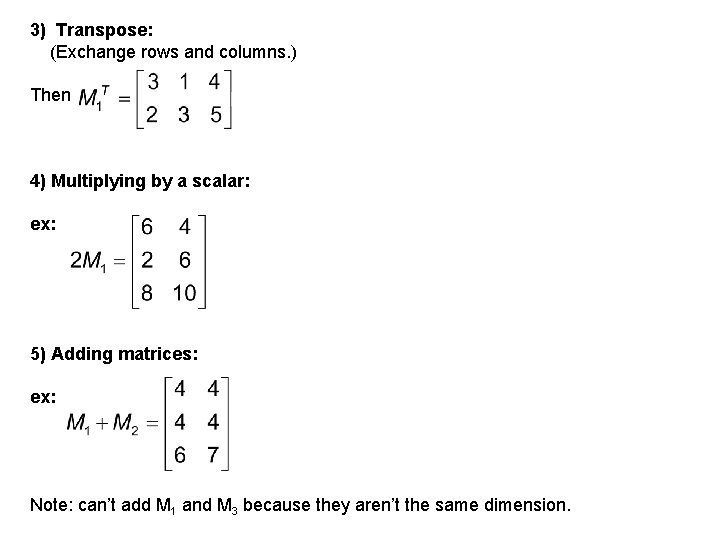
3) Transpose: (Exchange rows and columns. ) Then 4) Multiplying by a scalar: ex: 5) Adding matrices: ex: Note: can’t add M 1 and M 3 because they aren’t the same dimension.
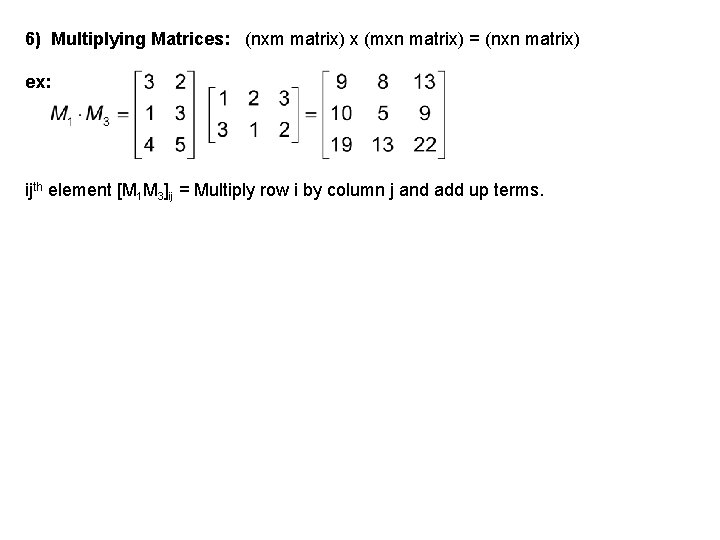
6) Multiplying Matrices: (nxm matrix) x (mxn matrix) = (nxn matrix) ex: ijth element [M 1 M 3]ij = Multiply row i by column j and add up terms.
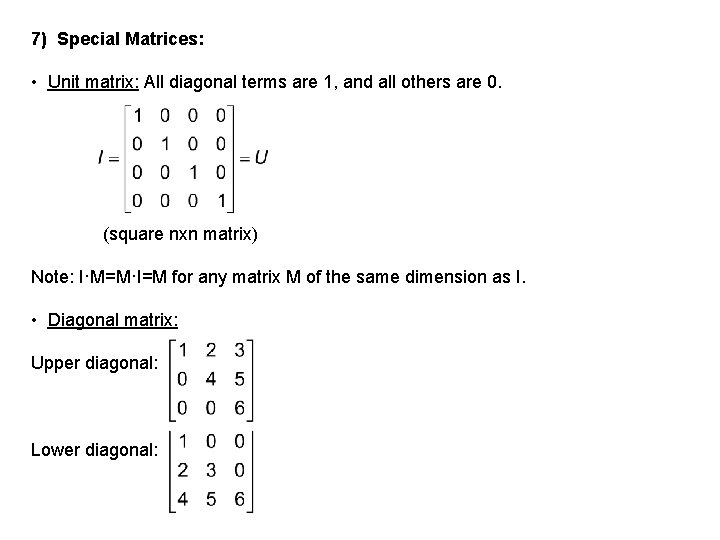
7) Special Matrices: • Unit matrix: All diagonal terms are 1, and all others are 0. (square nxn matrix) Note: I·M=M·I=M for any matrix M of the same dimension as I. • Diagonal matrix: Upper diagonal: Lower diagonal:
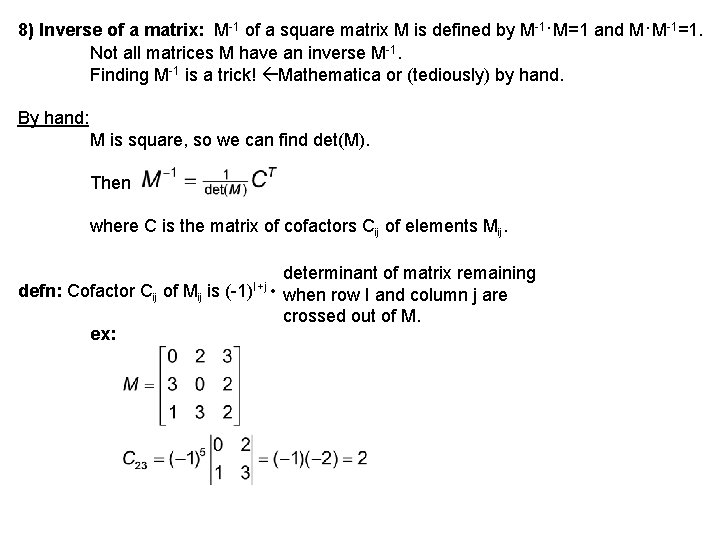
8) Inverse of a matrix: M-1 of a square matrix M is defined by M-1·M=1 and M·M-1=1. Not all matrices M have an inverse M-1. Finding M-1 is a trick! Mathematica or (tediously) by hand. By hand: M is square, so we can find det(M). Then where C is the matrix of cofactors Cij of elements Mij. defn: Cofactor Cij of Mij is ex: (-1)I+j • determinant of matrix remaining when row I and column j are crossed out of M.
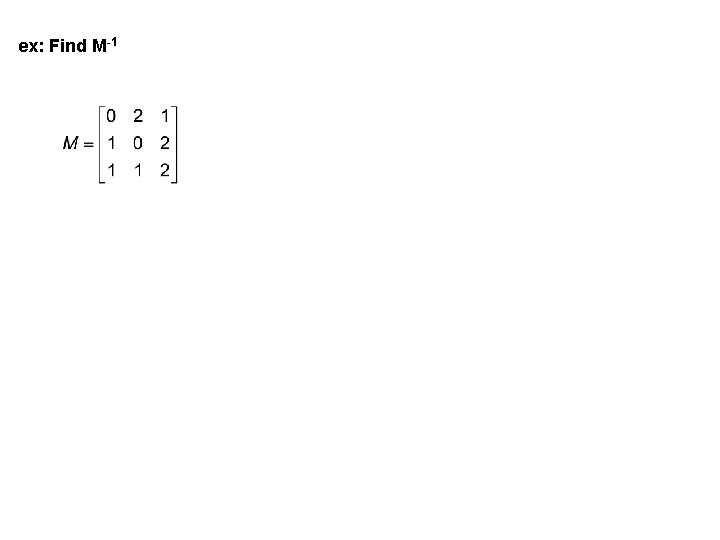
ex: Find M-1
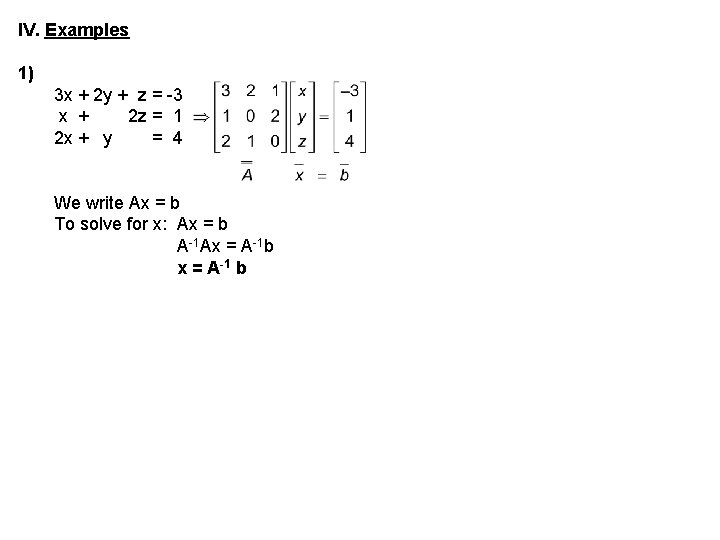
IV. Examples 1) 3 x + 2 y + z = -3 x + 2 z = 1 2 x + y = 4 We write Ax = b To solve for x: Ax = b A-1 Ax = A-1 b x = A-1 b
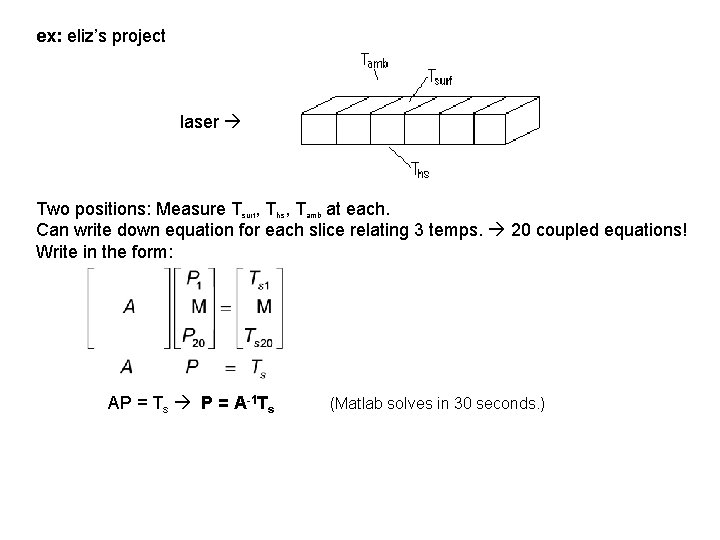
ex: eliz’s project laser Two positions: Measure Tsurf, Ths, Tamb at each. Can write down equation for each slice relating 3 temps. 20 coupled equations! Write in the form: AP = Ts P = A-1 Ts (Matlab solves in 30 seconds. )
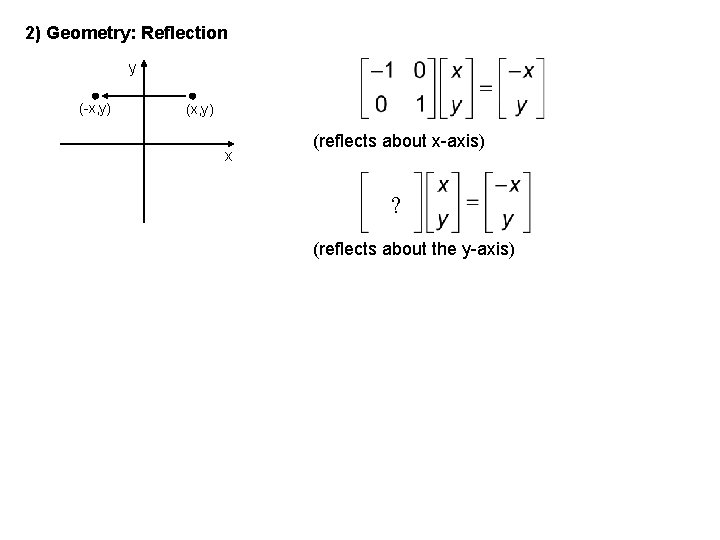
2) Geometry: Reflection y (-x, y) (x, y) x (reflects about x-axis) ? (reflects about the y-axis)
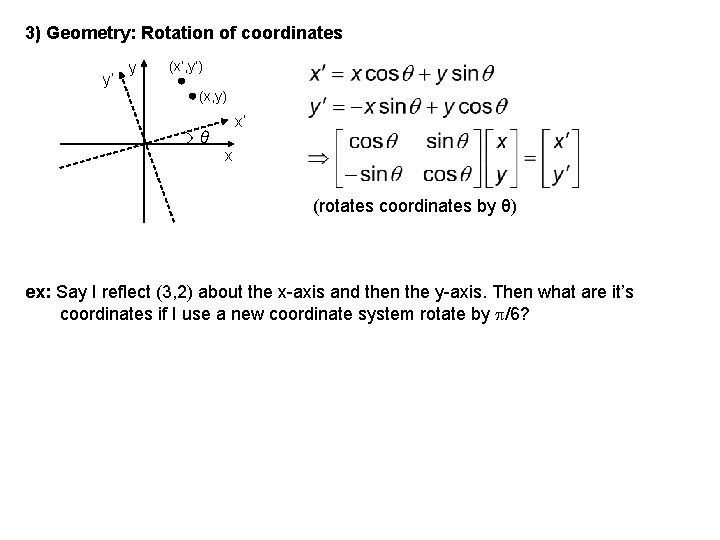
3) Geometry: Rotation of coordinates y’ y (x’, y’) (x, y) x’ θ x (rotates coordinates by θ) ex: Say I reflect (3, 2) about the x-axis and then the y-axis. Then what are it’s coordinates if I use a new coordinate system rotate by /6?
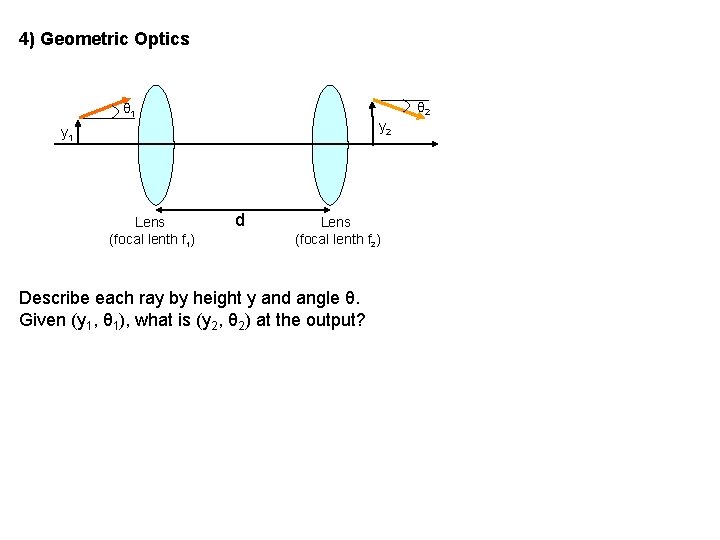
4) Geometric Optics θ 2 θ 1 y 2 y 1 Lens (focal lenth f 1) d Lens (focal lenth f 2) Describe each ray by height y and angle θ. Given (y 1, θ 1), what is (y 2, θ 2) at the output?
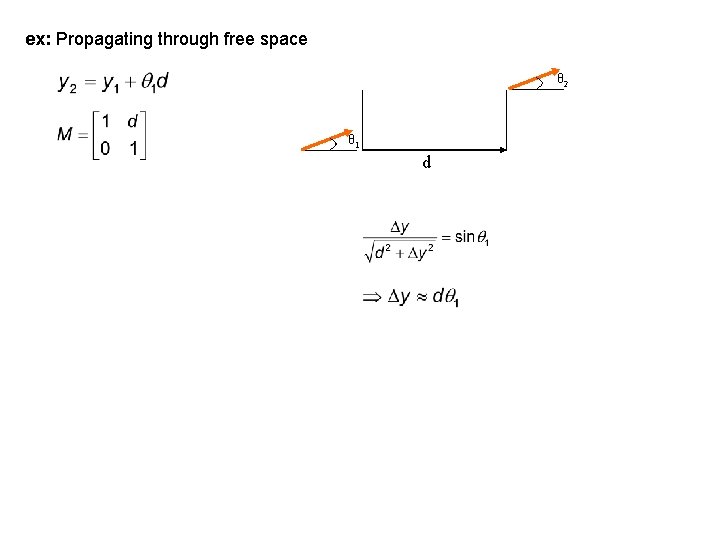
ex: Propagating through free space θ 2 θ 1 d
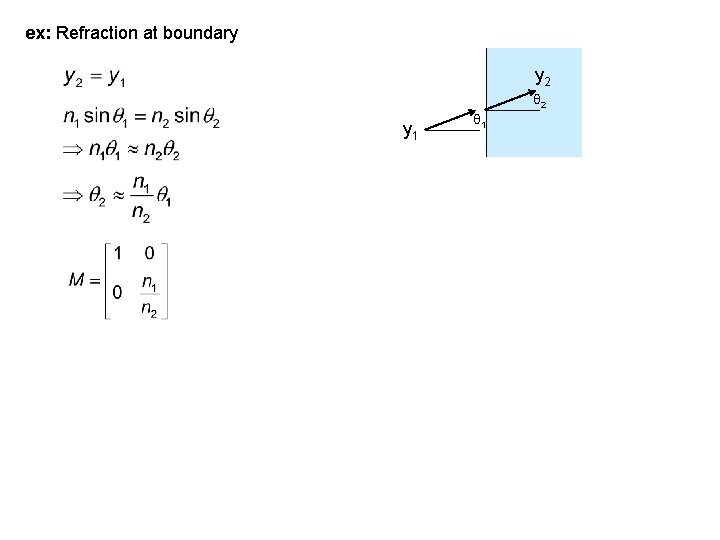
ex: Refraction at boundary y 2 θ 2 y 1 θ 1
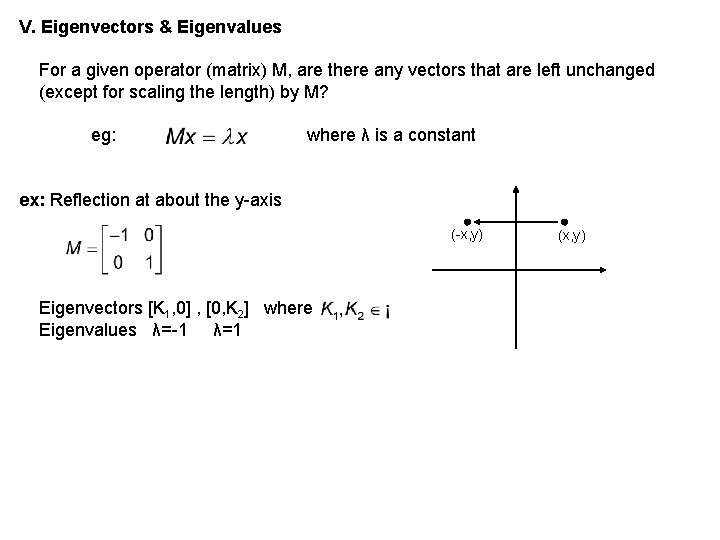
V. Eigenvectors & Eigenvalues For a given operator (matrix) M, are there any vectors that are left unchanged (except for scaling the length) by M? eg: where λ is a constant ex: Reflection at about the y-axis (-x, y) Eigenvectors [K 1, 0] , [0, K 2] where Eigenvalues λ=-1 λ=1 (x, y)
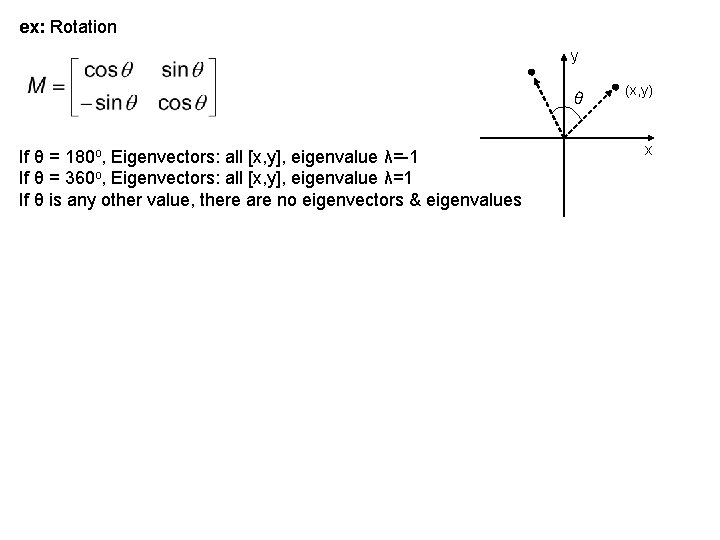
ex: Rotation y θ If θ = 180 o, Eigenvectors: all [x, y], eigenvalue λ=-1 If θ = 360 o, Eigenvectors: all [x, y], eigenvalue λ=1 If θ is any other value, there are no eigenvectors & eigenvalues (x, y) x
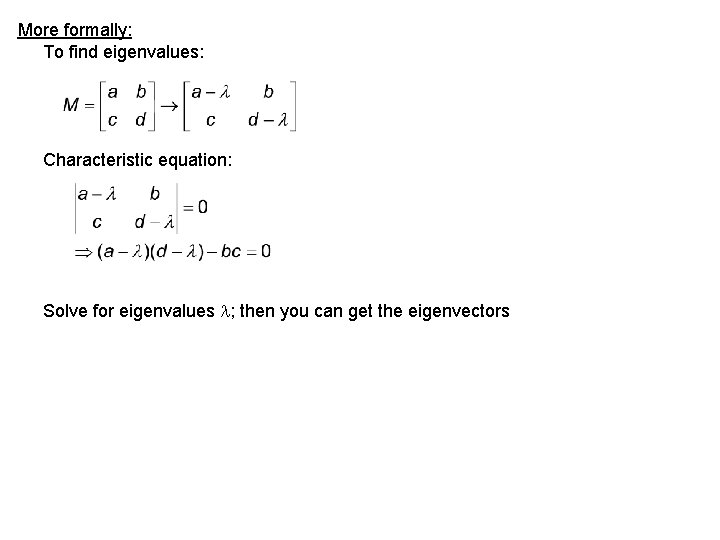
More formally: To find eigenvalues: Characteristic equation: Solve for eigenvalues ; then you can get the eigenvectors
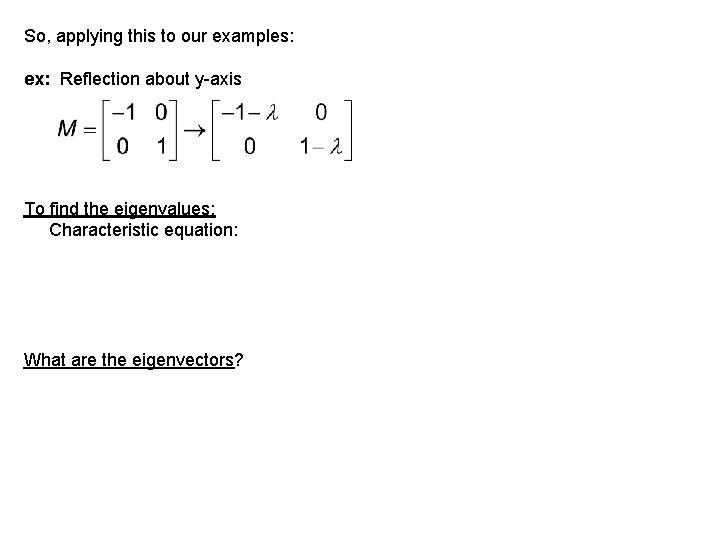
So, applying this to our examples: ex: Reflection about y-axis To find the eigenvalues: Characteristic equation: What are the eigenvectors?
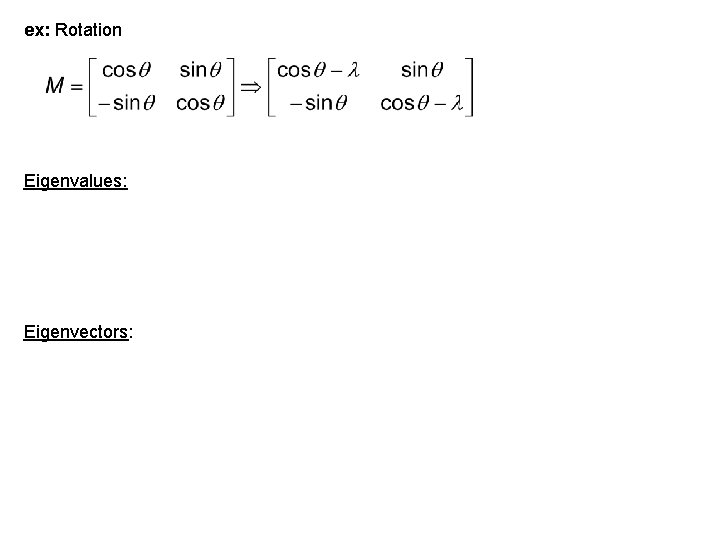
ex: Rotation Eigenvalues: Eigenvectors:
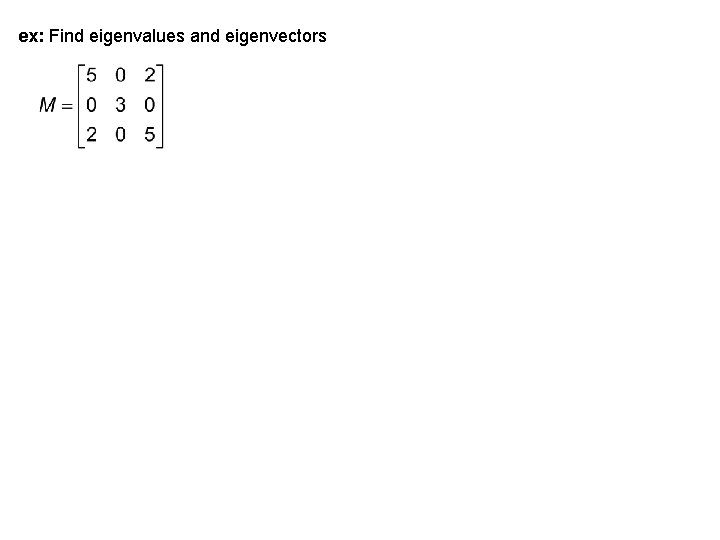
ex: Find eigenvalues and eigenvectors
- Slides: 28