
Chapter 3 Lecture Outline Prepared by Ashlyn Smith
Chapter 3 Lecture Outline Prepared by Ashlyn Smith Anderson University 1 Copyright © Mc. Graw-Hill Education. Permission required for reproduction or display.
3. 1 Introduction to Bonding • Bonding is the joining of two atoms in a stable arrangement. • Elements will gain, lose, or share electrons to reach the electron configuration of the noble gas closest to them in the periodic table. • There are two different kinds of bonding: 1. Ionic bonds result from the transfer of electrons from one element to another. 2. Covalent bonds result from the sharing of electrons between two atoms. 2
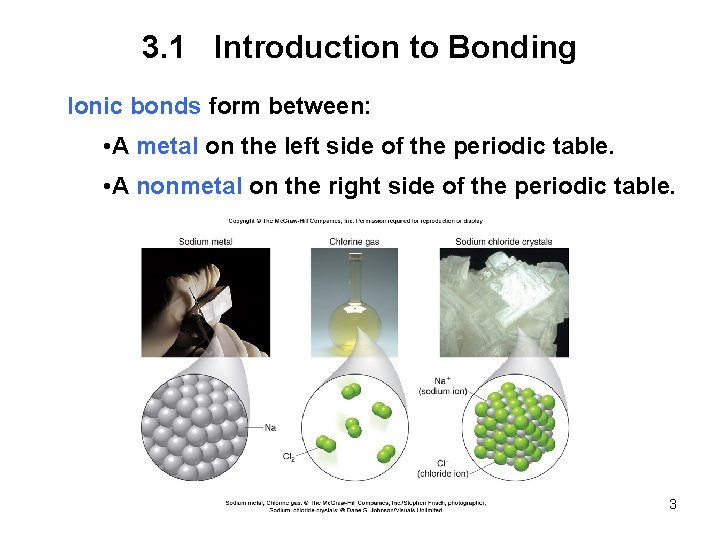
3. 1 Introduction to Bonding Ionic bonds form between: • A metal on the left side of the periodic table. • A nonmetal on the right side of the periodic table. 3
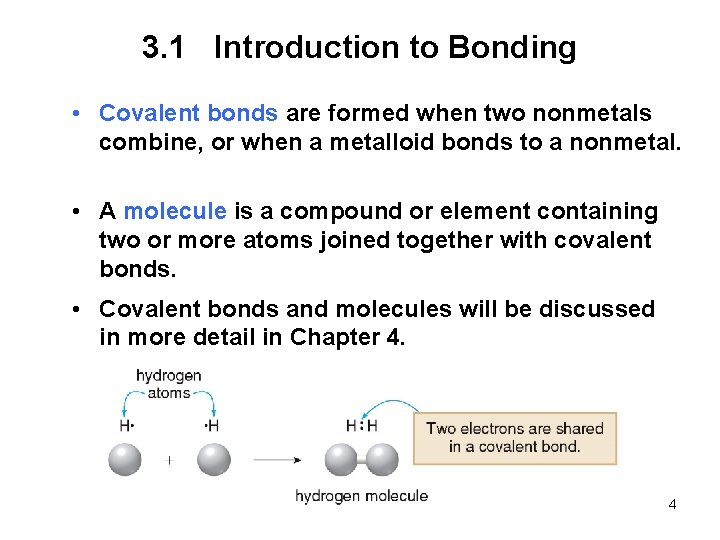
3. 1 Introduction to Bonding • Covalent bonds are formed when two nonmetals combine, or when a metalloid bonds to a nonmetal. • A molecule is a compound or element containing two or more atoms joined together with covalent bonds. • Covalent bonds and molecules will be discussed in more detail in Chapter 4. 4
3. 2 Ions A. Cations and Anions • Ions are charged species in which the number of protons and electrons in an atom is unequal. • Ionic compounds consist of oppositely charged ions that have a strong electrostatic attraction for each other. • There are two types of ions—cations and anions. 5

3. 2 Ions A. Cations and Anions Cations are positively charged ions. A cation has fewer electrons (e−) than protons. the sodium atom the sodium ion 6
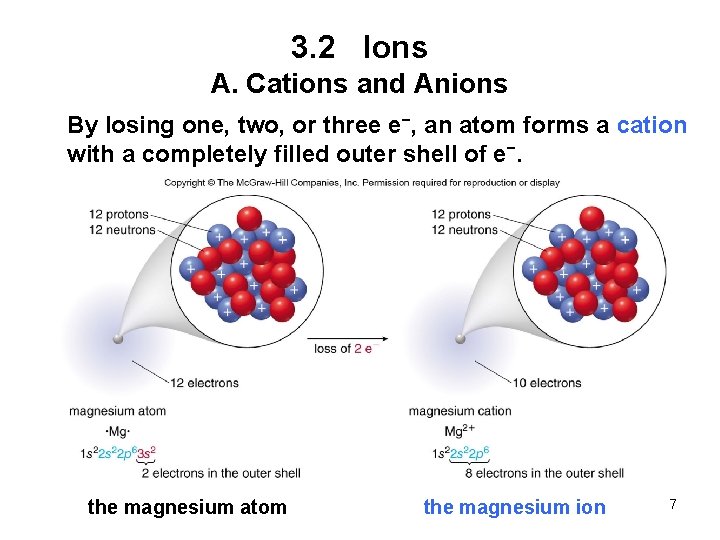
3. 2 Ions A. Cations and Anions By losing one, two, or three e−, an atom forms a cation with a completely filled outer shell of e−. the magnesium atom the magnesium ion 7
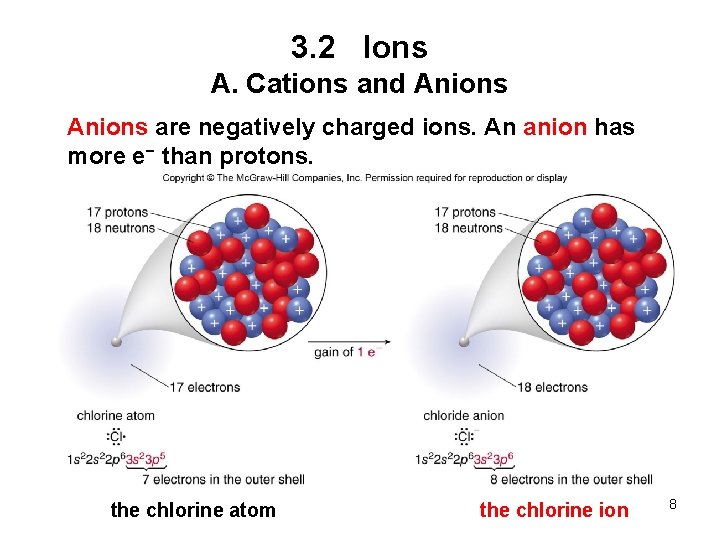
3. 2 Ions A. Cations and Anions are negatively charged ions. An anion has more e− than protons. the chlorine atom the chlorine ion 8
3. 2 Ions A. Cations and Anions • Metals, like sodium (Na) and magnesium (Mg), form cations. • By losing one, two, or three electrons, an atom forms a cation with a completely filled outer shell of electrons. • Nonmetals, like chlorine (Cl), form anions. • By gaining one, two, or three electrons, an atom forms an anion with a completely filled outer shell of e−. • The octet rule: a main group element is especially stable when it possesses an octet of e− in its outer shell. octet = 8 valence e− 9
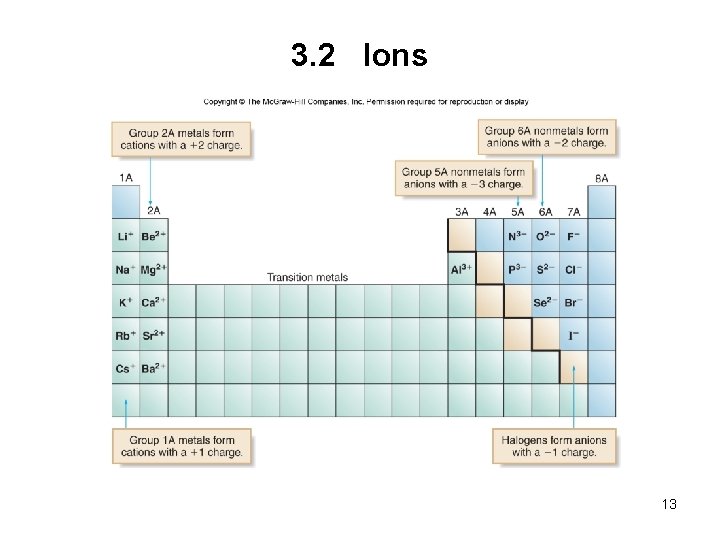
3. 2 Ions B. Relating Group Number to Ionic Charge for Main Group Elements • Elements in the same group form ions of similar charge. • For metals in groups 1 A, 2 A, and 3 A, the group number = the charge on the cation. • For nonmetals in Groups 6 A and 7 A, the anion charge = 8 – the group number. 10
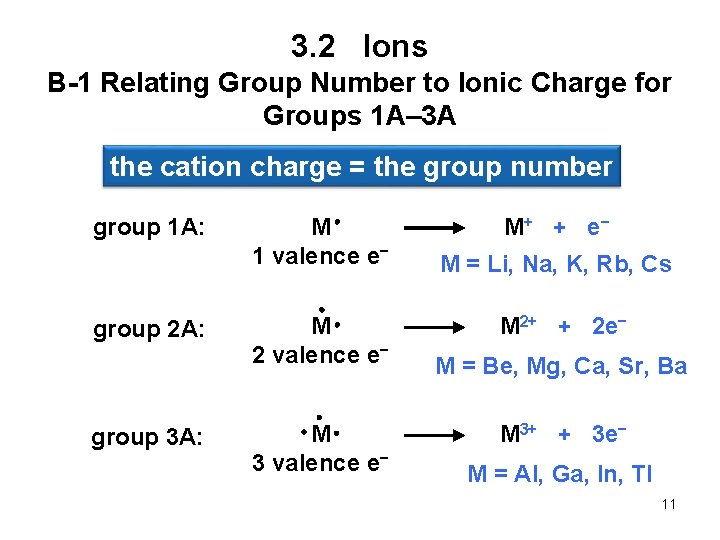
3. 2 Ions B-1 Relating Group Number to Ionic Charge for Groups 1 A– 3 A the cation charge = the group number group 1 A: group 2 A: group 3 A: M 1 valence e− M 2 valence e− M 3 valence e− M+ + e − M = Li, Na, K, Rb, Cs M 2+ + 2 e− M = Be, Mg, Ca, Sr, Ba M 3+ + 3 e− M = Al, Ga, In, Tl 11
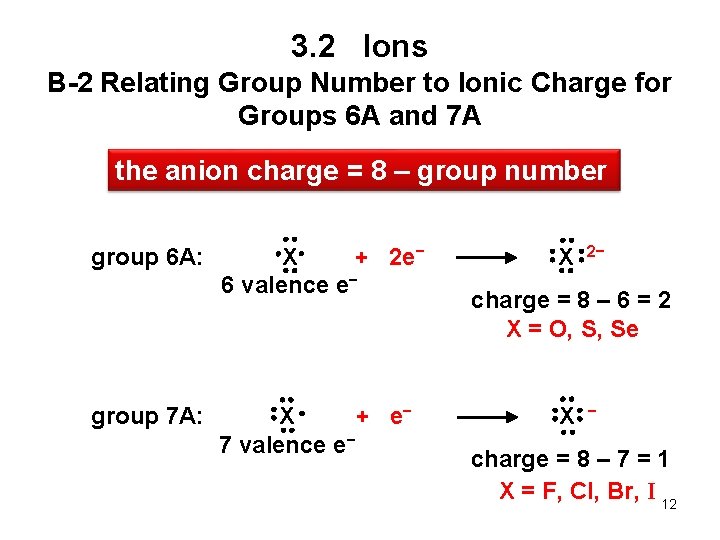
3. 2 Ions B-2 Relating Group Number to Ionic Charge for Groups 6 A and 7 A the anion charge = 8 – group number group 6 A: group 7 A: X + 2 e− 6 valence e− X + e− 7 valence e− X 2− charge = 8 – 6 = 2 X = O, S, Se X − charge = 8 – 7 = 1 X = F, Cl, Br, I 12
3. 2 Ions 13
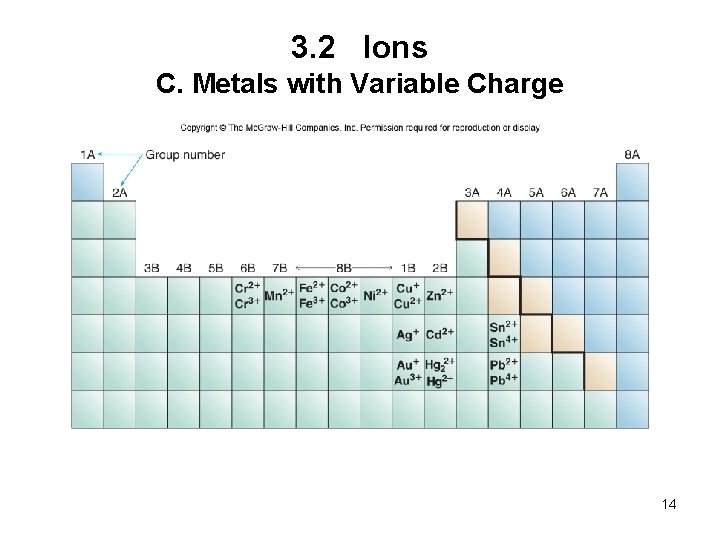
3. 2 Ions C. Metals with Variable Charge 14
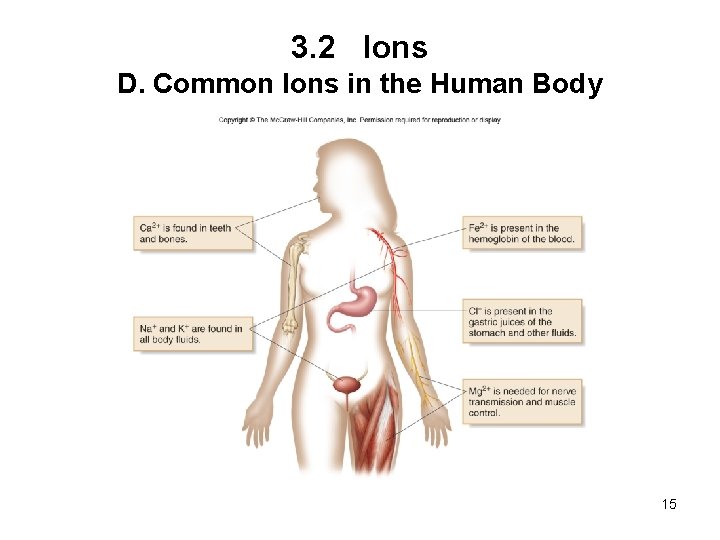
3. 2 Ions D. Common Ions in the Human Body 15
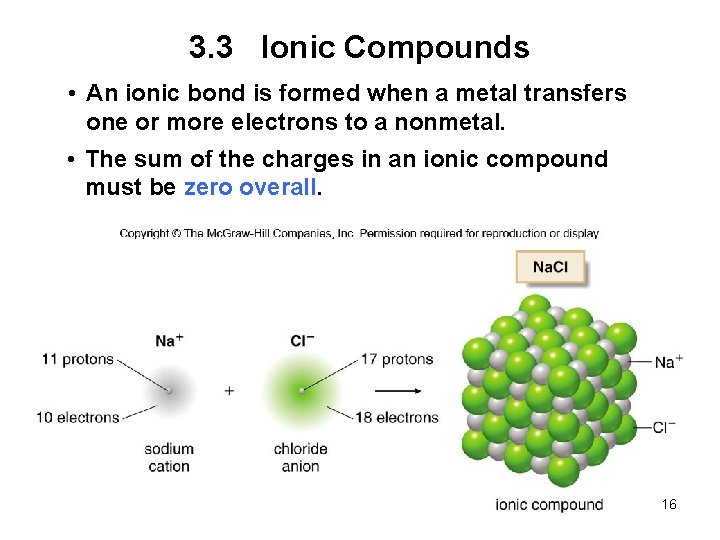
3. 3 Ionic Compounds • An ionic bond is formed when a metal transfers one or more electrons to a nonmetal. • The sum of the charges in an ionic compound must be zero overall. 16
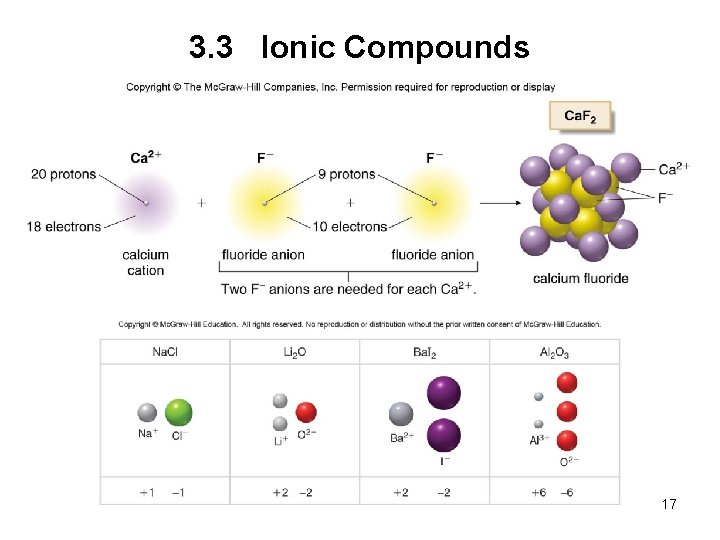
3. 3 Ionic Compounds 17
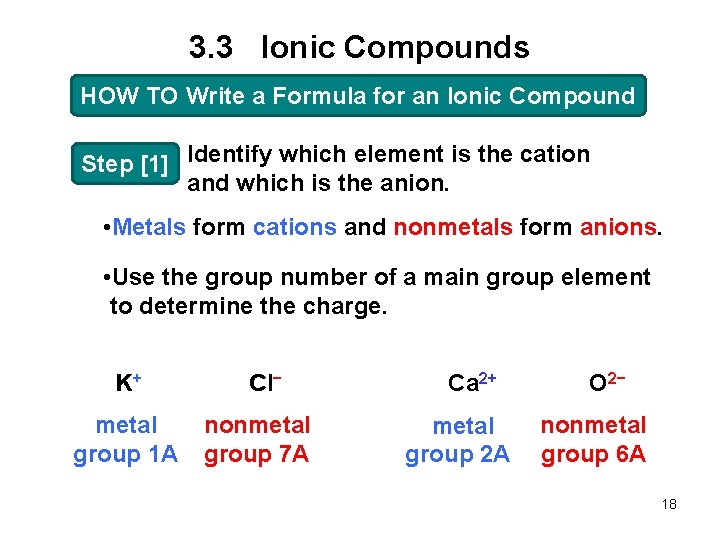
3. 3 Ionic Compounds HOW TO Write a Formula for an Ionic Compound Step [1] Identify which element is the cation and which is the anion. • Metals form cations and nonmetals form anions. • Use the group number of a main group element to determine the charge. K+ metal group 1 A Cl− nonmetal group 7 A Ca 2+ metal group 2 A O 2− nonmetal group 6 A 18
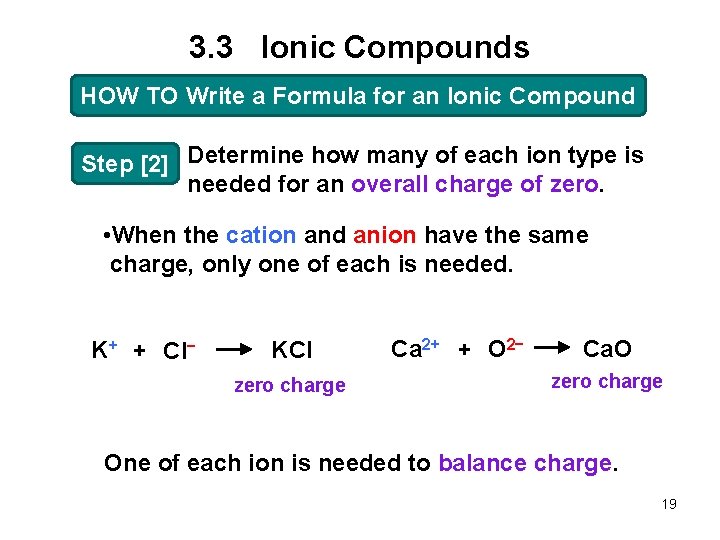
3. 3 Ionic Compounds HOW TO Write a Formula for an Ionic Compound Step [2] Determine how many of each ion type is needed for an overall charge of zero. • When the cation and anion have the same charge, only one of each is needed. K+ + Cl− KCl zero charge Ca 2+ + O 2− Ca. O zero charge One of each ion is needed to balance charge. 19
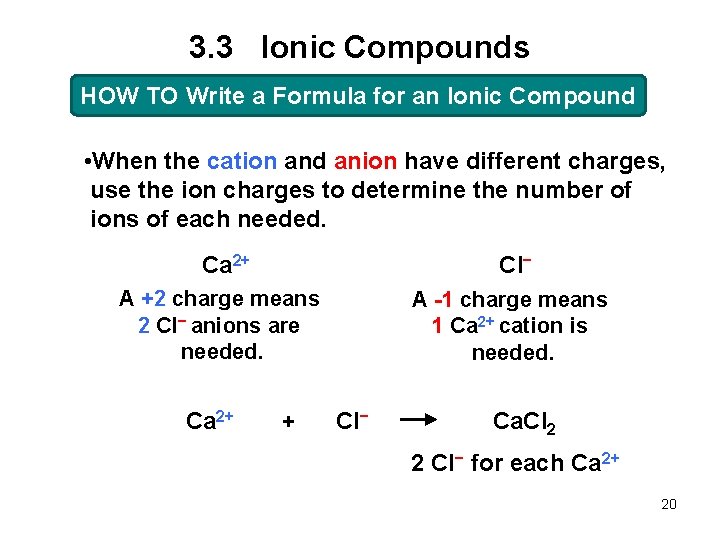
3. 3 Ionic Compounds HOW TO Write a Formula for an Ionic Compound • When the cation and anion have different charges, use the ion charges to determine the number of ions of each needed. Ca 2+ Cl− A +2 charge means 2 Cl− anions are needed. Ca 2+ + A -1 charge means 1 Ca 2+ cation is needed. Cl− Ca. Cl 2 2 Cl− for each Ca 2+ 20
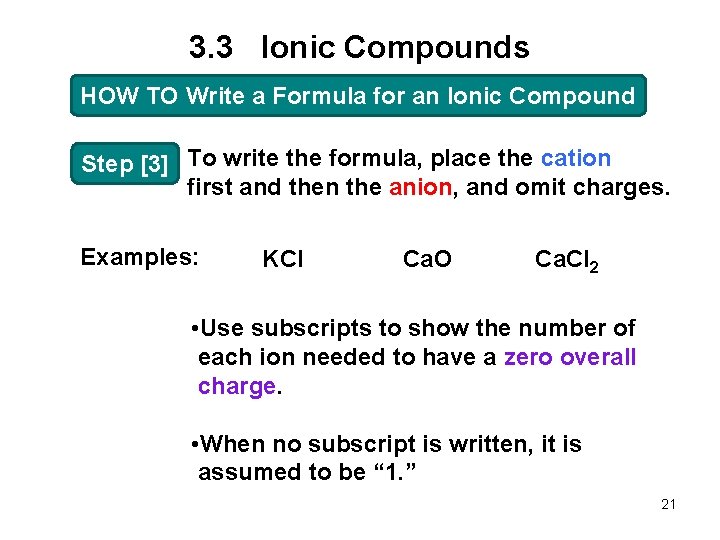
3. 3 Ionic Compounds HOW TO Write a Formula for an Ionic Compound Step [3] To write the formula, place the cation first and then the anion, and omit charges. Examples: KCl Ca. O Ca. Cl 2 • Use subscripts to show the number of each ion needed to have a zero overall charge. • When no subscript is written, it is assumed to be “ 1. ” 21
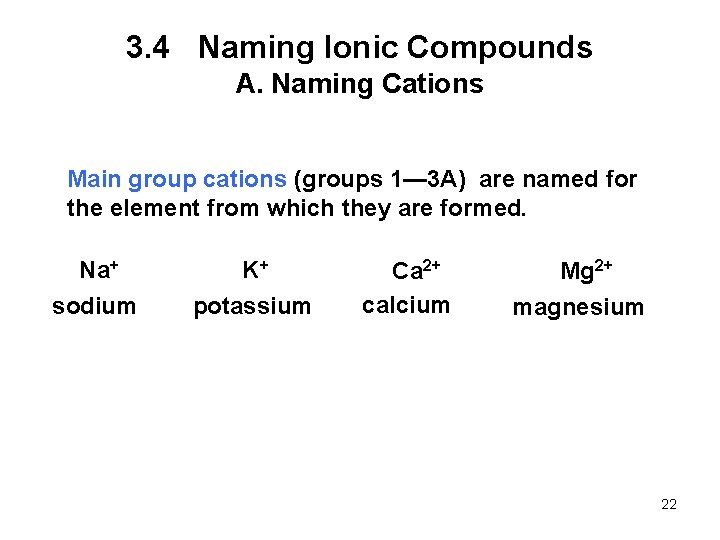
3. 4 Naming Ionic Compounds A. Naming Cations Main group cations (groups 1— 3 A) are named for the element from which they are formed. Na+ sodium K+ potassium Ca 2+ calcium Mg 2+ magnesium 22
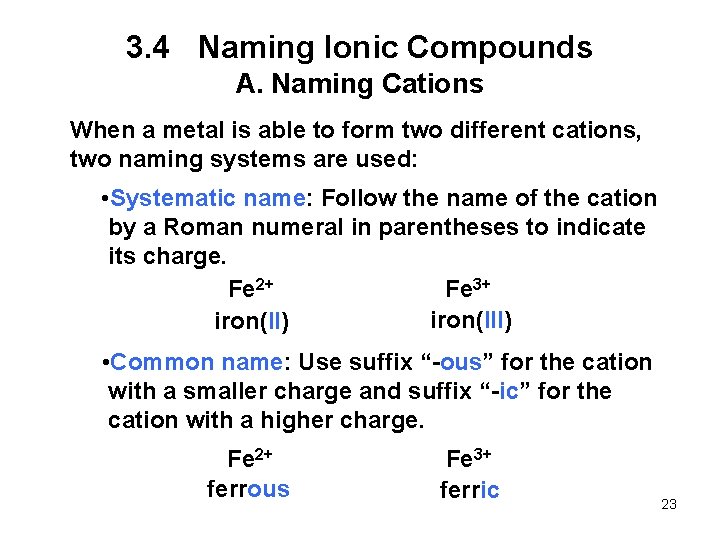
3. 4 Naming Ionic Compounds A. Naming Cations When a metal is able to form two different cations, two naming systems are used: • Systematic name: Follow the name of the cation by a Roman numeral in parentheses to indicate its charge. Fe 2+ Fe 3+ iron(III) iron(II) • Common name: Use suffix “-ous” for the cation with a smaller charge and suffix “-ic” for the cation with a higher charge. Fe 2+ ferrous Fe 3+ ferric 23
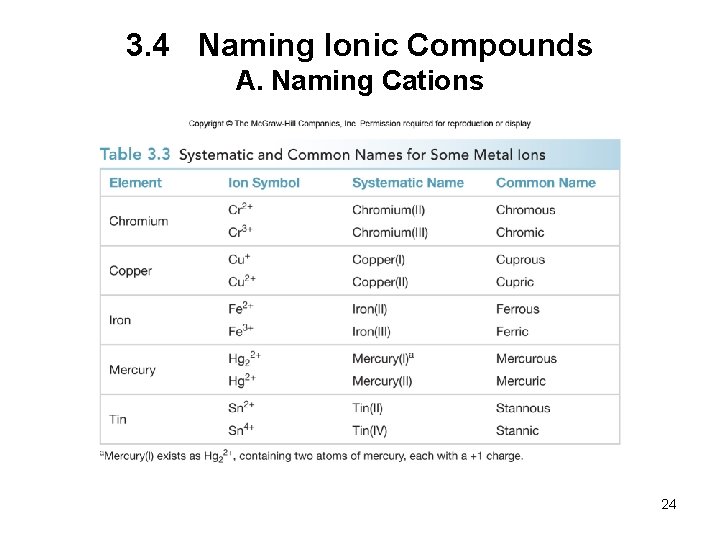
3. 4 Naming Ionic Compounds A. Naming Cations 24
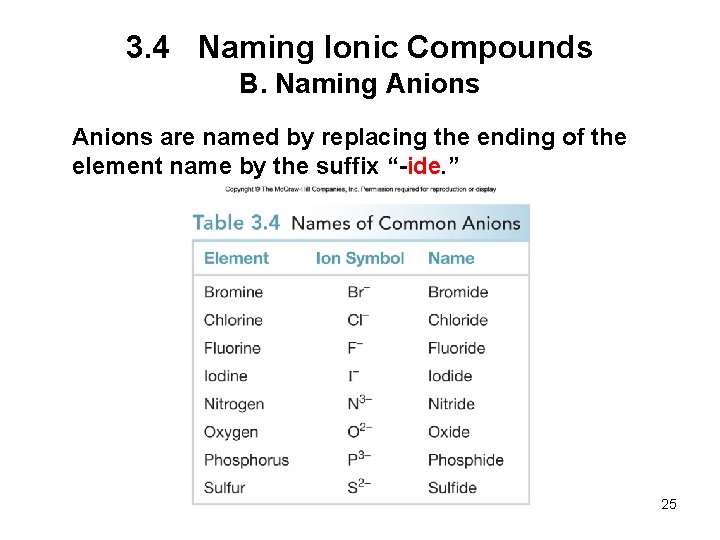
3. 4 Naming Ionic Compounds B. Naming Anions are named by replacing the ending of the element name by the suffix “-ide. ” 25
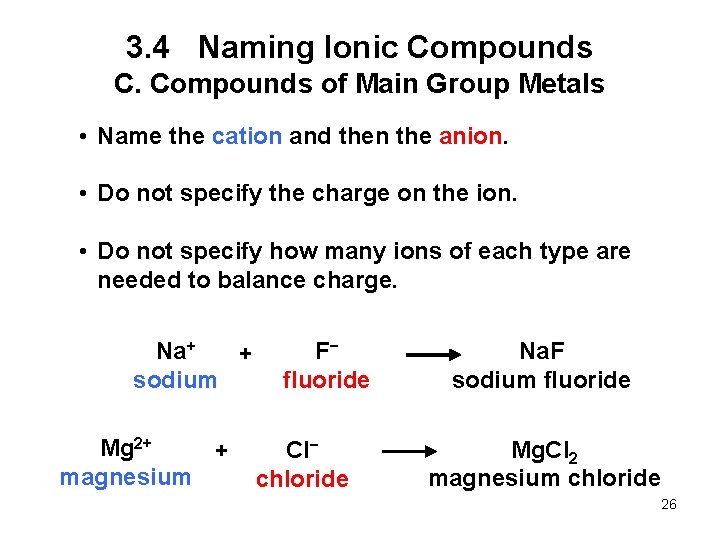
3. 4 Naming Ionic Compounds C. Compounds of Main Group Metals • Name the cation and then the anion. • Do not specify the charge on the ion. • Do not specify how many ions of each type are needed to balance charge. Na+ + sodium Mg 2+ + magnesium F− fluoride Cl− chloride Na. F sodium fluoride Mg. Cl 2 magnesium chloride 26
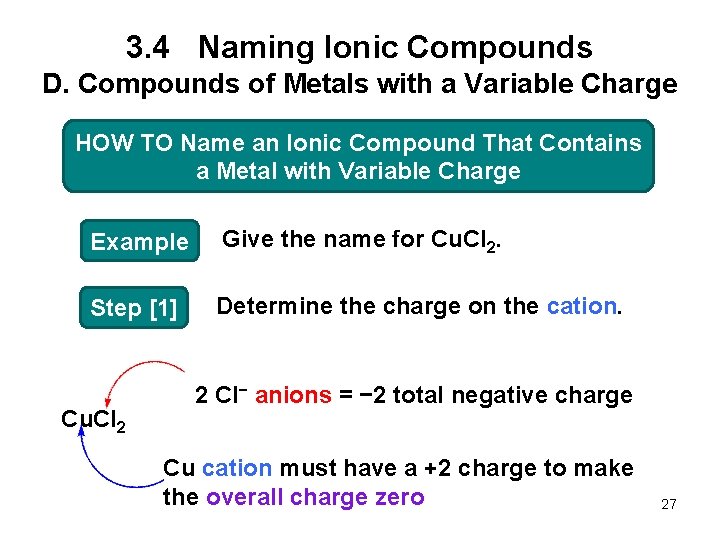
3. 4 Naming Ionic Compounds D. Compounds of Metals with a Variable Charge HOW TO Name an Ionic Compound That Contains a Metal with Variable Charge Example Give the name for Cu. Cl 2. Step [1] Determine the charge on the cation. Cu. Cl 2 2 Cl− anions = − 2 total negative charge Cu cation must have a +2 charge to make the overall charge zero 27
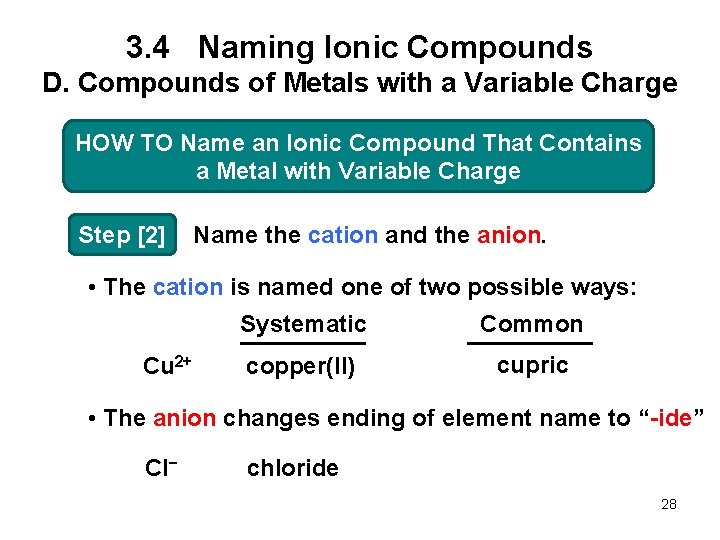
3. 4 Naming Ionic Compounds D. Compounds of Metals with a Variable Charge HOW TO Name an Ionic Compound That Contains a Metal with Variable Charge Step [2] Name the cation and the anion. • The cation is named one of two possible ways: Cu 2+ Systematic Common copper(II) cupric • The anion changes ending of element name to “-ide” Cl− chloride 28
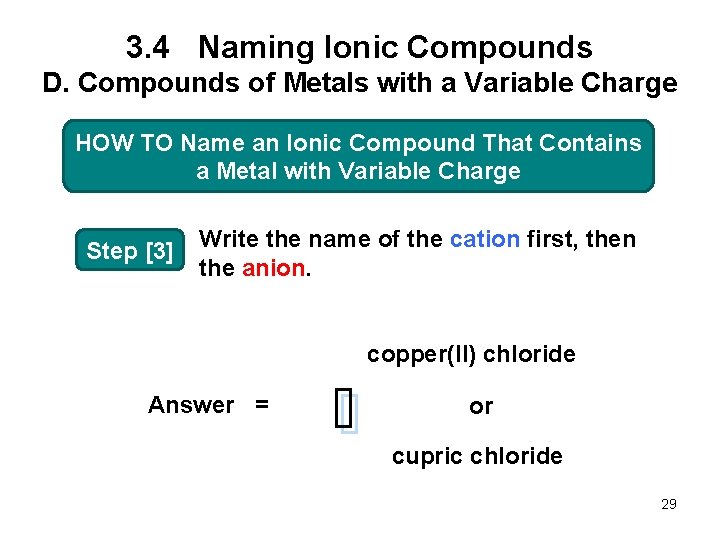
3. 4 Naming Ionic Compounds D. Compounds of Metals with a Variable Charge HOW TO Name an Ionic Compound That Contains a Metal with Variable Charge Step [3] Write the name of the cation first, then the anion. copper(II) chloride Answer = or cupric chloride 29
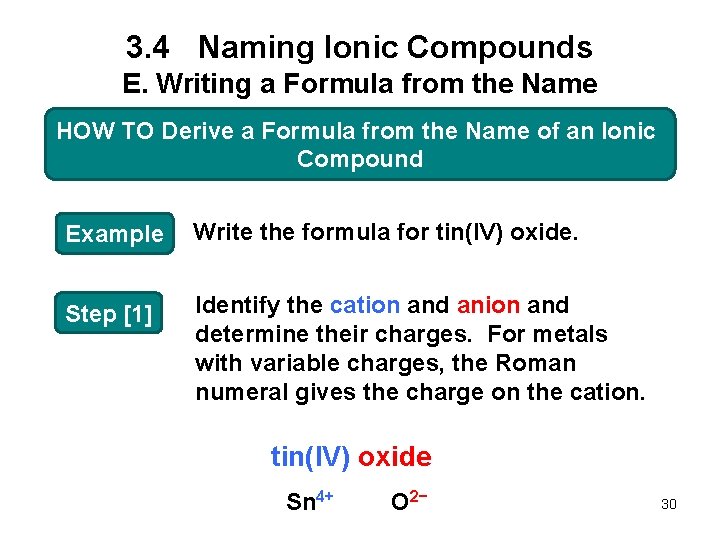
3. 4 Naming Ionic Compounds E. Writing a Formula from the Name HOW TO Derive a Formula from the Name of an Ionic Compound Example Write the formula for tin(IV) oxide. Step [1] Identify the cation and anion and determine their charges. For metals with variable charges, the Roman numeral gives the charge on the cation. tin(IV) oxide Sn 4+ O 2− 30
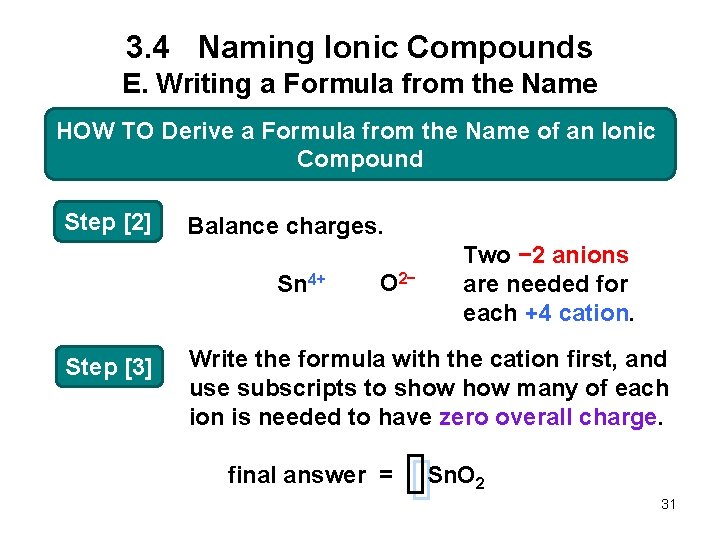
3. 4 Naming Ionic Compounds E. Writing a Formula from the Name HOW TO Derive a Formula from the Name of an Ionic Compound Step [2] Balance charges. Sn 4+ Step [3] O 2− Two − 2 anions are needed for each +4 cation. Write the formula with the cation first, and use subscripts to show many of each ion is needed to have zero overall charge. final answer = Sn. O 2 31
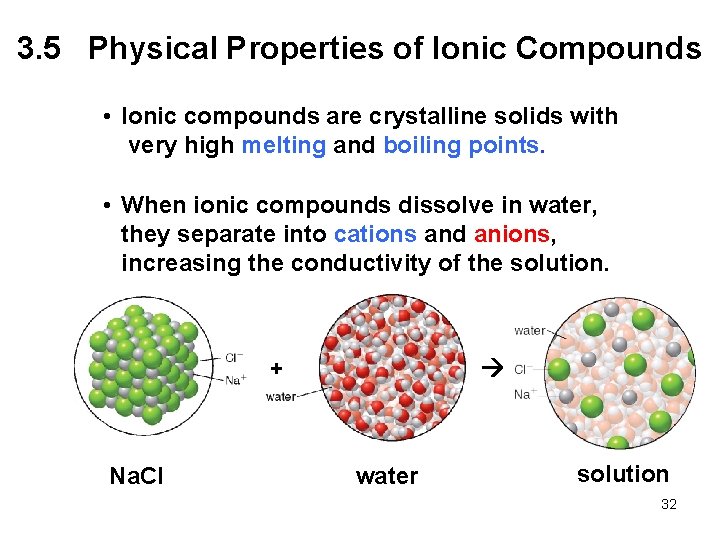
3. 5 Physical Properties of Ionic Compounds • Ionic compounds are crystalline solids with very high melting and boiling points. • When ionic compounds dissolve in water, they separate into cations and anions, increasing the conductivity of the solution. + Na. Cl water solution 32
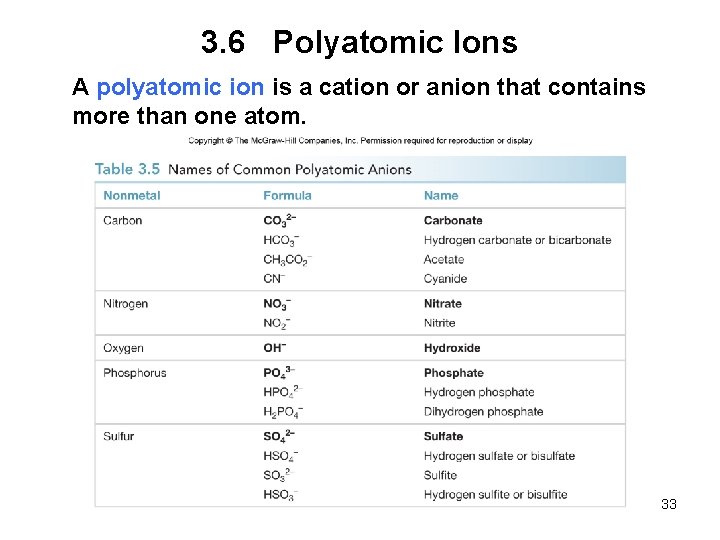
3. 6 Polyatomic Ions A polyatomic ion is a cation or anion that contains more than one atom. 33
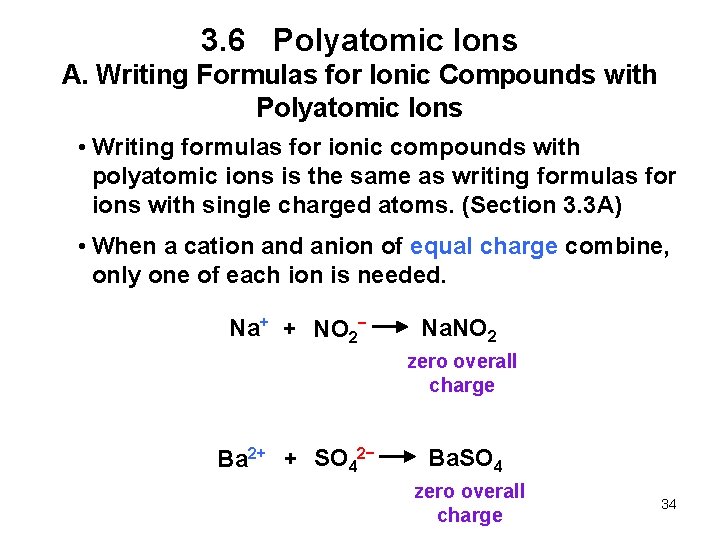
3. 6 Polyatomic Ions A. Writing Formulas for Ionic Compounds with Polyatomic Ions • Writing formulas for ionic compounds with polyatomic ions is the same as writing formulas for ions with single charged atoms. (Section 3. 3 A) • When a cation and anion of equal charge combine, only one of each ion is needed. Na+ + NO 2− Na. NO 2 zero overall charge Ba 2+ + SO 42− Ba. SO 4 zero overall charge 34
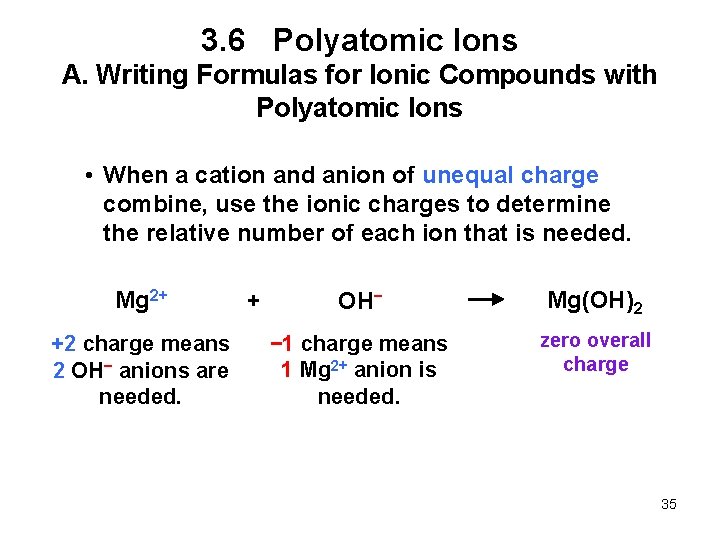
3. 6 Polyatomic Ions A. Writing Formulas for Ionic Compounds with Polyatomic Ions • When a cation and anion of unequal charge combine, use the ionic charges to determine the relative number of each ion that is needed. Mg 2+ +2 charge means 2 OH− anions are needed. + OH− Mg(OH)2 − 1 charge means 1 Mg 2+ anion is needed. zero overall charge 35
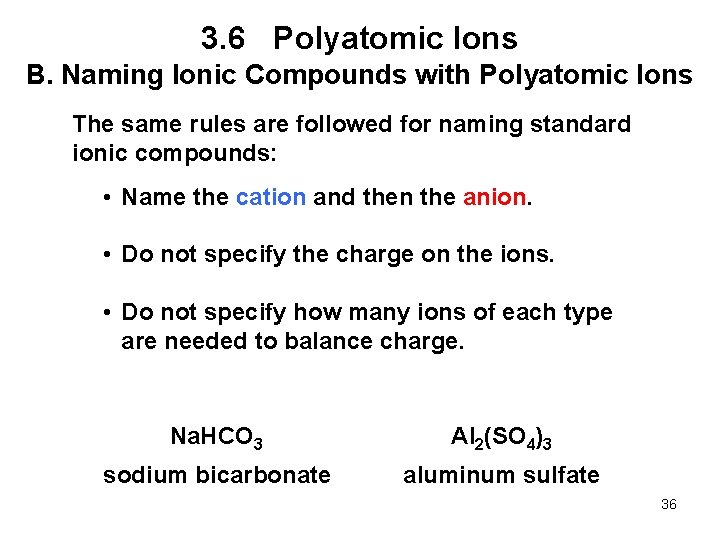
3. 6 Polyatomic Ions B. Naming Ionic Compounds with Polyatomic Ions The same rules are followed for naming standard ionic compounds: • Name the cation and then the anion. • Do not specify the charge on the ions. • Do not specify how many ions of each type are needed to balance charge. Na. HCO 3 Al 2(SO 4)3 sodium bicarbonate aluminum sulfate 36
- Slides: 36