
Chapter 3 Key Issue 1 WHERE ARE THE

- Slides: 17
Chapter 3 Key Issue 1 WHERE ARE THE WORLD’S MIGRANTS DISTRIBUTED?
Big Question Create a chart telling what migration is and describing the different types of migration and give examples: emigration; immigration; international; internal; voluntary; forced; interregional; and intraregional. Describe the basics of Ravenstein’s Laws of Migration and how they help us understand migration.
Key Terms Migration Mobility Circulation Emigration Immigration Net Migration Push Factors Pull Factors Ravenstein’s Laws of Migration Step Migration Counter Migration International Migration Zelinsky’s Migration Transition Model Voluntary Migration Forced Migration Interregional Migration Intraregional Migration
Introducing Migration A permanent move to a new location is known as migration Migration helps to spread certain characteristics such as culture, religion, and language through relocation diffusion and humans have been migrating around Earth since the beginning Migration Other is a type of mobility forms of mobility include daily commutes to work, school, or church, known as circulation, or seasonal mobility as seen with college students or migratory farm workers
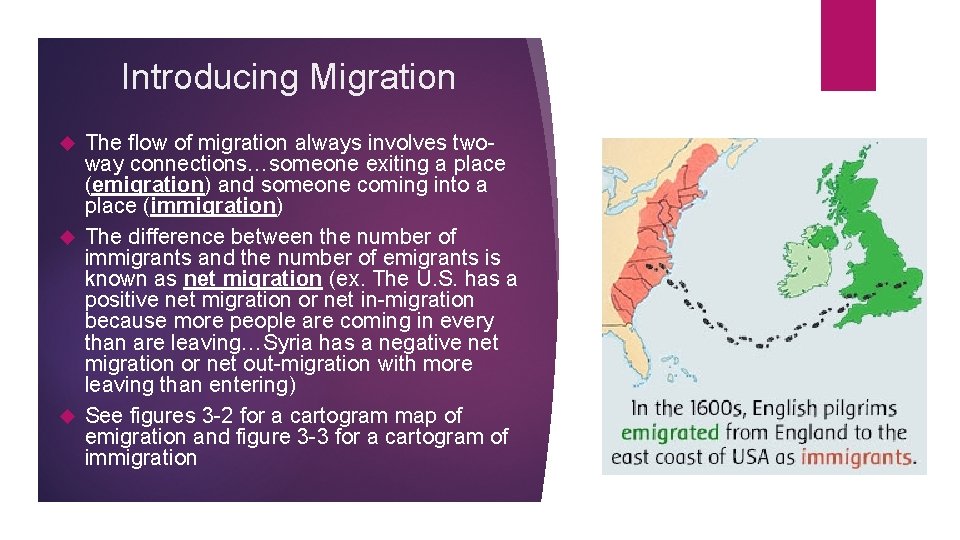
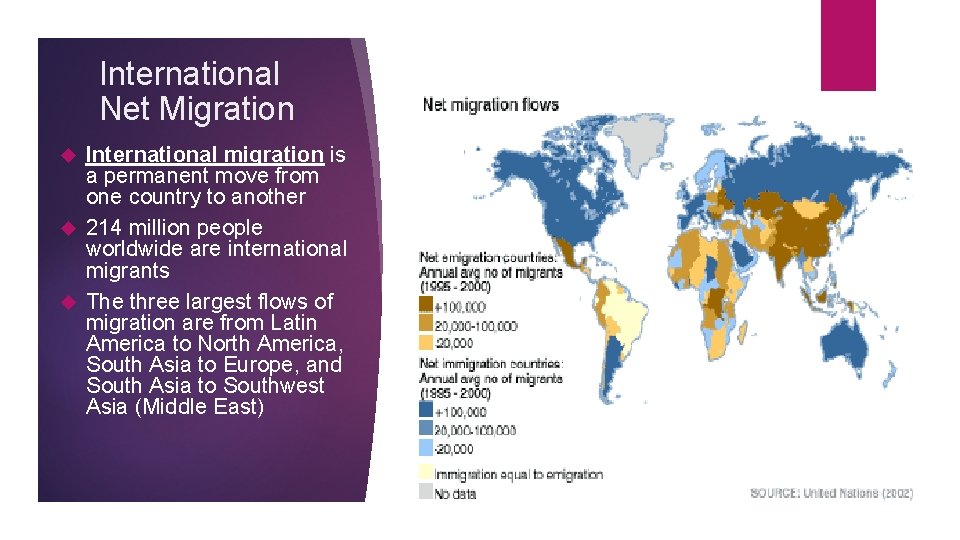
Introducing Migration The flow of migration always involves twoway connections…someone exiting a place (emigration) and someone coming into a place (immigration) The difference between the number of immigrants and the number of emigrants is known as net migration (ex. The U. S. has a positive net migration or net in-migration because more people are coming in every than are leaving…Syria has a negative net migration or net out-migration with more leaving than entering) See figures 3 -2 for a cartogram map of emigration and figure 3 -3 for a cartogram of immigration
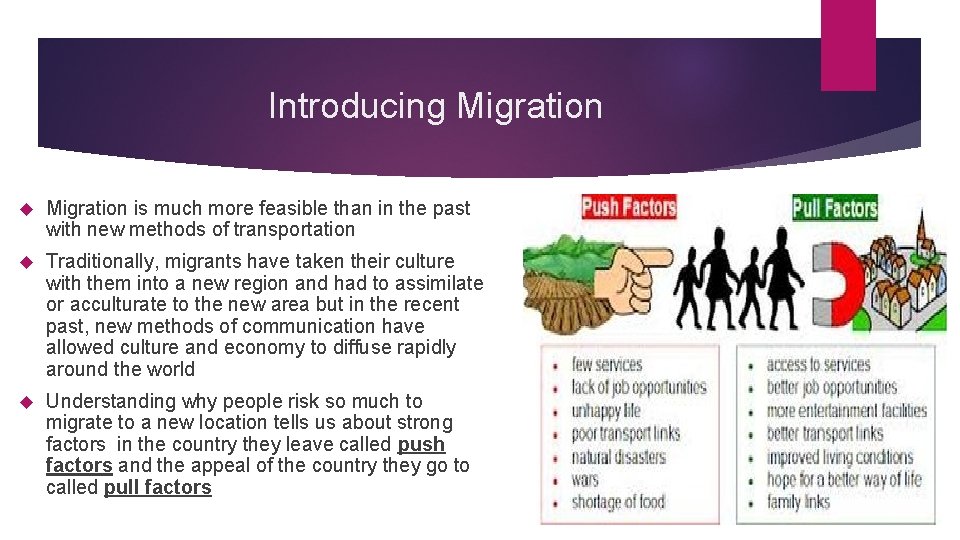
Introducing Migration is much more feasible than in the past with new methods of transportation Traditionally, migrants have taken their culture with them into a new region and had to assimilate or acculturate to the new area but in the recent past, new methods of communication have allowed culture and economy to diffuse rapidly around the world Understanding why people risk so much to migrate to a new location tells us about strong factors in the country they leave called push factors and the appeal of the country they go to called pull factors
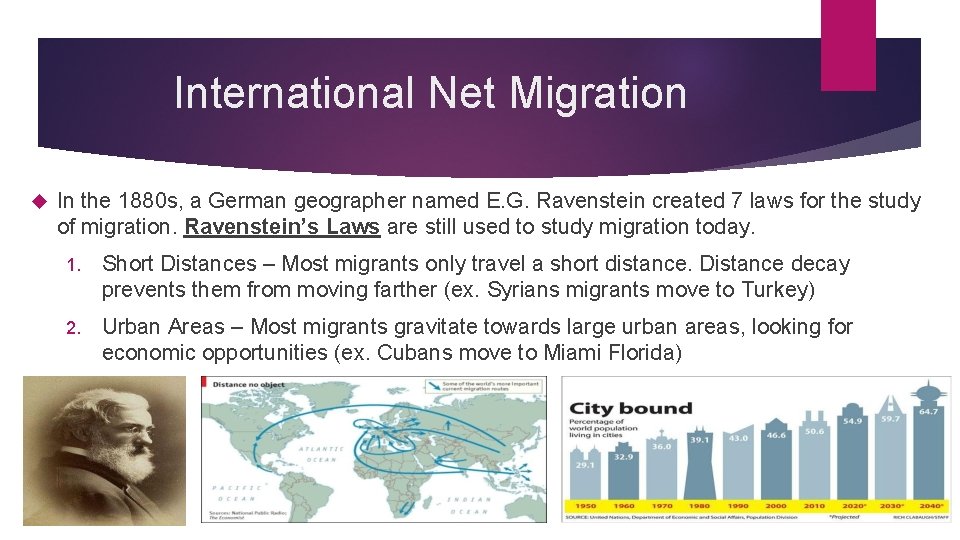
International Net Migration In the 1880 s, a German geographer named E. G. Ravenstein created 7 laws for the study of migration. Ravenstein’s Laws are still used to study migration today. 1. Short Distances – Most migrants only travel a short distance. Distance decay prevents them from moving farther (ex. Syrians migrants move to Turkey) 2. Urban Areas – Most migrants gravitate towards large urban areas, looking for economic opportunities (ex. Cubans move to Miami Florida)
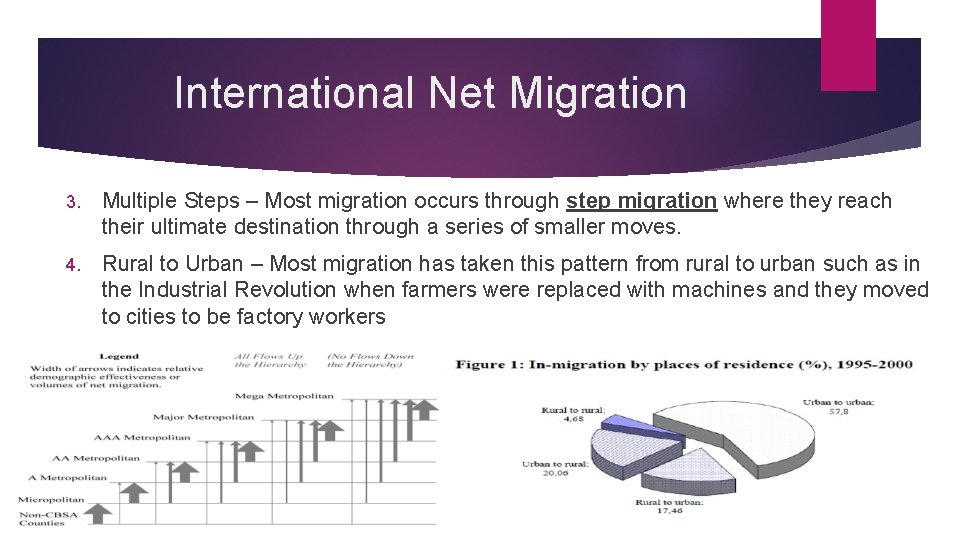
International Net Migration 3. Multiple Steps – Most migration occurs through step migration where they reach their ultimate destination through a series of smaller moves. 4. Rural to Urban – Most migration has taken this pattern from rural to urban such as in the Industrial Revolution when farmers were replaced with machines and they moved to cities to be factory workers
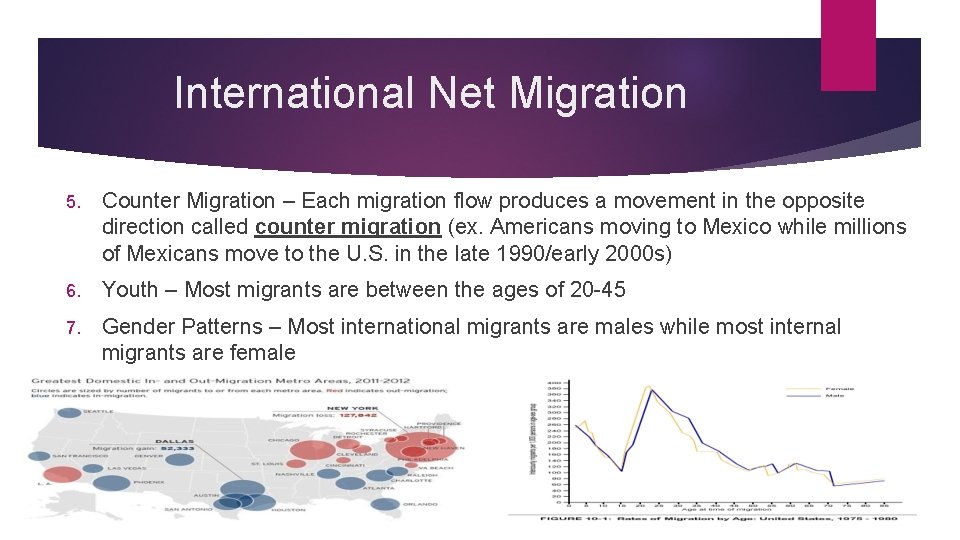
International Net Migration 5. Counter Migration – Each migration flow produces a movement in the opposite direction called counter migration (ex. Americans moving to Mexico while millions of Mexicans move to the U. S. in the late 1990/early 2000 s) 6. Youth – Most migrants are between the ages of 20 -45 7. Gender Patterns – Most international migrants are males while most internal migrants are female
International Net Migration International migration is a permanent move from one country to another 214 million people worldwide are international migrants The three largest flows of migration are from Latin America to North America, South Asia to Europe, and South Asia to Southwest Asia (Middle East)
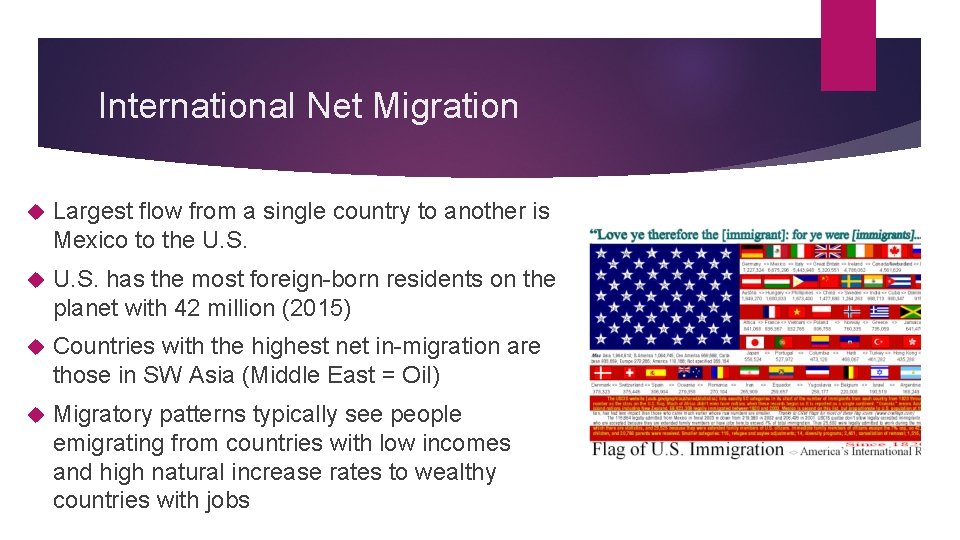
International Net Migration Largest flow from a single country to another is Mexico to the U. S. has the most foreign-born residents on the planet with 42 million (2015) Countries with the highest net in-migration are those in SW Asia (Middle East = Oil) Migratory patterns typically see people emigrating from countries with low incomes and high natural increase rates to wealthy countries with jobs
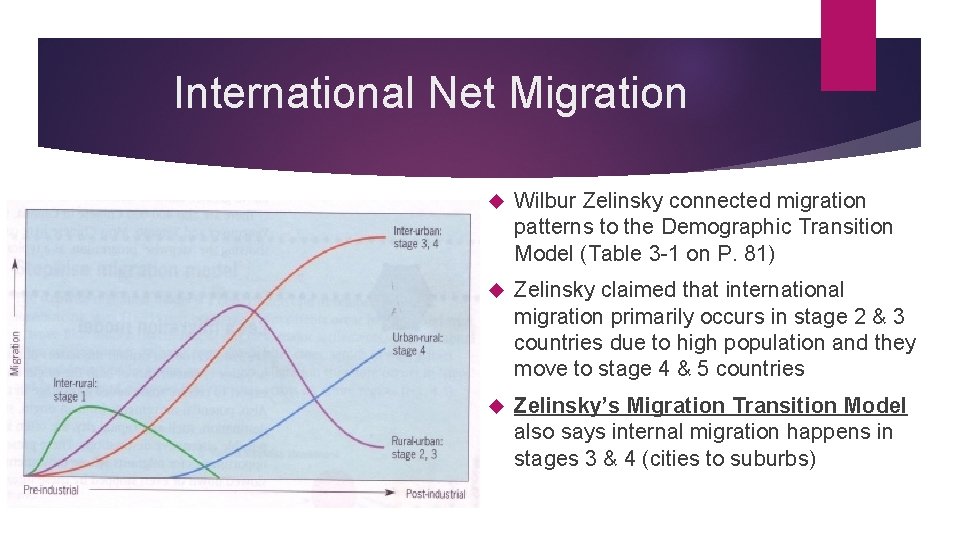
International Net Migration Wilbur Zelinsky connected migration patterns to the Demographic Transition Model (Table 3 -1 on P. 81) Zelinsky claimed that international migration primarily occurs in stage 2 & 3 countries due to high population and they move to stage 4 & 5 countries Zelinsky’s Migration Transition Model also says internal migration happens in stages 3 & 4 (cities to suburbs)
International and Internal Migration International Migration occurs for two reasons: 1. Voluntary migration – migrants choose to leave, usually for economic, social, or environmental reasons 2. Forced migration – migrant is pushed to leave country for cultural, social, political, or environmental reasons
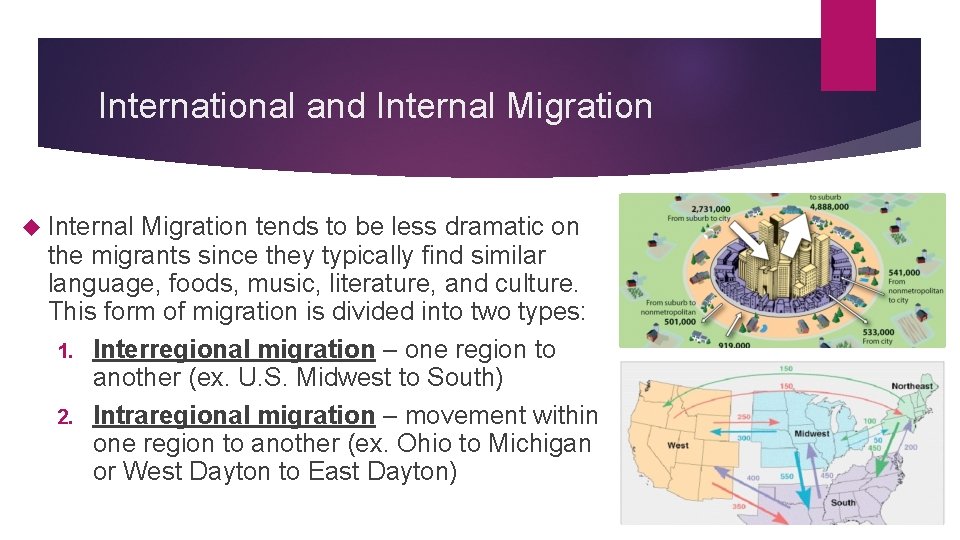
International and Internal Migration tends to be less dramatic on the migrants since they typically find similar language, foods, music, literature, and culture. This form of migration is divided into two types: 1. Interregional migration – one region to another (ex. U. S. Midwest to South) 2. Intraregional migration – movement within one region to another (ex. Ohio to Michigan or West Dayton to East Dayton)
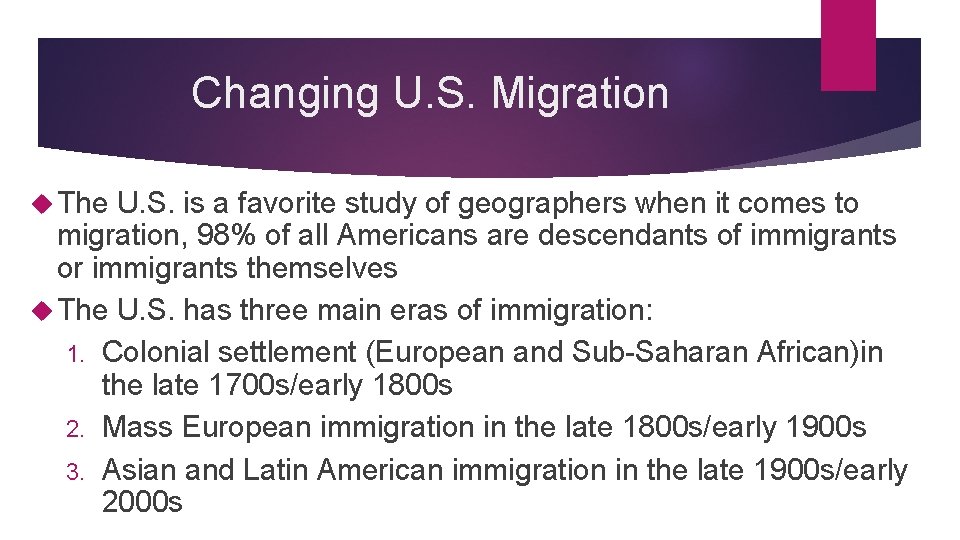
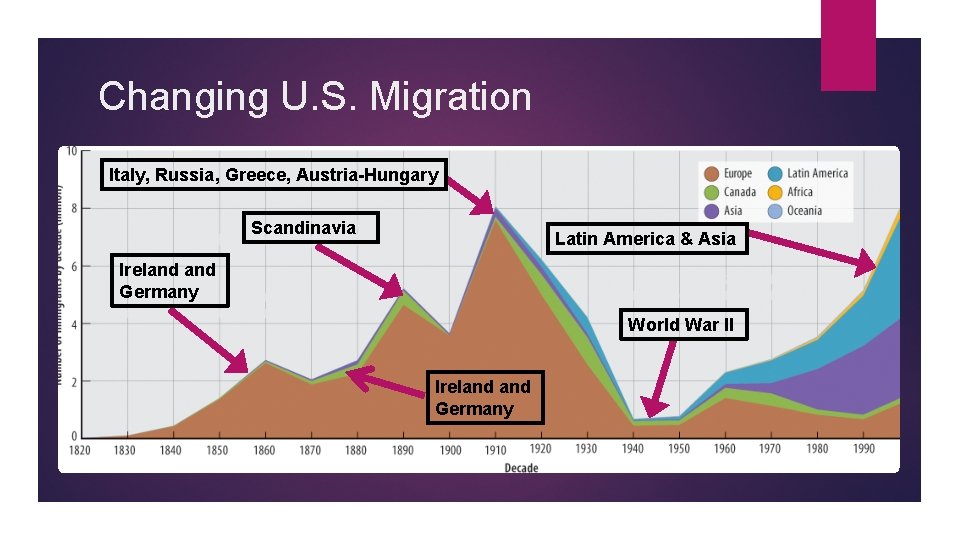
Changing U. S. Migration The U. S. is a favorite study of geographers when it comes to migration, 98% of all Americans are descendants of immigrants or immigrants themselves The U. S. has three main eras of immigration: 1. Colonial settlement (European and Sub-Saharan African)in the late 1700 s/early 1800 s 2. Mass European immigration in the late 1800 s/early 1900 s 3. Asian and Latin American immigration in the late 1900 s/early 2000 s
Changing U. S. Migration Italy, Russia, Greece, Austria-Hungary Scandinavia Latin America & Asia Ireland Germany World War II Ireland Germany
Big Questions & Create a chart telling what migration is and describing the different types of migration and give examples: emigration; immigration; international; internal; voluntary; forced; interregional; and intraregional. Describe the basics of Ravenstein’s Laws of Migration and how they help us understand migration. Key Terms Migration Mobility Circulation Emigration Immigration Net Migration Push Factors Pull Factors Ravenstein’s Laws of Migration Step Migration Counter Migration International Migration Zelinsky’s Migration Transition Model Voluntary Migration Forced Migration Interregional Migration Intraregional Migration