
Chapter 3 Introduction to the Periodic Table Section
Chapter 3: Introduction to the Periodic Table Section 3. 2: Using the Periodic Table
Objectives: Relate an element’s valence electron structure to its position in the periodic table, Use the periodic table to classify an element as a metal, nonmetal or metalloid, Compare the properties of metals, nonmetals or metalloids
Arrangement O Elements are arranged according to atomic number O Atomic number = electrons/ protons O PERIOD- horizontal row in the table O GROUP (family)- vertical column in the table O For elements in group 1 and 2: The group number equals the number of valence electrons For elements in groups 13, 14, 15, 16, 17, 18: The second digit in the group number is equal to the number of valence electrons O
Arrangement Elements in the same group have the same number of valence electrons, similar properties http: //www. ptable. com/ O Alkali metals are elements in Group 1 (most O O O reactive metals) Alkaline earth metals are elements in Group 2 Halogens are elements in Group 17 (most reactive nonmetals) NOBLE GASES: Elements in Group 18 Maximum 8 valence electron- unreactive – octet rule
Physical states of elements O Most elements are solid, only 2 elements are liquid (Br, Hg) O Gaseous elements are in the upper-right corner of the table, except hydrogen O Some elements are not found in nature- synthetic elements are produced artificially Include: Element 43, Technetium All elements after element 92, Uranium
Classifying Elements O Majority of elements are metals- left side and center O Nonmetals- upper-right-hand corner O Metalloids- along the boundary between metals and nonmetals http: //www. ptable. com/
METALS O Metals have 1, 2, or 3 valence electrons - except Lead, Bismuth, and Tin O Strong and durable O Have luster, conduct heat and electricity O Usually bend without breaking O All metals are solid at room temp, except Hg O Good conductors
METALS TRANSITION ELEMENTS: Elements in groups 3 through 12 of the periodic table O Predicting behavior and properties of transition metals is complicated due to the atomic structure of these elements Inner Transition Elements O Placed below the periodic table- proper position would make table too wide
METALS O LANTHANIDES- first series of inner transition elements Elements 58 -71, also called rare earth elements O ACTINIDES- second series of inner transition elements Elements 90 -103, all are radioactive
NONMETALS O Poor conductors of electricity and heat, and are brittle as solids O Many are gases at room temperature, lower melting points than metals O Nonmetals have 5, 6, 7, 8 valence electrons, except Carbon
Metals and Nonmetals O Atomic Structure O Metals O Valence electrons are loosely bound to the positive nucleus O Electrons are free to move in the solid metal and are easily lost O This motion allows for their good conductivity
METALLOIDS O Elements that have chemical and physical properties of metals and nonmetals Ex: Silicon, Germanium, Arsenic O Form border between metals and nonmetals O Some metalloids are semiconductors.
METALLOIDS SEMICONDUCTOR: Element that does not conduct electricity as well as metal, but does conduct slightly better than a nonmetal O Valence electrons in nonmetals and metalloids are tightly held to the nucleus O In reactions, nonmetals tend to share or gain electrons O http: //www. youtube. com/watch? v=u 3 Gdpb KTPQQ&safety_mode=true&persist_safet y_mode=1&safe=active
METALLOIDS Semiconductor uses: O Used in electronic devices (circuits): TV, computers, calculators O Semiconductors are “doped” with a small amount of another element → allows the movement of electrons → produces electricity O p-type semiconductor- creates “holes” that allows electrons to move in and out O n- type semiconductor- extra electrons present are free to move
METALLOIDS Transistors, diodes, and other semiconductors are incorporated onto thin slices of silicon (chip) to form integrated circuits → growth of computer technology
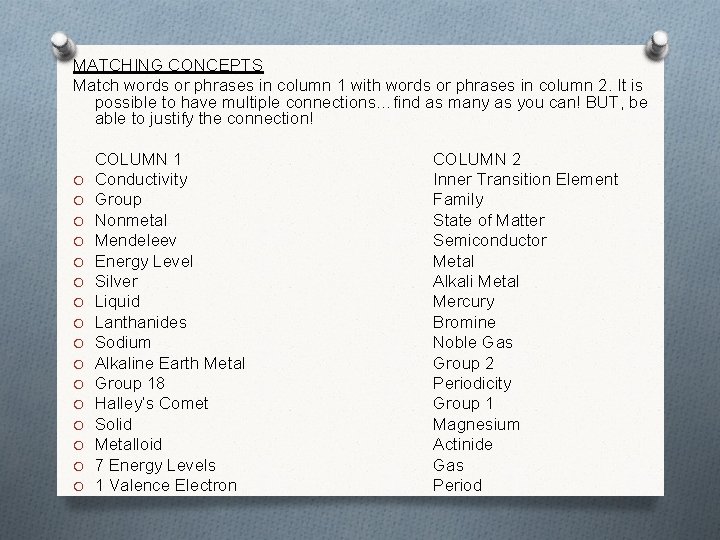
MATCHING CONCEPTS Match words or phrases in column 1 with words or phrases in column 2. It is possible to have multiple connections…find as many as you can! BUT, be able to justify the connection! O O O O COLUMN 1 Conductivity Group Nonmetal Mendeleev Energy Level Silver Liquid Lanthanides Sodium Alkaline Earth Metal Group 18 Halley’s Comet Solid Metalloid 7 Energy Levels 1 Valence Electron COLUMN 2 Inner Transition Element Family State of Matter Semiconductor Metal Alkali Metal Mercury Bromine Noble Gas Group 2 Periodicity Group 1 Magnesium Actinide Gas Period
- Slides: 16