
Chapter 3 Introduction to Logic 2008 Pearson AddisonWesley
- Slides: 13
Chapter 3 Introduction to Logic © 2008 Pearson Addison-Wesley. All rights reserved
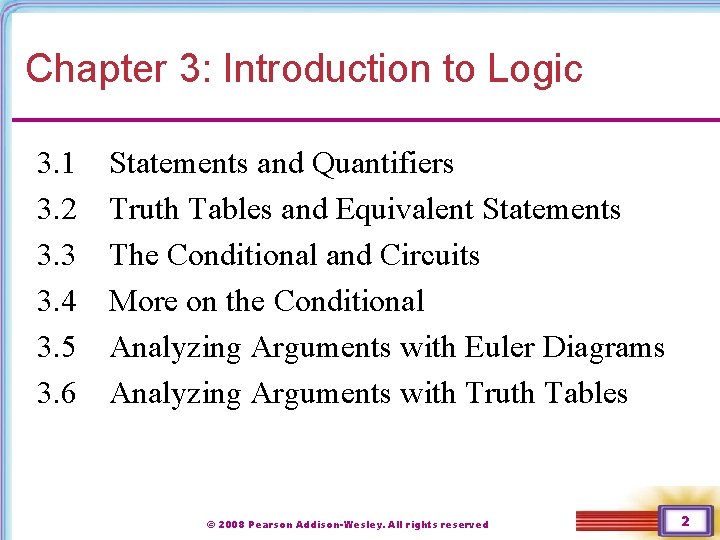
Chapter 3: Introduction to Logic 3. 1 3. 2 3. 3 3. 4 3. 5 3. 6 Statements and Quantifiers Truth Tables and Equivalent Statements The Conditional and Circuits More on the Conditional Analyzing Arguments with Euler Diagrams Analyzing Arguments with Truth Tables © 2008 Pearson Addison-Wesley. All rights reserved 2
Chapter 1 Section 3 -4 More on the Conditional © 2008 Pearson Addison-Wesley. All rights reserved
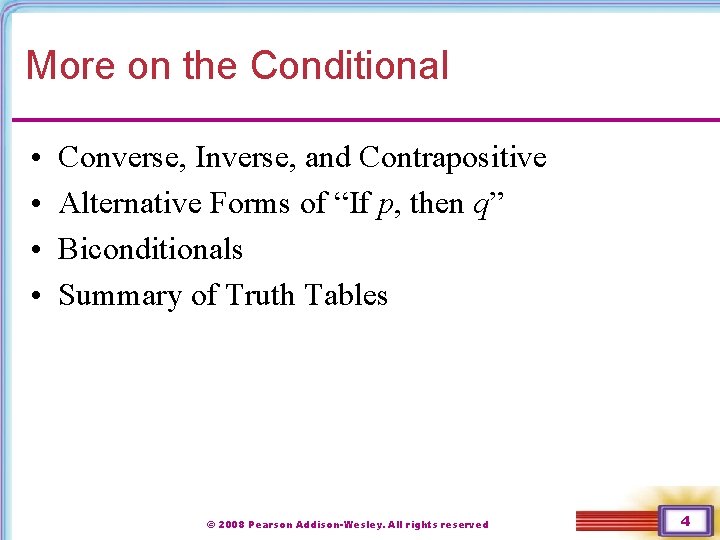
More on the Conditional • • Converse, Inverse, and Contrapositive Alternative Forms of “If p, then q” Biconditionals Summary of Truth Tables © 2008 Pearson Addison-Wesley. All rights reserved 4
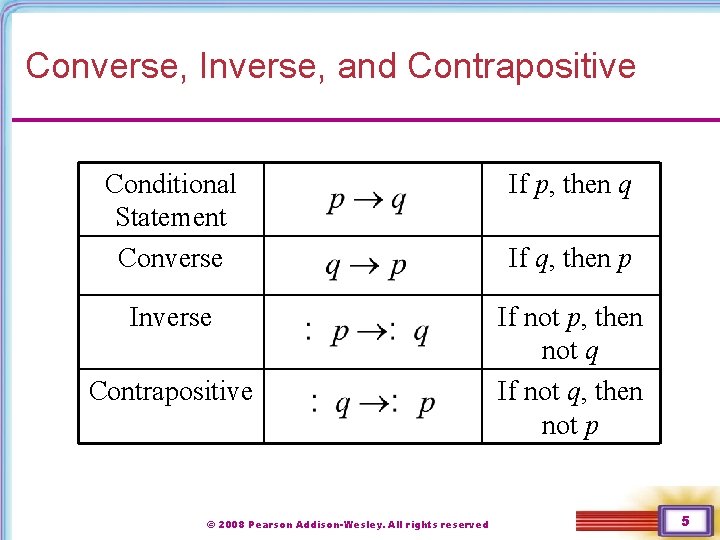
Converse, Inverse, and Contrapositive Conditional Statement Converse If p, then q Inverse If not p, then not q If not q, then not p Contrapositive © 2008 Pearson Addison-Wesley. All rights reserved If q, then p 5
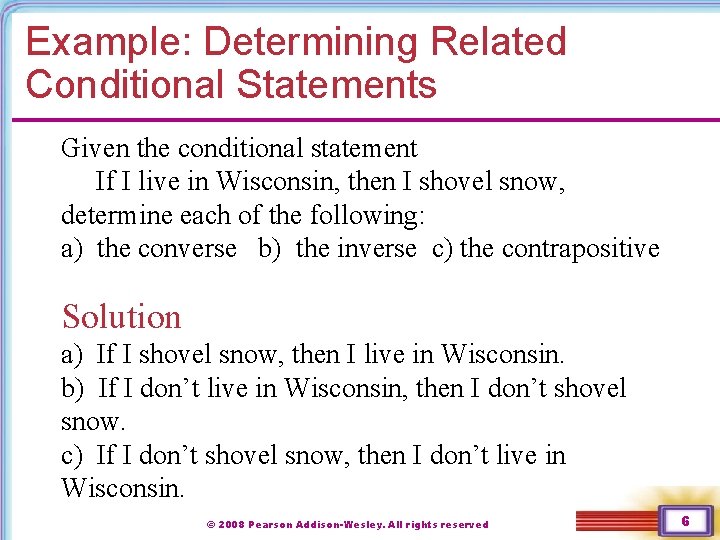
Example: Determining Related Conditional Statements Given the conditional statement If I live in Wisconsin, then I shovel snow, determine each of the following: a) the converse b) the inverse c) the contrapositive Solution a) If I shovel snow, then I live in Wisconsin. b) If I don’t live in Wisconsin, then I don’t shovel snow. c) If I don’t shovel snow, then I don’t live in Wisconsin. © 2008 Pearson Addison-Wesley. All rights reserved 6
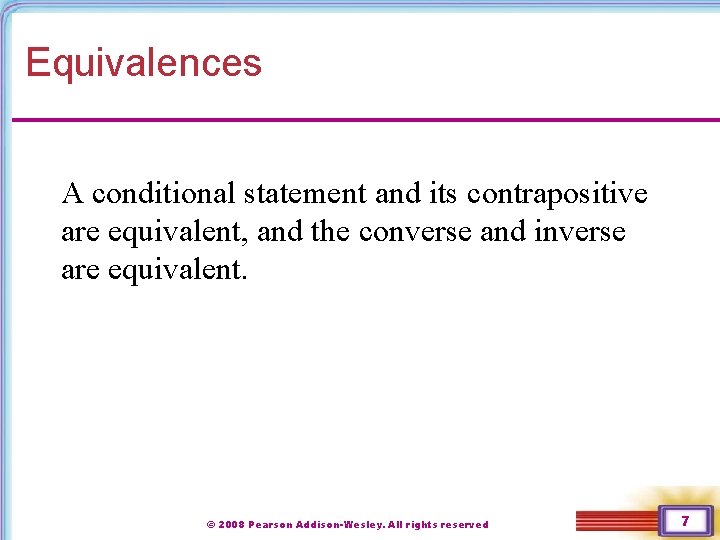
Equivalences A conditional statement and its contrapositive are equivalent, and the converse and inverse are equivalent. © 2008 Pearson Addison-Wesley. All rights reserved 7
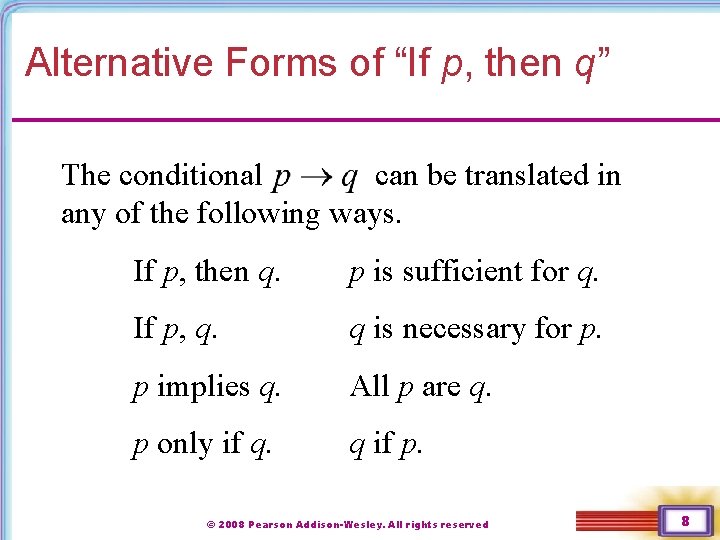
Alternative Forms of “If p, then q” The conditional can be translated in any of the following ways. If p, then q. p is sufficient for q. If p, q. q is necessary for p. p implies q. All p are q. p only if q. q if p. © 2008 Pearson Addison-Wesley. All rights reserved 8
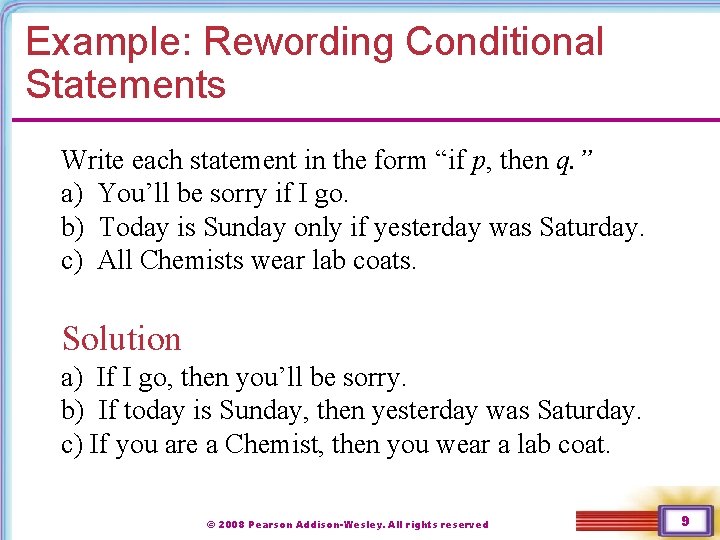
Example: Rewording Conditional Statements Write each statement in the form “if p, then q. ” a) You’ll be sorry if I go. b) Today is Sunday only if yesterday was Saturday. c) All Chemists wear lab coats. Solution a) If I go, then you’ll be sorry. b) If today is Sunday, then yesterday was Saturday. c) If you are a Chemist, then you wear a lab coat. © 2008 Pearson Addison-Wesley. All rights reserved 9
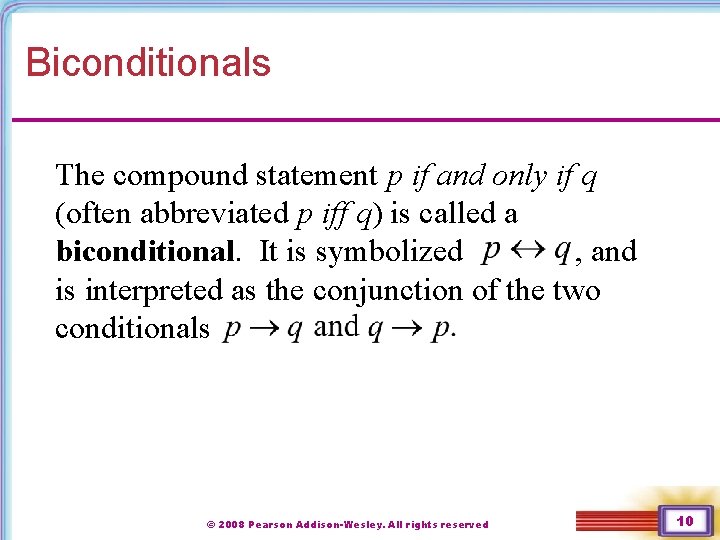
Biconditionals The compound statement p if and only if q (often abbreviated p iff q) is called a biconditional. It is symbolized , and is interpreted as the conjunction of the two conditionals © 2008 Pearson Addison-Wesley. All rights reserved 10
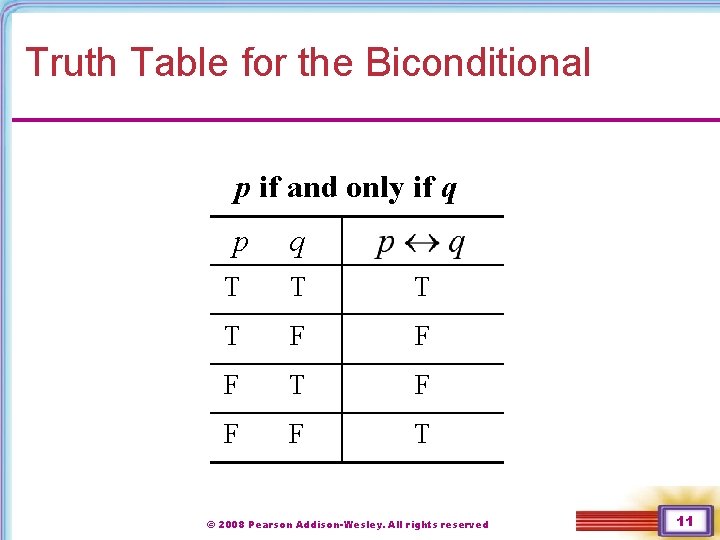
Truth Table for the Biconditional p if and only if q p q T T F F F T © 2008 Pearson Addison-Wesley. All rights reserved 11
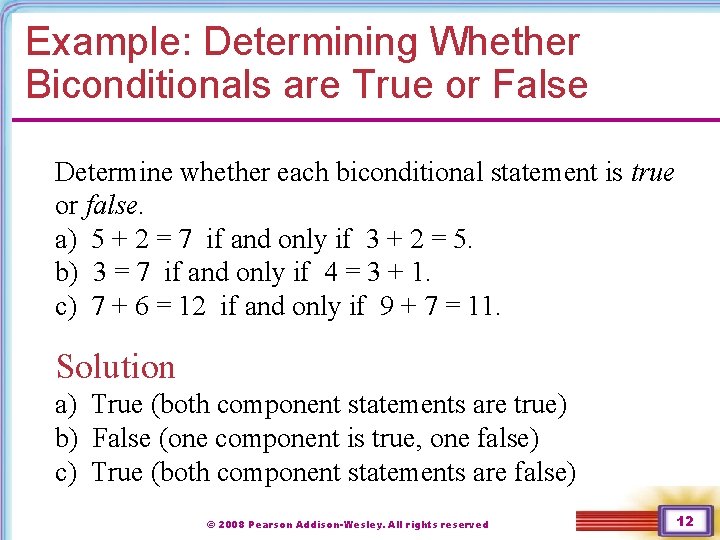
Example: Determining Whether Biconditionals are True or False Determine whether each biconditional statement is true or false. a) 5 + 2 = 7 if and only if 3 + 2 = 5. b) 3 = 7 if and only if 4 = 3 + 1. c) 7 + 6 = 12 if and only if 9 + 7 = 11. Solution a) True (both component statements are true) b) False (one component is true, one false) c) True (both component statements are false) © 2008 Pearson Addison-Wesley. All rights reserved 12
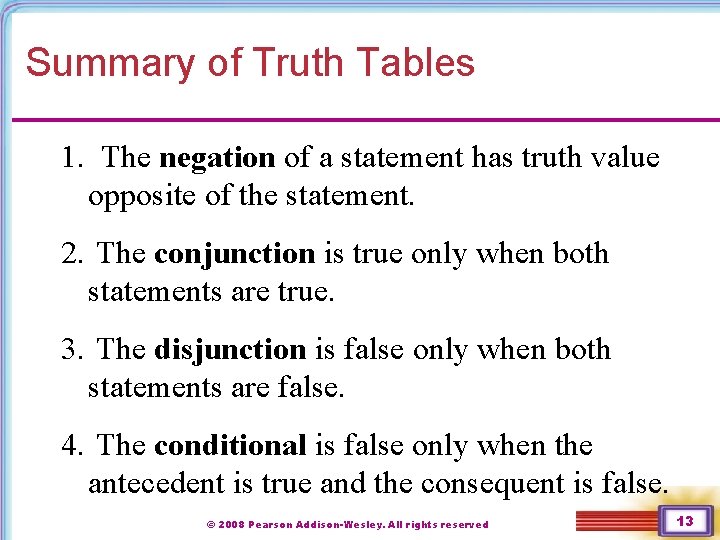
Summary of Truth Tables 1. The negation of a statement has truth value opposite of the statement. 2. The conjunction is true only when both statements are true. 3. The disjunction is false only when both statements are false. 4. The conditional is false only when the antecedent is true and the consequent is false. © 2008 Pearson Addison-Wesley. All rights reserved 13