
Chapter 3 INTERSYMBOL INTERFERENCE ISI Intersymbol Interference ISI
Chapter 3 INTERSYMBOL INTERFERENCE (ISI) Ø Intersymbol Interference Ø ISI on Eye Patterns Ø Combatting ISI Ø Nyquist’s First Method for zero ISI Ø Raised Cosine-Rolloff Pulse Shape Ø Nyquist Filter Huseyin Bilgekul Eeng 360 Communication Systems I Department of Electrical and Electronic Engineering Eastern Mediterranean University 1
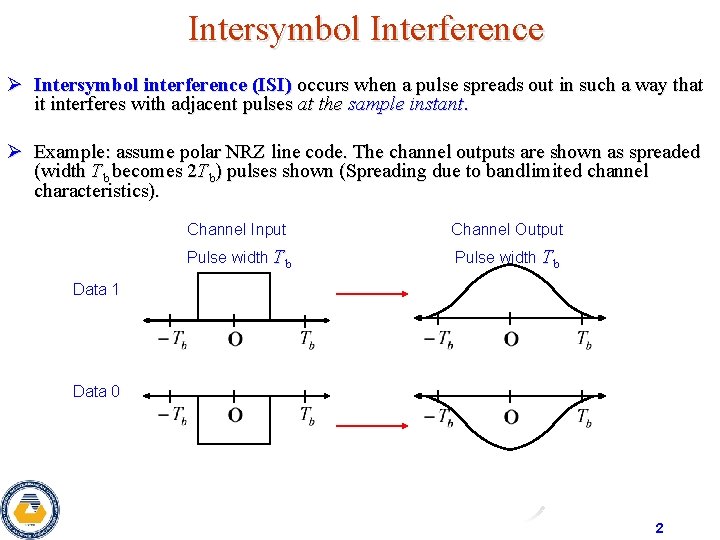
Intersymbol Interference Ø Intersymbol interference (ISI) occurs when a pulse spreads out in such a way that it interferes with adjacent pulses at the sample instant. Ø Example: assume polar NRZ line code. The channel outputs are shown as spreaded (width Tb becomes 2 Tb) pulses shown (Spreading due to bandlimited channel characteristics). Channel Input Channel Output Pulse width Tb Data 1 Data 0 2
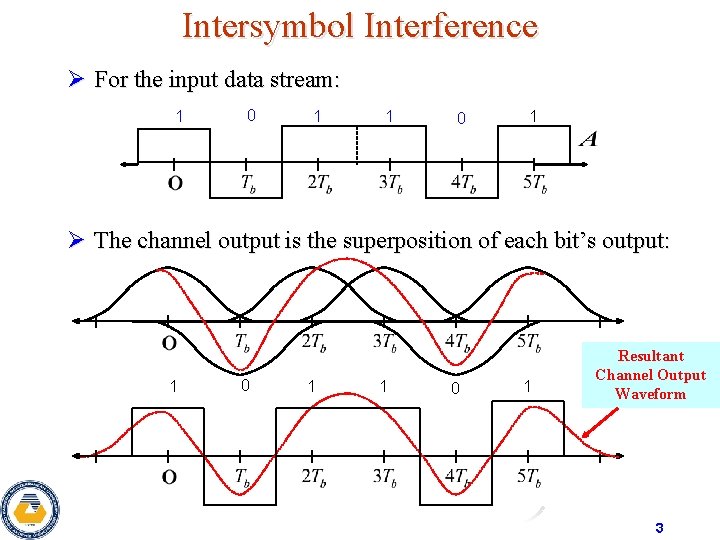
Intersymbol Interference Ø For the input data stream: 1 0 1 Ø The channel output is the superposition of each bit’s output: 1 0 1 Resultant Channel Output Waveform 3
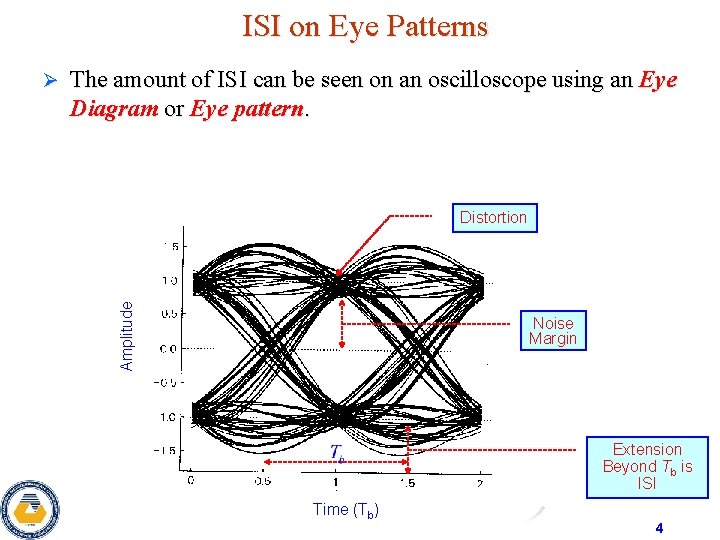
ISI on Eye Patterns The amount of ISI can be seen on an oscilloscope using an Eye Diagram or Eye pattern. Distortion Amplitude Ø Noise Margin Extension Beyond Tb is ISI Time (Tb) 4
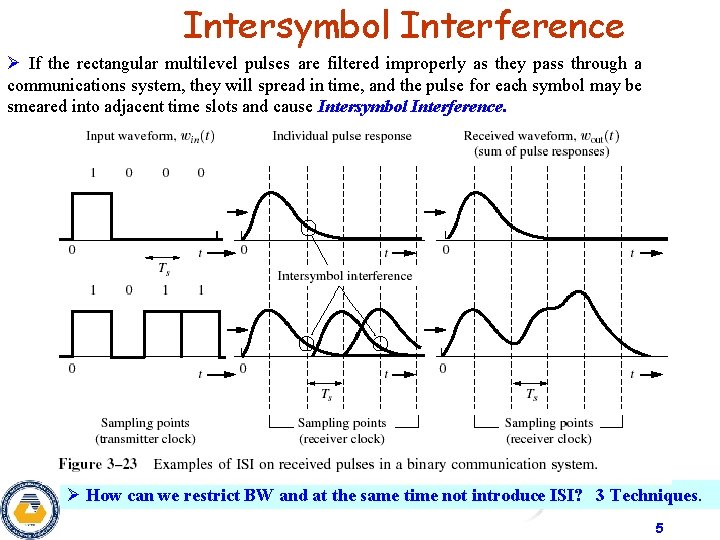
Intersymbol Interference Ø If the rectangular multilevel pulses are filtered improperly as they pass through a communications system, they will spread in time, and the pulse for each symbol may be smeared into adjacent time slots and cause Intersymbol Interference. Ø How can we restrict BW and at the same time not introduce ISI? 3 Techniques. 5
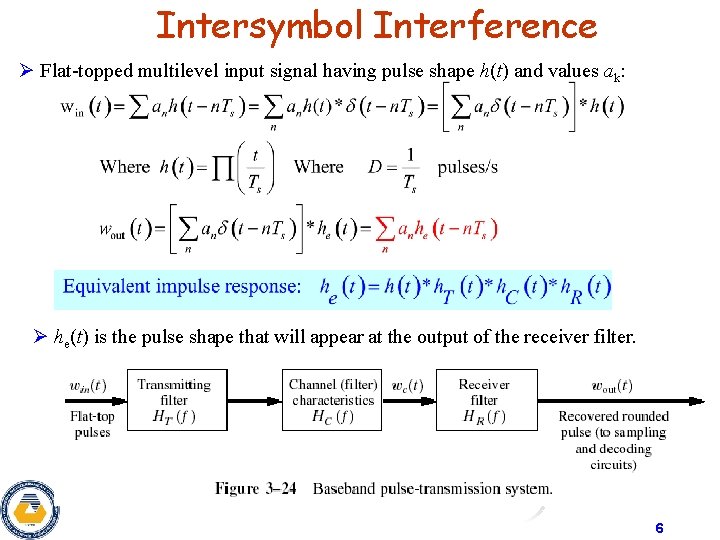
Intersymbol Interference Ø Flat-topped multilevel input signal having pulse shape h(t) and values ak: Ø he(t) is the pulse shape that will appear at the output of the receiver filter. 6
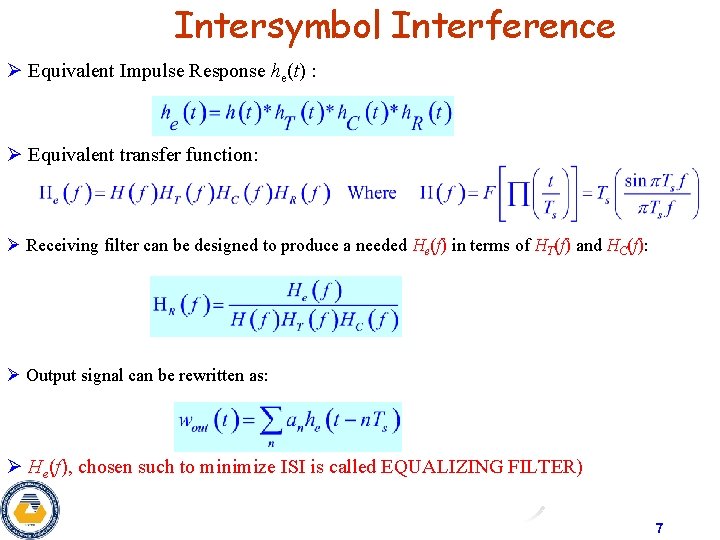
Intersymbol Interference Ø Equivalent Impulse Response he(t) : Ø Equivalent transfer function: Ø Receiving filter can be designed to produce a needed He(f) in terms of HT(f) and HC(f): Ø Output signal can be rewritten as: Ø He(f), chosen such to minimize ISI is called EQUALIZING FILTER) 7
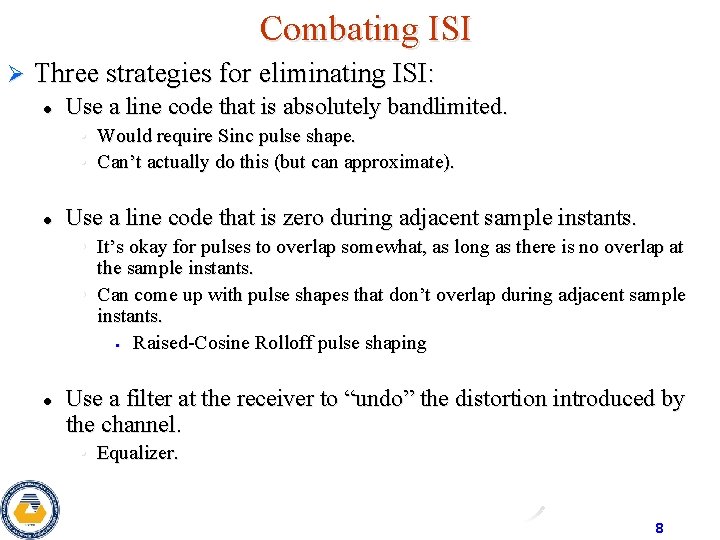
Combating ISI Ø Three strategies for eliminating ISI: l Use a line code that is absolutely bandlimited. • Would require Sinc pulse shape. • Can’t actually do this (but can approximate). l Use a line code that is zero during adjacent sample instants. • It’s okay for pulses to overlap somewhat, as long as there is no overlap at the sample instants. • Can come up with pulse shapes that don’t overlap during adjacent sample instants. § Raised-Cosine Rolloff pulse shaping l Use a filter at the receiver to “undo” the distortion introduced by the channel. • Equalizer. 8
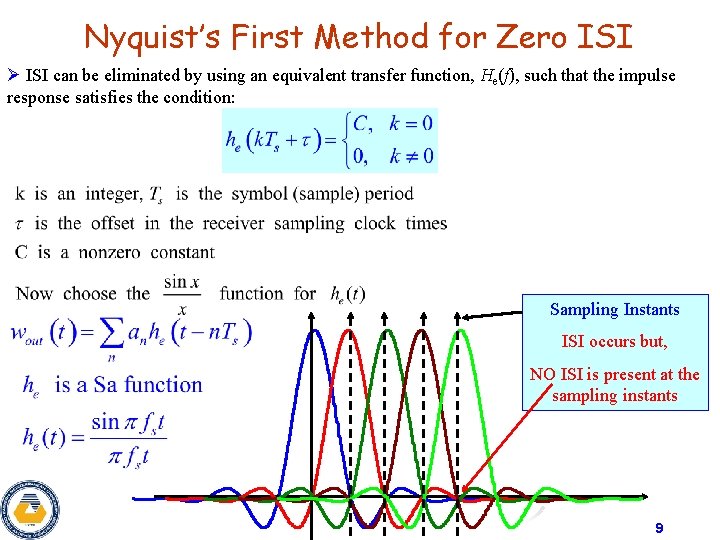
Nyquist’s First Method for Zero ISI Ø ISI can be eliminated by using an equivalent transfer function, He(f), such that the impulse response satisfies the condition: Sampling Instants ISI occurs but, NO ISI is present at the sampling instants 9
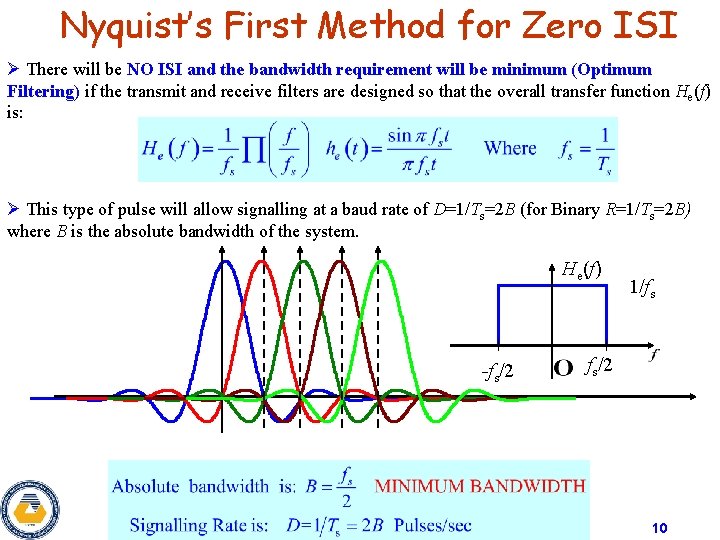
Nyquist’s First Method for Zero ISI Ø There will be NO ISI and the bandwidth requirement will be minimum (Optimum Filtering) if the transmit and receive filters are designed so that the overall transfer function He(f) is: Ø This type of pulse will allow signalling at a baud rate of D=1/Ts=2 B (for Binary R=1/Ts=2 B) where B is the absolute bandwidth of the system. He(f) -fs/2 1/fs fs/2 10
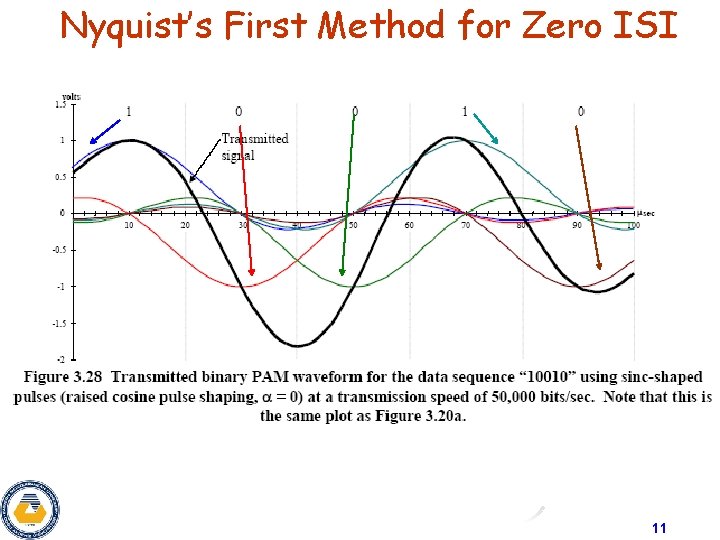
Nyquist’s First Method for Zero ISI 11
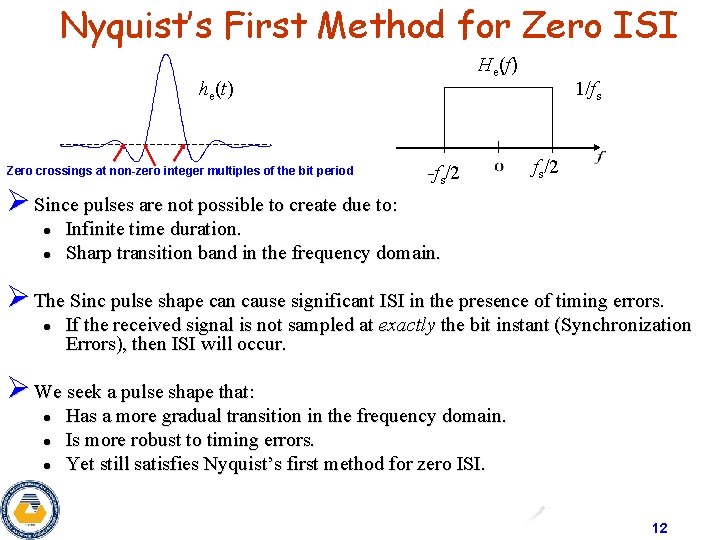
Nyquist’s First Method for Zero ISI He(f) he(t) Zero crossings at non-zero integer multiples of the bit period Ø Since pulses are not possible to create due to: l l -fs/2 1/fs fs/2 Infinite time duration. Sharp transition band in the frequency domain. Ø The Sinc pulse shape can cause significant ISI in the presence of timing errors. l If the received signal is not sampled at exactly the bit instant (Synchronization Errors), then ISI will occur. Ø We seek a pulse shape that: l l l Has a more gradual transition in the frequency domain. Is more robust to timing errors. Yet still satisfies Nyquist’s first method for zero ISI. 12
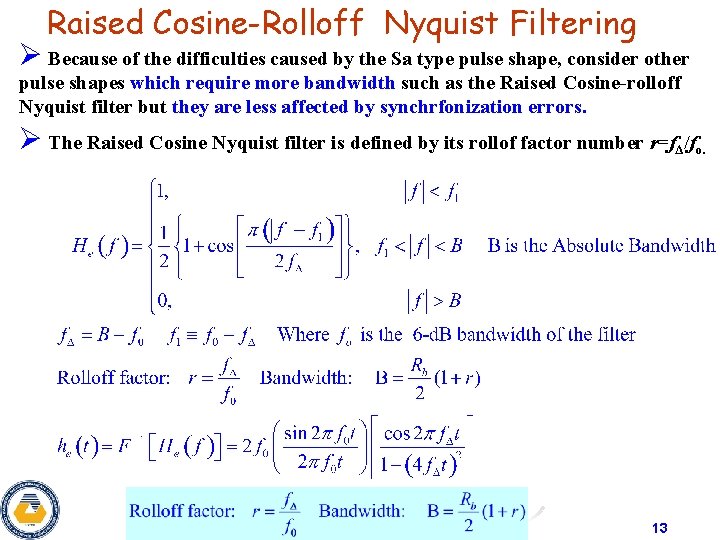
Raised Cosine-Rolloff Nyquist Filtering Ø Because of the difficulties caused by the Sa type pulse shape, consider other pulse shapes which require more bandwidth such as the Raised Cosine-rolloff Nyquist filter but they are less affected by synchrfonization errors. Ø The Raised Cosine Nyquist filter is defined by its rollof factor number r=fΔ/fo. 13
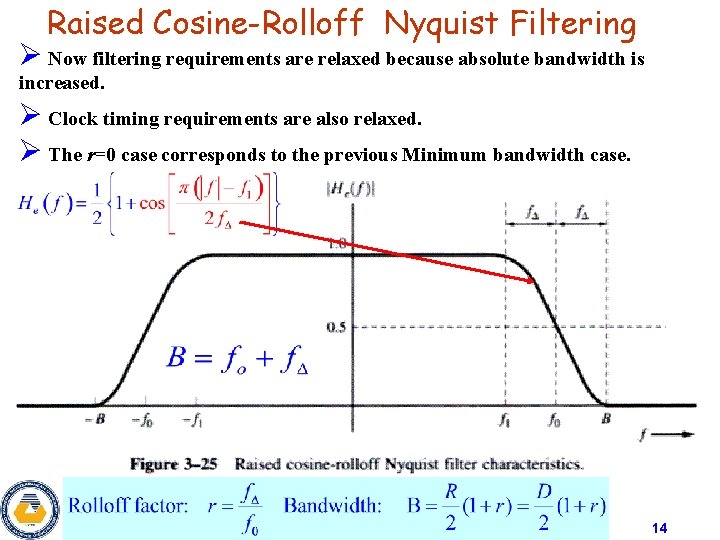
Raised Cosine-Rolloff Nyquist Filtering Ø Now filtering requirements are relaxed because absolute bandwidth is increased. Ø Clock timing requirements are also relaxed. Ø The r=0 case corresponds to the previous Minimum bandwidth case. 14
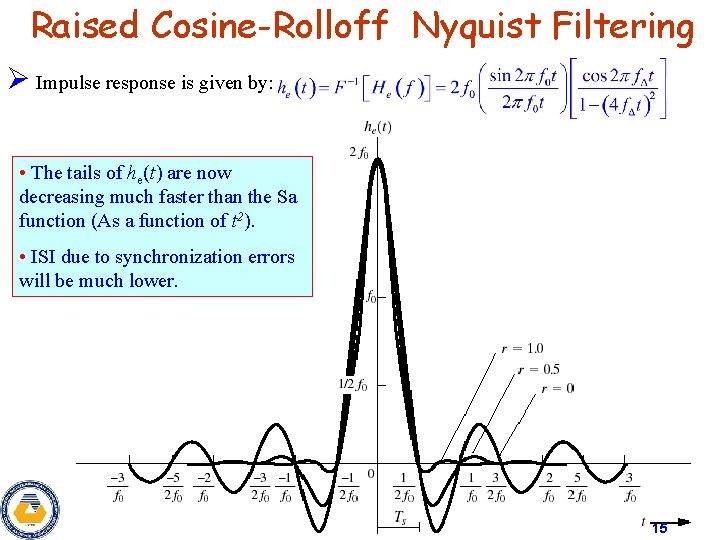
Raised Cosine-Rolloff Nyquist Filtering Ø Impulse response is given by: • The tails of he(t) are now decreasing much faster than the Sa function (As a function of t 2). • ISI due to synchronization errors will be much lower. 15
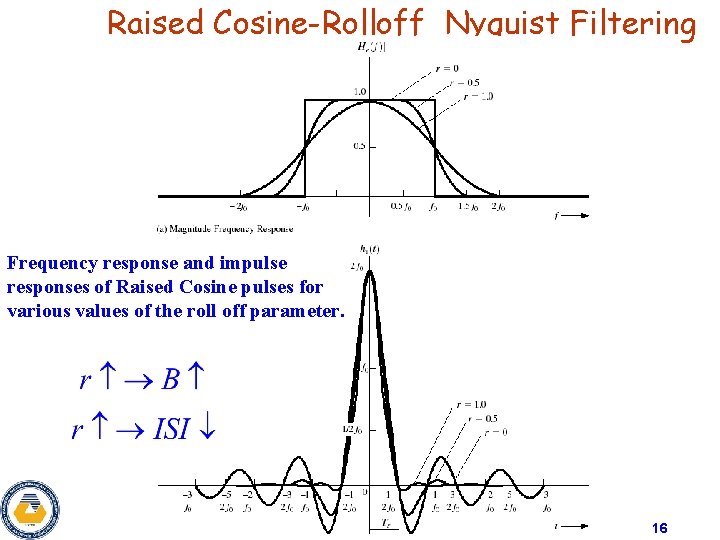
Raised Cosine-Rolloff Nyquist Filtering Frequency response and impulse responses of Raised Cosine pulses for various values of the roll off parameter. 16
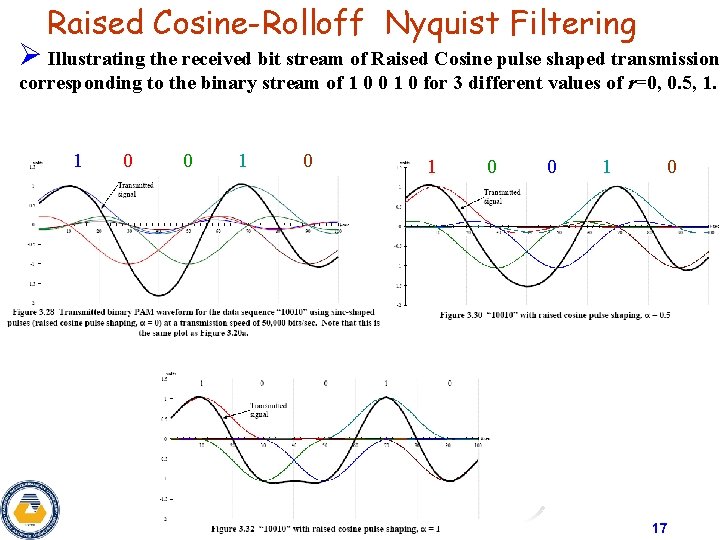
Raised Cosine-Rolloff Nyquist Filtering Ø Illustrating the received bit stream of Raised Cosine pulse shaped transmission corresponding to the binary stream of 1 0 0 1 0 for 3 different values of r=0, 0. 5, 1. 1 0 0 1 0 17
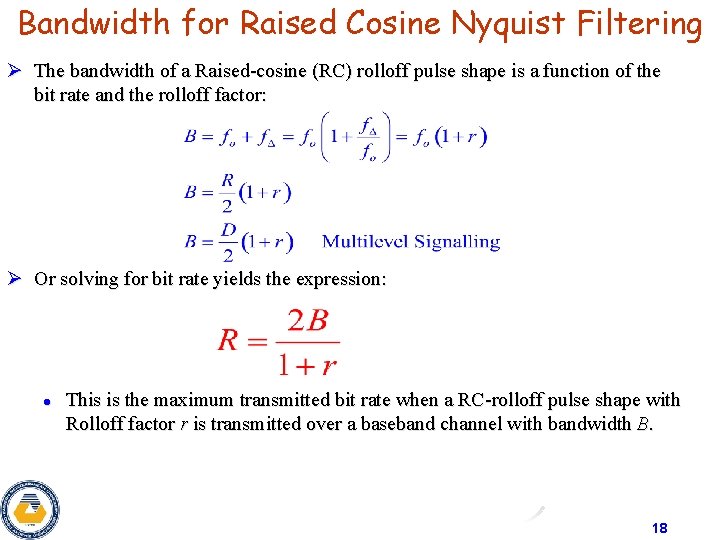
Bandwidth for Raised Cosine Nyquist Filtering Ø The bandwidth of a Raised-cosine (RC) rolloff pulse shape is a function of the bit rate and the rolloff factor: Ø Or solving for bit rate yields the expression: l This is the maximum transmitted bit rate when a RC-rolloff pulse shape with Rolloff factor r is transmitted over a baseband channel with bandwidth B. 18
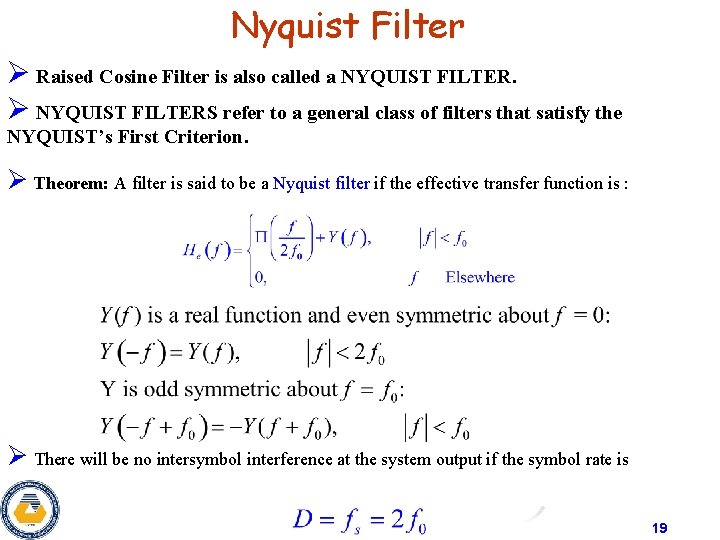
Nyquist Filter Ø Raised Cosine Filter is also called a NYQUIST FILTER. Ø NYQUIST FILTERS refer to a general class of filters that satisfy the NYQUIST’s First Criterion. Ø Theorem: A filter is said to be a Nyquist filter if the effective transfer function is : Ø There will be no intersymbol interference at the system output if the symbol rate is 19
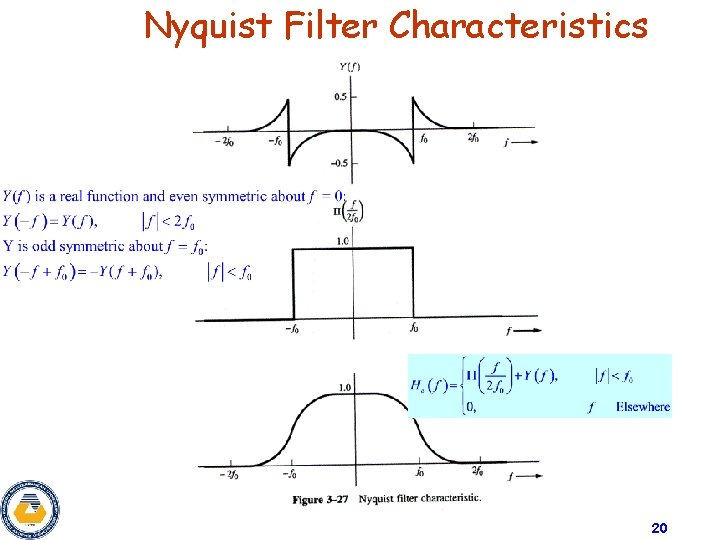
Nyquist Filter Characteristics 20
- Slides: 20