
Chapter 3 Insurance Collars and Other Strategies Basic
Chapter 3 Insurance, Collars, and Other Strategies
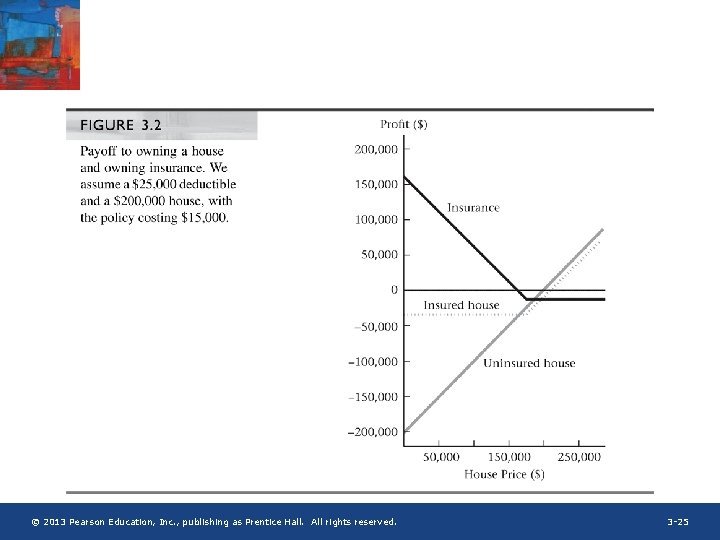
Basic Insurance Strategies • Options can be – Used to insure long positions (floors) – Used to insure short positions (caps) – Written against asset positions (selling insurance) © 2013 Pearson Education, Inc. , publishing as Prentice Hall. All rights reserved. 3 -2
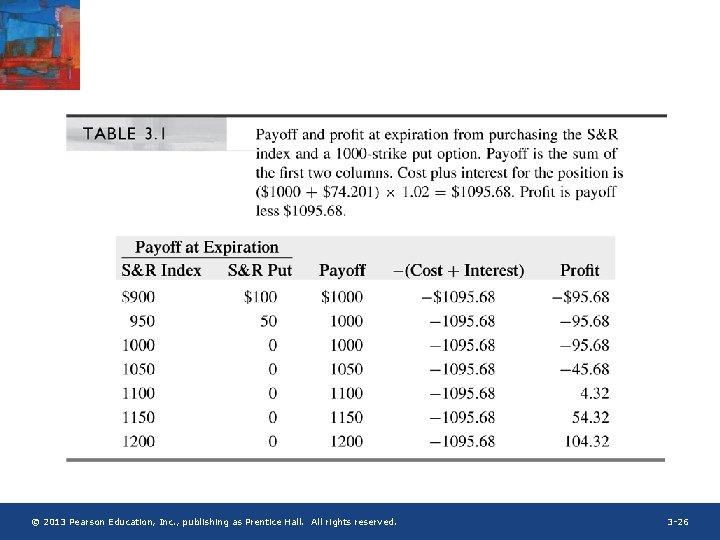
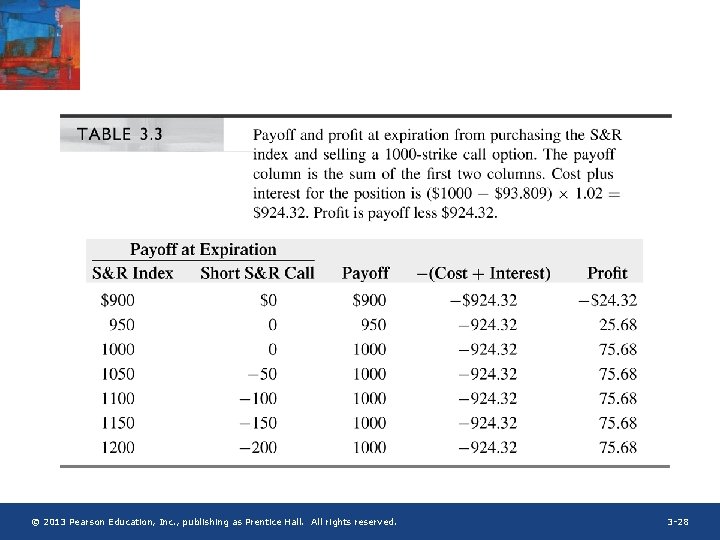
Insuring a Long Position: Floors • A put option is combined with a position in the underlying asset • Goal: to insure against a fall in the price of the underlying asset © 2013 Pearson Education, Inc. , publishing as Prentice Hall. All rights reserved. 3 -3
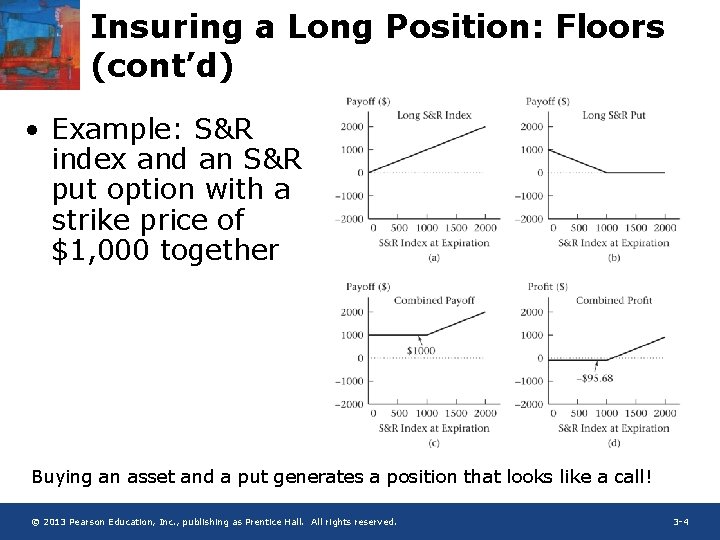
Insuring a Long Position: Floors (cont’d) • Example: S&R index and an S&R put option with a strike price of $1, 000 together Buying an asset and a put generates a position that looks like a call! © 2013 Pearson Education, Inc. , publishing as Prentice Hall. All rights reserved. 3 -4
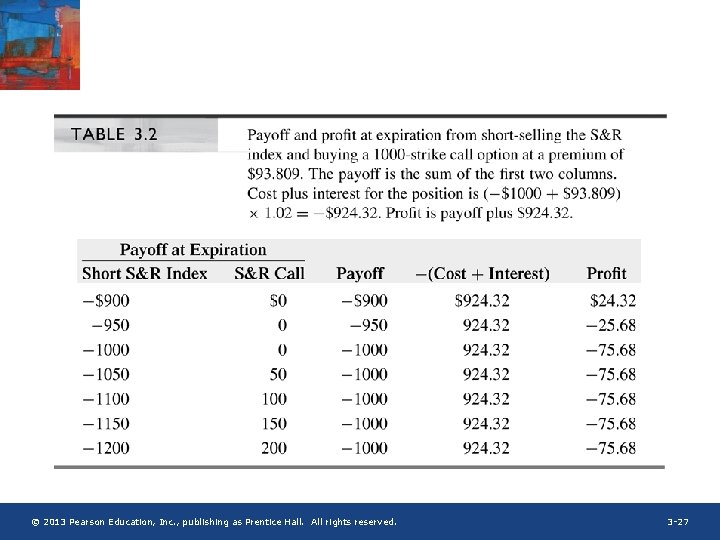
Insuring a Short Position: Caps • A call option is combined with a position in the underlying asset • Goal: to insure against an increase in the price of the underlying asset (when one has a short position in that asset) © 2013 Pearson Education, Inc. , publishing as Prentice Hall. All rights reserved. 3 -5
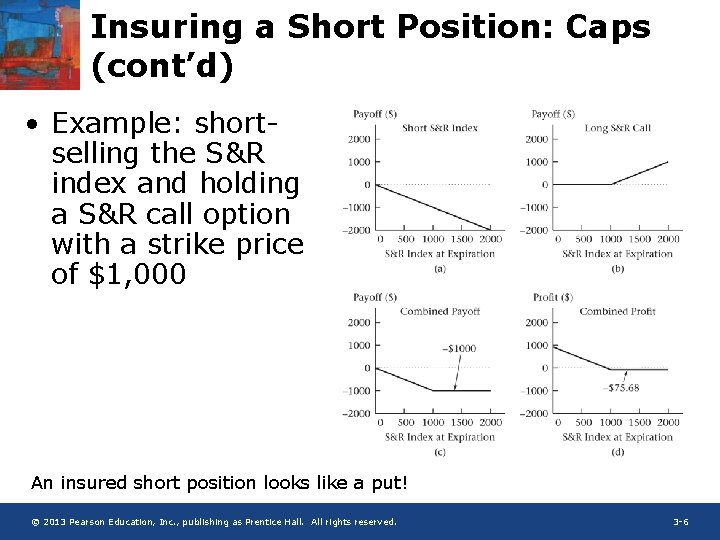
Insuring a Short Position: Caps (cont’d) • Example: shortselling the S&R index and holding a S&R call option with a strike price of $1, 000 An insured short position looks like a put! © 2013 Pearson Education, Inc. , publishing as Prentice Hall. All rights reserved. 3 -6
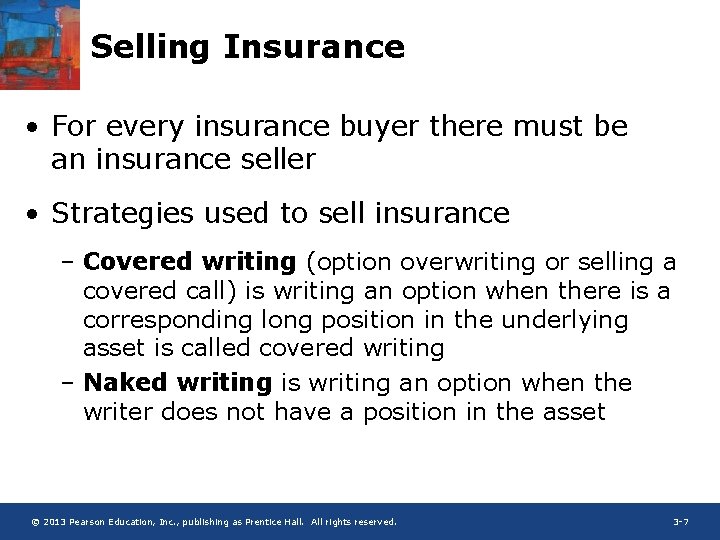
Selling Insurance • For every insurance buyer there must be an insurance seller • Strategies used to sell insurance – Covered writing (option overwriting or selling a covered call) is writing an option when there is a corresponding long position in the underlying asset is called covered writing – Naked writing is writing an option when the writer does not have a position in the asset © 2013 Pearson Education, Inc. , publishing as Prentice Hall. All rights reserved. 3 -7

Covered Writing: Covered Calls • Example: holding the S&R index and writing a S&R call option with a strike price of $1, 000 Writing a covered call generates the same profit as selling a put! © 2013 Pearson Education, Inc. , publishing as Prentice Hall. All rights reserved. 3 -8
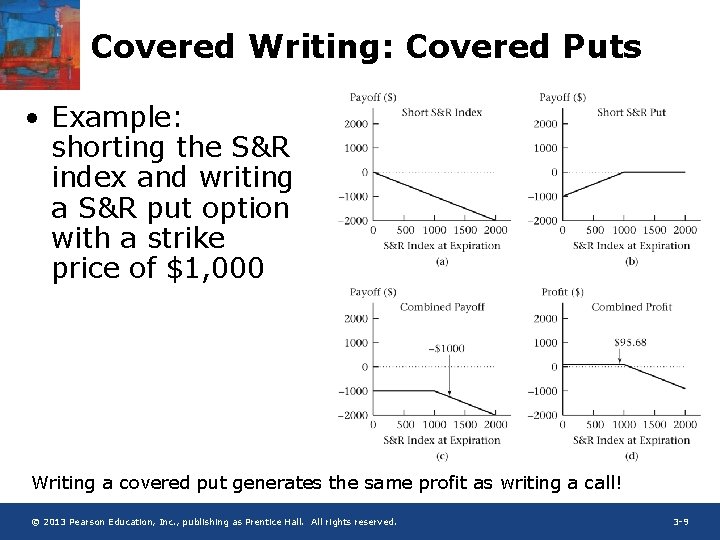
Covered Writing: Covered Puts • Example: shorting the S&R index and writing a S&R put option with a strike price of $1, 000 Writing a covered put generates the same profit as writing a call! © 2013 Pearson Education, Inc. , publishing as Prentice Hall. All rights reserved. 3 -9

Synthetic Forwards • A synthetic long forward contract – Buying a call and selling a put on the same underlying asset, with each option having the same strike price and time to expiration – Example: buy the $1, 000 strike S&R call and sell the $1, 000 -strike S&R put, each with 6 months to expiration © 2013 Pearson Education, Inc. , publishing as Prentice Hall. All rights reserved. 3 -10
Synthetic Forwards (cont’d) • Differences between a synthetic long forward contract and the actual forward – The forward contract has a zero premium, while the synthetic forward requires that we pay the net option premium – With the forward contract, we pay the forward price, while with the synthetic forward we pay the strike price © 2013 Pearson Education, Inc. , publishing as Prentice Hall. All rights reserved. 3 -11
Put-Call Parity • The net cost of buying the index using options must equal the net cost of buying the index using a forward contract • Call (K, t) – Put (K, t) = PV (F 0, t – K) – Call (K, t) and Put (K, t) denote the premiums of options with strike price K and time t until expiration, and PV (F 0, t ) is the present value of the forward price • This is one of the most important relationships in derivatives! © 2013 Pearson Education, Inc. , publishing as Prentice Hall. All rights reserved. 3 -12
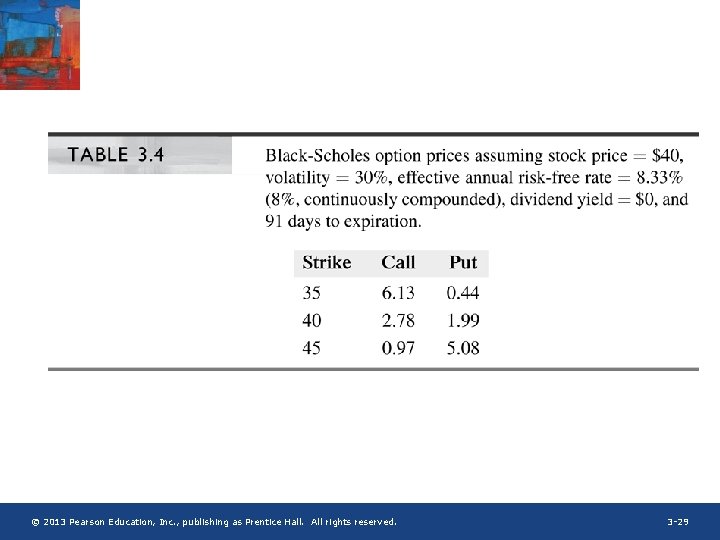
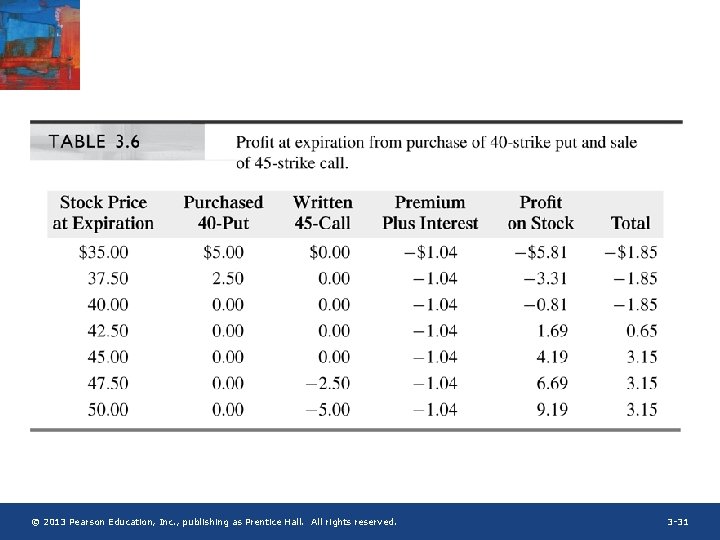
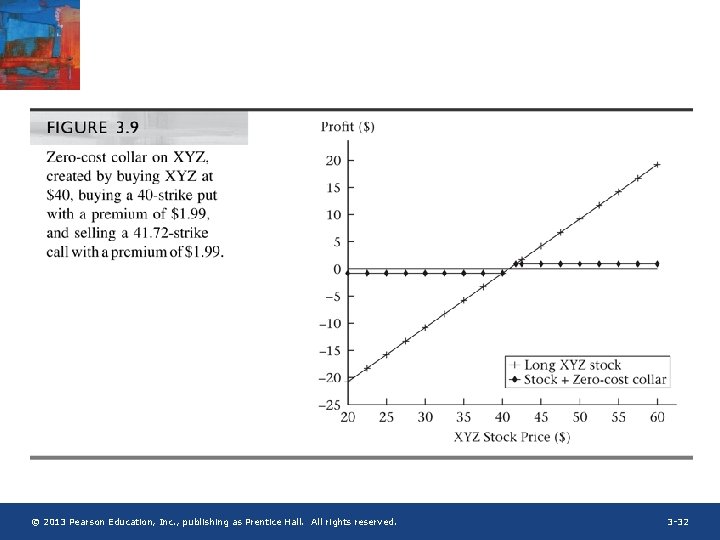
Spreads and Collars • An option spread is a position consisting of only calls or only puts, in which some options are purchased and some written – Examples: bull spread, bear spread, box spread • A collar is the purchase of a put option and the sale of a call option with a higher strike price, with both options having the same underlying asset and having the same expiration date – Example: zero-cost collar © 2013 Pearson Education, Inc. , publishing as Prentice Hall. All rights reserved. 3 -13
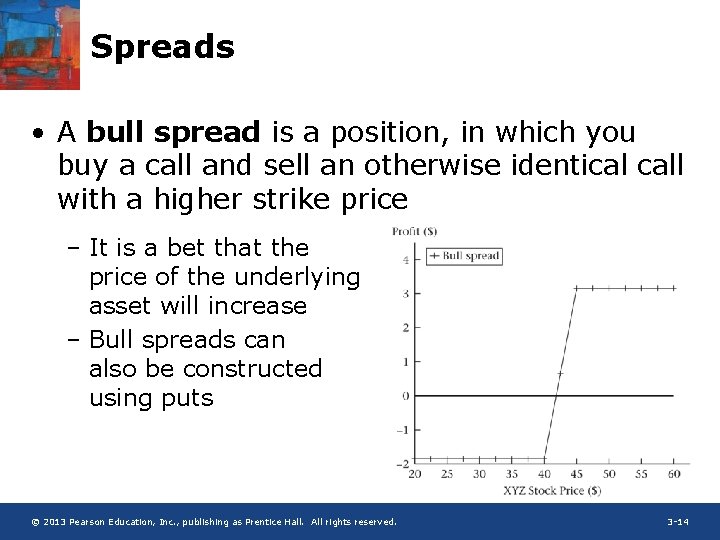
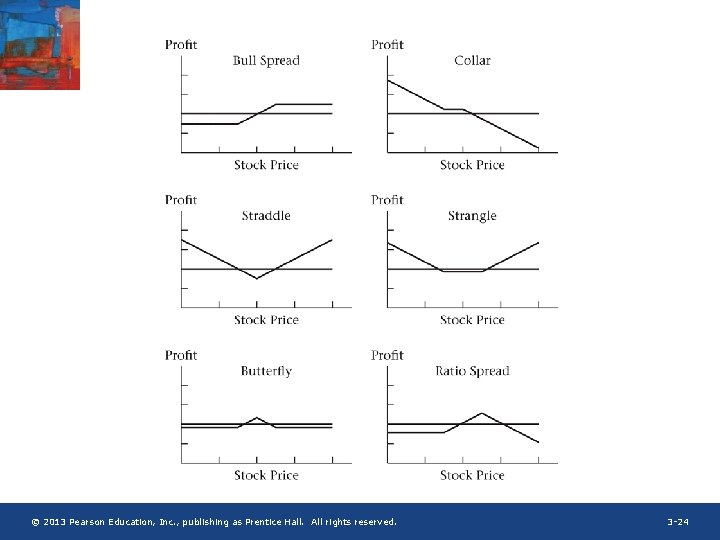
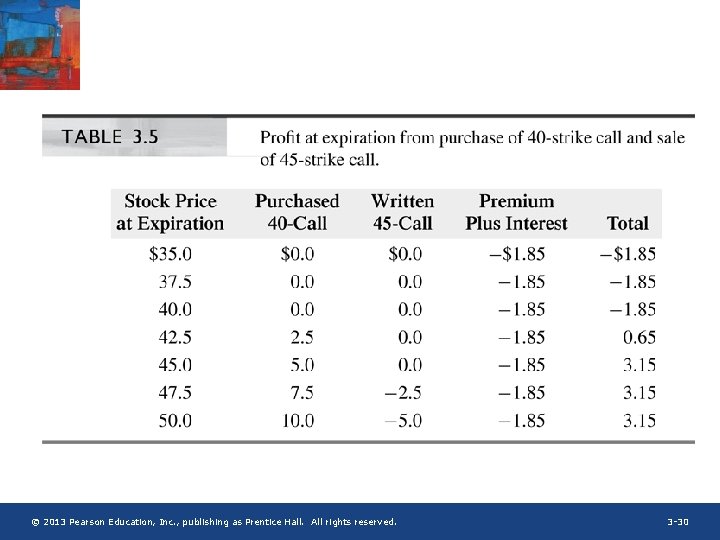
Spreads • A bull spread is a position, in which you buy a call and sell an otherwise identical call with a higher strike price – It is a bet that the price of the underlying asset will increase – Bull spreads can also be constructed using puts © 2013 Pearson Education, Inc. , publishing as Prentice Hall. All rights reserved. 3 -14
Spreads (cont’d) • A bear spread is a position in which one sells a call and buys an otherwise identical call with a higher strike price • A box spread is accomplished by using options to create a synthetic long forward at one price and a synthetic short forward at a different price – A box spread is a means of borrowing or lending money: It has no stock price risk • A ratio spread is constructed by buying m calls at one strike and selling n calls at a different strike, with all options having the same time to maturity and same underlying asset – Ratio spreads can also be constructed using puts © 2013 Pearson Education, Inc. , publishing as Prentice Hall. All rights reserved. 3 -15
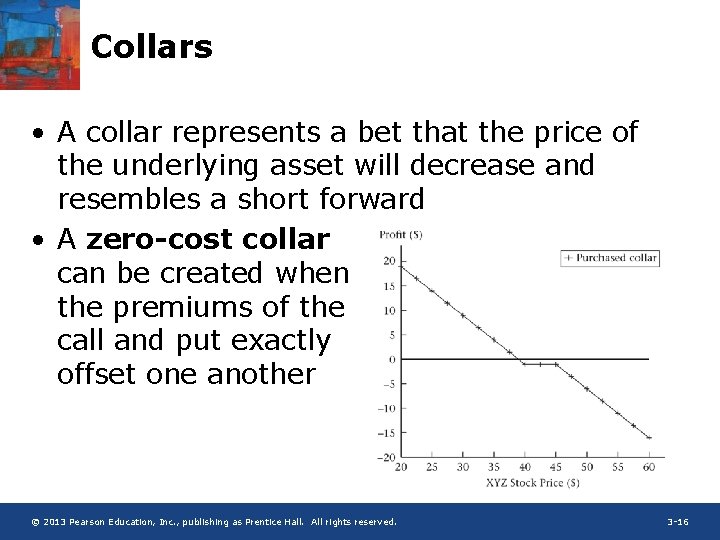
Collars • A collar represents a bet that the price of the underlying asset will decrease and resembles a short forward • A zero-cost collar can be created when the premiums of the call and put exactly offset one another © 2013 Pearson Education, Inc. , publishing as Prentice Hall. All rights reserved. 3 -16
Speculating on Volatility • Options can be used to create positions that are nondirectional with respect to the underlying asset • Examples – Straddles – Strangles – Butterfly spreads • Who would use nondirectional positions? – Investors who do not care whether the stock goes up or down, but only how much it moves, i. e. , who speculate on volatility © 2013 Pearson Education, Inc. , publishing as Prentice Hall. All rights reserved. 3 -17
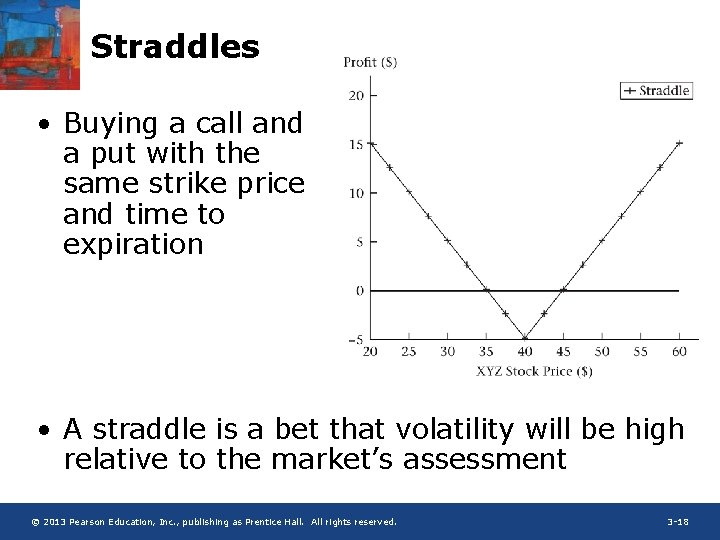
Straddles • Buying a call and a put with the same strike price and time to expiration • A straddle is a bet that volatility will be high relative to the market’s assessment © 2013 Pearson Education, Inc. , publishing as Prentice Hall. All rights reserved. 3 -18
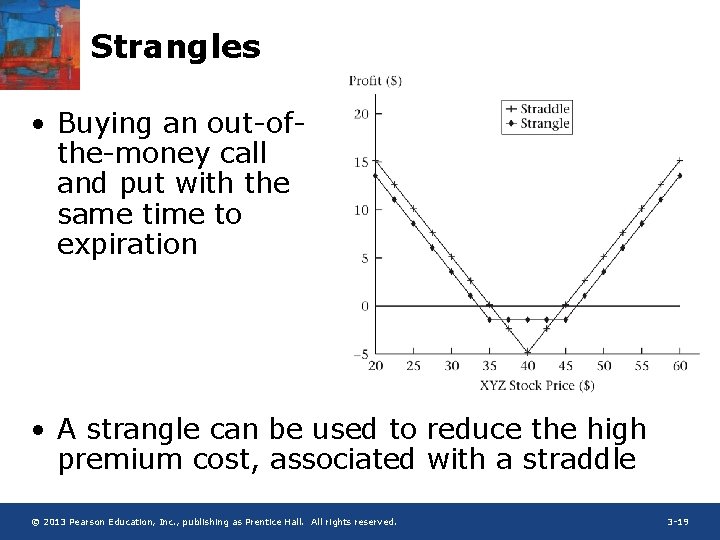
Strangles • Buying an out-ofthe-money call and put with the same time to expiration • A strangle can be used to reduce the high premium cost, associated with a straddle © 2013 Pearson Education, Inc. , publishing as Prentice Hall. All rights reserved. 3 -19
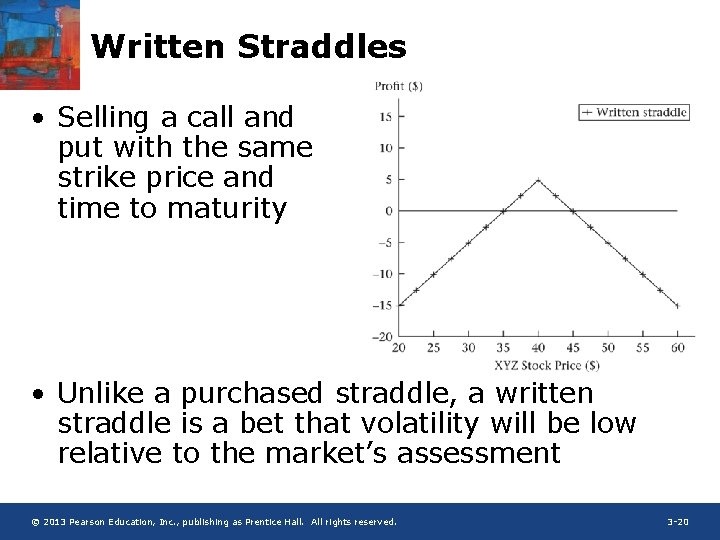
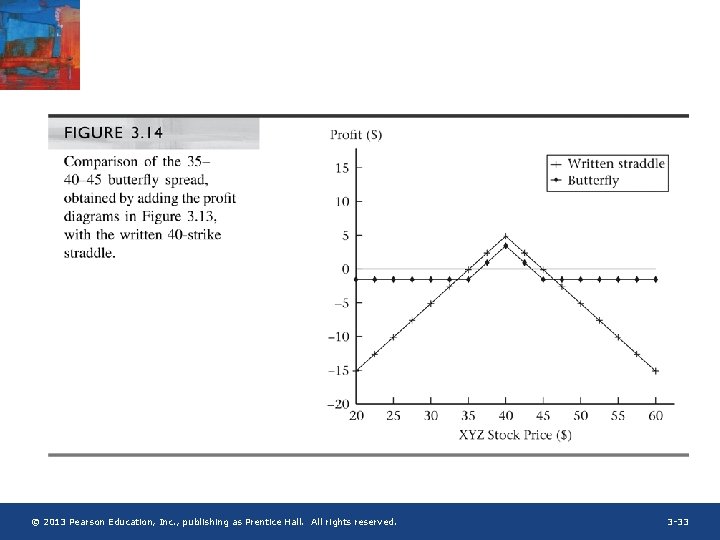
Written Straddles • Selling a call and put with the same strike price and time to maturity • Unlike a purchased straddle, a written straddle is a bet that volatility will be low relative to the market’s assessment © 2013 Pearson Education, Inc. , publishing as Prentice Hall. All rights reserved. 3 -20
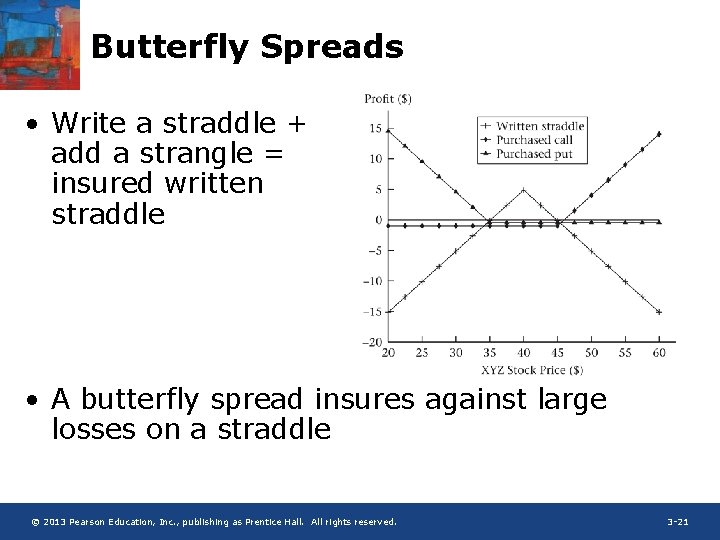
Butterfly Spreads • Write a straddle + add a strangle = insured written straddle • A butterfly spread insures against large losses on a straddle © 2013 Pearson Education, Inc. , publishing as Prentice Hall. All rights reserved. 3 -21
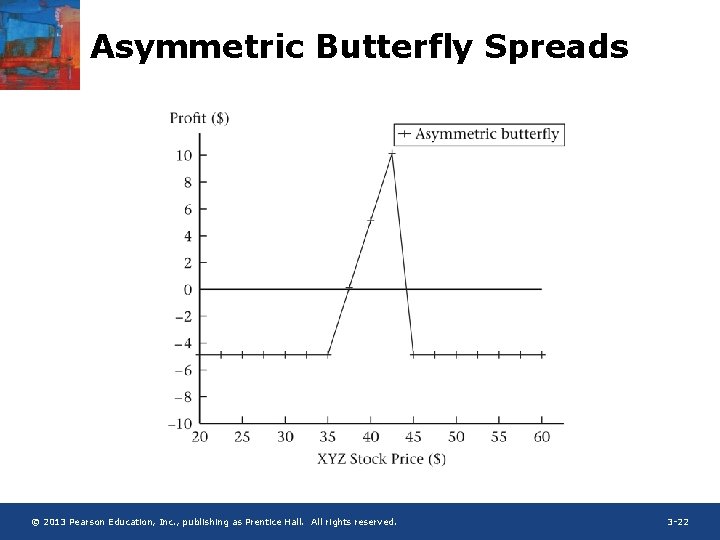
Asymmetric Butterfly Spreads © 2013 Pearson Education, Inc. , publishing as Prentice Hall. All rights reserved. 3 -22
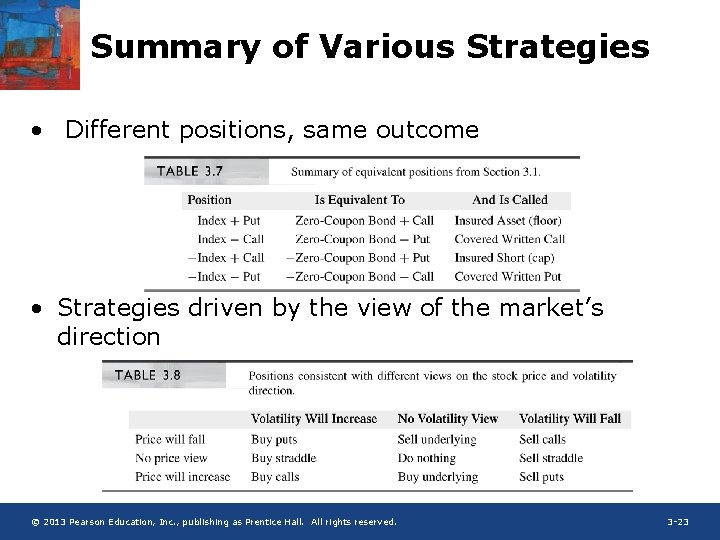
Summary of Various Strategies • Different positions, same outcome • Strategies driven by the view of the market’s direction © 2013 Pearson Education, Inc. , publishing as Prentice Hall. All rights reserved. 3 -23
© 2013 Pearson Education, Inc. , publishing as Prentice Hall. All rights reserved. 3 -24
© 2013 Pearson Education, Inc. , publishing as Prentice Hall. All rights reserved. 3 -25
© 2013 Pearson Education, Inc. , publishing as Prentice Hall. All rights reserved. 3 -26
© 2013 Pearson Education, Inc. , publishing as Prentice Hall. All rights reserved. 3 -27
© 2013 Pearson Education, Inc. , publishing as Prentice Hall. All rights reserved. 3 -28
© 2013 Pearson Education, Inc. , publishing as Prentice Hall. All rights reserved. 3 -29
© 2013 Pearson Education, Inc. , publishing as Prentice Hall. All rights reserved. 3 -30
© 2013 Pearson Education, Inc. , publishing as Prentice Hall. All rights reserved. 3 -31
© 2013 Pearson Education, Inc. , publishing as Prentice Hall. All rights reserved. 3 -32
© 2013 Pearson Education, Inc. , publishing as Prentice Hall. All rights reserved. 3 -33
- Slides: 33