
Chapter 3 Infancy and Toddlerhood Lifespan Development A
- Slides: 66
Chapter 3: Infancy and Toddlerhood Lifespan Development: A Psychological Perspective By Martha Lally and Suzanne Valentine-French (Published
In this chapter: Physical development � Growth, Cognitive development � Piaget’s reflexes, sleep, nutrition theory, memory, language Psychosocial development � Temperament, attachment, self-awareness
Learning objectives: Physical development in infancy and toddlerhood Summarize overall physical growth during infancy Describe the growth of the brain during infancy Explain infant sleep Identify newborn reflexes Compare gross and fine motor skills Contrast development of the senses in newborns Describe the habituation procedure Explain the merits of breastfeeding and when to introduce more solid foods Discuss the nutritional concerns of marasmus and kwashiorkor
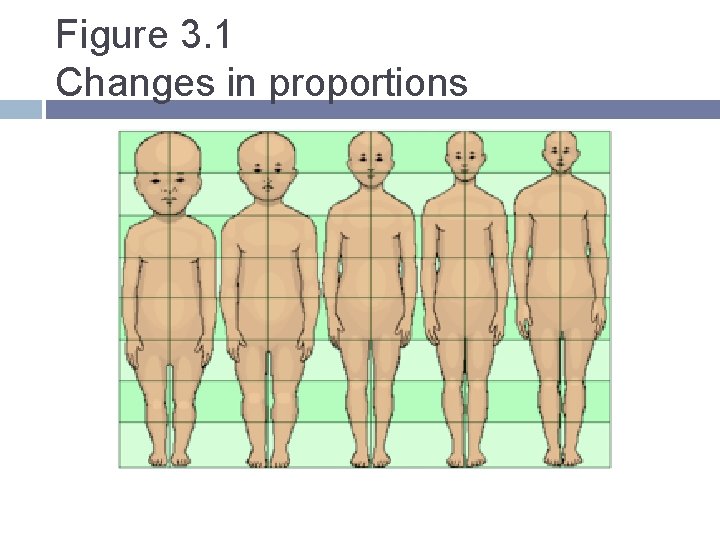
Physical growth Average newborn in U. S. weighs 7. 5 lbs and is 20 inches long Typically lose 5% of weight soon after birth Birth weight doubles by 4 months, triples by 1 year Change in proportions – At birth, head is 25% of our length, by adulthood it’s 20% of our length
Figure 3. 1 Changes in proportions
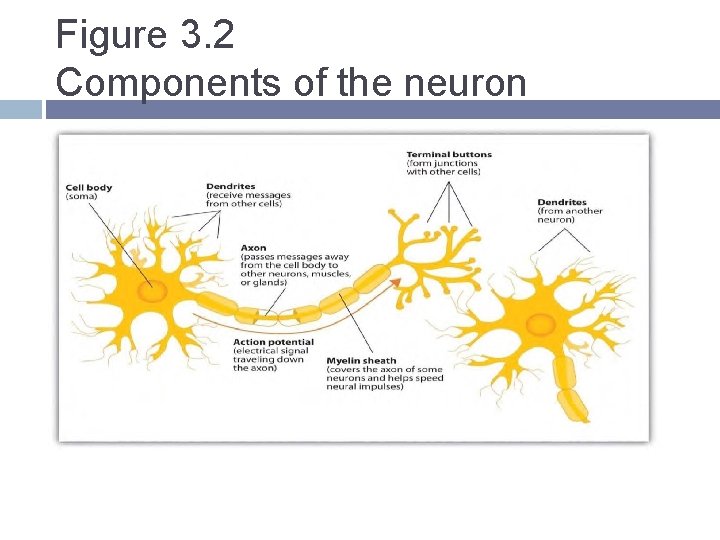
Brain development in infancy: Neurons Parts of a neuron � Cell body � Dendrites – Receive information � Axon – Sends information � Myelin sheath – Insulates axon � Synapses - Connections
Figure 3. 2 Components of the neuron
Brain development in infancy: Neurons (continued) Changes in neurons � Synaptogenesis – Formation of connections Caused by proliferation of dendrites � Synaptic blooming – Period of rapid neural growth � Synaptic pruning – Reduce unused neural connections to increase brain efficiency Experience determines what’s maintained and lost � Development of myelin sheath
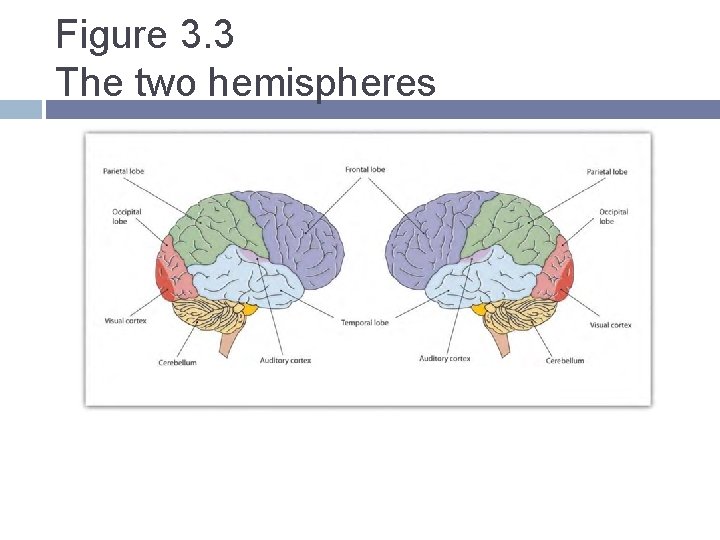
Parts of the brain Cortex � Thin outer covering of the brain � Involved in voluntary activity and thinking Two hemispheres, each divided into four lobes � Frontal lobe – Thinking, planning, memory, and judgment � Parietal lobe – Processing information about touch � Occipital lobe – Processing visual information � Temporal lobe – Processing auditory information and language
Figure 3. 3 The two hemispheres
Processes of brain maturation Lateralization – Different functions become localized primarily on one side of the brain Neuroplasticity � Brain’s ability to change, both physically and chemically Environmental stimulation Hormonal processes/medications � Enhance its adaptability to environmental change � Compensate for injury
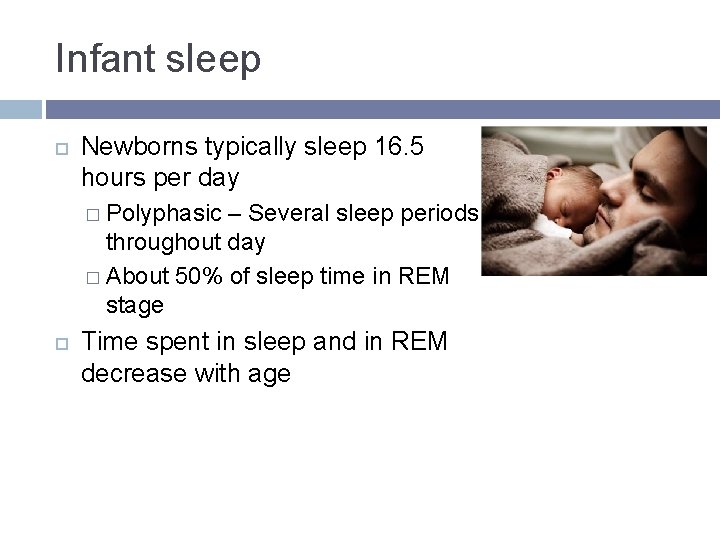
Infant sleep Newborns typically sleep 16. 5 hours per day � Polyphasic – Several sleep periods throughout day � About 50% of sleep time in REM stage Time spent in sleep and in REM decrease with age
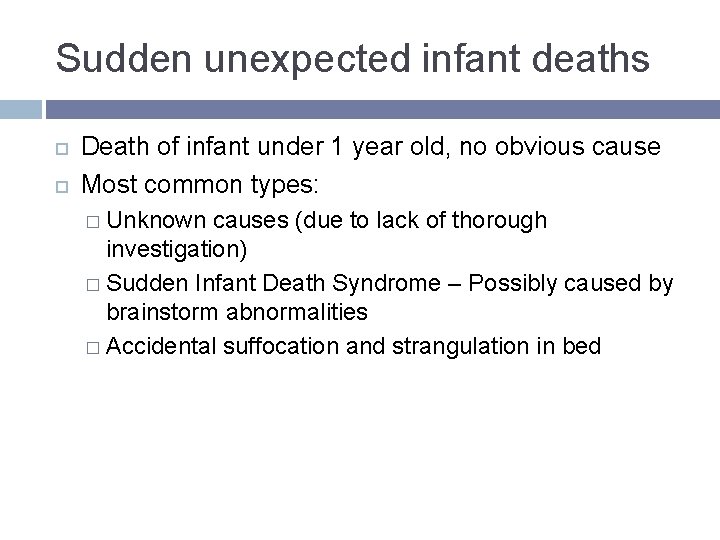
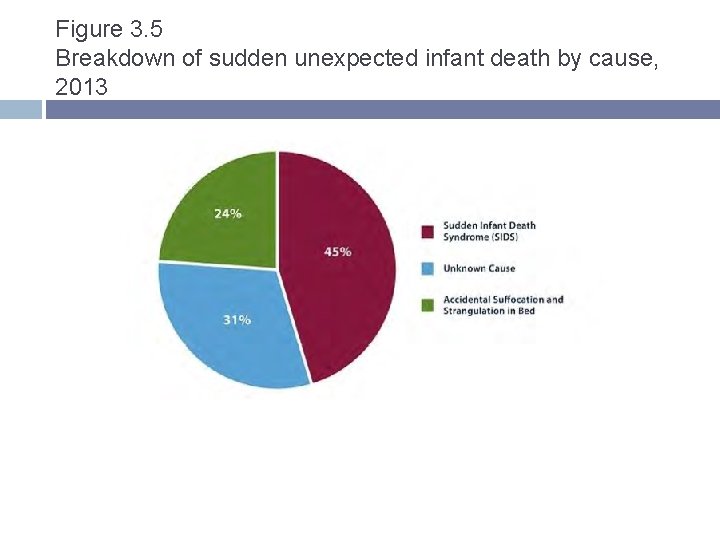
Sudden unexpected infant deaths Death of infant under 1 year old, no obvious cause Most common types: � Unknown causes (due to lack of thorough investigation) � Sudden Infant Death Syndrome – Possibly caused by brainstorm abnormalities � Accidental suffocation and strangulation in bed
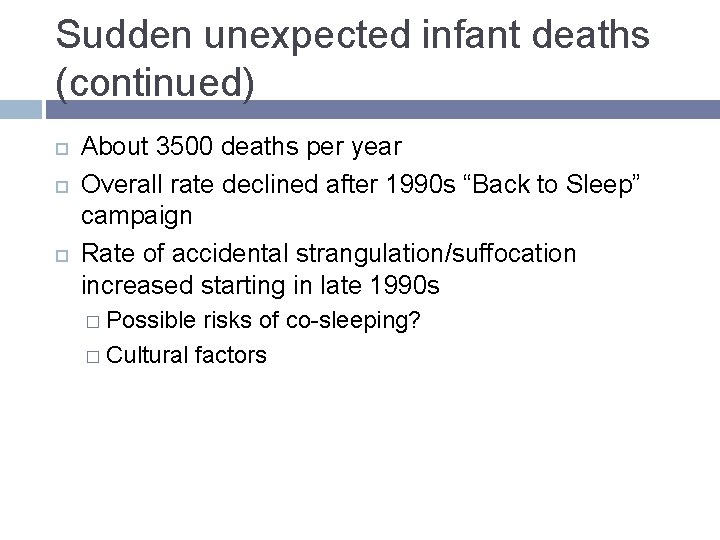
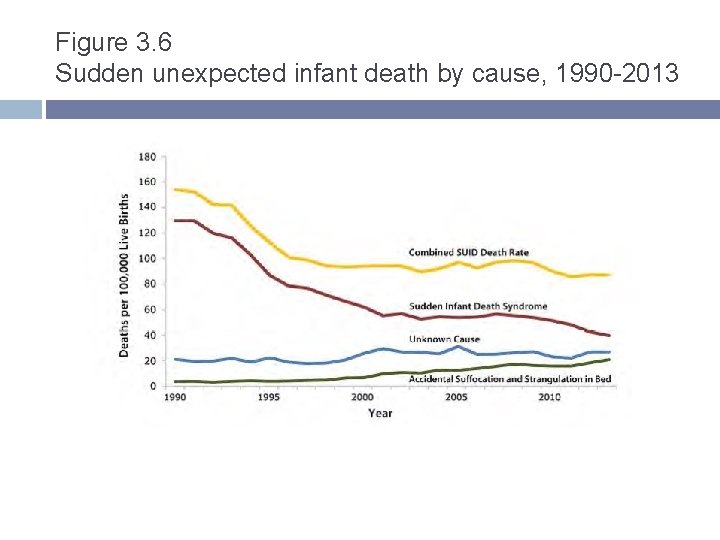
Sudden unexpected infant deaths (continued) About 3500 deaths per year Overall rate declined after 1990 s “Back to Sleep” campaign Rate of accidental strangulation/suffocation increased starting in late 1990 s � Possible risks of co-sleeping? � Cultural factors
Figure 3. 5 Breakdown of sudden unexpected infant death by cause, 2013
Figure 3. 6 Sudden unexpected infant death by cause, 1990 -2013
Infant reflexes Reflexes - Involuntary movements in response to stimulation Some related to feeding � Rooting, sucking Some replaced by voluntary behaviors later � Grasping, stepping Indicate functioning of nervous/sensory system � Eyeblink, Babinski, Moro, tonic neck
Motor development Progress from reflexes to voluntary movement Cephalocaudal pattern (head to tail) � Example: Gain head control before ability to walk Proximodistal pattern (from the center out) � Example: Grasp with whole hand first, then fingers later Average as well as range of typical ages � Example: Average sitting age 7 months (range 5 -9)
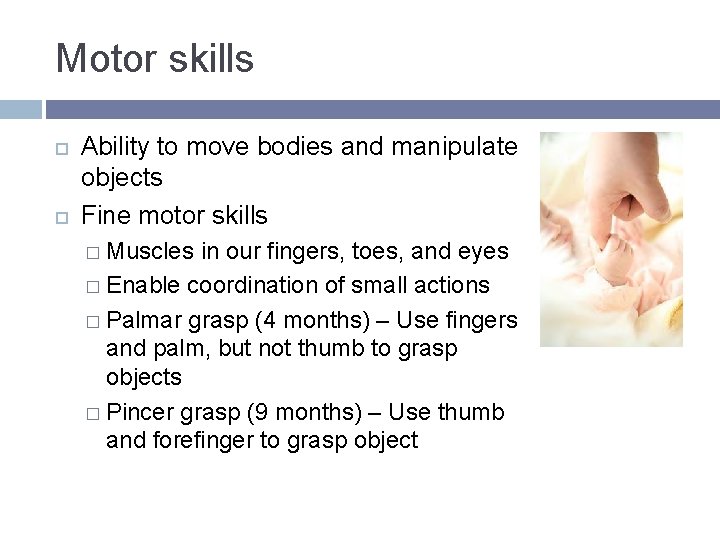
Motor skills Ability to move bodies and manipulate objects Fine motor skills � Muscles in our fingers, toes, and eyes � Enable coordination of small actions � Palmar grasp (4 months) – Use fingers and palm, but not thumb to grasp objects � Pincer grasp (9 months) – Use thumb and forefinger to grasp object
Motor skills (continued) Gross motor skills � Large muscle groups that control our head, torso, arms, and legs � Larger movements � Generally develop before fine motor skills
Sensory capacities Vision – Poorly developed at birth � Newborn range of vision – 8 -16 inches � Prefer large patterns, contrasting colors � Depth perception present by 6 months � Experience very important for proper development
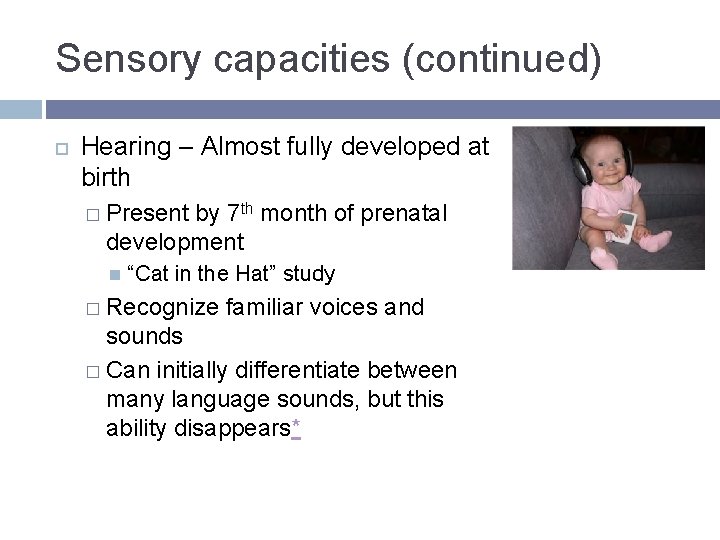
Sensory capacities (continued) Hearing – Almost fully developed at birth � Present by 7 th month of prenatal development “Cat in the Hat” study � Recognize familiar voices and sounds � Can initially differentiate between many language sounds, but this ability disappears*
Sensory capabilities (continued) Touch and pain – Fully developed at birth Smell and taste – Fully developed at birth � Newborns prefer sweet tastes � Newborns recognize and prefer their mother’s scent
Habituation Decreased responsiveness to a stimulus after repeated presentations Used to test cognitive and perceptual processes Predictive of later cognitive ability
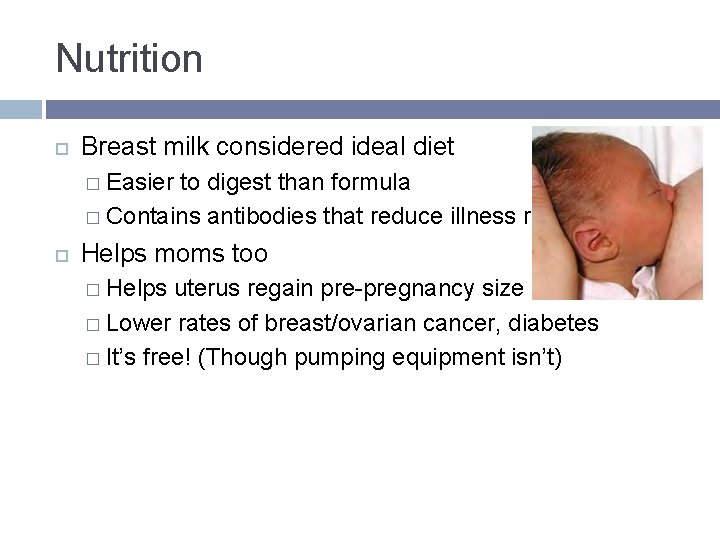
Nutrition Breast milk considered ideal diet � Easier to digest than formula � Contains antibodies that reduce illness risk Helps moms too � Helps uterus regain pre-pregnancy size � Lower rates of breast/ovarian cancer, diabetes � It’s free! (Though pumping equipment isn’t)
Challenges for breastfeeding moms USDHHS recommendations: � Exclusively breastfeed for first 6 months � Supplement diet with breast milk during first 2 years However, most moms stop by 6 -8 weeks � Many workplaces not supportive � Many health care providers not supportive
Introducing solid foods Usually around 4 -6 months old Start with semi-solid foods (rice/oatmeal cereal) Introduce one new food at a time (allergy check) Finger foods by 10 -12 months
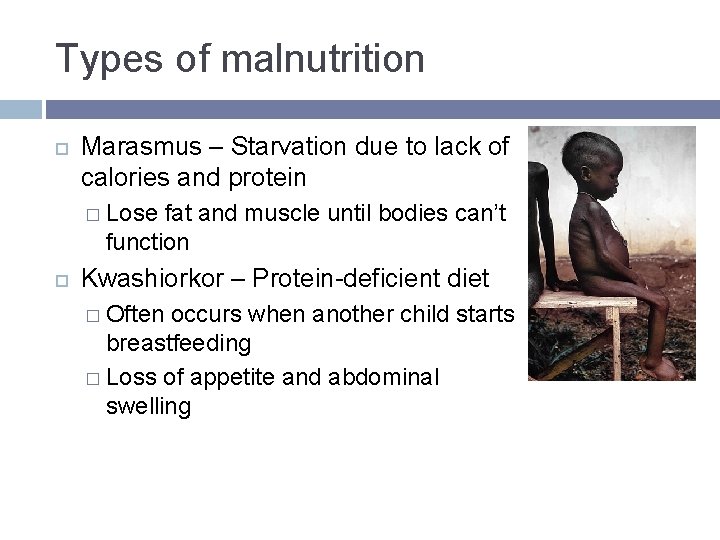
Types of malnutrition Marasmus – Starvation due to lack of calories and protein � Lose fat and muscle until bodies can’t function Kwashiorkor – Protein-deficient diet � Often occurs when another child starts breastfeeding � Loss of appetite and abdominal swelling
Malnutrition rates 2014 – 50 million children under age 5 (World Health Organization and UNICEF) 1 in every 13 children in the world � Most live in Asia (34. 3 million) and Africa (13. 9 million) Caused by: � Severe food shortages � Regional diets that lack certain proteins and vitamins � Infectious diseases that inhibit appetite
Possible effects of malnutrition Death Lower IQ scores Behavioral and attention problems Early malnutrition has worst effects
Learning objectives: Cognitive development in infancy and toddlerhood Compare the Piagetian concepts of schema, assimilation, and accommodation List and describe the six substages of sensorimotor intelligence Describe the characteristics of infant memory Describe components and developmental progression of language Identify and compare theories of language
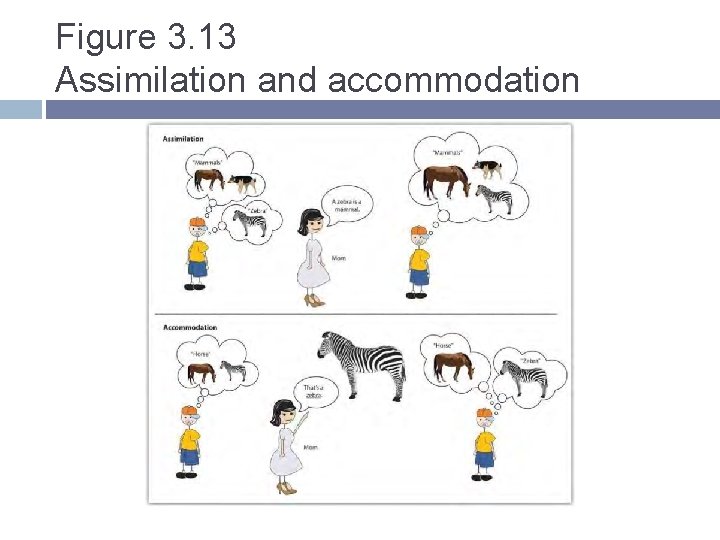
Piaget’s theory of cognitive development Children continuously trying to make sense of world Schema – Framework for organizing information Assimilation – Fitting new information into an existing schema Accommodation – Expanding schema to incorporate new information
Figure 3. 13 Assimilation and accommodation
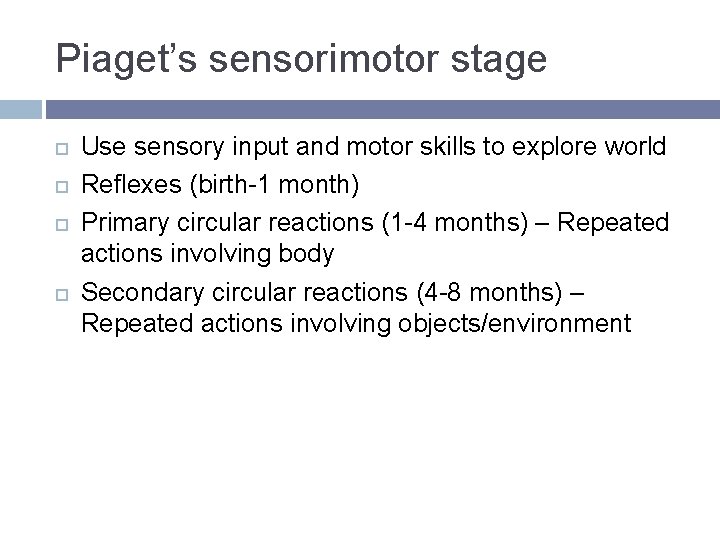
Piaget’s sensorimotor stage Use sensory input and motor skills to explore world Reflexes (birth-1 month) Primary circular reactions (1 -4 months) – Repeated actions involving body Secondary circular reactions (4 -8 months) – Repeated actions involving objects/environment
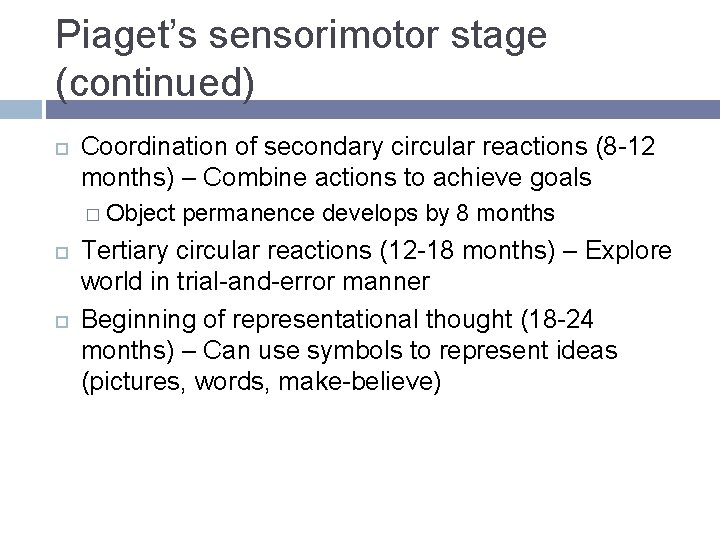
Piaget’s sensorimotor stage (continued) Coordination of secondary circular reactions (8 -12 months) – Combine actions to achieve goals � Object permanence develops by 8 months Tertiary circular reactions (12 -18 months) – Explore world in trial-and-error manner Beginning of representational thought (18 -24 months) – Can use symbols to represent ideas (pictures, words, make-believe)
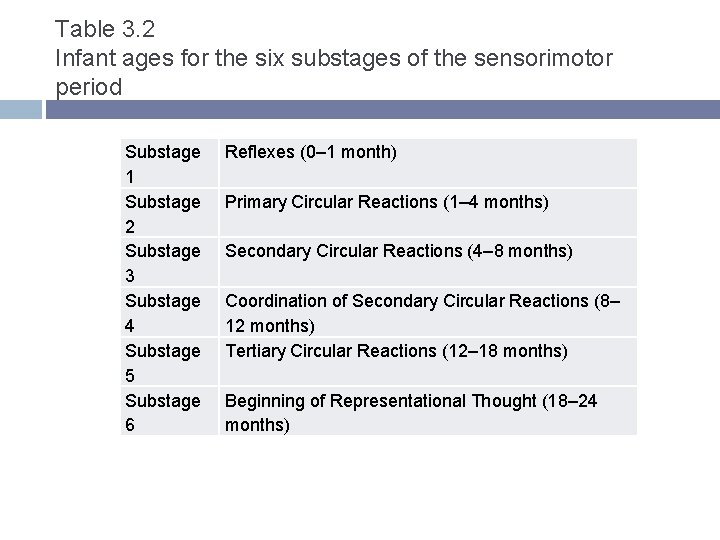
Table 3. 2 Infant ages for the six substages of the sensorimotor period Substage 1 Substage 2 Substage 3 Substage 4 Substage 5 Substage 6 Reflexes (0– 1 month) Primary Circular Reactions (1– 4 months) Secondary Circular Reactions (4– 8 months) Coordination of Secondary Circular Reactions (8– 12 months) Tertiary Circular Reactions (12– 18 months) Beginning of Representational Thought (18– 24 months)
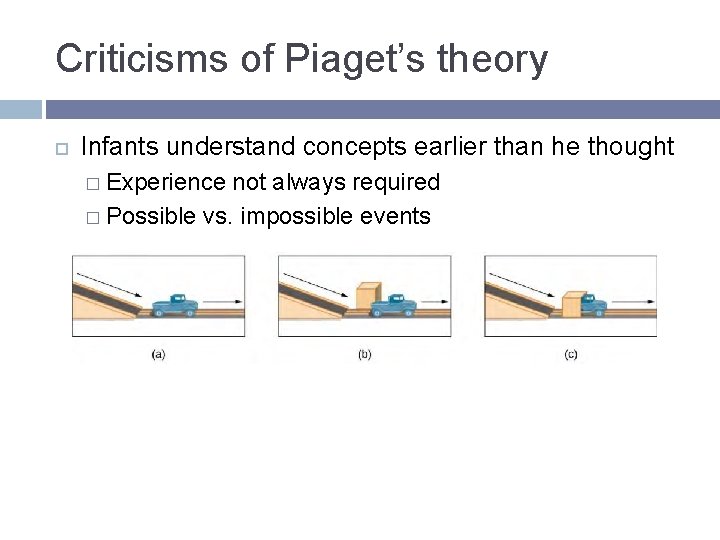
Criticisms of Piaget’s theory Infants understand concepts earlier than he thought � Experience not always required � Possible vs. impossible events
Infant memory Infantile amnesia – Inability to recall memories from first few years � Lack of language skills? � Lack of understanding of “self”? Deferred imitation – Imitation after delay � Present by 6 months of age Infant memory is context-dependent
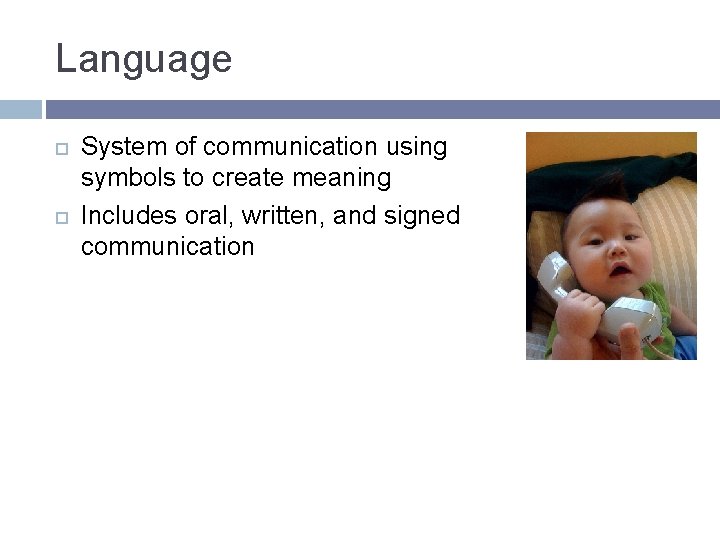
Language System of communication using symbols to create meaning Includes oral, written, and signed communication
Components of language Phoneme – Smallest unit of sound in a language Morpheme – Smallest unit of meaning in a language Semantics – Rules we use to determine meaning Syntax – Rules for constructing sentences Pragmatics – Rules for communicating � Contextual information helps determine meaning
Language development 2 months – cooing (vowel sounds)* 7 months – babbling (simple syllables)* � Gets more conversational over time* � Add gestures, intonation, facial expression
Language development (continued) 12 months – first word � Holphrasic speech – One word implies entire thought � First words differ by culture 18 months – naming explosion By 2 years – putting words together
Aspects of language use Receptive language – What we understand � Always more than we actually say � First name is often recognized early Language errors � Underextension – Thinking a word can be used for only that particular object (e. g. , “doggie” is the specific animal at my house) � Overextension – Thinking a label applies to all objects that are similar to the original object (e. g. , calling all animals “doggie”
Infant-directed speech Used by adults with babies Exaggerated vowel and consonant sounds High-pitched voice Exaggerated facial expression
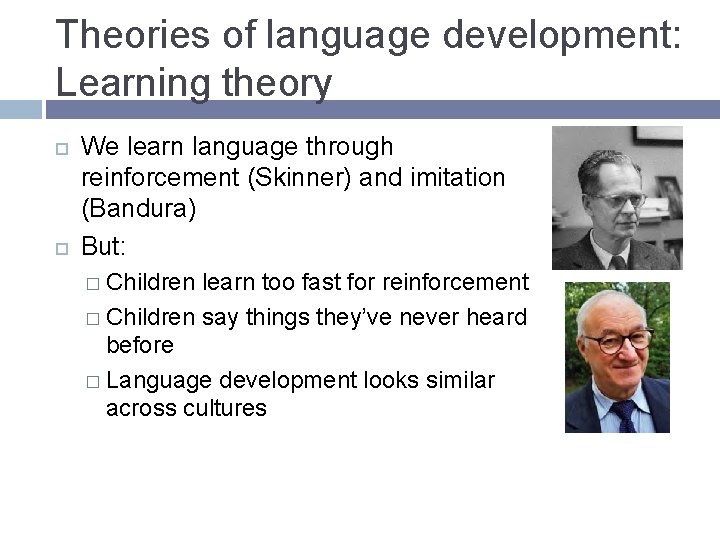
Theories of language development: Learning theory We learn language through reinforcement (Skinner) and imitation (Bandura) But: � Children learn too fast for reinforcement � Children say things they’ve never heard before � Language development looks similar across cultures
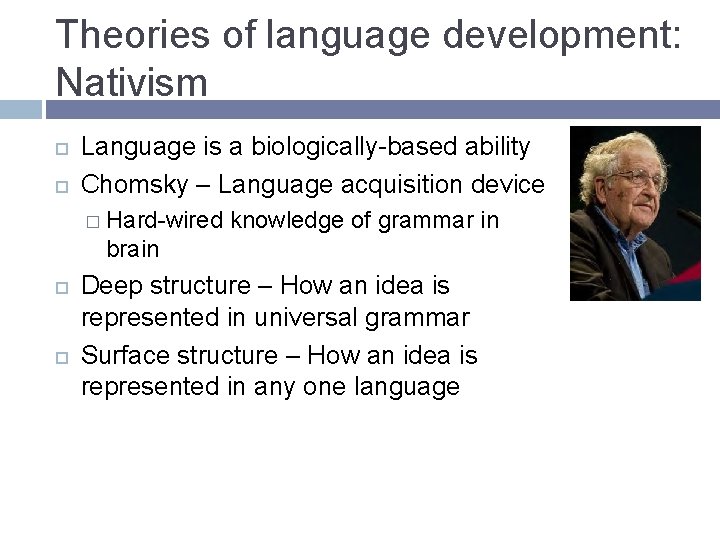
Theories of language development: Nativism Language is a biologically-based ability Chomsky – Language acquisition device � Hard-wired knowledge of grammar in brain Deep structure – How an idea is represented in universal grammar Surface structure – How an idea is represented in any one language
Theories of language development: Critical period and social pragmatics Critical period – Must learn language by puberty � Environmental input is crucial � Applies primarily to first language acquisition Social pragmatics – Focus on social aspects of language � Language is tool to communicate and connect � Language is tool to understand others and be understood
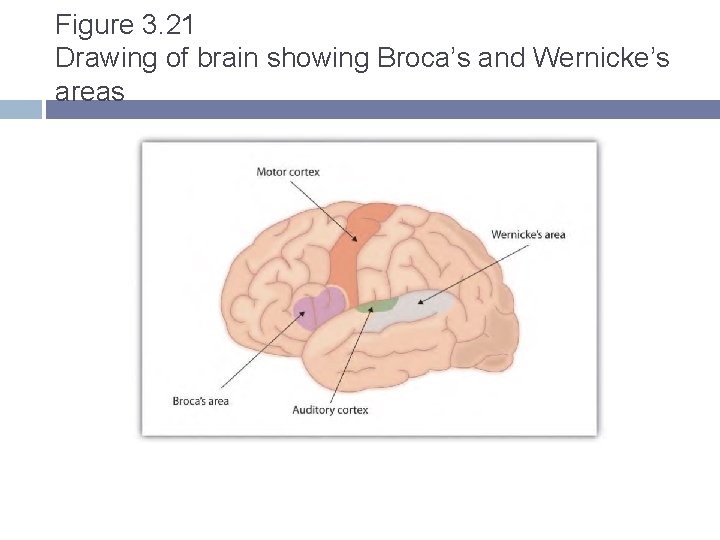
Brain aspects of language use Broca’s area – Left frontal lobe near motor cortex � Responsible for motor aspects of language production Wernicke’s area – Left temporal lobe near auditory cortex � Responsible for understanding and creating meaning
Figure 3. 21 Drawing of brain showing Broca’s and Wernicke’s areas
Learning objectives: Psychosocial development in infancy and toddlerhood Identify styles of temperament and explore goodness-of-fit Describe the early theories of attachment Contrast styles of attachment according to the Strange Situation Technique Explain the factors that influence attachment Describe self-awareness, stranger wariness, and separation anxiety Use Erikson’s theory to characterize psychosocial development during infancy
Temperament Innate characteristics of the infant, including mood, activity level, and emotional reactivity Chess and Thomas’ temperament styles � Easy – Easily soothed, adaptable, generally positive mood � Difficult – Reacts negatively to new situations, cries frequently, generally negative mood � Slow-to-warm-up – Low activity level, adjusts slowly to new situations, often negative in mood
Temperament (continued) Temperament may influence social interactions � Goodness-of-fit – How well infant and parent interaction styles match Social interactions are bidirectional
Temperament vs. personality Temperament – How people react to environments � Relatively stable but change with brain development Personality – An individual’s consistent pattern of feeling, thinking, and behaving � Caused by interaction of temperament and experience � Include things like self-concept, responsibility, motivation
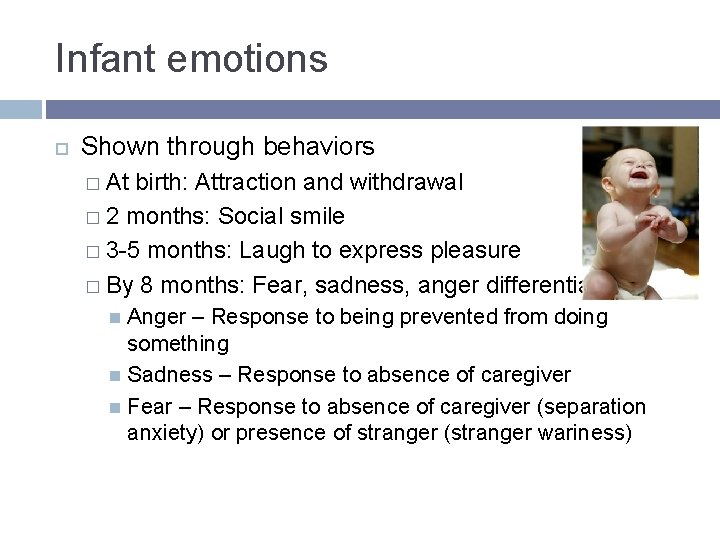
Infant emotions Shown through behaviors � At birth: Attraction and withdrawal � 2 months: Social smile � 3 -5 months: Laugh to express pleasure � By 8 months: Fear, sadness, anger differentiated Anger – Response to being prevented from doing something Sadness – Response to absence of caregiver Fear – Response to absence of caregiver (separation anxiety) or presence of stranger (stranger wariness)
Types of emotions Basic emotions � Happiness, anger, fear, surprise, sadness, and disgust � Appear early in infancy Self-conscious emotions � Envy, pride, shame, guilt, doubt, and embarrassment � Appear between 1 and 2 years � Require self-awareness, social understanding
Regulation of emotions Social referencing – Look to others for cues on how to act � Facial expressions are important clues � Visual cliff studies Emotional self-regulation – Strategies we use to control our emotional states to attain goals � Initially requires assistance from others � Control improves with experience and brain maturation
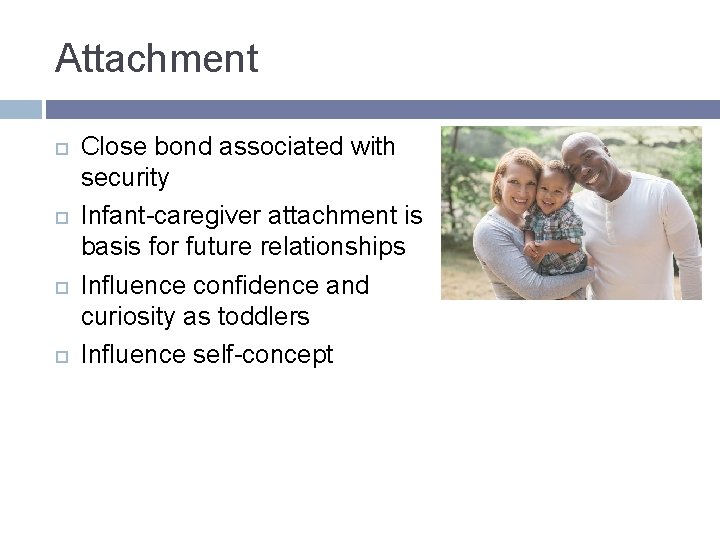
Attachment Close bond associated with security Infant-caregiver attachment is basis for future relationships Influence confidence and curiosity as toddlers Influence self-concept
Theories of attachment Freud – Infants are oral creatures � Will become attached to mother through feeding Harlow disagreed � Infant monkeys raised with wire or cloth mother � Preferred cloth mother � “Contact comfort” is basis for attachment
Theories of attachment (continued) Bowlby – Attachment important for survival � Infant behaviors (e. g. , crying) promote attachment � Secure base – Parental presence that gives the child a sense of safety � Caregivers must be responsive to the child’s needs � Caregiver and child must engage in mutually enjoyable interactions
Theories of attachment (continued) Erikson – Trust vs. mistrust � Most important goal of infancy: Developing a basic sense of trust in one’s caregivers � Caregivers need to be responsive to infant’s needs � Situations that impair responsiveness can create mistrust Example: Premature birth, parental stress
Ainsworth’s “Strange Situation” 3 main elements* � Unfamiliar environment � Stranger present � Mother absent Examine infant reactions to these things � Also examine infant reaction to reunion (most important)
Ainsworth’s attachment styles Secure – Trusts caregiver � Explores environment while caregiver present � Engages with caregiver and possibly stranger � Likely upset when the caregiver departs, but happy to see caregiver return Ambivalent (sometimes called resistant) – Shows mistrust through uncertainty � Wary about the situation and stranger � Distressed when caregiver leaves but ambivalent when caregiver returns
Ainsworth’s attachment styles (continued) Avoidant – Shows mistrust by avoiding caregiver � Avoids or ignores caregiver � Shows little emotion when caregiver departs or returns Disorganized/disoriented - Inconsistent coping � The child may cry during the separation, but avoid caregiver upon return
Parental behaviors and attachment styles Secure – Caregiver meets child’s needs in a responsive and appropriate manner Insecure ambivalent – Caregiver responds inconsistently to child’s needs Insecure avoidant – Caregiver does not respond to child’s needs Insecure disorganized/disoriented – Caregiver behaves erratically or abuses child
Consequences of poor attachment Non-organic failure to thrive – Infants do not grow, develop, or gain weight on schedule Reactive attachment disorder – Disturbed and inappropriate attachment behavior But some children are resilient – Can overcome challenges and successfully adapt
Erikson: Autonomy vs. shame and doubt Most important goal of toddlerhood: Developing a basic sense of independence � Caregivers need to be encourage appropriate independence � Negative reactions/restrictions will prevent independence � May affect self-esteem and initiative later