
CHAPTER 3 INFANCY AND CHILDHOOD CHANGESMORE THAN EVER






- Slides: 47
CHAPTER 3: INFANCY AND CHILDHOOD CHANGES…MORE THAN EVER BEFORE OR AFTER
DEVELOPMENTAL PSYCHOLOGY • Def: the study of changes that occur as an individual matures
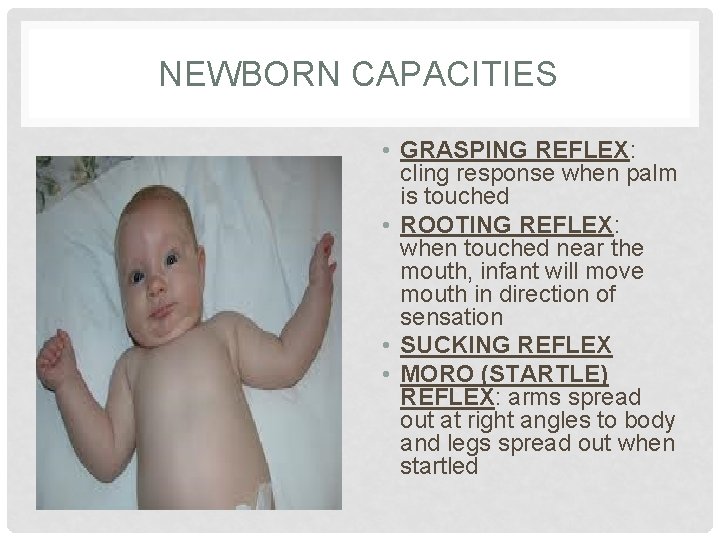
NEWBORN CAPACITIES • GRASPING REFLEX: cling response when palm is touched • ROOTING REFLEX: when touched near the mouth, infant will move mouth in direction of sensation • SUCKING REFLEX • MORO (STARTLE) REFLEX: arms spread out at right angles to body and legs spread out when startled
PHYSICAL DEVELOPMENT • Avg length of newborn: 18 -22 inches • MATURATION: the internally programmed growth of a child • LEARNING: relatively permanent change in behavior resulting from responses that change as a result of experience • Don’t force learning • Maturational readiness
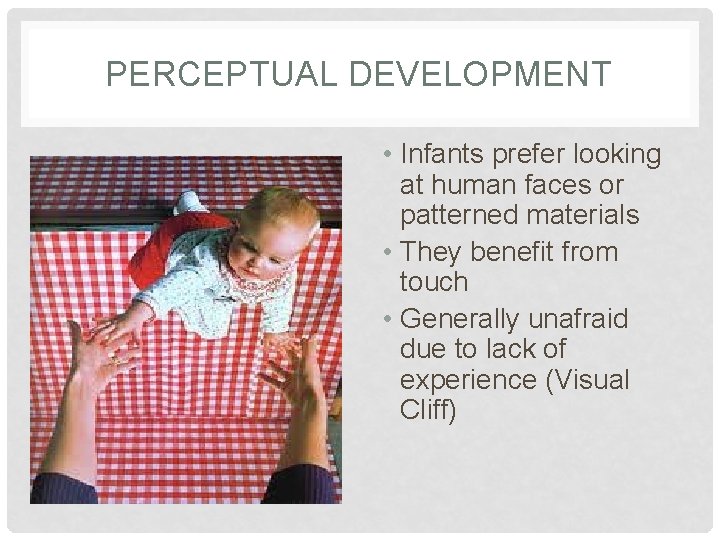
PERCEPTUAL DEVELOPMENT • Infants prefer looking at human faces or patterned materials • They benefit from touch • Generally unafraid due to lack of experience (Visual Cliff)
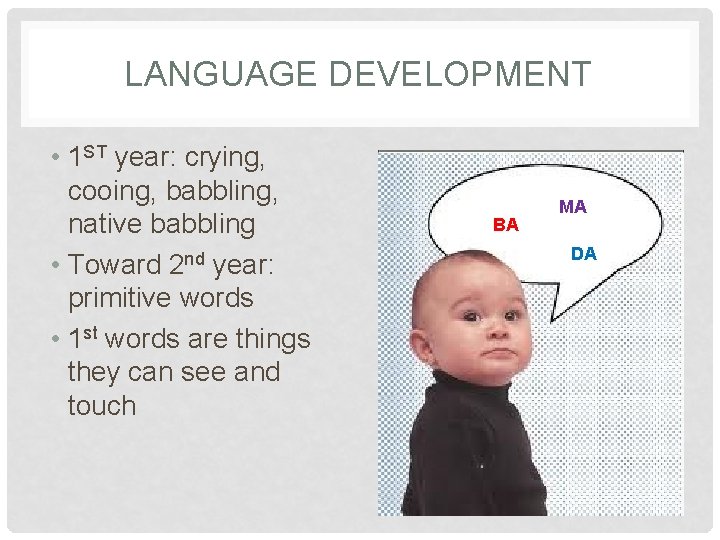
LANGUAGE DEVELOPMENT • 1 ST year: crying, cooing, babbling, native babbling • Toward 2 nd year: primitive words • 1 st words are things they can see and touch BA MA DA
LANGUAGE CONTINUED MY MOM ME NO PUTTED LIKE THIS STUPID HAT ON ME • End of 2 nd year: 500 -1500 word vocab. ; begin 2 word phrases • TELEGRAPHIC SPEECH: verbal utterances where words are left out but meaning is clear • Overgeneralization: improperly applying grammatical rules • Grammar: rules for arranging symbols to produce meaning
SECTION 2: COGNITIVE AND EMOTIONAL DEVELOPMENT
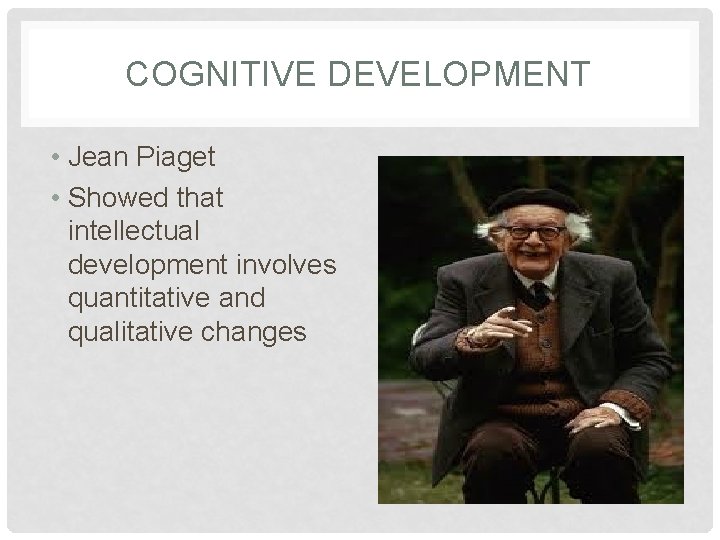
COGNITIVE DEVELOPMENT • Jean Piaget • Showed that intellectual development involves quantitative and qualitative changes
HOW KNOWING CHANGES • SCHEMA: conceptual framework a person uses to make sense of the world • ASSIMILATION: process of fitting objects and experiences into one’s schemas • ACCOMMODATION: adjustment of one’s schemas to include newly observed events and experiences
OBJECT PERMANENCE • Def: a child’s realization that an object exists even when he/she cannot see or touch it • Usually obtained by 12 -18 months
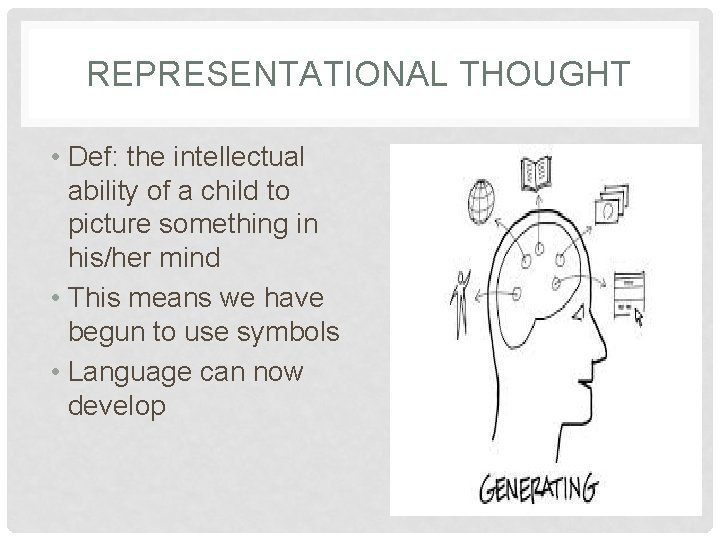
REPRESENTATIONAL THOUGHT • Def: the intellectual ability of a child to picture something in his/her mind • This means we have begun to use symbols • Language can now develop
PRINCIPLE OF CONSERVATION • Def: a given quantity does not change when its appearance is changed • Acquired by age 7 • EGOCENTRIC: a young child’s inability to understand another person’s perspective
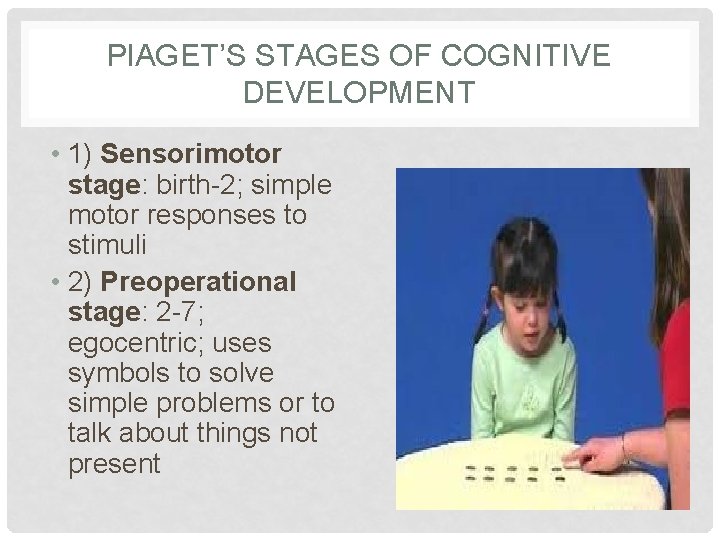
PIAGET’S STAGES OF COGNITIVE DEVELOPMENT • 1) Sensorimotor stage: birth-2; simple motor responses to stimuli • 2) Preoperational stage: 2 -7; egocentric; uses symbols to solve simple problems or to talk about things not present
STAGES OF COG DEV CONTINUED • 3) Concrete operational: 7 -11; organized and rational thinking; struggle w/hypotheticals • 4) Formal operational: 11 -on; understands abstract ideas and hypotheticals • We all follow the same order but at different times
EXPERIMENTS WITH ANIMALS
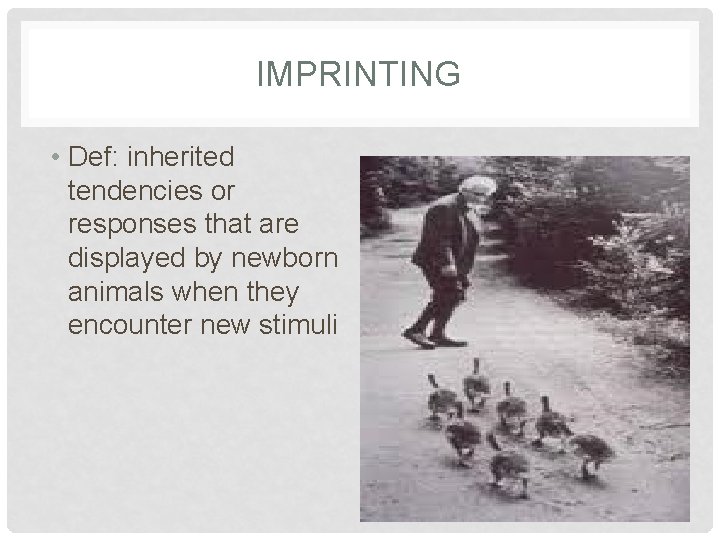
IMPRINTING • Def: inherited tendencies or responses that are displayed by newborn animals when they encounter new stimuli
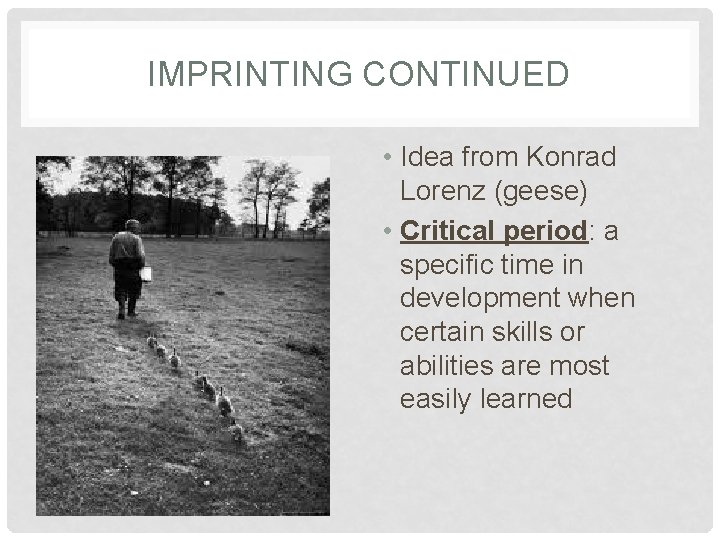
IMPRINTING CONTINUED • Idea from Konrad Lorenz (geese) • Critical period: a specific time in development when certain skills or abilities are most easily learned
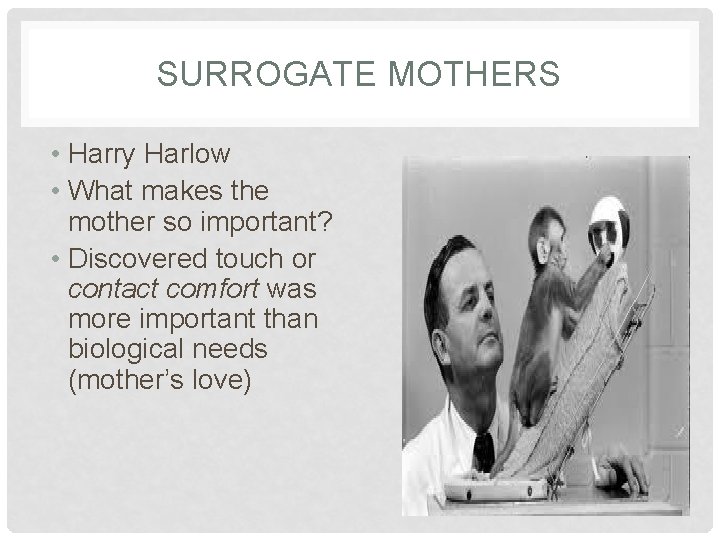
SURROGATE MOTHERS • Harry Harlow • What makes the mother so important? • Discovered touch or contact comfort was more important than biological needs (mother’s love)
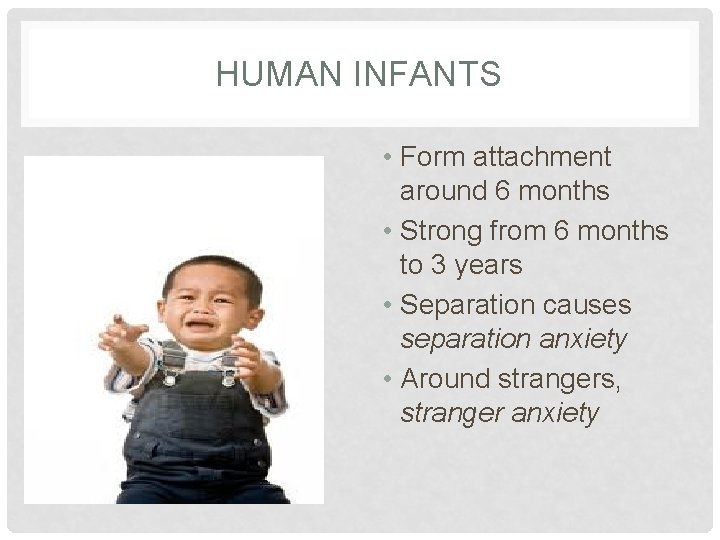
HUMAN INFANTS • Form attachment around 6 months • Strong from 6 months to 3 years • Separation causes separation anxiety • Around strangers, stranger anxiety
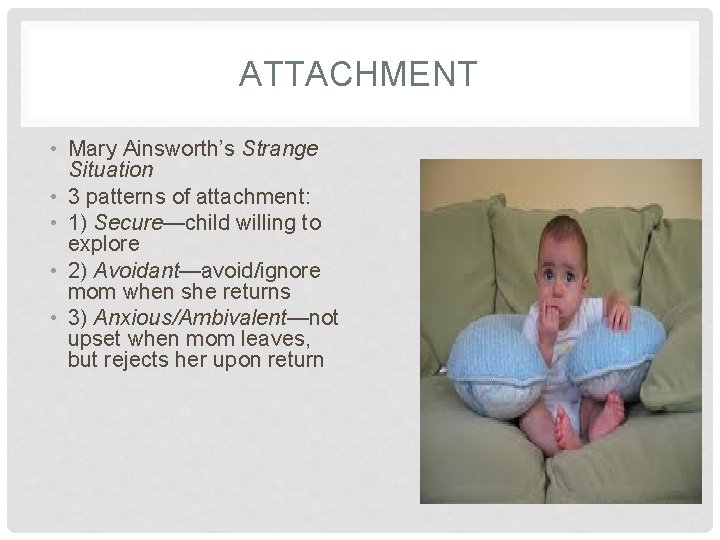
ATTACHMENT • Mary Ainsworth’s Strange Situation • 3 patterns of attachment: • 1) Secure—child willing to explore • 2) Avoidant—avoid/ignore mom when she returns • 3) Anxious/Ambivalent—not upset when mom leaves, but rejects her upon return
SECTION 3: PARENTING STYLES AND SOCIAL DEVELOPMENT
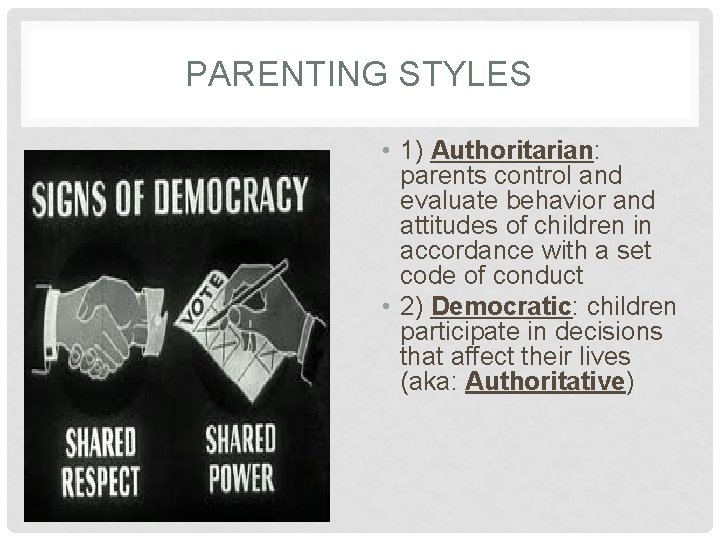
PARENTING STYLES • 1) Authoritarian: parents control and evaluate behavior and attitudes of children in accordance with a set code of conduct • 2) Democratic: children participate in decisions that affect their lives (aka: Authoritative)
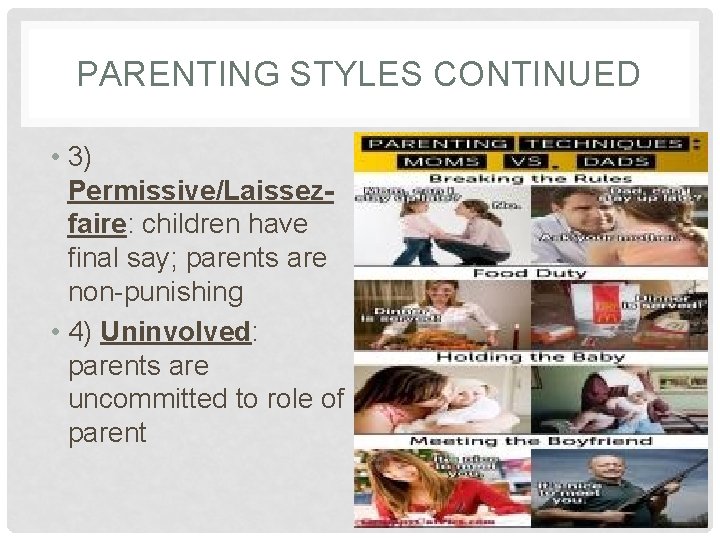
PARENTING STYLES CONTINUED • 3) Permissive/Laissezfaire: children have final say; parents are non-punishing • 4) Uninvolved: parents are uncommitted to role of parent
EFFECTS OF PARENTING STYLES • • Authoritative produces more confident kids It establishes limits Allows children to assume responsibility gradually Able to identify with parents
CHILD ABUSE • Physical or mental injury, sexual abuse, negligence • Child must be under age of 18 • Various causes • Stress is most prevalent cause • Can create: loss of trust, feelings of guilt, antisocial behavior, depression, identity confusion, etc…
SOCIAL DEVELOPMENT
SOCIALIZATION • Def: the process of learning the rules of behavior of the culture within which an individual is born and will live • Involves learning to live with others • Learning the rules
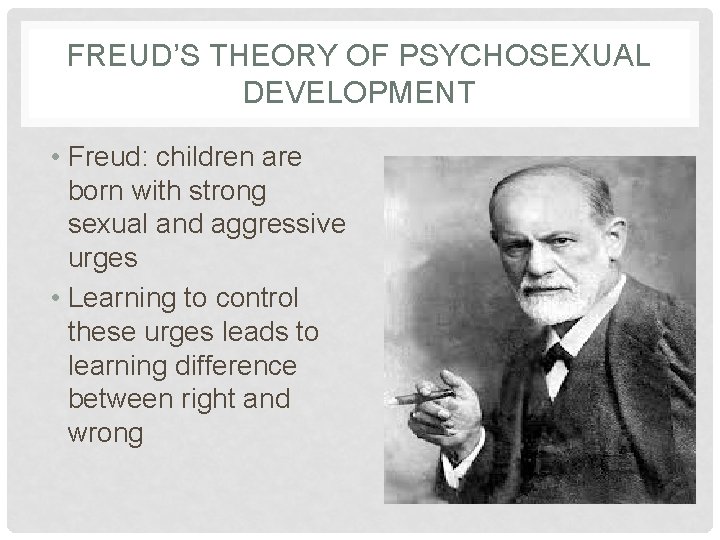
FREUD’S THEORY OF PSYCHOSEXUAL DEVELOPMENT • Freud: children are born with strong sexual and aggressive urges • Learning to control these urges leads to learning difference between right and wrong
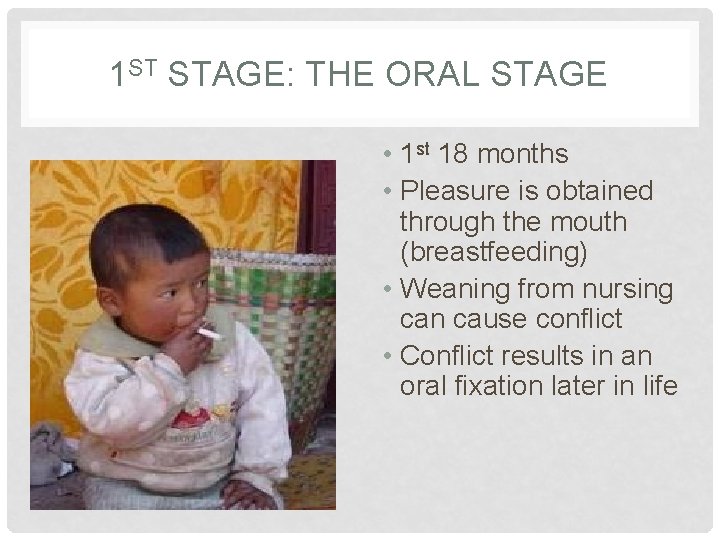
1 ST STAGE: THE ORAL STAGE • 1 st 18 months • Pleasure is obtained through the mouth (breastfeeding) • Weaning from nursing can cause conflict • Conflict results in an oral fixation later in life
2 ND STAGE: ANAL STAGE • C. 1. 5 -3 years old • Pleasure obtained through the anus • Toilet training teaches to curb freedom and establish social control
3 RD STAGE: PHALLIC STAGE • Between ages 3 -5 • Child becomes aware of gender differences • Child becomes rival for the affections of the parent of the opposite sex • IDENTIFICATION: process by which a child adopts the values and principles of the same-sex parents • Conflict can lead to Oedipus/Elektra Complex
4 TH STAGE: LATENCY STAGE • C. age 5 -6 • Sexual desires pushed back • Focus on exploration and learning • SUBLIMATION: process of redirecting sexual impulses into learning tasks
5 TH STAGE: GENITAL STAGE • Adolescence to adulthood • One gets as much satisfaction from giving pleasure as from receiving it • Sexual desires renewed • Seek relationships with others
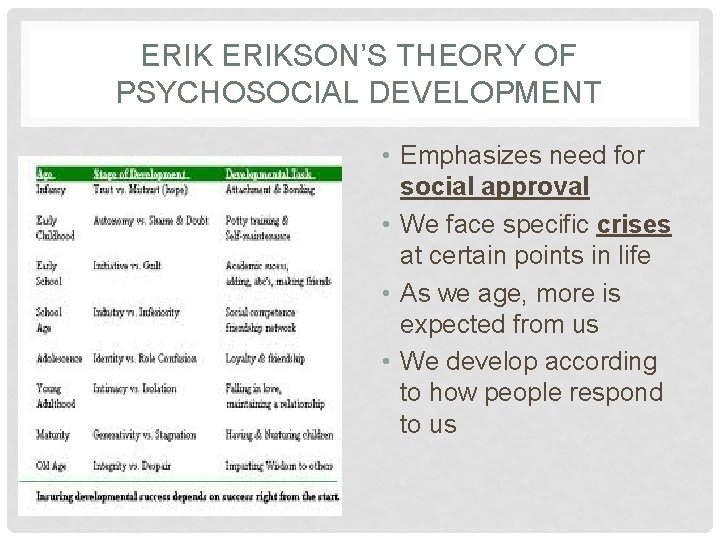
ERIKSON’S THEORY OF PSYCHOSOCIAL DEVELOPMENT • Emphasizes need for social approval • We face specific crises at certain points in life • As we age, more is expected from us • We develop according to how people respond to us
LEARNING THEORIES OF DEVELOPMENT • We learn social rules b/c we are rewarded for conforming • Social development is due to conditioning and imitation
COGNITIVE-DEVELOPMENTAL APPROACH • Social development is due to the child acting on the environment • Trying to make sense out of experience • Children’s games show this…
GAMES AND PLAY • Games and playing offer a way for kids to learn for themselves • Playing creates a small society • Experience, NOT winning, is what counts
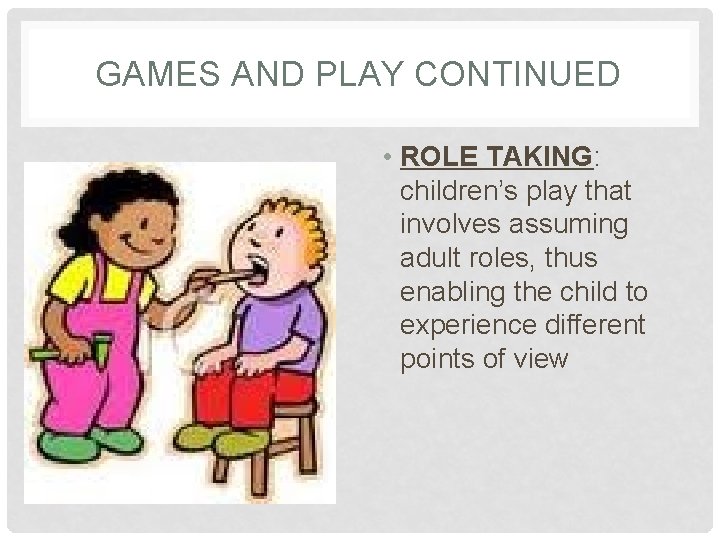
GAMES AND PLAY CONTINUED • ROLE TAKING: children’s play that involves assuming adult roles, thus enabling the child to experience different points of view
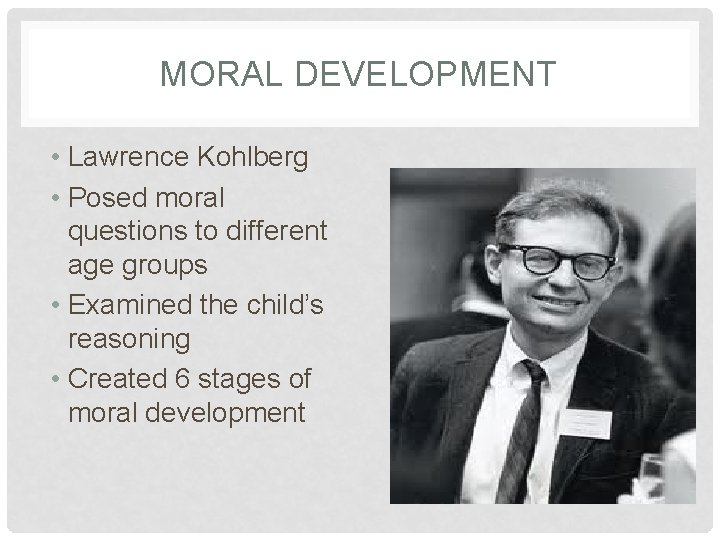
MORAL DEVELOPMENT • Lawrence Kohlberg • Posed moral questions to different age groups • Examined the child’s reasoning • Created 6 stages of moral development
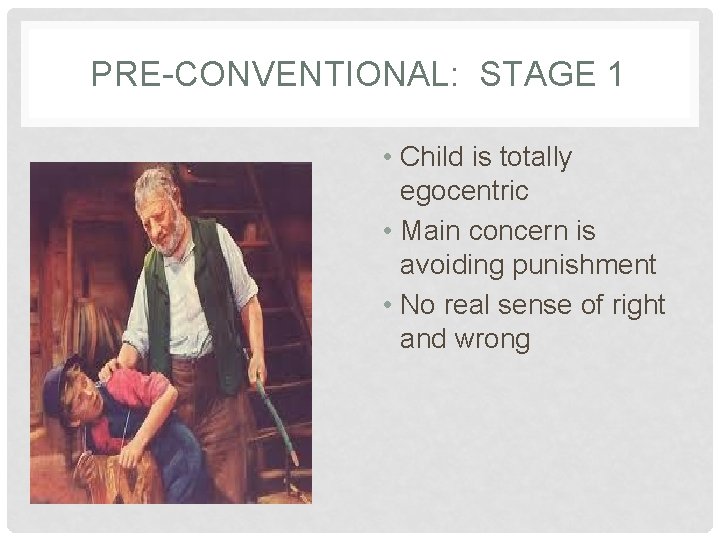
PRE-CONVENTIONAL: STAGE 1 • Child is totally egocentric • Main concern is avoiding punishment • No real sense of right and wrong
PRECONVENTIONAL: STAGE 2 • Child learns how to receive rewards • Believe Golden Rule is quid pro quo • Still egocentric • Evaluate acts in terms of consequences
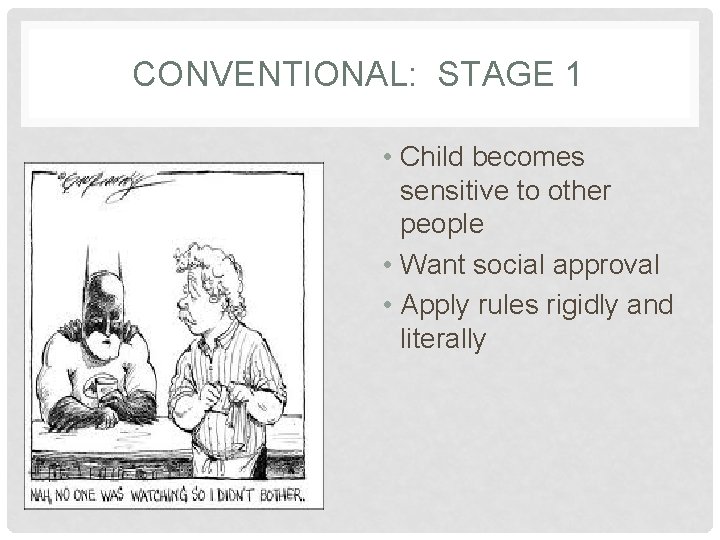
CONVENTIONAL: STAGE 1 • Child becomes sensitive to other people • Want social approval • Apply rules rigidly and literally
CONVENTIONAL: STAGE 2 • Key issue is law and order • Strong belief in established authority
POST-CONVENTIONAL: STAGE 1 • Is the law fair? • Belief that laws must change to fit the changing world • Is the law good for society?
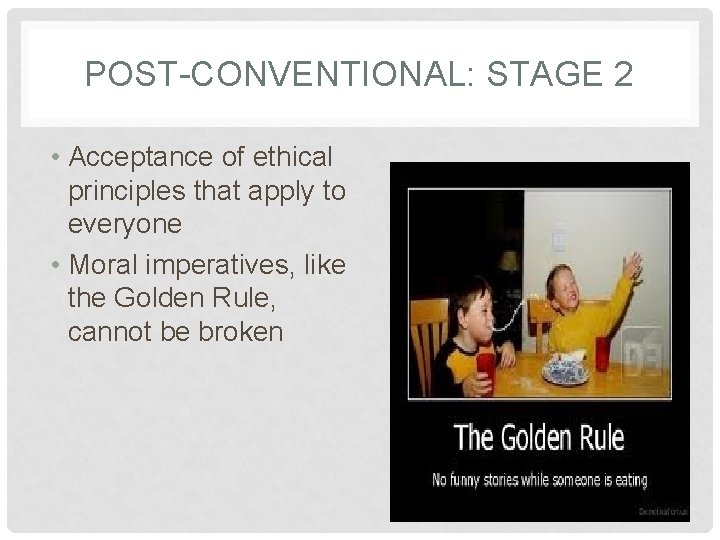
POST-CONVENTIONAL: STAGE 2 • Acceptance of ethical principles that apply to everyone • Moral imperatives, like the Golden Rule, cannot be broken
GENDER BIAS IN KOHLBERG’S THEORY • Females are raised to be empathetic • Boys are taught the goals of justice • This puts males at a higher level of moral development