
Chapter 3 Infancy and Childhood By Tiffany Miller

Chapter 3: Infancy and Childhood By: Tiffany Miller
Newborns Development for newborns also occur inside the mom. In the later months of pregnancy they suck their thumb, and even hiccup inside the mom. When babies are born, they have the ability to see, hear, smell, and respond to the environment. Newborns also have certain responses, such as reflexes. These reflexes are called grasping reflex and rooting reflex.
Perceptual Development During perceptual development, newborns discover their body. They discover that they have arms, legs etc. Robert Fantz discovered that babies like looking at human faces rather then other things. Parents touch is a very good benefit for a baby. Gibson and Walk experimented if newborns had depth perception. Their results were: young infants seemed unafraid of crossing the cliff, while 6 months old refused.
Development of Language Before a child can speak, they think and represent things to himself. When children are 1, they begin to make cooing sounds, and crying, which develop into a type of babble. Babies learn how to talk by listening to their parents or siblings, then getting appraised for it so they keep doing it. By the time they are 2, they have about 500 to 1, 500 words in their vocabulary.

Object Performance: (Cognitive Development) Object performance is when a child sees the toy, understands the way it feels in her hands and the sensation it produces in their mouth. Infants don’t picture the toy, they don’t remember it. When their toys are hidden from they act like it never existed. They don't even look for it. They simply grab whatever else they can find and play with that. When they are 7 to 12 months old they are harder to trick. From 18 to 24 months they will look until they find the toy, knowing it must be somewhere.
Principle of Conservation: (Cognitive Development) Conservation occurs between the ages of five and seven. Conservation is the principle that a given quantity does not change when its appearance changed. Children who are five and younger are not able to think about height and width at the same time. By age seven, they understand know.
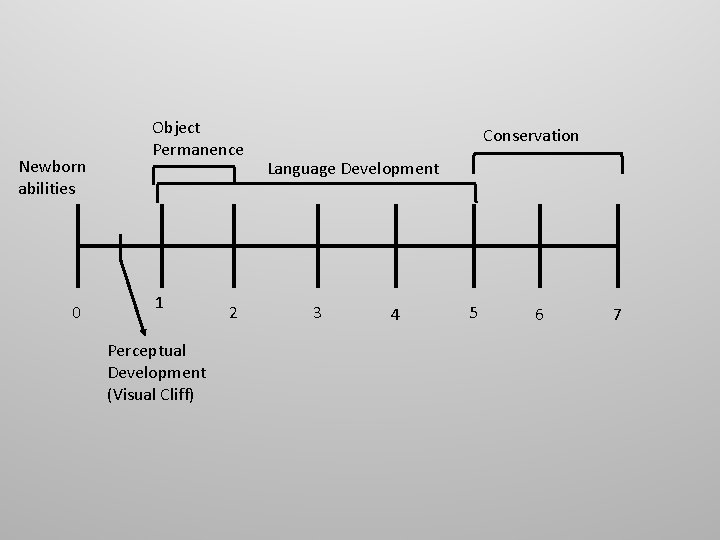
Newborn abilities 0 Object Permanence 1 Perceptual Development (Visual Cliff) 2 Conservation Language Development 3 4 5 6 7
Chapter 4: Adolescence
Physical Development: At the end of everyone’s childhood they go through puberty. Boys and girls are both different. Some girls get hit with puberty as early as age 8. Some boys start at age 9 or 10. Most girls start between ages 8 and 10, while boys start between 9 and 16. Right before they hit puberty, they experience a growth spurt. Between ages of 10 and 17 girls have their first menstrual period. Around the age of 12 boys develop pubic hair and larger genitals. Boys growth spurt lasts 3 years longer than girls. The boys develop broad shoulders, thicker trunk, and more muscle tissue than girls and have a larger heart and lungs. Girls develop breasts and their hips begin to fill out, and they also develop pubic hair.
Sexual Development: During puberty, their behavior changes too. They develop attitudes about sex and the expectations of the roles they play. How teens act today, people question the role of family, religion, and how the government provided information about sex. The fear of getting sexually transmitted diseases such as AIDS, have a very big impact on sexual attitudes as well.
Identity Development: Identity development is when people are trying to develop who they really are. Everyone knows what everyone thinks of them. Identity crisis is a time of inner conflict during which they worry intensely about their identities. They start to see the future as reality, and start taking life seriously. This is a painful process, because they want to be one of a kind, yet they want to fit in. This results in self consciousness, and the confusion of all this is handled by acting childish to avoid resolving conflicts.
Reactions to Growth: People today have a better understanding of what’s going on. They now don’t find this upsetting, but it does make adolescents selfconscious. Adolescents always want to be accepted by peers, or fit their cultural expectations. Not very many can do this, so this is one thing that makes adolescents selfconscious.
Cognitive Development: Cognitive development is the thinking patterns and characteristics of adolescence. Finding fault with authority figures, is when they find faults in who was a role model to them. Adolescence get argumentativeness and they tend to argue about anything they don’t agree on. Indecisiveness is when adolescence has trouble making decisions. Self-consciousness is when they think everybody gossips about you. Invulnerability is when they begin to feel special, they think they are unique and this causes risk-taking behavior and self-destructive behavior. These are all examples of cognitive development.
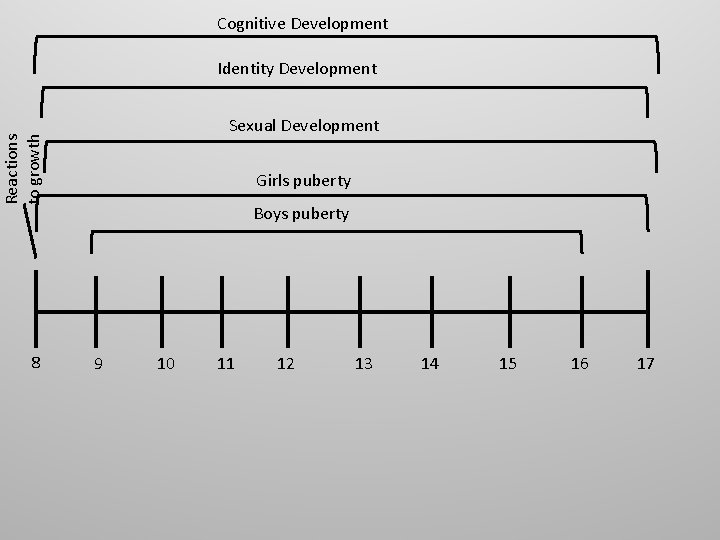
Cognitive Development Identity Development Reactions to growth Sexual Development 8 Girls puberty Boys puberty 9 10 11 12 13 14 15 16 17
Chapter 5: Adulthood and Old Age
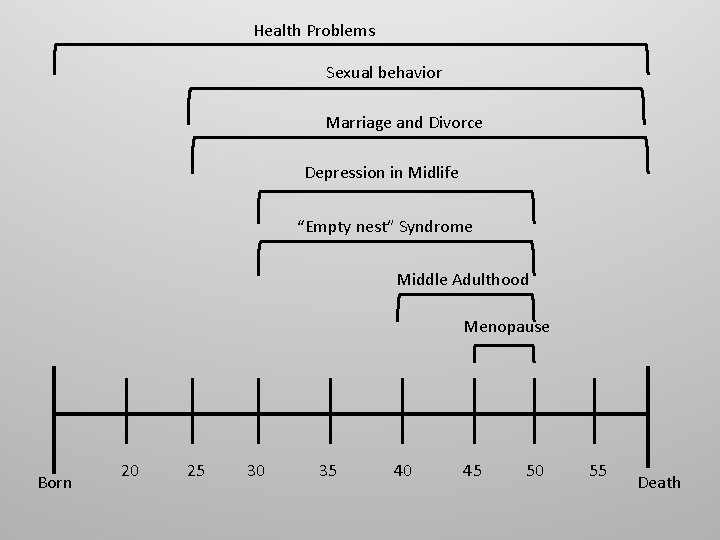
Health Problems: The key to having good health is to exercise, diet and make good life choices. People who do this, eats somewhat healthy, avoids any type of drug, is less likely to suffer from stress and will look and feel younger than people who do not do so. The most common causes of death is heart disease, cancer, and cirrhosis of the liver.
Menopause: When women reach the age of 45 to 50, they reach an event called menopause. Menopause is when the sex hormones of a women drop sharply. When this happens, the woman can no longer have children. Most women cannot even feel the event of menopause. Some women may have severe depression, but they have an emotional rather than physical origin. When women got interviewed, 50% of them said they felt better, more confident and calmer. They no longer get their period. Many said the worst part of this was not knowing what to expect.
Marriage and Divorce: The key to having a good marriage is to argue constructively, instead of ignoring, denying conflict, exaggerating issues, or having bad verbal fights. About 90 percent of Americans will get married in their lifetime, and about 40 -60 percent of them get divorced. Couples who listen to each other and show respect are more likely not to get a divorce.
Sexual Behavior: Most people think that with age, sex stops. Well, It doesn’t. Those who stop having sex as they age, get bored with their partner and have a poorer physical condition to those who do have sex regularly, causing them to have an illness, such as heart disease. Unless the doctor says you should not have sex, most elder people still do have sex.
Middle Adulthood: In your lifetime, your middle adulthood would be when you are in your 40’s. This is when your in your true adulthood. Men who reach this, are more understanding of others and tolerates them. But not for all men, some men during their 40 s have extreme frustration and unhappiness. Most men change and improve. others are happy and don’t get frustrated as easy as they had before. But these men feel like there’s no future, and like they are distant from their friends and family.
“Empty Nest” Syndrome: When a woman’s baby leaves the house they go through “empty nest” syndrome. They feel depressed, but not all women get this. Women that have a stable relationship with their husband aren’t as bad, because the husband has a big impact and a lot of support. Some women feel free as their last child leaves.
Depression in Midlife: Depression affects a lot of people, but mostly in the midlife of a women. They question their role of daughter, lover, wife, mother and wage earner. They feel lost and worthless. Menopause also can cause depression.
Health Problems Sexual behavior Marriage and Divorce Depression in Midlife “Empty nest” Syndrome Middle Adulthood Menopause Born 20 25 30 35 40 45 50 55 Death
- Slides: 23