
Chapter 3 Implementing Classes Copyright 2014 by John
Chapter 3 – Implementing Classes Copyright © 2014 by John Wiley & Sons. All rights reserved. 1
Chapter Goals To become familiar with the process of implementing classes To be able to implement and test simple methods To understand the purpose and use of constructors To understand how to access instance variables and local variables § To be able to write javadoc comments § To implement classes for drawing graphical shapes § § Copyright © 2014 by John Wiley & Sons. All rights reserved. 2
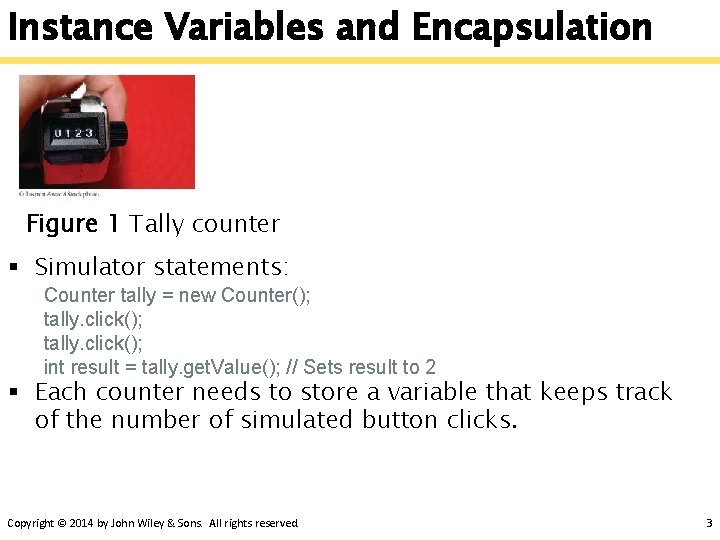
Instance Variables and Encapsulation Figure 1 Tally counter § Simulator statements: Counter tally = new Counter(); tally. click(); int result = tally. get. Value(); // Sets result to 2 § Each counter needs to store a variable that keeps track of the number of simulated button clicks. Copyright © 2014 by John Wiley & Sons. All rights reserved. 3
Instance Variables § Instance variables store the data of an object. § Instance of a class: an object of the class. § An instance variable is a storage location present in each object of the class. § The class declaration specifies the instance variables: public class Counter { private int value; … } § An object's instance variables store the data required for executing its methods. Copyright © 2014 by John Wiley & Sons. All rights reserved. 4
Instance Variables § An instance variable declaration consists of the following parts: • access specifier (private) • type of variable (such as int) • name of variable (such as value) § You should declare all instance variables as private. Copyright © 2014 by John Wiley & Sons. All rights reserved. 5
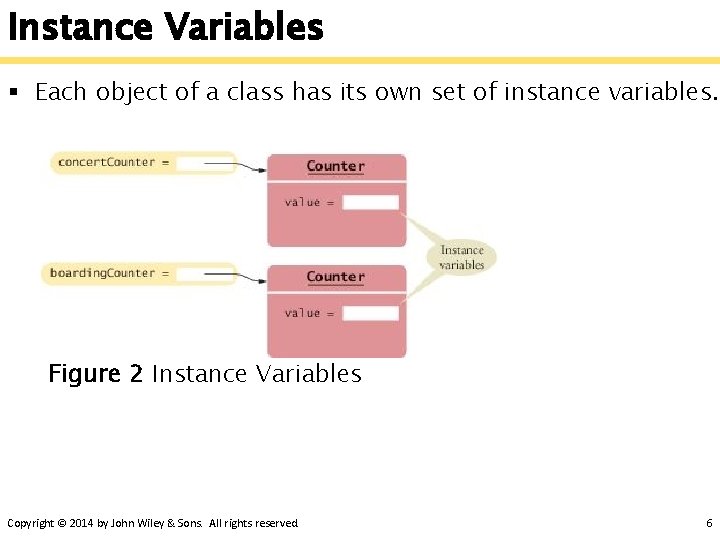
Instance Variables § Each object of a class has its own set of instance variables. Figure 2 Instance Variables Copyright © 2014 by John Wiley & Sons. All rights reserved. 6
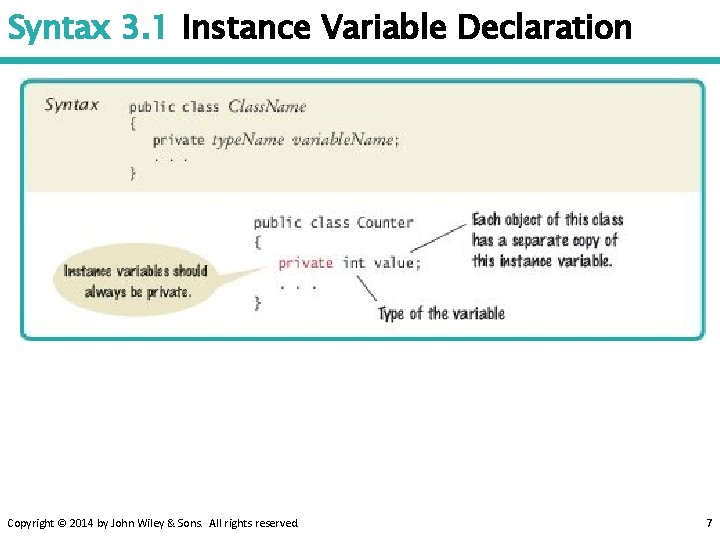
Syntax 3. 1 Instance Variable Declaration Copyright © 2014 by John Wiley & Sons. All rights reserved. 7
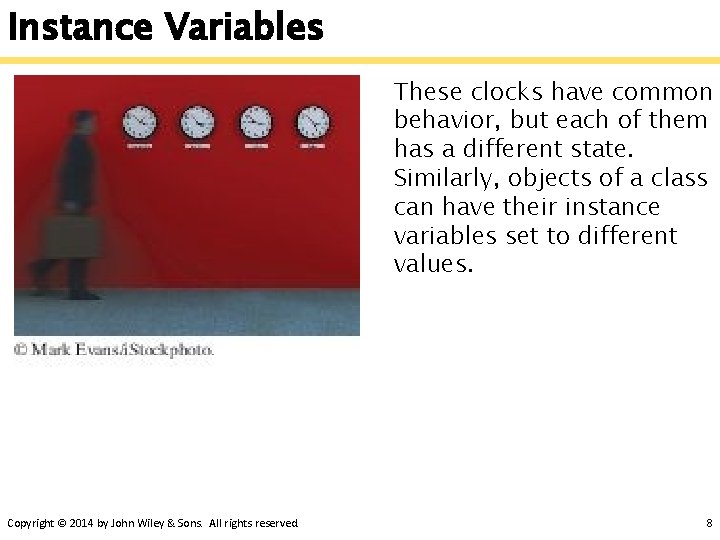
Instance Variables These clocks have common behavior, but each of them has a different state. Similarly, objects of a class can have their instance variables set to different values. Copyright © 2014 by John Wiley & Sons. All rights reserved. 8
The Methods of the Counter Class § The click method advances the counter value by 1: public void click() { value = value + 1; } • Affects the value of the instance variable of the object on which the method is invoked • The method call concert. Counter. click(); o Advances the value variable of the concert. Counter object Copyright © 2014 by John Wiley & Sons. All rights reserved. 9
The Methods of the Counter Class § The get. Value method returns the current value: public int get. Value() { return value; } § The return statement • Terminates the method call • Returns a result (the return value) to the method's caller § Private instance variables can only be accessed by methods of the same class. Copyright © 2014 by John Wiley & Sons. All rights reserved. 10
Encapsulation § Encapsulation is the process of hiding implementation details and providing methods for data access. § To encapsulate data: • Declare instance variables as private and • Declare public methods that access the variables § Encapsulation allows a programmer to use a class without having to know its implementation. § Information hiding makes it simpler for the implementor of a class to locate errors and change implementations. Copyright © 2014 by John Wiley & Sons. All rights reserved. 11
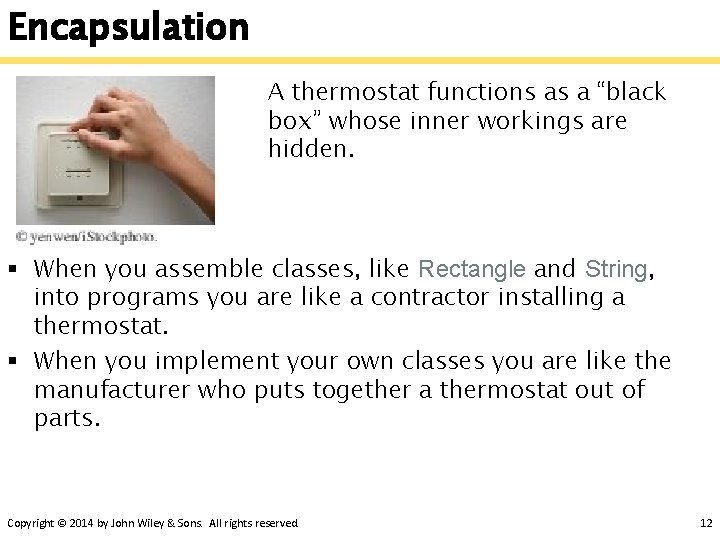
Encapsulation A thermostat functions as a “black box” whose inner workings are hidden. § When you assemble classes, like Rectangle and String, into programs you are like a contractor installing a thermostat. § When you implement your own classes you are like the manufacturer who puts together a thermostat out of parts. Copyright © 2014 by John Wiley & Sons. All rights reserved. 12
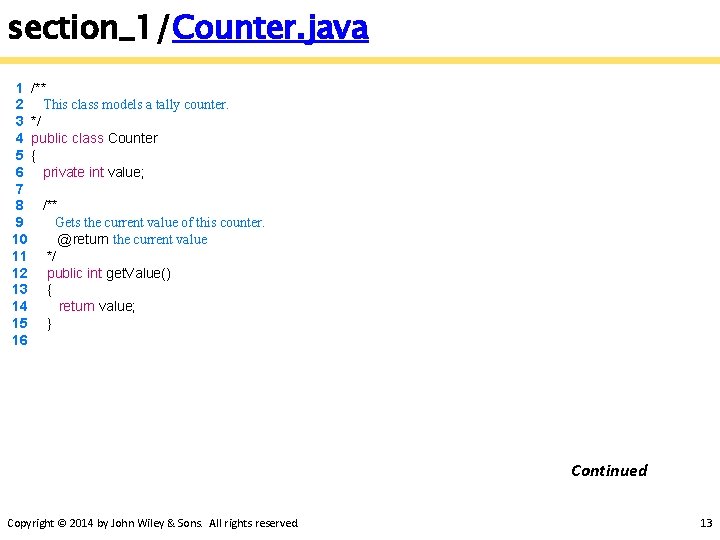
section_1/Counter. java 1 /** 2 This class models a tally counter. 3 */ 4 public class Counter 5 { 6 private int value; 7 8 /** 9 Gets the current value of this counter. 10 @return the current value 11 */ 12 public int get. Value() 13 { 14 return value; 15 } 16 Continued Copyright © 2014 by John Wiley & Sons. All rights reserved. 13
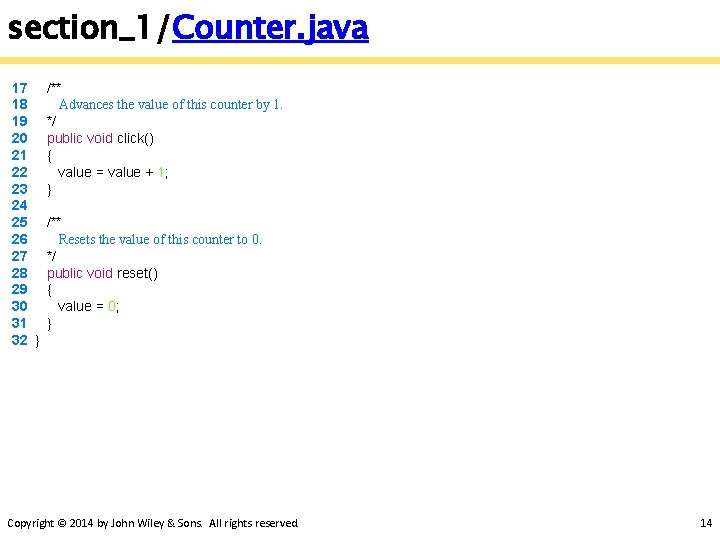
section_1/Counter. java 17 18 19 20 21 22 23 24 25 26 27 28 29 30 31 32 } /** Advances the value of this counter by 1. */ public void click() { value = value + 1; } /** Resets the value of this counter to 0. */ public void reset() { value = 0; } Copyright © 2014 by John Wiley & Sons. All rights reserved. 14
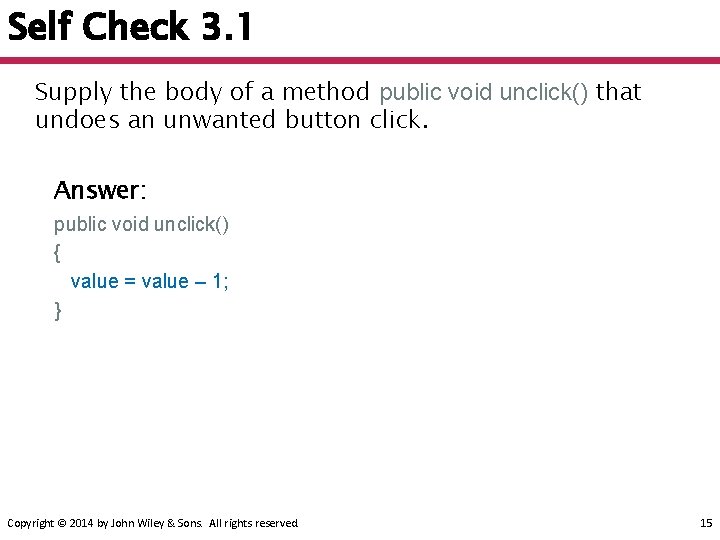
Self Check 3. 1 Supply the body of a method public void unclick() that undoes an unwanted button click. Answer: public void unclick() { value = value – 1; } Copyright © 2014 by John Wiley & Sons. All rights reserved. 15
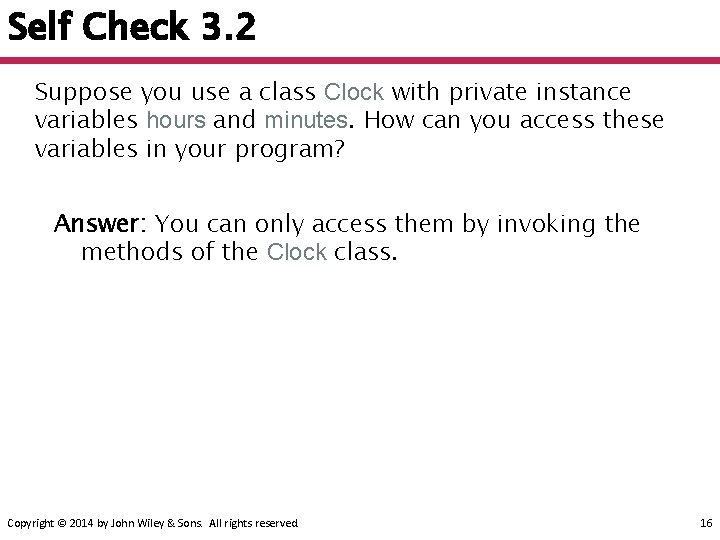
Self Check 3. 2 Suppose you use a class Clock with private instance variables hours and minutes. How can you access these variables in your program? Answer: You can only access them by invoking the methods of the Clock class. Copyright © 2014 by John Wiley & Sons. All rights reserved. 16
Self Check 3. 3 Consider the Counter class. A counter’s value starts at 0 and is advanced by the click method, so it should never be negative. Suppose you found a negative value variable during testing. Where would you look for the error? Answer: In one of the methods of the Counter class. Copyright © 2014 by John Wiley & Sons. All rights reserved. 17
Self Check 3. 4 In Chapters 1 and 2, you used System. out as a black box to cause output to appear on the screen. Who designed and implemented System. out? Answer: The programmers who designed and implemented the Java library. Copyright © 2014 by John Wiley & Sons. All rights reserved. 18
Specifying the Public Interface of a Class § In order to implement a class, you first need to know which methods are required. § Essential behavior of a bank account: • deposit money • withdraw money • get balance Copyright © 2014 by John Wiley & Sons. All rights reserved. 19
Specifying the Public Interface of a Class § We want to support method calls such as the following: harrys. Checking. deposit(2000); harrys. Checking. withdraw(500); System. out. println(harrys. Checking. get. Balance()); § Here are the method headers needed for a Bank. Account class: public void deposit(double amount) public void withdraw(double amount) public double get. Balance() Copyright © 2014 by John Wiley & Sons. All rights reserved. 20
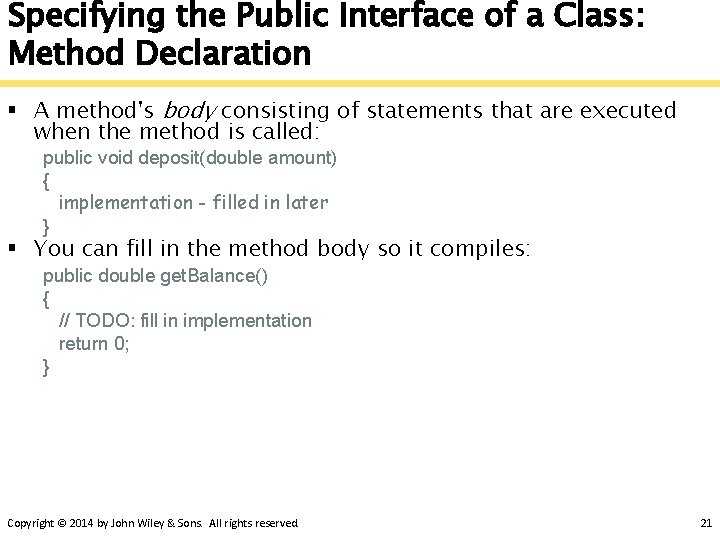
Specifying the Public Interface of a Class: Method Declaration § A method's body consisting of statements that are executed when the method is called: public void deposit(double amount) { implementation - filled in later } § You can fill in the method body so it compiles: public double get. Balance() { // TODO: fill in implementation return 0; } Copyright © 2014 by John Wiley & Sons. All rights reserved. 21
Specifying the Public Interface of a Class § Bank. Account methods were declared as public. § public methods can be called by all other methods in the program. § Methods can also be declared private • private methods only be called by other methods in the same class • private methods are not part of the public interface Copyright © 2014 by John Wiley & Sons. All rights reserved. 22
Specifying Constructors § Initialize objects § Set the initial data for objects § Similar to a method with two differences: • The name of the constructor is always the same as the name of the class • Constructors have no return type Copyright © 2014 by John Wiley & Sons. All rights reserved. 23
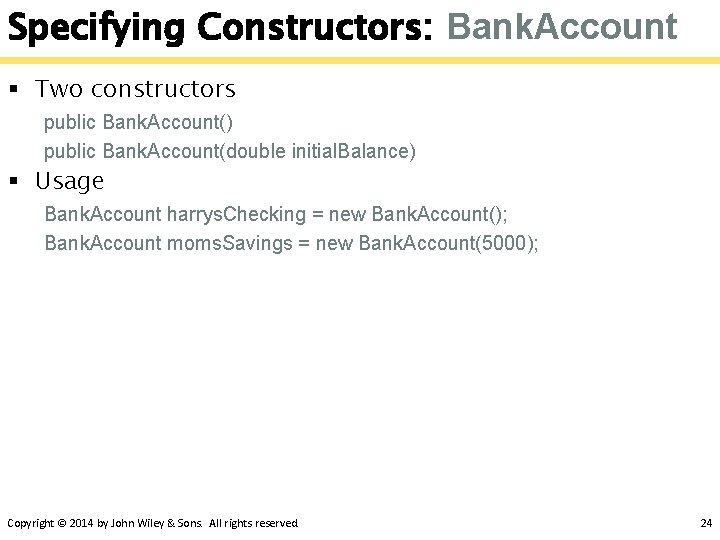
Specifying Constructors: Bank. Account § Two constructors public Bank. Account() public Bank. Account(double initial. Balance) § Usage Bank. Account harrys. Checking = new Bank. Account(); Bank. Account moms. Savings = new Bank. Account(5000); Copyright © 2014 by John Wiley & Sons. All rights reserved. 24
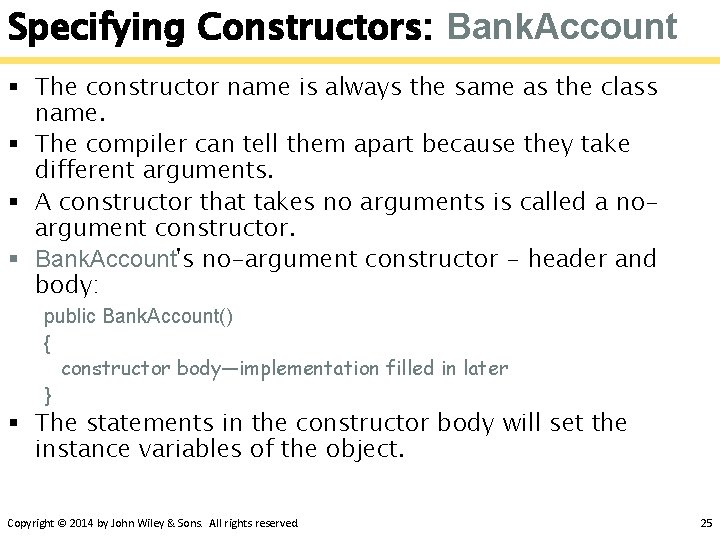
Specifying Constructors: Bank. Account § The constructor name is always the same as the class name. § The compiler can tell them apart because they take different arguments. § A constructor that takes no arguments is called a noargument constructor. § Bank. Account's no-argument constructor - header and body: public Bank. Account() { constructor body—implementation filled in later } § The statements in the constructor body will set the instance variables of the object. Copyright © 2014 by John Wiley & Sons. All rights reserved. 25
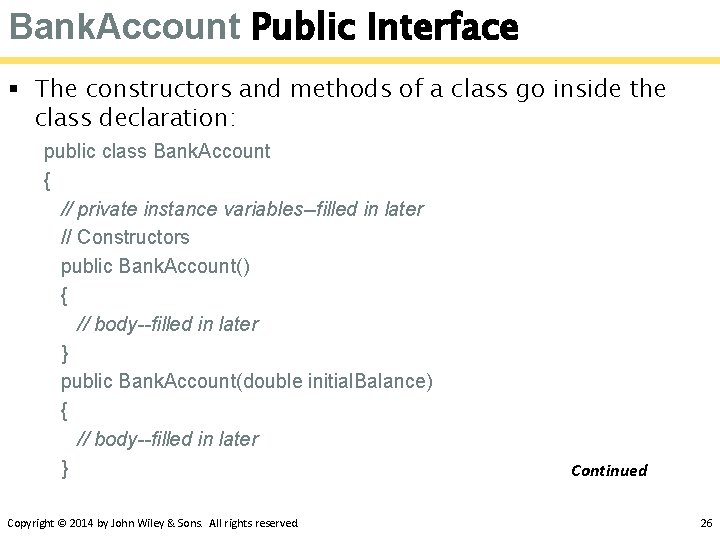
Bank. Account Public Interface § The constructors and methods of a class go inside the class declaration: public class Bank. Account { // private instance variables--filled in later // Constructors public Bank. Account() { // body--filled in later } public Bank. Account(double initial. Balance) { // body--filled in later } Copyright © 2014 by John Wiley & Sons. All rights reserved. Continued 26
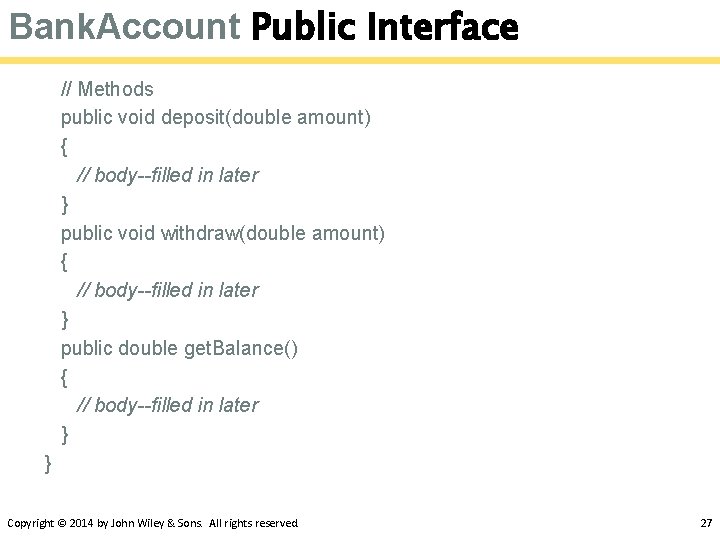
Bank. Account Public Interface // Methods public void deposit(double amount) { // body--filled in later } public void withdraw(double amount) { // body--filled in later } public double get. Balance() { // body--filled in later } } Copyright © 2014 by John Wiley & Sons. All rights reserved. 27
Specifying the Public Interface of a Class § public constructors and methods of a class form the public interface of the class. § These are the operations that any programmer can use. Copyright © 2014 by John Wiley & Sons. All rights reserved. 28
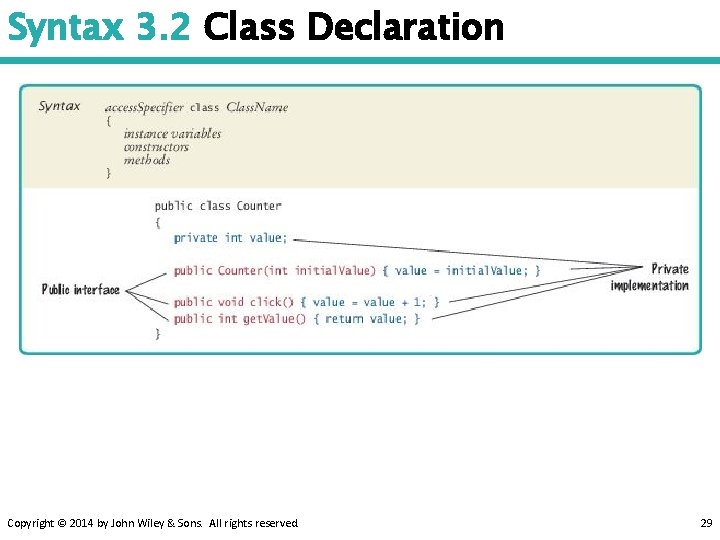
Syntax 3. 2 Class Declaration Copyright © 2014 by John Wiley & Sons. All rights reserved. 29
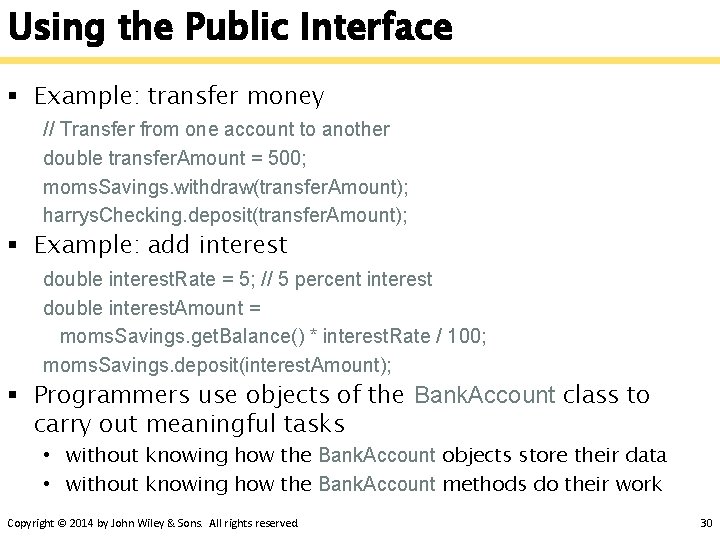
Using the Public Interface § Example: transfer money // Transfer from one account to another double transfer. Amount = 500; moms. Savings. withdraw(transfer. Amount); harrys. Checking. deposit(transfer. Amount); § Example: add interest double interest. Rate = 5; // 5 percent interest double interest. Amount = moms. Savings. get. Balance() * interest. Rate / 100; moms. Savings. deposit(interest. Amount); § Programmers use objects of the Bank. Account class to carry out meaningful tasks • without knowing how the Bank. Account objects store their data • without knowing how the Bank. Account methods do their work Copyright © 2014 by John Wiley & Sons. All rights reserved. 30
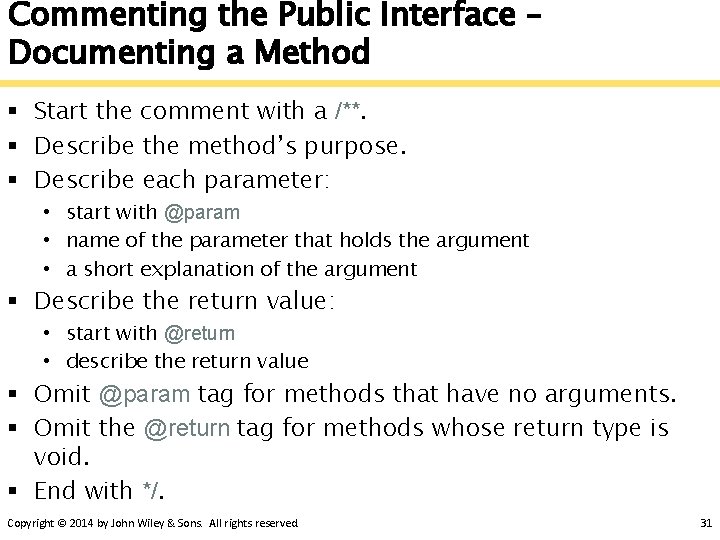
Commenting the Public Interface – Documenting a Method § Start the comment with a /**. § Describe the method’s purpose. § Describe each parameter: • start with @param • name of the parameter that holds the argument • a short explanation of the argument § Describe the return value: • start with @return • describe the return value § Omit @param tag for methods that have no arguments. § Omit the @return tag for methods whose return type is void. § End with */. Copyright © 2014 by John Wiley & Sons. All rights reserved. 31
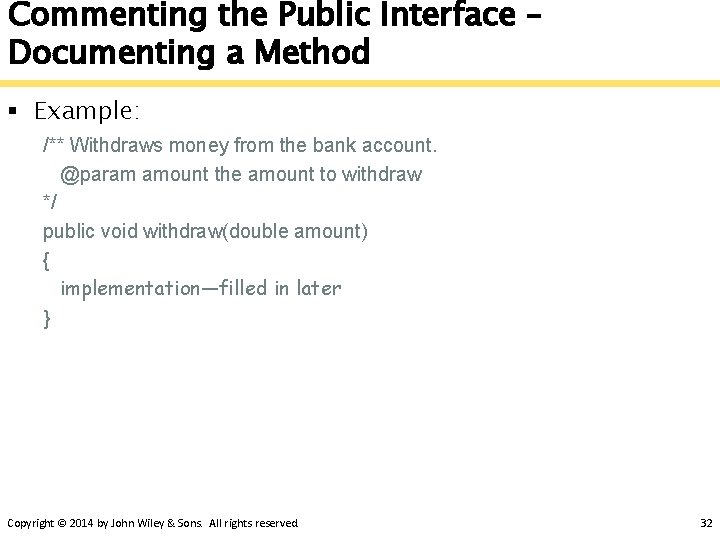
Commenting the Public Interface – Documenting a Method § Example: /** Withdraws money from the bank account. @param amount the amount to withdraw */ public void withdraw(double amount) { implementation—filled in later } Copyright © 2014 by John Wiley & Sons. All rights reserved. 32
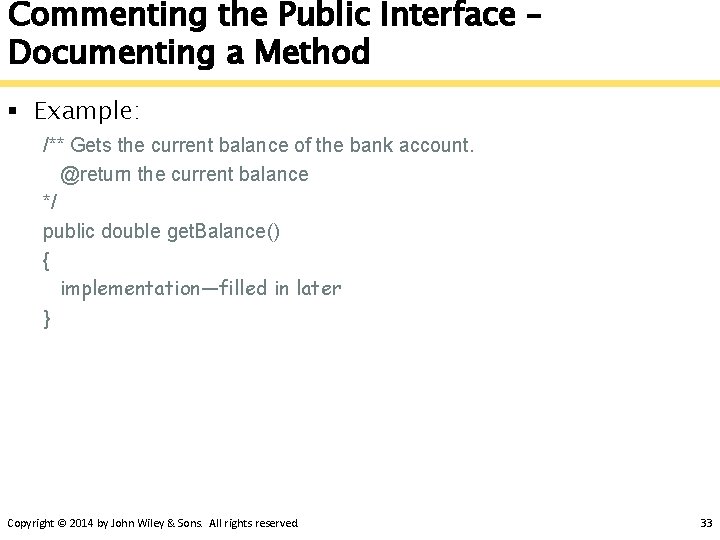
Commenting the Public Interface – Documenting a Method § Example: /** Gets the current balance of the bank account. @return the current balance */ public double get. Balance() { implementation—filled in later } Copyright © 2014 by John Wiley & Sons. All rights reserved. 33
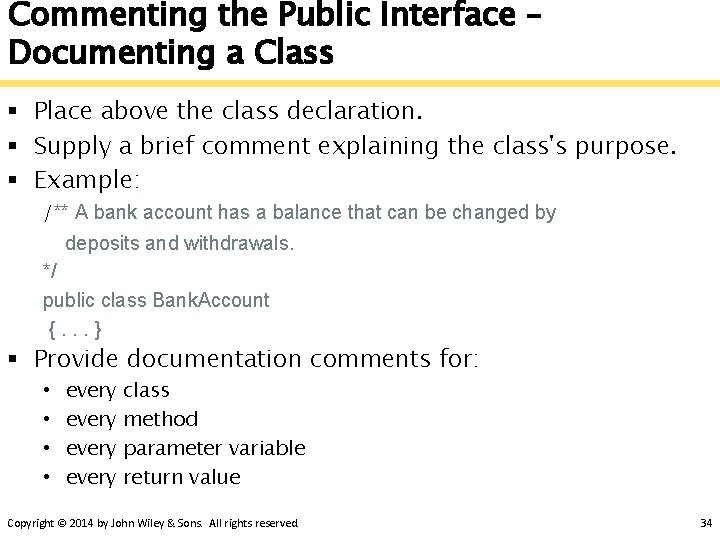
Commenting the Public Interface – Documenting a Class § Place above the class declaration. § Supply a brief comment explaining the class's purpose. § Example: /** A bank account has a balance that can be changed by deposits and withdrawals. */ public class Bank. Account {. . . } § Provide documentation comments for: • • every class method parameter variable return value Copyright © 2014 by John Wiley & Sons. All rights reserved. 34
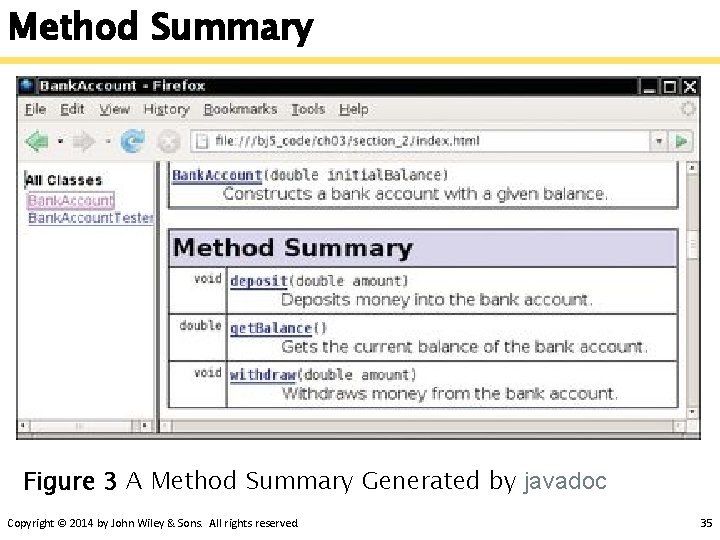
Method Summary Figure 3 A Method Summary Generated by javadoc Copyright © 2014 by John Wiley & Sons. All rights reserved. 35
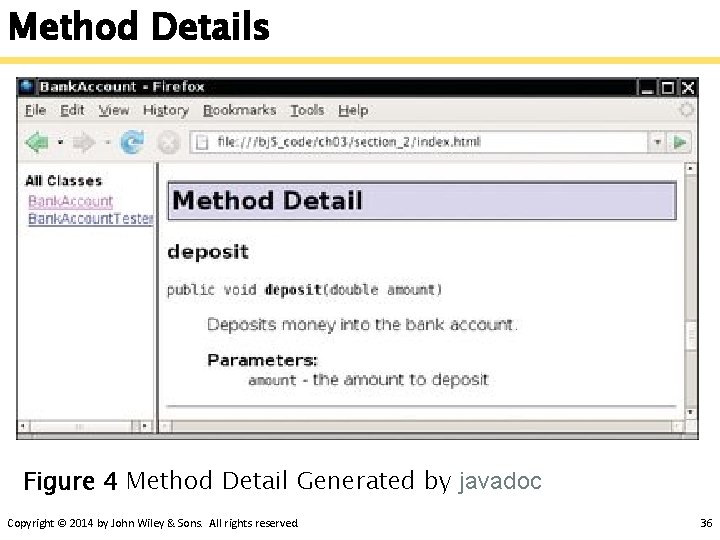
Method Details Figure 4 Method Detail Generated by javadoc Copyright © 2014 by John Wiley & Sons. All rights reserved. 36
Self Check 3. 6 How can you use the methods of the public interface to empty the harrys. Checking bank account? Answer: harrys. Checking. withdraw(harrys. Checking. get. Balance()) Copyright © 2014 by John Wiley & Sons. All rights reserved. 37
Self Check 3. 7 What is wrong with this sequence of statements? Bank. Account harrys. Checking = new Bank. Account(10000); System. out. println(harrys. Checking. withdraw(500)); Answer: The withdraw method has return type void. It doesn’t return a value. Use the get. Balance method to obtain the balance after the withdrawal. Copyright © 2014 by John Wiley & Sons. All rights reserved. 38
Self Check 3. 8 Suppose you want a more powerful bank account abstraction that keeps track of an account number in addition to the balance. How would you change the public interface to accommodate this enhancement? Answer: Add an account. Number parameter to the constructors, and add a get. Account. Number method. There is no need for a set. Account. Number method – the account number never changes after construction. Copyright © 2014 by John Wiley & Sons. All rights reserved. 39
Self Check 3. 9 Suppose we enhance the Bank. Account class so that each account has an account number. Supply a documentation comment for the constructor public Bank. Account(int account. Number, double initial. Balance) Answer: /** Constructs a new bank account with a given initial balance. @param account. Number the account number for this account @param initial. Balance the initial balance for this account */ Copyright © 2014 by John Wiley & Sons. All rights reserved. 40
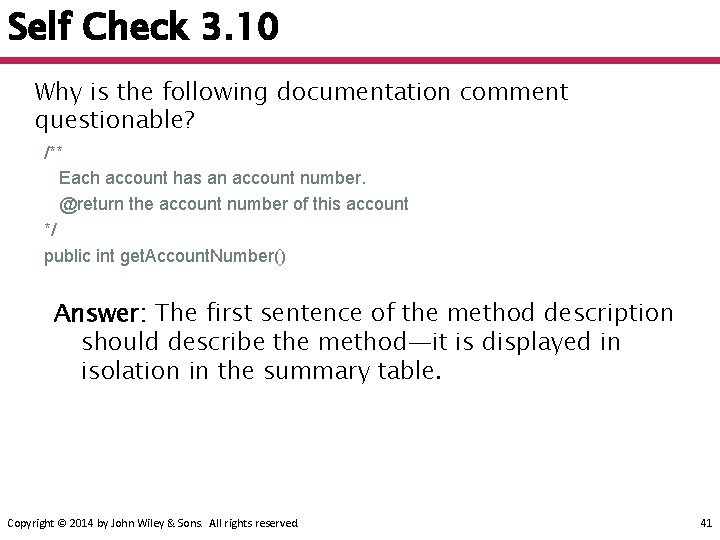
Self Check 3. 10 Why is the following documentation comment questionable? /** Each account has an account number. @return the account number of this account */ public int get. Account. Number() Answer: The first sentence of the method description should describe the method—it is displayed in isolation in the summary table. Copyright © 2014 by John Wiley & Sons. All rights reserved. 41
Providing the Class Implementation § The implementation of a class consists of: • instance variables • the bodies of constructors • the bodies of methods. Copyright © 2014 by John Wiley & Sons. All rights reserved. 42
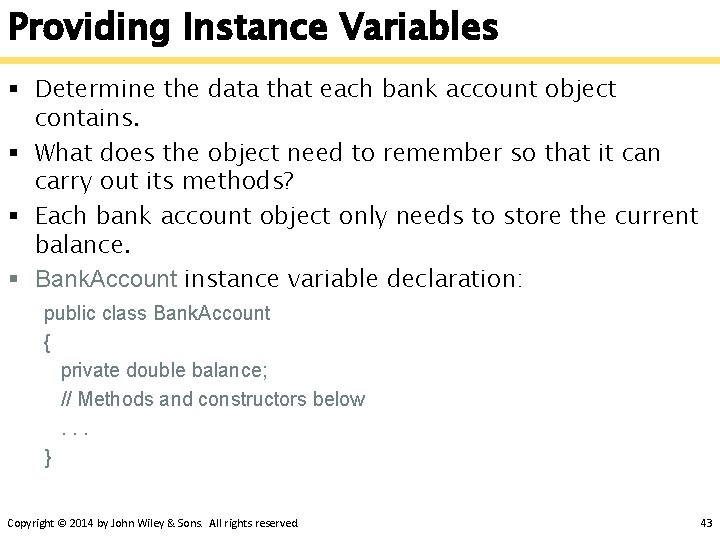
Providing Instance Variables § Determine the data that each bank account object contains. § What does the object need to remember so that it can carry out its methods? § Each bank account object only needs to store the current balance. § Bank. Account instance variable declaration: public class Bank. Account { private double balance; // Methods and constructors below. . . } Copyright © 2014 by John Wiley & Sons. All rights reserved. 43
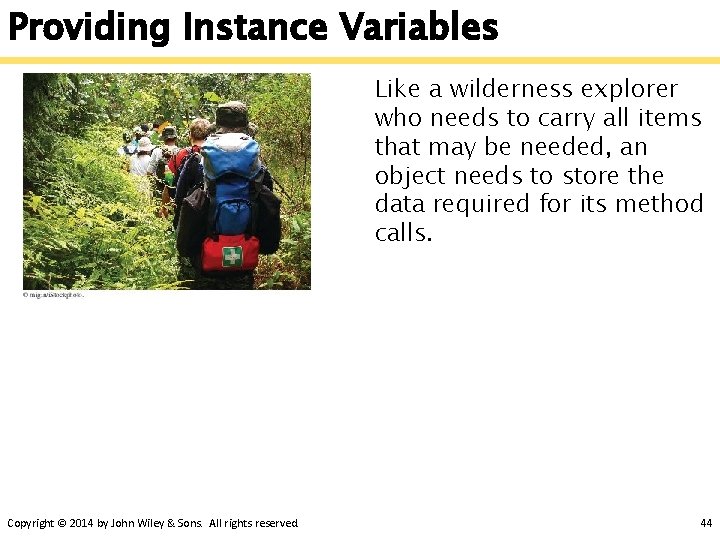
Providing Instance Variables Like a wilderness explorer who needs to carry all items that may be needed, an object needs to store the data required for its method calls. Copyright © 2014 by John Wiley & Sons. All rights reserved. 44
Providing Constructors § Constructor's job is to initialize the instance variables of the object. § The no-argument constructor sets the balance to zero. public Bank. Account() { balance = 0; } § The second constructor sets the balance to the value supplied as the construction argument. public Bank. Account(double initial. Balance) { balance = initial. Balance; } Copyright © 2014 by John Wiley & Sons. All rights reserved. 45
Providing Constructors - Tracing the Statement Steps carried out when the following statement is executed: Bank. Account harrys. Checking = new Bank. Account(1000); § Create a new object of type Bank. Account. § Call the second constructor • because an argument is supplied in the constructor call § Set the parameter variable initial. Balance to 1000. § Set the balance instance variable of the newly created object to initial. Balance. § Return an object reference, that is, the memory location of the object. § Store that object reference in the harrys. Checking variable. Copyright © 2014 by John Wiley & Sons. All rights reserved. 46
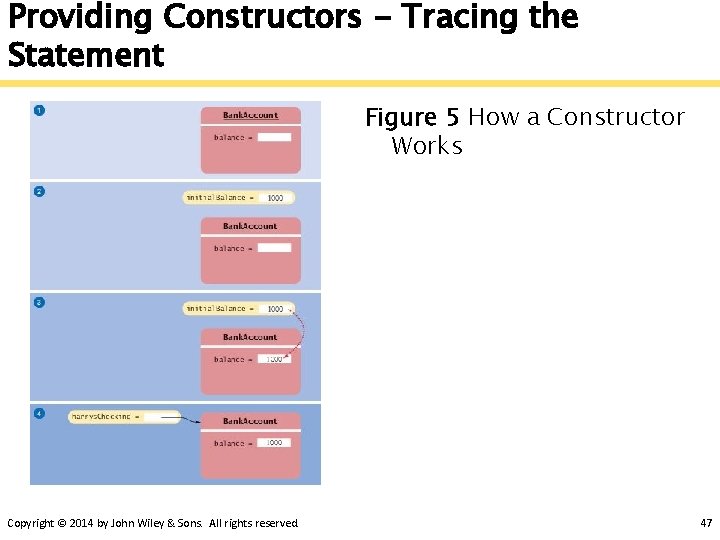
Providing Constructors - Tracing the Statement Figure 5 How a Constructor Works Copyright © 2014 by John Wiley & Sons. All rights reserved. 47
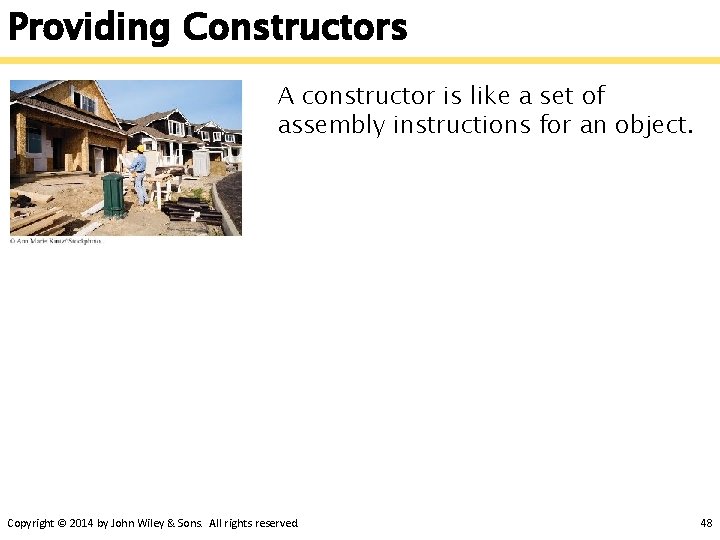
Providing Constructors A constructor is like a set of assembly instructions for an object. Copyright © 2014 by John Wiley & Sons. All rights reserved. 48
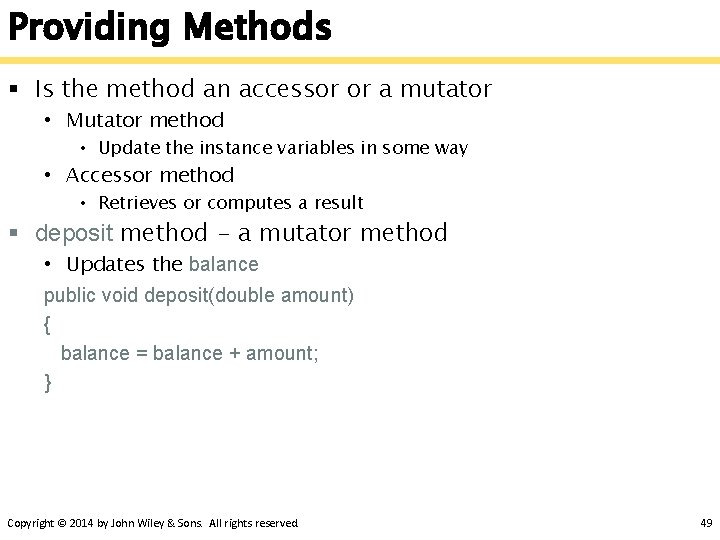
Providing Methods § Is the method an accessor or a mutator • Mutator method • Update the instance variables in some way • Accessor method • Retrieves or computes a result § deposit method - a mutator method • Updates the balance public void deposit(double amount) { balance = balance + amount; } Copyright © 2014 by John Wiley & Sons. All rights reserved. 49
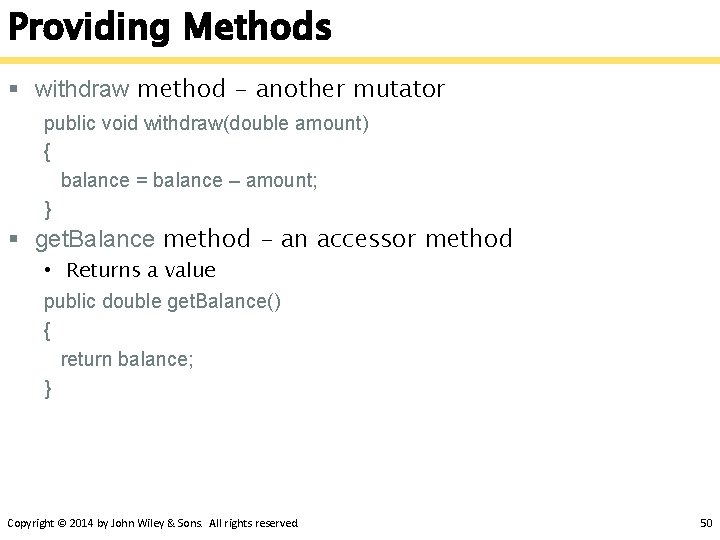
Providing Methods § withdraw method - another mutator public void withdraw(double amount) { balance = balance – amount; } § get. Balance method - an accessor method • Returns a value public double get. Balance() { return balance; } Copyright © 2014 by John Wiley & Sons. All rights reserved. 50
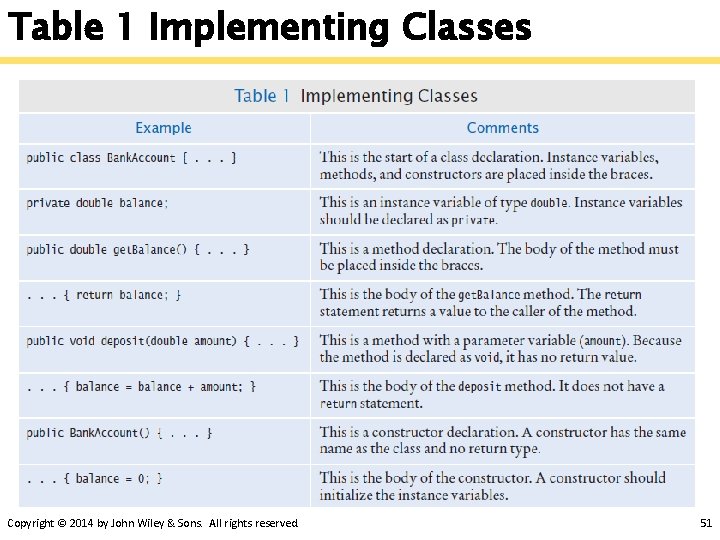
Table 1 Implementing Classes Copyright © 2014 by John Wiley & Sons. All rights reserved. 51
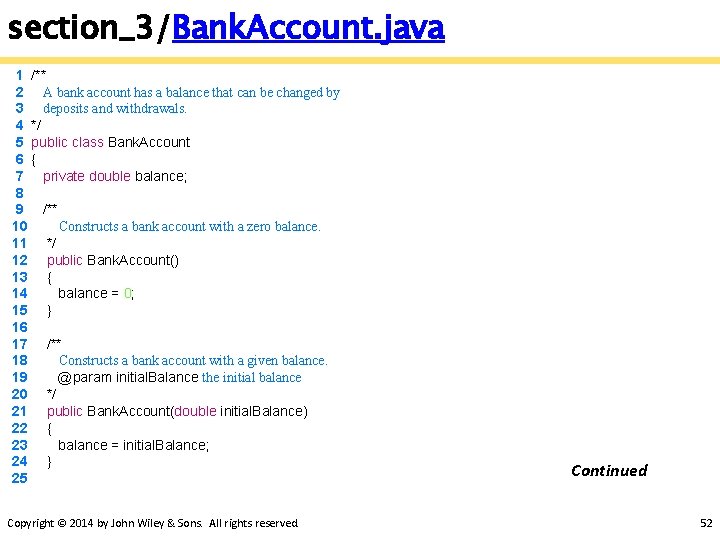
section_3/Bank. Account. java 1 /** 2 A bank account has a balance that can be changed by 3 deposits and withdrawals. 4 */ 5 public class Bank. Account 6 { 7 private double balance; 8 9 /** 10 Constructs a bank account with a zero balance. 11 */ 12 public Bank. Account() 13 { 14 balance = 0; 15 } 16 17 /** 18 Constructs a bank account with a given balance. 19 @param initial. Balance the initial balance 20 */ 21 public Bank. Account(double initial. Balance) 22 { 23 balance = initial. Balance; 24 } 25 Copyright © 2014 by John Wiley & Sons. All rights reserved. Continued 52
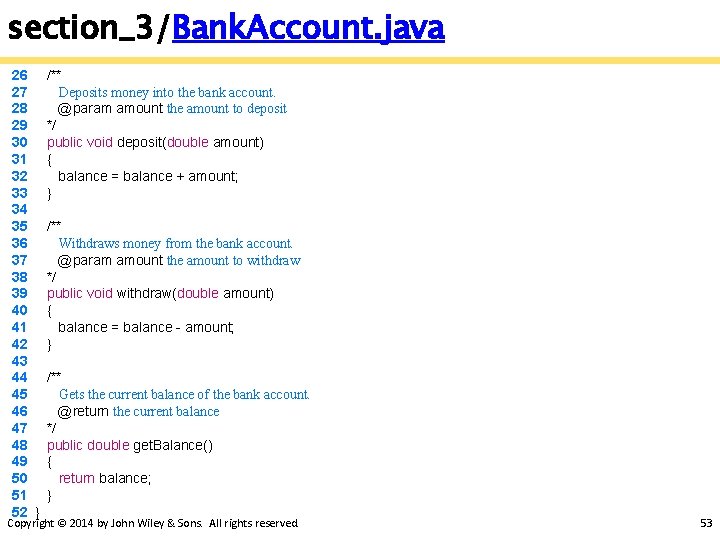
section_3/Bank. Account. java 26 27 28 29 30 31 32 33 34 35 36 37 38 39 40 41 42 43 44 45 46 47 48 49 50 51 52 } /** Deposits money into the bank account. @param amount the amount to deposit */ public void deposit(double amount) { balance = balance + amount; } /** Withdraws money from the bank account. @param amount the amount to withdraw */ public void withdraw(double amount) { balance = balance - amount; } /** Gets the current balance of the bank account. @return the current balance */ public double get. Balance() { return balance; } Copyright © 2014 by John Wiley & Sons. All rights reserved. 53
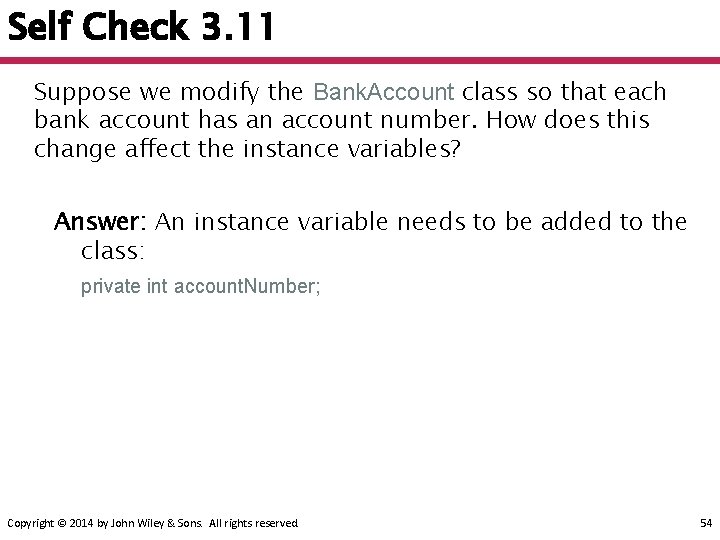
Self Check 3. 11 Suppose we modify the Bank. Account class so that each bank account has an account number. How does this change affect the instance variables? Answer: An instance variable needs to be added to the class: private int account. Number; Copyright © 2014 by John Wiley & Sons. All rights reserved. 54
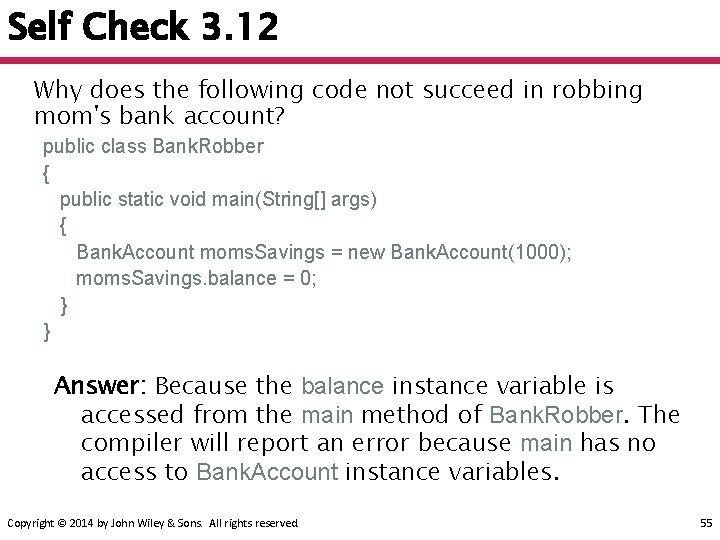
Self Check 3. 12 Why does the following code not succeed in robbing mom's bank account? public class Bank. Robber { public static void main(String[] args) { Bank. Account moms. Savings = new Bank. Account(1000); moms. Savings. balance = 0; } } Answer: Because the balance instance variable is accessed from the main method of Bank. Robber. The compiler will report an error because main has no access to Bank. Account instance variables. Copyright © 2014 by John Wiley & Sons. All rights reserved. 55
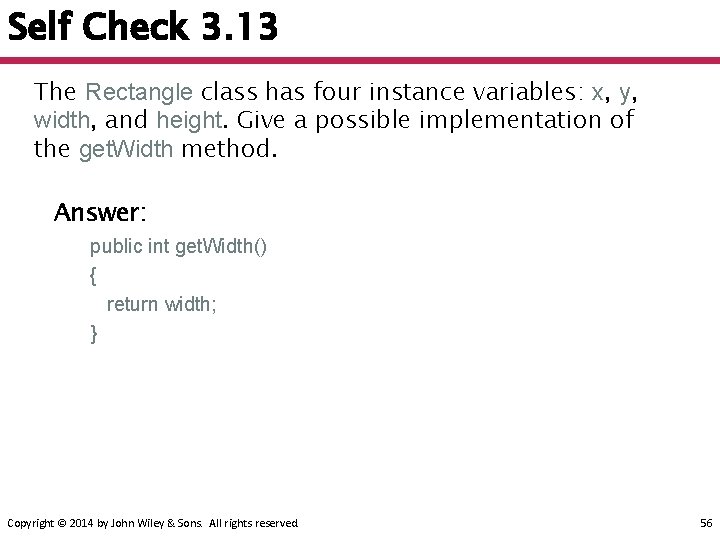
Self Check 3. 13 The Rectangle class has four instance variables: x, y, width, and height. Give a possible implementation of the get. Width method. Answer: public int get. Width() { return width; } Copyright © 2014 by John Wiley & Sons. All rights reserved. 56
Self Check 3. 14 Give a possible implementation of the translate method of the Rectangle class. Answer: There is more than one correct answer. One possible implementation is as follows: public void translate(int dx, int dy) { int newx = x + dx; x = newx; int newy = y + dy; y = newy; } Copyright © 2014 by John Wiley & Sons. All rights reserved. 57
Unit Testing § Bank. Account. java can not be executed: • It has no main method • Most classes do not have a main method § Before using Bank. Account. java in a larger program: • You should test in isolation § Unit test: verifies that a class works correctly in isolation, outside a complete program. Copyright © 2014 by John Wiley & Sons. All rights reserved. 58
Unit Testing § To test a class, either • use an environment for interactive testing, or • write a tester class to execute test instructions. § Tester class: a class with a main method that contains statements to test another class. § Typically carries out the following steps: 1. 2. 3. 4. Construct one or more objects of the class that is being tested Invoke one or more methods Print out one or more results Print the expected results Copyright © 2014 by John Wiley & Sons. All rights reserved. 59
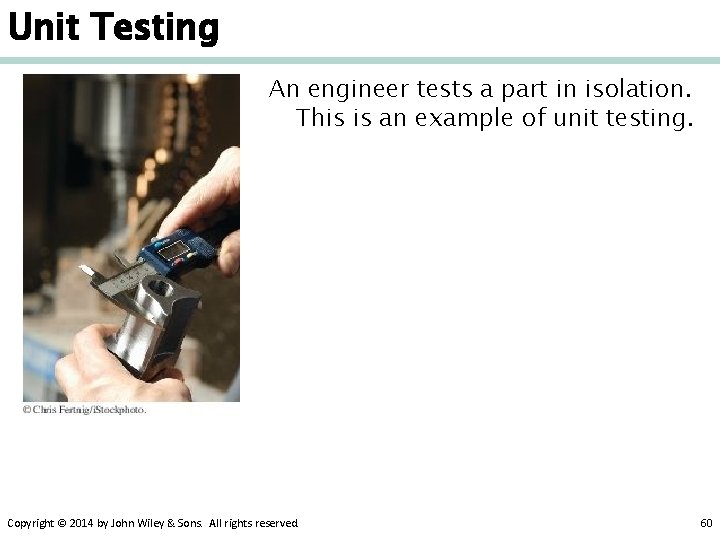
Unit Testing An engineer tests a part in isolation. This is an example of unit testing. Copyright © 2014 by John Wiley & Sons. All rights reserved. 60
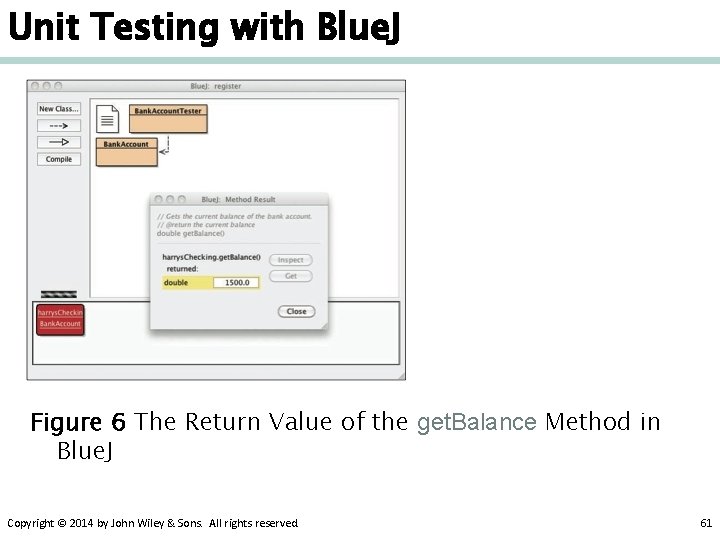
Unit Testing with Blue. J Figure 6 The Return Value of the get. Balance Method in Blue. J Copyright © 2014 by John Wiley & Sons. All rights reserved. 61
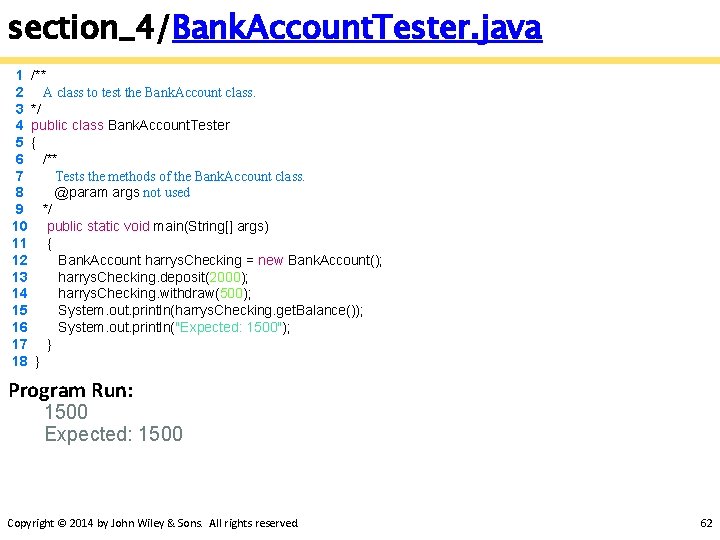
section_4/Bank. Account. Tester. java 1 /** 2 A class to test the Bank. Account class. 3 */ 4 public class Bank. Account. Tester 5 { 6 /** 7 Tests the methods of the Bank. Account class. 8 @param args not used 9 */ 10 public static void main(String[] args) 11 { 12 Bank. Account harrys. Checking = new Bank. Account(); 13 harrys. Checking. deposit(2000); 14 harrys. Checking. withdraw(500); 15 System. out. println(harrys. Checking. get. Balance()); 16 System. out. println("Expected: 1500"); 17 } 18 } Program Run: 1500 Expected: 1500 Copyright © 2014 by John Wiley & Sons. All rights reserved. 62
Unit Testing – Building a Program § To produce a program: combine both Bank. Account and Bank. Account. Tester classes. § Details for building the program vary. § In most environments, you need to carry out these steps: 1. 2. 3. 4. Make a new subfolder for your program Make two files, one for each class Compile both files Run the test program § Bank. Account and Bank. Account. Test have entirely different purposes: • Bank. Account class describes objects that compute bank balances • Bank. Account. Tester class runs tests that put a Bank. Account object through its paces Copyright © 2014 by John Wiley & Sons. All rights reserved. 63
Self Check 3. 15 When you run the Bank. Account. Tester program, how many objects of class Bank. Account are constructed? How many objects of type Bank. Account. Tester? Answer: One Bank. Account object, no Bank. Account. Tester object. The purpose of the Bank. Account. Tester class is merely to hold the main method. Copyright © 2014 by John Wiley & Sons. All rights reserved. 64
Self Check 3. 16 Why is the Bank. Account. Tester class unnecessary in development environments that allow interactive testing, such as Blue. J? Answer: In those environments, you can issue interactive commands to construct Bank. Account objects, invoke methods, and display their return values. Copyright © 2014 by John Wiley & Sons. All rights reserved. 65
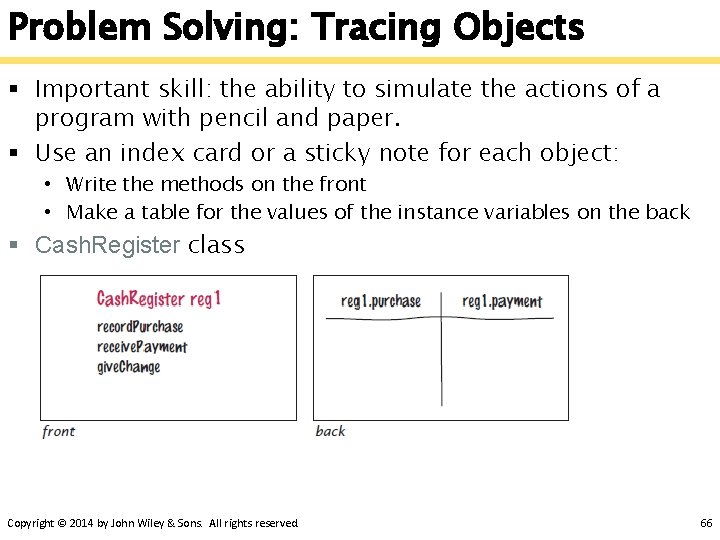
Problem Solving: Tracing Objects § Important skill: the ability to simulate the actions of a program with pencil and paper. § Use an index card or a sticky note for each object: • Write the methods on the front • Make a table for the values of the instance variables on the back § Cash. Register class Copyright © 2014 by John Wiley & Sons. All rights reserved. 66
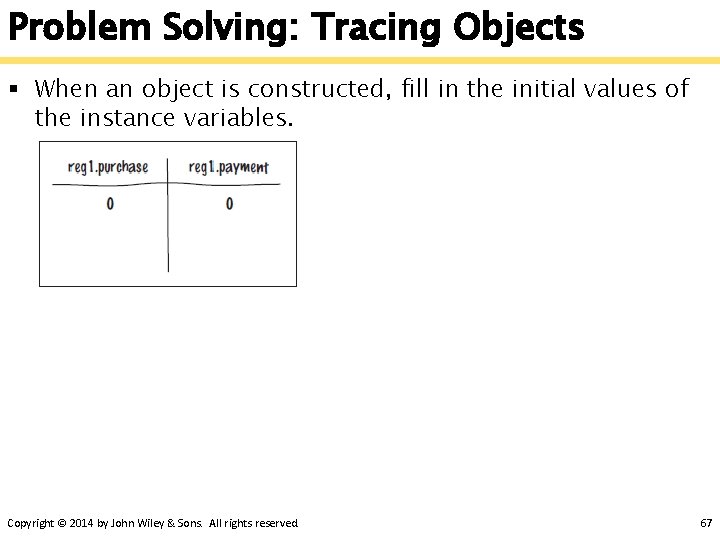
Problem Solving: Tracing Objects § When an object is constructed, fill in the initial values of the instance variables. Copyright © 2014 by John Wiley & Sons. All rights reserved. 67
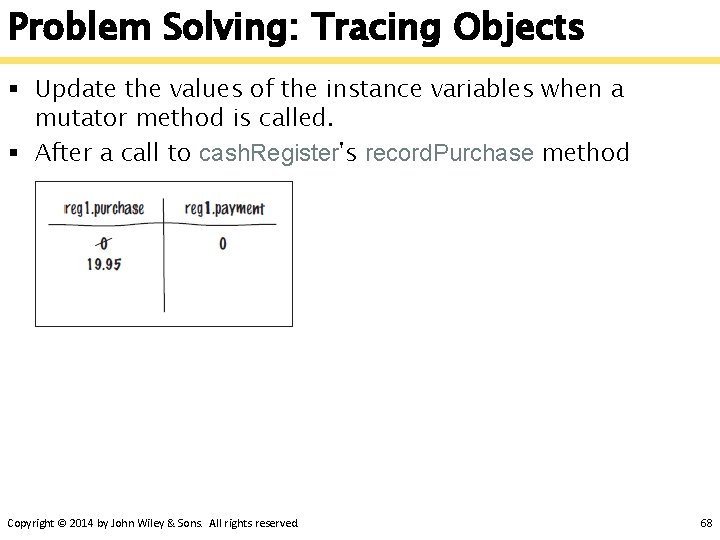
Problem Solving: Tracing Objects § Update the values of the instance variables when a mutator method is called. § After a call to cash. Register's record. Purchase method Copyright © 2014 by John Wiley & Sons. All rights reserved. 68
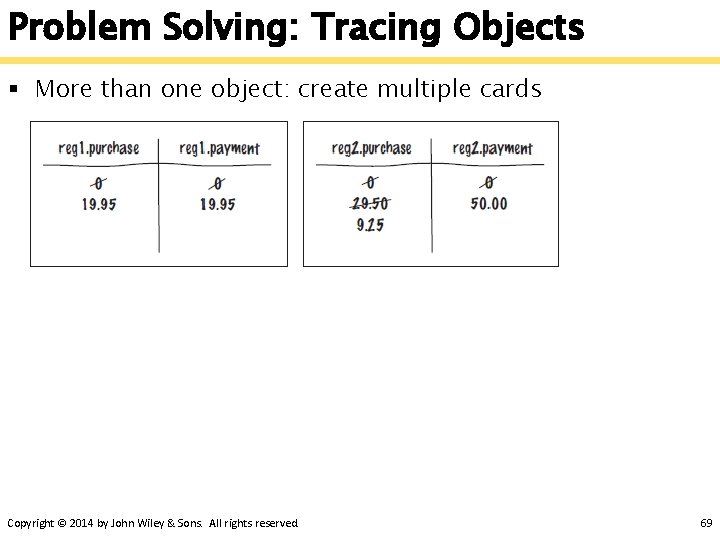
Problem Solving: Tracing Objects § More than one object: create multiple cards Copyright © 2014 by John Wiley & Sons. All rights reserved. 69
Problem Solving: Tracing Objects § Useful when enhancing a class. § Enhance Cash. Register class to compute the sales tax. § Add methods record. Taxable. Purchase and get. Sales. Tax to the front of the card. § Don’t have enough information to compute sales tax: • need tax rate • need total of the taxable items § Need additional instance variables for: • tax. Rate • taxable. Purchase Copyright © 2014 by John Wiley & Sons. All rights reserved. 70
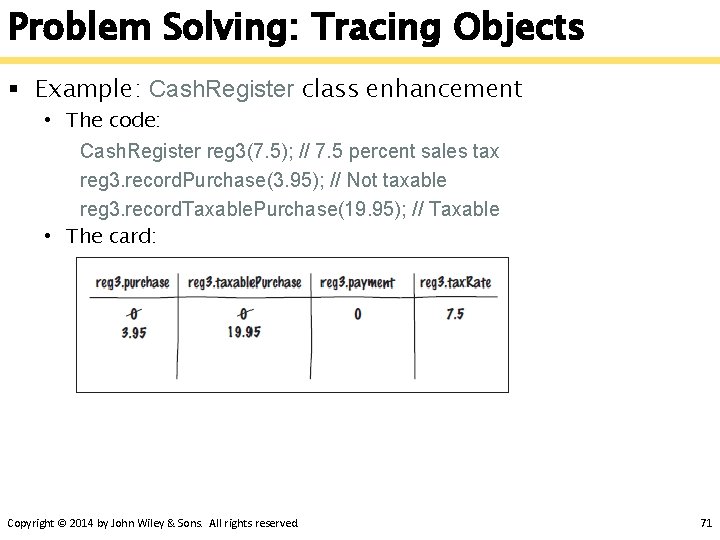
Problem Solving: Tracing Objects § Example: Cash. Register class enhancement • The code: Cash. Register reg 3(7. 5); // 7. 5 percent sales tax reg 3. record. Purchase(3. 95); // Not taxable reg 3. record. Taxable. Purchase(19. 95); // Taxable • The card: Copyright © 2014 by John Wiley & Sons. All rights reserved. 71
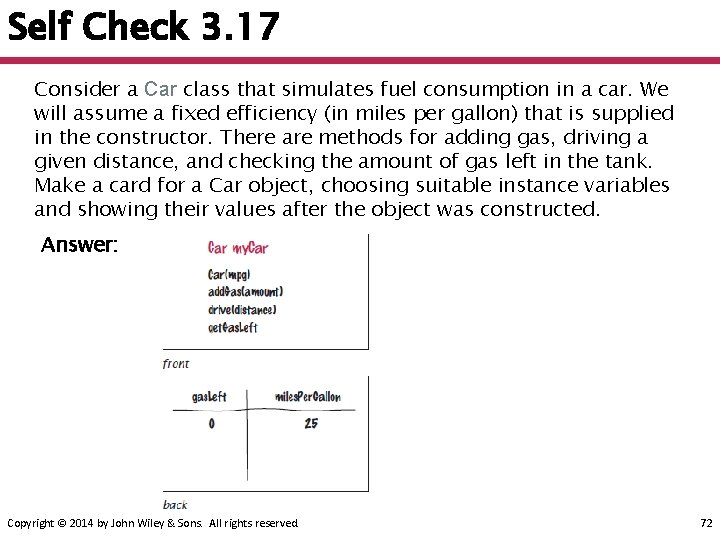
Self Check 3. 17 Consider a Car class that simulates fuel consumption in a car. We will assume a fixed efficiency (in miles per gallon) that is supplied in the constructor. There are methods for adding gas, driving a given distance, and checking the amount of gas left in the tank. Make a card for a Car object, choosing suitable instance variables and showing their values after the object was constructed. Answer: Copyright © 2014 by John Wiley & Sons. All rights reserved. 72
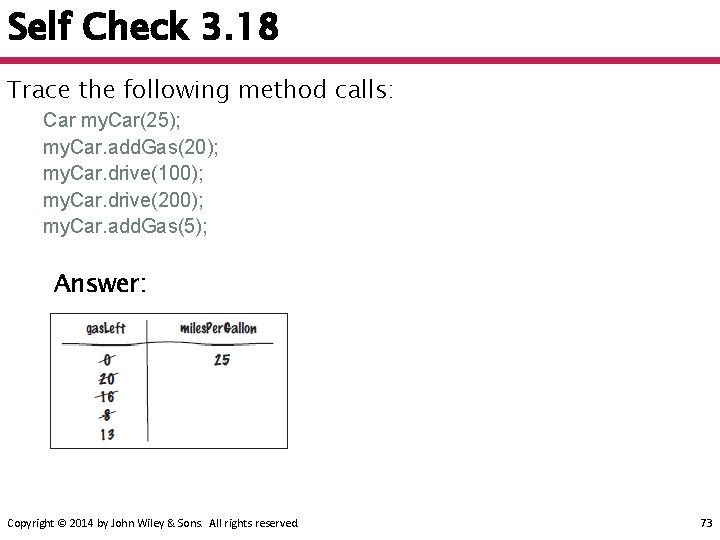
Self Check 3. 18 Trace the following method calls: Car my. Car(25); my. Car. add. Gas(20); my. Car. drive(100); my. Car. drive(200); my. Car. add. Gas(5); Answer: Copyright © 2014 by John Wiley & Sons. All rights reserved. 73
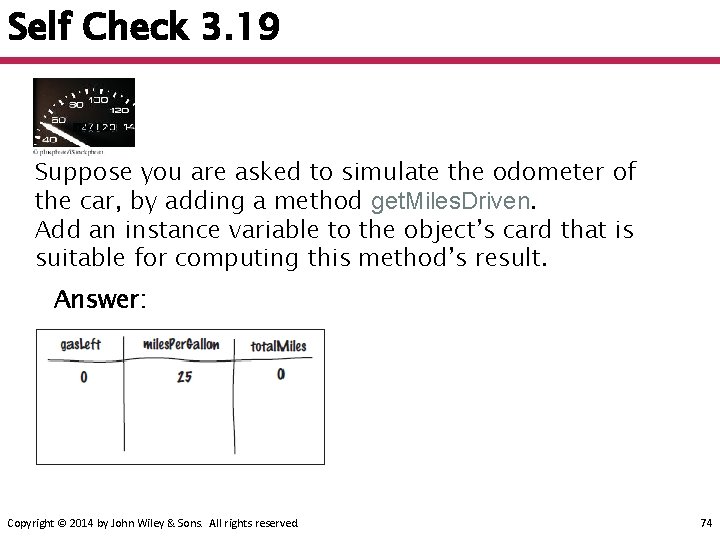
Self Check 3. 19 Suppose you are asked to simulate the odometer of the car, by adding a method get. Miles. Driven. Add an instance variable to the object’s card that is suitable for computing this method’s result. Answer: Copyright © 2014 by John Wiley & Sons. All rights reserved. 74
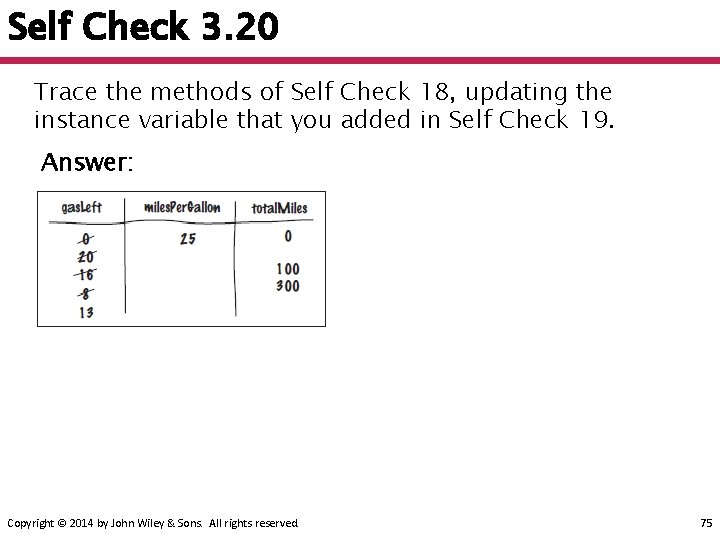
Self Check 3. 20 Trace the methods of Self Check 18, updating the instance variable that you added in Self Check 19. Answer: Copyright © 2014 by John Wiley & Sons. All rights reserved. 75
Local Variables § Local variables are declared in the body of a method: public double give. Change() { double change = payment – purchase; purchase = 0; payment = 0; return change; } § When a method exits, its local variables are removed. § Parameter variables are declared in the header of a method: public void enter. Payment(double amount) Copyright © 2014 by John Wiley & Sons. All rights reserved. 76
Local Variables § Local and parameter variables belong to methods: • When a method runs, its local and parameter variables come to life • When the method exits, they are removed immediately § Instance variables belong to objects, not methods: • When an object is constructed, its instance variables are created • The instance variables stay alive until no method uses the object any longer § Instance variables are initialized to a default value: • Numbers are initialized to 0 • Object references are set to a special value called null • A null object reference refers to no object at all § You must initialize local variables: • The compiler complains if you do not Copyright © 2014 by John Wiley & Sons. All rights reserved. 77
Self Check 3. 21 What do local variables and parameter variables have in common? In which essential aspect do they differ? Answer: Variables of both categories belong to methods – they come alive when the method is called, and they die when the method exits. They differ in their initialization. Parameter variables are initialized with the call values; local variables must be explicitly initialized. Copyright © 2014 by John Wiley & Sons. All rights reserved. 78
Self Check 3. 22 Why was it necessary to introduce the local variable change in the give. Change method? That is, why didn’t the method simply end with the statement return payment - purchase; Answer: After computing the change due, payment and purchase were set to zero. If the method returned payment - purchase, it would always return zero. Copyright © 2014 by John Wiley & Sons. All rights reserved. 79
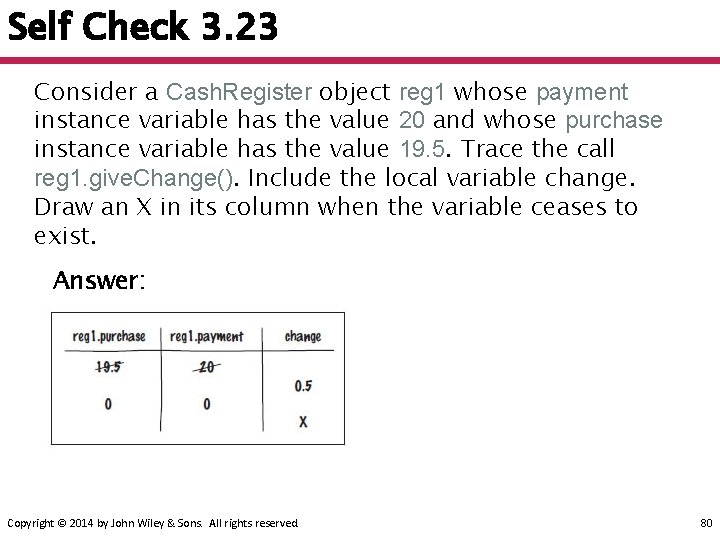
Self Check 3. 23 Consider a Cash. Register object reg 1 whose payment instance variable has the value 20 and whose purchase instance variable has the value 19. 5. Trace the call reg 1. give. Change(). Include the local variable change. Draw an X in its column when the variable ceases to exist. Answer: Copyright © 2014 by John Wiley & Sons. All rights reserved. 80
The this Reference § Two types of inputs are passed when a method is called: • The object on which you invoke the method • The method arguments § In the call moms. Savings. deposit(500) the method needs to know: • The account object (moms. Savings) • The amount being deposited (500) § The implicit parameter of a method is the object on which the method is invoked. § All other parameter variables are called explicit parameters. Copyright © 2014 by John Wiley & Sons. All rights reserved. 81
The this Reference § Look at this method: public void deposit(double amount) { balance = balance + amount; } • amount is the explicit parameter • The implicit parameter(mom. Savings) is not seen • balance means mom. Savings. balance § When you refer to an instance variable inside a method, it means the instance variable of the implicit parameter. Copyright © 2014 by John Wiley & Sons. All rights reserved. 82
The this Reference § The this reference denotes the implicit parameter balance = balance + amount; actually means this. balance = this. balance + amount; § When you refer to an instance variable in a method, the compiler automatically applies it to the this reference. Copyright © 2014 by John Wiley & Sons. All rights reserved. 83
The this Reference § Some programmers feel that inserting the this reference before every instance variable reference makes the code clearer: public Bank. Account(double initial. Balance) { this. balance = initial. Balance; } Copyright © 2014 by John Wiley & Sons. All rights reserved. 84
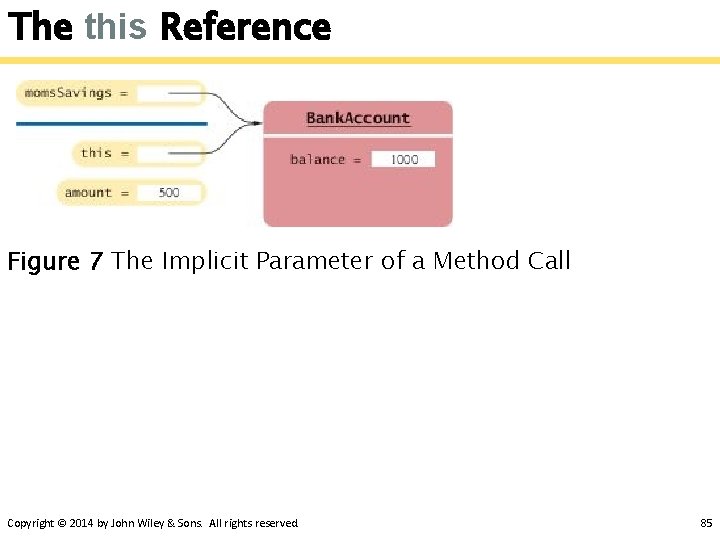
The this Reference Figure 7 The Implicit Parameter of a Method Call Copyright © 2014 by John Wiley & Sons. All rights reserved. 85
The this Reference § The this reference can be used to distinguish between instance variables and local or parameter variables: public Bank. Account(double balance) { this. balance = balance; } § A local variable shadows an instance variable with the same name. • You can access the instance variable name through the this reference. Copyright © 2014 by John Wiley & Sons. All rights reserved. 86
The this Reference § In Java, local and parameter variables are considered first when looking up variable names. § Statement this. balance = balance; means: “Set the instance variable balance to the parameter variable balance”. Copyright © 2014 by John Wiley & Sons. All rights reserved. 87
The this Reference § A method call without an implicit parameter is applied to the same object. § Example: public class Bank. Account {. . . public void monthly. Fee() { withdraw(10); // Withdraw $10 from this account } } § The implicit parameter of the withdraw method is the (invisible) implicit parameter of the monthly. Fee method Copyright © 2014 by John Wiley & Sons. All rights reserved. 88
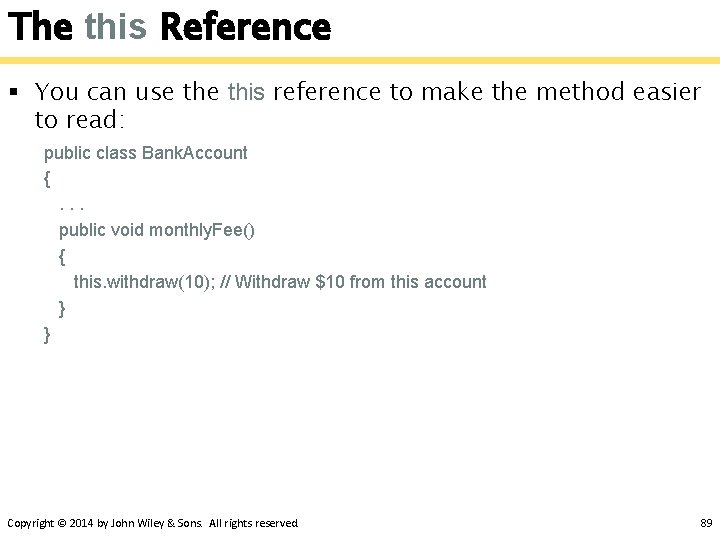
The this Reference § You can use this reference to make the method easier to read: public class Bank. Account {. . . public void monthly. Fee() { this. withdraw(10); // Withdraw $10 from this account } } Copyright © 2014 by John Wiley & Sons. All rights reserved. 89
Self Check 3. 24 How many implicit and explicit parameters does the withdraw method of the Bank. Account class have, and what are their names and types? Answer: One implicit parameter, called this, of type Bank. Account, and one explicit parameter, called amount, of type double. Copyright © 2014 by John Wiley & Sons. All rights reserved. 90
Self Check 3. 25 In the deposit method, what is the meaning of this. amount? Or, if the expression has no meaning, why not? Answer: It is not a legal expression. this is of type Bank. Account and the Bank. Account class has no instance variable named amount. Copyright © 2014 by John Wiley & Sons. All rights reserved. 91
Self Check 3. 26 How many implicit and explicit parameters does the main method of the Bank. Account. Tester class have, and what are they called? Answer: No implicit parameter — the main method is not invoked on any object — and one explicit parameter, called args. Copyright © 2014 by John Wiley & Sons. All rights reserved. 92
Shape Classes § Good practice: Make a class for each part of a drawing that occurs more than once. public class Car { public Car(int x, int y) { // Remember position. . . } public void draw(Graphics 2 D g 2) { // Drawing instructions. . . } } Copyright © 2014 by John Wiley & Sons. All rights reserved. 93
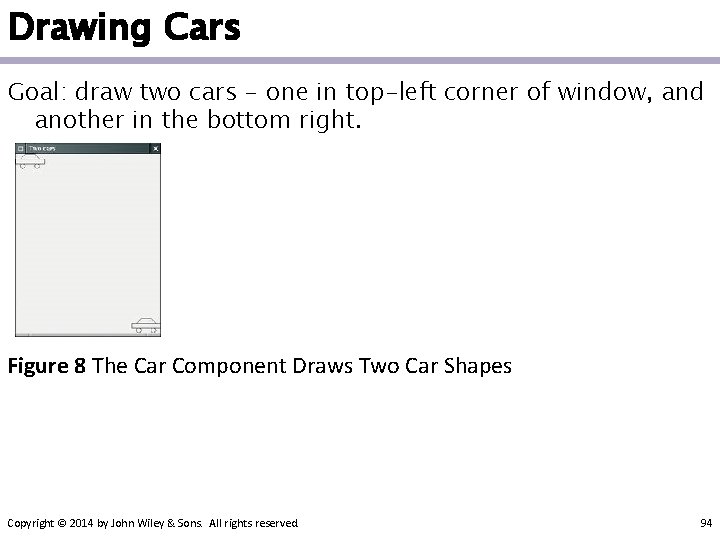
Drawing Cars Goal: draw two cars - one in top-left corner of window, and another in the bottom right. Figure 8 The Car Component Draws Two Car Shapes Copyright © 2014 by John Wiley & Sons. All rights reserved. 94
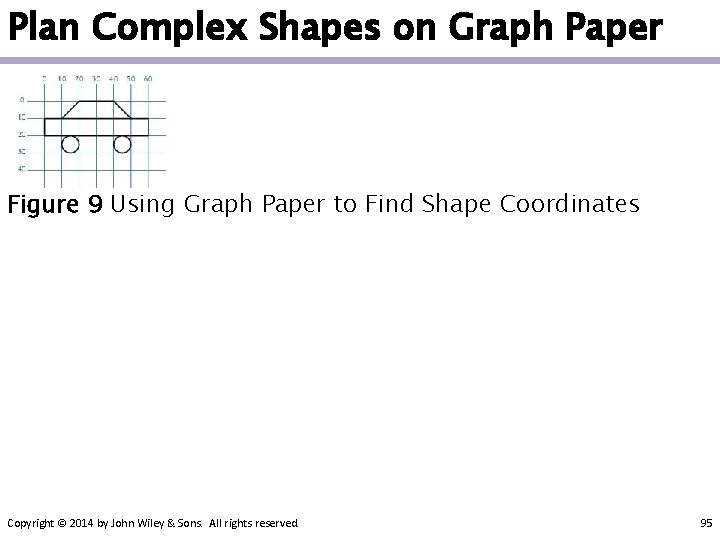
Plan Complex Shapes on Graph Paper Figure 9 Using Graph Paper to Find Shape Coordinates Copyright © 2014 by John Wiley & Sons. All rights reserved. 95
Drawing Cars The program that produces the drawing is composed of three classes: § The Car class is responsible for drawing a single car. • Two objects of this class are constructed, one for each car. § The Car. Component class displays the drawing § The Car. Viewer class shows a frame that contains a Car. Component Copyright © 2014 by John Wiley & Sons. All rights reserved. 96
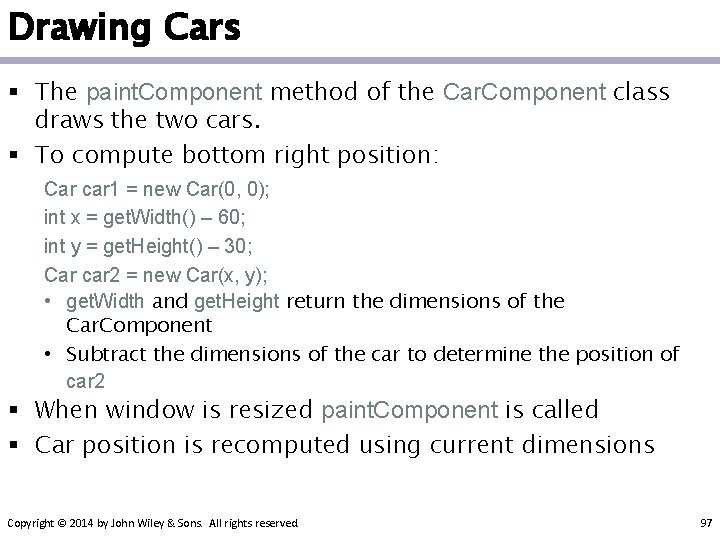
Drawing Cars § The paint. Component method of the Car. Component class draws the two cars. § To compute bottom right position: Car car 1 = new Car(0, 0); int x = get. Width() – 60; int y = get. Height() – 30; Car car 2 = new Car(x, y); • get. Width and get. Height return the dimensions of the Car. Component • Subtract the dimensions of the car to determine the position of car 2 § When window is resized paint. Component is called § Car position is recomputed using current dimensions Copyright © 2014 by John Wiley & Sons. All rights reserved. 97
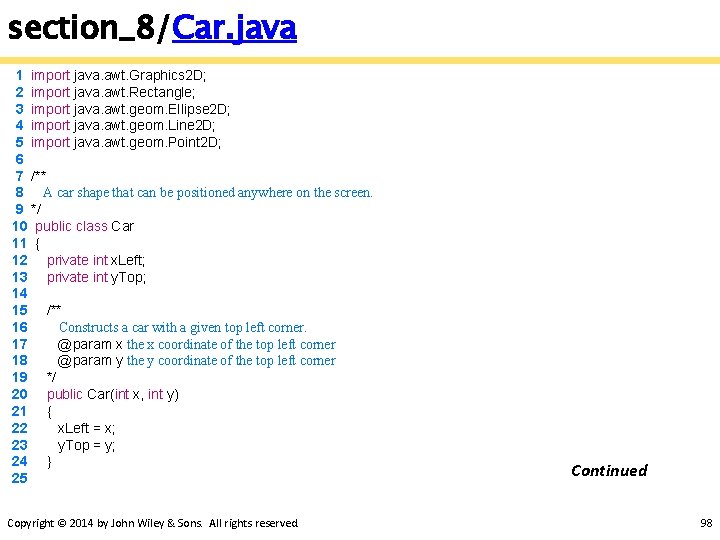
section_8/Car. java 1 import java. awt. Graphics 2 D; 2 import java. awt. Rectangle; 3 import java. awt. geom. Ellipse 2 D; 4 import java. awt. geom. Line 2 D; 5 import java. awt. geom. Point 2 D; 6 7 /** 8 A car shape that can be positioned anywhere on the screen. 9 */ 10 public class Car 11 { 12 private int x. Left; 13 private int y. Top; 14 15 /** 16 Constructs a car with a given top left corner. 17 @param x the x coordinate of the top left corner 18 @param y the y coordinate of the top left corner 19 */ 20 public Car(int x, int y) 21 { 22 x. Left = x; 23 y. Top = y; 24 } 25 Copyright © 2014 by John Wiley & Sons. All rights reserved. Continued 98
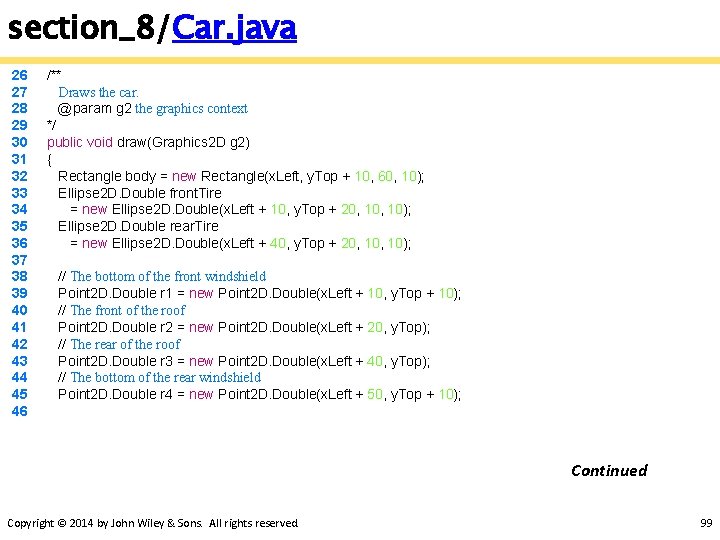
section_8/Car. java 26 27 28 29 30 31 32 33 34 35 36 37 38 39 40 41 42 43 44 45 46 /** Draws the car. @param g 2 the graphics context */ public void draw(Graphics 2 D g 2) { Rectangle body = new Rectangle(x. Left, y. Top + 10, 60, 10); Ellipse 2 D. Double front. Tire = new Ellipse 2 D. Double(x. Left + 10, y. Top + 20, 10); Ellipse 2 D. Double rear. Tire = new Ellipse 2 D. Double(x. Left + 40, y. Top + 20, 10); // The bottom of the front windshield Point 2 D. Double r 1 = new Point 2 D. Double(x. Left + 10, y. Top + 10); // The front of the roof Point 2 D. Double r 2 = new Point 2 D. Double(x. Left + 20, y. Top); // The rear of the roof Point 2 D. Double r 3 = new Point 2 D. Double(x. Left + 40, y. Top); // The bottom of the rear windshield Point 2 D. Double r 4 = new Point 2 D. Double(x. Left + 50, y. Top + 10); Continued Copyright © 2014 by John Wiley & Sons. All rights reserved. 99
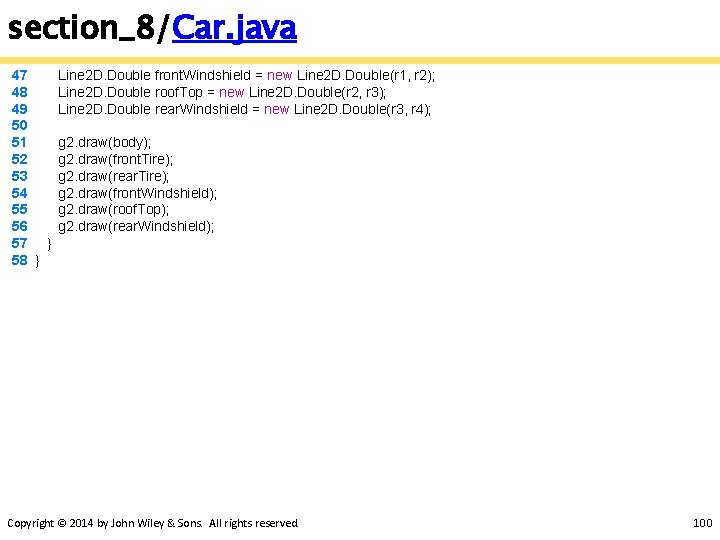
section_8/Car. java 47 48 49 50 51 52 53 54 55 56 57 } 58 } Line 2 D. Double front. Windshield = new Line 2 D. Double(r 1, r 2); Line 2 D. Double roof. Top = new Line 2 D. Double(r 2, r 3); Line 2 D. Double rear. Windshield = new Line 2 D. Double(r 3, r 4); g 2. draw(body); g 2. draw(front. Tire); g 2. draw(rear. Tire); g 2. draw(front. Windshield); g 2. draw(roof. Top); g 2. draw(rear. Windshield); Copyright © 2014 by John Wiley & Sons. All rights reserved. 100
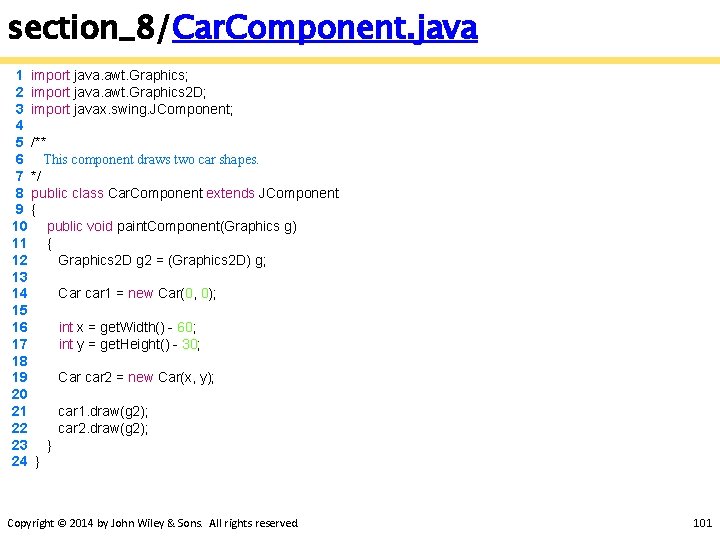
section_8/Car. Component. java 1 import java. awt. Graphics; 2 import java. awt. Graphics 2 D; 3 import javax. swing. JComponent; 4 5 /** 6 This component draws two car shapes. 7 */ 8 public class Car. Component extends JComponent 9 { 10 public void paint. Component(Graphics g) 11 { 12 Graphics 2 D g 2 = (Graphics 2 D) g; 13 14 Car car 1 = new Car(0, 0); 15 16 int x = get. Width() - 60; 17 int y = get. Height() - 30; 18 19 Car car 2 = new Car(x, y); 20 21 car 1. draw(g 2); 22 car 2. draw(g 2); 23 } 24 } Copyright © 2014 by John Wiley & Sons. All rights reserved. 101
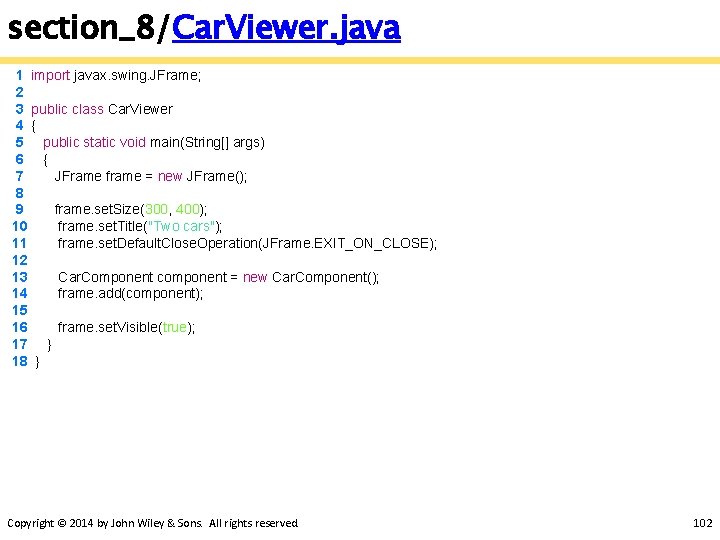
section_8/Car. Viewer. java 1 import javax. swing. JFrame; 2 3 public class Car. Viewer 4 { 5 public static void main(String[] args) 6 { 7 JFrame frame = new JFrame(); 8 9 frame. set. Size(300, 400); 10 frame. set. Title("Two cars"); 11 frame. set. Default. Close. Operation(JFrame. EXIT_ON_CLOSE); 12 13 Car. Component component = new Car. Component(); 14 frame. add(component); 15 16 frame. set. Visible(true); 17 } 18 } Copyright © 2014 by John Wiley & Sons. All rights reserved. 102
Self Check 3. 27 Which class needs to be modified to have the two cars positioned next to each other? Answer: Car. Component Copyright © 2014 by John Wiley & Sons. All rights reserved. 103
Self Check 3. 28 Which class needs to be modified to have the car tires painted in black, and what modification do you need to make? Answer: In the draw method of the Car class, call g 2. fill(front. Tire); g 2. fill(rear. Tire); Copyright © 2014 by John Wiley & Sons. All rights reserved. 104
Self Check 3. 29 How do you make the cars twice as big? Answer: Double all measurements in the draw method of the Car class. Copyright © 2014 by John Wiley & Sons. All rights reserved. 105
- Slides: 105