
Chapter 3 Horstmanns Book Guidelines for Class Design
Chapter 3 (Horstmann’s Book) Guidelines for Class Design Hwajung Lee ITEC 324 Principle of CS III
Objective of this chapter Have “bottom up point of view” Learn how to write a single class well. The classes will Be useful Be reusable Increased pride and satisfaction for you, the designer.
Quality of Class Interface Customers: Programmers using the class Criteria: (5 Cs) Cohesion Completeness Convenience Clarity Consistency

Cohesion A class is an abstraction of a single concept. A class is cohesive if all of its methods are related to a single abstraction. Methods should be related to the single abstraction Bad example: public class Mailbox { public add. Message(Message a. Message) {. . . } public Message get. Current. Message() {. . . } public Message remove. Current. Message() {. . . } public void process. Command(String command) {. . . }
Completeness A class interface should support all operations that are a part of the abstraction that the class represents. Potentially bad example: Date start = new Date(); // do some work Date end = new Date(); //How many milliseconds have elapsed? No such operation in Date class Does it fall outside the responsibility? After all, we have before, after, get. Time
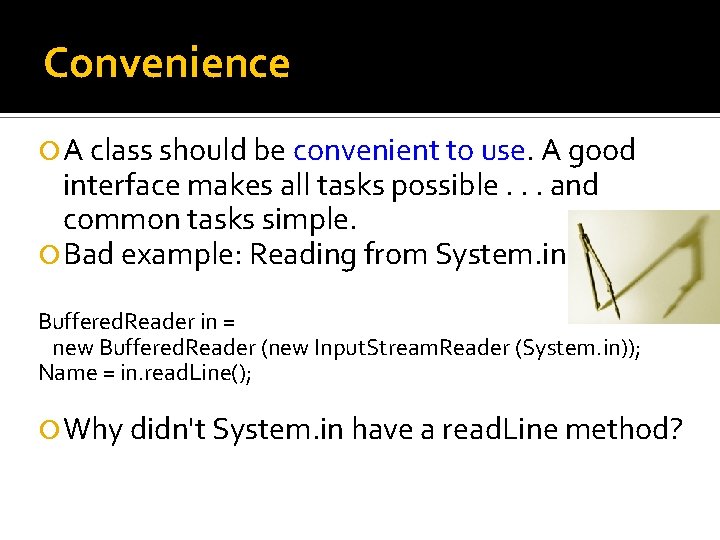
Convenience A class should be convenient to use. A good interface makes all tasks possible. . . and common tasks simple. Bad example: Reading from System. in Buffered. Reader in = new Buffered. Reader (new Input. Stream. Reader (System. in)); Name = in. read. Line(); Why didn't System. in have a read. Line method?
Clarity (1) A class interface should be clear to understand to programmers. Confused programmers write buggy code Bad example: Removing elements from Linked. List countries = new Linked. List(); countries. add("A"); countries. add("B"); countries. add("C"); List. Iterator iterator = countries. list. Iterator(); while (iterator. has. Next()) System. out. println(iterator. next());
Clarity (2) Iterator between elements is like blinking cursor in a word processor. Thus, if X is added before B: List. Iterator iterator = countries. list. Iterator(); // |ABC iterator. next(); // A|BC iterator. add("France"); // AX|BC Then, to remove first two elements, you can't just "backspace. " The remove() method does not remove element to the left of the iterator. Will the following work? iterator. remove(); //A|BC iterator. remove(); //|BC
Clarity (3) In fact, void remove() from API documentation says: Removes from the list the last element that was returned by next or previous. This call can only be made once per call to next or previous. It can be made only if add has not been called after the last call to next or previous. http: //java. sun. com/j 2 se/1. 5. 0/docs/api/java/util/List. Iterator. html#remove() http: //java. sun. com/docs/books/tutorial/ Huh?

Consistency (1) The operations in a class should be consistent with each other with respect to names parameters return values behavior Bad example: new Gregorian. Calendar(year, month - 1, day) Why is month 0 -based?

Consistency (2) Bad example: String class s. equals(t) or s. equals. Ignore. Case(t) But boolean region. Matches(int toffset, String other, int ooffset, int len) boolean region. Matches(boolean ignore. Case, int toffset, String other, int ooffset, int len) Why not region. Matches. Ignore. Case?
Recap (5 Cs) Cohesion Completeness Convenience Clarity Consistency
Law of Demeter A method should only use objects that are instance fields of its class parameters objects that it constructs with new A method shouldn't use an object that is returned from a method call
Programming by Contract Spell out responsibilities of caller of implementer Increase reliability Increase efficiency
Programming by Contract We will look through the ideas on Preconditions Postconditions Exceptions in the Contract Class Invariants Assertions

Preconditions (1) A precondition of a method is a condition that must be fulfilled before the method may be called. Is a condition that the method caller must fulfill.
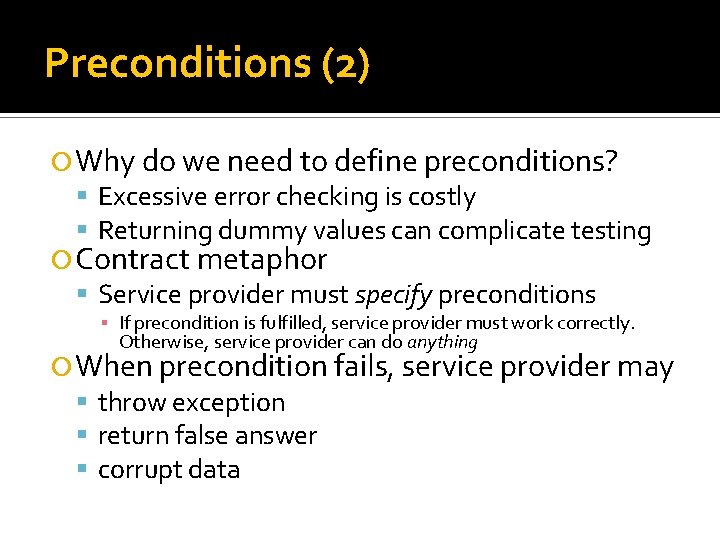
Preconditions (2) Why do we need to define preconditions? Excessive error checking is costly Returning dummy values can complicate testing Contract metaphor Service provider must specify preconditions ▪ If precondition is fulfilled, service provider must work correctly. Otherwise, service provider can do anything When precondition fails, service provider may throw exception return false answer corrupt data

Preconditions (3) Example: /** Remove message at head @return the message at the head @precondition size() > 0 */ Message remove. First() { return (Message)elements. remove(0); }
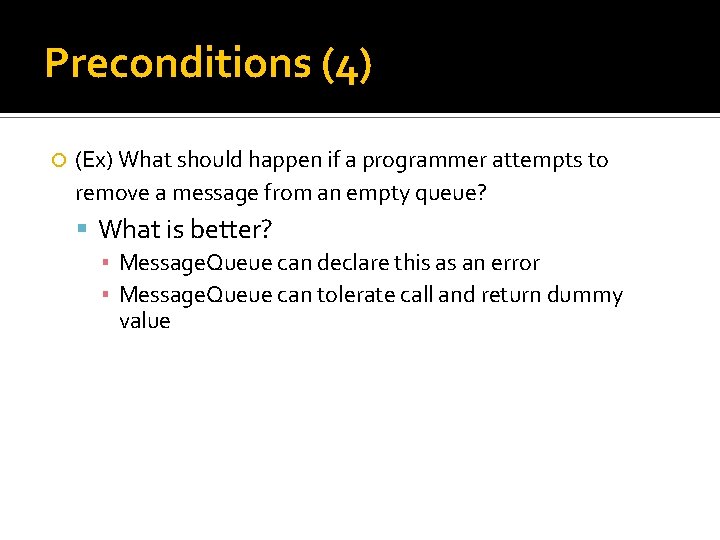
Preconditions (4) (Ex) What should happen if a programmer attempts to remove a message from an empty queue? What is better? ▪ Message. Queue can declare this as an error ▪ Message. Queue can tolerate call and return dummy value
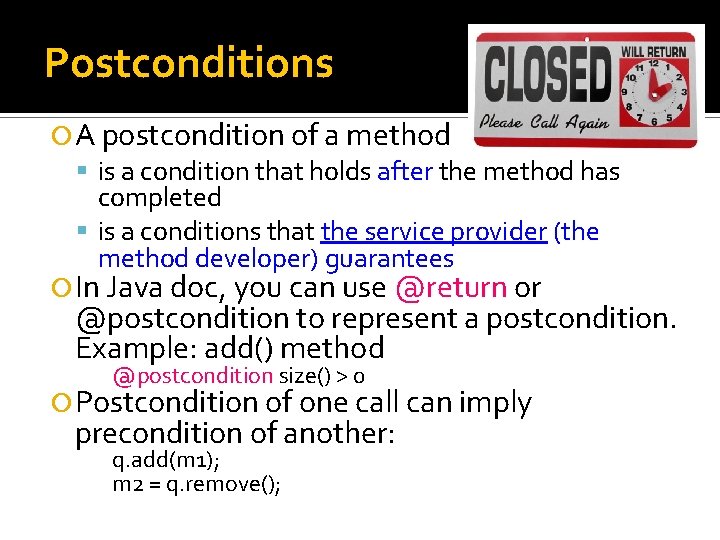
Postconditions A postcondition of a method is a condition that holds after the method has completed is a conditions that the service provider (the method developer) guarantees In Java doc, you can use @return or @postcondition to represent a postcondition. Example: add() method @postcondition size() > 0 Postcondition of one call can imply precondition of another: q. add(m 1); m 2 = q. remove();
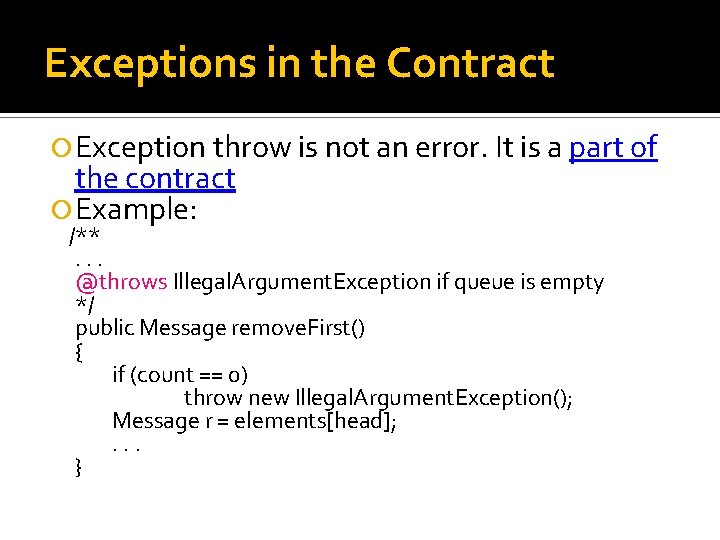
Exceptions in the Contract Exception throw is not an error. It is a part of the contract Example: /**. . . @throws Illegal. Argument. Exception if queue is empty */ public Message remove. First() { if (count == 0) throw new Illegal. Argument. Exception(); Message r = elements[head]; . . . }
Class Invariants (1) A class invariant is a logical condition that is true after every constructor preserved by every mutator (if it's true before the call, it's again true afterwards) Useful for checking validity of operations
Class Invariants (2) Example: Circular array queue (Ch 2/mail/Message. Queue. java) 0 <= head && head < elements. length First check it's true for constructor ▪ Sets head = 0 ▪ Need precondition size() >= 0 Check mutators. Start with remove. First() ▪ Sets headnew = (headold + 1) % elements. length ▪ We know headold + 1> 0 (Why? ) % operator property: 0 <= headnew && headnew < elements. length What's the use of a class invariant? Every array access of the form element[head] is legal!
Assertions (1) An assertions: is a condition that a programmer expects to be true is a mechanism for warning programmers ▪ Useful for warning programmers about precondition failure can be turned off after testing Syntax: assert condition; assert condition : explanation; Throws Assertion. Error if condition false and checking enabled
Assertions (2) Example: public Message remove. First() { assert count > 0 : "violated precondition size() > 0"; Message r = elements[head]; . . . } How to execute the assertion: During testing, run with java -enableassertions My. Prog or Java -ea My. Prog
Unit Testing Unit test = test of a single class How to test? Design test cases during implementation Run tests after every implementation change When you find a bug, add a test case that catches it Download the JUnit tool http: //junit. sourceforge. net/doc/faq. htm
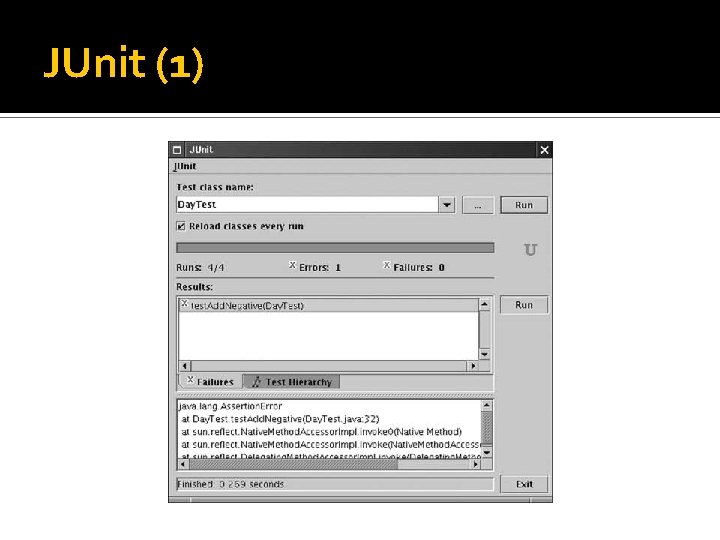
JUnit (1)
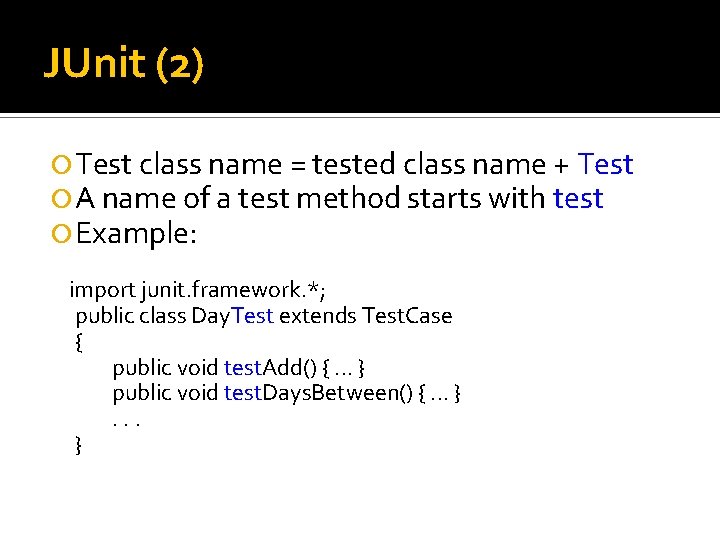
JUnit (2) Test class name = tested class name + Test A name of a test method starts with test Example: import junit. framework. *; public class Day. Test extends Test. Case { public void test. Add() {. . . } public void test. Days. Between() {. . . }
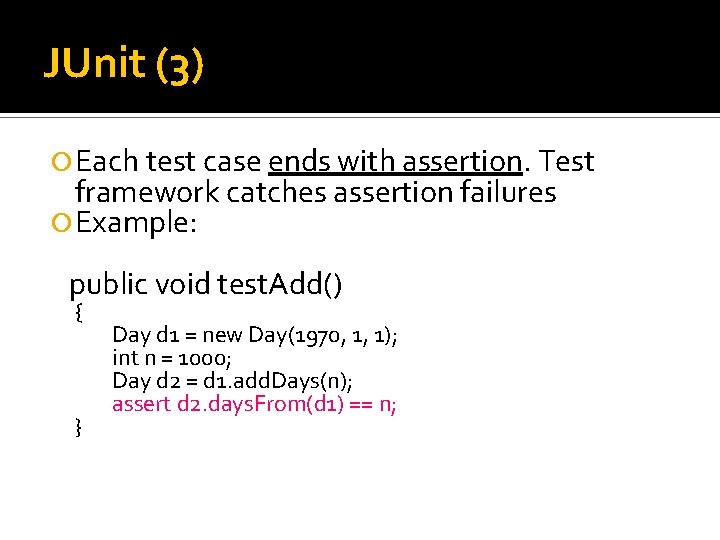
JUnit (3) Each test case ends with assertion. Test framework catches assertion failures Example: public void test. Add() { } Day d 1 = new Day(1970, 1, 1); int n = 1000; Day d 2 = d 1. add. Days(n); assert d 2. days. From(d 1) == n;
JUnit (4) Day. java Day. Test. java Compiling javac –classpath. : junit. jar Day. Test. java Run java –classpath. : junit. jar –ea junit. swingui. Test. Runner Day. Test
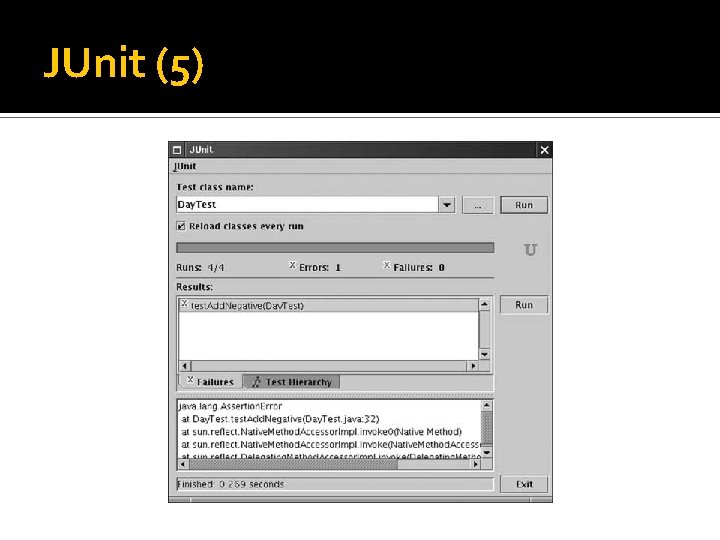
JUnit (5)
Encapsulation using Private, Public, or Protected: public: a field, method, or class that is accessible to every class. protected: a field, method, or class that is accessible to the class itself, subclasses, and all classes in the same package or directory. private: a field or method that is accessible only to the class in which it is defined. Note that a class can not be declared private as a whole.
- Slides: 32