
Chapter 3 HISTORY OF ASSESSMENT IN RECREATIONAL THERAPY
- Slides: 20
Chapter 3 HISTORY OF ASSESSMENT IN RECREATIONAL THERAPY
EVOLUTION IN EVALUATION � Age of Reform (1800 -1900) � Age of Efficiency and Testing (1900 -1930) � Tylerian Age (1930 -1945) � Age of Innocence (1946 -1957) � Age of Expansion (1958 -1972) � Age of Professionalization (1973 -2000) � Age of Computers (2000 -Present)
HOSPITAL RECREATION ASSESSMENTS PRIOR TO THE 1950 S � Modern field of recreational therapy came into existence around the 1950 s � Began to meet on a national basis � Standardized professional training � Set national standards for practice � Assessments � Recreational Therapeutics chapter in Psycho-Physio- Kinesiology � Handbook on physical Training and Recreation in a Mental Hospital � Clients assessed and assigned to one of three different levels of function called grades. . Based in part of marching patterns (pg. 40)
RECREATION THERAPY ASSESSMENTS IN THE 1950 S � By 1950 s, viewed by people who practiced it as a clinically based practice � Breaking activities down into discrete tasks � Encouraging client participation � Adaptations to the activity tasks � Ongoing clinical analysis of client’s performance � Methods used to document a client’s functional status � Measuring functional ability and change in clients who have undergone a frontal lobotomy (pg. 41).
RECREATION THERAPY ASSESSMENTS IN THE 1950 S CONT. . . � Recreation in Hospitals: Report of a Study of Organized Recreation Programs in Hospitals and of the Personnel Conducting Them �A major study conducted by the National Recreation Association in 1959 � 3, 507 Hospitals reporting � 1, 756 professionals stated that their position was a full time position in recreation within the hospital � Table 3. 1 pg. 44 gives titles listed by study respondents � The document lacked specifics related to
RECREATION THERAPY ASSESSMENTS IN THE 1960 S � In the 1960 s the National Recreation Accreditation Project developed a set of standards related to the general and professional preparation of the TR major � Suggested knowledge and skill (pg. 44 -45) � However the standards did not mention client assessment
RECREATION THERAPY ASSESSMENTS IN THE 1960 S CONT. . . � One of the earliest standardized assessment tools in the field was the Mundy Inventory for the Trainable Mentally Retarded � Functional Skill Test � At end of test, professional had a clear understanding of the client’s abilities � Participation in suitable activities (pg. 45).
RECREATION THERAPY ASSESSMENTS IN THE 1960 S CONT. . . � Other literature in the field emphasized evaluation of the program, however little emphasis was place on the evaluation of the individual � TRJ’s direction for inclusion of people with disabilities focused on benefits of involvement versus the assessment of needs of the individual. � Although silent on techniques, some consideration was taken into assessing the individual’s needs
RECREATION THERAPY ASSESSMENTS IN THE 1970 S � In 1971 O’Morrow spoke up about the need for professionals in the field to become competent in assessment. � Competency being the ability to assess or measure evidences of client’s level of recreation literacy and to assess relationships of the participant with others as well as potential for participation in recreation
RECREATION THERAPY ASSESSMENTS IN THE 1970 S CONT. . . � Around a dozen testing tools constructed for leisure counseling were developed by 1977, but these tools lacked validity and reliability � What was being published in professional journals was often years behind what was taking place in the field. � State, regional and national conferences were more often the site for display of new, commonly used tools � FOX � CIP
RECREATION THERAPY ASSESSMENTS IN THE 1970 S CONT. . . � Other well known assessments developed in the 1970 s � STILAP � CERT-Psych
RECREATIONAL THERAPY ASSESSMENTS IN THE 1980 S In 1980, O’Morrow developed the four steps of the TR process � Austin commented that while we are expected to assess, there is little guidance in the field as to How to assess. � In 1982, Austin proposed the following guidelines � Assess to gain information that is useful in helping the client profit from our service � Determine client strengths, interests, and expectations � Identify the nature and extent of the problem � � Austin emphasized that the lack of standardized assessments in the field was a problem
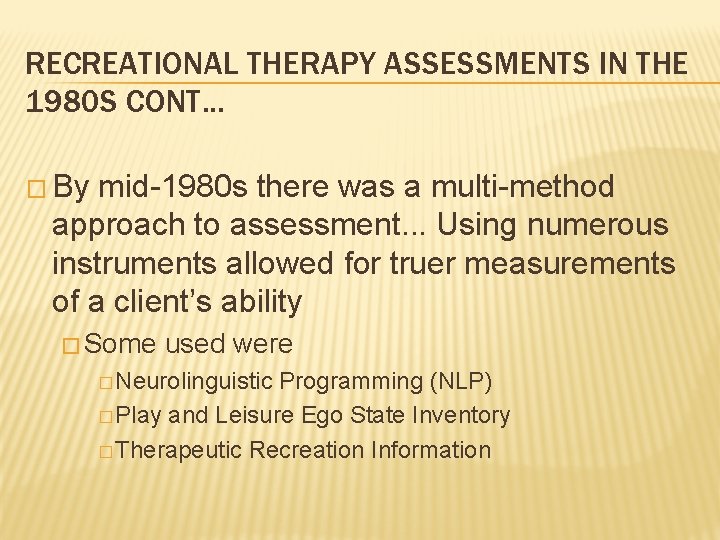
RECREATIONAL THERAPY ASSESSMENTS IN THE 1980 S CONT. . . � By mid-1980 s there was a multi-method approach to assessment. . . Using numerous instruments allowed for truer measurements of a client’s ability � Some used were � Neurolinguistic Programming (NLP) � Play and Leisure Ego State Inventory � Therapeutic Recreation Information
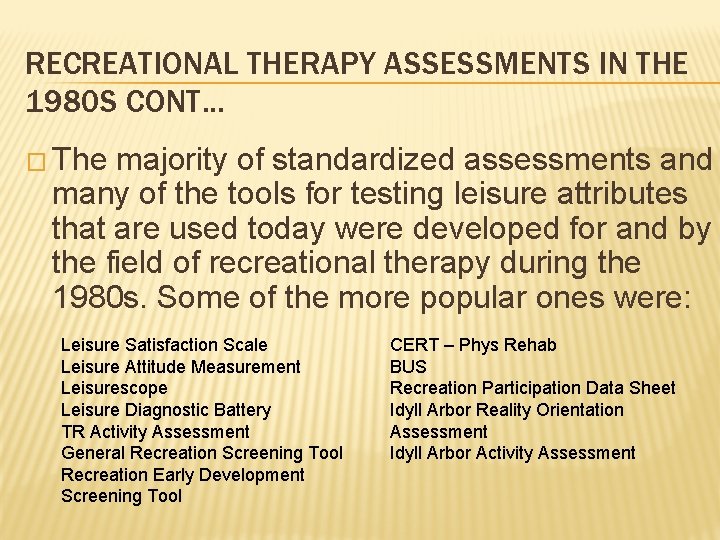
RECREATIONAL THERAPY ASSESSMENTS IN THE 1980 S CONT. . . � The majority of standardized assessments and many of the tools for testing leisure attributes that are used today were developed for and by the field of recreational therapy during the 1980 s. Some of the more popular ones were: Leisure Satisfaction Scale Leisure Attitude Measurement Leisurescope Leisure Diagnostic Battery TR Activity Assessment General Recreation Screening Tool Recreation Early Development Screening Tool CERT – Phys Rehab BUS Recreation Participation Data Sheet Idyll Arbor Reality Orientation Assessment Idyll Arbor Activity Assessment
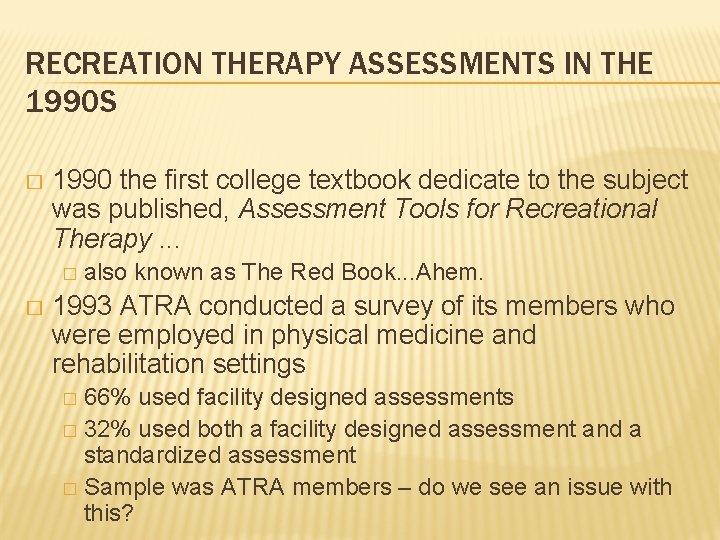
RECREATION THERAPY ASSESSMENTS IN THE 1990 S � 1990 the first college textbook dedicate to the subject was published, Assessment Tools for Recreational Therapy. . . � � also known as The Red Book. . . Ahem. 1993 ATRA conducted a survey of its members who were employed in physical medicine and rehabilitation settings 66% used facility designed assessments � 32% used both a facility designed assessment and a standardized assessment � Sample was ATRA members – do we see an issue with this? �
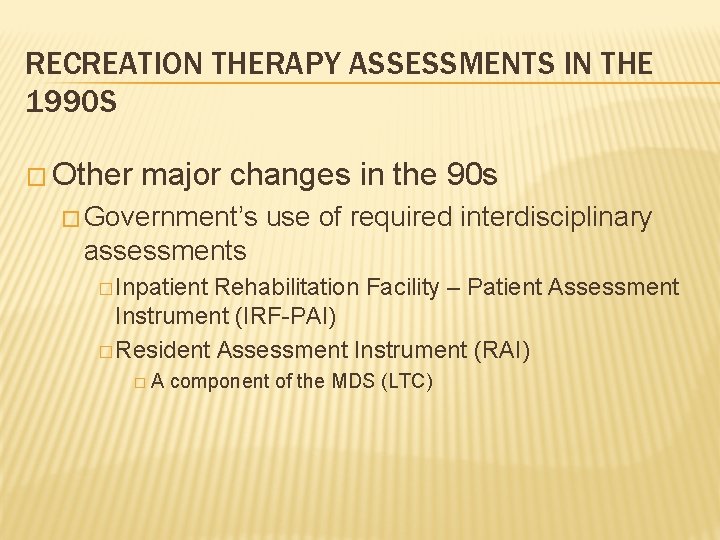
RECREATION THERAPY ASSESSMENTS IN THE 1990 S � Other major changes in the 90 s � Government’s use of required interdisciplinary assessments � Inpatient Rehabilitation Facility – Patient Assessment Instrument (IRF-PAI) � Resident Assessment Instrument (RAI) �A component of the MDS (LTC)
RECREATION THERAPY ASSESSMENTS IN THE 2000 S � Biggest changes � Move to interdisciplinary assessments � Increasing use of computerized records � More accurate � More useful
SIX QUALITIES DESIRED IN ASSESSMENT PROTOCOLS 1. 2. 3. 4. 5. 6. Fulfills the intended purpose of the assessment Obtains the specific information needed Allows the accurate gathering of information Uses information gathering methods appropriate for the type of information needed Appropriate for the clients being assessed Meet the needs of the facility and situation
TROUBLING PATTERNS IN ASSESSMENT � We have some very strong tools available � However, very little research has been done into the meaning of the scores � Field needs to start researching the implications of the scores achieved on these standardized testing tools � Researchers using portions of scales, not whole thing � Studies using testing tools with coefficients below. 80
WHERE TO GO? � Some clinical aspects of our field have not evolved since the middle of the 20 th century � Field’s � For limited use of standardized testing tools us to move forward, we will need to use standardized assessments, compare results, and determine through scientific procedures the most efficient and effective methods of intervention.