
CHAPTER 3 HEALTH ILLNESS AND DISPARITIES 1 DEFINITIONS

- Slides: 22
CHAPTER 3 HEALTH, ILLNESS, AND DISPARITIES 1
DEFINITIONS OF HEALTH STATES Health—a state of complete physical, mental, spiritual, environmental and social wellbeing, not just the absence of disease or infirmity Wellness—an active state of being healthy by living a lifestyle promoting good physical, mental, and emotional health Illness—the unique response of a person to a disease; an abnormal process involving a changed level of functioning Copyright © 2015 Wolters Kluwer • All Rights Reserved 2
ACUTE ILLNESS Generally has a rapid onset of symptoms and lasts only a relatively short time Examples: appendicitis, pneumonia, diarrhea, common cold 3 Copyright © 2015 Wolters Kluwer • All Rights Reserved
CHRONIC ILLNESS A broad term that encompasses many different physical and mental alterations in health. Usually has a slow onset and may have periods of remission and exacerbation Examples: diabetes mellitus, lung disease, arthritis, lupus 4 Copyright © 2015 Wolters Kluwer • All Rights Reserved
CHARACTERISTICS OF A CHRONIC ILLNESS It is usually a permanent change. It causes, or is caused by, irreversible alterations in normal anatomy and physiology. It requires special patient education for rehabilitation. It requires a long period of care or support. 5 Copyright © 2015 Wolters Kluwer • All Rights Reserved
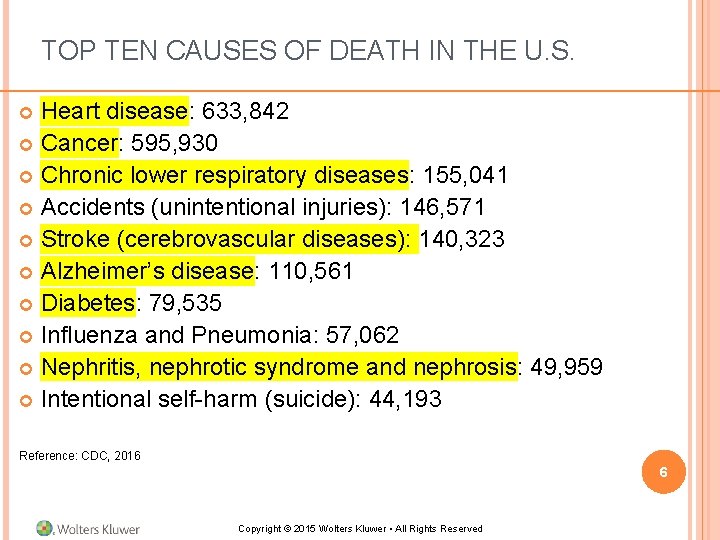
TOP TEN CAUSES OF DEATH IN THE U. S. Heart disease: 633, 842 Cancer: 595, 930 Chronic lower respiratory diseases: 155, 041 Accidents (unintentional injuries): 146, 571 Stroke (cerebrovascular diseases): 140, 323 Alzheimer’s disease: 110, 561 Diabetes: 79, 535 Influenza and Pneumonia: 57, 062 Nephritis, nephrotic syndrome and nephrosis: 49, 959 Intentional self-harm (suicide): 44, 193 Reference: CDC, 2016 6 Copyright © 2015 Wolters Kluwer • All Rights Reserved
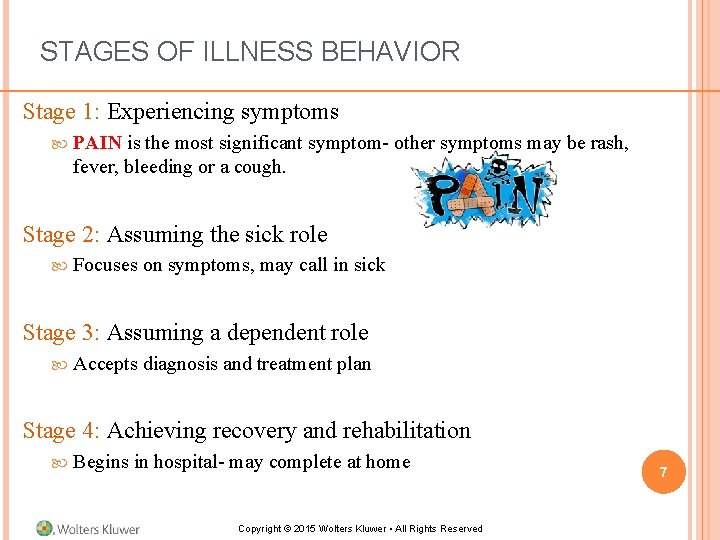
STAGES OF ILLNESS BEHAVIOR Stage 1: Experiencing symptoms PAIN is the most significant symptom- other symptoms may be rash, fever, bleeding or a cough. Stage 2: Assuming the sick role Focuses on symptoms, may call in sick Stage 3: Assuming a dependent role Accepts diagnosis and treatment plan Stage 4: Achieving recovery and rehabilitation Begins in hospital- may complete at home Copyright © 2015 Wolters Kluwer • All Rights Reserved 7
HEALTH DISPARITY “A particular type of health difference that is closely link with social, economic, and/or environmental disadvantage” Copyright © 2015 Wolters Kluwer • All Rights Reserved 8
FACTORS INFLUENCING HEALTH DISPARITIES Racial and ethnic groups Poverty w o n k Gender; age o t d e Mental health e n u o Educational level Y e… s Disabilities e h t Sexual orientation Health insurance and access to health care Copyright © 2015 Wolters Kluwer • All Rights Reserved 9
FACTORS AFFECTING HEALTH AND ILLNESS Basic The human needs human dimensions Self-concept Risk factors for illness or injury 10 Copyright © 2015 Wolters Kluwer • All Rights Reserved
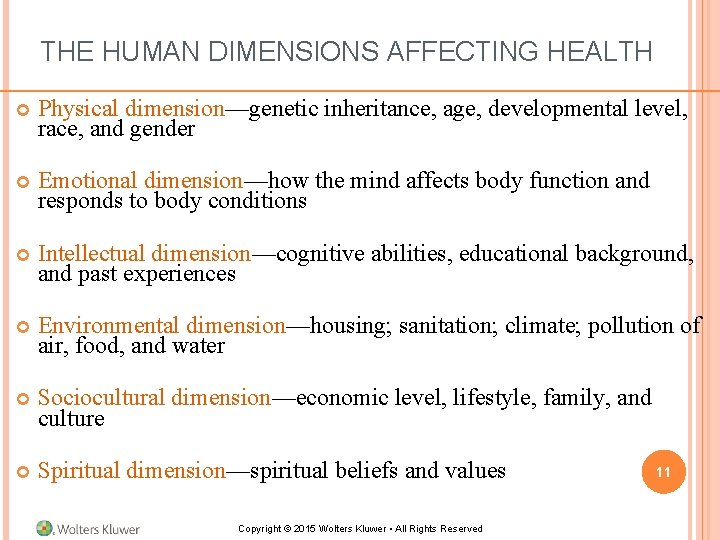
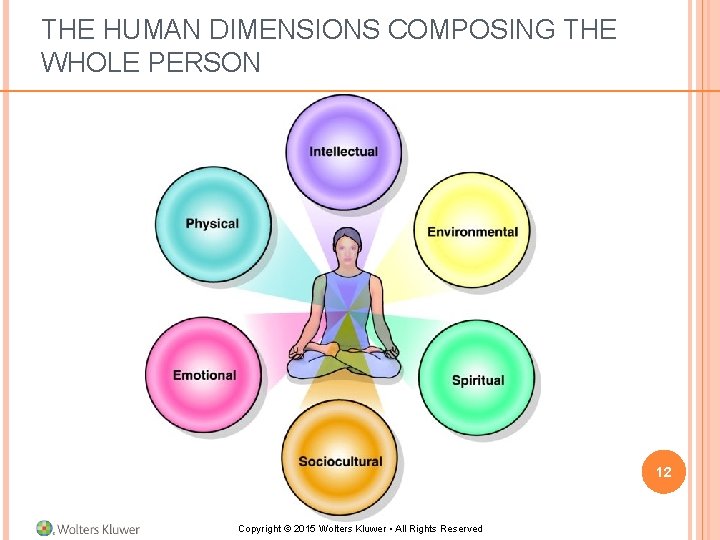
THE HUMAN DIMENSIONS AFFECTING HEALTH Physical dimension—genetic inheritance, age, developmental level, race, and gender Emotional dimension—how the mind affects body function and responds to body conditions Intellectual dimension—cognitive abilities, educational background, and past experiences Environmental dimension—housing; sanitation; climate; pollution of air, food, and water Sociocultural dimension—economic level, lifestyle, family, and culture Spiritual dimension—spiritual beliefs and values Copyright © 2015 Wolters Kluwer • All Rights Reserved 11
THE HUMAN DIMENSIONS COMPOSING THE WHOLE PERSON 12 Copyright © 2015 Wolters Kluwer • All Rights Reserved
HEALTH PROMOTION AND ILLNESS PREVENTION Health Promotion: Motivated by personal desire to increase well-being and health potential Illness Prevention: Motivated by desire to avoid or detect disease or maintain functioning within the constraints of illness or injury 13 Copyright © 2015 Wolters Kluwer • All Rights Reserved
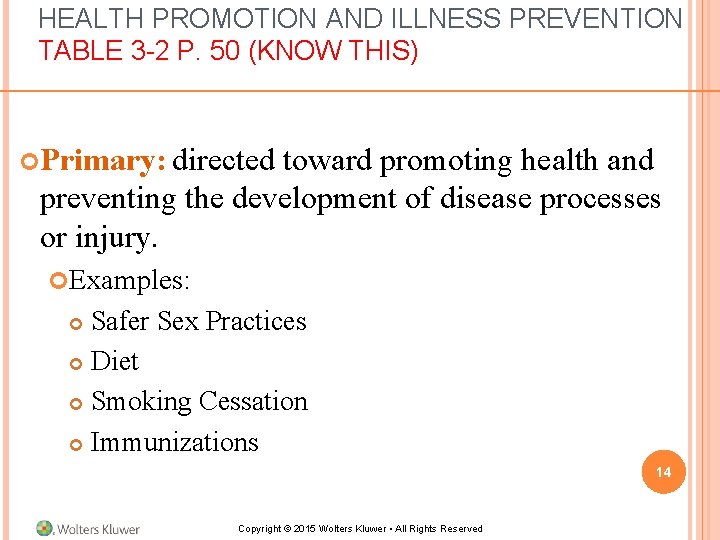
HEALTH PROMOTION AND ILLNESS PREVENTION TABLE 3 -2 P. 50 (KNOW THIS) Primary: directed toward promoting health and preventing the development of disease processes or injury. Examples: Safer Sex Practices Diet Smoking Cessation Immunizations 14 Copyright © 2015 Wolters Kluwer • All Rights Reserved
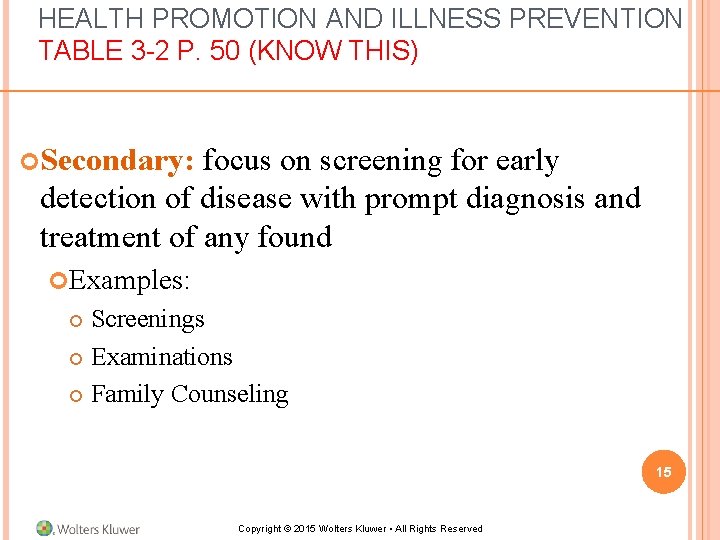
HEALTH PROMOTION AND ILLNESS PREVENTION TABLE 3 -2 P. 50 (KNOW THIS) Secondary: focus on screening for early detection of disease with prompt diagnosis and treatment of any found Examples: Screenings Examinations Family Counseling 15 Copyright © 2015 Wolters Kluwer • All Rights Reserved
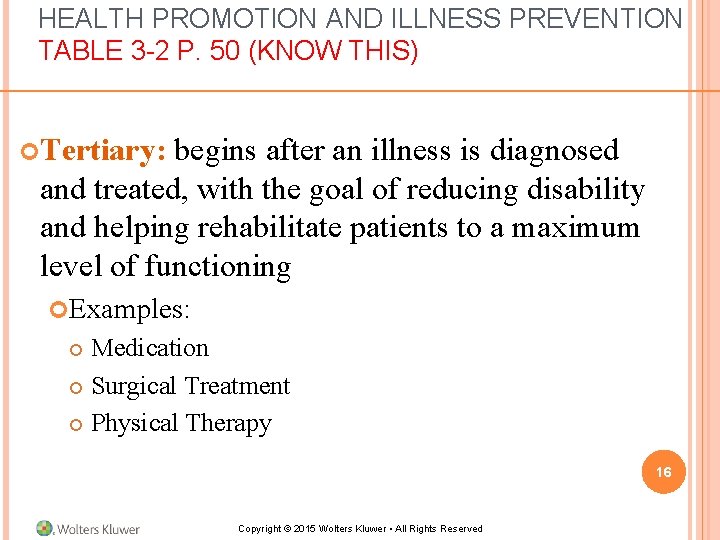
HEALTH PROMOTION AND ILLNESS PREVENTION TABLE 3 -2 P. 50 (KNOW THIS) Tertiary: begins after an illness is diagnosed and treated, with the goal of reducing disability and helping rehabilitate patients to a maximum level of functioning Examples: Medication Surgical Treatment Physical Therapy 16 Copyright © 2015 Wolters Kluwer • All Rights Reserved
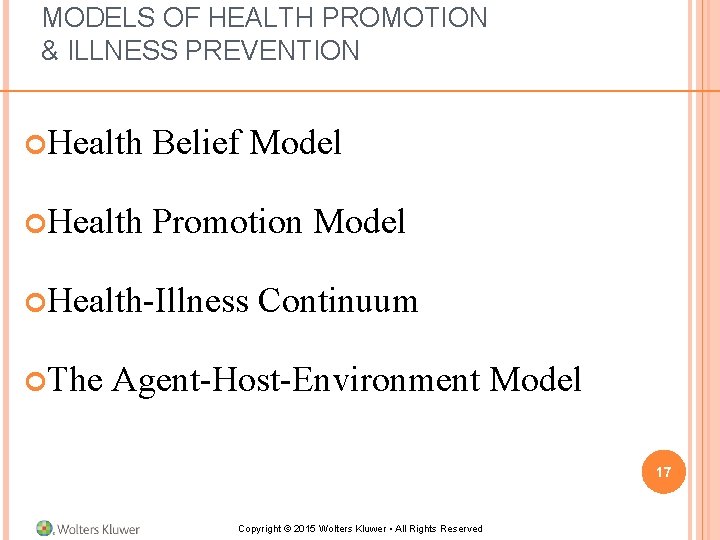
MODELS OF HEALTH PROMOTION & ILLNESS PREVENTION Health Belief Model Health Promotion Model Health-Illness The Continuum Agent-Host-Environment Model 17 Copyright © 2015 Wolters Kluwer • All Rights Reserved
THE HEALTH BELIEF MODEL Concerned with what people perceive to be true about themselves in relation to their health Modifying factors for health include demographic, sociopsychological, and structural variables Based on 3 components of individual perceptions of threat of disease Perceived susceptibility to disease Perceived seriousness of a disease Perceived benefits of action 18 Copyright © 2015 Wolters Kluwer • All Rights Reserved
THE HEALTH PROMOTION MODEL Developed to illustrate how people interact with their environment as they pursue health Incorporates individual characteristics, experiences, behavior-specific knowledge, and beliefs, to motivate health -promoting behavior Personal, biologic, psychological, and sociocultural factors are predictive of certain health-related habits Health-related behavior is the outcome of the model and is directed toward attaining positive health outcomes and experiences throughout the lifespan 19 Copyright © 2015 Wolters Kluwer • All Rights Reserved
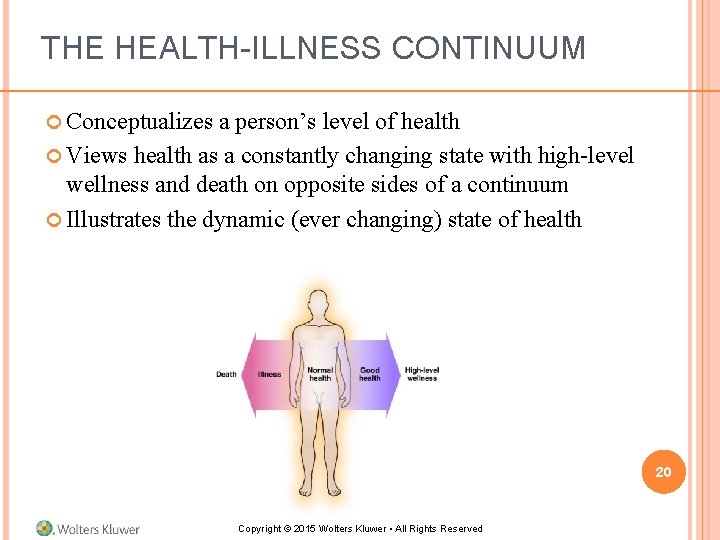
THE HEALTH-ILLNESS CONTINUUM Conceptualizes a person’s level of health Views health as a constantly changing state with high-level wellness and death on opposite sides of a continuum Illustrates the dynamic (ever changing) state of health 20 Copyright © 2015 Wolters Kluwer • All Rights Reserved
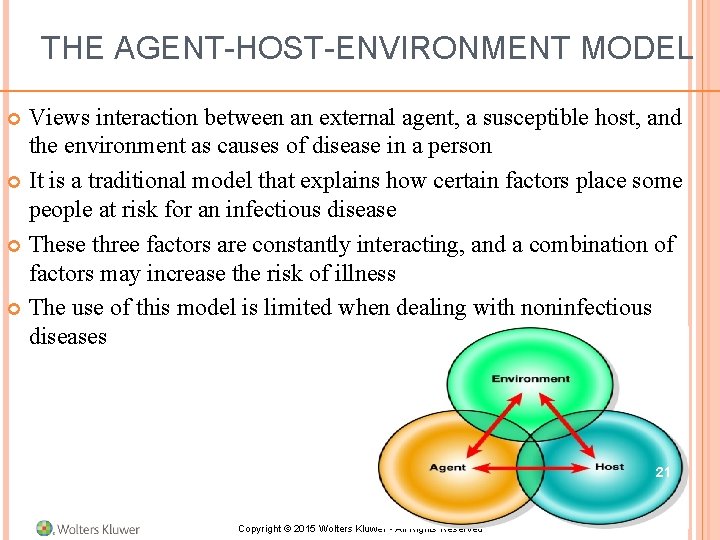
THE AGENT-HOST-ENVIRONMENT MODEL Views interaction between an external agent, a susceptible host, and the environment as causes of disease in a person It is a traditional model that explains how certain factors place some people at risk for an infectious disease These three factors are constantly interacting, and a combination of factors may increase the risk of illness The use of this model is limited when dealing with noninfectious diseases 21 Copyright © 2015 Wolters Kluwer • All Rights Reserved
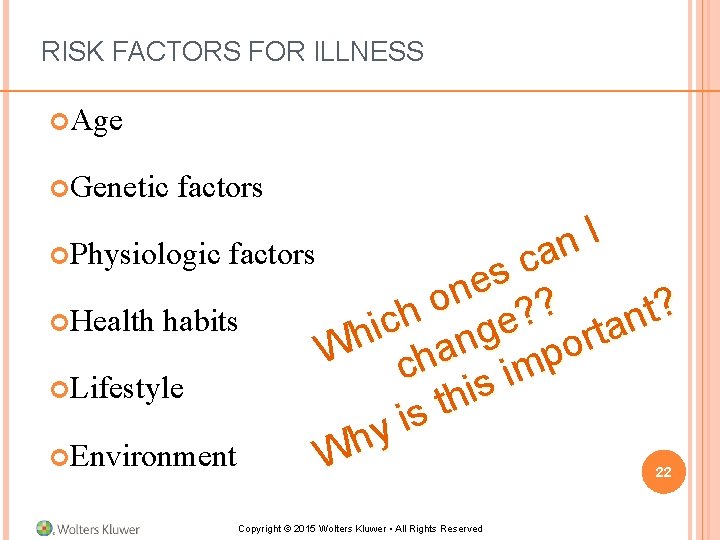
RISK FACTORS FOR ILLNESS Age Genetic factors I n Physiologic factors a c s e n o ? ? t h ? Health habits n c e i a t g Wh chan mpor i Lifestyle s i h t s i y h Environment W 22 Copyright © 2015 Wolters Kluwer • All Rights Reserved