
Chapter 3 Genetic Bases of Child Development Module
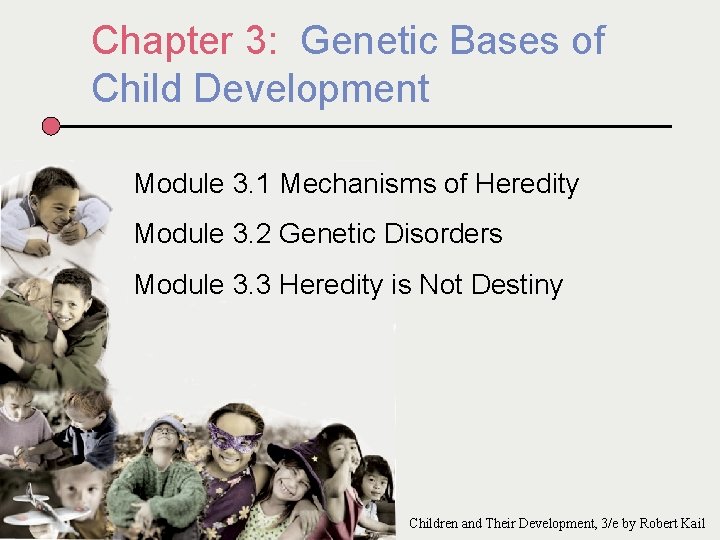
Chapter 3: Genetic Bases of Child Development Module 3. 1 Mechanisms of Heredity Module 3. 2 Genetic Disorders Module 3. 3 Heredity is Not Destiny Children and Their Development, 3/e by Robert Kail
3. 1 Mechanisms of Heredity The Biology of Heredity Single Gene Inheritance Behavioral Genetics
3. 1 The Biology of Heredity • The first 22 pairs of chromosomes are autosomes and the 23 rd pair is sex chromosomes • Genotype is one’s complete set of genes and phenotype is one’s physical, behavioral, and psychological features
3. 1 Single Gene Inheritance • Pairs of alleles can be either homozygous or heterozygous • Dominant allele: its chemical instructions are followed • Recessive allele: its chemical instructions are ignored • Incomplete dominance: one allele doesn’t dominate the other completely
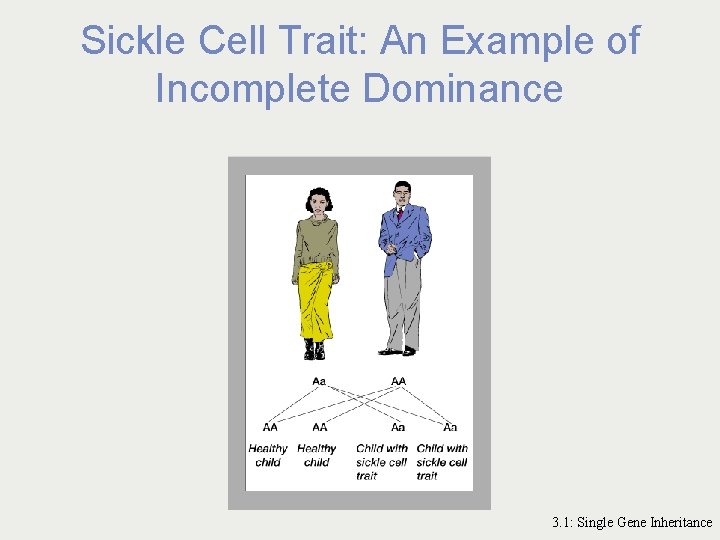
Sickle Cell Trait: An Example of Incomplete Dominance 3. 1: Single Gene Inheritance
3. 1 Behavioral Genetics • Many behavioral genotypes reflect polygenic inheritance, which involves many genes • Behavioral geneticists rely upon twin studies and adoption studies • Cognitive abilities, psychological disorders, substance abuse, and personality are all affected by heredity
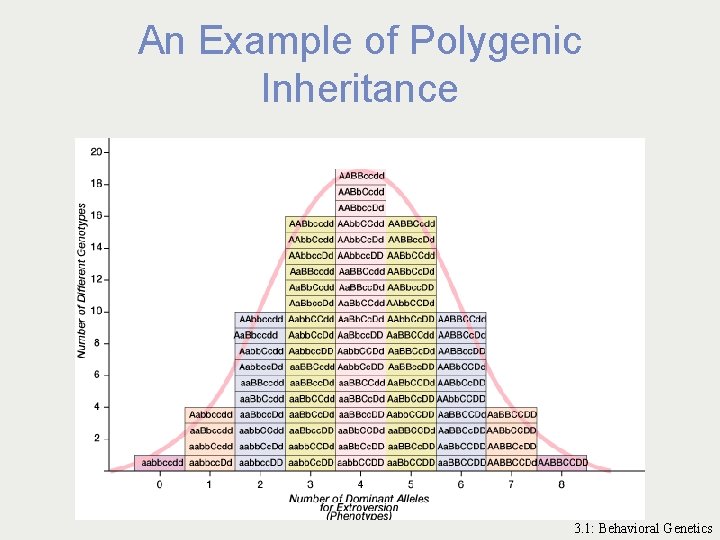
An Example of Polygenic Inheritance 3. 1: Behavioral Genetics
3. 2 Genetic Disorders Inherited Disorders Abnormal Chromosomes
3. 2 Inherited Disorders • Many disorders are triggered when a child inherits two recessive alleles • Examples include cystic fibrosis, PKU, albinism, and Tay-sachs disease • Most inherited disorders are very rare
3. 2 Abnormal Chromosomes • Some people are born with too many, too few, or damaged chromosomes • People with Down Syndrome usually have an extra 21 st chromosome • A number of disorders (e. g. , Turner’s Syndrome, Klinefelter’s Syndrome, XYY complement, XXX Syndrome) are caused by missing or extra sex chromosomes
3. 3 Heredity is Not Destiny Paths from Genes to Behavior Reaction Range Changing Relations Between Nature and Nurture The Nature of Nurture
3. 3 Paths From Genes to Behavior • Genes never cause behavior directly • The behavioral consequences of genetic instructions depends on environment
3. 3 Reaction Range • A genotype can lead to a range of phenotypes depending on the environment • People with PKU genotype: those who eat normal diet will be mentally retarded, but those who eat special diet will have normal intelligence
3. 3 Changing Relations Between Nature and Nurture • Passive G-E relation: parents pass on genotype and environment • Evocative G-E relation: different genotypes evoke different responses from the environment • Active G-E relation: actively seek environments related to their genes • Niche-picking: deliberately seeking environments that fit one’s heredity
3. 3 The Nature of Nurture • Parents don’t provide exactly the same environments for all of their children (non-shared environmental influences) • Parents provide the child’s genes and environment, but the child also influences her own environment
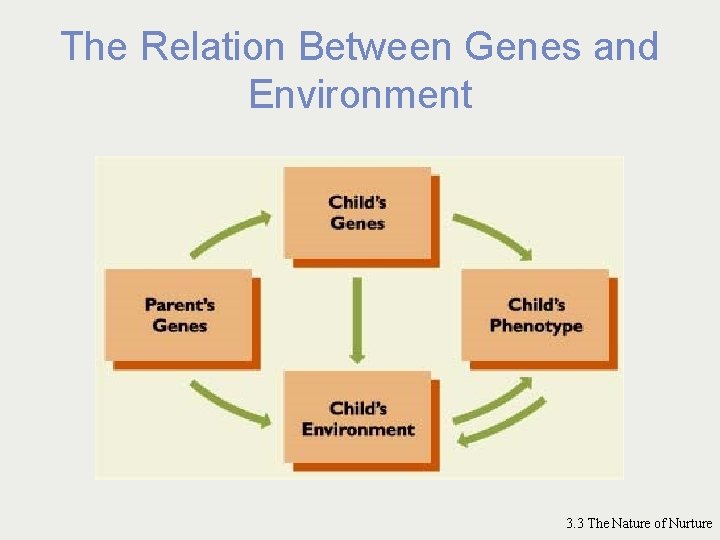
The Relation Between Genes and Environment 3. 3 The Nature of Nurture
- Slides: 16