
CHAPTER 3 Gas Turbine Cycles for Aircraft Propulsion
CHAPTER 3 Gas Turbine Cycles for Aircraft Propulsion Chapter 2 Shaft Power Cycles

Simple Turbojet Cycle T 03 p 03 (ΔT 0) turb c V 5² / 2 p 04 Δp b 02 p 02 01 p 04 p 5 5 p (ΔT 0) com c V a² / 2 p p 01 pa s Chapter 2 Shaft Power Cycles 2

Simple Turbojet Cycle § 3. 3. 1 Optimisation of a Turbojet Cycle § When considering the design of a turbojet, the basic thermodynamic parameters at the disposal of the designer are the Turbine Inlet Temperature and the compressor pressure ratio (t , rc) § It is common practice to carry out a series of design point calculations covering a suitable range of these two variables (t , rc) using fixed polytropic efficiencies for the compressor and the turbine and plot sfc vs Fs with " TIT“ (T 03) and " rc " as parameters. Chapter 2 Shaft Power Cycles 3

Fig. 3. 8 Typical Turbojet Cycle Performance Chapter 2 Shaft Power Cycles 4
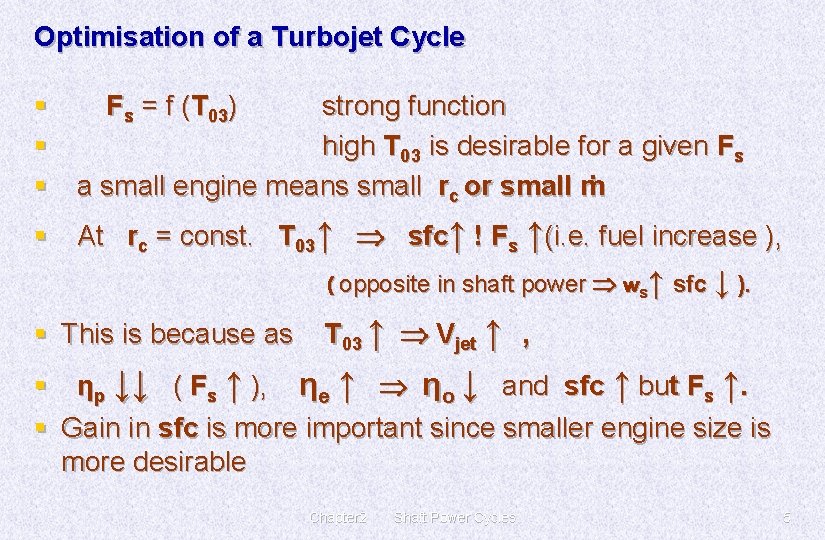
Optimisation of a Turbojet Cycle § Fs = f (T 03) strong function § high T 03 is desirable for a given Fs § a small engine means small rc or small ṁ § At rc = const. T 03↑ sfc↑ ! Fs ↑(i. e. fuel increase ), ( opposite in shaft power ws↑ sfc ↓ ). § This is because as T 03 ↑ Vjet ↑ , § ηp ↓↓ ( Fs ↑ ), ηe ↑ ηo ↓ and sfc ↑ but Fs ↑. § Gain in sfc is more important since smaller engine size is more desirable Chapter 2 Shaft Power Cycles 5

Optimisation of a Turbojet Cycle § rc ↑ sfc ↓ ; at a fixed T 03 § Fs first ↑ then ↓ ( Optimum rc ↑ for best Fs ) as T 03 ↑ § At the same altitude Z , but higher Crusing Speed Va : § i. e Va ↑ ; for given rc and T 03 sfc ↑, Fs ↓ because Momentum Drag ↑ , (wcomp ↑, since T 01 ↑ ) § At different altitudes Z ↑ Fs ↑ , sfc ↓ since T 01 ↓ and ws ↓. § As Va ↑ rcopt ↓ due to r. RAM ↑ at the intake Chapter 2 Shaft Power Cycles 6
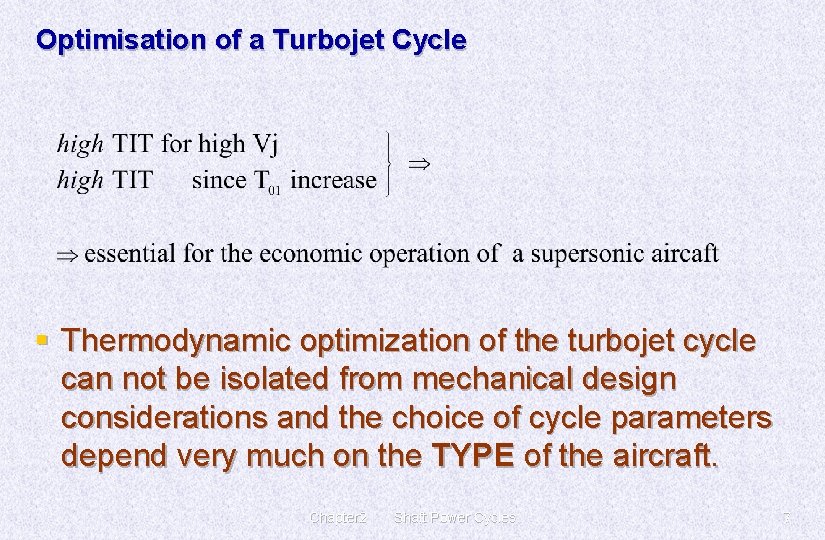
Optimisation of a Turbojet Cycle § Thermodynamic optimization of the turbojet cycle can not be isolated from mechanical design considerations and the choice of cycle parameters depend very much on the TYPE of the aircraft. Chapter 2 Shaft Power Cycles 7

Fig. 3. 9. Performance and Design Considerations for Aircraft Gas Turbines Chapter 2 Shaft Power Cycles 8

Optimisation of a Turbojet Cycle § high TIT § § thermodynamically desirable causes complexity in mechanical design, such as expensive alloys & cooled blades. § high rc § § increased weight large number of compressor-turbine stages i. e multi spool engines. Chapter 2 Shaft Power Cycles 9

3. 3. 2 Variation of Thrust & sfc with Flight Conditions § The previous figures represent design point calculations. § At different flight conditions, § both thrust & sfc vary due to the change in ma with ra § and variation of Momentum Drag with forward speed Va. § As altitude Z ↑ , FNet ↓ due to ra decrease as Pa ↓ § Although Fs ↑ since T 01 ↓ , sfc ↓ a little § At a fixed altitude Z, § as M ↑ FN ↓ at first due to increased momentum drag, then FNet due to benefical effects of Ram pressure ratio. § For M >1 increase in FNet is substantial for M ↑ Chapter 2 Shaft Power Cycles 10
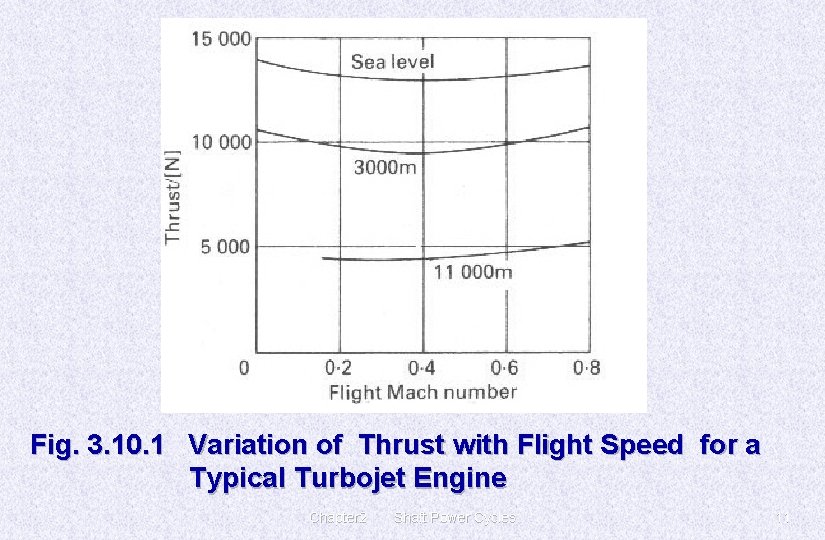
Fig. 3. 10. 1 Variation of Thrust with Flight Speed for a Typical Turbojet Engine Chapter 2 Shaft Power Cycles 11
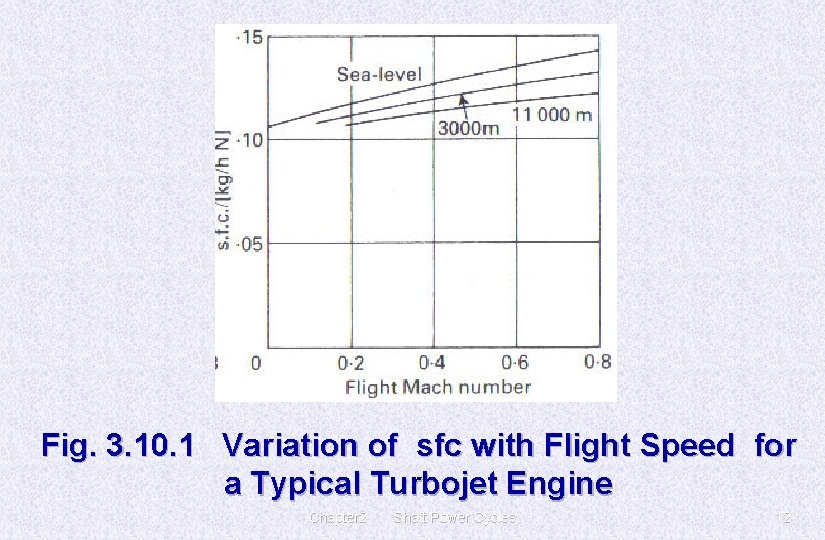
Fig. 3. 10. 1 Variation of sfc with Flight Speed for a Typical Turbojet Engine Chapter 2 Shaft Power Cycles 12
3. 4 THE TURBOFAN ENGINE § The Turbofan engine was originally conceived as a method of improving the propulsive efficiency of the jet engine by reducing the Mean Jet Velocity particularly for operation at high subsonic speeds. § It was soon realized that reducing jet velocity had a considerable effect on Jet Noise , a matter that became critical when large numbers of jet propelled aircraft entered commercial service. Chapter 2 Shaft Power Cycles 13
The Turbofan Engine § In Turbofan engines ; a portion of the total flow by-passes part of the compressor, combustion chamber, turbine and nozzle, before being ejected through a seperate nozzle. § Turbofan Engines are usually decribed in terms of "by-pass ratio" defined as : the ratio of the flow through the by-pass duct (cold stream) to that through the high pressure compressor (HPC) (hot stream). Chapter 2 Shaft Power Cycles 14
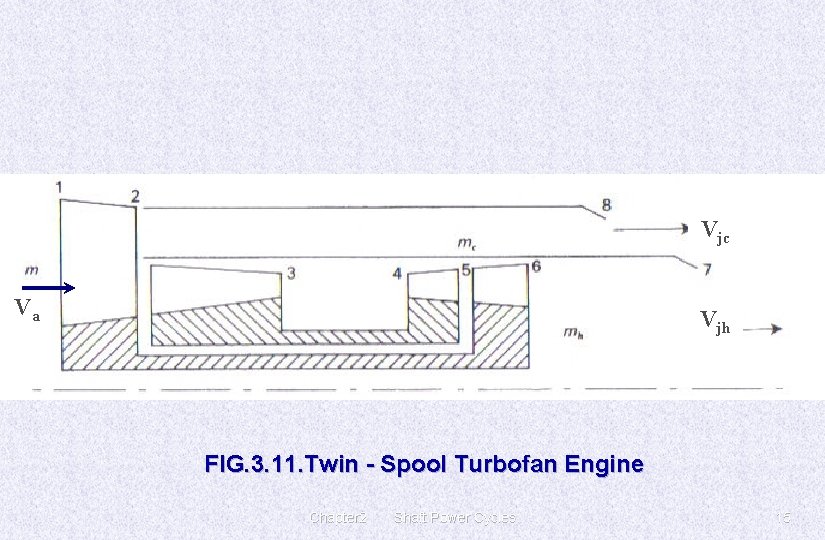
Vjc Va Vjh FIG. 3. 11. Twin - Spool Turbofan Engine Chapter 2 Shaft Power Cycles 15
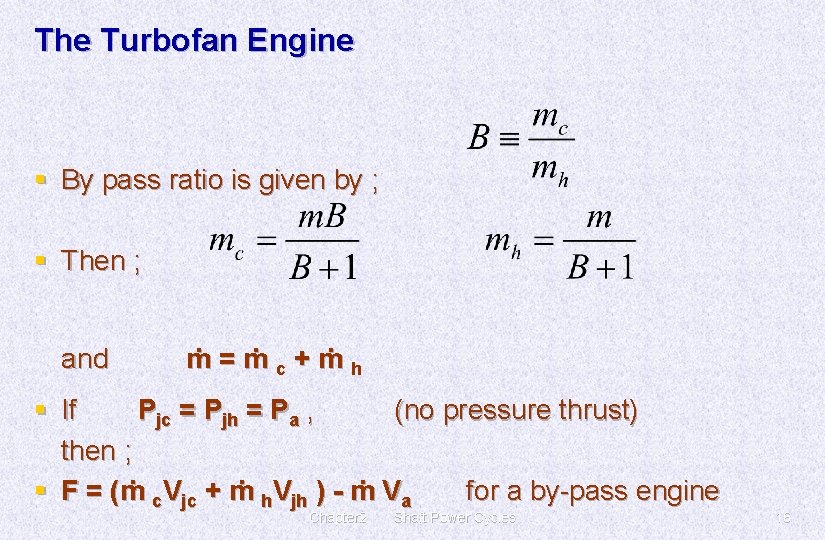
The Turbofan Engine § By pass ratio is given by ; § Then ; and ṁ=ṁc+ṁh § If Pjc = Pjh = Pa , (no pressure thrust) then ; § F = (ṁ c. Vjc + ṁ h. Vjh ) - ṁ Va for a by-pass engine Chapter 2 Shaft Power Cycles 16

The Turbofan Engine § The design point calculations for the turbofan are similar to those for the turbojet. § In view of this only the differences in calculations will be outlined. § a) Overall pressure ratio ( rc ) and turbine inlet temperature ( TIT) are specified as before ; but it is also necessary to specify the bypass ratio B and the fan pressure ratio FPR. Chapter 2 Shaft Power Cycles 17
The Turbofan Engine § b) From the inlet conditions and FPR ; the pressure and temperature of the flow leaving the fan and entering the by-pass duct can be calculated. § The mass flow down the by-pass duct ṁc can be established from the total mass flow rate ṁ and B. § The cold stream thrust can then be calculated as for the jet engine noting that the working fluid is air. § It is necessary to check whether the fan nozzle is choked or unchoked. § If choked the pressure thrust must be calculated. Chapter 2 Shaft Power Cycles 18
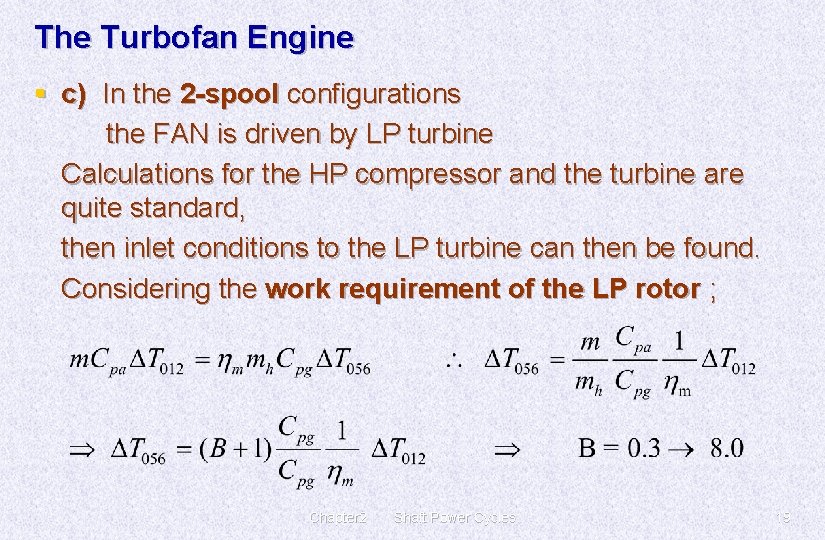
The Turbofan Engine § c) In the 2 -spool configurations the FAN is driven by LP turbine Calculations for the HP compressor and the turbine are quite standard, then inlet conditions to the LP turbine can then be found. Considering the work requirement of the LP rotor ; Chapter 2 Shaft Power Cycles 19
The Turbofan Engine § The value of B has a major effect on the temperature drop and the pressure ratio required from the LP turbine § Knowing T 05, ht and T 056 , LP turbine pressure ratio can be found, and conditions at the entry to the hot stream nozzle can be established. Chapter 2 Shaft Power Cycles 20
The Turbofan Engine § d) If the two streams are mixed it is necessary to find the conditions after mixing by means of an enthalpy and momentum balance. § Mixing is essential for a reheated turbofan. Chapter 2 Shaft Power Cycles 21

The Turbofan Engine 3. 4. 1 Optimization of the Turbofan Cycle § There are 4 thermodynamic parameters the designer can play with. § i) Overall pressure ratio rp § ii) Turbine inlet temperature TIT § iii) By-pass Ratio B § iv) Fan pressure ratio FPR Chapter 2 Shaft Power Cycles 22
Optimization of the Turbofan Cycle § At first fix; § a) the overall pressure ratio, rp § b) By pass ratio, B. § Note that optimum values for each TIT ( minimum sfc & max Fs ) coincide because of the fixed energy input. § Taking the values of sfc and Fs for each of these FPR values in turn, a curve of sfc vs. Fs can be plotted. § Note that each point on this curve is the result of a previous optimization and it is associated with a particular value of FPR and TIT. Chapter 2 Shaft Power Cycles 23
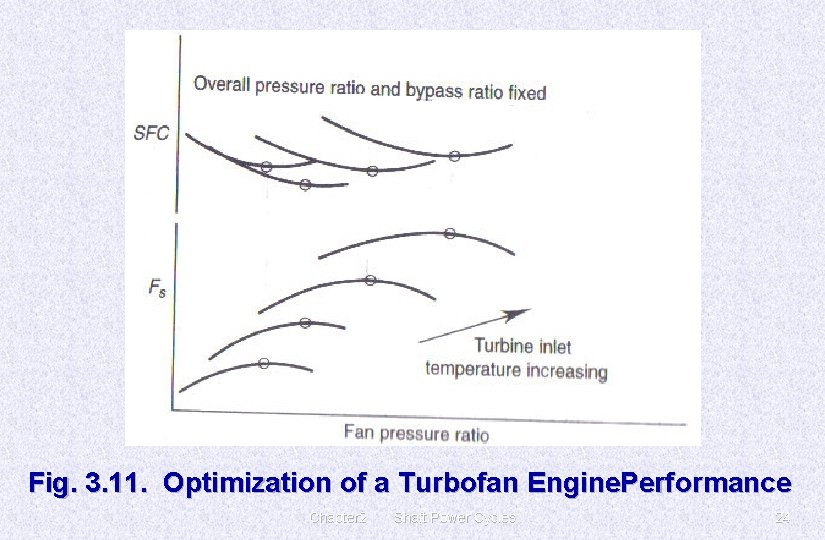
Fig. 3. 11. Optimization of a Turbofan Engine. Performance Chapter 2 Shaft Power Cycles 24
Optimization of the Turbofan Cycle § Note that optimum values for each TIT ( minimum sfc & max Fs ) coincide because of the fixed energy input. § Taking the values of sfc and Fs , for each of these FPR values in turn, a curve of sfc vs. Fs can be plotted. § Note that each point on this curve is the result of a previous optimization and it is associated with a particular value of FPR and TIT. Chapter 2 Shaft Power Cycles 25

Optimization of the Turbofan Cycle Chapter 2 Shaft Power Cycles 26
Optimization of the Turbofan Cycle § The foregoing calculations may be repeated for a series of B, still at the same rp to give a family of curves. § This plot yields the optimum variation of sfc with Fs for the selected rp as shown by the envelope curve. § The procedure can be repeated for a range of rp. Chapter 2 Shaft Power Cycles 27
Optimization of the Turbofan Cycle § The quantitative results are summarized as : a) B improves sfc at the expense of significant reduction in Fs, b) Optimum FPR with TIT , c) Optimum FPR with B. Chapter 2 Shaft Power Cycles 28
The Turbofan Engine § Long range subsonic transport, sfc is important § B = 4 -6 ; high rp high TIT. § Military Aircraft; with supersonic dash capability & good subsonic sfc B = 0. 5 - 1 to keep the frontal area down, optional reheat. § Short Haul Commercial Aircraft, sfc is not as critical B = 2 -3 § Thrust of engines of high B is very sensitive to forward speed due to large intake ṁ and momentum drag Chapter 2 Shaft Power Cycles 29
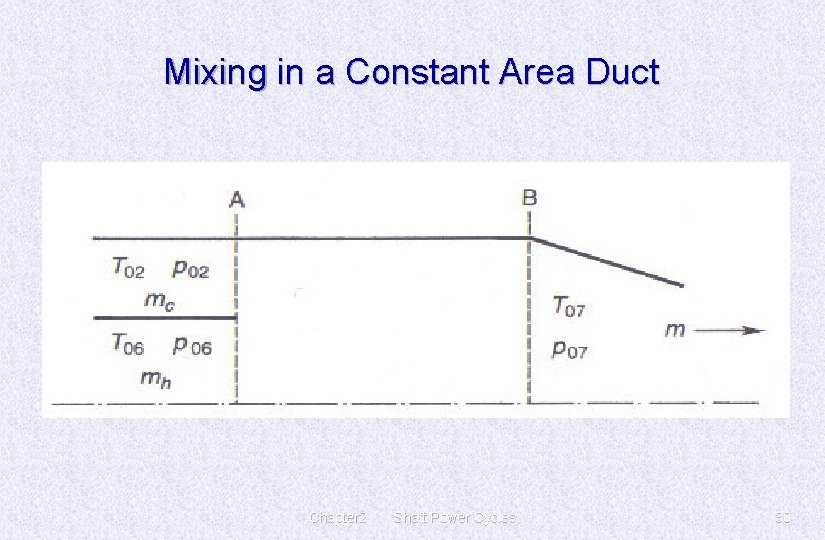
Mixing in a Constant Area Duct Chapter 2 Shaft Power Cycles 30

3. 5 AFT - FAN CONFIGURATION § Some early turbofans were directly developed from existing turbojets, § A combined turbine-fan was mounted downstream of the Gas Generator turbine. Vjc Vjh Chapter 2 Shaft Power Cycles 31
3. 6 TURBO PROP ENGINE § The turboprop engine differs from the shaft power unit in that some of the useful output appears as jet thrust. § Power must eventually be delivered to the aircraft in the form of thrust power (TP). § This can be expressed in terms of equivalent shaft Power (SP), propeller efficiency hp, and jet thrust F by TP = (SP)pr + FVa § The turboshaft engine is of greater importance and is almost universally used in helicopters because of its low weight. Chapter 2 Shaft Power Cycles 32

3. 7 Thrust Augmentation § If the thrust of an engine has to be increased above the original design value, several alternatives are available. i) Increase of turbine inlet temperature , TIT ii) Increase of mass flow rate through the engine § Both of these methods imply the re-design of the engine, and either of them or both may be used to update the existing engine. Chapter 2 Shaft Power Cycles 33
Thrust Augmentation § Frequently there will be a requirement for a temporary increase in thrust. e. g. for take off, for an acceleration from subsonic to supersonic speeds or during combat manoeuvres. § The problem then becomes one of thrust augmentation. § Two methods most widely used are: i) Liquid injection (water+methanol) ii) Reheat (after burner) § Spraying water to the compressor inlet results in a drop in inlet temperature in net thrust Chapter 2 Shaft Power Cycles 34

Cycle of Turbojet with Afterburning Chapter 2 Shaft Power Cycles 35
DESIGN POINT PERFORMANCE CALCULATION FOR TURBOJET & TURBOPROP ENGINES. A Turbojet & Turboprop unit may be considered as consisting of 2 parts: § Thus: i / GAS GENERATOR ii / POWER UNIT a) Turbojet Jet Pipe & Final Nozzle b) Turboprop Power Turbine Jet Pipe & Final Nozzle Chapter 2 Shaft Power Cycles 36
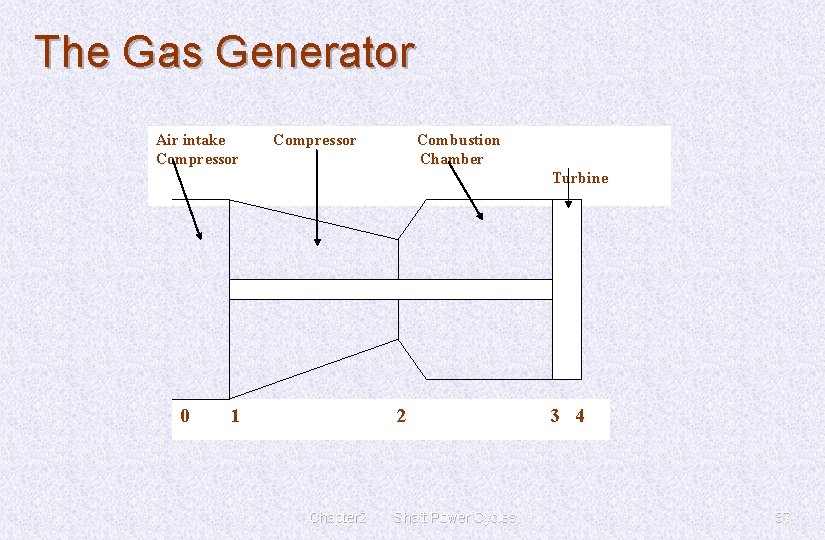
The Gas Generator Air intake Compressor Combustion Chamber Turbine 0 1 2 Chapter 2 Shaft Power Cycles 3 4 37

Turbojet Turboprop 5 4 5 6 6 Chapter 2 Shaft Power Cycles 38

Problem : Turbojet & Turboprop Engines § § § § § DATA: Altitude Z = 0 ISA (101. 325 k. Pa; 288. 0 K) True Airspeed (Va) = 0 Static Power Output turbojet = 90 k. N Thrust Power Output turboprop = 4. 5 MW Shaft Power Compressor Pressure Ratio (P 02 / P 01) = 10 TIT (total) T 03 = 1500 K Jet Velocity V 6 = 220 m/s (turboprop) Compressor Isentropic efficiency h 12 = 88% Turbine Isentropic efficiency h 34 = 90% h 45 = 90 % Chapter 2 Shaft Power Cycles 39
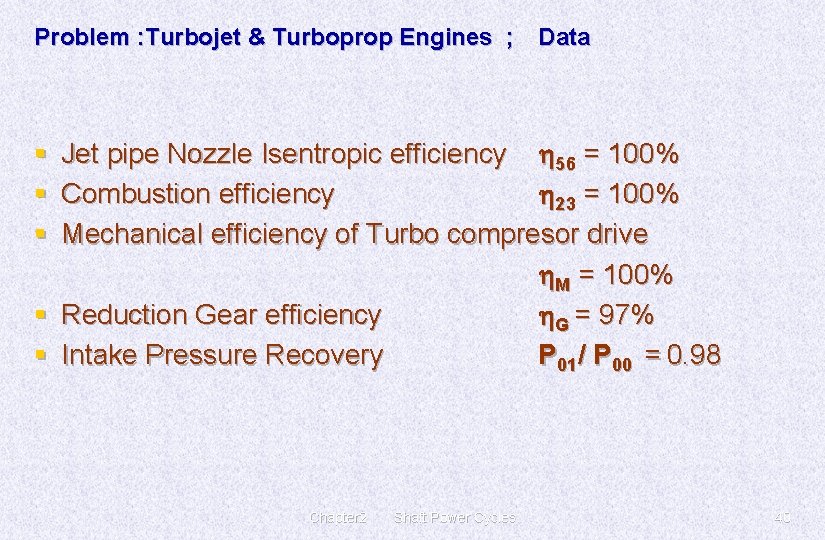
Problem : Turbojet & Turboprop Engines ; Data Jet pipe Nozzle Isentropic efficiency h 56 = 100% Combustion efficiency h 23 = 100% Mechanical efficiency of Turbo compresor drive h. M = 100% § Reduction Gear efficiency h. G = 97% § Intake Pressure Recovery P 01/ P 00 = 0. 98 § § § Chapter 2 Shaft Power Cycles 40

Problem : Turbojet & Turboprop Engines ; Data § Combustion Chamber total pressure loss : ΔP 023 = 7% of compressor outlet total pressure (P 02) § Jet Pipe-Nozzle pressure loss : ΔP 056 = 3% of turbine outlet total pressure (P 04 or P 05) § Nozzle discharge Coefficient Cd= 0. 98 r = 5% of Compressor mass flow. § Cooling air bleed Chapter 2 Shaft Power Cycles 41
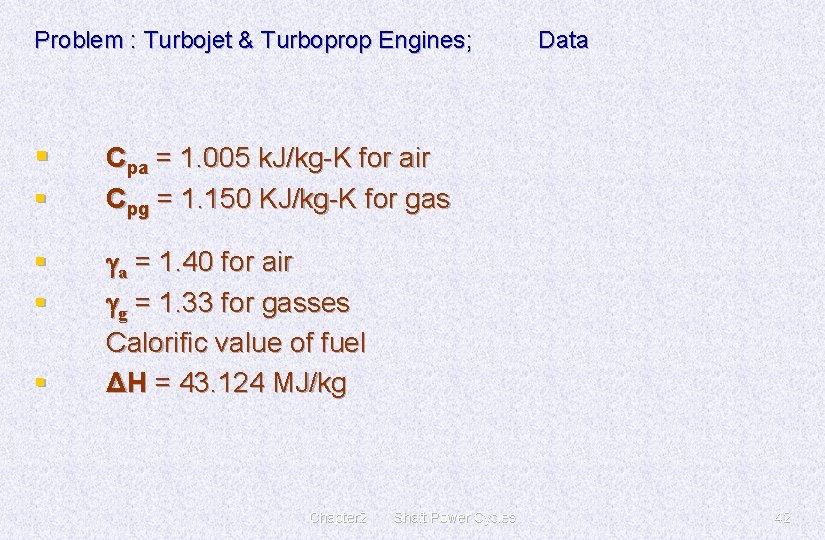
Problem : Turbojet & Turboprop Engines ; § § § Data Cpa = 1. 005 k. J/kg-K for air Cpg = 1. 150 KJ/kg-K for gas ga = 1. 40 for air gg = 1. 33 for gasses Calorific value of fuel ΔH = 43. 124 MJ/kg Chapter 2 Shaft Power Cycles 42
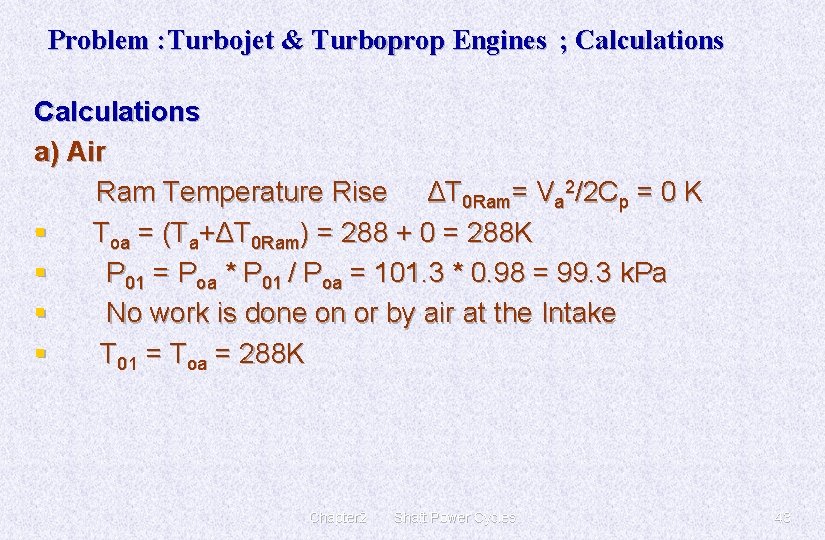
Problem : Turbojet & Turboprop Engines ; Calculations a) Air Ram Temperature Rise ΔT 0 Ram= Va 2/2 Cp = 0 K § Toa = (Ta+ΔT 0 Ram) = 288 + 0 = 288 K § P 01 = Poa * P 01 / Poa = 101. 3 * 0. 98 = 99. 3 k. Pa § No work is done on or by air at the Intake § T 01 = Toa = 288 K Chapter 2 Shaft Power Cycles 43
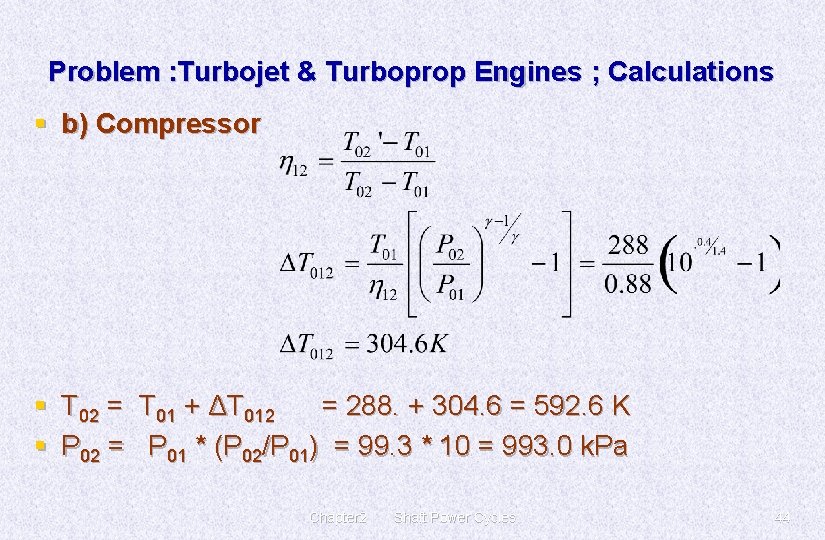
Problem : Turbojet & Turboprop Engines ; Calculations § b) Compressor § § T 02 = P 02 = T 01 + ΔT 012 = 288. + 304. 6 = 592. 6 K P 01 * (P 02/P 01) = 99. 3 * 10 = 993. 0 k. Pa Chapter 2 Shaft Power Cycles 44
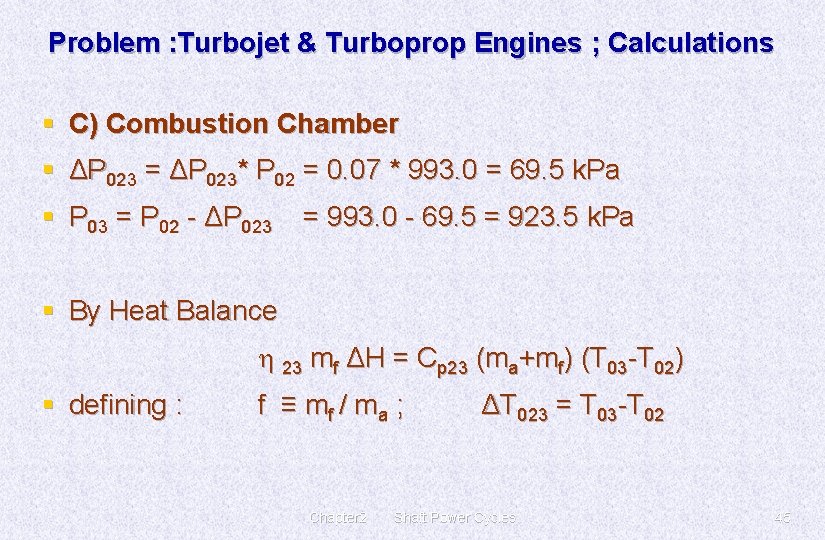
Problem : Turbojet & Turboprop Engines ; Calculations § C) Combustion Chamber § ΔP 023 = ΔP 023* P 02 = 0. 07 * 993. 0 = 69. 5 k. Pa § P 03 = P 02 - ΔP 023 = 993. 0 - 69. 5 = 923. 5 k. Pa § By Heat Balance h 23 mf ΔH = Cp 23 (ma+mf) (T 03 -T 02) § defining : f ≡ m f / ma ; Chapter 2 ΔT 023 = T 03 -T 02 Shaft Power Cycles 45

Problem : Turbojet & Turboprop Engines ; Calculations § Using the Combustion Curves Ideal Temperature Rise (Δ T 23) vs f (with T 02 as a parameter) § ΔT 023' = ΔT 023 / h 23 = 907. 4 K ; T 02 = 592. 6 K (h 23 =100%) f’ = 0. 0262 § This takes account of the variation of Cp 23 with f and temperature f = 0. 0262 / h 23 = 0. 0262 / 1. 00 = 0. 0262 Chapter 2 Shaft Power Cycles 46
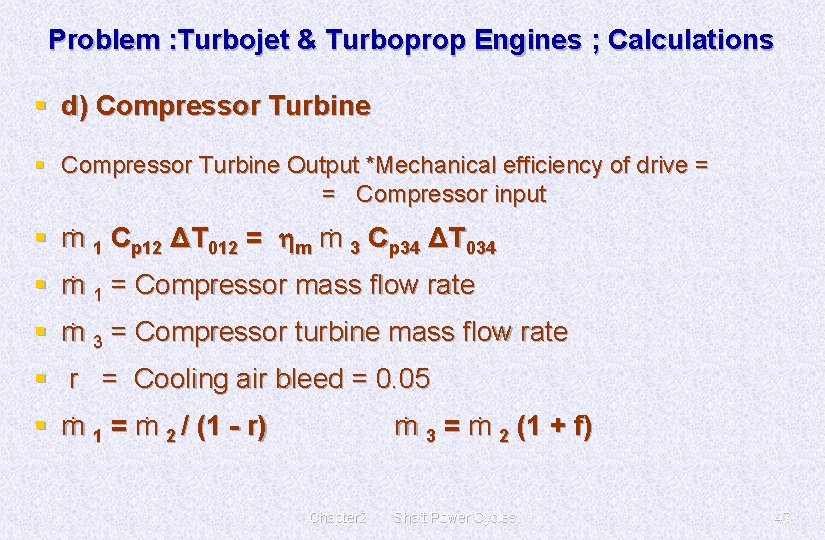
Problem : Turbojet & Turboprop Engines ; Calculations § d) Compressor Turbine § Compressor Turbine Output *Mechanical efficiency of drive = = Compressor input § ṁ 1 Cp 12 ΔT 012 = hm ṁ 3 Cp 34 ΔT 034 § ṁ 1 = Compressor mass flow rate § ṁ 3 = Compressor turbine mass flow rate § r = Cooling air bleed = 0. 05 § ṁ 1 = ṁ 2 / ( 1 - r) ṁ 3 = ṁ 2 (1 + f) Chapter 2 Shaft Power Cycles 47
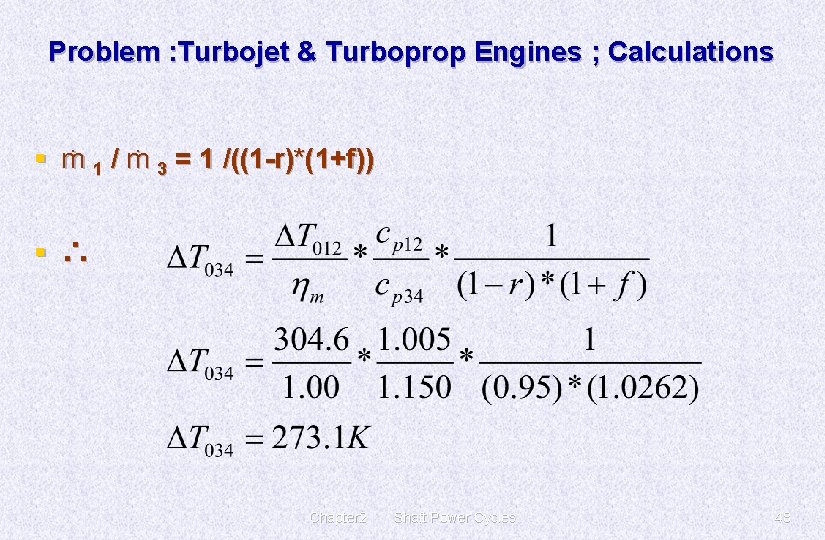
Problem : Turbojet & Turboprop Engines ; Calculations § ṁ 1 / ṁ 3 = 1 /((1 -r)*(1+f)) § ∴ Chapter 2 Shaft Power Cycles 48
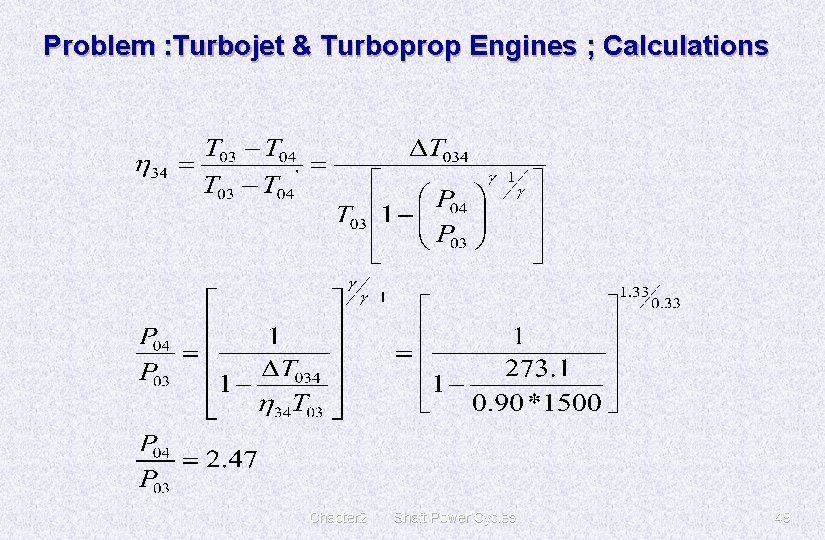
Problem : Turbojet & Turboprop Engines ; Calculations Chapter 2 Shaft Power Cycles 49
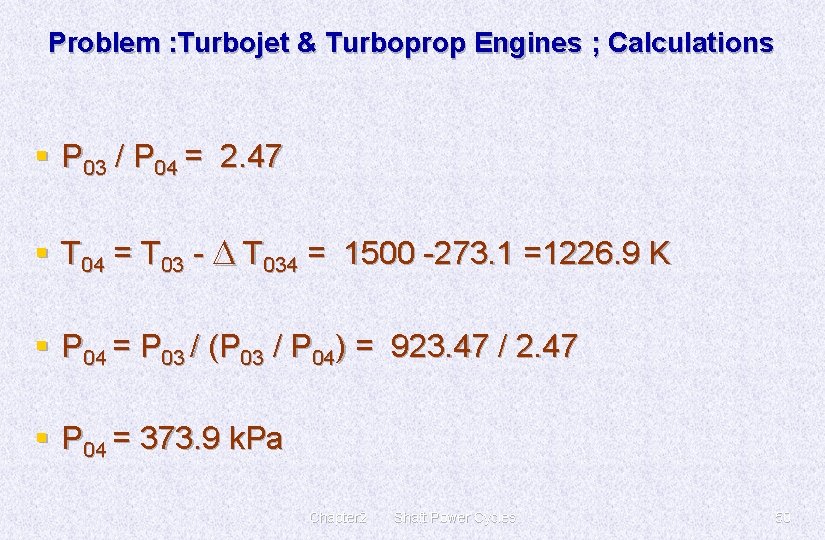
Problem : Turbojet & Turboprop Engines ; Calculations § P 03 / P 04 = 2. 47 § T 04 = T 03 - D T 034 = 1500 -273. 1 =1226. 9 K § P 04 = P 03 / (P 03 / P 04) = 923. 47 / 2. 47 § P 04 = 373. 9 k. Pa Chapter 2 Shaft Power Cycles 50
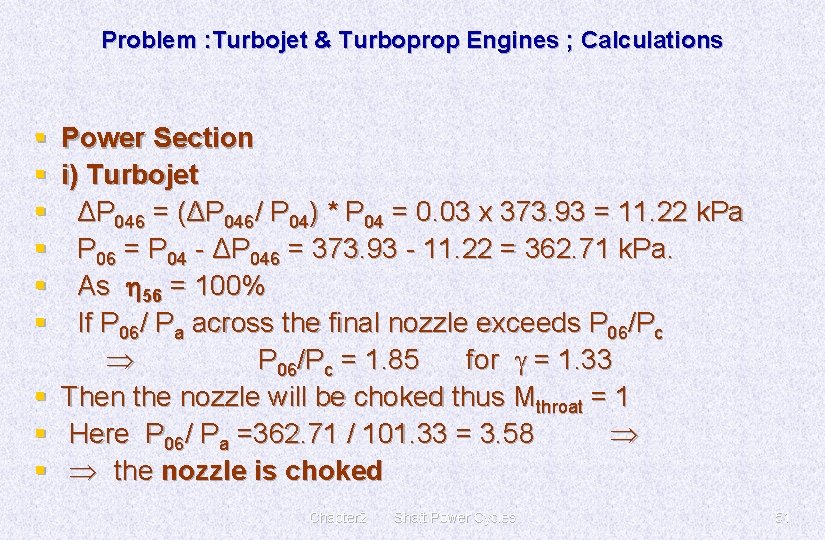
Problem : Turbojet & Turboprop Engines ; Calculations § § § § § Power Section i) Turbojet ΔP 046 = (ΔP 046/ P 04) * P 04 = 0. 03 x 373. 93 = 11. 22 k. Pa P 06 = P 04 - ΔP 046 = 373. 93 - 11. 22 = 362. 71 k. Pa. As h 56 = 100% If P 06/ Pa across the final nozzle exceeds P 06/Pc = 1. 85 for g = 1. 33 Then the nozzle will be choked thus Mthroat = 1 Here P 06/ Pa =362. 71 / 101. 33 = 3. 58 the nozzle is choked Chapter 2 Shaft Power Cycles 51
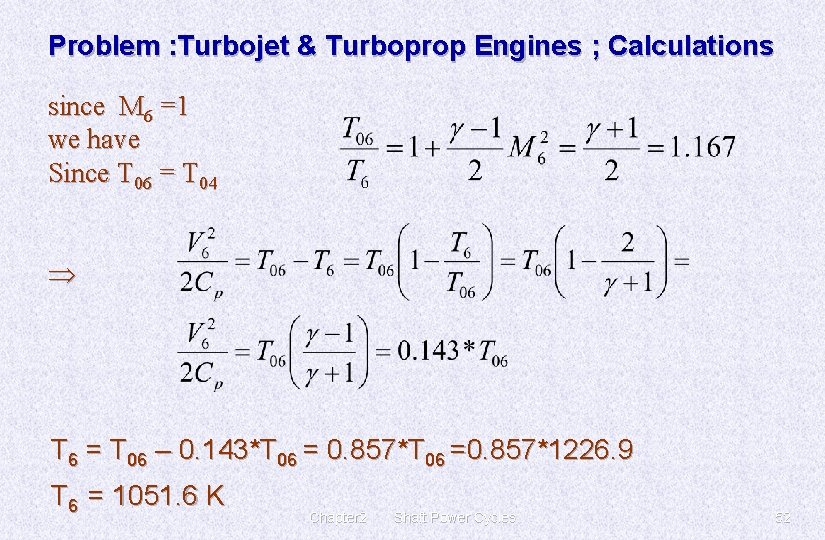
Problem : Turbojet & Turboprop Engines ; Calculations since M 6 =1 we have Since T 06 = T 04 T 6 = T 06 – 0. 143*T 06 = 0. 857*T 06 =0. 857*1226. 9 T 6 = 1051. 6 K Chapter 2 Shaft Power Cycles 52
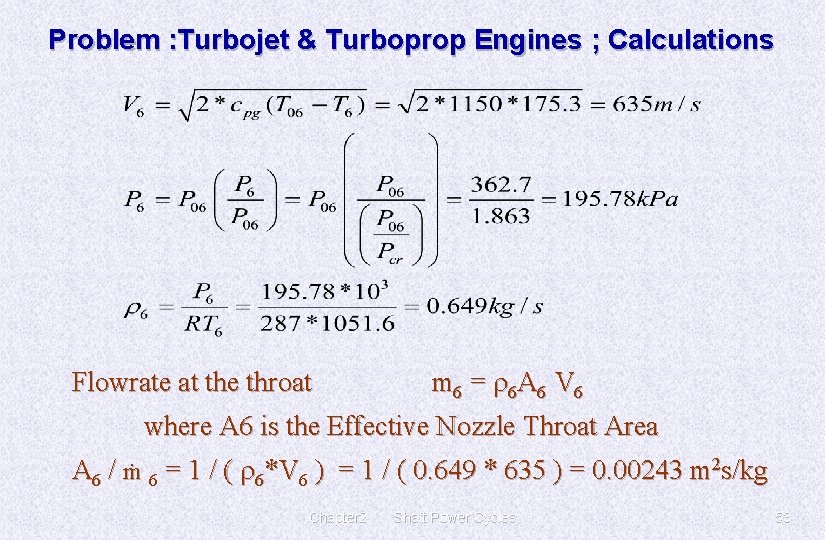
Problem : Turbojet & Turboprop Engines ; Calculations Flowrate at the throat m 6 = r 6 A 6 V 6 where A 6 is the Effective Nozzle Throat Area A 6 / ṁ 6 = 1 / ( r 6*V 6 ) = 1 / ( 0. 649 * 635 ) = 0. 00243 m 2 s/kg Chapter 2 Shaft Power Cycles 53
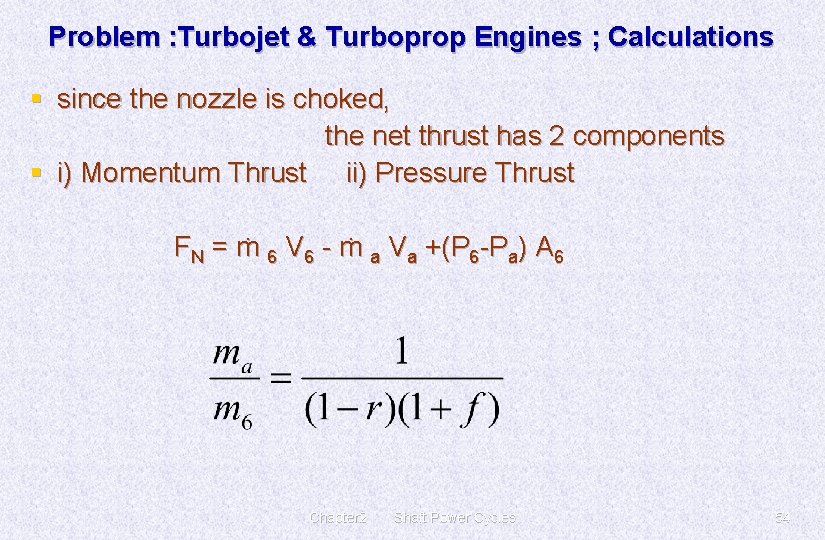
Problem : Turbojet & Turboprop Engines ; Calculations § since the nozzle is choked, the net thrust has 2 components § i) Momentum Thrust ii) Pressure Thrust FN = ṁ 6 V 6 - ṁ a Va +(P 6 -Pa) A 6 Chapter 2 Shaft Power Cycles 54
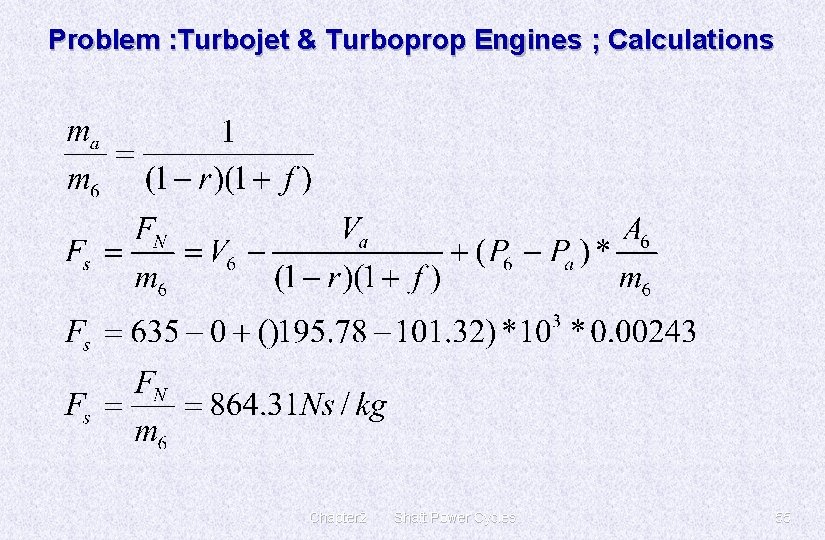
Problem : Turbojet & Turboprop Engines ; Calculations Chapter 2 Shaft Power Cycles 55
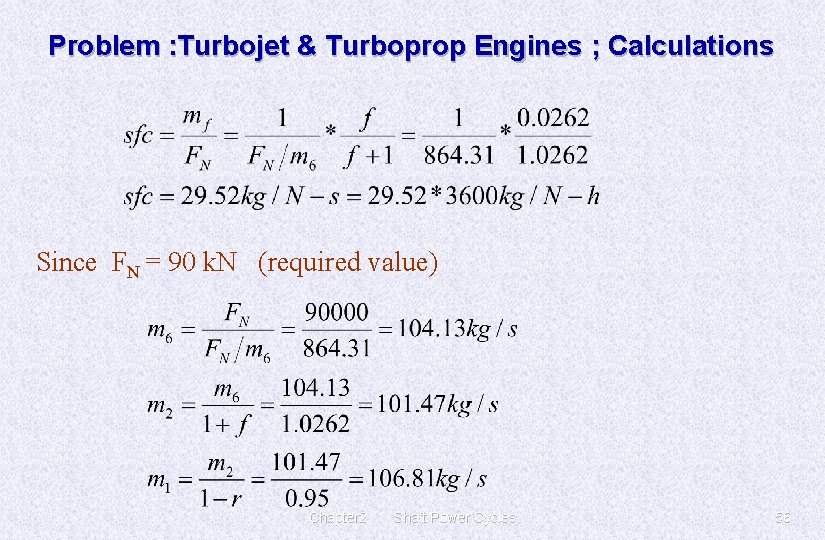
Problem : Turbojet & Turboprop Engines ; Calculations Since FN = 90 k. N (required value) Chapter 2 Shaft Power Cycles 56
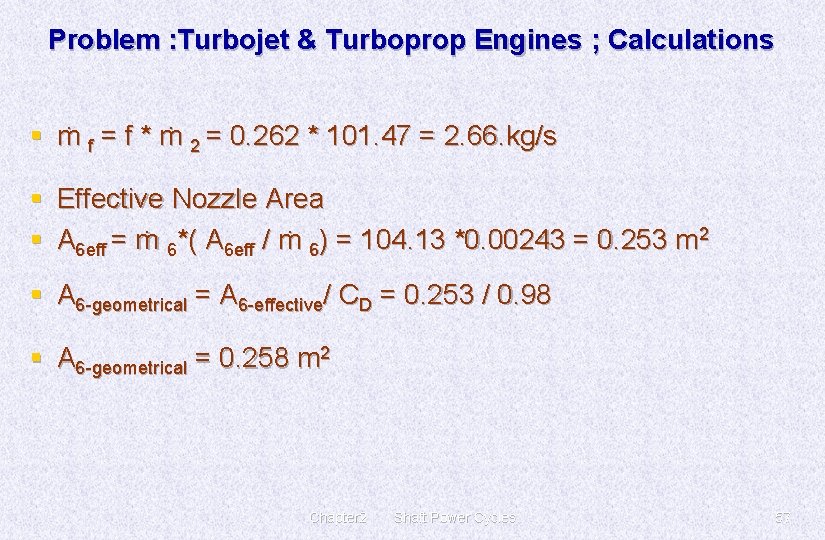
Problem : Turbojet & Turboprop Engines ; Calculations § ṁ f = f * ṁ 2 = 0. 262 * 101. 47 = 2. 66. kg/s § Effective Nozzle Area § A 6 eff = ṁ 6*( A 6 eff / ṁ 6) = 104. 13 *0. 00243 = 0. 253 m 2 § A 6 -geometrical = A 6 -effective/ CD = 0. 253 / 0. 98 § A 6 -geometrical = 0. 258 m 2 Chapter 2 Shaft Power Cycles 57
Problem : Turbojet & Turboprop Engines ; Calculations ii) Turboprop § Here the expansion takes place mainly in the power turbine, leaving only sufficient pressure ratio across the nozzle to produce the specified jet velocity. § The required division of pressure drop through the turbine & the nozzle is found by trial and error: § As a first trial, assume that the power turbine temperature drop is ΔT 045 = 295 K Chapter 2 Shaft Power Cycles 58

Problem : Turbojet & Turboprop Engines ; Calculations Then § and: T 05 =T 06 = T 04 - ΔT 045 = 12227 - 295 = 931. 9 K § P 05 =P 04 * (P 05/P 04) = 373. 9 / 3. 47 = 107. 85 k. Pa. Chapter 2 Shaft Power Cycles 59
Problem : Turbojet & Turboprop Engines ; Calculations § Also ΔP 056 = (ΔP 056 / P 05)* P 05 = = 0. 03 * 107. 85 = 3. 24 k. Pa § P 06 = P 05 – ΔP 056 = 107. 85 -3. 24 =104. 62 k. Pa § Since P 06/Pa = 104. 6 / 101. 33 = 1. 033 < 1. 85 far less then the critial value ! § Thus the Nozzle is unchoked; Chapter 2 so Shaft Power Cycles P 6 = Pa 60
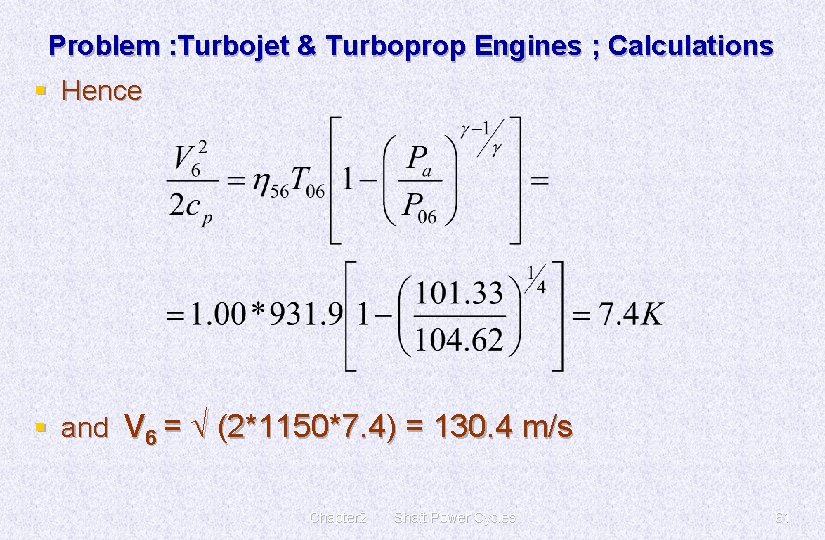
Problem : Turbojet & Turboprop Engines ; Calculations § Hence § and V 6 = √ (2*1150*7. 4) = 130. 4 m/s Chapter 2 Shaft Power Cycles 61
Problem : Turbojet & Turboprop Engines ; Calculations § But the given value V 6= 220 m/s § Since the found value is too low, we now try a somewhat lower value of ΔT 045 = 283. 2 K § Proceeding as above ; P 04 / P 05 = 3. 27 T 05 = T 06 =943. 7 K § P 05 = 114. 28 k. Pa ΔP 056 = 3. 43 k. Pa § P 06 =110. 85 k. Pa § V 62 / 2 Cp = 21 K V 6 = 219. 8 m/s ≈ 220 m/s § this is close enough, with the Nozzle Unckoked Chapter 2 Shaft Power Cycles 62
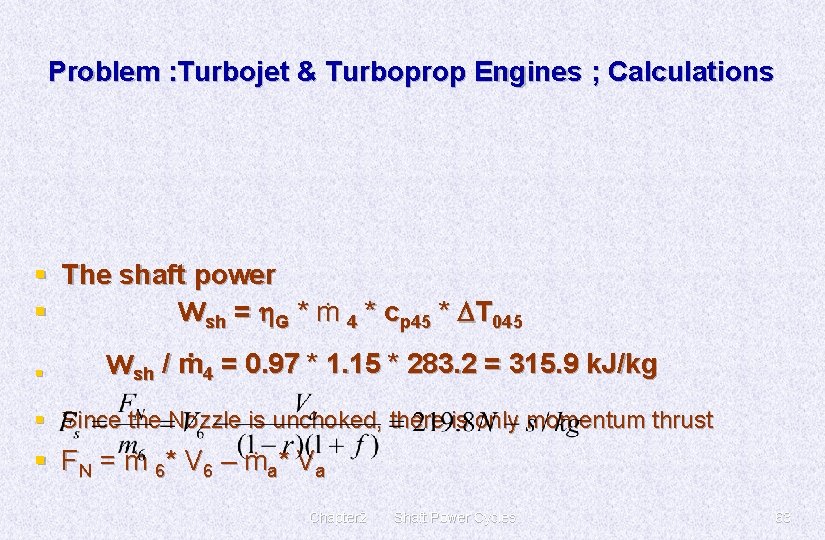
Problem : Turbojet & Turboprop Engines ; Calculations § The shaft power § Wsh = h. G * ṁ 4 * cp 45 * DT 045 § Wsh / ṁ4 = 0. 97 * 1. 15 * 283. 2 = 315. 9 k. J/kg § Since the Nozzle is unchoked, there is only momentum thrust § F N = ṁ 6 * V 6 – ṁa * V a Chapter 2 Shaft Power Cycles 63
Problem : Turbojet & Turboprop Engines ; Calculations § For the static case it is given that ; § 1 N of jet Thrust is equivalent to 65 W of propeller shaft Power. § Shaft power equivalent of jet thrust per unit mass flow = (wj/ ṁ 6) = (FN/ ṁ 6)* 65 / 1000 wj/ ṁ 6 = 14. 3 k. J/kg § Then the equivalent shaft power per unit mass flow wj/ ṁ 6 = (ws + wj ) / ṁ 6 = 315. 9 + 14. 3 wj/ ṁ 6 = 330. 2 k. J/kg Chapter 2 Shaft Power Cycles 64
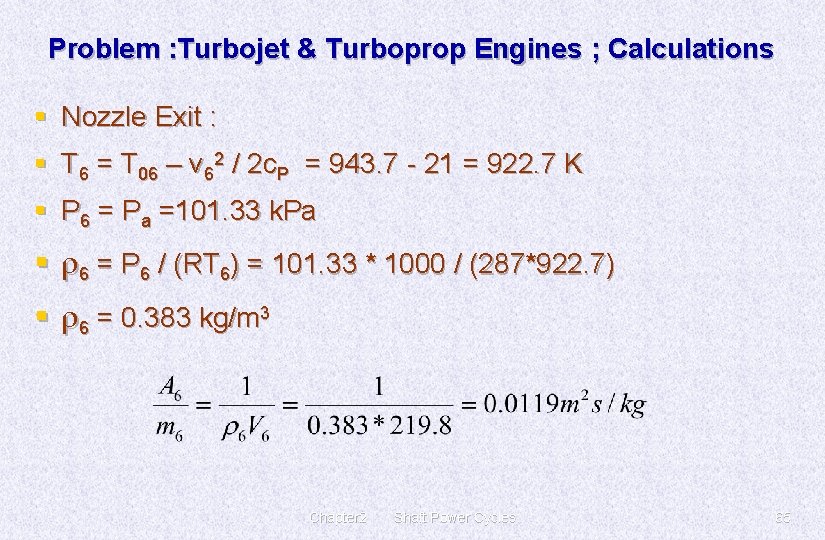
Problem : Turbojet & Turboprop Engines ; Calculations § Nozzle Exit : § T 6 = T 06 – v 62 / 2 c. P = 943. 7 - 21 = 922. 7 K § P 6 = Pa =101. 33 k. Pa § r 6 = P 6 / (RT 6) = 101. 33 * 1000 / (287*922. 7) § r 6 = 0. 383 kg/m 3 Chapter 2 Shaft Power Cycles 65
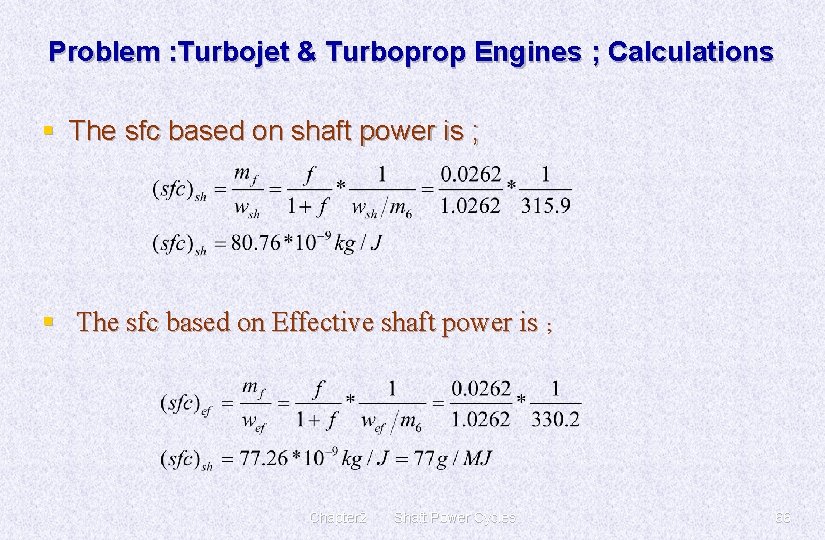
Problem : Turbojet & Turboprop Engines ; Calculations § The sfc based on shaft power is ; § The sfc based on Effective shaft power is ; Chapter 2 Shaft Power Cycles 66
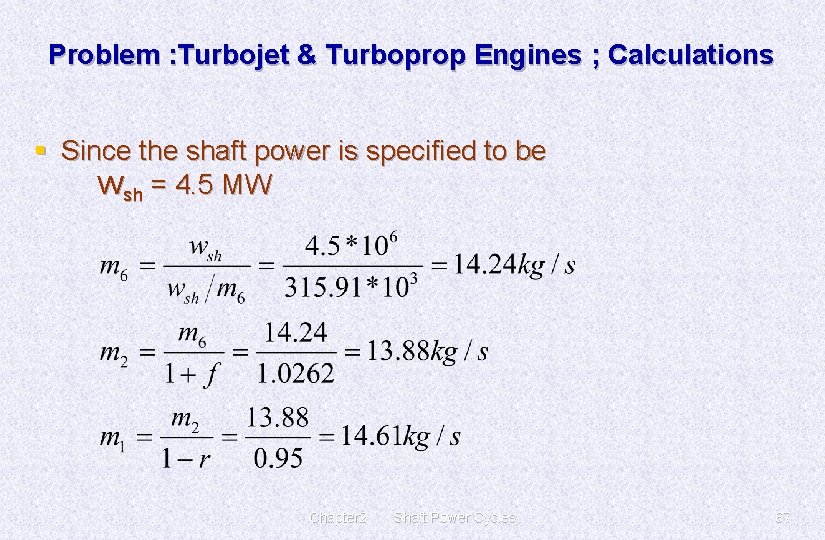
Problem : Turbojet & Turboprop Engines ; Calculations § Since the shaft power is specified to be Wsh = 4. 5 MW Chapter 2 Shaft Power Cycles 67
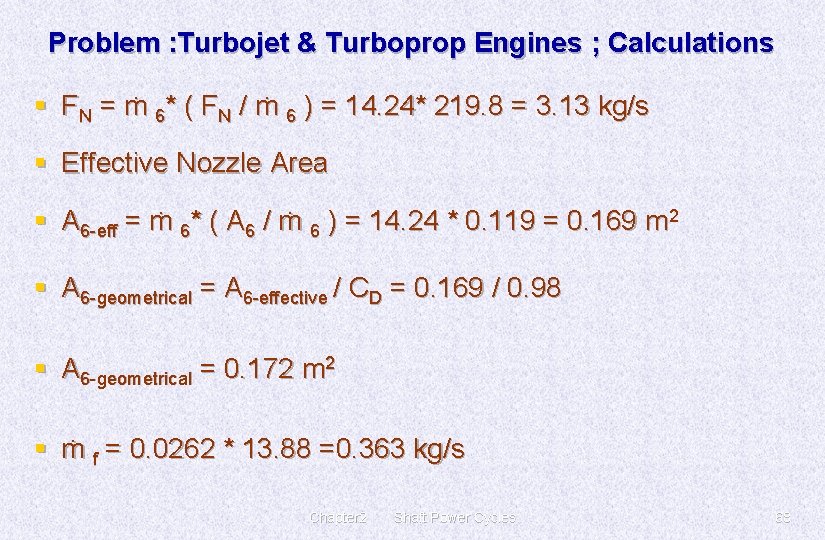
Problem : Turbojet & Turboprop Engines ; Calculations § FN = ṁ 6* ( FN / ṁ 6 ) = 14. 24* 219. 8 = 3. 13 kg/s § Effective Nozzle Area § A 6 -eff = ṁ 6* ( A 6 / ṁ 6 ) = 14. 24 * 0. 119 = 0. 169 m 2 § A 6 -geometrical = A 6 -effective / CD = 0. 169 / 0. 98 § A 6 -geometrical = 0. 172 m 2 § ṁ f = 0. 0262 * 13. 88 =0. 363 kg/s Chapter 2 Shaft Power Cycles 68
- Slides: 68