
Chapter 3 Fundamentals of Organization Structure 2010 Cengage
- Slides: 25
Chapter 3 Fundamentals of Organization Structure © 2010 Cengage Learning. All Rights Reserved. May not be scanned, copied or duplicated, or posted to a publicly accessible website, in whole or in part.
Organization Structure • Formal Reporting Relationships – Number of levels – Span of Control • Grouping of Individuals – Creation of Departments • Design of Systems – Communication, Coordination and integration of efforts • Define Structural Framework and interactions © 2010 Cengage Learning. All Rights Reserved. May not be scanned, copied or duplicated, or posted to a publicly accessible website, in whole or in part.
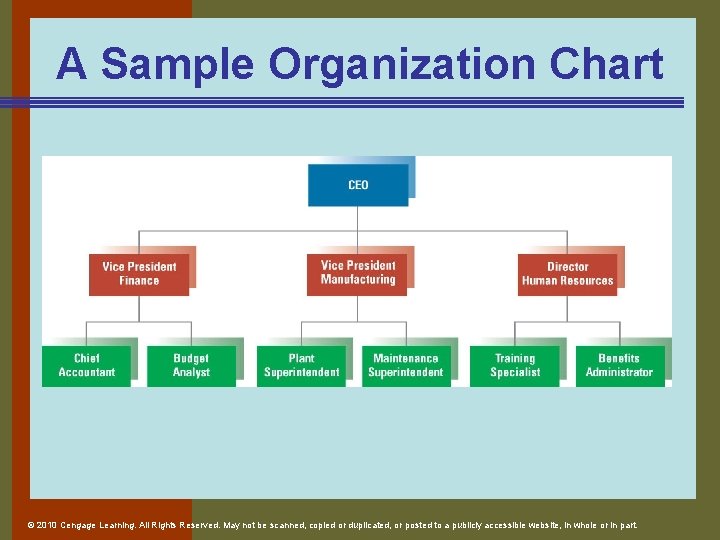
A Sample Organization Chart © 2010 Cengage Learning. All Rights Reserved. May not be scanned, copied or duplicated, or posted to a publicly accessible website, in whole or in part.
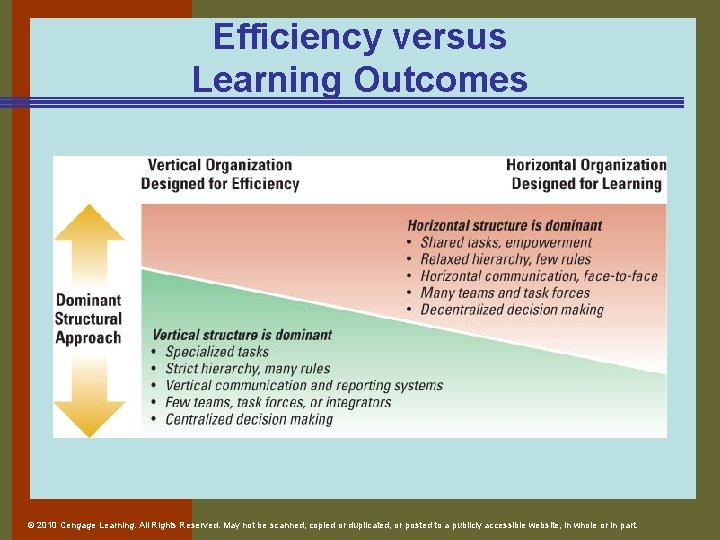
Information-Sharing Perspective on Structure Vertical and horizontal information flow – Traditional organization designed for efficiency? • Centralized authority focused on top level decision-making – Learning organization which emphasizes communication and collaboration • Decentralized authority focused on shared tasks and decisions © 2010 Cengage Learning. All Rights Reserved. May not be scanned, copied or duplicated, or posted to a publicly accessible website, in whole or in part.
Efficiency versus Learning Outcomes © 2010 Cengage Learning. All Rights Reserved. May not be scanned, copied or duplicated, or posted to a publicly accessible website, in whole or in part.
Vertical Information Sharing • Vertical linkages coordinate activities between the top and the bottom of the organization • Hierarchical referral are the vertical lines which identify the chain of command • Rules and Plans create vertical links • Reports, computer systems and written information are vertical information systems © 2010 Cengage Learning. All Rights Reserved. May not be scanned, copied or duplicated, or posted to a publicly accessible website, in whole or in part.
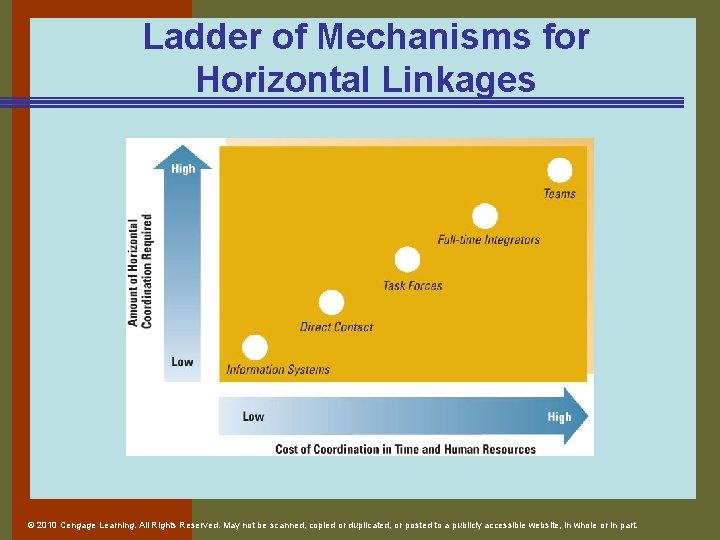
Horizontal Information Sharing • Horizontal linkage coordinate activities across organizational departments - not traditionally drawn on the organizational chart ü ü ü Information Systems Direct Contact (i. e. liaison role) Task Forces Full-Time Integrator Teams (virtual) © 2010 Cengage Learning. All Rights Reserved. May not be scanned, copied or duplicated, or posted to a publicly accessible website, in whole or in part.
Ladder of Mechanisms for Horizontal Linkages © 2010 Cengage Learning. All Rights Reserved. May not be scanned, copied or duplicated, or posted to a publicly accessible website, in whole or in part.
Organization Design Alternatives Required Work Activities Reporting Relationships Departmental Grouping Options © 2010 Cengage Learning. All Rights Reserved. May not be scanned, copied or duplicated, or posted to a publicly accessible website, in whole or in part.
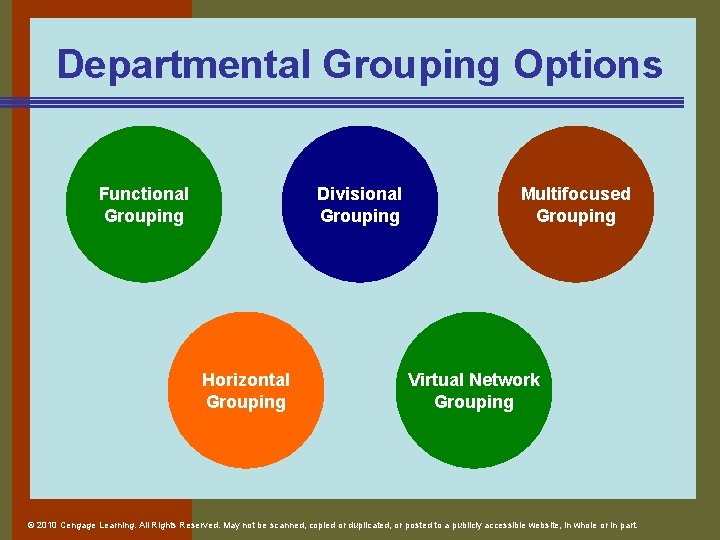
Departmental Grouping Options Functional Grouping Divisional Grouping Horizontal Grouping Multifocused Grouping Virtual Network Grouping © 2010 Cengage Learning. All Rights Reserved. May not be scanned, copied or duplicated, or posted to a publicly accessible website, in whole or in part.
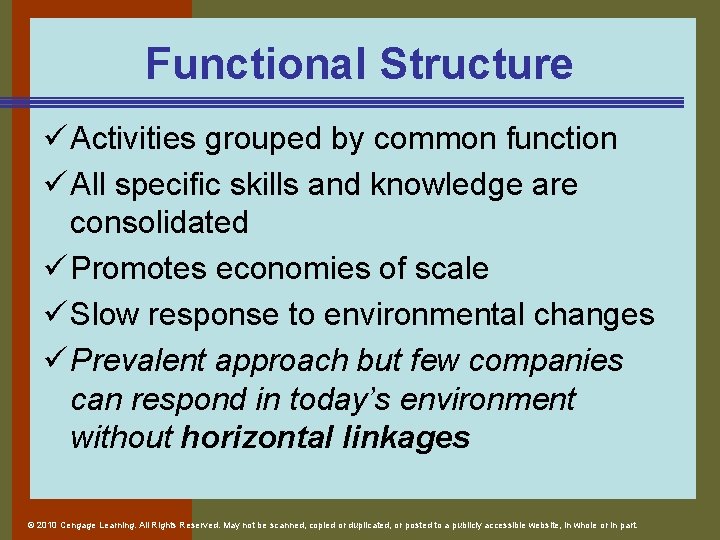
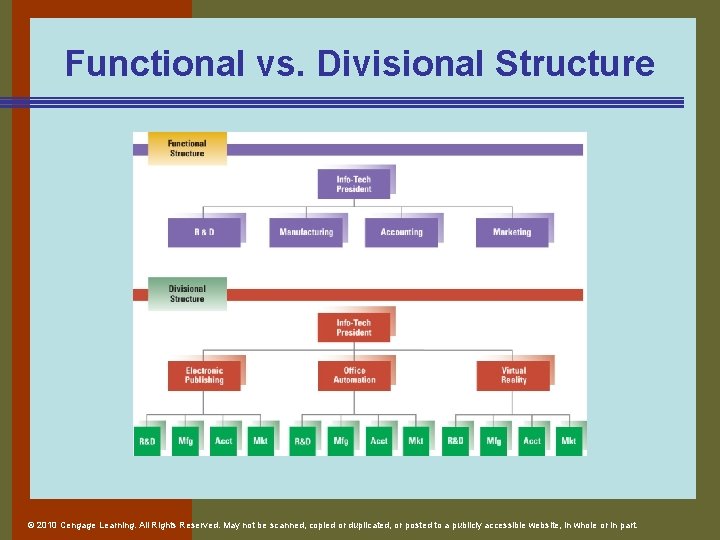
Functional Structure ü Activities grouped by common function ü All specific skills and knowledge are consolidated ü Promotes economies of scale ü Slow response to environmental changes ü Prevalent approach but few companies can respond in today’s environment without horizontal linkages © 2010 Cengage Learning. All Rights Reserved. May not be scanned, copied or duplicated, or posted to a publicly accessible website, in whole or in part.
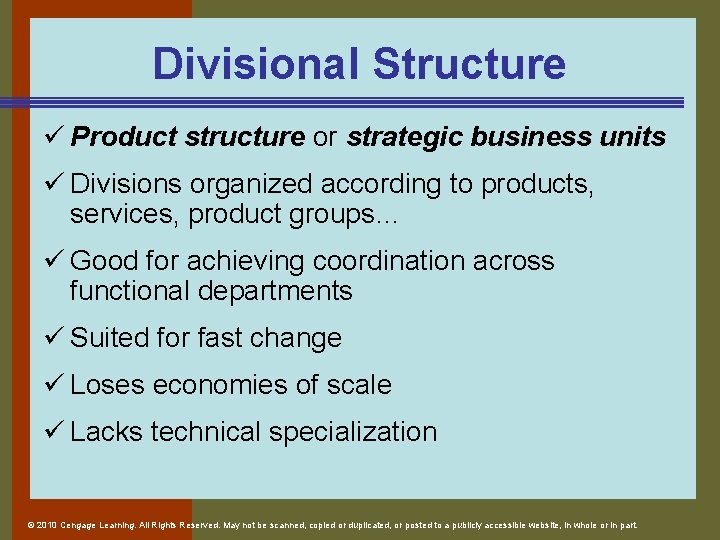
Divisional Structure ü Product structure or strategic business units ü Divisions organized according to products, services, product groups… ü Good for achieving coordination across functional departments ü Suited for fast change ü Loses economies of scale ü Lacks technical specialization © 2010 Cengage Learning. All Rights Reserved. May not be scanned, copied or duplicated, or posted to a publicly accessible website, in whole or in part.
Functional vs. Divisional Structure © 2010 Cengage Learning. All Rights Reserved. May not be scanned, copied or duplicated, or posted to a publicly accessible website, in whole or in part.
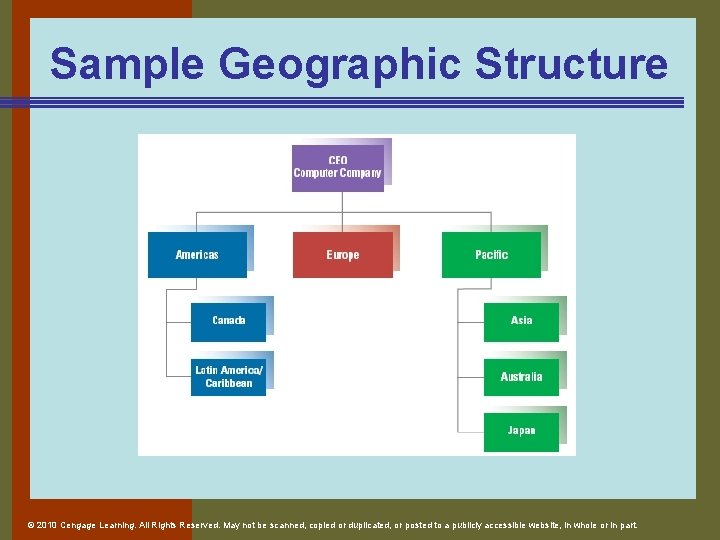
Geographic Structure ü Organizing to meet needs of users/customers by geography ü Many multinational corporations are organized by country ü Focuses managers and employees on specific geographic regions ü Strengths and weaknesses similar to divisional organization © 2010 Cengage Learning. All Rights Reserved. May not be scanned, copied or duplicated, or posted to a publicly accessible website, in whole or in part.
Sample Geographic Structure © 2010 Cengage Learning. All Rights Reserved. May not be scanned, copied or duplicated, or posted to a publicly accessible website, in whole or in part.
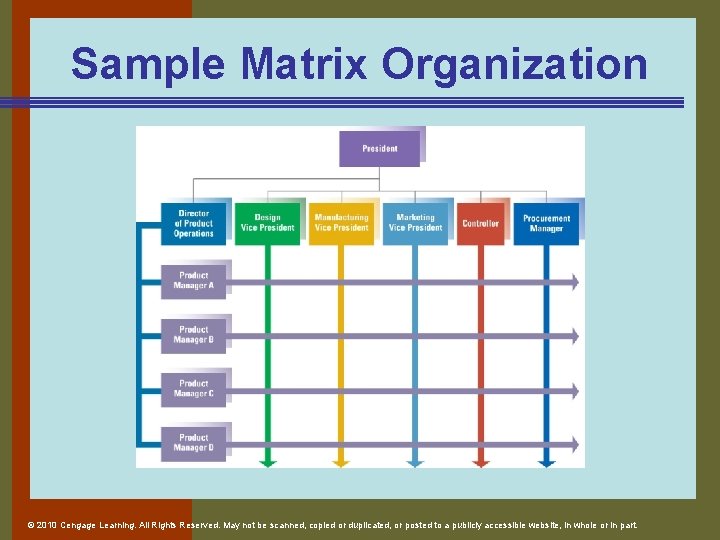
Matrix Structure ü Multifocused with strong horizontal linkage ü Conditions for Matrix: 1. Share resources across the organization 2. Two or more critical outputs required: products and technical knowledge 3. Environment is complex and uncertain ü Allows organization to meet dual demands ü Largest weakness is that employees have two bosses and conflicting demands © 2010 Cengage Learning. All Rights Reserved. May not be scanned, copied or duplicated, or posted to a publicly accessible website, in whole or in part.
Sample Matrix Organization © 2010 Cengage Learning. All Rights Reserved. May not be scanned, copied or duplicated, or posted to a publicly accessible website, in whole or in part.
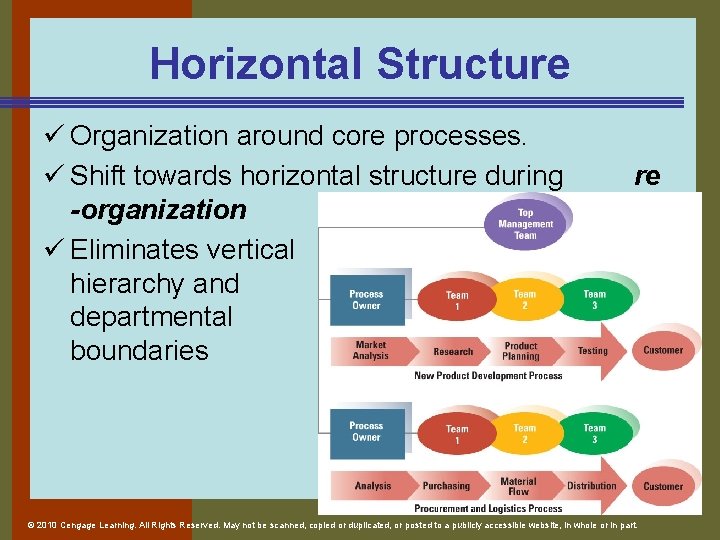
Horizontal Structure ü Organization around core processes. ü Shift towards horizontal structure during -organization ü Eliminates vertical hierarchy and departmental boundaries re © 2010 Cengage Learning. All Rights Reserved. May not be scanned, copied or duplicated, or posted to a publicly accessible website, in whole or in part.
Characteristics of Horizontal Structure ü Structure is created around cross-functional processes ü Self-directed teams, not individuals are dominant players ü Process owners are responsible for entire process ü People on the team are given authority for decisions ü Can increase organization’s flexibility ü May harm performance if critical processes are not correctly defined © 2010 Cengage Learning. All Rights Reserved. May not be scanned, copied or duplicated, or posted to a publicly accessible website, in whole or in part.
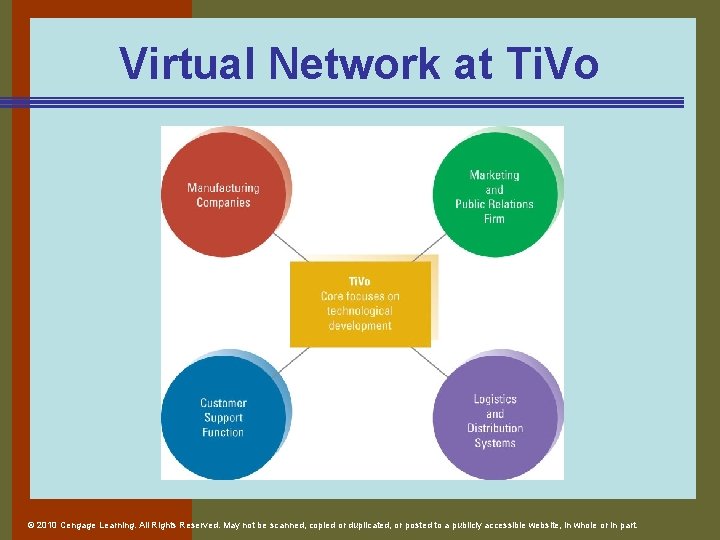
Virtual Networks and Outsourcing ü Extend horizontal coordination beyond the boundaries of the organization ü Most common strategy is outsourcing • Contract out certain tasks/functions ü Virtual or modular structures subcontract most of its major functions to separate companies ü The virtual network organization serves as a central hub with contracted experts © 2010 Cengage Learning. All Rights Reserved. May not be scanned, copied or duplicated, or posted to a publicly accessible website, in whole or in part.
Virtual Network at Ti. Vo © 2010 Cengage Learning. All Rights Reserved. May not be scanned, copied or duplicated, or posted to a publicly accessible website, in whole or in part.
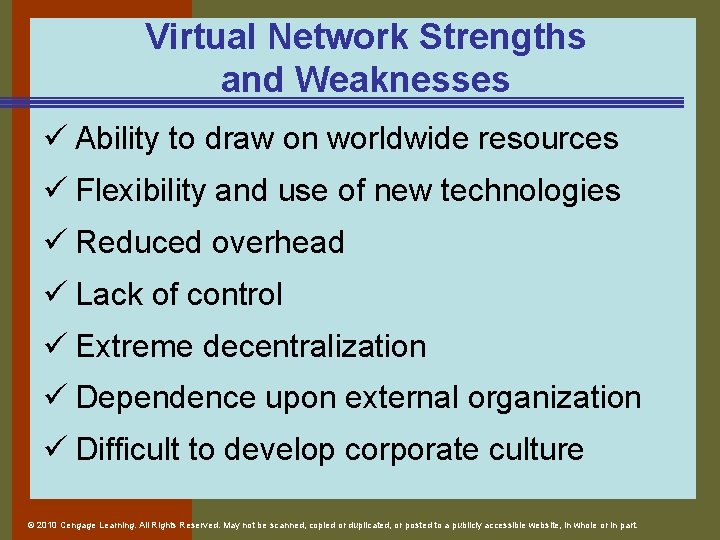
Virtual Network Strengths and Weaknesses ü Ability to draw on worldwide resources ü Flexibility and use of new technologies ü Reduced overhead ü Lack of control ü Extreme decentralization ü Dependence upon external organization ü Difficult to develop corporate culture © 2010 Cengage Learning. All Rights Reserved. May not be scanned, copied or duplicated, or posted to a publicly accessible website, in whole or in part.
Hybrid Structure ü Combination of various structure approaches ü Tailored to specific needs ü Often used in rapidly changing environments ü Greater flexibility © 2010 Cengage Learning. All Rights Reserved. May not be scanned, copied or duplicated, or posted to a publicly accessible website, in whole or in part.
Application of Structural Design • Each structure meets different needs and is a tool that can help managers be more effective • Structural alignment aligns structure with organizational goal • Symptoms of Structural Deficiency: – Decision making is delayed or lacking quality – Organization cannot meet changing needs – Employee performance declines, needs are not meet – Too much conflict © 2010 Cengage Learning. All Rights Reserved. May not be scanned, copied or duplicated, or posted to a publicly accessible website, in whole or in part.
Design Essentials • Structure must provide a framework, linking organization into whole • Provide vertical and horizontal linkages • Variety of alternatives for grouping • Virtual network extends horizontal coordination • Matrix structure attempts to achieve balance • Managers must find right balance • The purpose of the organization chart is to encourage and direct activities © 2010 Cengage Learning. All Rights Reserved. May not be scanned, copied or duplicated, or posted to a publicly accessible website, in whole or in part.