
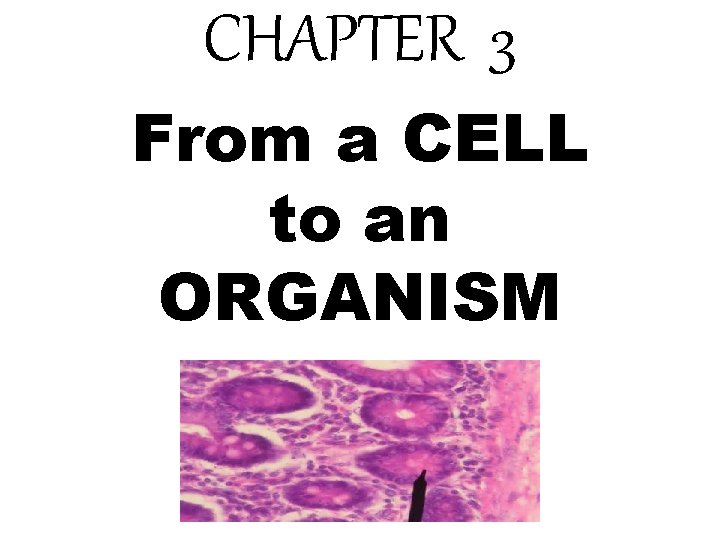
CHAPTER 3 From a CELL to an ORGANISM




- Slides: 18
CHAPTER 3 From a CELL to an ORGANISM
Cell reproduction • Cell division- Increases the number of cells that may cause many celled organisms to grow. The cell cycle - The cells have periods of formation, growth and development, and death called life cycles. - Interphase- most of life in any eukaryotic cell, or cell with a nucleus, is spent in a period of growth and development - During interphase, a cell duplicates its chromosomes and prepares for cell division - After interphase, the nucleus divides, and the cytoplasm separates to form two new cells
Phases of the cell cycle • There are two main phases of the cell cycleinterphase and the mitotic phase. • Interphase is the period of growth and development for a cell. • During interphase, most cells go through three stages- rapid growth and replication of the organelles, replication of the DNA, the genetic information in a cell; and preparation for cell division. • During the mitotic phase a cell reproduces.
Length of a cell cycle • Interphase makes up most of the cell cycle. • During interphase, the DNA in the cell is called CHROMATIN.
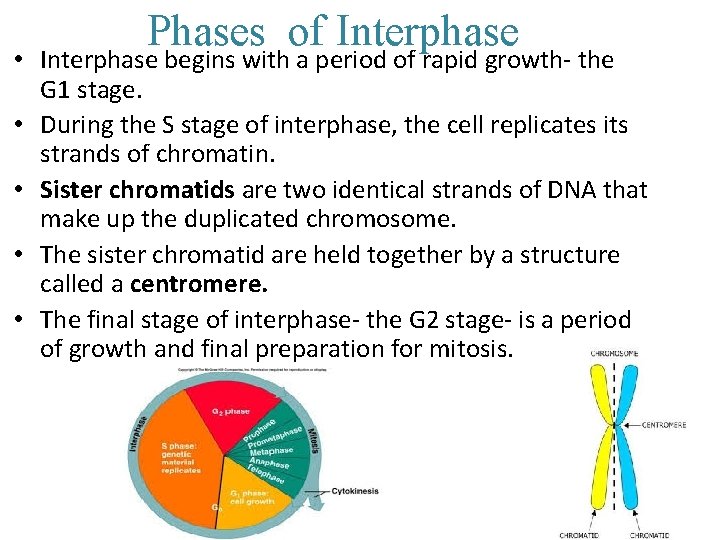
Phases of Interphase • Interphase begins with a period of rapid growth- the G 1 stage. • During the S stage of interphase, the cell replicates its strands of chromatin. • Sister chromatids are two identical strands of DNA that make up the duplicated chromosome. • The sister chromatid are held together by a structure called a centromere. • The final stage of interphase- the G 2 stage- is a period of growth and final preparation for mitosis.
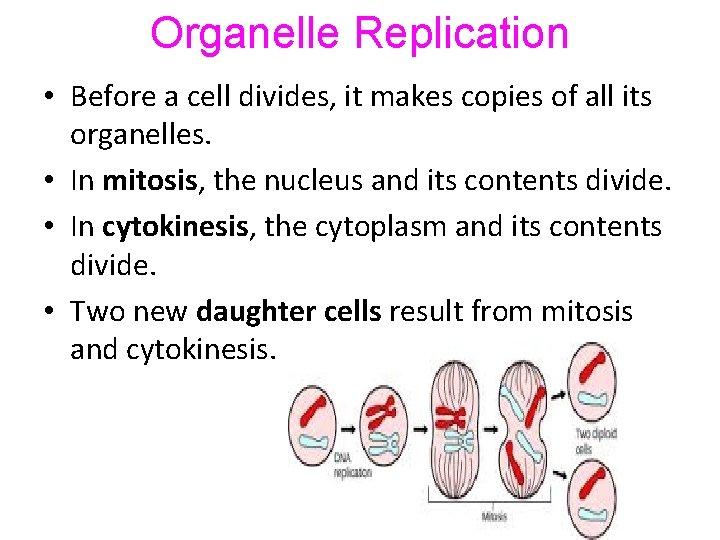
Organelle Replication • Before a cell divides, it makes copies of all its organelles. • In mitosis, the nucleus and its contents divide. • In cytokinesis, the cytoplasm and its contents divide. • Two new daughter cells result from mitosis and cytokinesis.
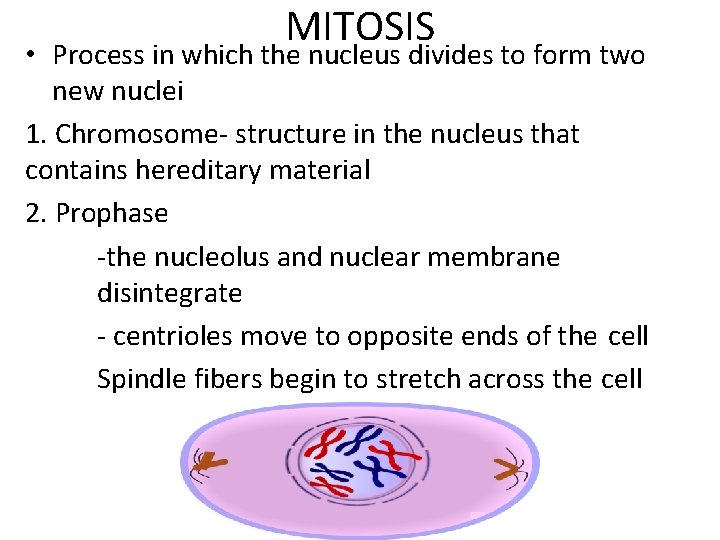
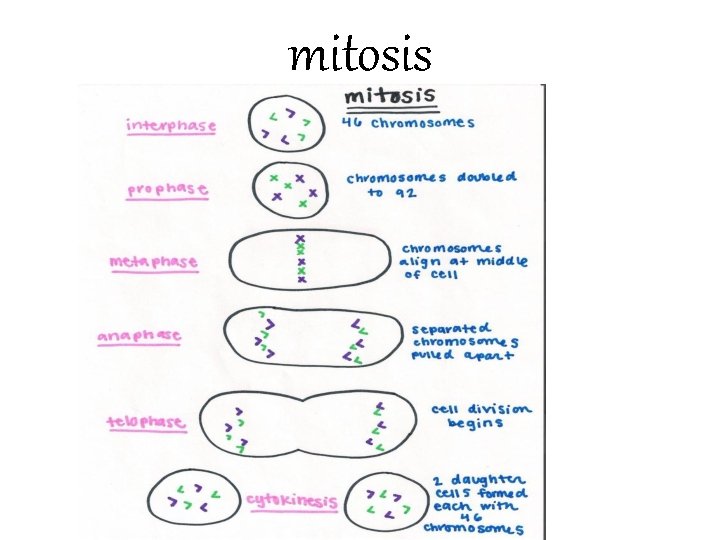
MITOSIS • Process in which the nucleus divides to form two new nuclei 1. Chromosome- structure in the nucleus that contains hereditary material 2. Prophase -the nucleolus and nuclear membrane disintegrate - centrioles move to opposite ends of the cell Spindle fibers begin to stretch across the cell
Metaphase - Pairs of chromatids line up across the center of the cell. Anaphase -each centromere divides - Each pair of chromatids separates and moves to opposite ends of the cell
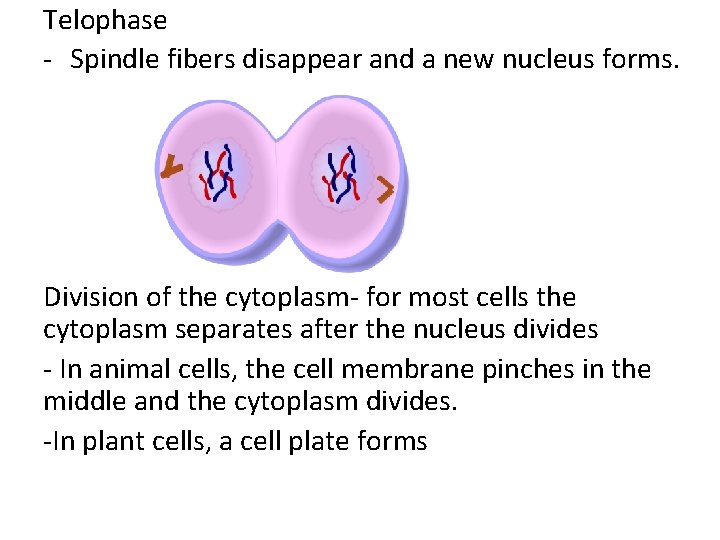
Telophase - Spindle fibers disappear and a new nucleus forms. Division of the cytoplasm- for most cells the cytoplasm separates after the nucleus divides - In animal cells, the cell membrane pinches in the middle and the cytoplasm divides. -In plant cells, a cell plate forms
mitosis
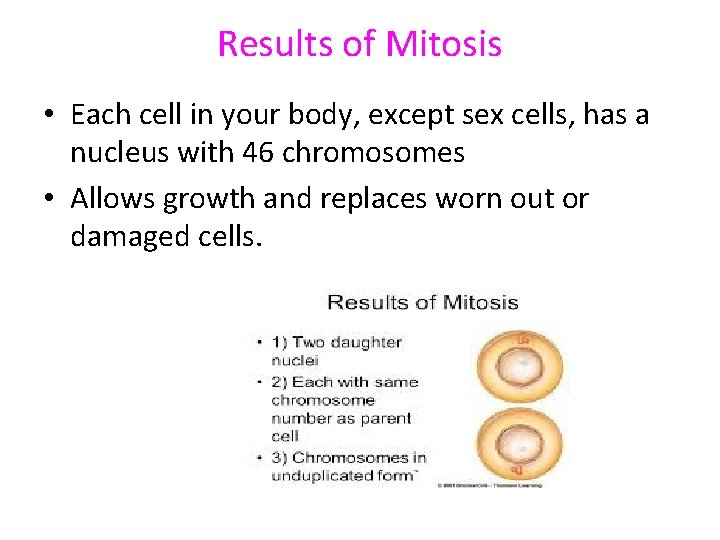
Results of Mitosis • Each cell in your body, except sex cells, has a nucleus with 46 chromosomes • Allows growth and replaces worn out or damaged cells.
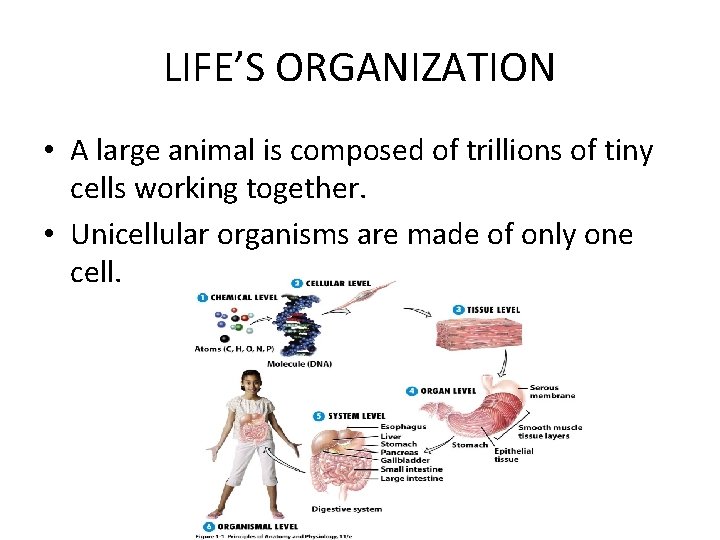
LIFE’S ORGANIZATION • A large animal is composed of trillions of tiny cells working together. • Unicellular organisms are made of only one cell.
Unicellular organisms • Unicellular organisms are eukaryotes or prokaryotic cells. • A cell without a membrane bound nucleus is a prokaryotic cell. • A eukaryotic cell has a nucleus surrounded by a membrane and many other specialized organelles/
Multicellular Organism Each type of cell in a multicellular organism has a specific job that is important to the survival of an organism. Cells become different types during cell differentiation. -Nearly all the cells in an organism have identical chromosomes. -Different types of cells use different parts of the chromosomes.
Stem cells are unspecialized cells that can develop into many different types of cell types. Stem cells can produce new muscle cells when fibers are torn. In plants unspecialized cells similar to animal stem cells are grouped in areas called meristems. Tissues are groups of similar types of cells that work together to carry out specific tasks. -most animals have 4 types of main tissuemuscle, epiyhelial, nervous, and connectove. - The 3 main types of plant tissue are dermal, vascular, and ground tissue.
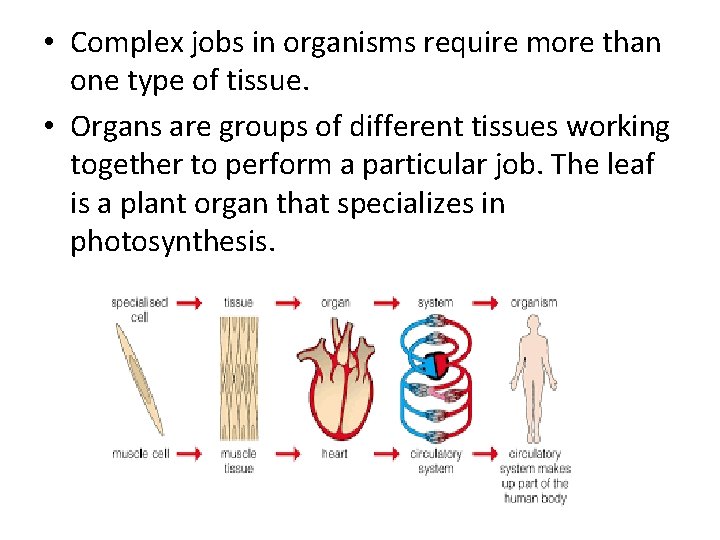
• Complex jobs in organisms require more than one type of tissue. • Organs are groups of different tissues working together to perform a particular job. The leaf is a plant organ that specializes in photosynthesis.
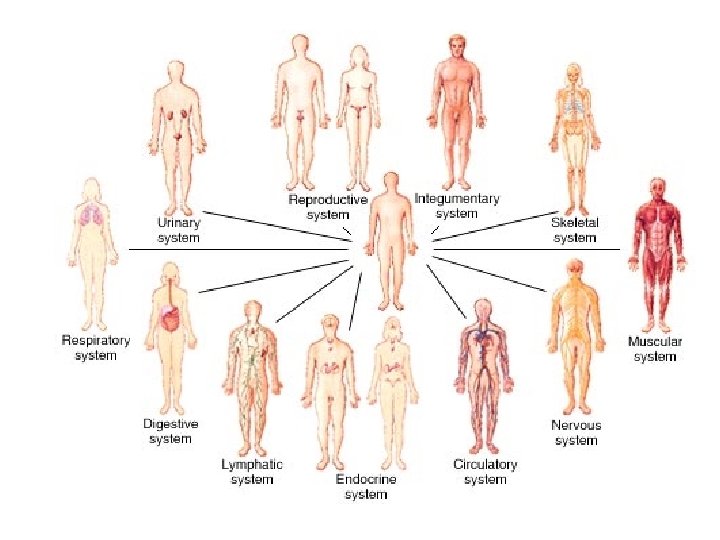
Organs are groups of different tissues working together to complete a series of tasks. • One human organ system –the digestive systemincludes the stomach and intestines. • Plants have tow major organ systems- the shoot system and the root system. • Multicellular organisms usually have many organ systems. • Each organ system depends on the others and cannot work alone.