
Chapter 3 Forming A New Life Conception Heredity
- Slides: 28
Chapter 3 Forming A New Life: Conception, Heredity, and Environment Copyright © 2014 Mc. Graw-Hill Education. All rights reserved. No reproduction or distribution without the prior written consent of Mc. Graw-Hill Education.
How Fertilization Takes Place § Fertilization § Union of sperm and ovum to produce a zygote. § Also called conception § Zygote: § One-celled organism resulting from fertilization. § Duplicates itself by cell division to create a baby Copyright © 2014 Mc. Graw-Hill Education. All rights reserved. No reproduction or distribution without the prior written consent of Mc. Graw-Hill Education. 3 -2
How Fertilization Takes Place § Women § At birth, have 2 million ova in their ovaries, each contained in a follicle. § During ovulation, when sexual maturity is attained, a mature follicle is ruptured and the ovum is expelled from the ovary. Copyright © 2014 Mc. Graw-Hill Education. All rights reserved. No reproduction or distribution without the prior written consent of Mc. Graw-Hill Education. 3 -3
How Fertilization Takes Place § Men § Several hundred million sperm are produced in the testicles each day. § Sperm enter the vagina through ejaculation and attempt to reach the cervix. § Few will arrive in the fallopian tubes where fertilization takes place. Copyright © 2014 Mc. Graw-Hill Education. All rights reserved. No reproduction or distribution without the prior written consent of Mc. Graw-Hill Education. 3 -4
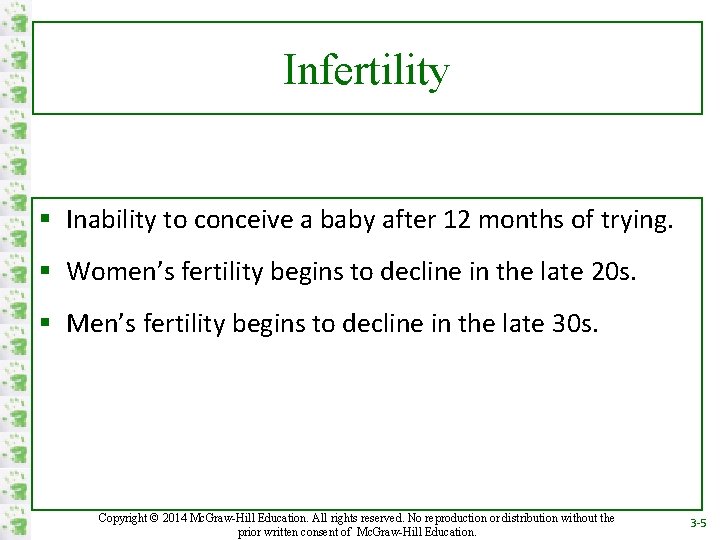
Infertility § Inability to conceive a baby after 12 months of trying. § Women’s fertility begins to decline in the late 20 s. § Men’s fertility begins to decline in the late 30 s. Copyright © 2014 Mc. Graw-Hill Education. All rights reserved. No reproduction or distribution without the prior written consent of Mc. Graw-Hill Education. 3 -5
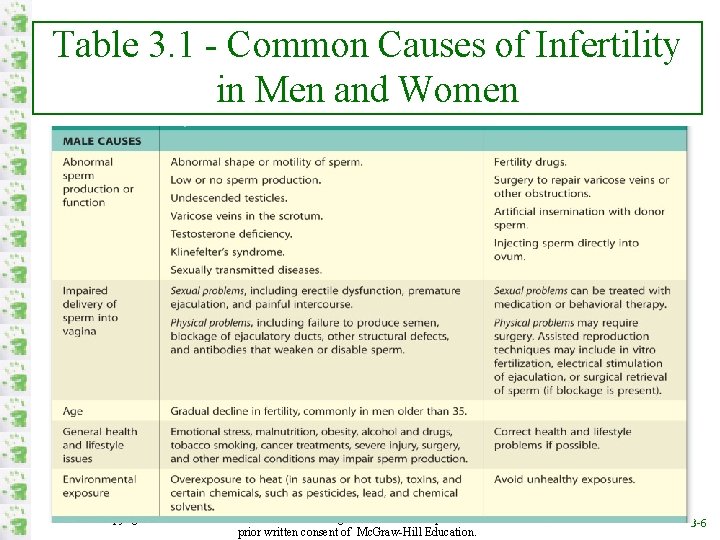
Table 3. 1 - Common Causes of Infertility in Men and Women Copyright © 2014 Mc. Graw-Hill Education. All rights reserved. No reproduction or distribution without the prior written consent of Mc. Graw-Hill Education. 3 -6
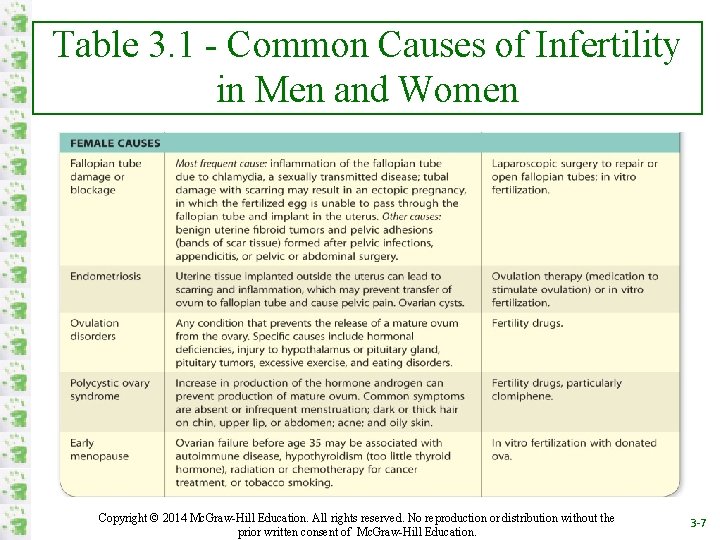
Table 3. 1 - Common Causes of Infertility in Men and Women Copyright © 2014 Mc. Graw-Hill Education. All rights reserved. No reproduction or distribution without the prior written consent of Mc. Graw-Hill Education. 3 -7
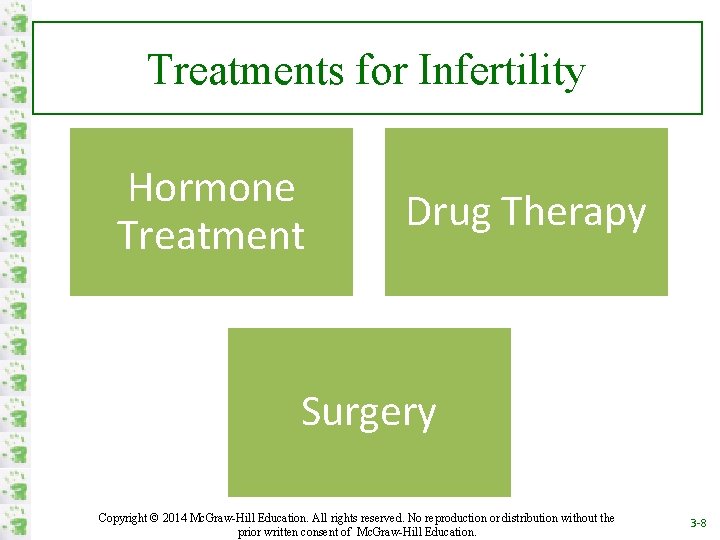
Treatments for Infertility Hormone Treatment Drug Therapy Surgery Copyright © 2014 Mc. Graw-Hill Education. All rights reserved. No reproduction or distribution without the prior written consent of Mc. Graw-Hill Education. 3 -8
Alternative Ways to Parenthood § In vitro fertilization (IVF) - Increases the likelihood of multiple, usually premature, births. § In vitro maturation (IVM) - Diminishes the likelihood of multiple births. § Performed earlier in the monthly cycle § Makes hormone injections unnecessary Copyright © 2014 Mc. Graw-Hill Education. All rights reserved. No reproduction or distribution without the prior written consent of Mc. Graw-Hill Education. 3 -9
Alternative Ways to Parenthood § Male infertility § Intracytoplasmic sperm injection (ICSI) § Artificial insemination by a donor (AID) § Gamete intrafallopian transfer (GIFT) § Zygote intrafallopian transfer (ZIFT) § Surrogate motherhood § Surrogate - Fertile woman impregnated by a prospective father by artificial insemination. Copyright © 2014 Mc. Graw-Hill Education. All rights reserved. No reproduction or distribution without the prior written consent of Mc. Graw-Hill Education. 3 -10
Mechanisms of Heredity § Genetic transmission of heritable characteristics from parents to offspring. § Genetic code § Sequence of bases within the DNA molecule. § Set of rules that govern the formation of proteins that determine the structure and functions of living cells. Copyright © 2014 Mc. Graw-Hill Education. All rights reserved. No reproduction or distribution without the prior written consent of Mc. Graw-Hill Education. 3 -11
Genetic Code § Chromosomes: Coils of DNA that consist of genes. § Genes: Small segments of DNA located in definite positions on particular chromosomes. § Functional units of heredity § Located in a definite position on chromosome § Human genome: Complete sequence of genes in the human body. Copyright © 2014 Mc. Graw-Hill Education. All rights reserved. No reproduction or distribution without the prior written consent of Mc. Graw-Hill Education. 3 -12
Cell Division § Meiosis § Type of cell division which the sex cells undergo when they are developing. § Crossing Over § Each sex cell ends up with only 23 chromosomes. § Mitosis § Process by which the nonsex cells divide in half over and over again. § DNA replicates itself, so that each newly formed cell has the same DNA structure as all the others. Copyright © 2014 Mc. Graw-Hill Education. All rights reserved. No reproduction or distribution without the prior written consent of Mc. Graw-Hill Education. 3 -13
Genotypes and Phenotypes § Phenotype: Observable characteristics of a person. § Genotype: Genetic makeup of a person, containing both expressed and unexpressed characteristics. Copyright © 2014 Mc. Graw-Hill Education. All rights reserved. No reproduction or distribution without the prior written consent of Mc. Graw-Hill Education. 3 -14
Patterns of Genetic Transmission § Dominant and recessive inheritance § Every offspring gets a pair of alleles for each characteristic, one from each parent. § Alleles: Two or more alternative forms of a gene that can occupy the same position on paired chromosomes and affect the same trait. § Homozygous: Possessing two identical alleles for a trait. § Heterozygous: Possessing differing alleles for a trait. Copyright © 2014 Mc. Graw-Hill Education. All rights reserved. No reproduction or distribution without the prior written consent of Mc. Graw-Hill Education. 3 -15
Patterns of Genetic Transmission § Polygenic inheritance § Pattern of inheritance in which multiple genes at different sites on chromosomes affect a complex trait. § Multifactorial transmission § Combination of genetic and environmental factors to produce certain complex traits. § Traits may also be affected by mutations. § Mutations: Permanent alterations in genes or chromosomes Copyright © 2014 Mc. Graw-Hill Education. All rights reserved. No reproduction or distribution without the prior written consent of Mc. Graw-Hill Education. 3 -16
Genetic Birth Defects Dominant traits Achondroplasia - Type of dwarfism Huntington’s disease Copyright © 2014 Mc. Graw-Hill Education. All rights reserved. No reproduction or distribution without the prior written consent of Mc. Graw-Hill Education. 3 -17
Genetic Disorders § Huntington’s disease § Sickle-cell anemia - Can be incomplete dominance § PKU - Phenylketonuria Copyright © 2014 Mc. Graw-Hill Education. All rights reserved. No reproduction or distribution without the prior written consent of Mc. Graw-Hill Education. 3 -18
Dominant or Recessive Inheritance of Defects § Dominant traits § Achondroplasia - Type of dwarfism § Huntington’s disease § Recessive traits § Tay-Sachs § PKU § Sickle-cell anemia - Can be incomplete dominance § Incomplete dominance: Pattern of inheritance in which a child receives two different alleles, resulting in partial expression of a trait. Copyright © 2014 Mc. Graw-Hill Education. All rights reserved. No reproduction or distribution without the prior written consent of Mc. Graw-Hill Education. 3 -19
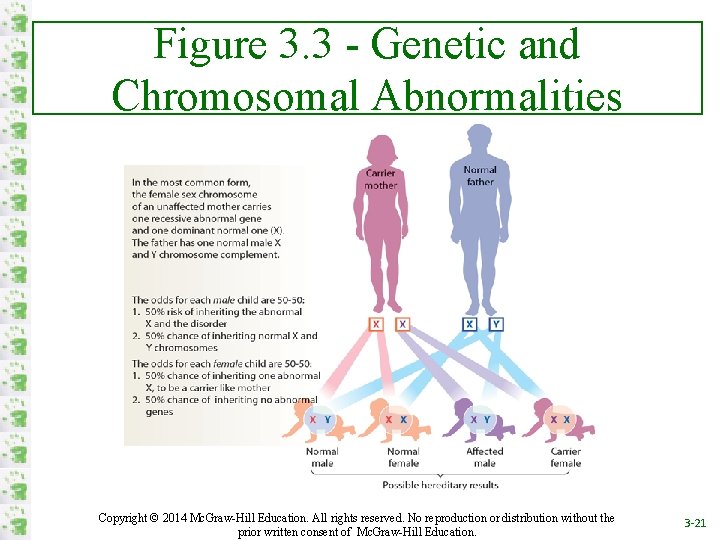
Sex-Linked Inheritance of Defects § Sex-linked inheritance: Pattern of inheritance in which certain characteristics carried on the X chromosome inherited from the mother are transmitted differently to her male and female offspring. § Certain recessive disorders are linked to genes on the sex chromosomes. § Male and female children affected differently. § Carriers - Heterozygote females who carry one bad copy of a recessive gene and one good one. Copyright © 2014 Mc. Graw-Hill Education. All rights reserved. No reproduction or distribution without the prior written consent of Mc. Graw-Hill Education. 3 -20
Figure 3. 3 - Genetic and Chromosomal Abnormalities Copyright © 2014 Mc. Graw-Hill Education. All rights reserved. No reproduction or distribution without the prior written consent of Mc. Graw-Hill Education. 3 -21
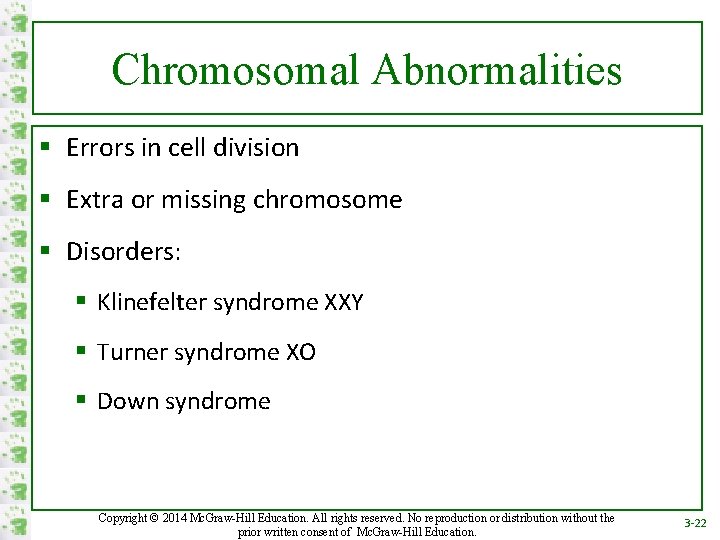
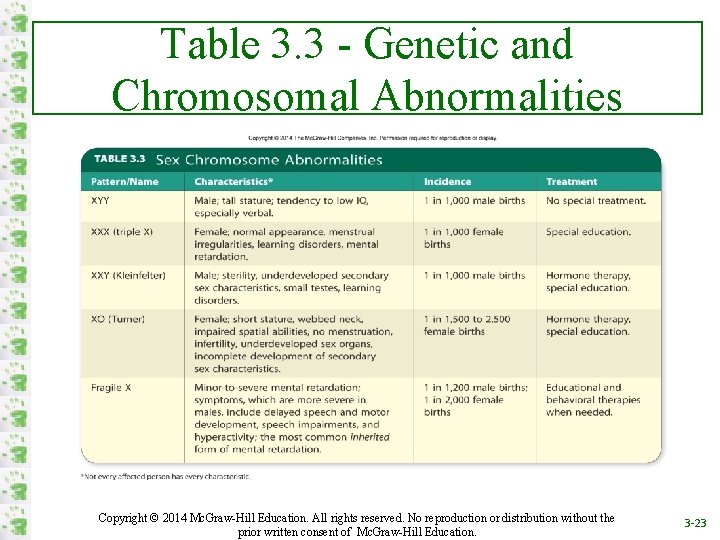
Chromosomal Abnormalities § Errors in cell division § Extra or missing chromosome § Disorders: § Klinefelter syndrome XXY § Turner syndrome XO § Down syndrome Copyright © 2014 Mc. Graw-Hill Education. All rights reserved. No reproduction or distribution without the prior written consent of Mc. Graw-Hill Education. 3 -22
Table 3. 3 - Genetic and Chromosomal Abnormalities Copyright © 2014 Mc. Graw-Hill Education. All rights reserved. No reproduction or distribution without the prior written consent of Mc. Graw-Hill Education. 3 -23
Relative Influences of Heredity and Environment § Behavioral genetics: Quantitative study of relative hereditary and environmental influences on behavior. § Heritability: Statistical estimate of contribution of heredity to individual differences in a specific trait within a given population at a particular time. Copyright © 2014 Mc. Graw-Hill Education. All rights reserved. No reproduction or distribution without the prior written consent of Mc. Graw-Hill Education. 3 -24
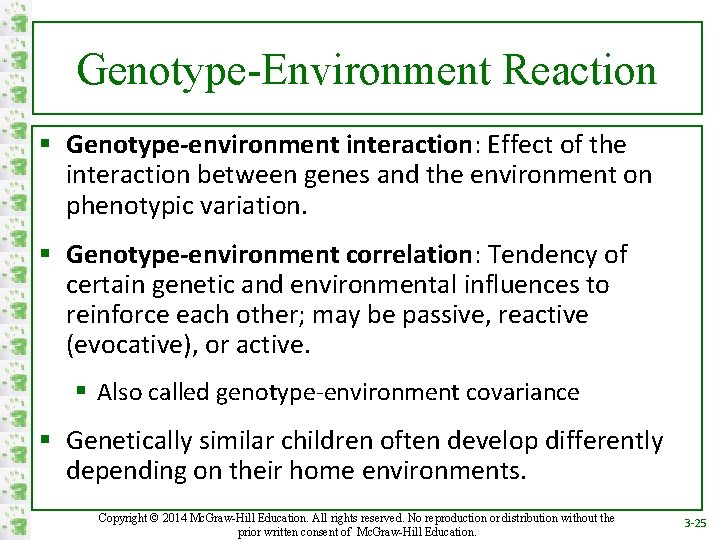
Genotype-Environment Reaction § Genotype-environment interaction: Effect of the interaction between genes and the environment on phenotypic variation. § Genotype-environment correlation: Tendency of certain genetic and environmental influences to reinforce each other; may be passive, reactive (evocative), or active. § Also called genotype-environment covariance § Genetically similar children often develop differently depending on their home environments. Copyright © 2014 Mc. Graw-Hill Education. All rights reserved. No reproduction or distribution without the prior written consent of Mc. Graw-Hill Education. 3 -25
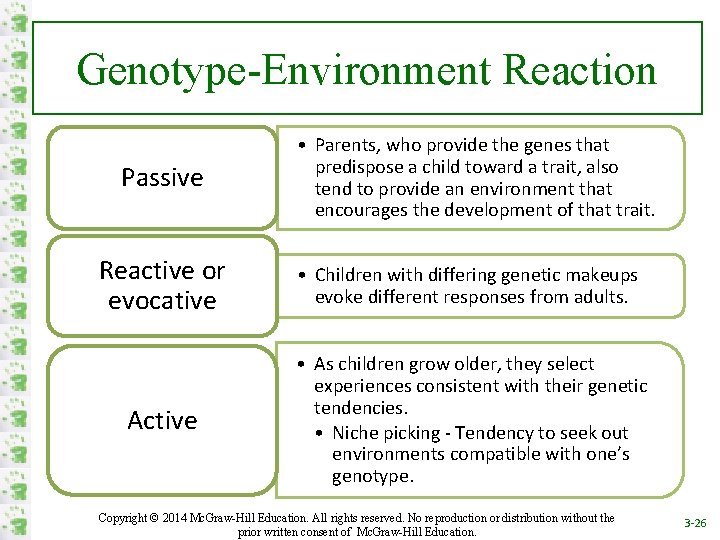
Genotype-Environment Reaction Passive • Parents, who provide the genes that predispose a child toward a trait, also tend to provide an environment that encourages the development of that trait. Reactive or evocative • Children with differing genetic makeups evoke different responses from adults. Active • As children grow older, they select experiences consistent with their genetic tendencies. • Niche picking - Tendency to seek out environments compatible with one’s genotype. Copyright © 2014 Mc. Graw-Hill Education. All rights reserved. No reproduction or distribution without the prior written consent of Mc. Graw-Hill Education. 3 -26
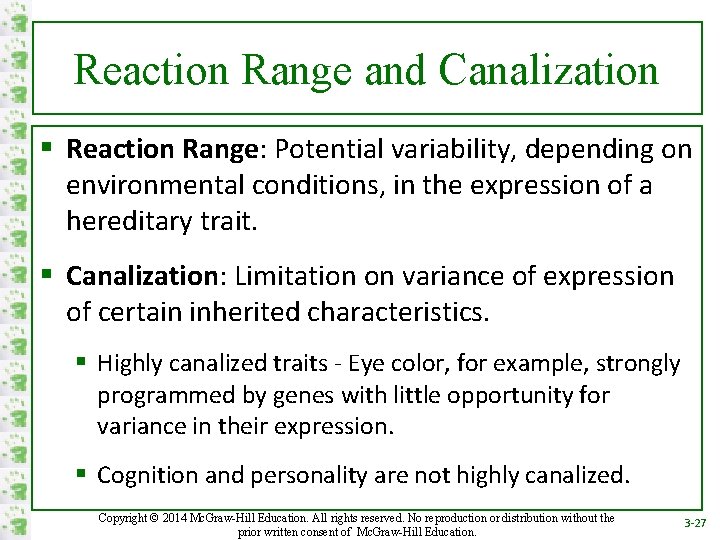
Reaction Range and Canalization § Reaction Range: Potential variability, depending on environmental conditions, in the expression of a hereditary trait. § Canalization: Limitation on variance of expression of certain inherited characteristics. § Highly canalized traits - Eye color, for example, strongly programmed by genes with little opportunity for variance in their expression. § Cognition and personality are not highly canalized. Copyright © 2014 Mc. Graw-Hill Education. All rights reserved. No reproduction or distribution without the prior written consent of Mc. Graw-Hill Education. 3 -27
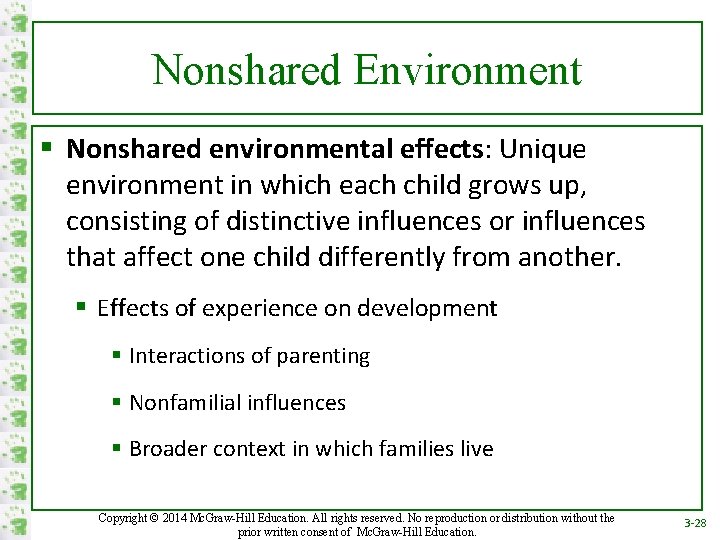
Nonshared Environment § Nonshared environmental effects: Unique environment in which each child grows up, consisting of distinctive influences or influences that affect one child differently from another. § Effects of experience on development § Interactions of parenting § Nonfamilial influences § Broader context in which families live Copyright © 2014 Mc. Graw-Hill Education. All rights reserved. No reproduction or distribution without the prior written consent of Mc. Graw-Hill Education. 3 -28