
Chapter 3 Formalism Hilbert space Lets recall for

Chapter 3 Formalism
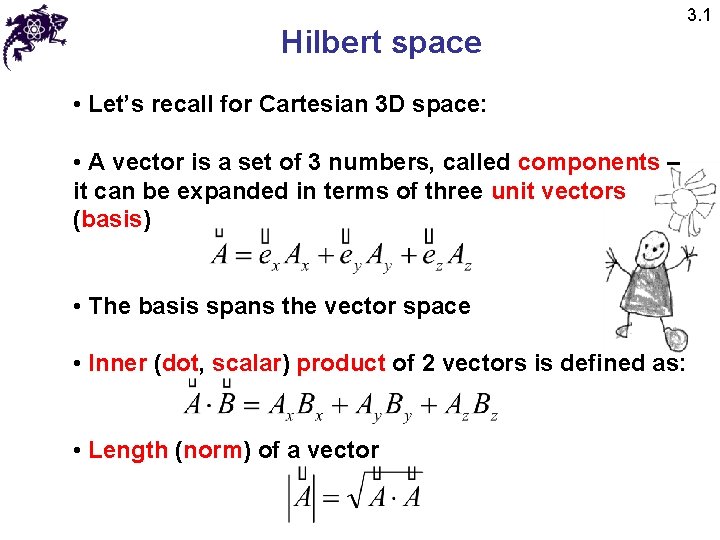
Hilbert space • Let’s recall for Cartesian 3 D space: • A vector is a set of 3 numbers, called components – it can be expanded in terms of three unit vectors (basis) • The basis spans the vector space • Inner (dot, scalar) product of 2 vectors is defined as: • Length (norm) of a vector 3. 1

Hilbert space 3. 1
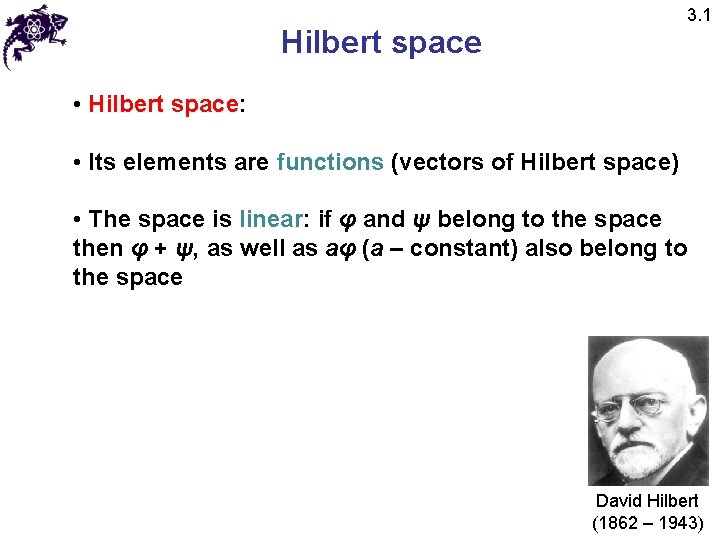
3. 1 Hilbert space • Hilbert space: • Its elements are functions (vectors of Hilbert space) • The space is linear: if φ and ψ belong to the space then φ + ψ, as well as aφ (a – constant) also belong to the space David Hilbert (1862 – 1943)
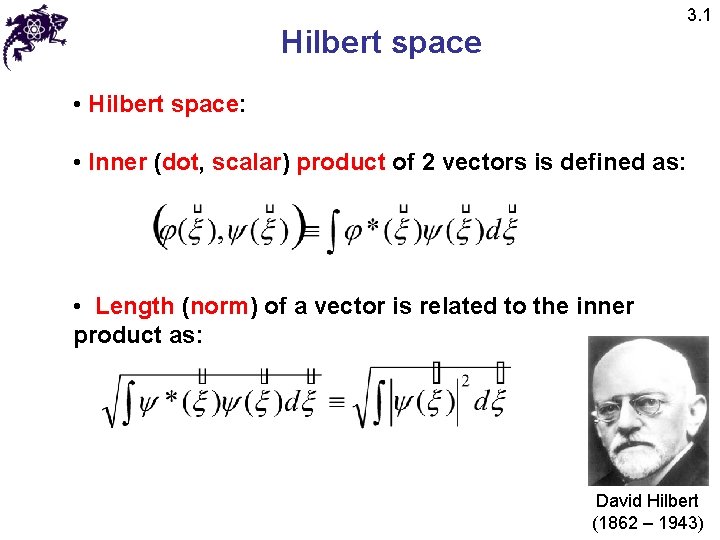
3. 1 Hilbert space • Hilbert space: • Inner (dot, scalar) product of 2 vectors is defined as: • Length (norm) of a vector is related to the inner product as: David Hilbert (1862 – 1943)
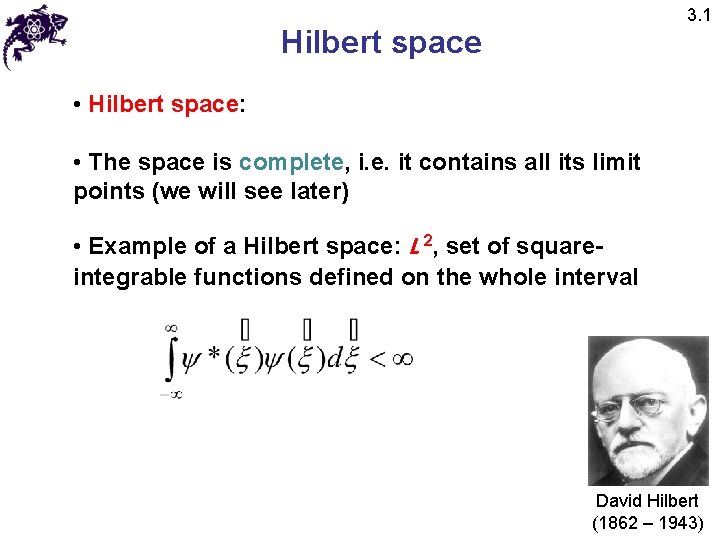
3. 1 Hilbert space • Hilbert space: • The space is complete, i. e. it contains all its limit points (we will see later) • Example of a Hilbert space: L 2, set of squareintegrable functions defined on the whole interval David Hilbert (1862 – 1943)
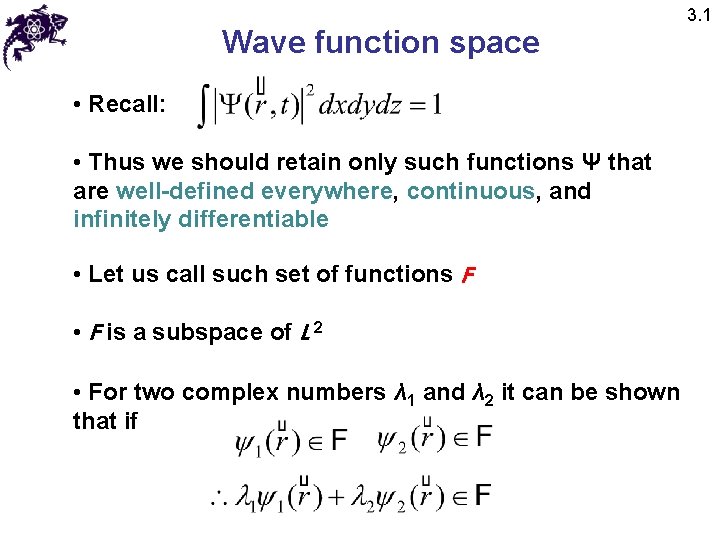
Wave function space • Recall: • Thus we should retain only such functions Ψ that are well-defined everywhere, continuous, and infinitely differentiable • Let us call such set of functions F • F is a subspace of L 2 • For two complex numbers λ 1 and λ 2 it can be shown that if 3. 1
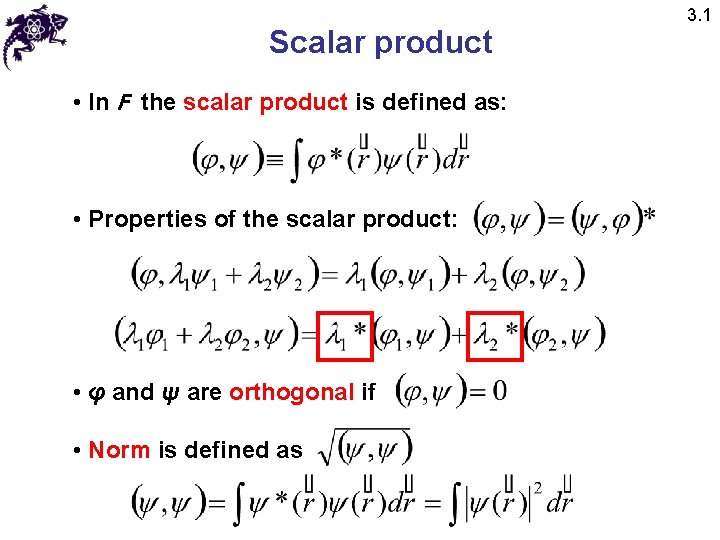
Scalar product • In F the scalar product is defined as: • Properties of the scalar product: • φ and ψ are orthogonal if • Norm is defined as 3. 1
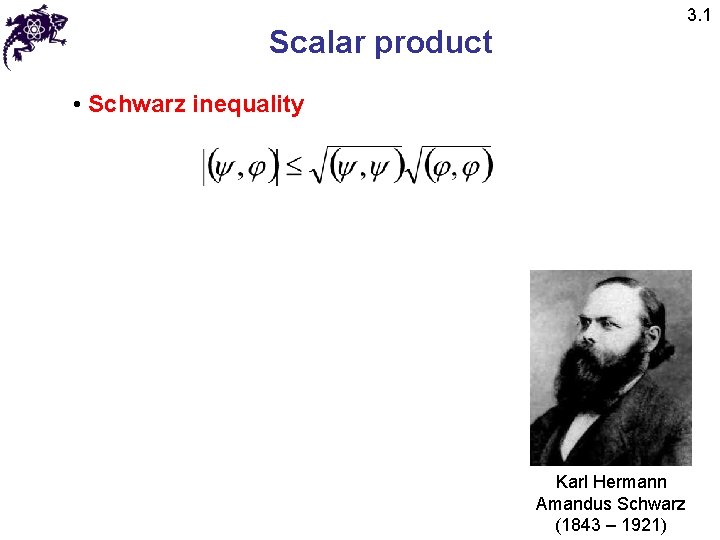
3. 1 Scalar product • Schwarz inequality Karl Hermann Amandus Schwarz (1843 – 1921)
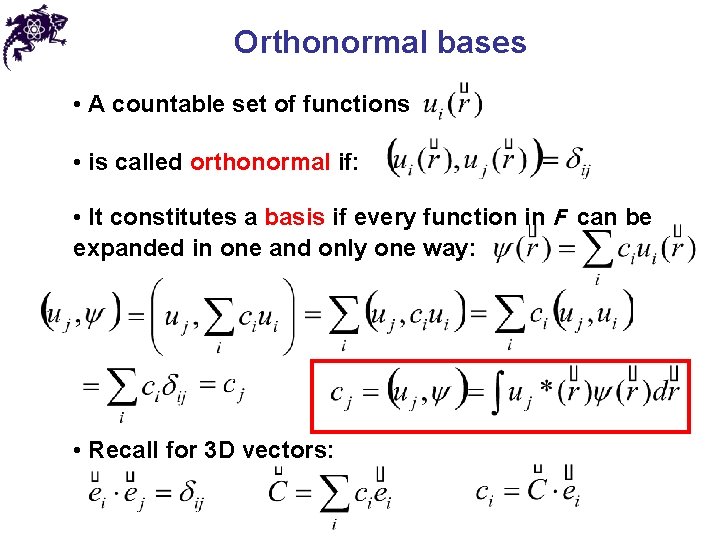
Orthonormal bases • A countable set of functions • is called orthonormal if: • It constitutes a basis if every function in F can be expanded in one and only one way: • Recall for 3 D vectors:
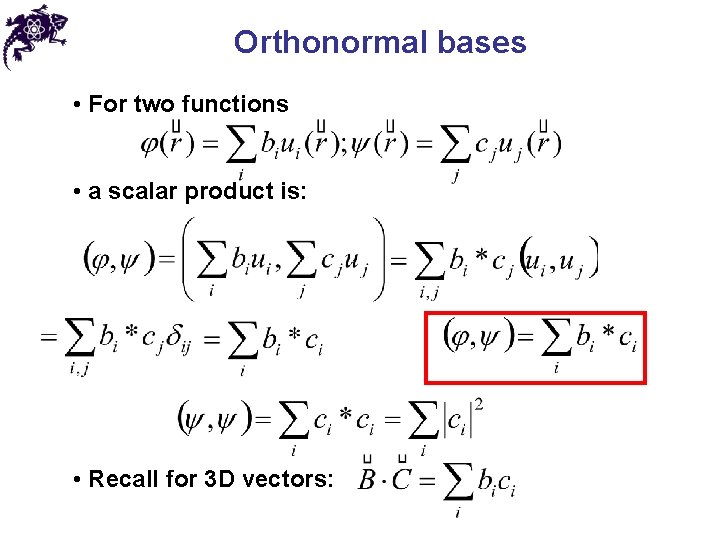
Orthonormal bases • For two functions • a scalar product is: • Recall for 3 D vectors:
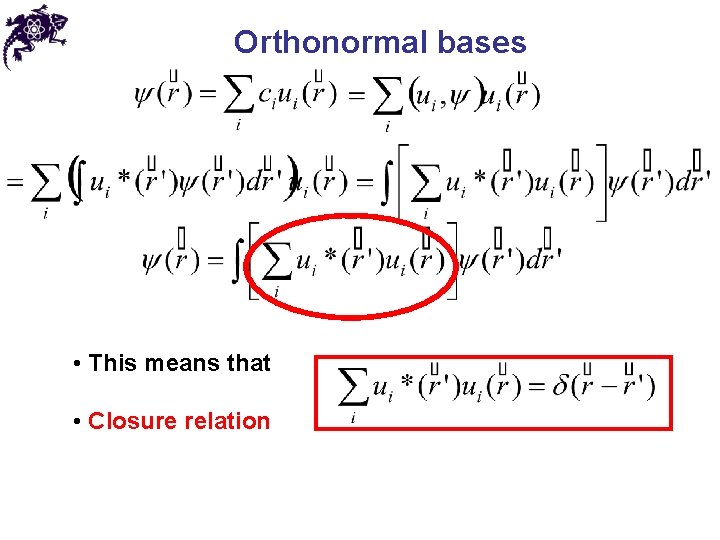
Orthonormal bases • This means that • Closure relation
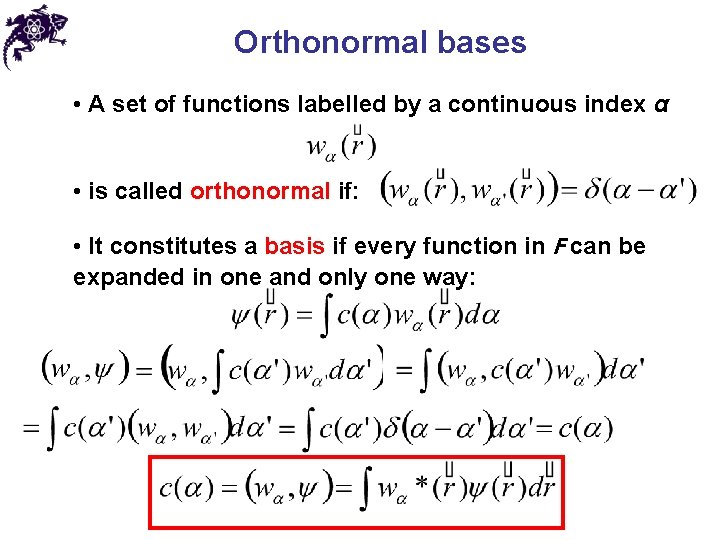
Orthonormal bases • A set of functions labelled by a continuous index α • is called orthonormal if: • It constitutes a basis if every function in F can be expanded in one and only one way:
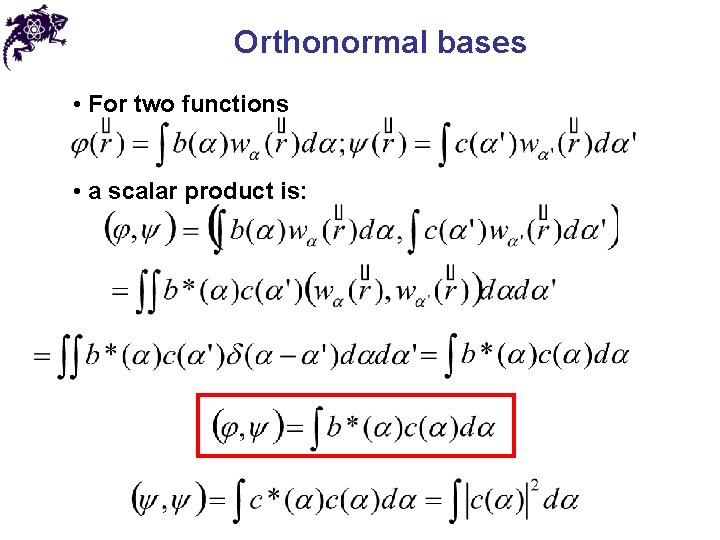
Orthonormal bases • For two functions • a scalar product is:
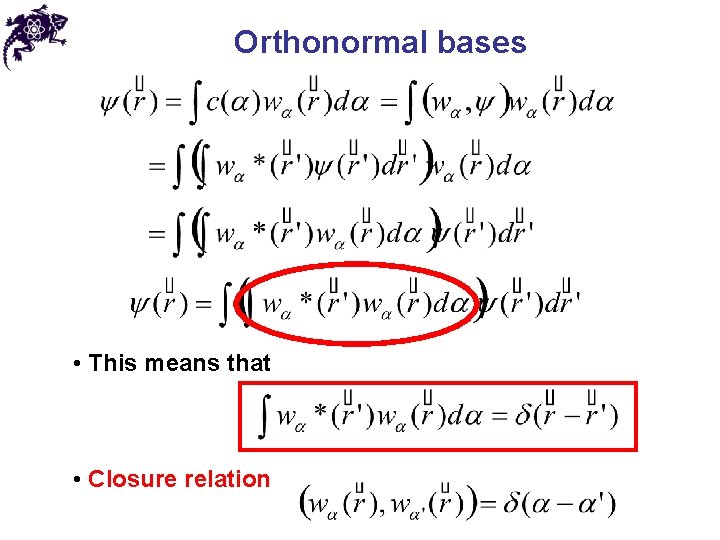
Orthonormal bases • This means that • Closure relation
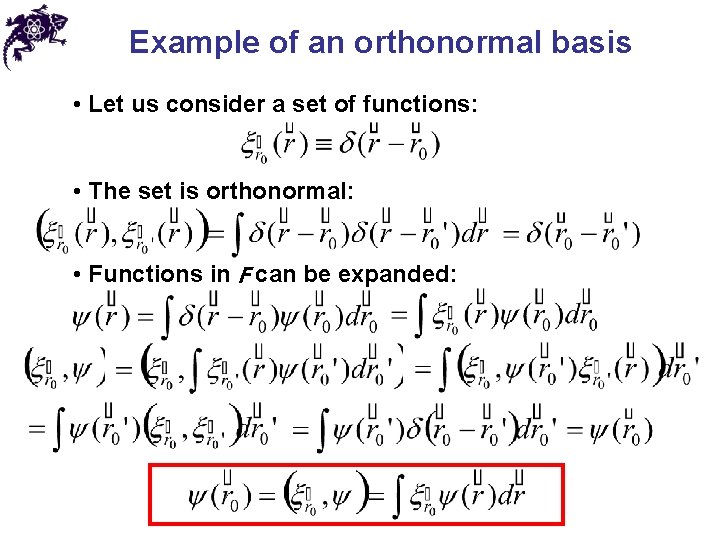
Example of an orthonormal basis • Let us consider a set of functions: • The set is orthonormal: • Functions in F can be expanded:
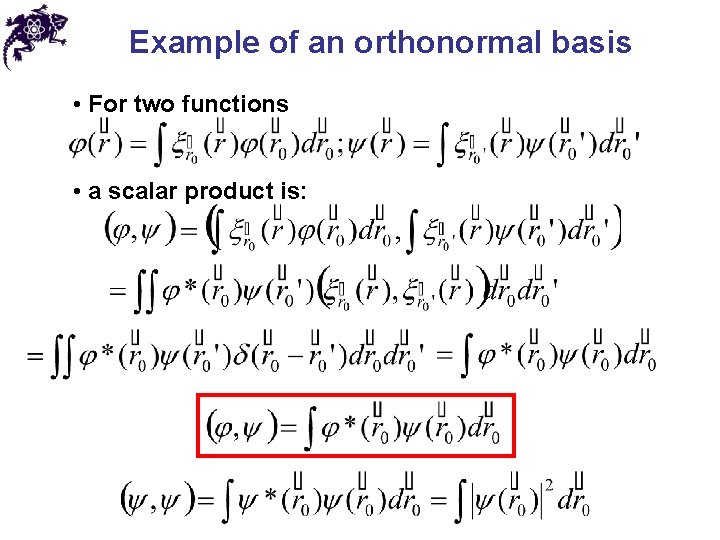
Example of an orthonormal basis • For two functions • a scalar product is:
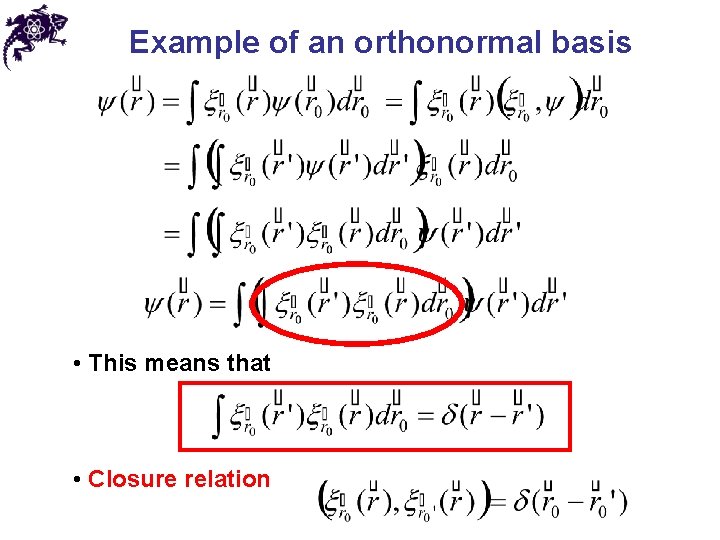
Example of an orthonormal basis • This means that • Closure relation
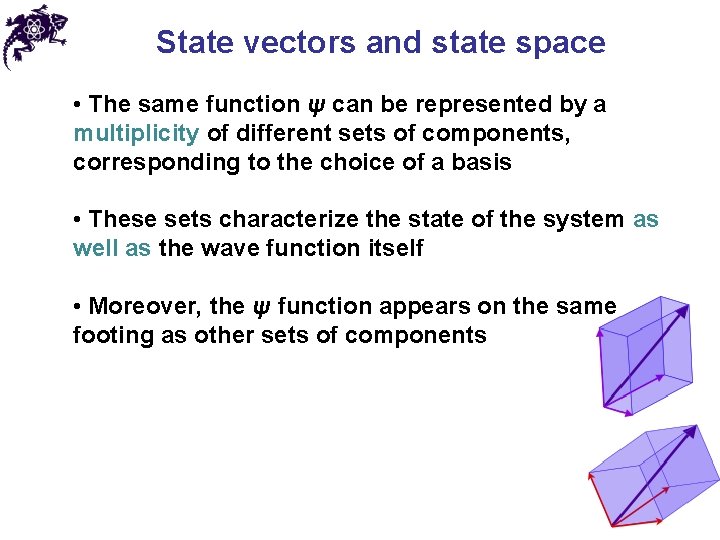
State vectors and state space • The same function ψ can be represented by a multiplicity of different sets of components, corresponding to the choice of a basis • These sets characterize the state of the system as well as the wave function itself • Moreover, the ψ function appears on the same footing as other sets of components
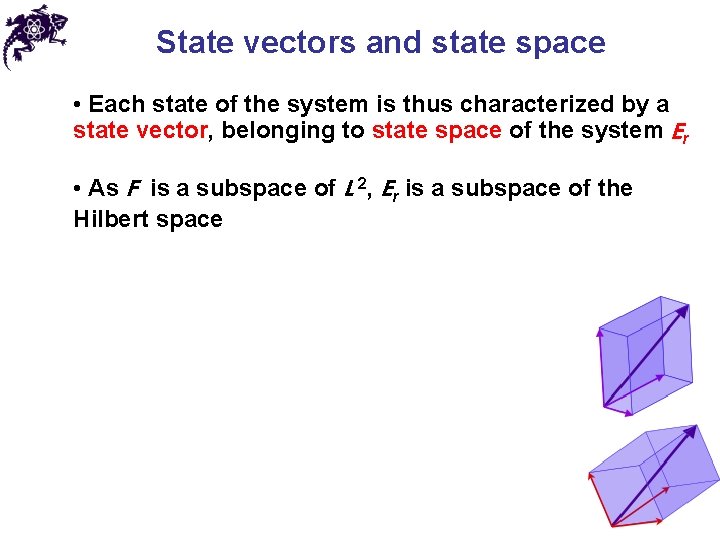
State vectors and state space • Each state of the system is thus characterized by a state vector, belonging to state space of the system Er • As F is a subspace of L 2, Er is a subspace of the Hilbert space
Dirac notation 3. 6 • Bracket = “bra” x “ket” • < > = < | > = “< |” x “| >” Paul Adrien Maurice Dirac (1902 – 1984)
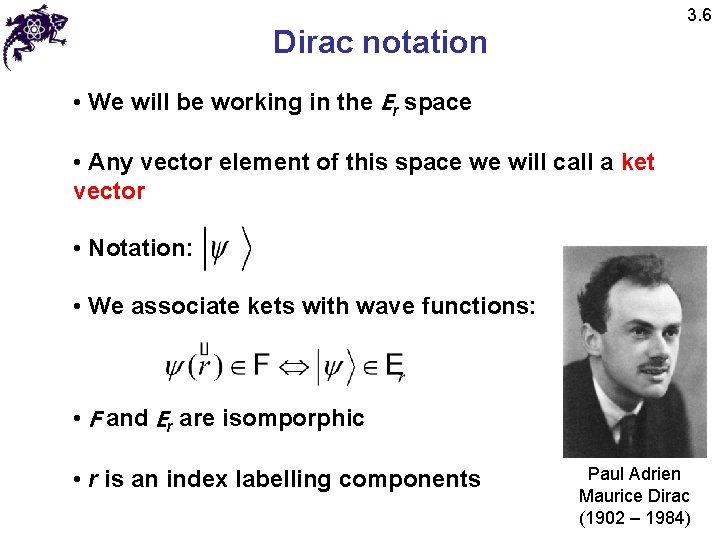
3. 6 Dirac notation • We will be working in the Er space • Any vector element of this space we will call a ket vector • Notation: • We associate kets with wave functions: • F and Er are isomporphic • r is an index labelling components Paul Adrien Maurice Dirac (1902 – 1984)
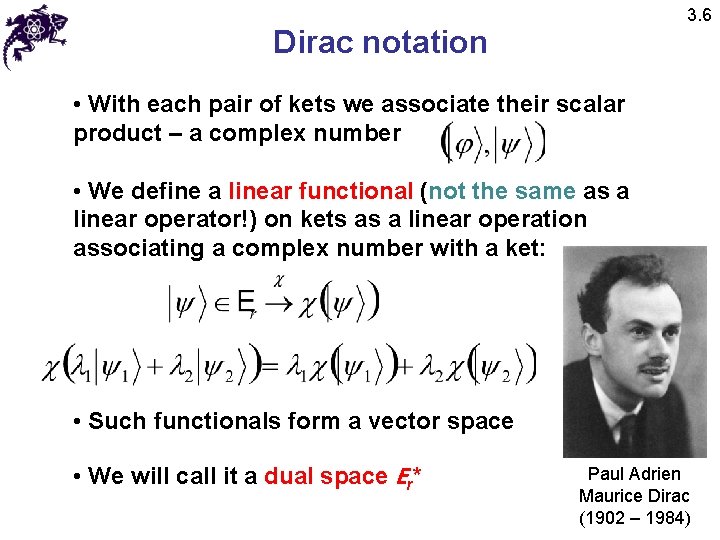
3. 6 Dirac notation • With each pair of kets we associate their scalar product – a complex number • We define a linear functional (not the same as a linear operator!) on kets as a linear operation associating a complex number with a ket: • Such functionals form a vector space • We will call it a dual space Er* Paul Adrien Maurice Dirac (1902 – 1984)
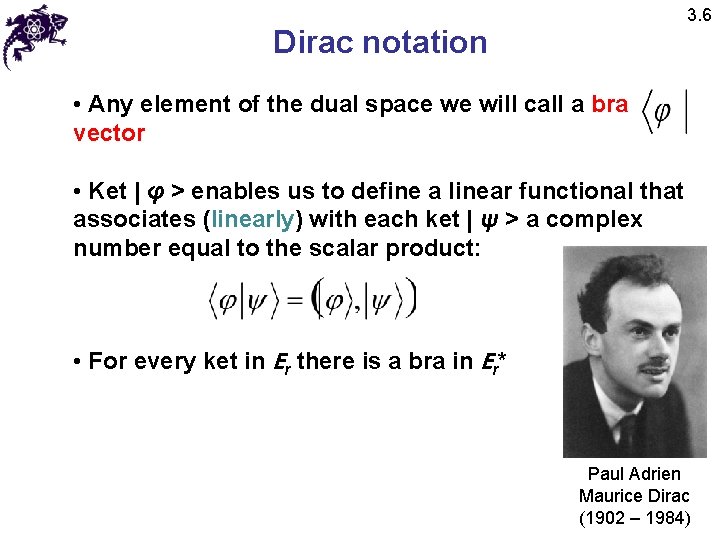
3. 6 Dirac notation • Any element of the dual space we will call a bra vector • Ket | φ > enables us to define a linear functional that associates (linearly) with each ket | ψ > a complex number equal to the scalar product: • For every ket in Er there is a bra in Er* Paul Adrien Maurice Dirac (1902 – 1984)
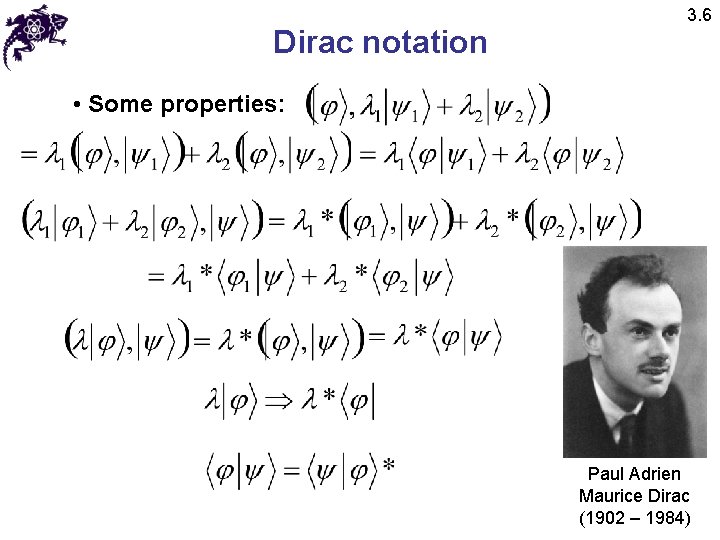
Dirac notation 3. 6 • Some properties: Paul Adrien Maurice Dirac (1902 – 1984)
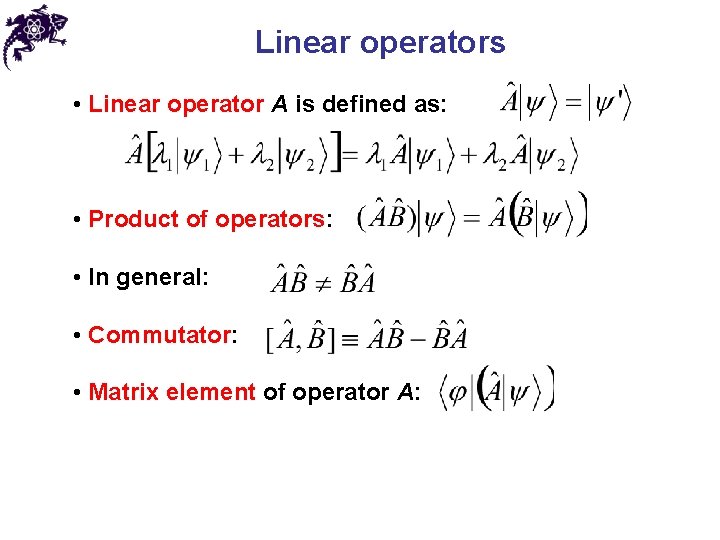
Linear operators • Linear operator A is defined as: • Product of operators: • In general: • Commutator: • Matrix element of operator A:
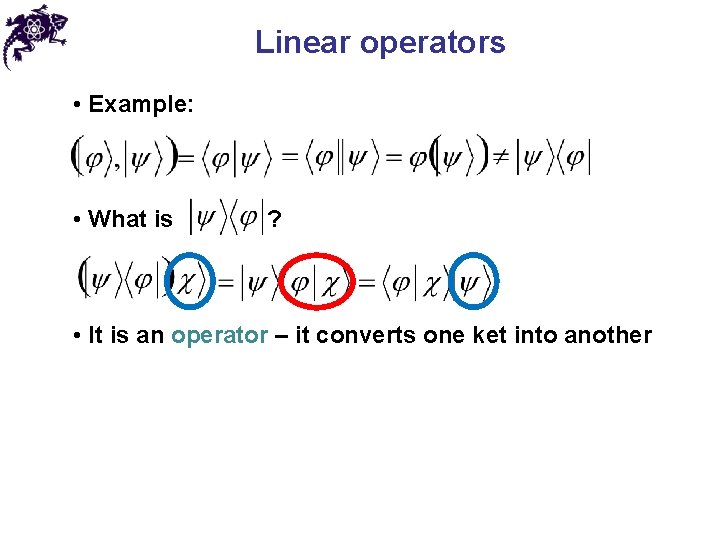
Linear operators • Example: • What is ? • It is an operator – it converts one ket into another
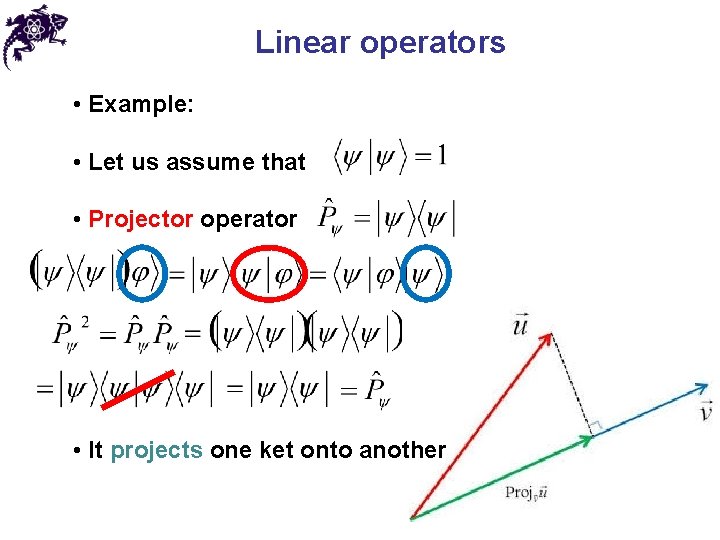
Linear operators • Example: • Let us assume that • Projector operator • It projects one ket onto another
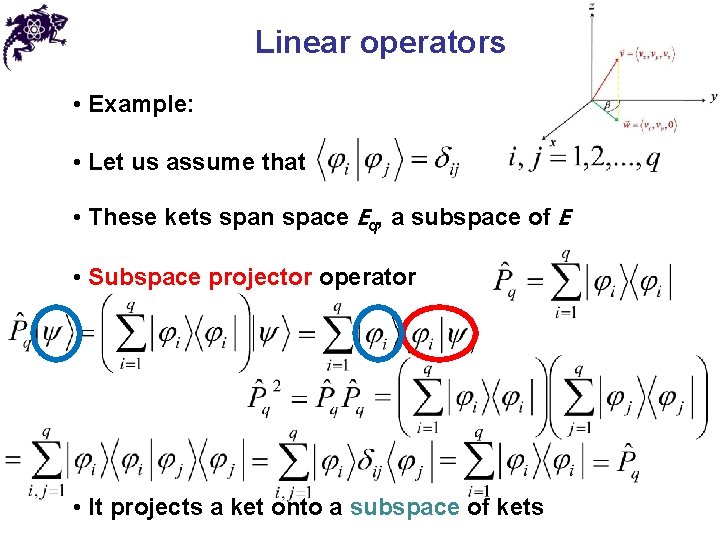
Linear operators • Example: • Let us assume that • These kets span space Eq, a subspace of E • Subspace projector operator • It projects a ket onto a subspace of kets
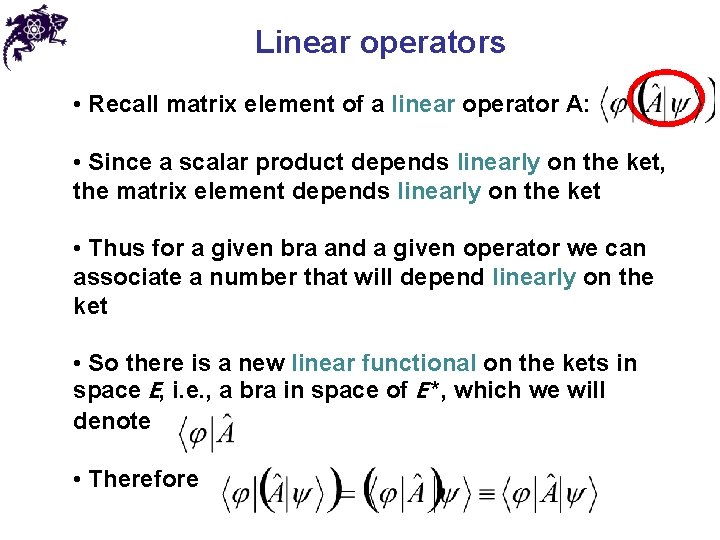
Linear operators • Recall matrix element of a linear operator A: • Since a scalar product depends linearly on the ket, the matrix element depends linearly on the ket • Thus for a given bra and a given operator we can associate a number that will depend linearly on the ket • So there is a new linear functional on the kets in space E, i. e. , a bra in space of E *, which we will denote • Therefore
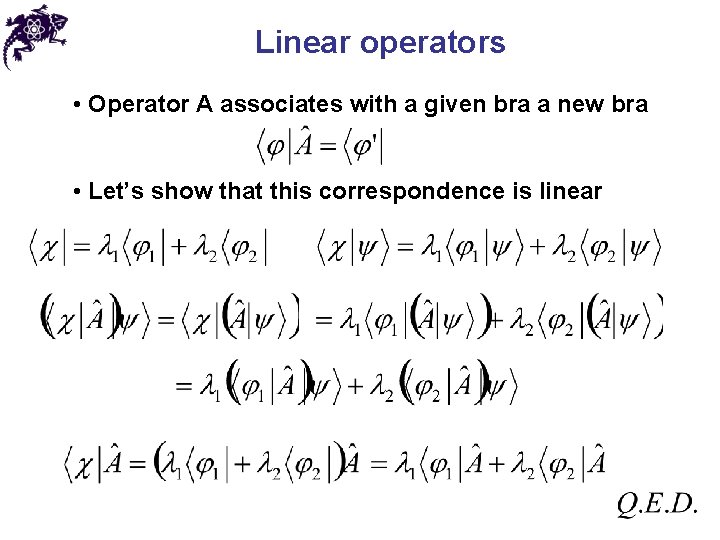
Linear operators • Operator A associates with a given bra a new bra • Let’s show that this correspondence is linear
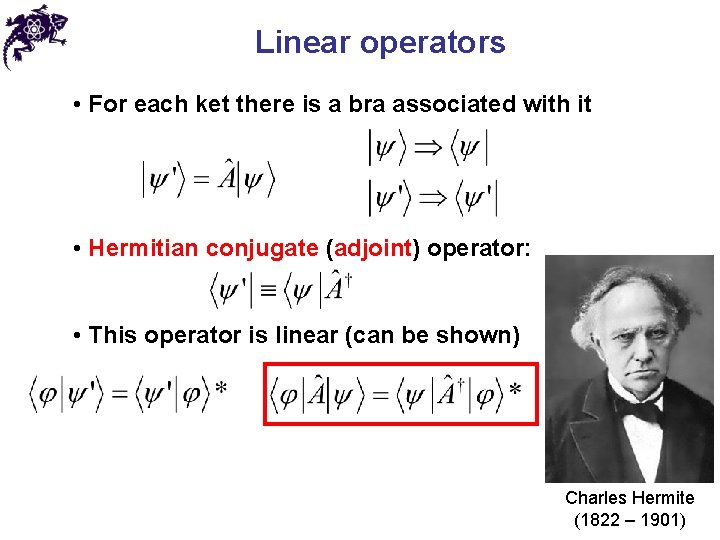
Linear operators • For each ket there is a bra associated with it • Hermitian conjugate (adjoint) operator: • This operator is linear (can be shown) Charles Hermite (1822 – 1901)
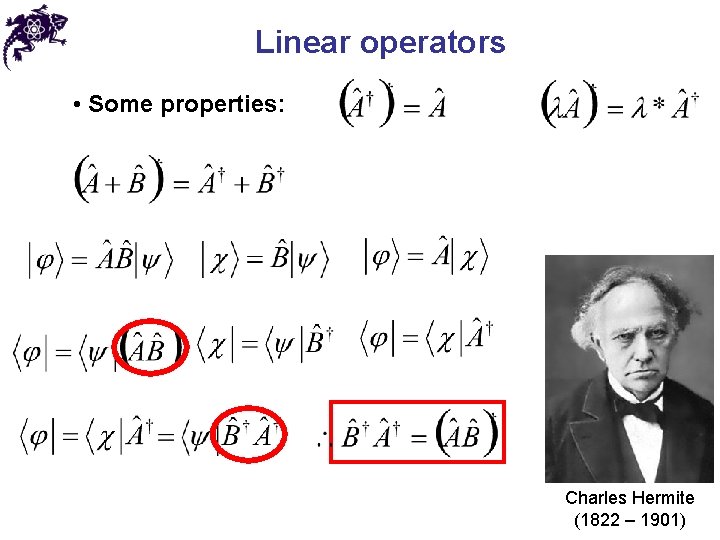
Linear operators • Some properties: Charles Hermite (1822 – 1901)
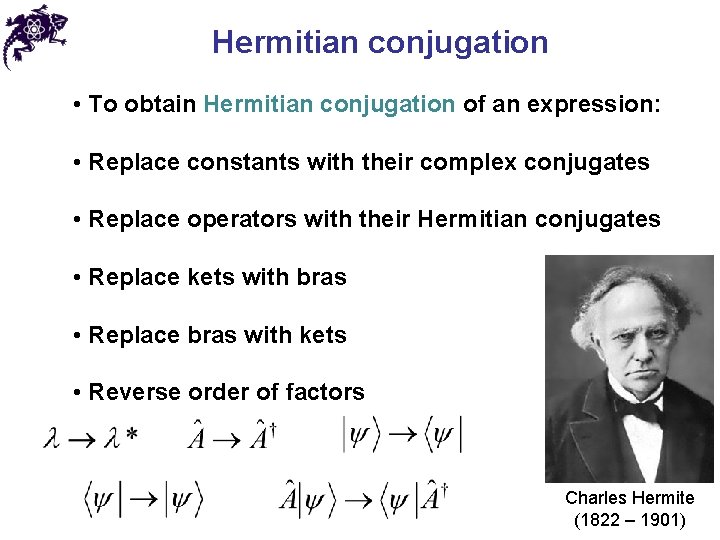
Hermitian conjugation • To obtain Hermitian conjugation of an expression: • Replace constants with their complex conjugates • Replace operators with their Hermitian conjugates • Replace kets with bras • Replace bras with kets • Reverse order of factors Charles Hermite (1822 – 1901)
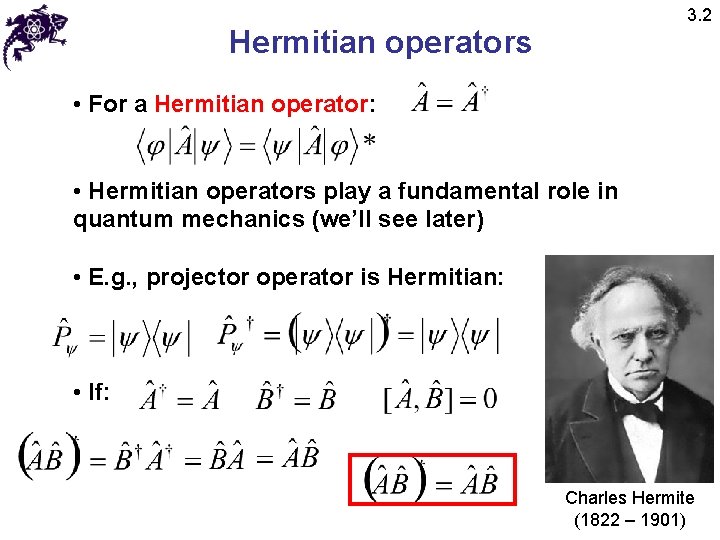
3. 2 Hermitian operators • For a Hermitian operator: • Hermitian operators play a fundamental role in quantum mechanics (we’ll see later) • E. g. , projector operator is Hermitian: • If: Charles Hermite (1822 – 1901)
Representations in state space • In a certain basis, vectors and operators are represented by numbers (components and matrix elements) • Thus vector calculus becomes matrix calculus • A choice of a specific representation is dictated by the simplicity of calculations • We will rewrite expressions obtained above for orthonormal bases using Dirac notation
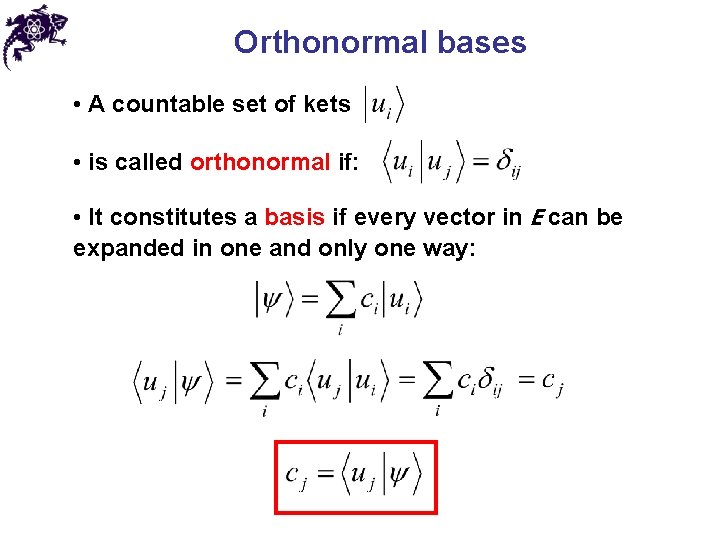
Orthonormal bases • A countable set of kets • is called orthonormal if: • It constitutes a basis if every vector in E can be expanded in one and only one way:
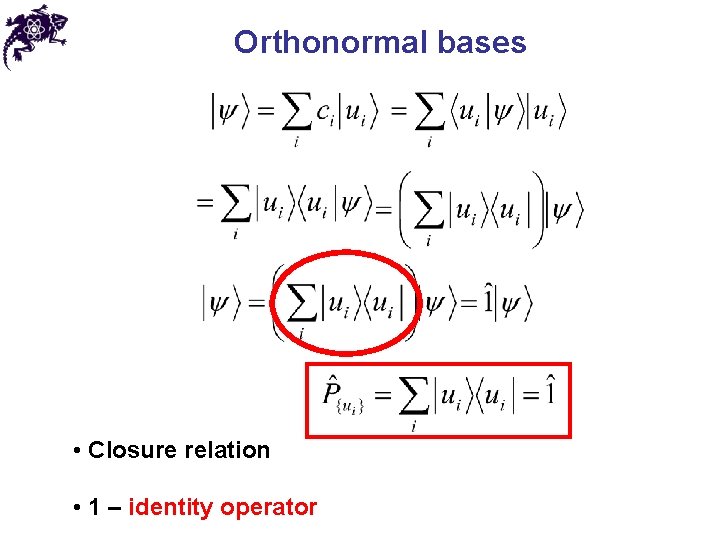
Orthonormal bases • Closure relation • 1 – identity operator
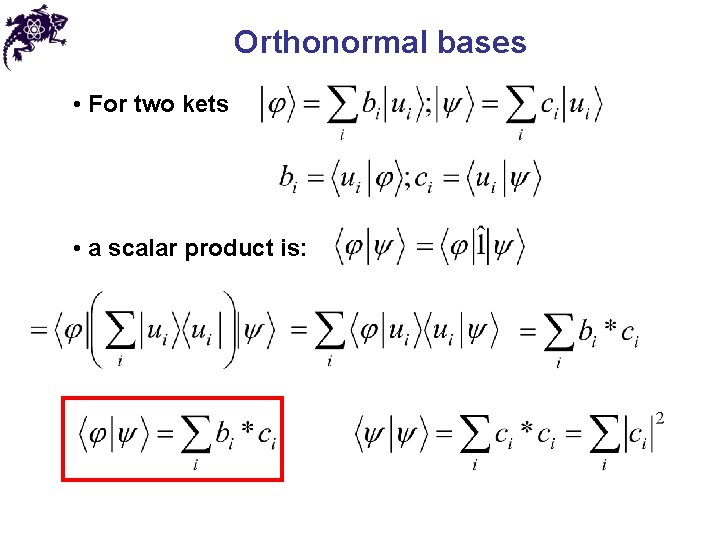
Orthonormal bases • For two kets • a scalar product is:
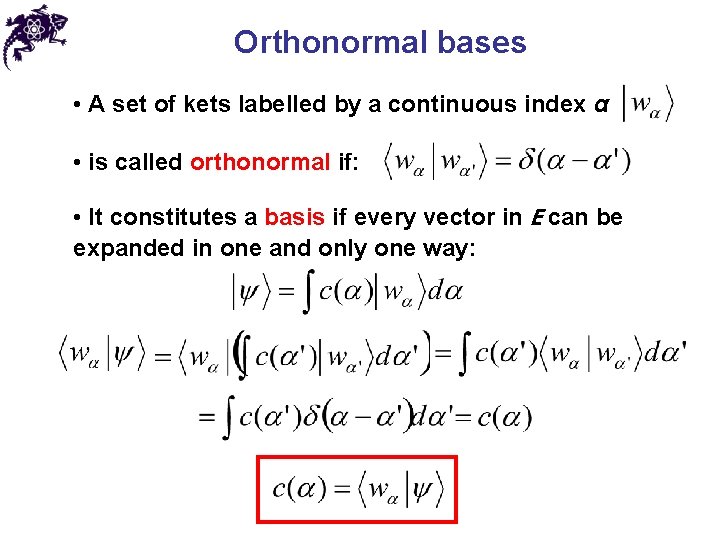
Orthonormal bases • A set of kets labelled by a continuous index α • is called orthonormal if: • It constitutes a basis if every vector in E can be expanded in one and only one way:
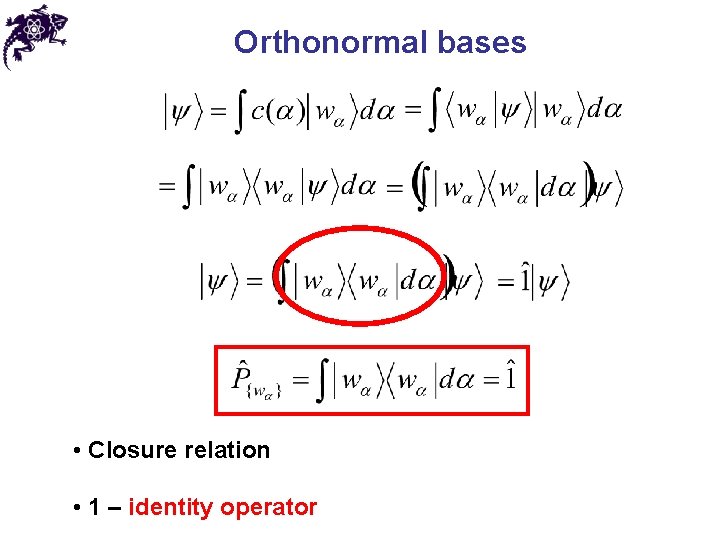
Orthonormal bases • Closure relation • 1 – identity operator
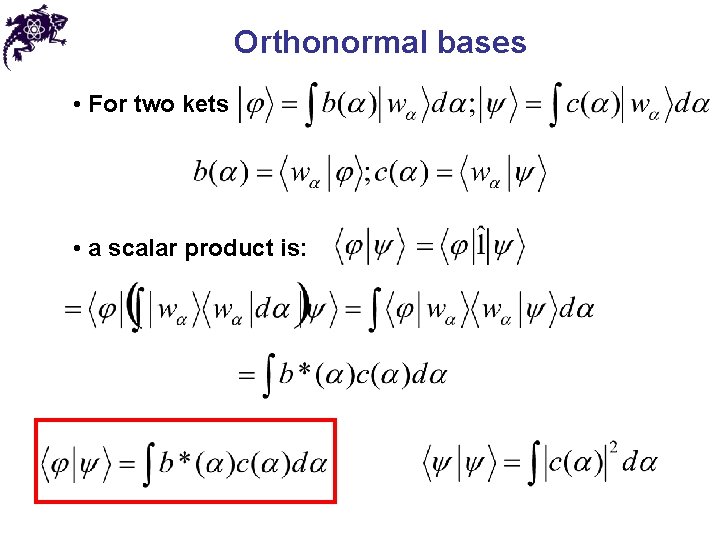
Orthonormal bases • For two kets • a scalar product is:
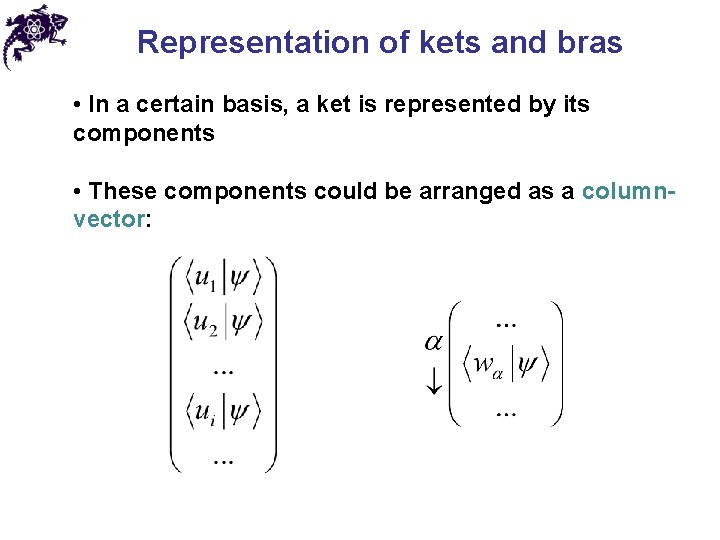
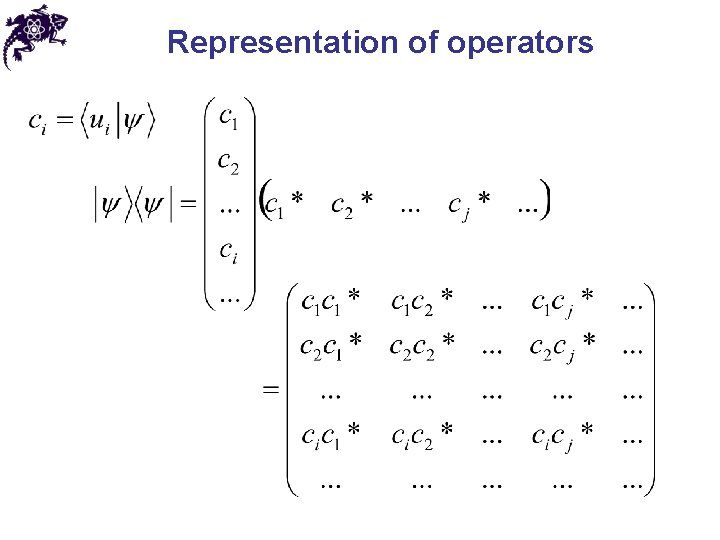
Representation of kets and bras • In a certain basis, a ket is represented by its components • These components could be arranged as a columnvector:
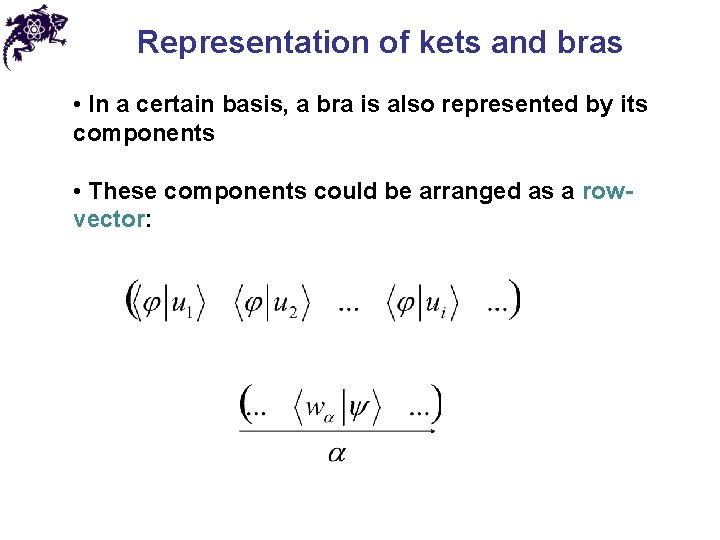
Representation of kets and bras • In a certain basis, a bra is also represented by its components • These components could be arranged as a rowvector:
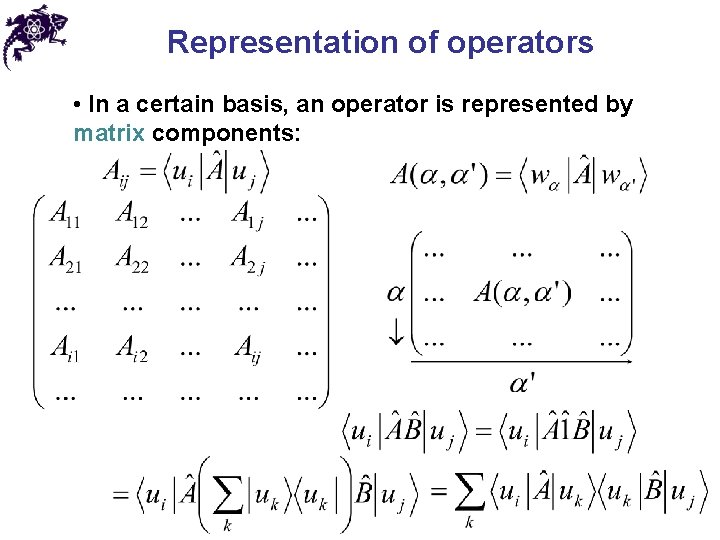
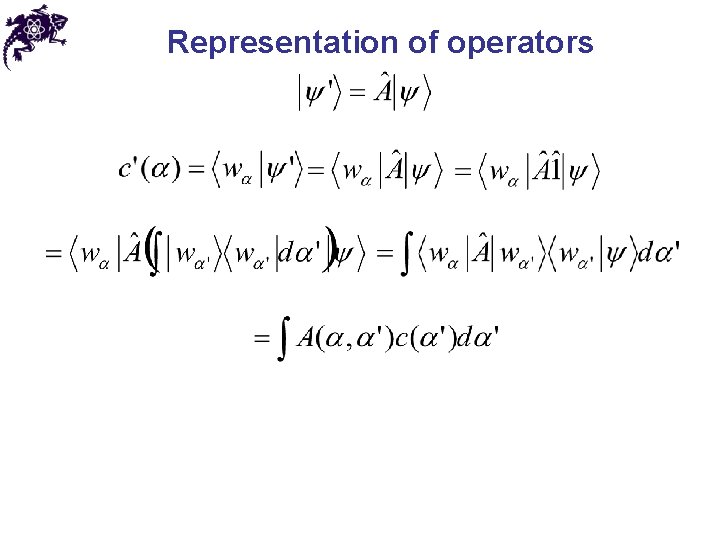
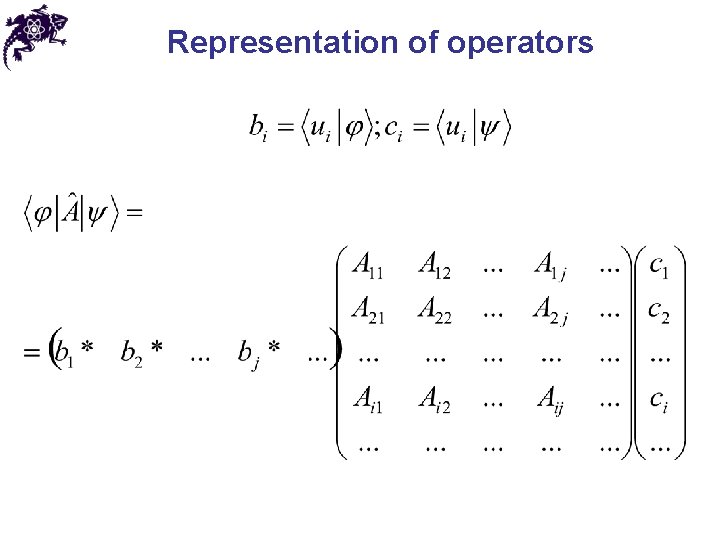
Representation of operators • In a certain basis, an operator is represented by matrix components:
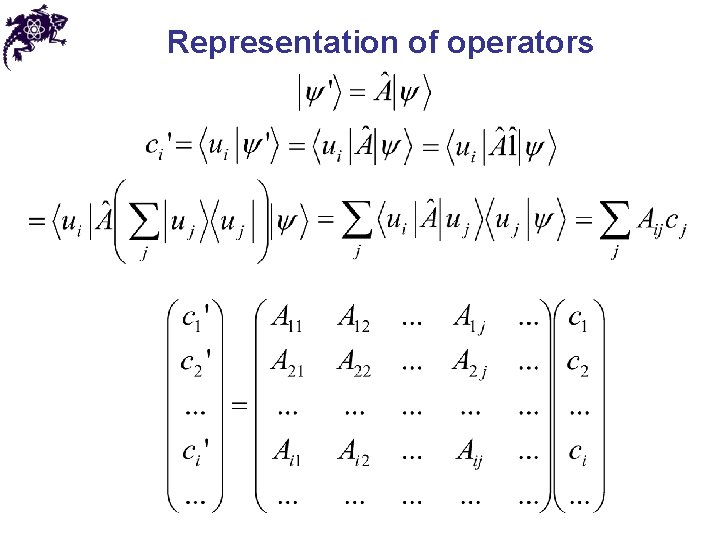
Representation of operators
Representation of operators
Representation of operators
Representation of operators
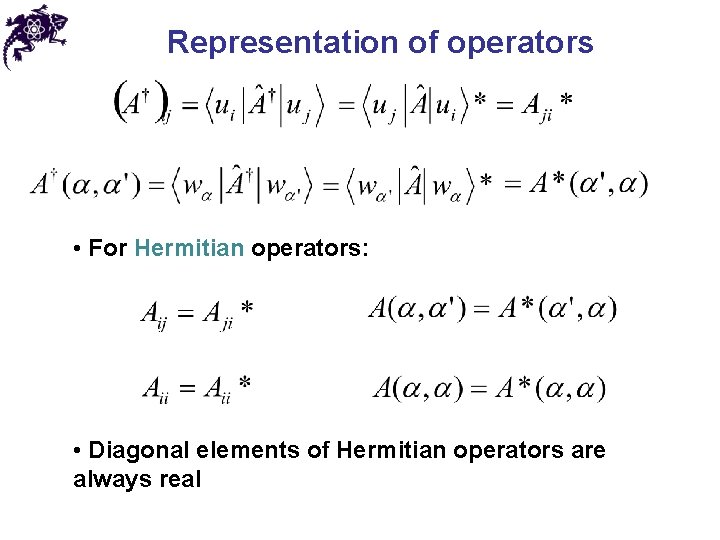
Representation of operators • For Hermitian operators: • Diagonal elements of Hermitian operators are always real
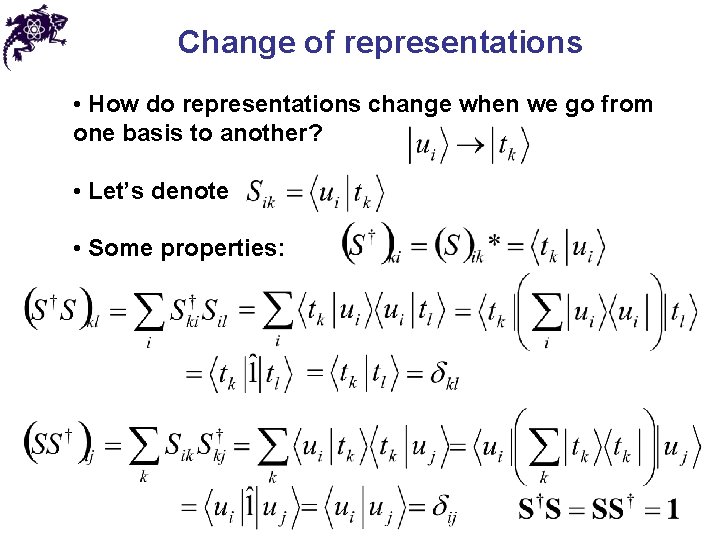
Change of representations • How do representations change when we go from one basis to another? • Let’s denote • Some properties:
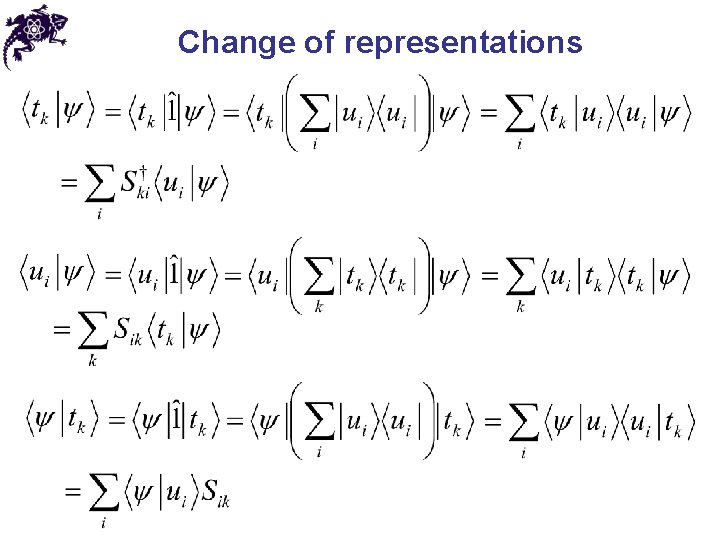
Change of representations
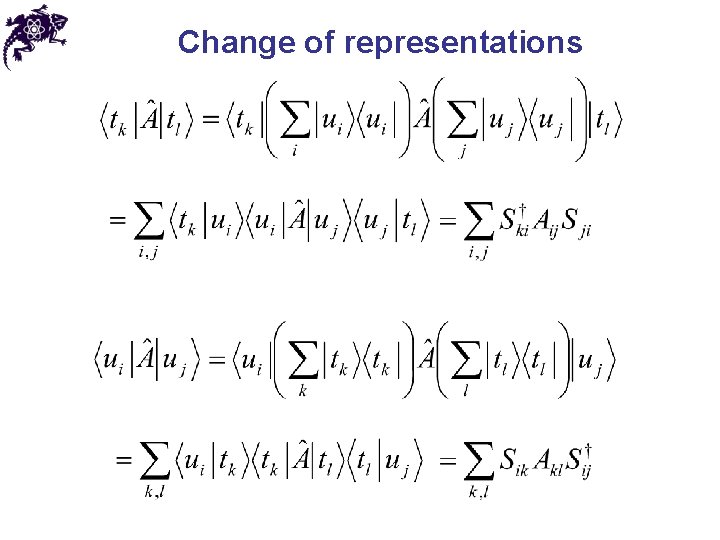
Change of representations
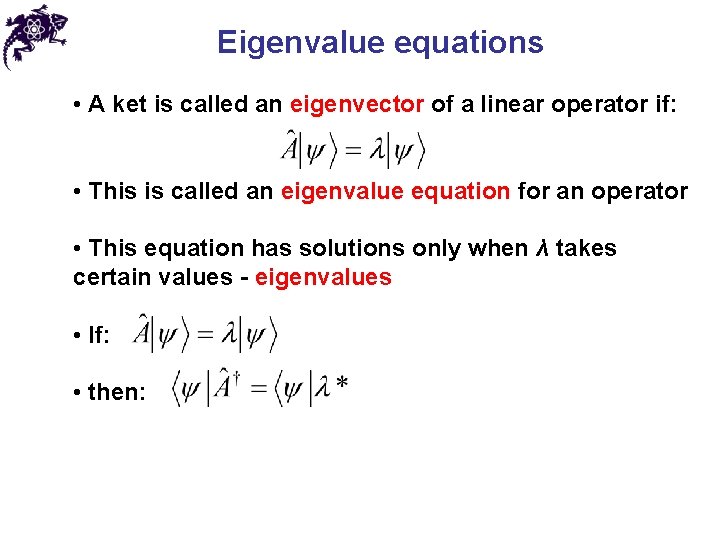
Eigenvalue equations • A ket is called an eigenvector of a linear operator if: • This is called an eigenvalue equation for an operator • This equation has solutions only when λ takes certain values - eigenvalues • If: • then:
Eigenvalue equations • The eigenvalue is called nondegenerate (simple) if the corresponding eigenvector is unique to within a constant • The eigenvalue is called degenerate if there at least two linearly independent kets corresponding to this eigenvalue • The number of linearly independent eigenvectors corresponding to a certain eigenvalue is called a degree of degeneracy
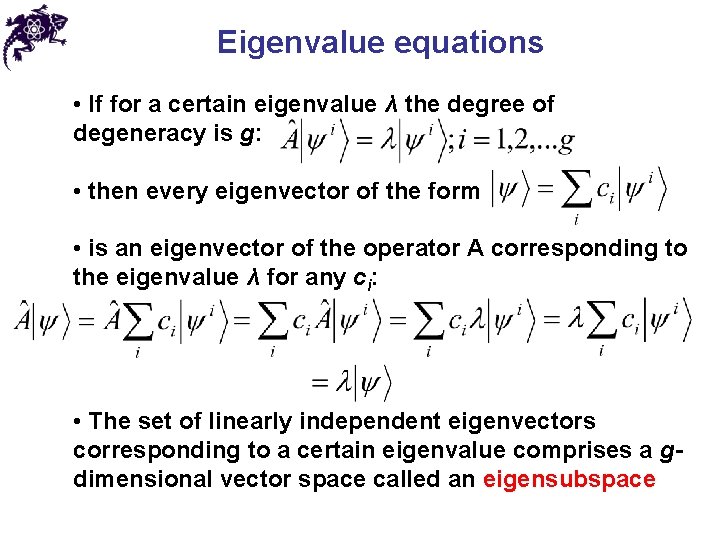
Eigenvalue equations • If for a certain eigenvalue λ the degree of degeneracy is g: • then every eigenvector of the form • is an eigenvector of the operator A corresponding to the eigenvalue λ for any ci: • The set of linearly independent eigenvectors corresponding to a certain eigenvalue comprises a gdimensional vector space called an eigensubspace
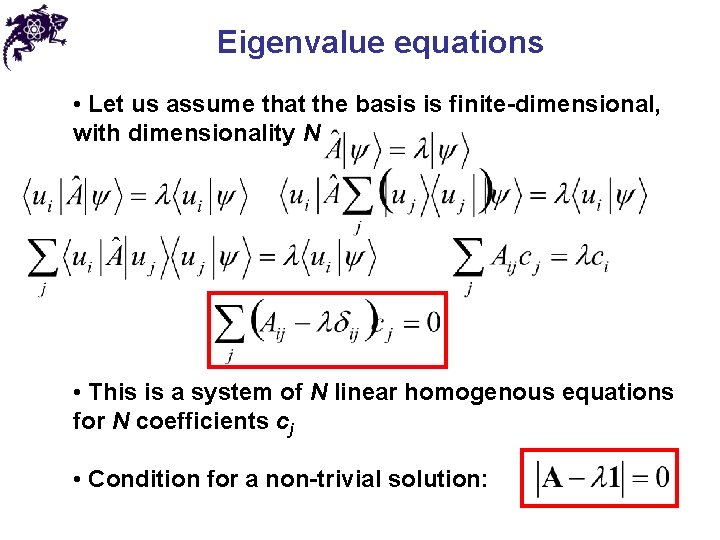
Eigenvalue equations • Let us assume that the basis is finite-dimensional, with dimensionality N • This is a system of N linear homogenous equations for N coefficients cj • Condition for a non-trivial solution:
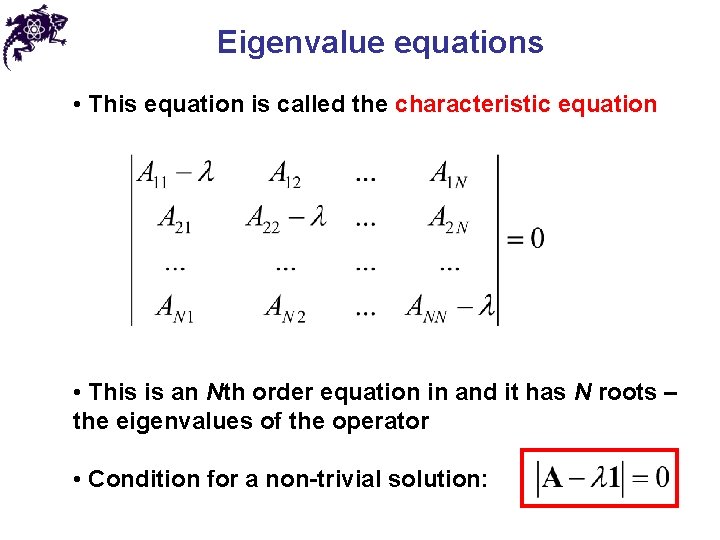
Eigenvalue equations • This equation is called the characteristic equation • This is an Nth order equation in and it has N roots – the eigenvalues of the operator • Condition for a non-trivial solution:
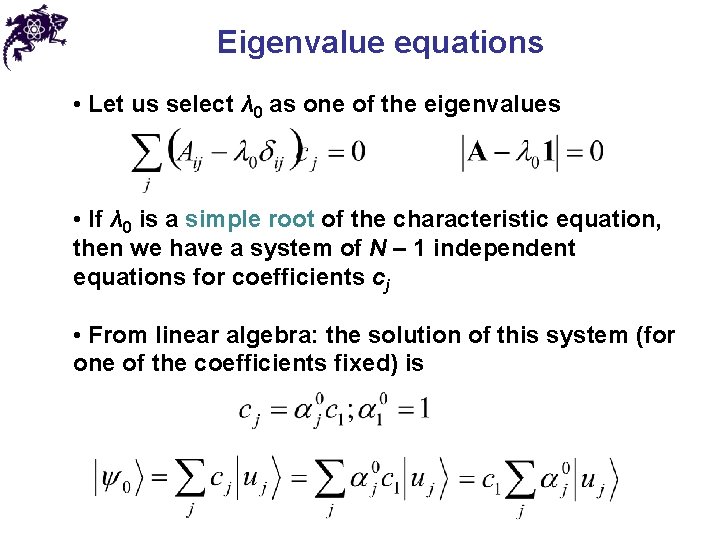
Eigenvalue equations • Let us select λ 0 as one of the eigenvalues • If λ 0 is a simple root of the characteristic equation, then we have a system of N – 1 independent equations for coefficients cj • From linear algebra: the solution of this system (for one of the coefficients fixed) is
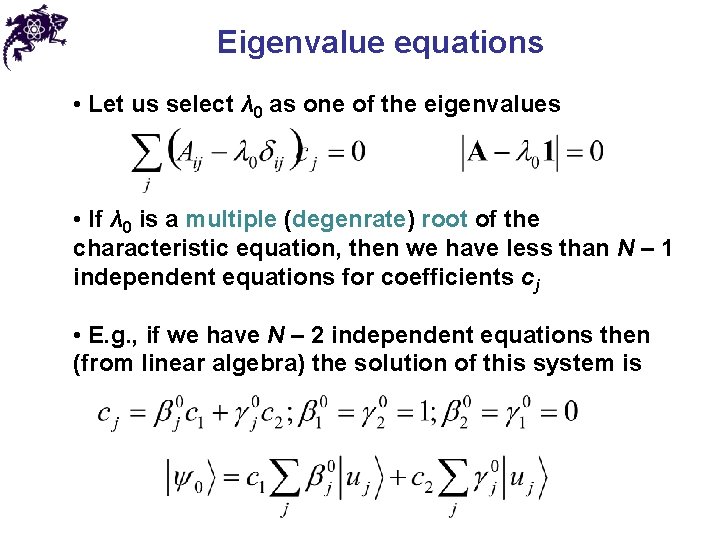
Eigenvalue equations • Let us select λ 0 as one of the eigenvalues • If λ 0 is a multiple (degenrate) root of the characteristic equation, then we have less than N – 1 independent equations for coefficients cj • E. g. , if we have N – 2 independent equations then (from linear algebra) the solution of this system is
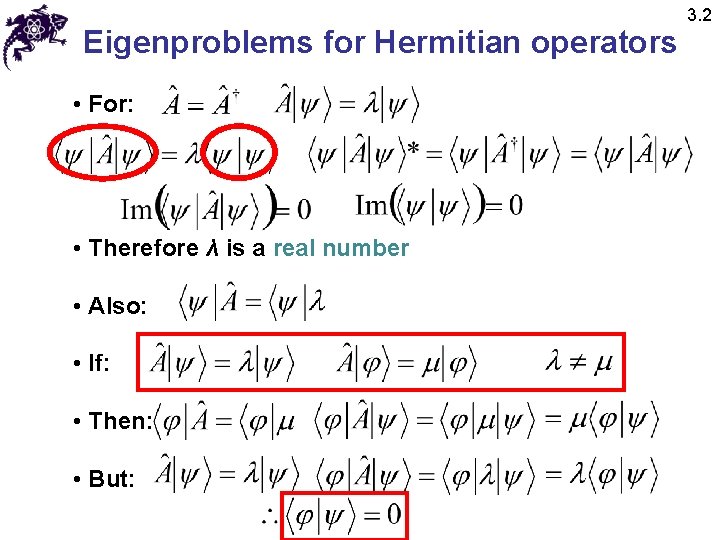
Eigenproblems for Hermitian operators • For: • Therefore λ is a real number • Also: • If: • Then: • But: 3. 2
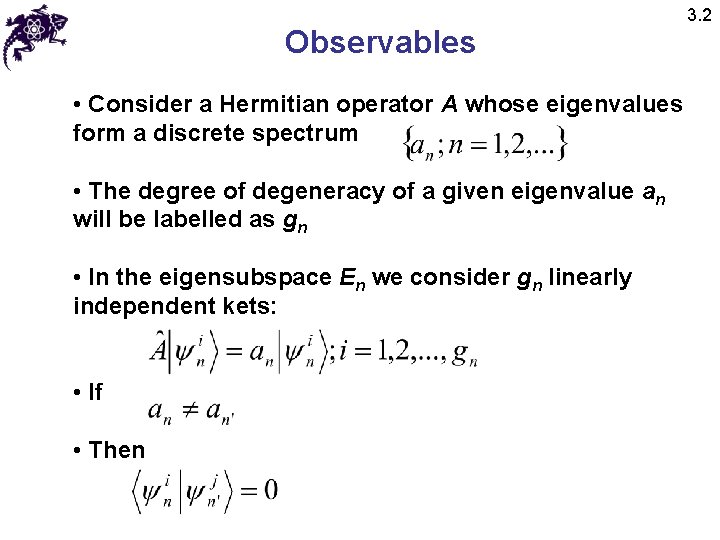
Observables • Consider a Hermitian operator A whose eigenvalues form a discrete spectrum • The degree of degeneracy of a given eigenvalue an will be labelled as gn • In the eigensubspace En we consider gn linearly independent kets: • If • Then 3. 2
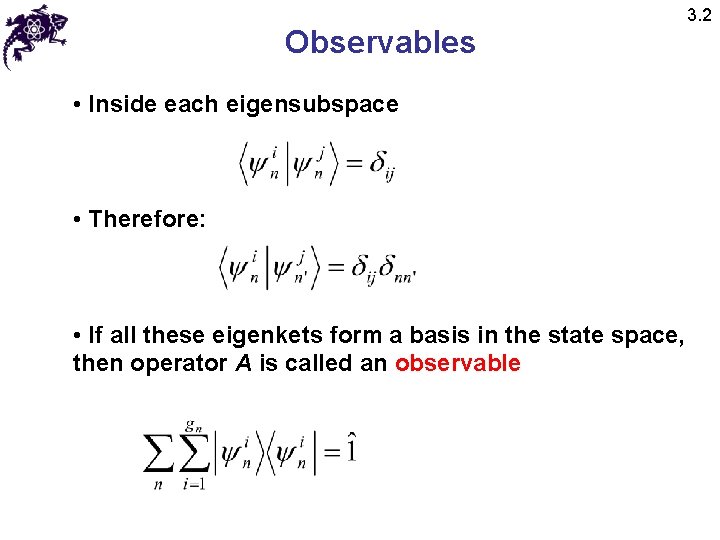
Observables • Inside each eigensubspace • Therefore: • If all these eigenkets form a basis in the state space, then operator A is called an observable 3. 2
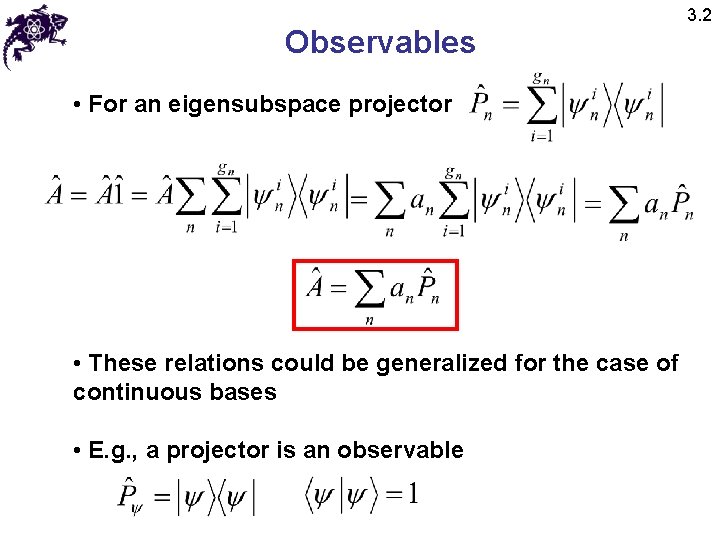
Observables • For an eigensubspace projector • These relations could be generalized for the case of continuous bases • E. g. , a projector is an observable 3. 2
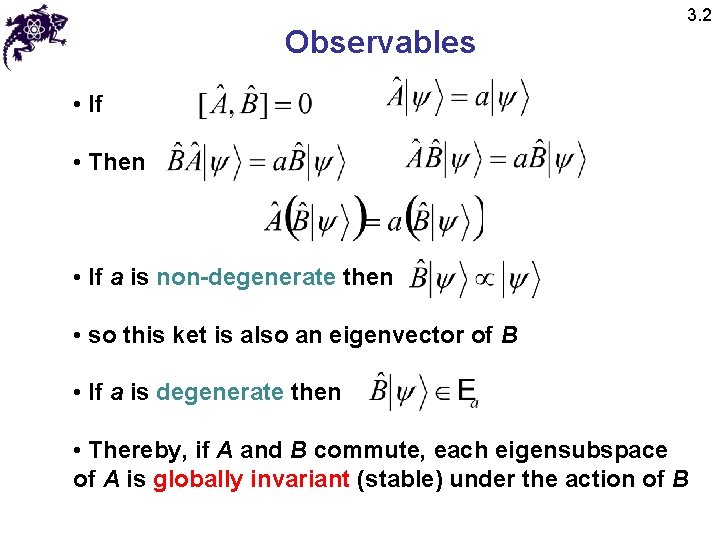
Observables 3. 2 • If • Then • If a is non-degenerate then • so this ket is also an eigenvector of B • If a is degenerate then • Thereby, if A and B commute, each eigensubspace of A is globally invariant (stable) under the action of B
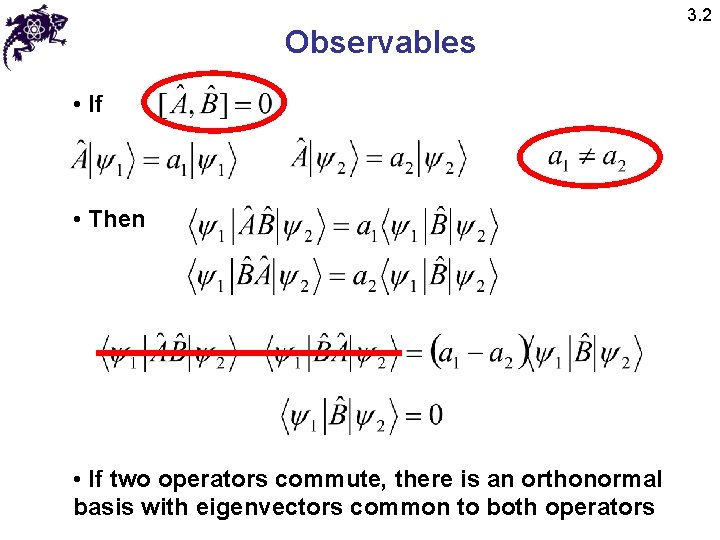
Observables • If • Then • If two operators commute, there is an orthonormal basis with eigenvectors common to both operators 3. 2
Questions QM answers • 1) How is the state of a system described mathematically? (In CM – via generalized coordinates and momenta) • 2) For a given state, how can one predict results of measurements of various physical quantities? (In CM – unambiguously, via the calculated trajectory in a phase space) • 3) For a given state of the system known at time t 0, how can one find a state of this system at an arbitrary time t? (In CM – using Hamilton’s equations) • Answers to these questions are given by the postulates of QM 3. 4
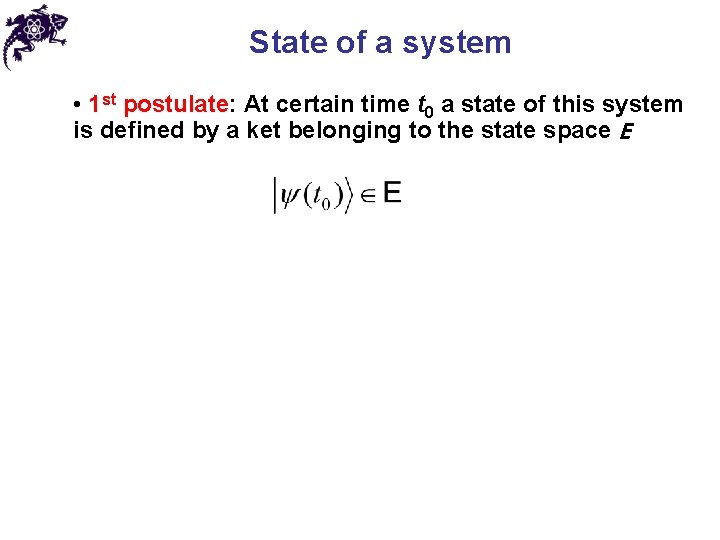
State of a system • 1 st postulate: At certain time t 0 a state of this system is defined by a ket belonging to the state space E

Physical quantities • 2 nd postulate: Every measurable physical quantity is described by an observable operator acting in E
Measurement • 3 rd postulate: Measurements of a physical quantity result only in (real) eigenvalues of a corresponding observable
Measurement • 3 rd postulate: Measurements of a physical quantity result only in (real) eigenvalues of a corresponding observable • It is not obvious a priori whether the spectrum of the measured quantity is continuous or discrete (e. g. , a system consisting of a proton and an electron)
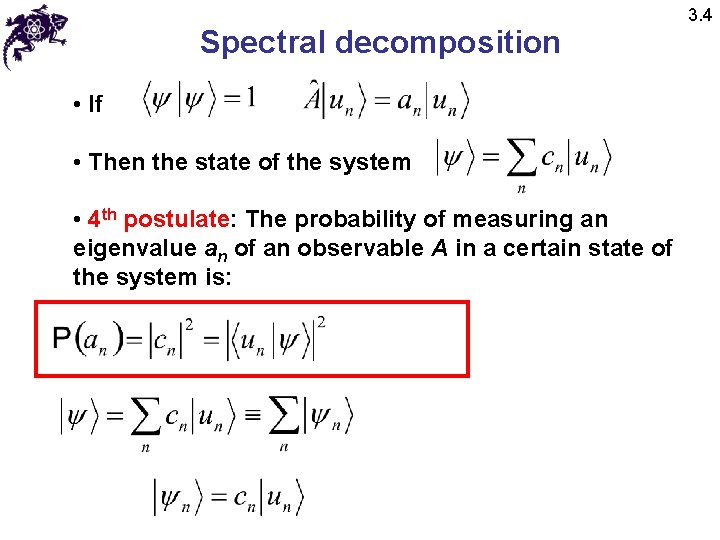
Spectral decomposition • If • Then the state of the system • 4 th postulate: The probability of measuring an eigenvalue an of an observable A in a certain state of the system is: 3. 4
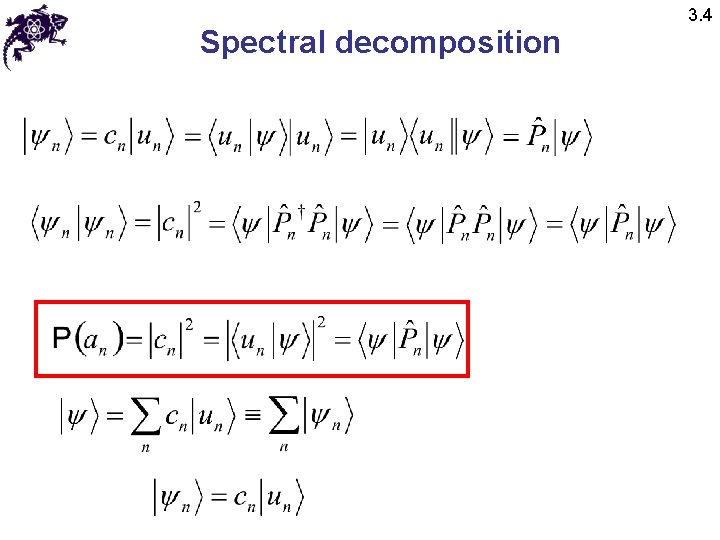
Spectral decomposition 3. 4
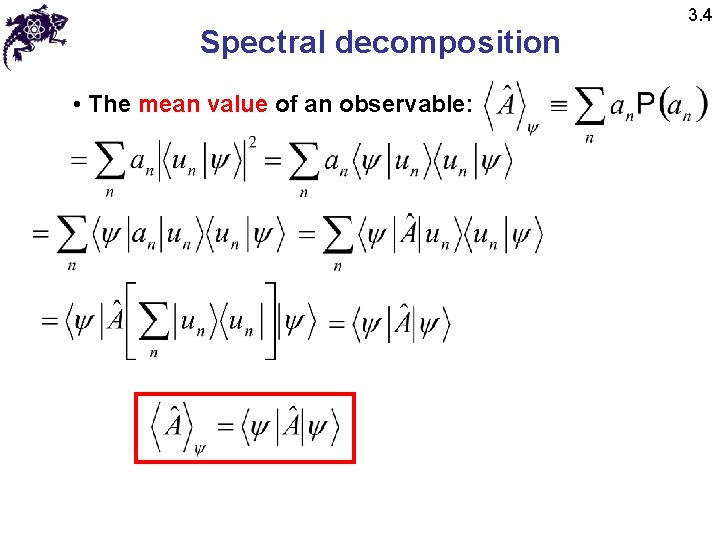
Spectral decomposition • The mean value of an observable: 3. 4
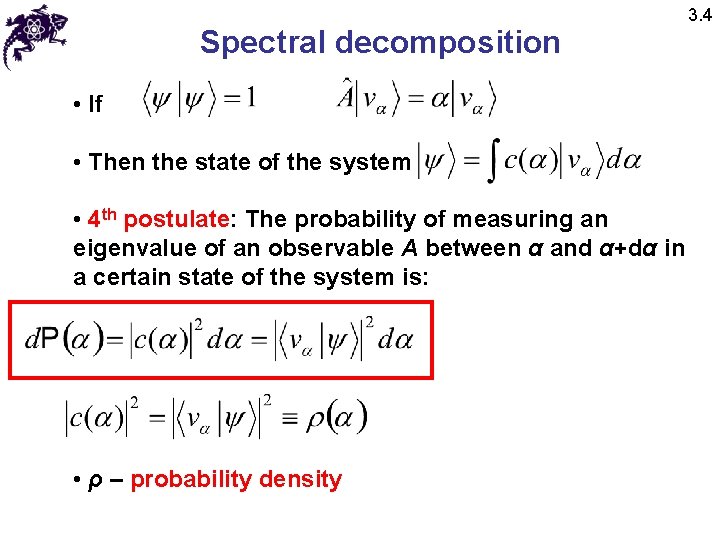
Spectral decomposition • If • Then the state of the system • 4 th postulate: The probability of measuring an eigenvalue of an observable A between α and α+dα in a certain state of the system is: • ρ – probability density 3. 4
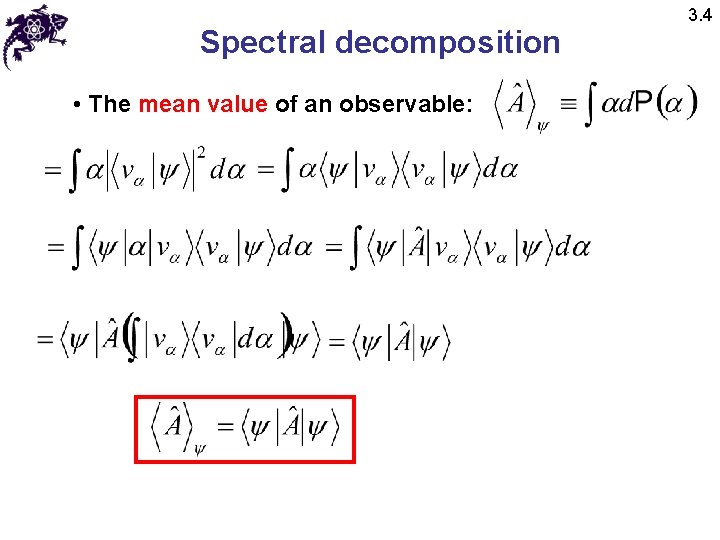
Spectral decomposition • The mean value of an observable: 3. 4
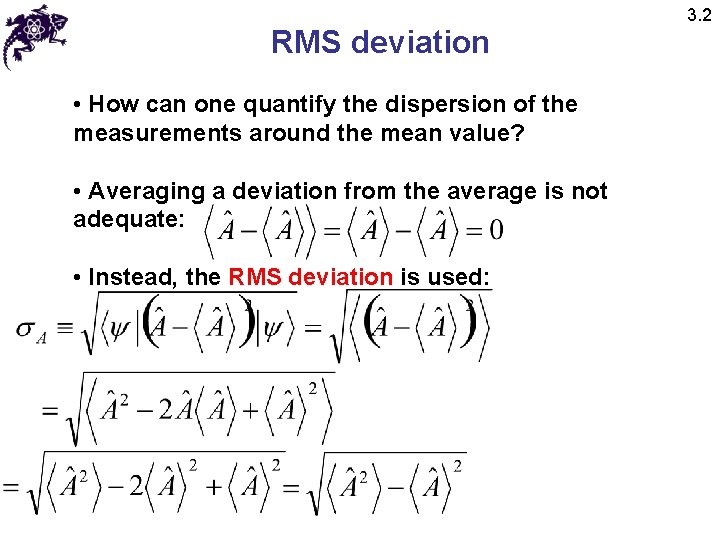
RMS deviation • How can one quantify the dispersion of the measurements around the mean value? • Averaging a deviation from the average is not adequate: • Instead, the RMS deviation is used: 3. 2
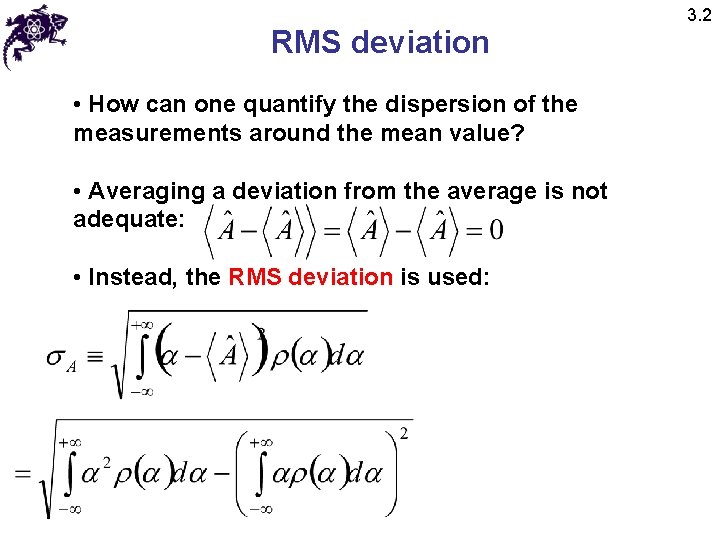
RMS deviation • How can one quantify the dispersion of the measurements around the mean value? • Averaging a deviation from the average is not adequate: • Instead, the RMS deviation is used: 3. 2
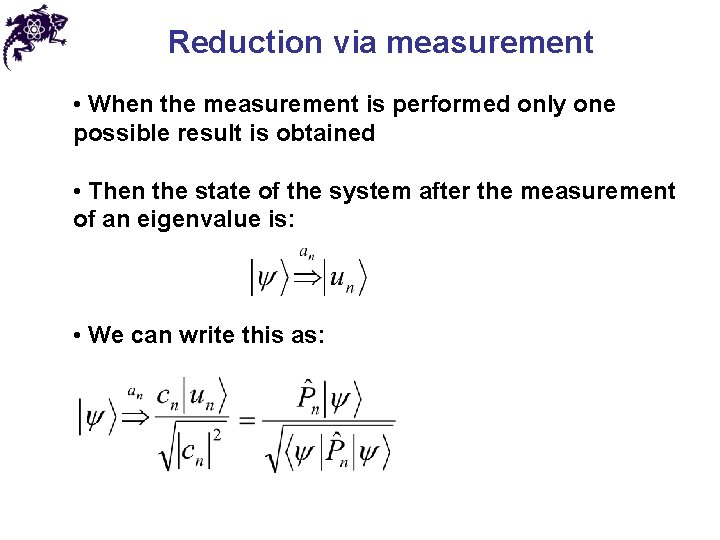
Reduction via measurement • When the measurement is performed only one possible result is obtained • Then the state of the system after the measurement of an eigenvalue is: • We can write this as:
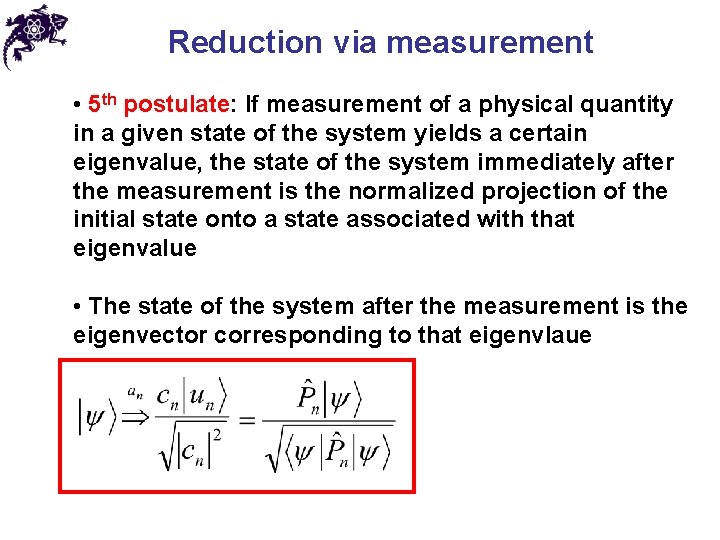
Reduction via measurement • 5 th postulate: If measurement of a physical quantity in a given state of the system yields a certain eigenvalue, the state of the system immediately after the measurement is the normalized projection of the initial state onto a state associated with that eigenvalue • The state of the system after the measurement is the eigenvector corresponding to that eigenvlaue
Reduction via measurement • We shall consider only ideal measurements • This means that the perturbations the measurement devices produce are only due to the quantummechanical aspect of measurement • We will consider the studied system and the measurement device together as a whole
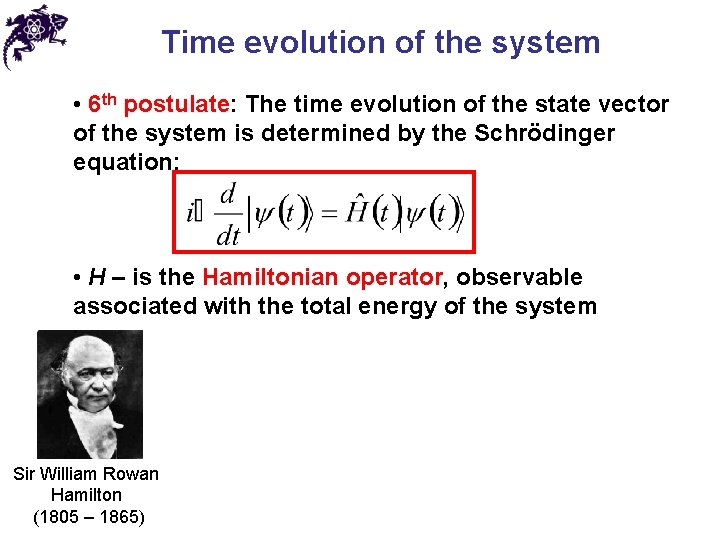
Time evolution of the system • 6 th postulate: The time evolution of the state vector of the system is determined by the Schrödinger equation: • H – is the Hamiltonian operator, observable associated with the total energy of the system Sir William Rowan Hamilton (1805 – 1865)
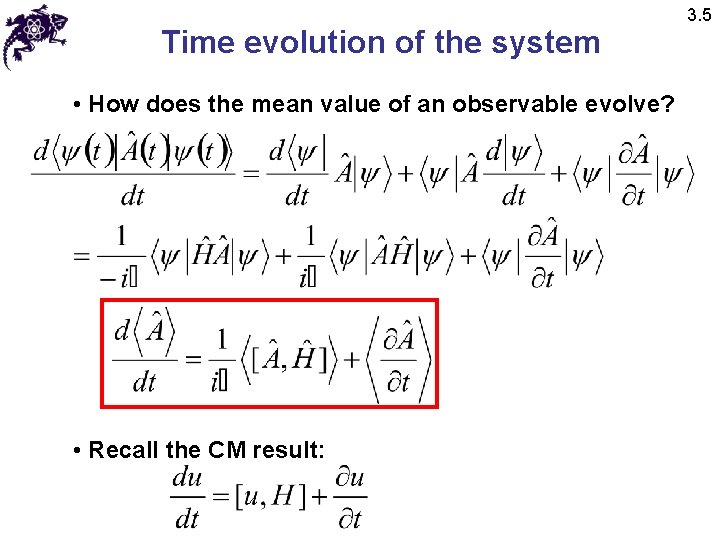
Time evolution of the system • How does the mean value of an observable evolve? • Recall the CM result: 3. 5
Compatibility of observables • If two (observable) operators commute, there exists a basis common to both operators • There is at least one state that will simultaneously yield specific eigenvalues for these two operators, thereby these two observable can be measured simultaneously • Such operators are called compatible with each other • If, on the other hand, the operators do not commute, a state cannot in general be an eigenvector of both observables, thus these operators are called incompatible 3. 5
Compatibility of observables • When two observables are compatible, the measurement of the second does not produce any loss of the information obtained from the measurement of the first • When two observables are incompatible, the measurement of the second does produces a loss of the information obtained from the measurement of the first 3. 5
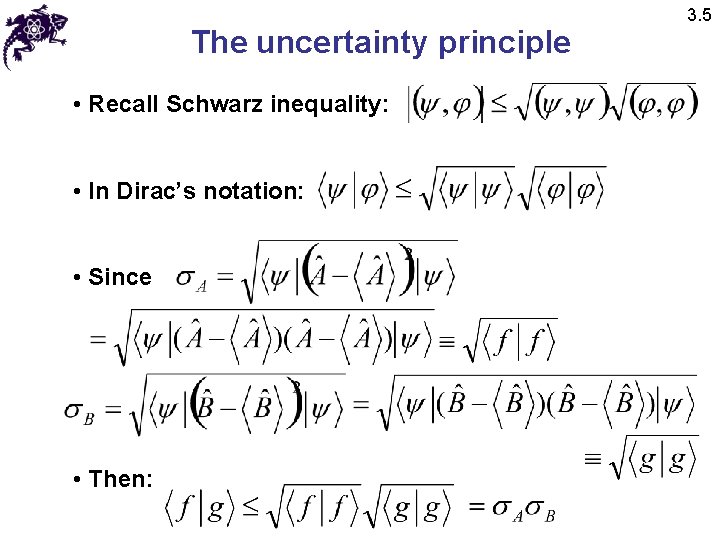
The uncertainty principle • Recall Schwarz inequality: • In Dirac’s notation: • Since • Then: 3. 5
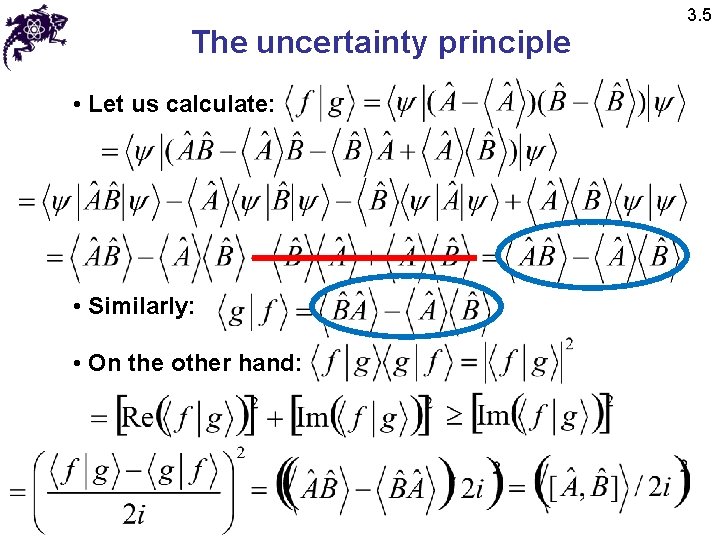
The uncertainty principle • Let us calculate: • Similarly: • On the other hand: 3. 5
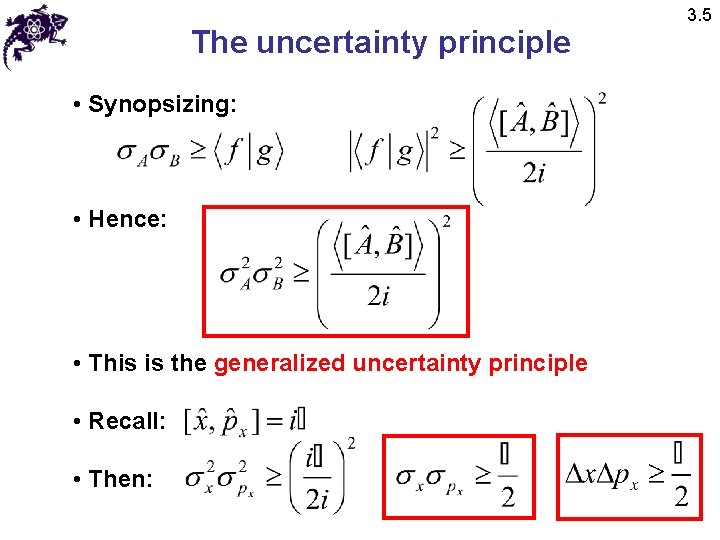
The uncertainty principle • Synopsizing: • Hence: • This is the generalized uncertainty principle • Recall: • Then: 3. 5
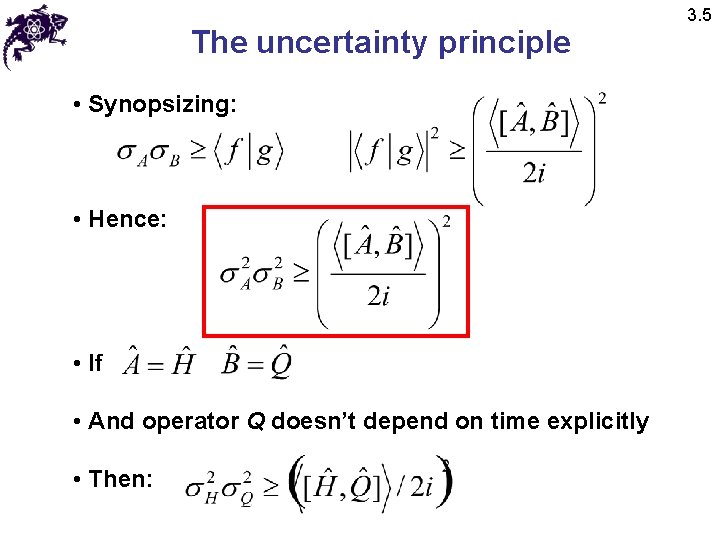
The uncertainty principle • Synopsizing: • Hence: • If • And operator Q doesn’t depend on time explicitly • Then: 3. 5
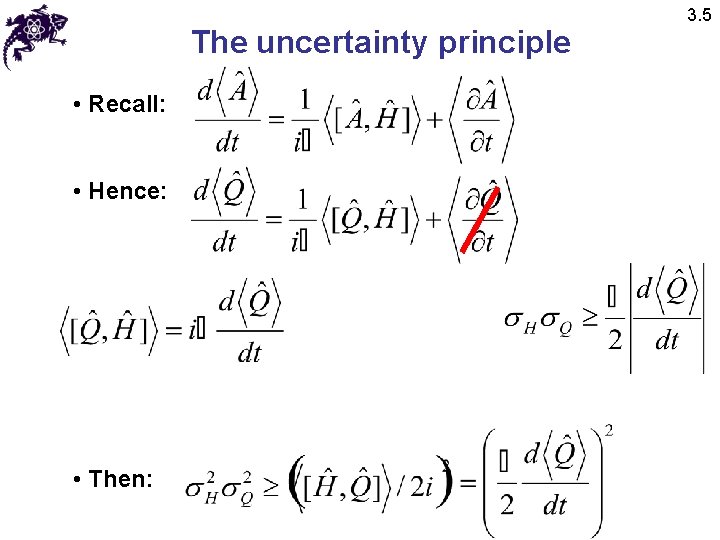
The uncertainty principle • Recall: • Hence: • Then: 3. 5
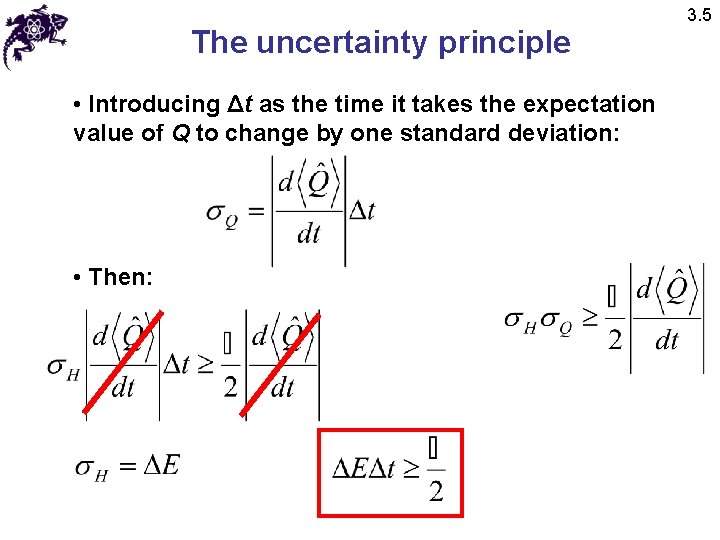
The uncertainty principle • Introducing Δt as the time it takes the expectation value of Q to change by one standard deviation: • Then: 3. 5
- Slides: 91