
Chapter 3 Forces and Newtons Laws SECTION 2
- Slides: 14
Chapter 3: Forces and Newton’s Laws SECTION 2: NEWTON’S LAWS OF MOTION
Vocabulary Review acceleration Copyright © Mc. Graw-Hill Education New • • Newton’s first law of motion inertia Newton’s second law of motion Newton’s third law of motion Newton’s Laws of Motion
Newton’s First Law of Motion Newton's first law of motion states that an object moving at a constant velocity keeps moving at that velocity unless an unbalanced net force acts on it. If an object is at rest, it stays at rest unless an unbalanced net force acts on it. This law is sometimes called the law of inertia. Copyright © Mc. Graw-Hill Education Newton’s Laws of Motion
Newton’s Laws of Motion Brain Pop FPO Add link to Brain Pop from page 80 here. Copyright © Mc. Graw-Hill Education Newton’s Laws of Motion
Inertia and Mass Inertia (ih NUR shuh) is the tendency of an object to resist any change in its motion. If an object is moving, it will have uniform motion. It will keep moving at the same speed and in the same direction unless an unbalanced force acts on it. If an object is at rest, it tends to remain at rest. Its velocity is zero unless a force makes it move. The inertia of an object is related to its mass. The greater the mass of an object is, the greater its inertia. Copyright © Mc. Graw-Hill Education Newton’s Laws of Motion
Force and Acceleration Newton’s second law of motion describes how the forces exerted on an object, its mass, and its acceleration are related. What’s different about throwing a ball horizontally as hard as you can and tossing it gently? When you throw hard, you exert a much greater force on the ball. The hard-thrown ball has a greater change in velocity, and the change occurs over a shorter period of time. Copyright © Mc. Graw-Hill Education Newton’s Laws of Motion
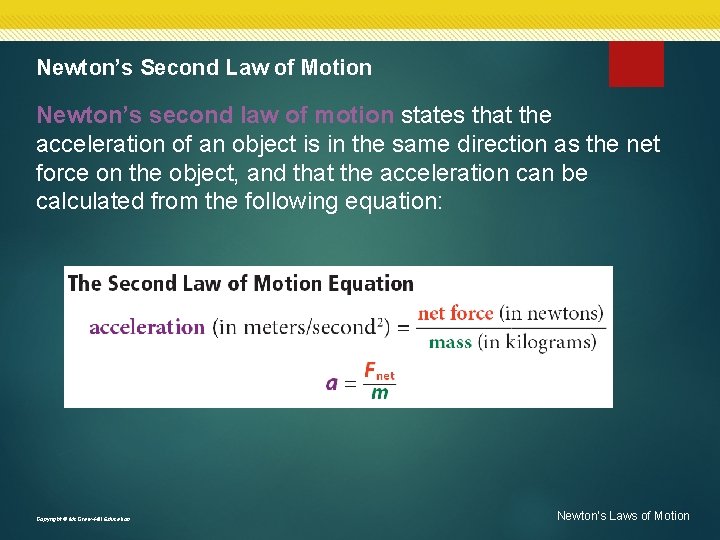
Newton’s Second Law of Motion Newton’s second law of motion states that the acceleration of an object is in the same direction as the net force on the object, and that the acceleration can be calculated from the following equation: Copyright © Mc. Graw-Hill Education Newton’s Laws of Motion
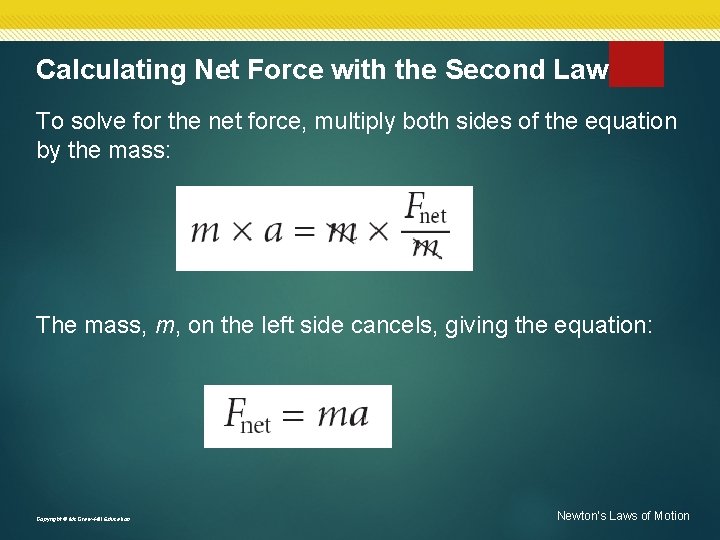
Calculating Net Force with the Second Law Newton’s second law also can be used to calculate the net force if mass and acceleration are known. To do this, the equation for Newton’s second law must be solved for the net force, F. Copyright © Mc. Graw-Hill Education Newton’s Laws of Motion
Calculating Net Force with the Second Law To solve for the net force, multiply both sides of the equation by the mass: The mass, m, on the left side cancels, giving the equation: Copyright © Mc. Graw-Hill Education Newton’s Laws of Motion
SOLVE FOR ACCELERATION Use with Example Problem 2. Problem You push a wagon that has a mass of 12 kg. If the net force on the wagon is 6 N south, what is the wagon’s acceleration? Copyright © Mc. Graw-Hill Education Newton’s Laws of Motion
Newton’s Third Law Newton’s third law of motion states that when one object exerts a force on a second object, the second one exerts a force on the first that is equal in strength and opposite in direction. These forces are sometimes called the action and reaction forces. But, the action force doesn’t cause the reaction force. They occur at the same time. When you jump on a trampoline, for example, you exert a downward force on the trampoline. Simultaneously, the trampoline exerts an equal force upward, sending you high into the air. Copyright © Mc. Graw-Hill Education Newton’s Laws of Motion
Action and Reaction Forces Don’t Cancel According to the third law of motion, action and reaction forces act on different objects. Thus, even though the forces are equal, they are not balanced because they act on different objects. For example, consider a student pushing on a box. The box pushes on the student, but the student remains in place because of the friction between her shoes and the floor. Copyright © Mc. Graw-Hill Education Newton’s Laws of Motion
Forces are Interactions A force is an interaction between two objects. The forces on the box include the student’s push to the right and sliding friction to the left. The net force on the box is not zero and the box accelerates to the right. For example, it does not make sense to say, “The box has a force of 20 N. ” However, it does make sense to say, “The student pushes on the box with a force of 20 N. ” Copyright © Mc. Graw-Hill Education Newton’s Laws of Motion
Review Essential Questions What is inertia and how is it related to Newton’s first law of motion? How is acceleration calculated using Newton’s second law of motion? According to Newton’s third law of motion, how are the forces between interacting objects related? Vocabulary • Newton’s first law of motion • inertia Copyright © Mc. Graw-Hill Education • Newton’s second law of motion • Newton’s third law of motion Newton’s Laws of Motion