
Chapter 3 Flow of Control ifelse and switch
- Slides: 14
Chapter 3 Flow of Control if-else and switch statements Slides prepared by Rose Williams, Binghamton University
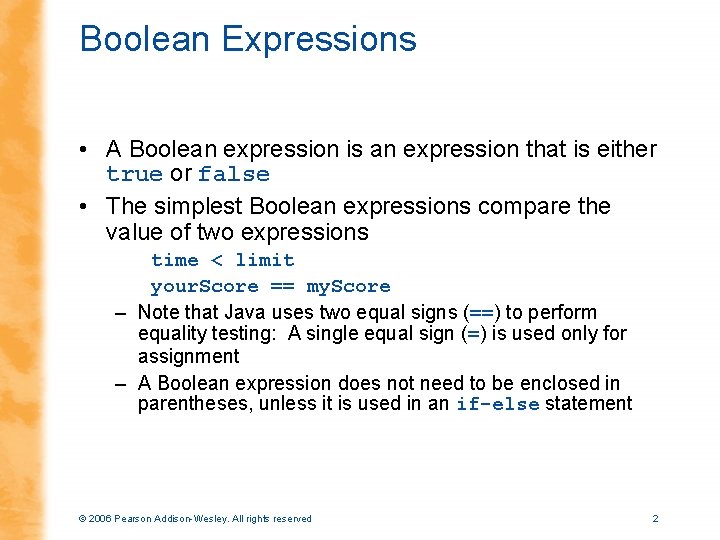
Boolean Expressions • A Boolean expression is an expression that is either true or false • The simplest Boolean expressions compare the value of two expressions time < limit your. Score == my. Score – Note that Java uses two equal signs (==) to perform equality testing: A single equal sign (=) is used only for assignment – A Boolean expression does not need to be enclosed in parentheses, unless it is used in an if-else statement © 2006 Pearson Addison-Wesley. All rights reserved 2
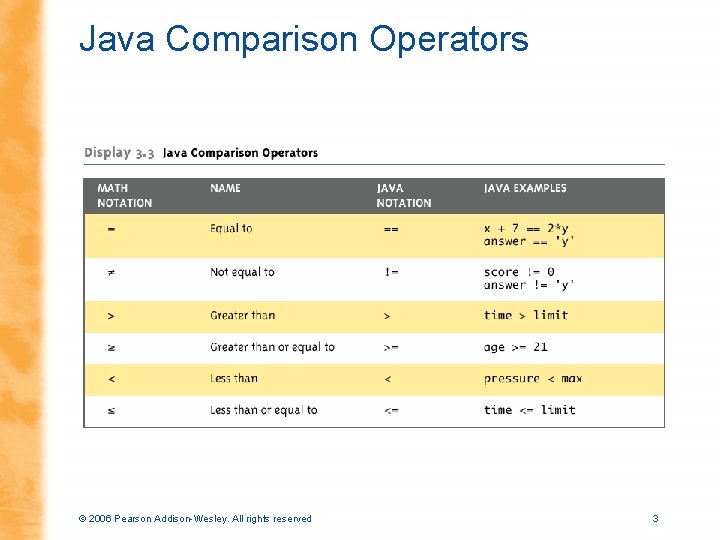
Java Comparison Operators © 2006 Pearson Addison-Wesley. All rights reserved 3
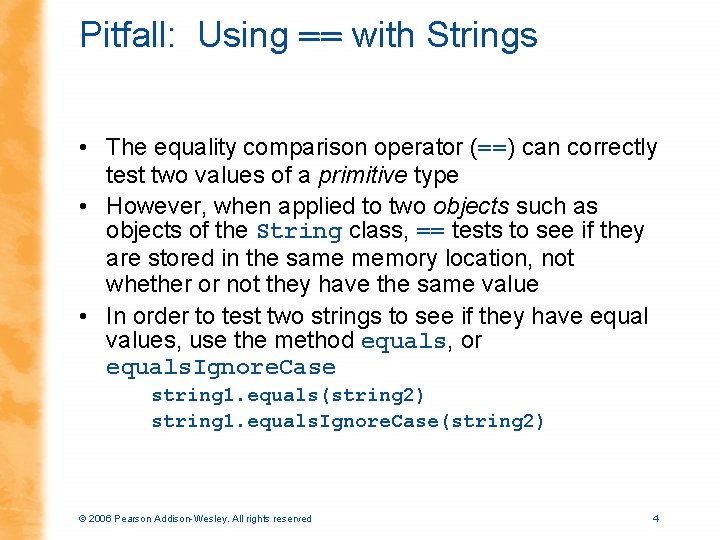
Pitfall: Using == with Strings • The equality comparison operator (==) can correctly test two values of a primitive type • However, when applied to two objects such as objects of the String class, == tests to see if they are stored in the same memory location, not whether or not they have the same value • In order to test two strings to see if they have equal values, use the method equals, or equals. Ignore. Case string 1. equals(string 2) string 1. equals. Ignore. Case(string 2) © 2006 Pearson Addison-Wesley. All rights reserved 4
Lexicographic and Alphabetical Order • Lexicographic ordering is the same as ASCII ordering, and includes letters, numbers, and other characters – All uppercase letters are in alphabetic order, and all lowercase letters are in alphabetic order, but all uppercase letters come before lowercase letters – If s 1 and s 2 are two variables of type String that have been given String values, then s 1. compare. To(s 2) returns a negative number if s 1 comes before s 2 in lexicographic ordering, returns zero if the two strings are equal, and returns a positive number if s 2 comes before s 1 • When performing an alphabetic comparison of strings (rather than a lexicographic comparison) that consist of a mix of lowercase and uppercase letters, use the compare. To. Ignore. Case method instead © 2006 Pearson Addison-Wesley. All rights reserved 5
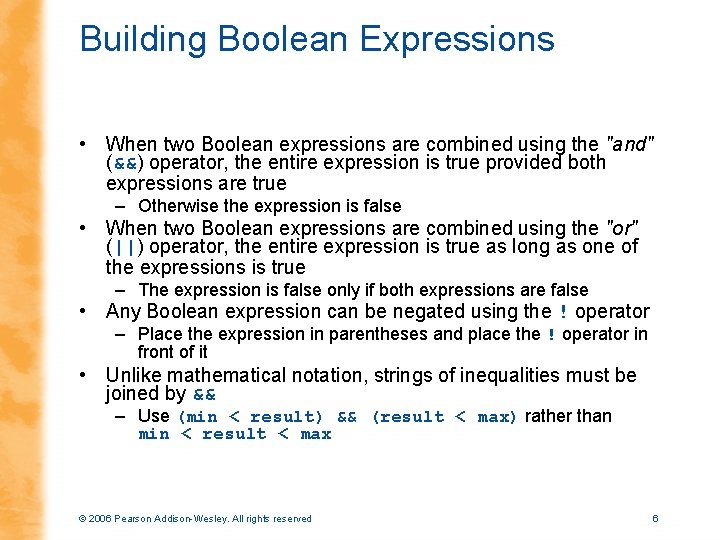
Building Boolean Expressions • When two Boolean expressions are combined using the "and" (&&) operator, the entire expression is true provided both expressions are true – Otherwise the expression is false • When two Boolean expressions are combined using the "or" (||) operator, the entire expression is true as long as one of the expressions is true – The expression is false only if both expressions are false • Any Boolean expression can be negated using the ! operator – Place the expression in parentheses and place the ! operator in front of it • Unlike mathematical notation, strings of inequalities must be joined by && – Use (min < result) && (result < max) rather than min < result < max © 2006 Pearson Addison-Wesley. All rights reserved 6
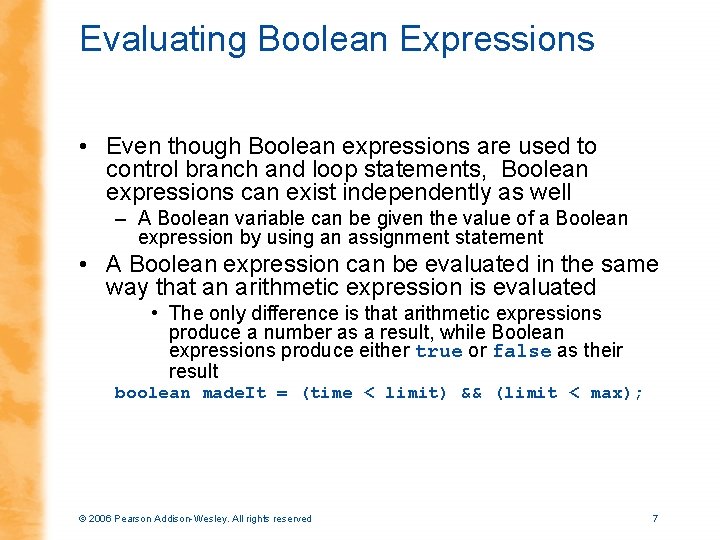
Evaluating Boolean Expressions • Even though Boolean expressions are used to control branch and loop statements, Boolean expressions can exist independently as well – A Boolean variable can be given the value of a Boolean expression by using an assignment statement • A Boolean expression can be evaluated in the same way that an arithmetic expression is evaluated • The only difference is that arithmetic expressions produce a number as a result, while Boolean expressions produce either true or false as their result boolean made. It = (time < limit) && (limit < max); © 2006 Pearson Addison-Wesley. All rights reserved 7
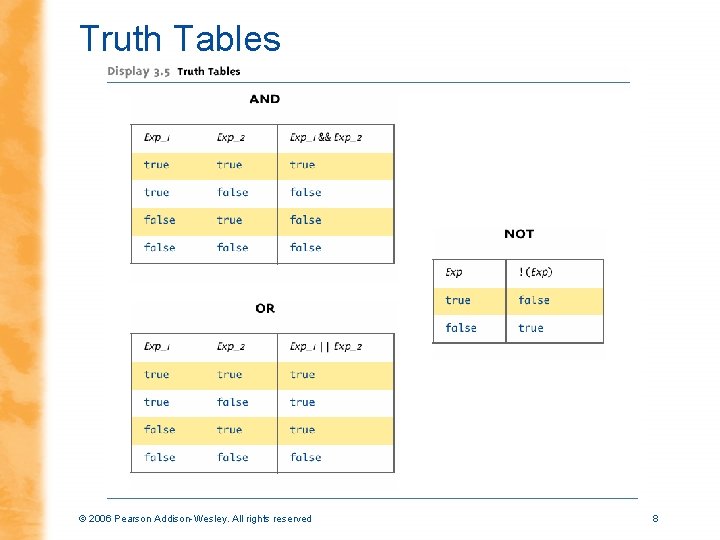
Truth Tables © 2006 Pearson Addison-Wesley. All rights reserved 8
Short-Circuit and Complete Evaluation • Java can take a shortcut when the evaluation of the first part of a Boolean expression produces a result that evaluation of the second part cannot change • This is called short-circuit evaluation or lazy evaluation – For example, when evaluating two Boolean subexpressions joined by &&, if the first subexpression evaluates to false, then the entire expression will evaluate to false, no matter the value of the second subexpression – In like manner, when evaluating two Boolean subexpressions joined by ||, if the first subexpression evaluates to true, then the entire expression will evaluate to true © 2006 Pearson Addison-Wesley. All rights reserved 9
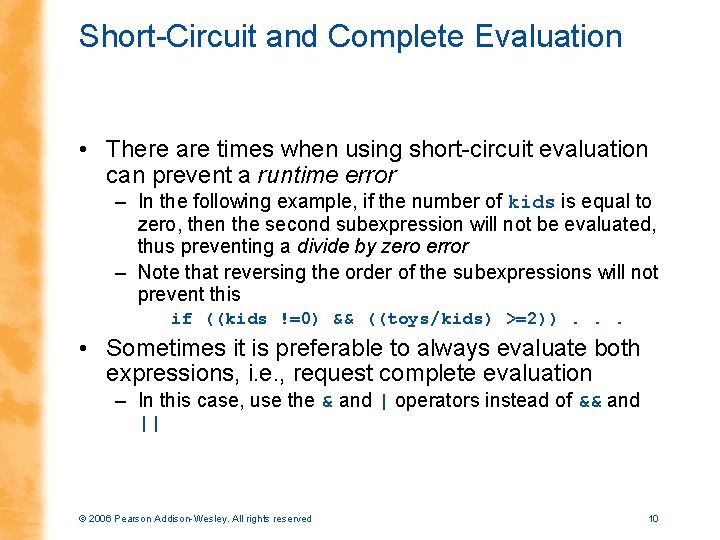
Short-Circuit and Complete Evaluation • There are times when using short-circuit evaluation can prevent a runtime error – In the following example, if the number of kids is equal to zero, then the second subexpression will not be evaluated, thus preventing a divide by zero error – Note that reversing the order of the subexpressions will not prevent this if ((kids !=0) && ((toys/kids) >=2)). . . • Sometimes it is preferable to always evaluate both expressions, i. e. , request complete evaluation – In this case, use the & and | operators instead of && and || © 2006 Pearson Addison-Wesley. All rights reserved 10
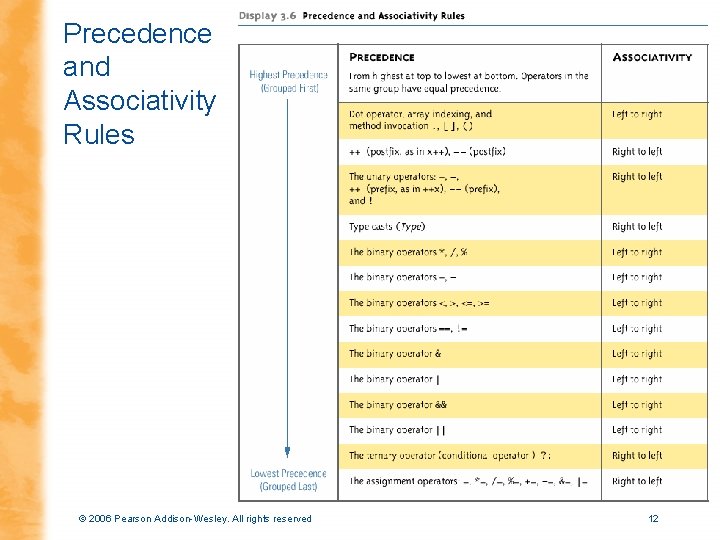
Precedence and Associativity Rules • Boolean and arithmetic expressions need not be fully parenthesized • If some or all of the parentheses are omitted, Java will follow precedence and associativity rules (summarized in the following table) to determine the order of operations – If one operator occurs higher in the table than another, it has higher precedence, and is grouped with its operands before the operator of lower precedence – If two operators have the same precedence, then associativity rules determine which is grouped first © 2006 Pearson Addison-Wesley. All rights reserved 11
Precedence and Associativity Rules © 2006 Pearson Addison-Wesley. All rights reserved 12
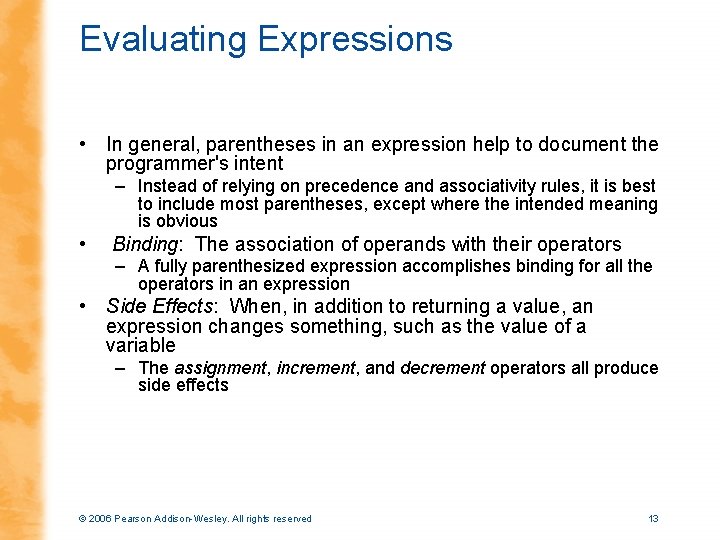
Evaluating Expressions • In general, parentheses in an expression help to document the programmer's intent – Instead of relying on precedence and associativity rules, it is best to include most parentheses, except where the intended meaning is obvious • Binding: The association of operands with their operators – A fully parenthesized expression accomplishes binding for all the operators in an expression • Side Effects: When, in addition to returning a value, an expression changes something, such as the value of a variable – The assignment, increment, and decrement operators all produce side effects © 2006 Pearson Addison-Wesley. All rights reserved 13
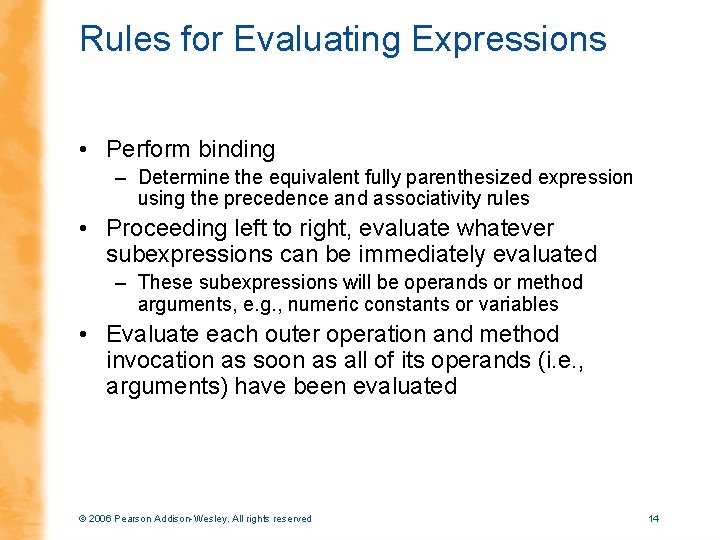
Rules for Evaluating Expressions • Perform binding – Determine the equivalent fully parenthesized expression using the precedence and associativity rules • Proceeding left to right, evaluate whatever subexpressions can be immediately evaluated – These subexpressions will be operands or method arguments, e. g. , numeric constants or variables • Evaluate each outer operation and method invocation as soon as all of its operands (i. e. , arguments) have been evaluated © 2006 Pearson Addison-Wesley. All rights reserved 14