
Chapter 3 FEDERALISM The Founding Does Federalism protect
- Slides: 13
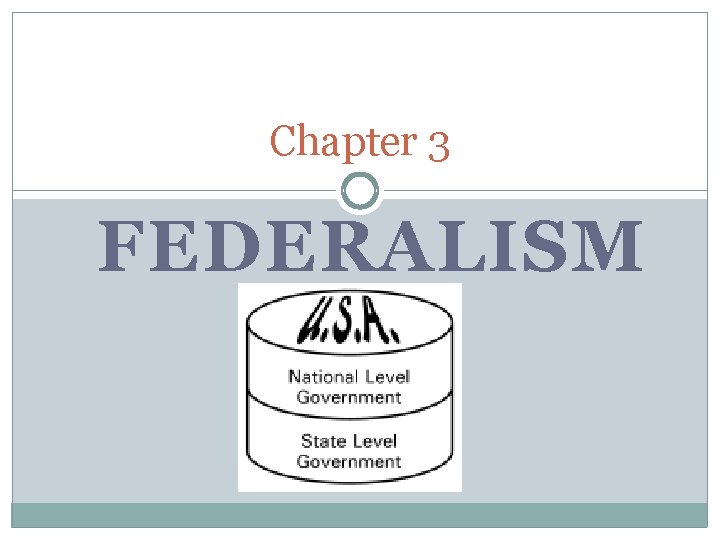
Chapter 3 FEDERALISM
The Founding Does Federalism protect personal liberties? --Founders believed that neither the national nor state gov’t would have the authority over the other because, in a federalist system, power derives from the people --The 10 th Amendment was added as an after- thought --10 th Amendment has become a source of constant debate…Nullification Theory & Civil War
The Elastic Clause Article I of the Constitution: necessary & proper Alexander Hamilton believed it to be necessary so that the Nat’l gov’ts power remained supreme in competing interests (commerce) Thomas Jefferson believed supreme power should be w/ the people (sovereignty) Is this clause necessary?
Mc. Culloch v. Maryland 1 st Supreme Court case involving interpretation of the Elastic Clause Case involved the nat’l bank Questions: 1. Could Congress charter a nat’l bank? YES 2. Could states tax a nat’l bank? NO Reasons: Elastic Clause & Supremacy Clause
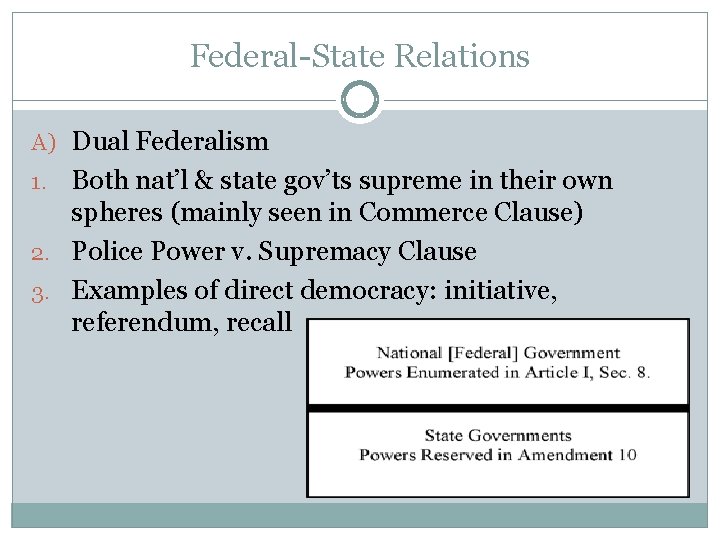
Federal-State Relations A) Dual Federalism Both nat’l & state gov’ts supreme in their own spheres (mainly seen in Commerce Clause) 2. Police Power v. Supremacy Clause 3. Examples of direct democracy: initiative, referendum, recall 1.
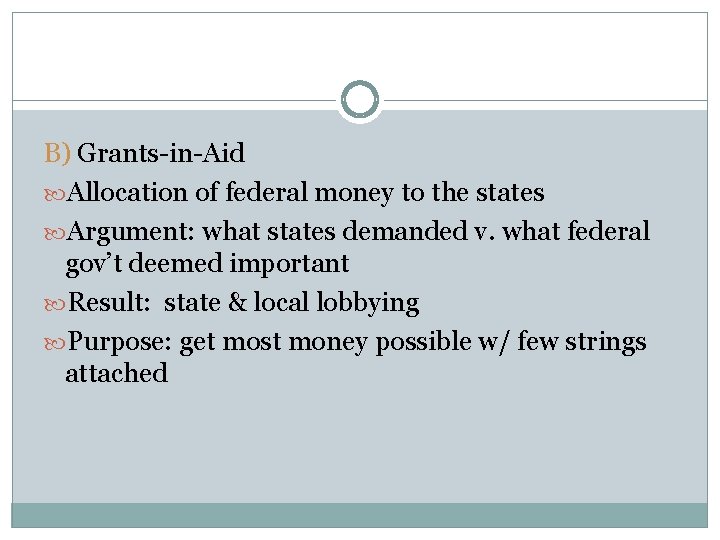
B) Grants-in-Aid Allocation of federal money to the states Argument: what states demanded v. what federal gov’t deemed important Result: state & local lobbying Purpose: get most money possible w/ few strings attached
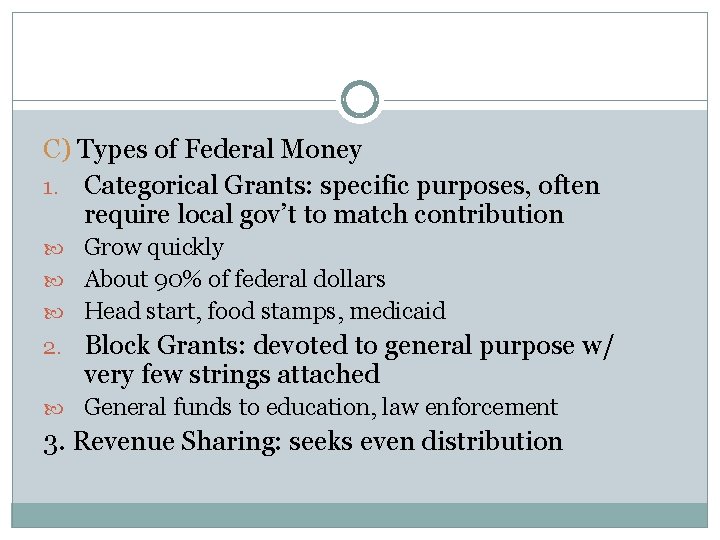
C) Types of Federal Money 1. Categorical Grants: specific purposes, often require local gov’t to match contribution Grow quickly About 90% of federal dollars Head start, food stamps, medicaid 2. Block Grants: devoted to general purpose w/ very few strings attached General funds to education, law enforcement 3. Revenue Sharing: seeks even distribution
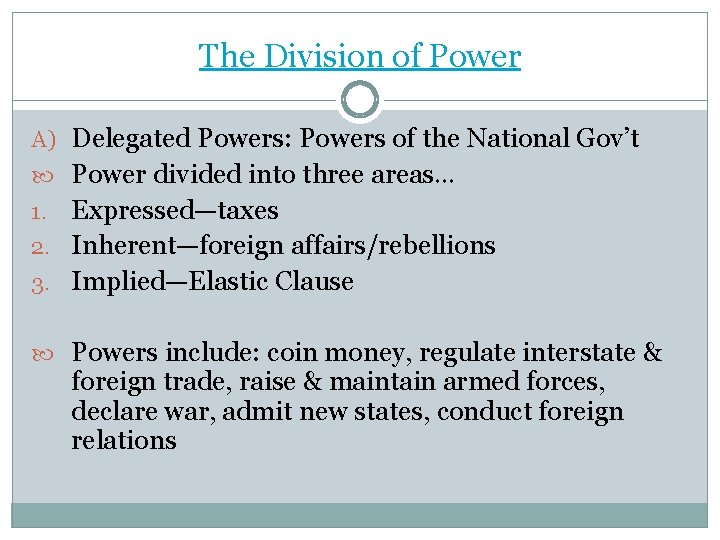
The Division of Power A) Delegated Powers: Powers of the National Gov’t Power divided into three areas… Expressed—taxes 2. Inherent—foreign affairs/rebellions 3. Implied—Elastic Clause 1. Powers include: coin money, regulate interstate & foreign trade, raise & maintain armed forces, declare war, admit new states, conduct foreign relations
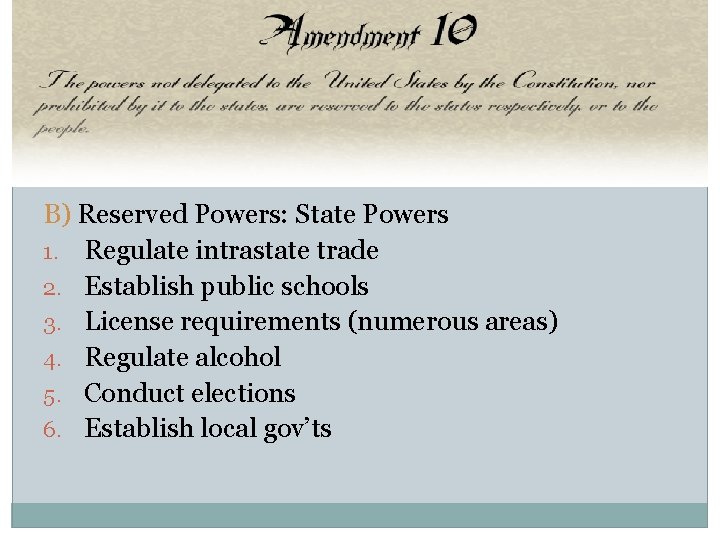
B) Reserved Powers: State Powers 1. Regulate intrastate trade 2. Establish public schools 3. License requirements (numerous areas) 4. Regulate alcohol 5. Conduct elections 6. Establish local gov’ts
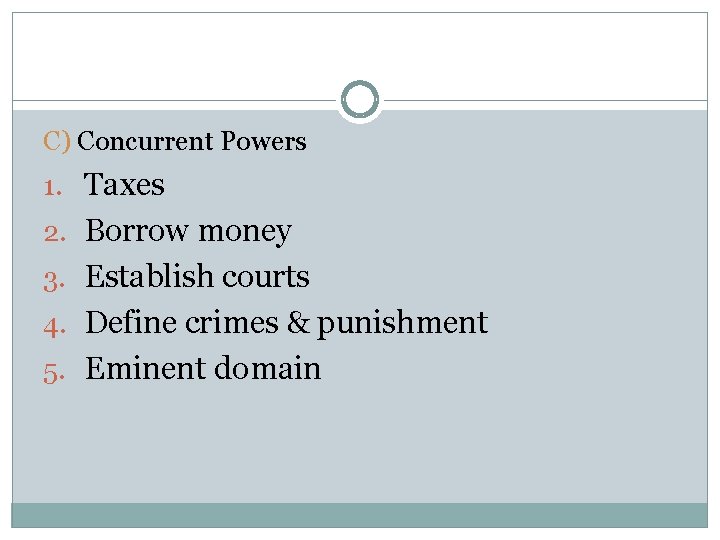
C) Concurrent Powers 1. Taxes 2. Borrow money 3. Establish courts 4. Define crimes & punishment 5. Eminent domain
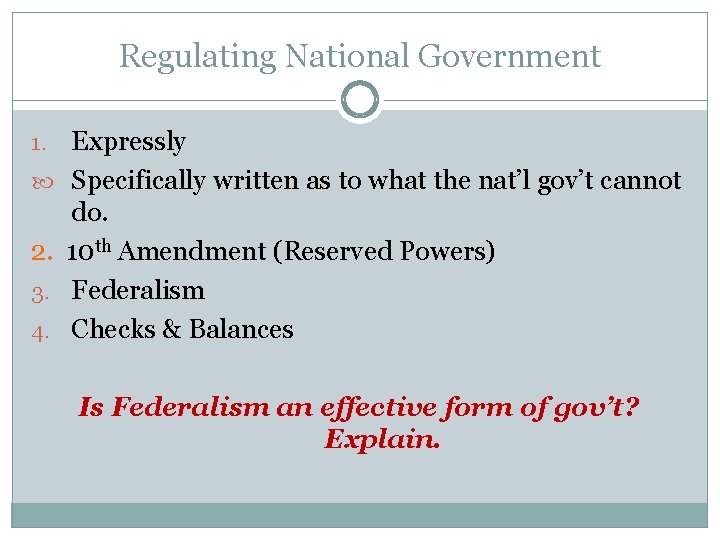
Regulating National Government 1. 2. 3. 4. Expressly Specifically written as to what the nat’l gov’t cannot do. 10 th Amendment (Reserved Powers) Federalism Checks & Balances Is Federalism an effective form of gov’t? Explain.
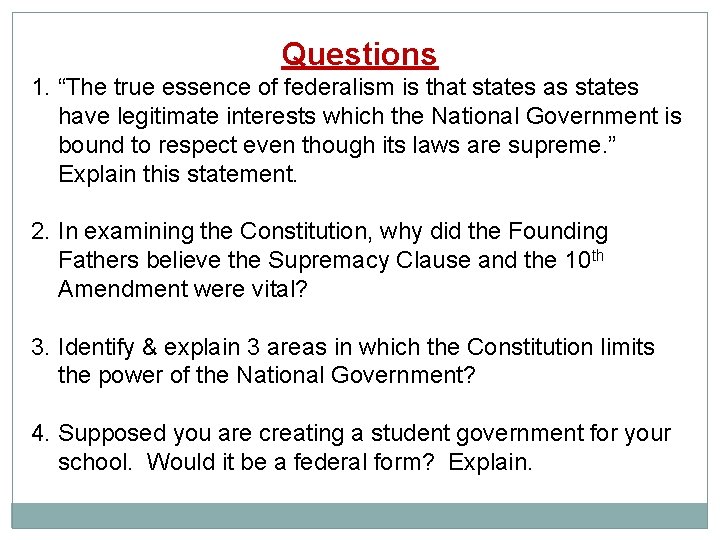
Questions 1. “The true essence of federalism is that states as states have legitimate interests which the National Government is bound to respect even though its laws are supreme. ” Explain this statement. 2. In examining the Constitution, why did the Founding Fathers believe the Supremacy Clause and the 10 th Amendment were vital? 3. Identify & explain 3 areas in which the Constitution limits the power of the National Government? 4. Supposed you are creating a student government for your school. Would it be a federal form? Explain.
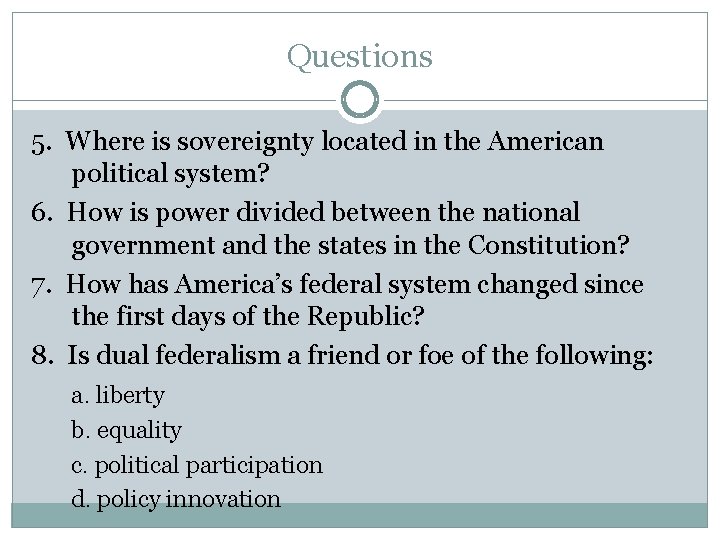
Questions 5. Where is sovereignty located in the American political system? 6. How is power divided between the national government and the states in the Constitution? 7. How has America’s federal system changed since the first days of the Republic? 8. Is dual federalism a friend or foe of the following: a. liberty b. equality c. political participation d. policy innovation