
CHAPTER 3 Federalism Learning Objectives Define federalism and
CHAPTER 3 Federalism
Learning Objectives ü Define federalism and compare it to other forms of government, including confederations and unitary systems of government ü Explain how the Constitution differentiates between federal government powers, state government powers, and concurrent powers ü Describe the powers accorded to Congress under Article I 2 Copyright © 2014 Cengage Learning
Learning Objectives ü Explain the significance of the supremacy clause, the preemption doctrine, and the full faith and credit clause of Article IV in distributing sovereignty ü Define the five eras of American federalism and assess the role played by the Supreme Court in articulating state-federal relations during each era 3 Copyright © 2014 Cengage Learning
Learning Objectives ü Evaluate different forms of federalism (layer -cake federalism versus marble-cake federalism) in the modern era ü Identify the advantages and disadvantages of federalism in terms of fairness and accountability 4 Copyright © 2014 Cengage Learning
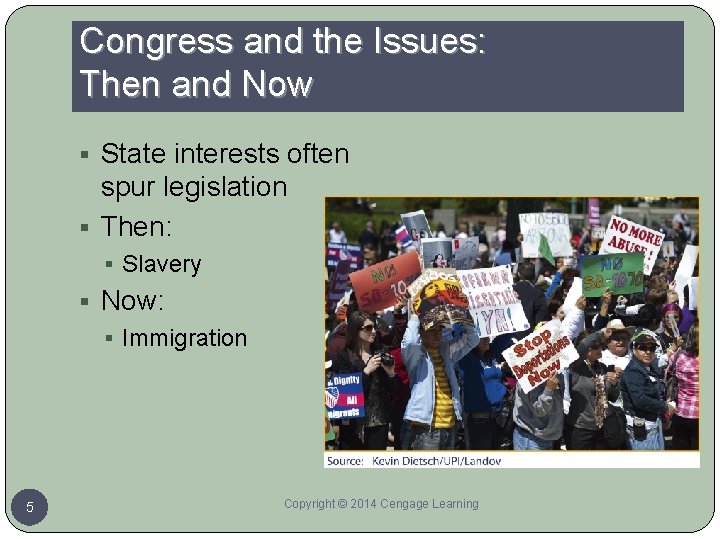
Congress and the Issues: Then and Now § State interests often spur legislation § Then: § Slavery § Now: § Immigration 5 Copyright © 2014 Cengage Learning
What is Federalism? § Federalism: political system in which power is divided between a central authority and constituent political subunits § Must sustain this division of power by whatever means possible 6 Copyright © 2014 Cengage Learning
What is Federalism? § Greatest challenge is sovereignty § Supreme political power of a government to regulate its affairs without outside interference § Sovereignty resides in the central government, and also within each of the subunits 7 Copyright © 2014 Cengage Learning
What is Federalism? § Comparing Federalism to Other Systems Government § Confederation (“confederacy”) § A league of two or more independent states that unite to achieve certain specified common aims § Unitary system § Sovereignty rests in the central government alone 8 Copyright © 2014 Cengage Learning of
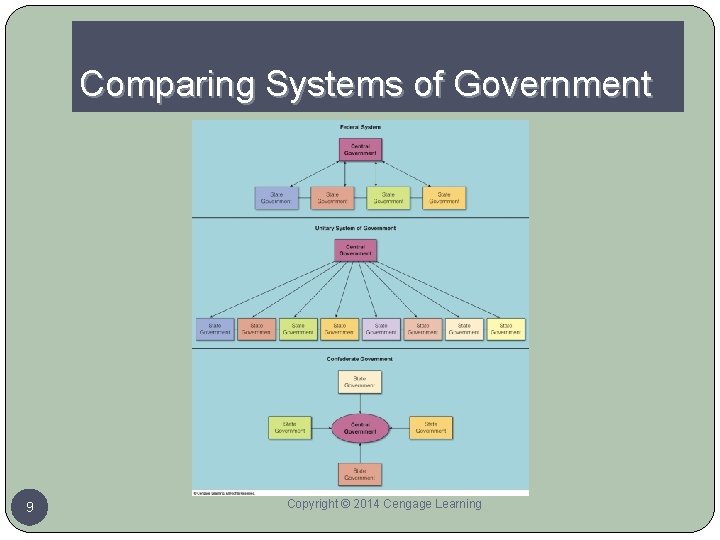
Comparing Systems of Government 9 Copyright © 2014 Cengage Learning
What is Federalism? § Government Powers in a Federal System § Enumerated: powers delegated to Congress under Article I § Necessary and proper clause § Reserved: powers retained by the states § Concurrent: powers shared by the federal and state governments 10 Copyright © 2014 Cengage Learning
What is Federalism? § Supremacy clause § The Constitution and laws passed by Congress shall be “the supreme law of the land” § Overrides state constitutions or state laws § Doctrine of preemption 11 Copyright © 2014 Cengage Learning
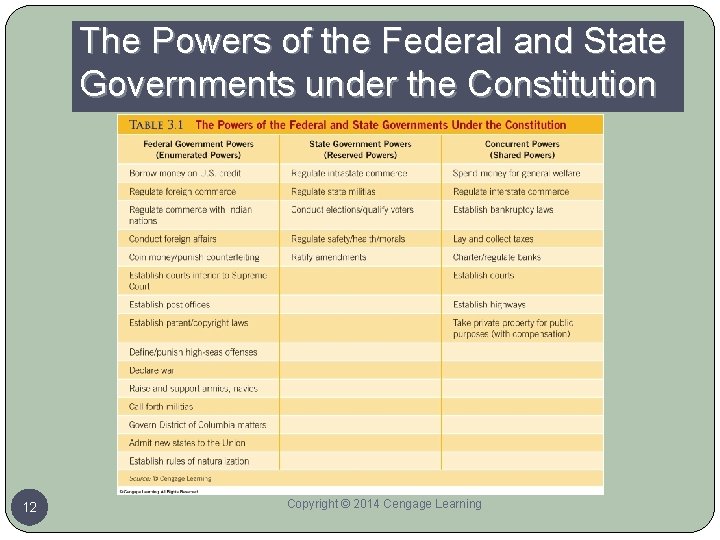
The Powers of the Federal and State Governments under the Constitution 12 Copyright © 2014 Cengage Learning
What is Federalism? § Relations between the States § Full faith and credit clause, Article IV § Each state must abide by the decisions of other state and local governments § Assures stability in relations beyond state borders § Privileges and immunities clause, Article IV protects the rights of citizens to § Travel through other states § Reside in any state § Participate in trade, agriculture, and professional pursuits 13 Copyright © 2014 Cengage Learning
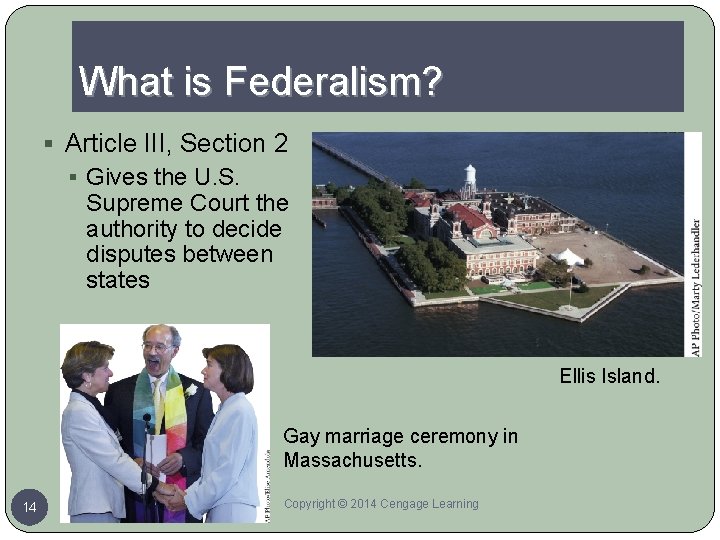
What is Federalism? § Article III, Section 2 § Gives the U. S. Supreme Court the authority to decide disputes between states Ellis Island. Gay marriage ceremony in Massachusetts. 14 Copyright © 2014 Cengage Learning
The History of American Federalism § Concept of federalism has changed over time § 5 eras of American Federalism § State-centered federalism: 1789– 1819 § National supremacy period: 1819– 1837 § Dual federalism: 1837– 1937 § Cooperative federalism: 1937– 1990 § The “new federalism”: 1990–present 15 Copyright © 2014 Cengage Learning
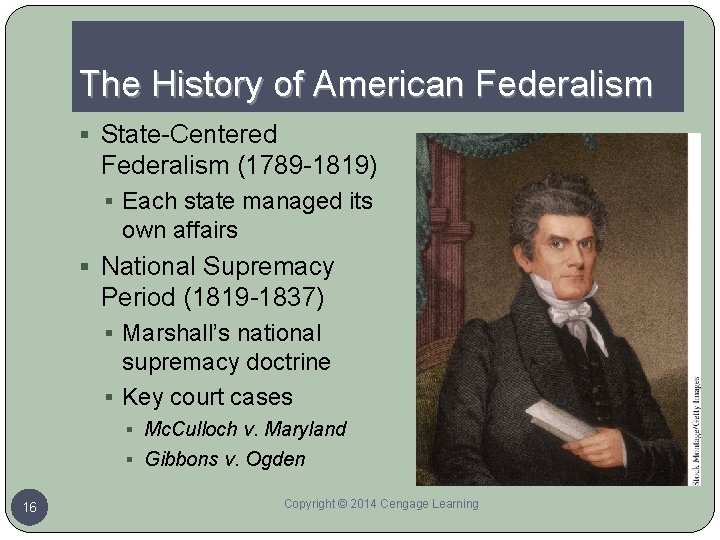
The History of American Federalism § State-Centered Federalism (1789 -1819) § Each state managed its own affairs § National Supremacy Period (1819 -1837) § Marshall’s national supremacy doctrine § Key court cases § Mc. Culloch v. Maryland § Gibbons v. Ogden 16 Copyright © 2014 Cengage Learning
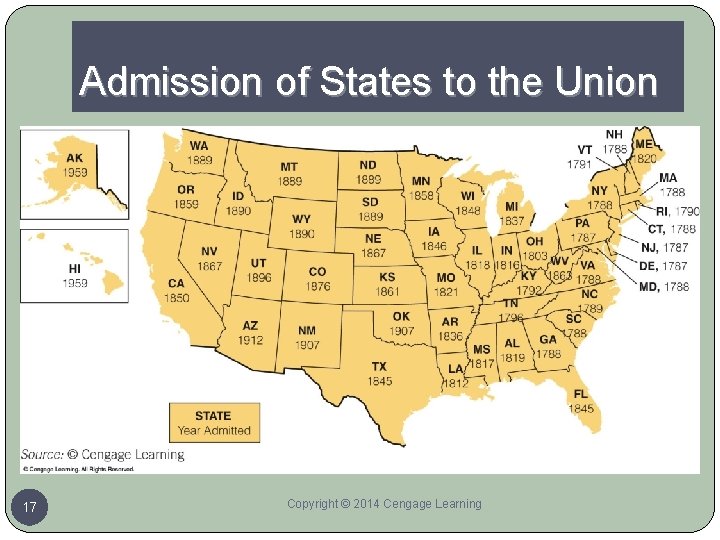
Admission of States to the Union 17 Copyright © 2014 Cengage Learning
The History of American Federalism § Dual Federalism (1837 -1937) § State authority acts as a limit on congressional power under the Constitution § Cooperative Federalism (1937 -1990) § Shift from layer-cake to marble-cake federalism § Positive aspects: grants-in-aid and block grants § Negative aspect: protective conditions 18 Copyright © 2014 Cengage Learning
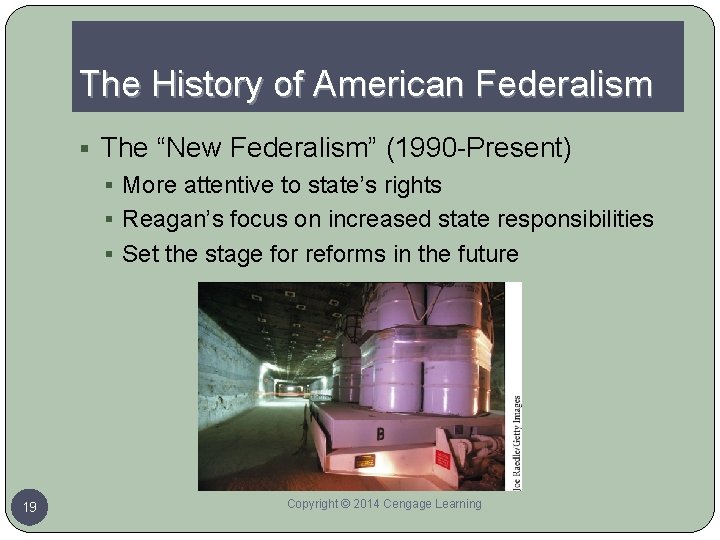
The History of American Federalism § The “New Federalism” (1990 -Present) § More attentive to state’s rights § Reagan’s focus on increased state responsibilities § Set the stage for reforms in the future 19 Copyright © 2014 Cengage Learning

The History of American Federalism 20 Copyright © 2014 Cengage Learning

Has the Federal Government Gotten Too Big? 21 Copyright © 2014 Cengage Learning
Why Federalism? Advantages and Disadvantages § Advantages of Federalism § Accommodation of diversity § Strengthening of liberty through the division powers § Encouragement of laboratories of democracy 22 Copyright © 2014 Cengage Learning of
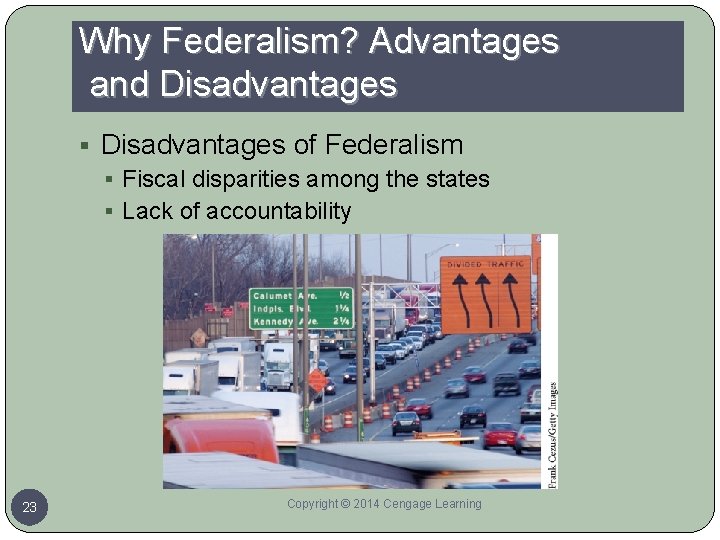
Why Federalism? Advantages and Disadvantages § Disadvantages of Federalism § Fiscal disparities among the states § Lack of accountability 23 Copyright © 2014 Cengage Learning
- Slides: 23