
Chapter 3 Federalism AP U S Government Politics


- Slides: 43
Chapter 3 Federalism AP U. S. Government & Politics
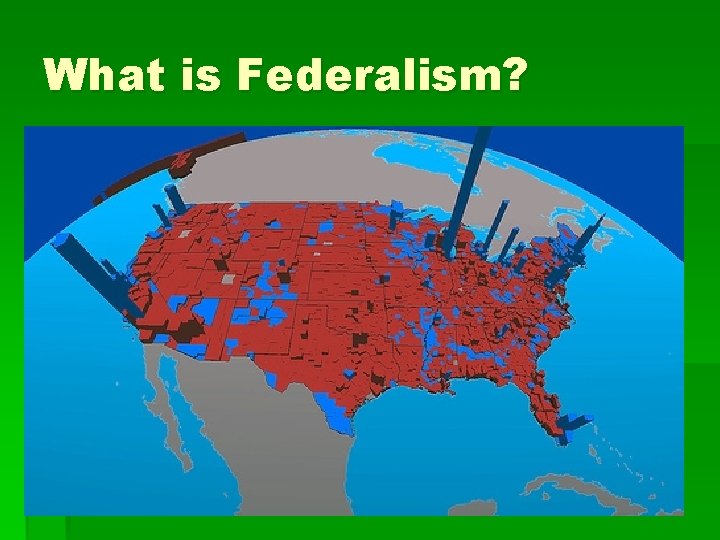
What is Federalism?
§ Can the state of Nevada pass laws that affect Nevadans? § Can the federal government?
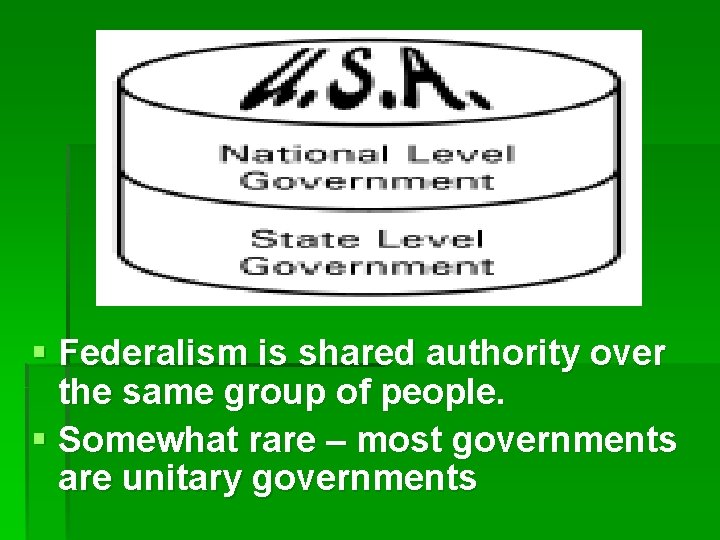
§ Federalism is shared authority over the same group of people. § Somewhat rare – most governments are unitary governments
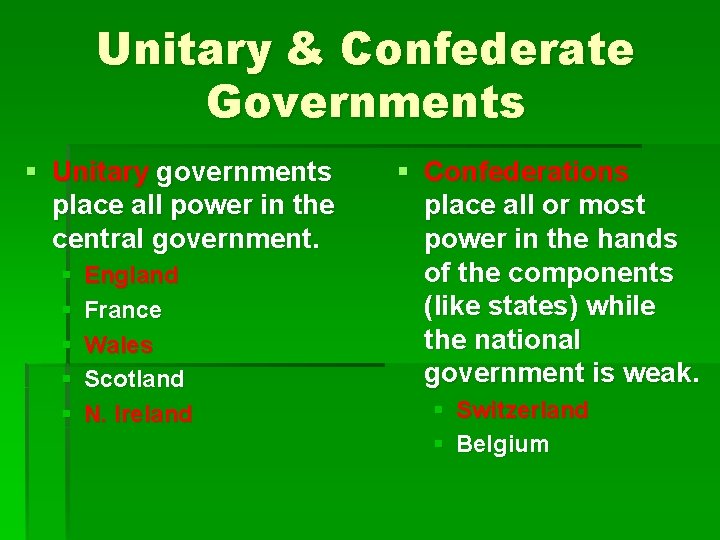
Unitary & Confederate Governments § Unitary governments place all power in the central government. § § § England France Wales Scotland N. Ireland § Confederations place all or most power in the hands of the components (like states) while the national government is weak. § Switzerland § Belgium
Why is Federalism so Important?
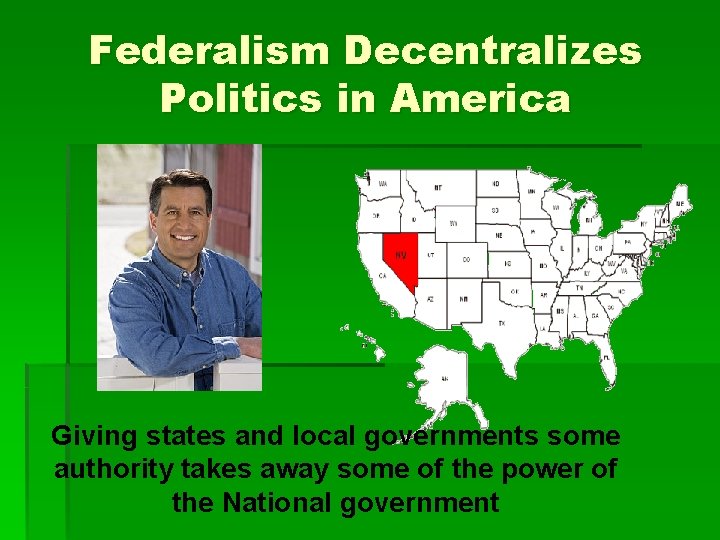
Federalism Decentralizes Politics in America Giving states and local governments some authority takes away some of the power of the National government
§ What things should be handled by the federal government and which by the states? § Constitution doesn’t specify everything § Constant debate § Republicans and Democrats
Federalism Decentralizes Policies in America
Federalism Decentralizes Policies in America § States regulate drinking ages, marriage, and speed limits. But… § MADD § States are “policy innovators” § Most national programs originate in states § States are more likely to “experiment”
Federalism in the Constitution
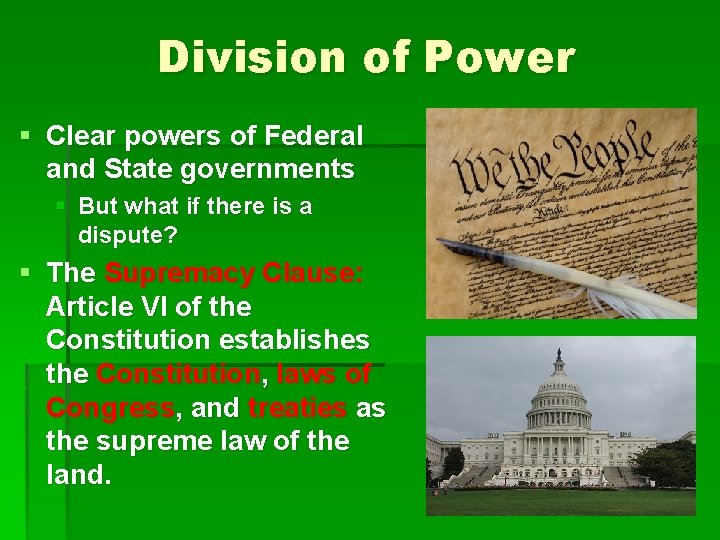
Division of Power § Clear powers of Federal and State governments § But what if there is a dispute? § The Supremacy Clause: Article VI of the Constitution establishes the Constitution, laws of Congress, and treaties as the supreme law of the land.
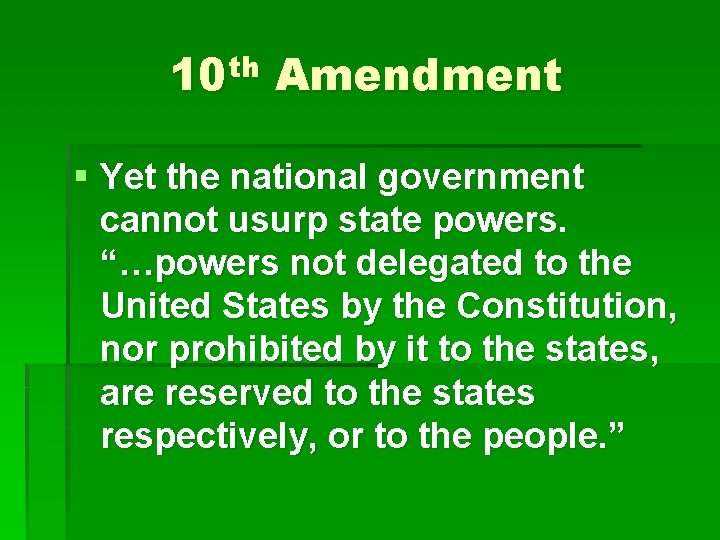
10 th Amendment § Yet the national government cannot usurp state powers. “…powers not delegated to the United States by the Constitution, nor prohibited by it to the states, are reserved to the states respectively, or to the people. ”
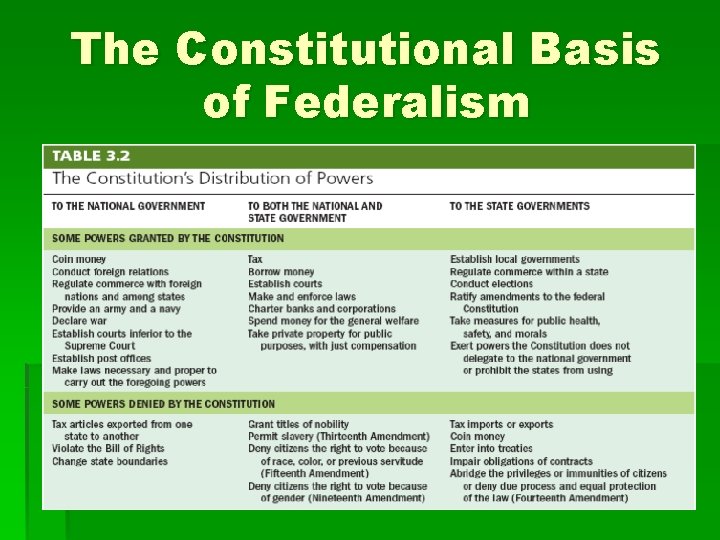
The Constitutional Basis of Federalism
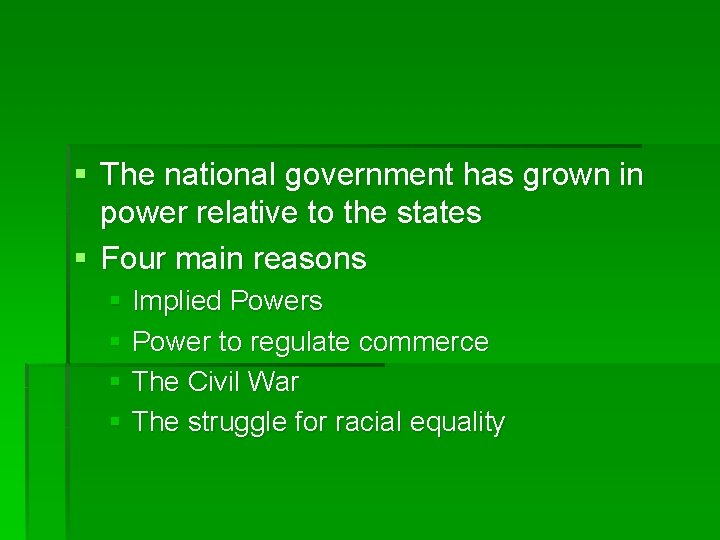
§ The national government has grown in power relative to the states § Four main reasons § Implied Powers § Power to regulate commerce § The Civil War § The struggle for racial equality
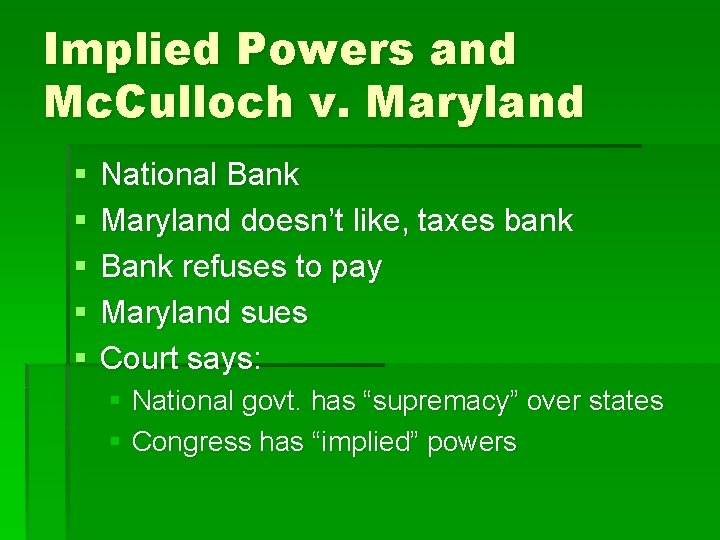
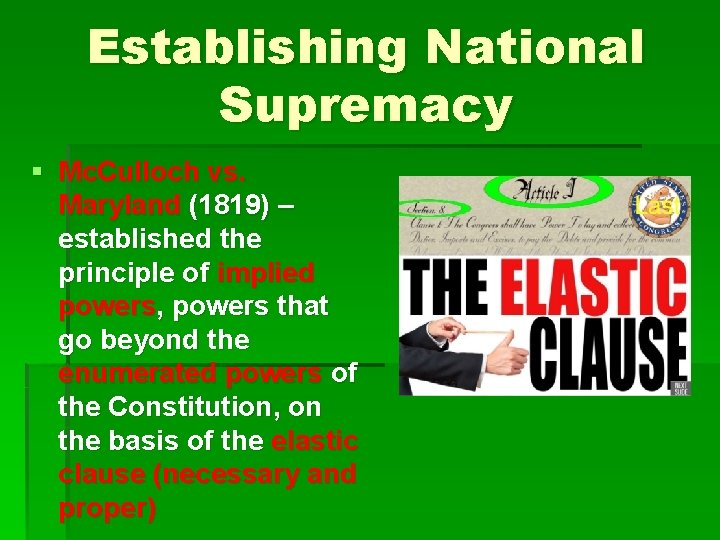
Implied Powers and Mc. Culloch v. Maryland § § § National Bank Maryland doesn’t like, taxes bank Bank refuses to pay Maryland sues Court says: § National govt. has “supremacy” over states § Congress has “implied” powers
Establishing National Supremacy § Mc. Culloch vs. Maryland (1819) – established the principle of implied powers, powers that go beyond the enumerated powers of the Constitution, on the basis of the elastic clause (necessary and proper)
Gibbons vs. Ogden § Commerce Power – Gibbons v. Ogden (1824) § Defined commerce very broadly § Gave Congress the power to regulate interstate commerce, encompassing almost every form of commercial activity.
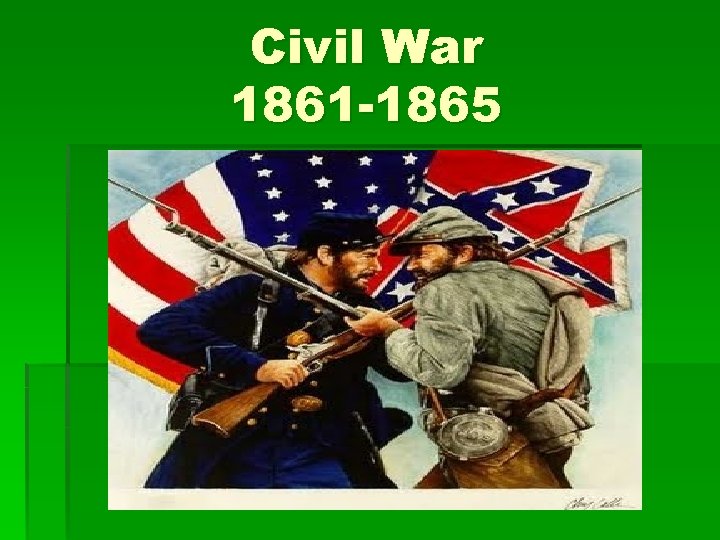
Civil War 1861 -1865
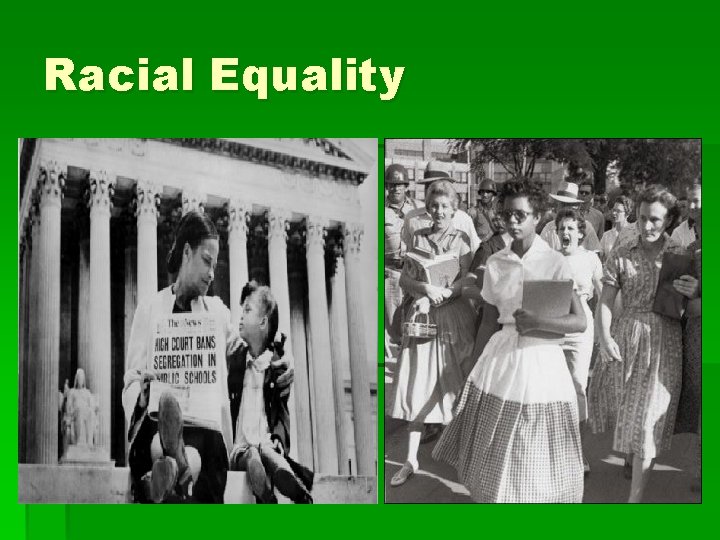
Racial Equality
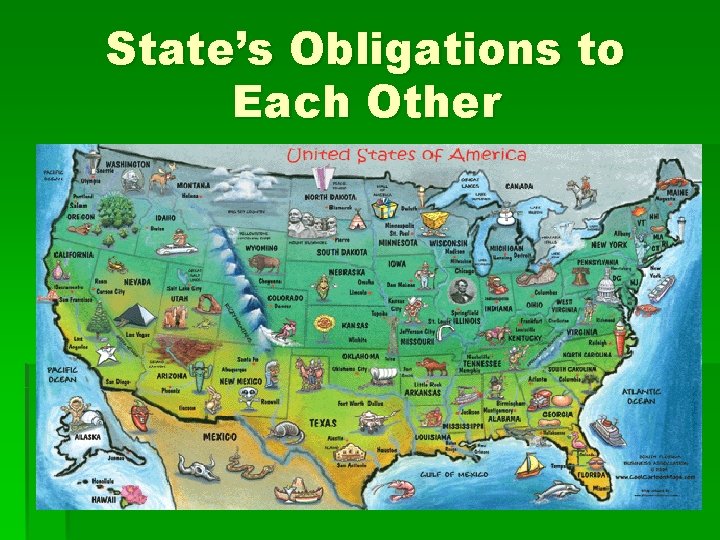
State’s Obligations to Each Other
Full Faith & Credit (Article IV Sec I)
Full Faith & Credit (Article IV Sec I)
Privileges & Immunities (Article IV Sec 2) § Sales Tax § Fines § Voting § Tuition Fees
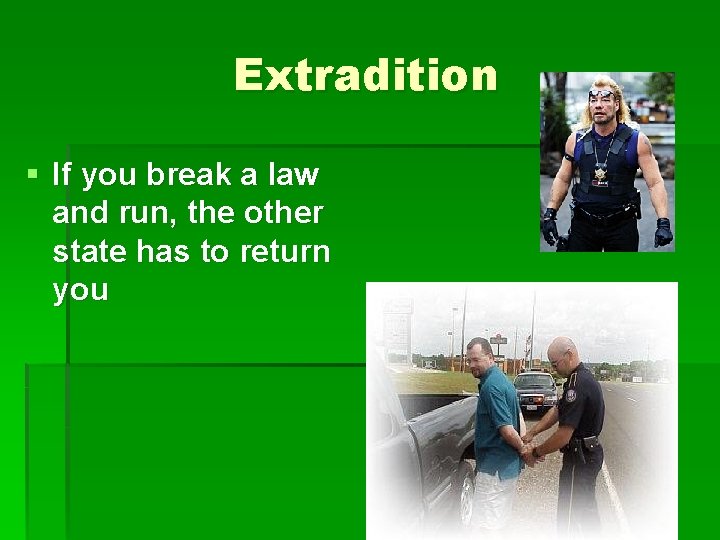
Extradition § If you break a law and run, the other state has to return you
Dual and Cooperative Federalism § Two main changes in the area of Federalism: § 1. The shift from Dual Federalism to Cooperative Federalism. § 2. The rise of fiscal federalism (grant-inaid)
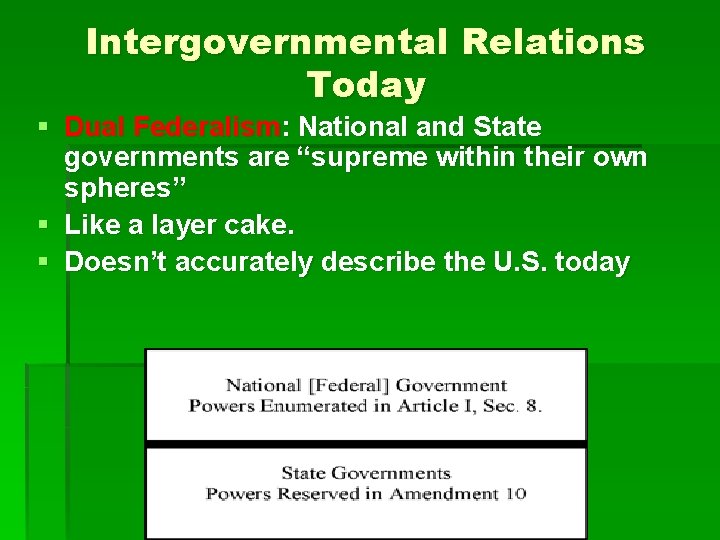
Intergovernmental Relations Today § Dual Federalism: National and State governments are “supreme within their own spheres” § Like a layer cake. § Doesn’t accurately describe the U. S. today
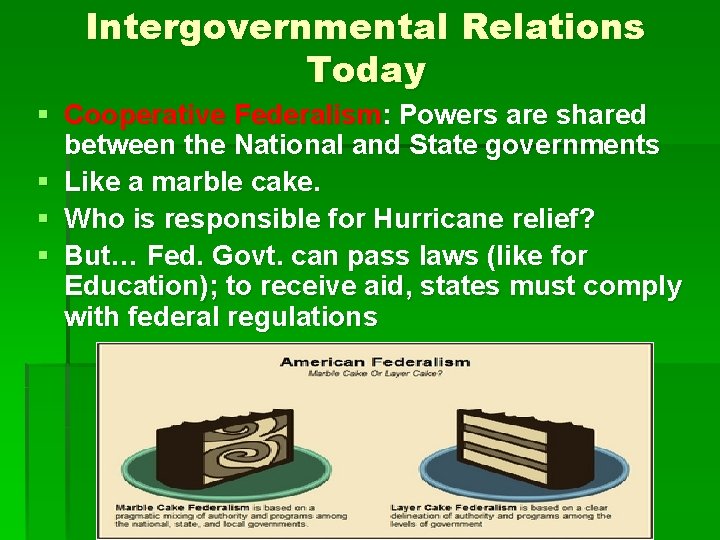
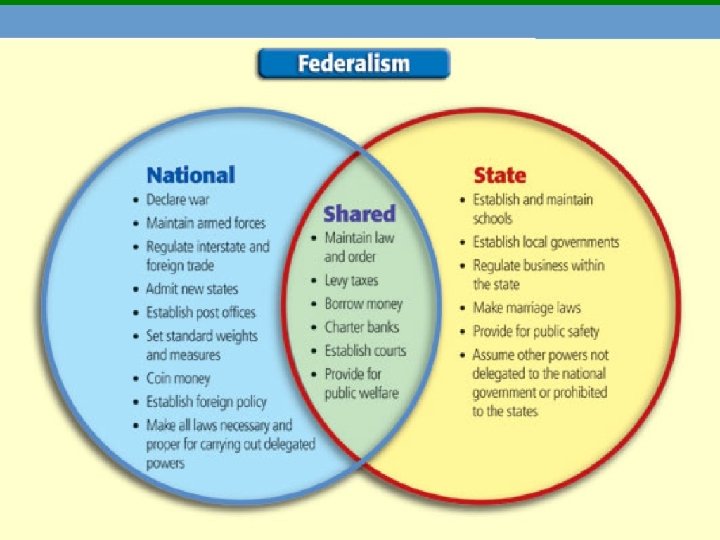
Intergovernmental Relations Today § Cooperative Federalism: Powers are shared between the National and State governments § Like a marble cake. § Who is responsible for Hurricane relief? § But… Fed. Govt. can pass laws (like for Education); to receive aid, states must comply with federal regulations
§ Generally in cooperative Federalism: § There are shared costs and administrations § States follow federal guidelines.
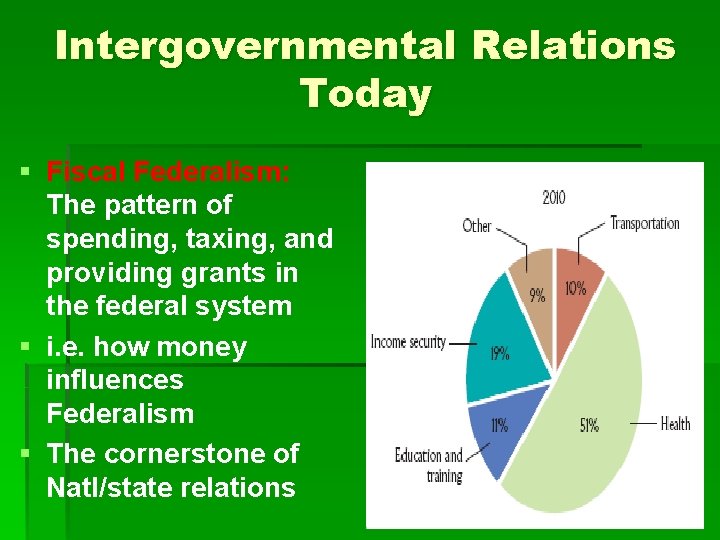
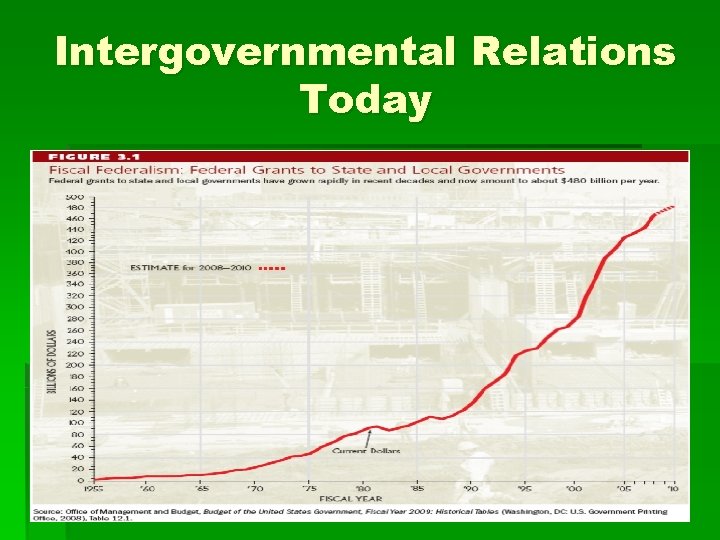
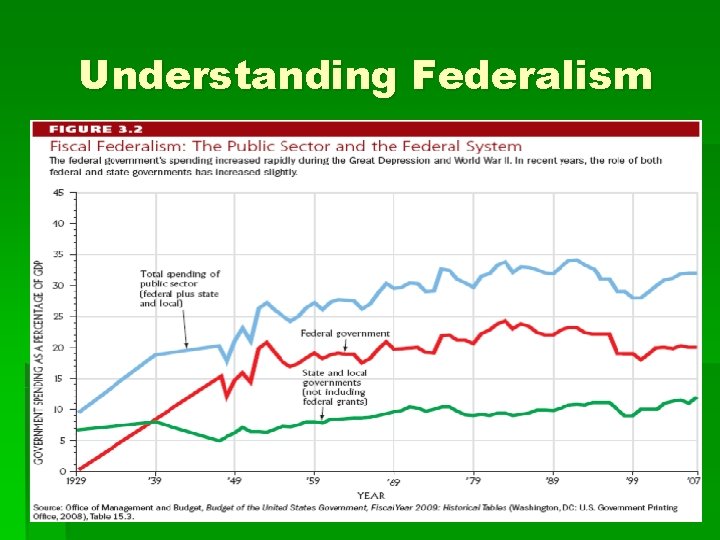
Intergovernmental Relations Today § Fiscal Federalism: The pattern of spending, taxing, and providing grants in the federal system § i. e. how money influences Federalism § The cornerstone of Natl/state relations
Intergovernmental Relations Today
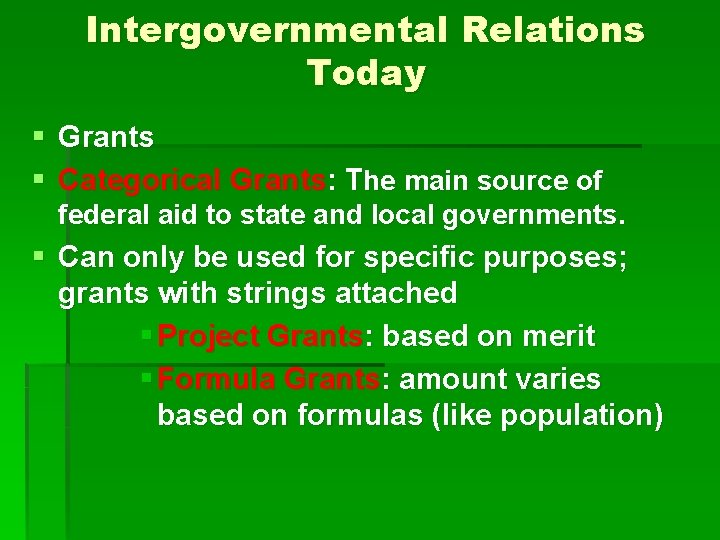
Intergovernmental Relations Today § Grants § Categorical Grants: The main source of federal aid to state and local governments. § Can only be used for specific purposes; grants with strings attached § Project Grants: based on merit § Formula Grants: amount varies based on formulas (like population)
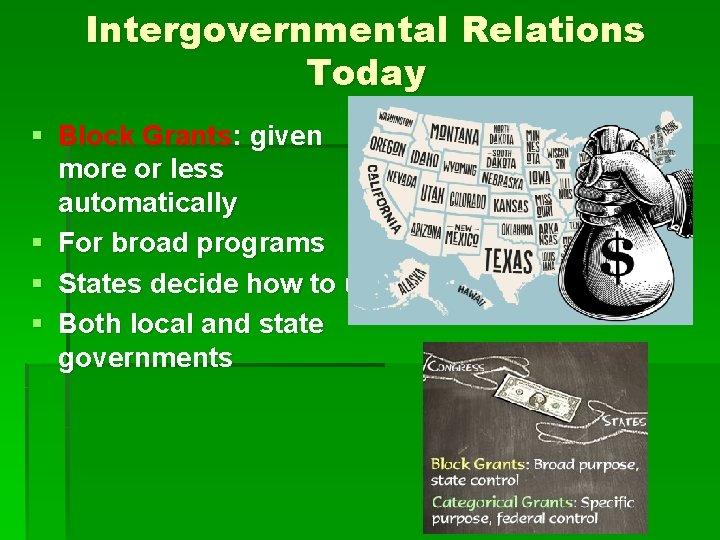
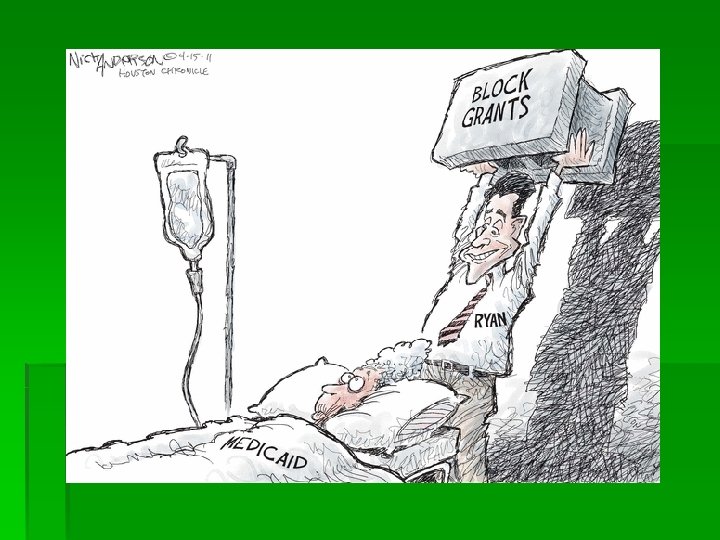
Intergovernmental Relations Today § Block Grants: given more or less automatically § For broad programs § States decide how to use § Both local and state governments
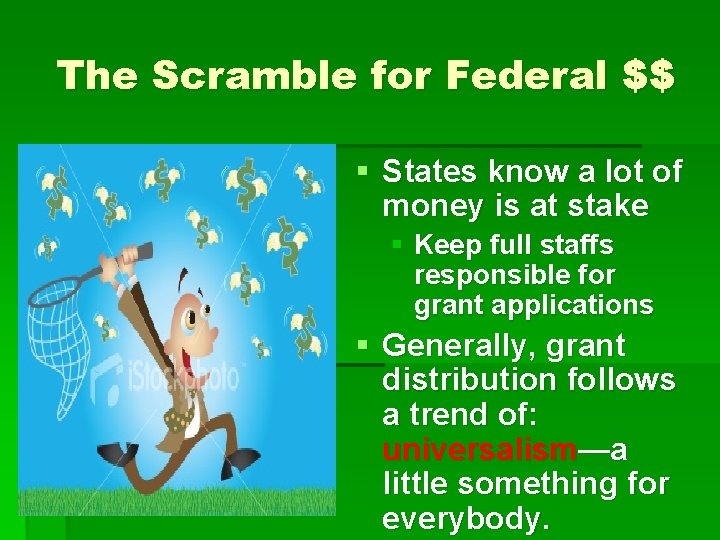
The Scramble for Federal $$ § States know a lot of money is at stake § Keep full staffs responsible for grant applications § Generally, grant distribution follows a trend of: universalism—a little something for everybody.
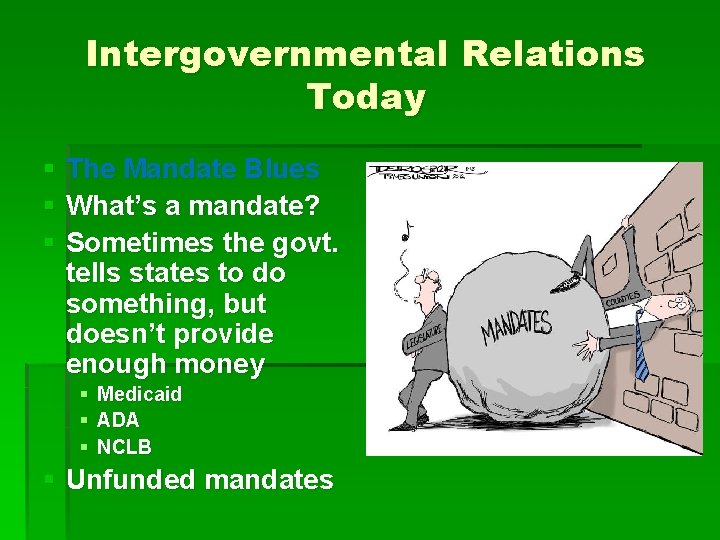
Intergovernmental Relations Today § The Mandate Blues § What’s a mandate? § Sometimes the govt. tells states to do something, but doesn’t provide enough money § § § Medicaid ADA NCLB § Unfunded mandates
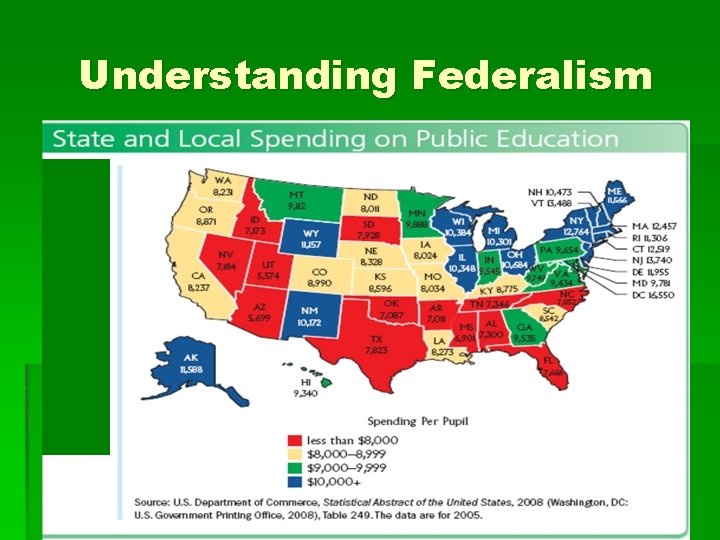
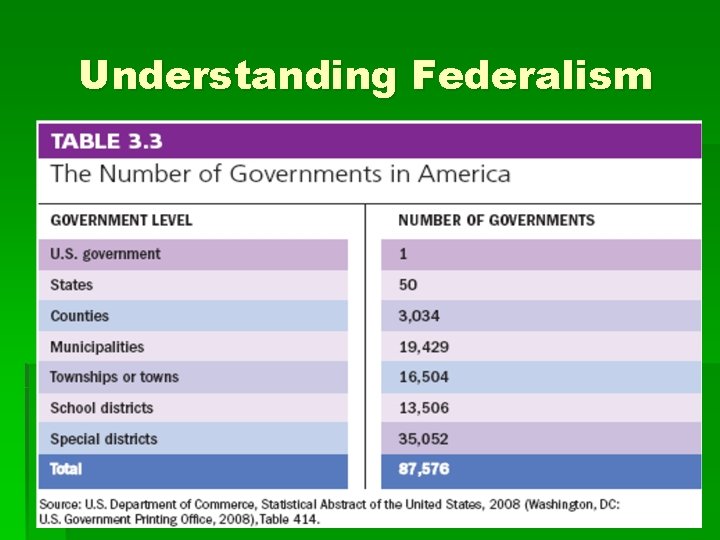
Is Federalism good or bad for democracy? § Advantages for Democracy § Increases access to government. § Local problems can be solved … locally. § Hard for political parties or interest groups to dominate all politics. § Disadvantages for Democracy § States differ in the resources they can/will devote to services. § Local interests can counteract national interests. § Too many levels of government and too much money being spent.
Understanding Federalism
Understanding Federalism
Understanding Federalism
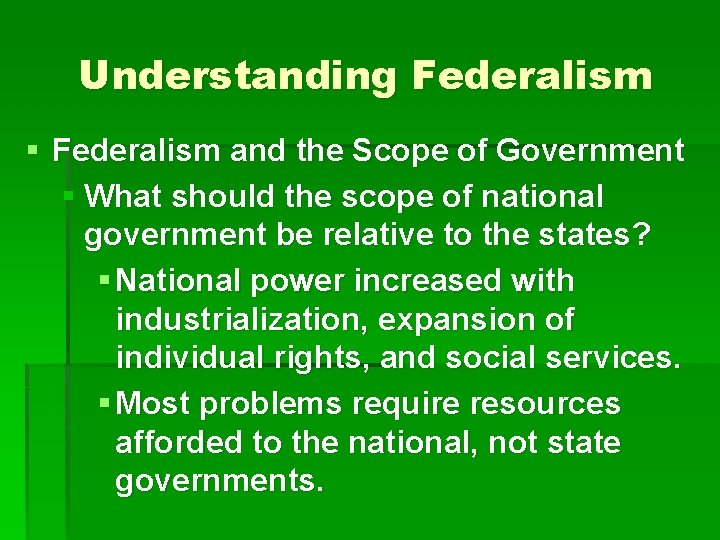
Understanding Federalism § Federalism and the Scope of Government § What should the scope of national government be relative to the states? § National power increased with industrialization, expansion of individual rights, and social services. § Most problems require resources afforded to the national, not state governments.
Summary § American federalism is a governmental system in which power is shared between a central government and the 50 state governments. § The United States has moved from dual to cooperative federalism; fiscal federalism. § Federalism leads to both advantages and disadvantages to democracy.