
Chapter 3 Externalities and Public Policy 1 Externalities
Chapter 3 Externalities and Public Policy 1
Externalities n Externalities are costs or benefits of market transactions not reflected in prices. n n Negative externalities are costs to third parties. Positive externalities are benefits to third parties. 2

Externalities and Efficiency n The marginal external cost is the dollar value of the cost to third parties from the production or consumption of an additional unit of a good. These occur when market transactions for a good produce negative externalities. 3

Social Costs MSC = MPC + MEC 4
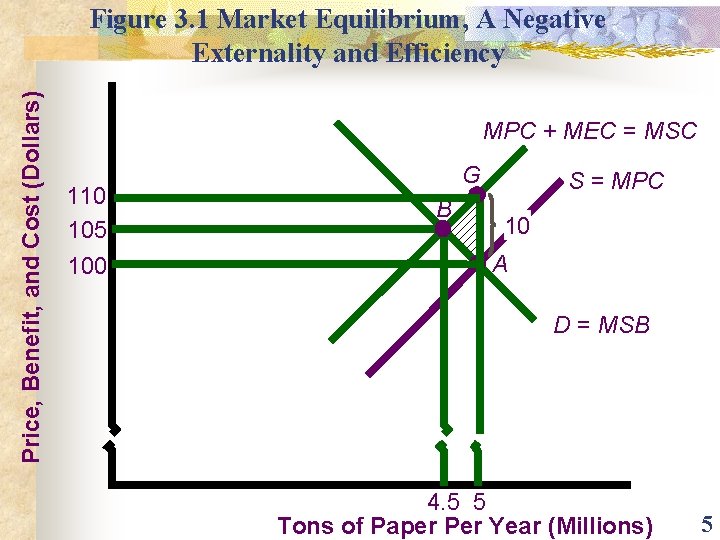
Price, Benefit, and Cost (Dollars) Figure 3. 1 Market Equilibrium, A Negative Externality and Efficiency MPC + MEC = MSC 110 105 100 G B S = MPC 10 A D = MSB 4. 5 5 Tons of Paper Per Year (Millions) 5

Implications of Figure 3. 1 Market equilibrium occurs where MPC = MSB n Efficiency Requires that MSC = MPC + MEC = MSB n 6
Positive externalities n The marginal external benefit is the dollar value of the benefit to third parties from an additional unit of production or consumption of a good. These occur when the market for a good creates positive externalities. 7

Social Benefit MSB = MPB + MEB 8
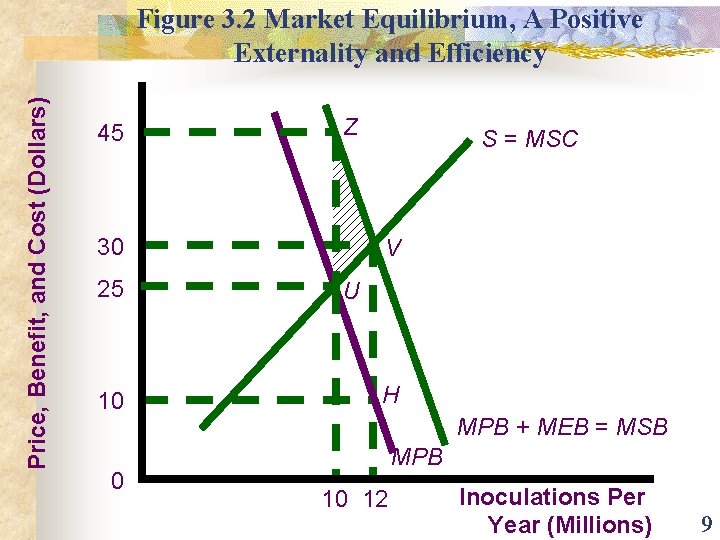
Price, Benefit, and Cost (Dollars) Figure 3. 2 Market Equilibrium, A Positive Externality and Efficiency 45 Z 30 25 10 0 S = MSC V U H MPB + MEB = MSB MPB 10 12 Inoculations Per Year (Millions) 9

Price, Benefit, and Cost (Dollars) Figure 3. 3 A Positive Externality for Which MEB Declines With Annual Output MPBi + MEB = MSB 30 25 F A B S' = MSC' C 20 0 S = MSC MPBi 10 12 16 20 Inoculations per Year (Millions) 10

Internalization of Externalities n An externality can be internalized under policies that force market participants to account for the costs of benefits of their actions. 11
Corrective Taxes to Negative Externalities n Setting a tax equal to the MEC will internalize a negative externality. 12
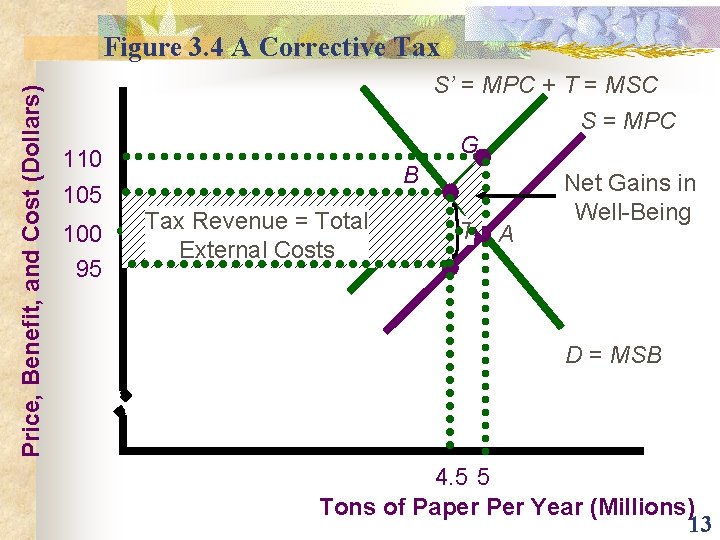
Price, Benefit, and Cost (Dollars) Figure 3. 4 A Corrective Tax S’ = MPC + T = MSC 110 105 100 95 S = MPC G B Tax Revenue = Total External Costs T A Net Gains in Well-Being D = MSB 4. 5 5 Tons of Paper Per Year (Millions) 13
Results of a Corrective Tax Price rises. n The tax revenue is sufficient to pay costs to third parties. n Socially optimal levels of production are achieved. n 14
Using a Corrective Tax n The greenhouse effect and a “Carbon Tax” n n The greenhouse effect is caused by burning carbon-based fuels. A carbon tax can be imposed to limit greenhouse gasses to their socially optimal levels. It is called a carbon tax because the amount of the tax would depend on the amount of carbon in the fuel. 15
Theory of the Second Best n When one condition for an optimum is violated, then maintaining the others will not guarantee a secondbest solution. 16
A Polluting Monopolist n n Chapter 2 showed that monopoly creates a loss to society. This chapter shows that a negative externality causes a loss as well. The losses do not necessarily add to one another. In fact, they cancel each other out. 17

Figure 3. 5 A Second Best Efficient Solution MPC + MEC = MSC F PM MPC A Price B C D = MSB MR 0 QM Q* Output per Year 18
Corrective Subsidies n Setting a subsidy equal to MEB will internalize a positive externality. 19
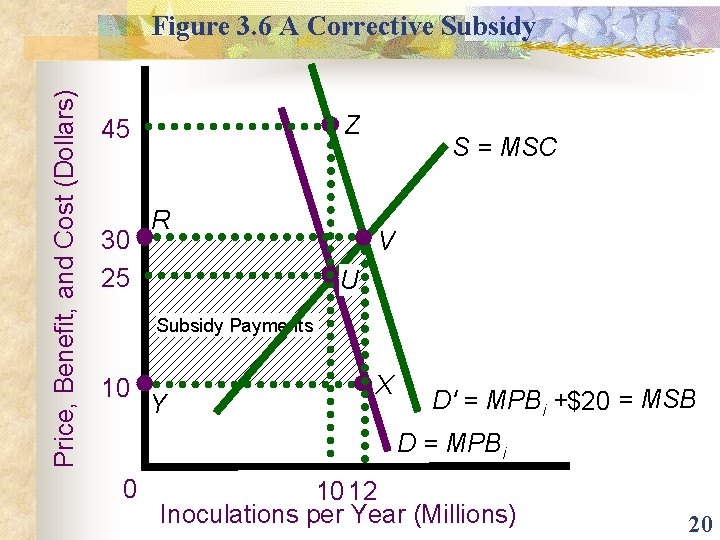
Price, Benefit, and Cost (Dollars) Figure 3. 6 A Corrective Subsidy Z 45 30 25 R S = MSC V U Subsidy Payments 10 Y X D' = MPBi +$20 = MSB D = MPBi 0 10 12 Inoculations per Year (Millions) 20

Property Rights and Internalization of Externalities n n Externalities arise because some resource users’ property rights are not considered in the marketplace by buyers or sellers of products. Governments can give businesses the right to emit wastes in the air and water or it can give individuals the right to clean air and water. 21
Coase's Theorem n By establishing rights to use resources, government can internalize externalities when transactions or bargaining costs are zero. 22
The Significance of Coase’s Theorem n n n The efficient mix of output will result simply as a consequence of the establishment of exchangeable property rights. It makes no difference which party is assigned the right to use a resource. If the transactions costs of exchanging the rights are zero, the efficient mix of outputs among competing uses of the resource will emerge. 23
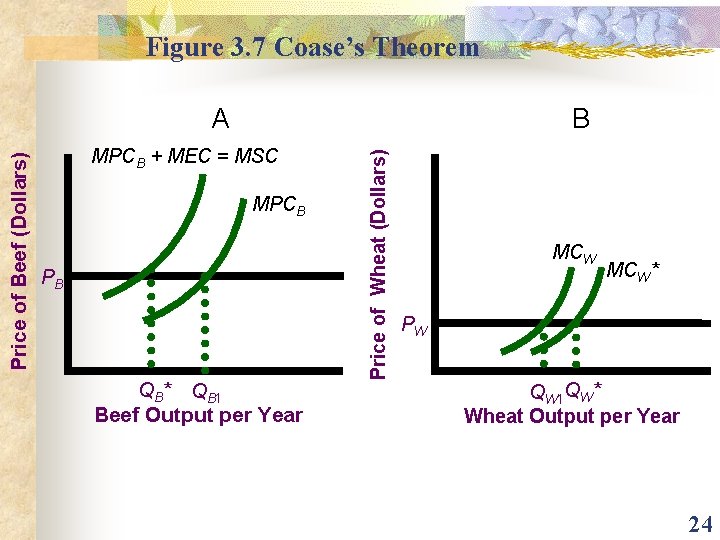
Figure 3. 7 Coase’s Theorem B MPCB + MEC = MSC MPCB PB QB* QB 1 Beef Output per Year Price of Wheat (Dollars) Price of Beef (Dollars) A MCW* PW QW 1 QW* Wheat Output per Year 24
Limitations of Coase’s Theorem n Transactions costs are not zero in many situations. n However you allocate the property rights, the distribution of income is affected. 25
Applying Coase's Theorem n n The Clean Air Act of 1990 allows for the sale of the "right to pollute. " Firms face a tradeoff when they pollute. If they pollute, they forgo the right to sell their emission permits to others. In markets for electricity, Clean Air Act has motivated firms to shift to natural gas and away from coal as a means of producing electricity. 26
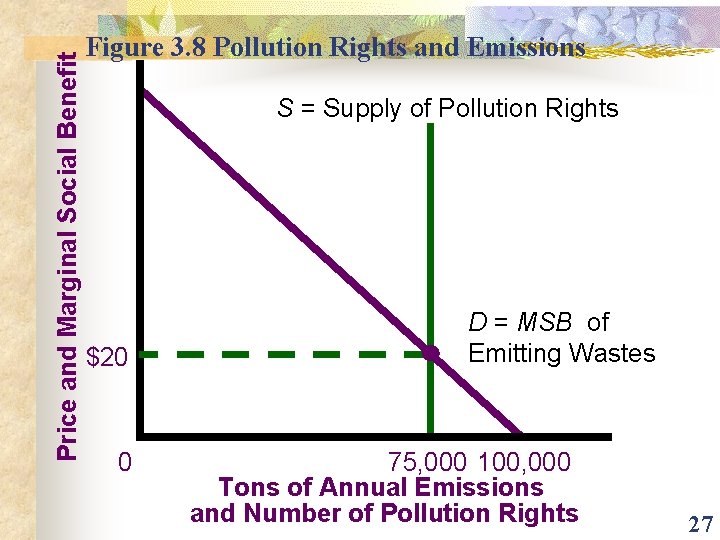
Price and Marginal Social Benefit Figure 3. 8 Pollution Rights and Emissions S = Supply of Pollution Rights $20 0 D = MSB of Emitting Wastes 75, 000 100, 000 Tons of Annual Emissions and Number of Pollution Rights 27
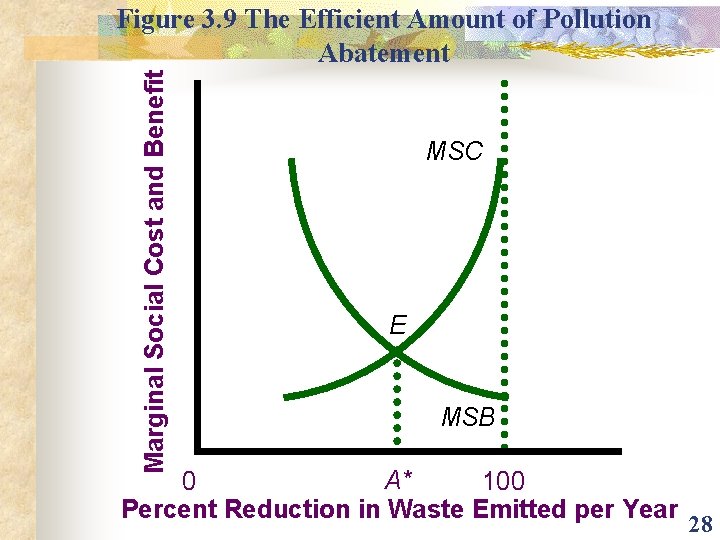
Marginal Social Cost and Benefit Figure 3. 9 The Efficient Amount of Pollution Abatement MSC E MSB A* 0 100 Percent Reduction in Waste Emitted per Year 28
Recycling n Recycling may be a less efficient and more polluting use of labor, land capital than simple land fill disposal because: n n n Collecting waste for recycling costs three times as much as collecting it for disposal. Rural land is inexpensive. Recycling paper creates more water pollution and does not “save” trees; it simply reduces the number that are planted. 29
Regulatory Solutions n Instead of using market forces to force firms to internalize externalities, we can use emission standards and apply these to all market players. 30
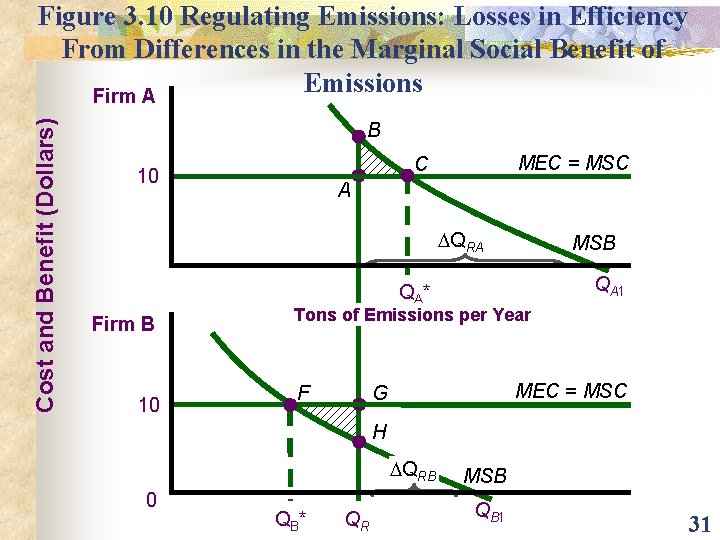
Cost and Benefit (Dollars) Figure 3. 10 Regulating Emissions: Losses in Efficiency From Differences in the Marginal Social Benefit of Emissions Firm A B MEC = MSC C 10 A DQRA QA 1 QA* Firm B 10 MSB Tons of Emissions per Year F MEC = MSC G H DQRB 0 QB* QR MSB QB 1 31
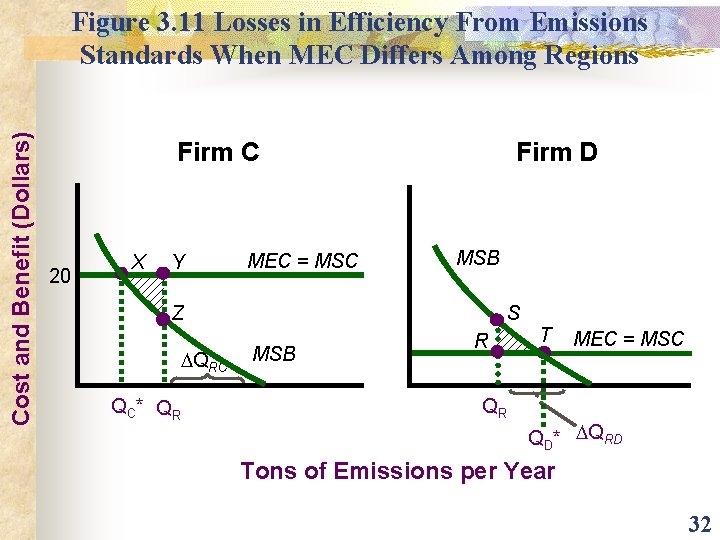
Cost and Benefit (Dollars) Figure 3. 11 Losses in Efficiency From Emissions Standards When MEC Differs Among Regions Firm C 20 X Y MEC = MSC Firm D MSB S Z DQRC QC* QR MSB R QR T MEC = MSC QD* DQRD Tons of Emissions per Year 32
Markets for Pollution Rights n n n The Clean Air Act of 1990 allowed firms the right to trade Sulfur Dioxide emissions allowances. The market for the allowances began in 1991. Firms must have the allowances to emit Sulfur Dioxide. Firms increasing production can buy permits or use pollution controls to keep their total emissions constant. Firms that reduce their emissions can sell their allowances to others. 33
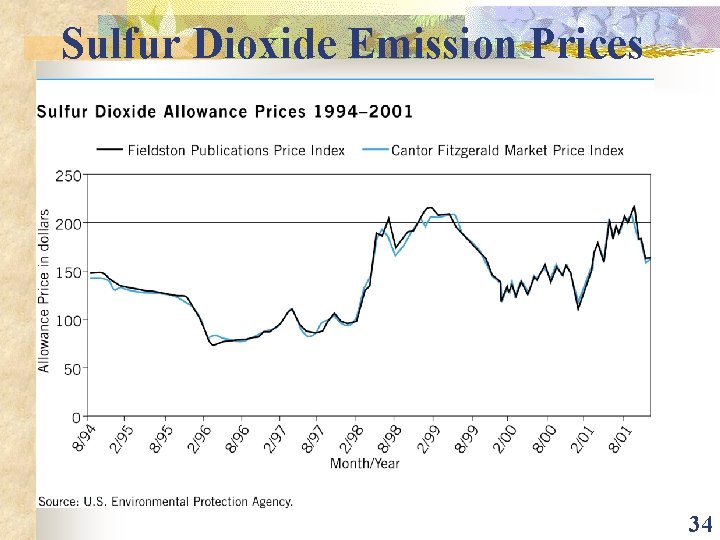
Sulfur Dioxide Emission Prices 34
Global Externalities CFC’s n Deforestation n Global Warming n 35
Costs and Benefits to the EPA n n n The EPA estimates that annual compliance costs could be in the range of $225 billion per year. The EPA estimated in 1990 that the benefits of the Clean Air Act were nearly 50 times the costs. Ninety percent of the benefits are estimated to come from laws pertaining to power plants and factories. 36
- Slides: 36