
Chapter 3 Examining the Internal Context of Strategy

- Slides: 25
Chapter 3 Examining the Internal Context of Strategy
OBJECTIVES 1 Explain the internal context of strategy 2 Identify a firm’s resources and capabilities and explain their role in its performance 3 Define dynamic capabilities and explain their role in both strategic change and a firm’s performance 4 Explain how value‑chain activities are related to firm performance and competitive advantage 5 Explain the role of managers with respect to resources, capabilities, and value‑chain activities 1
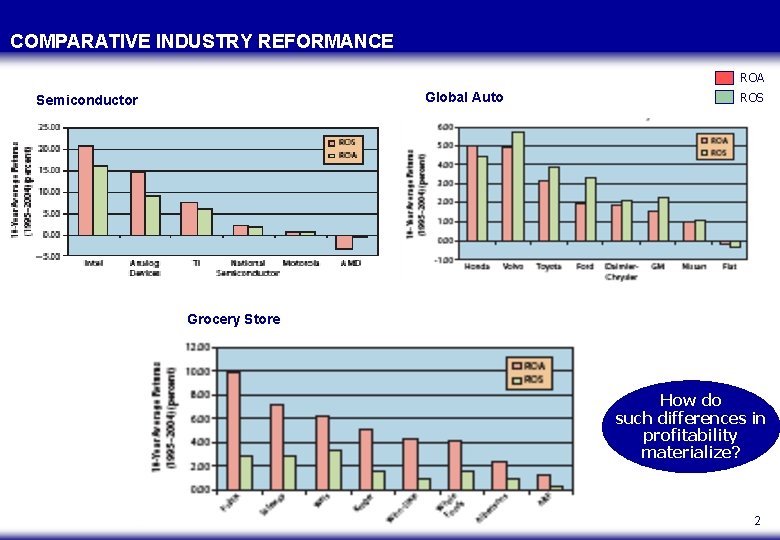
COMPARATIVE INDUSTRY REFORMANCE ROA Global Auto Semiconductor ROS Grocery Store How do such differences in profitability materialize? 2
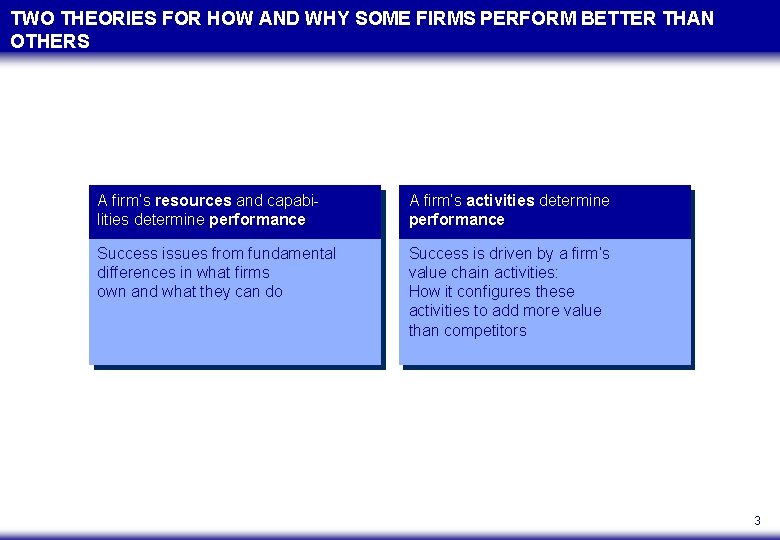
TWO THEORIES FOR HOW AND WHY SOME FIRMS PERFORM BETTER THAN OTHERS A firm’s resources and capabilities determine performance A firm’s activities determine performance Success issues from fundamental differences in what firms own and what they can do Success is driven by a firm’s value chain activities: How it configures these activities to add more value than competitors 3
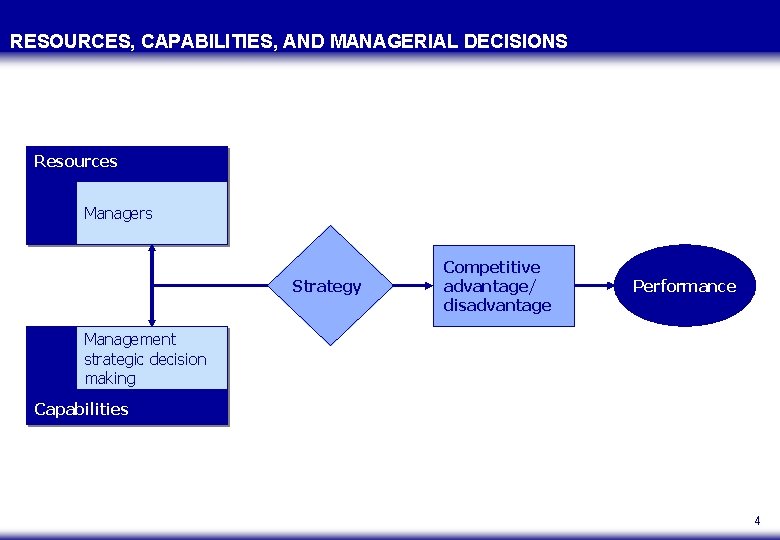
RESOURCES, CAPABILITIES, AND MANAGERIAL DECISIONS Resources Managers Strategy Competitive advantage/ disadvantage Performance Management strategic decision making Capabilities 4
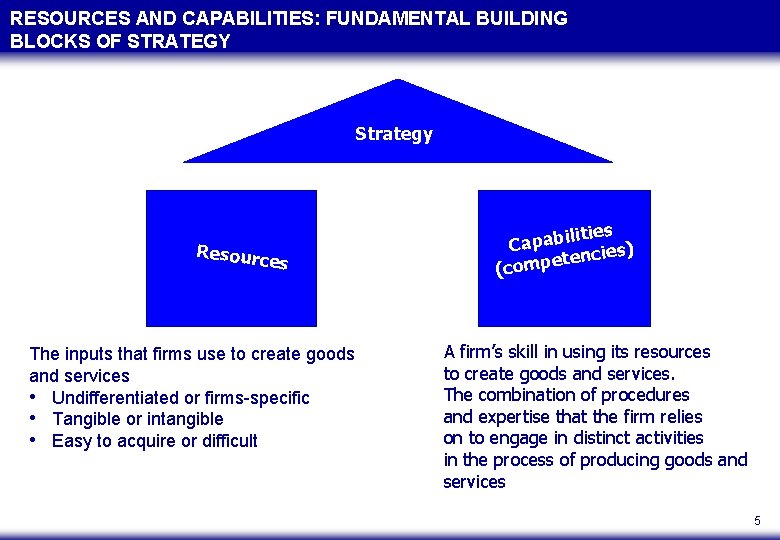
RESOURCES AND CAPABILITIES: FUNDAMENTAL BUILDING BLOCKS OF STRATEGY Strategy Resourc es The inputs that firms use to create goods and services • Undifferentiated or firms-specific • Tangible or intangible • Easy to acquire or difficult lities Capabi cies) ten (compe A firm’s skill in using its resources to create goods and services. The combination of procedures and expertise that the firm relies on to engage in distinct activities in the process of producing goods and services 5
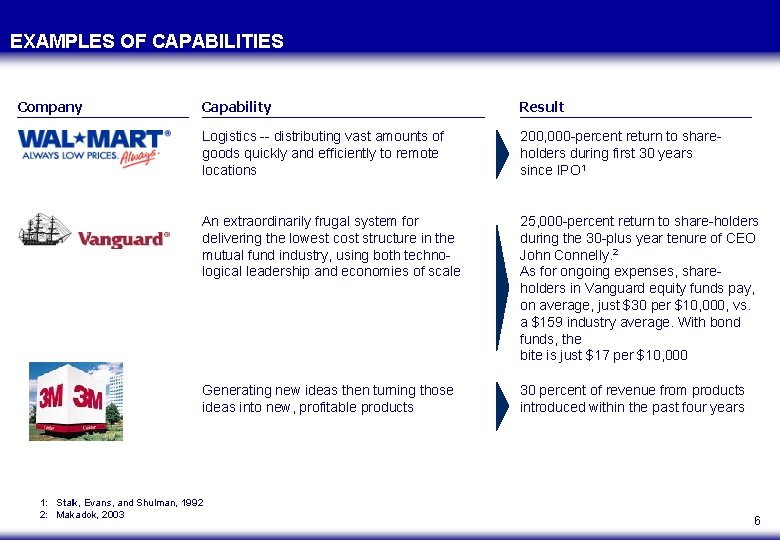
EXAMPLES OF CAPABILITIES Company Capability Result Logistics -- distributing vast amounts of goods quickly and efficiently to remote locations 200, 000 -percent return to shareholders during first 30 years since IPO 1 An extraordinarily frugal system for delivering the lowest cost structure in the mutual fund industry, using both technological leadership and economies of scale 25, 000 -percent return to share-holders during the 30 -plus year tenure of CEO John Connelly. 2 As for ongoing expenses, shareholders in Vanguard equity funds pay, on average, just $30 per $10, 000, vs. a $159 industry average. With bond funds, the bite is just $17 per $10, 000 Generating new ideas then turning those ideas into new, profitable products 30 percent of revenue from products introduced within the past four years 1: Stalk, Evans, and Shulman, 1992 2: Makadok, 2003 6
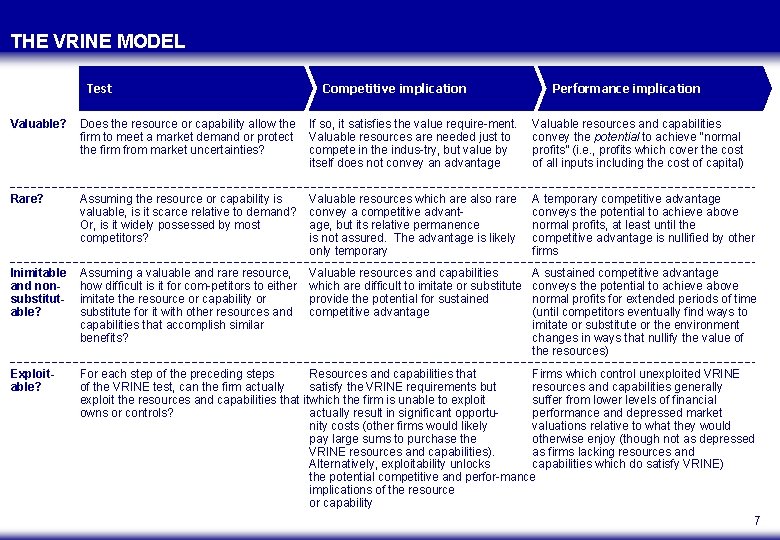
THE VRINE MODEL Test Competitive implication Performance implication Valuable? Does the resource or capability allow the If so, it satisfies the value require-ment. Valuable resources and capabilities firm to meet a market demand or protect Valuable resources are needed just to convey the potential to achieve “normal compete in the indus-try, but value by profits” (i. e. , profits which cover the cost the firm from market uncertainties? itself does not convey an advantage of all inputs including the cost of capital) Rare? Assuming the resource or capability is valuable, is it scarce relative to demand? Or, is it widely possessed by most competitors? Valuable resources which are also rare convey a competitive advantage, but its relative permanence is not assured. The advantage is likely only temporary A temporary competitive advantage conveys the potential to achieve above normal profits, at least until the competitive advantage is nullified by other firms Inimitable and nonsubstitutable? Assuming a valuable and rare resource, how difficult is it for com-petitors to either imitate the resource or capability or substitute for it with other resources and capabilities that accomplish similar benefits? Valuable resources and capabilities which are difficult to imitate or substitute provide the potential for sustained competitive advantage A sustained competitive advantage conveys the potential to achieve above normal profits for extended periods of time (until competitors eventually find ways to imitate or substitute or the environment changes in ways that nullify the value of the resources) Exploitable? For each step of the preceding steps Firms which control unexploited VRINE Resources and capabilities that of the VRINE test, can the firm actually resources and capabilities generally satisfy the VRINE requirements but exploit the resources and capabilities that it which the firm is unable to exploit suffer from lower levels of financial owns or controls? performance and depressed market actually result in significant opportuvaluations relative to what they would nity costs (other firms would likely otherwise enjoy (though not as depressed pay large sums to purchase the as firms lacking resources and VRINE resources and capabilities). capabilities which do satisfy VRINE) Alternatively, exploitability unlocks the potential competitive and perfor-mance implications of the resource or capability 7
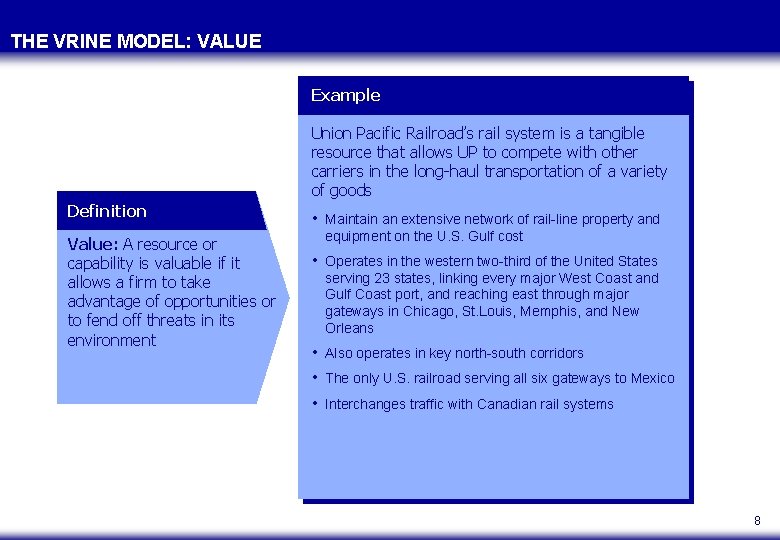
THE VRINE MODEL: VALUE Example Union Pacific Railroad’s rail system is a tangible resource that allows UP to compete with other carriers in the long-haul transportation of a variety of goods Definition Value: A resource or capability is valuable if it allows a firm to take advantage of opportunities or to fend off threats in its environment • Maintain an extensive network of rail-line property and equipment on the U. S. Gulf cost • Operates in the western two-third of the United States serving 23 states, linking every major West Coast and Gulf Coast port, and reaching east through major gateways in Chicago, St. Louis, Memphis, and New Orleans • Also operates in key north-south corridors • The only U. S. railroad serving all six gateways to Mexico • Interchanges traffic with Canadian rail systems 8
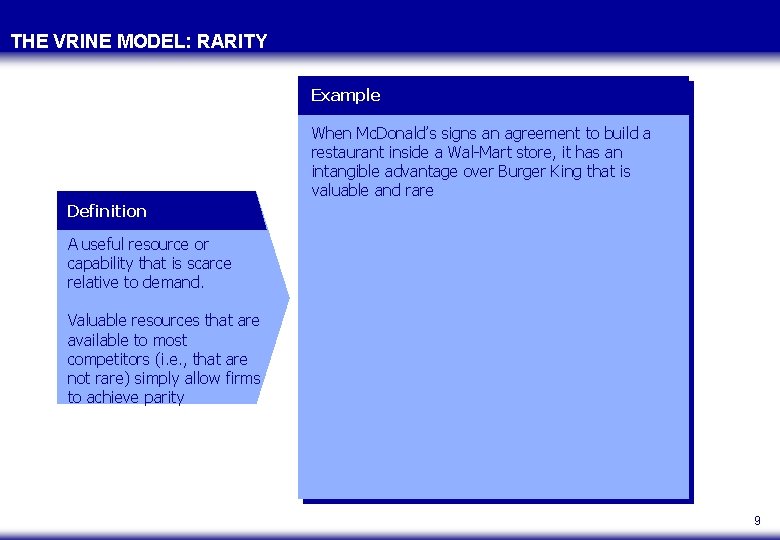
THE VRINE MODEL: RARITY Example When Mc. Donald’s signs an agreement to build a restaurant inside a Wal-Mart store, it has an intangible advantage over Burger King that is valuable and rare Definition A useful resource or capability that is scarce relative to demand. Valuable resources that are available to most competitors (i. e. , that are not rare) simply allow firms to achieve parity 9
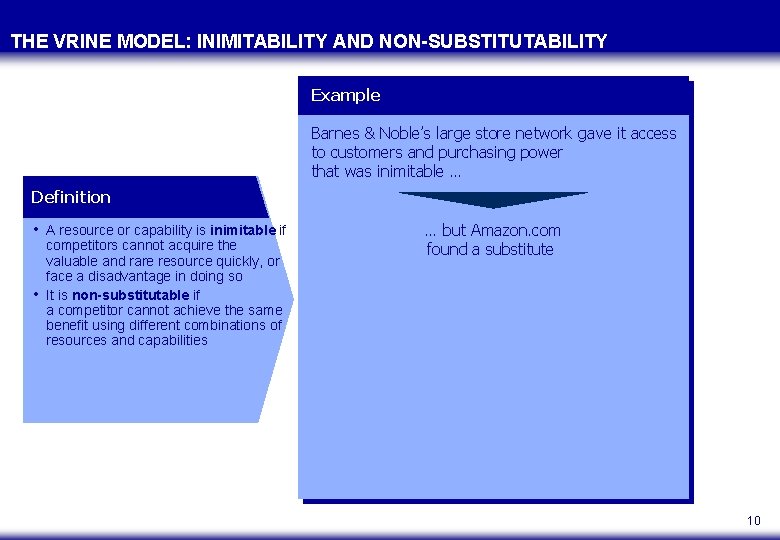
THE VRINE MODEL: INIMITABILITY AND NON-SUBSTITUTABILITY Example Barnes & Noble’s large store network gave it access to customers and purchasing power that was inimitable … Definition • A resource or capability is inimitable if • competitors cannot acquire the valuable and rare resource quickly, or face a disadvantage in doing so It is non-substitutable if a competitor cannot achieve the same benefit using different combinations of resources and capabilities … but Amazon. com found a substitute 10
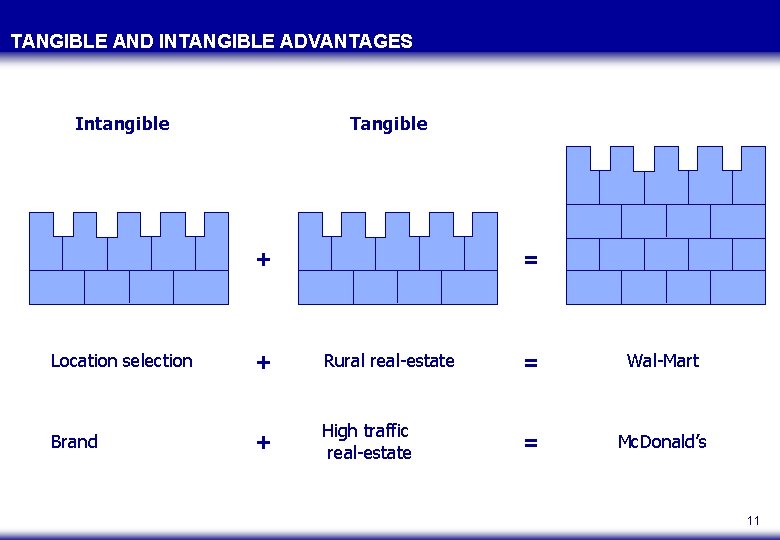
TANGIBLE AND INTANGIBLE ADVANTAGES Intangible Tangible + = Location selection + Rural real-estate = Wal-Mart Brand + High traffic real-estate = Mc. Donald’s 11
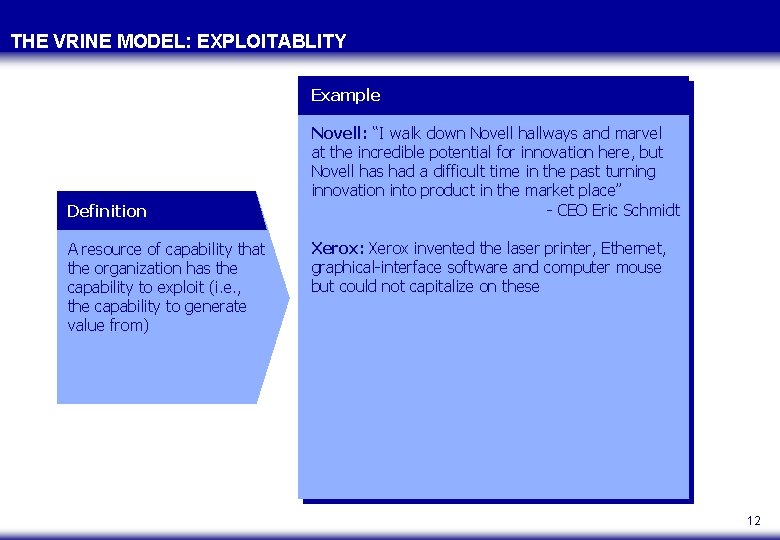
THE VRINE MODEL: EXPLOITABLITY Example Definition A resource of capability that the organization has the capability to exploit (i. e. , the capability to generate value from) Novell: “I walk down Novell hallways and marvel at the incredible potential for innovation here, but Novell has had a difficult time in the past turning innovation into product in the market place” - CEO Eric Schmidt Xerox: Xerox invented the laser printer, Ethernet, graphical-interface software and computer mouse but could not capitalize on these 12
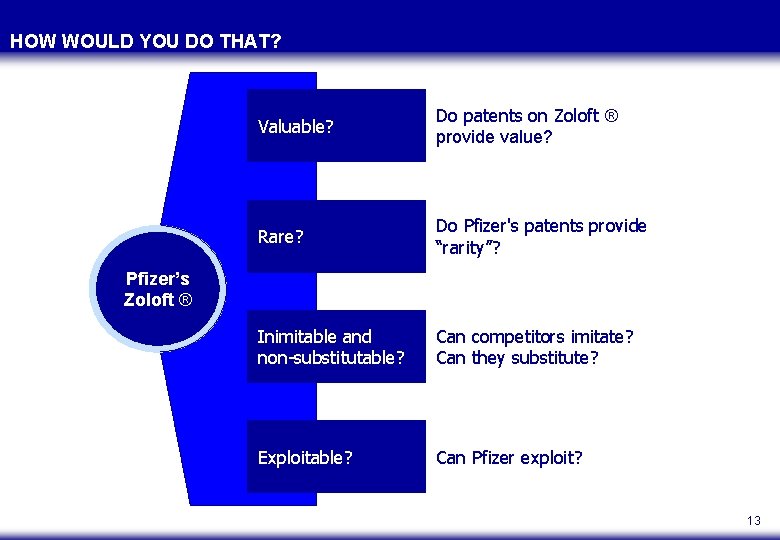
HOW WOULD YOU DO THAT? Valuable? Do patents on Zoloft ® provide value? Rare? Do Pfizer's patents provide “rarity”? Inimitable and non-substitutable? Can competitors imitate? Can they substitute? Exploitable? Can Pfizer exploit? Pfizer’s Zoloft ® 13
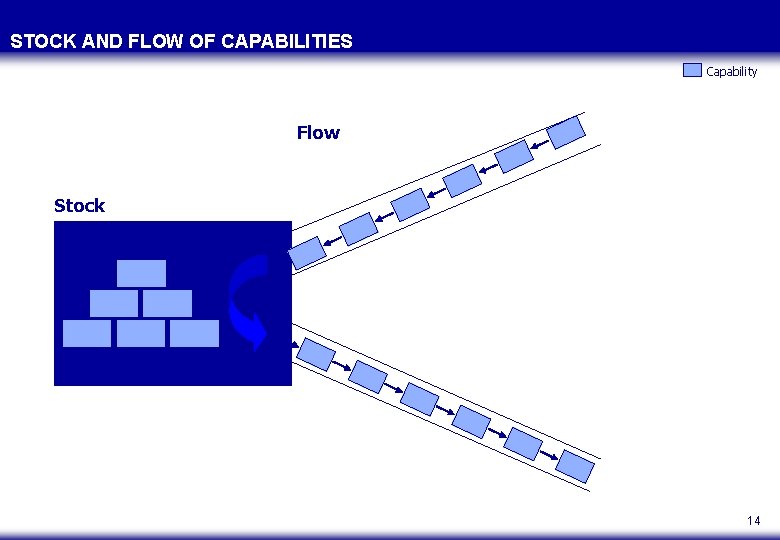
STOCK AND FLOW OF CAPABILITIES Capability Flow Stock 14
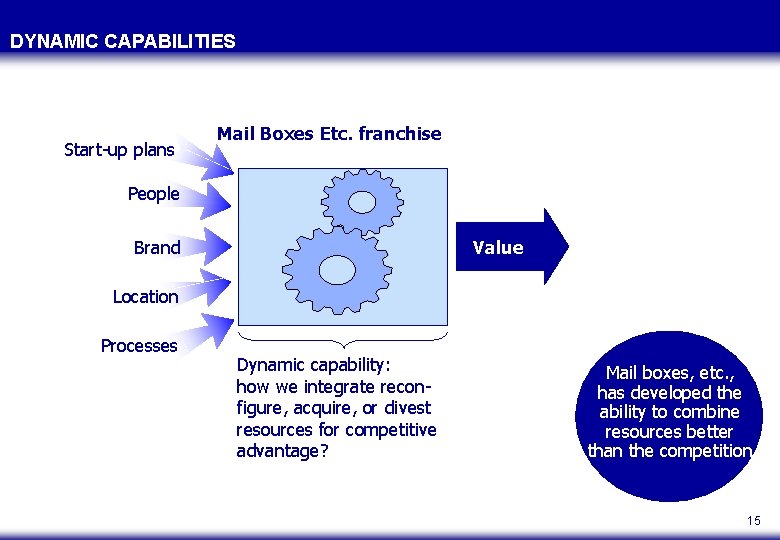
DYNAMIC CAPABILITIES Start-up plans Mail Boxes Etc. franchise People Brand Value Location Processes Dynamic capability: how we integrate reconfigure, acquire, or divest resources for competitive advantage? Mail boxes, etc. , has developed the ability to combine resources better than the competition 15
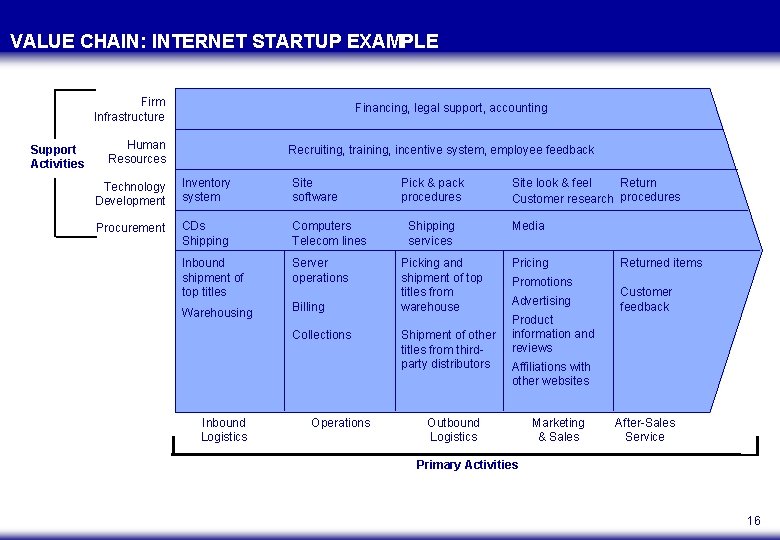
VALUE CHAIN: INTERNET STARTUP EXAMPLE Firm Infrastructure Support Activities Financing, legal support, accounting Human Resources Recruiting, training, incentive system, employee feedback Technology Development Inventory system Site software Procurement CDs Shipping Computers Telecom lines Inbound shipment of top titles Server operations Warehousing Billing Collections Inbound Logistics Operations Pick & pack procedures Shipping services Picking and shipment of top titles from warehouse Shipment of other titles from third- party distributors Return Site look & feel Customer research procedures Media Pricing Promotions Advertising Product information and reviews Returned items Customer feedback Affiliations with other websites Outbound Logistics Marketing & Sales After-Sales Service Primary Activities 16
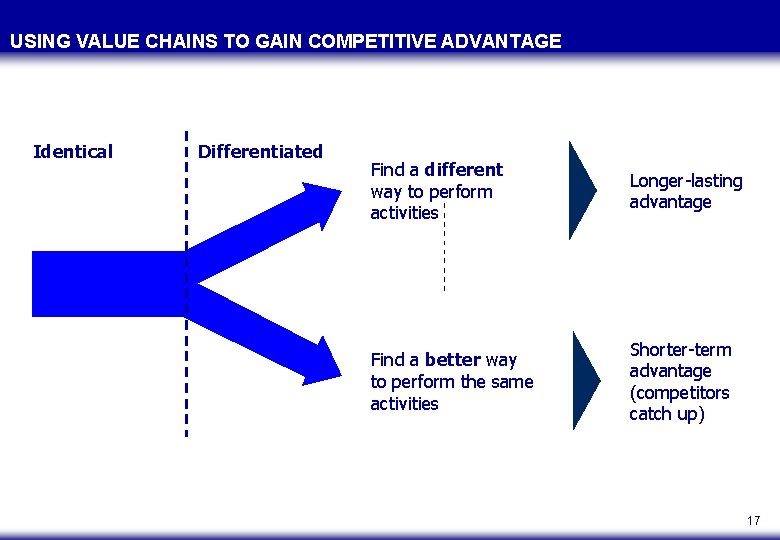
USING VALUE CHAINS TO GAIN COMPETITIVE ADVANTAGE Identical Differentiated Find a different way to perform activities Longer-lasting advantage Find a better way to perform the same activities Shorter-term advantage (competitors catch up) 17
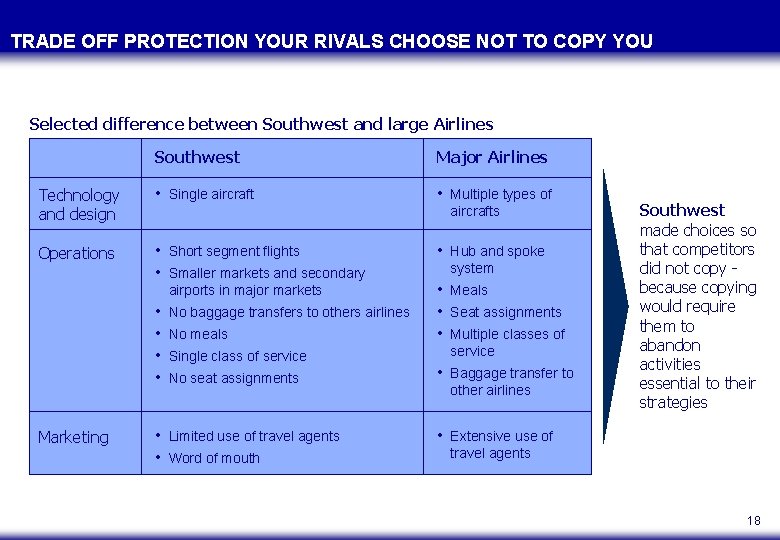
TRADE OFF PROTECTION YOUR RIVALS CHOOSE NOT TO COPY YOU Selected difference between Southwest and large Airlines Southwest Major Airlines Technology and design • Single aircraft • Multiple types of Operations • Short segment flights • Smaller markets and secondary aircrafts airports in major markets • • Marketing No baggage transfers to others airlines No meals Single class of service No seat assignments • Limited use of travel agents • Word of mouth • Hub and spoke system • Meals • Seat assignments • Multiple classes of service • Baggage transfer to other airlines Southwest made choices so that competitors did not copy because copying would require them to abandon activities essential to their strategies • Extensive use of travel agents 18
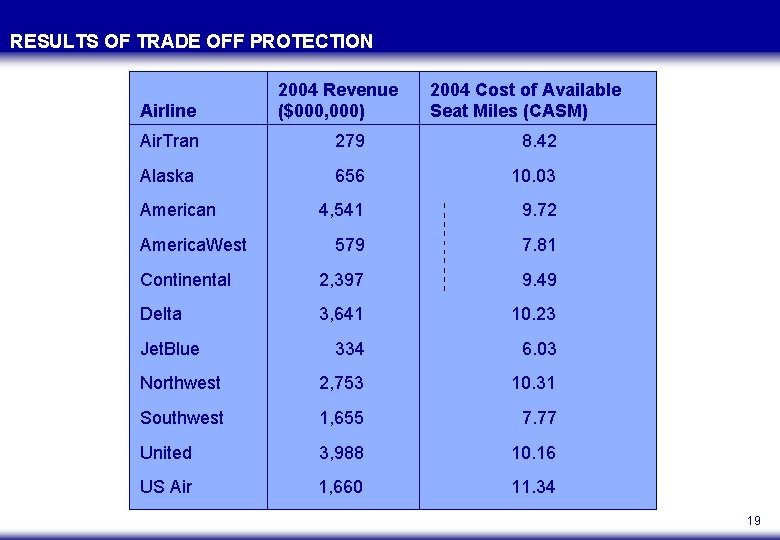
RESULTS OF TRADE OFF PROTECTION Airline 2004 Revenue ($000, 000) 2004 Cost of Available Seat Miles (CASM) Air. Tran 279 8. 42 Alaska 656 10. 03 4, 541 9. 72 579 7. 81 Continental 2, 397 9. 49 Delta 3, 641 10. 23 334 6. 03 Northwest 2, 753 10. 31 Southwest 1, 655 7. 77 United 3, 988 10. 16 US Air 1, 660 11. 34 American America. West Jet. Blue 19
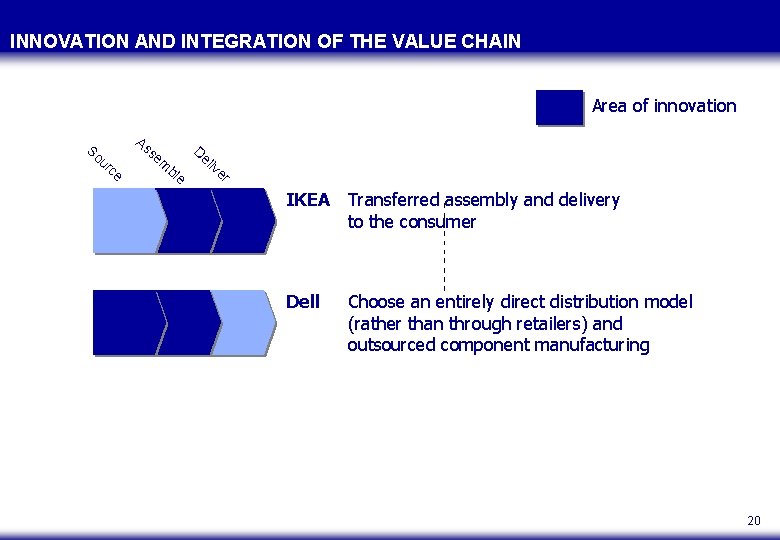
INNOVATION AND INTEGRATION OF THE VALUE CHAIN Area of innovation So ur ce As s em bl De e liv er IKEA Transferred assembly and delivery to the consumer Dell Choose an entirely direct distribution model (rather than through retailers) and outsourced component manufacturing 20
STRATEGIC LEADERSHIP “Companies that overlook the role of leadership in the early phases of strategic planning often find themselves scrambling when it’s time to execute. No matter how thorough the plan, with-out the right leaders it is unlikely to succeed” – Mc. Kinsey & Company 21
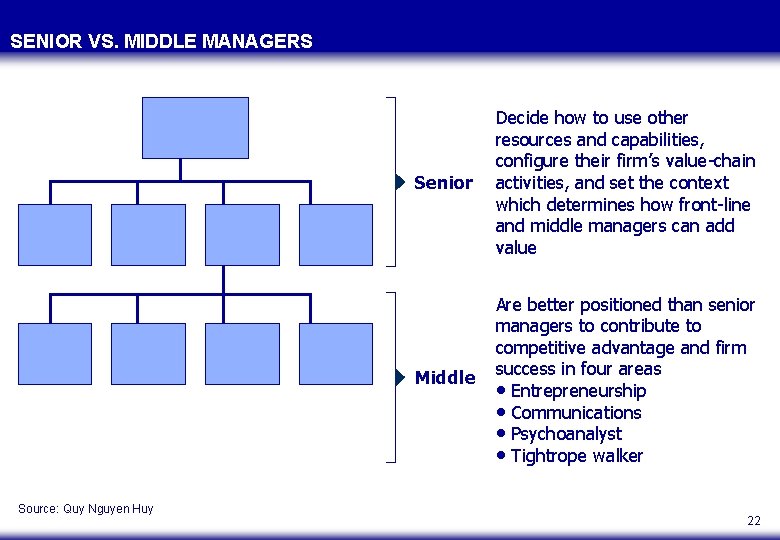
SENIOR VS. MIDDLE MANAGERS Source: Quy Nguyen Huy Senior Decide how to use other resources and capabilities, configure their firm’s value-chain activities, and set the context which determines how front-line and middle managers can add value Middle Are better positioned than senior managers to contribute to competitive advantage and firm success in four areas • Entrepreneurship • Communications • Psychoanalyst • Tightrope walker 22
SUMMARY 1 Explain the internal context of strategy 2 Identify a firm’s resources and capabilities and explain their role in its performance 3 Define dynamic capabilities and explain their role in both strategic change and a firm’s performance 4 Understand how value‑chain activities are related to firm performance and competitive advantage 5 Explain the role of managers with respect to resources, capabilities, and value‑chain activities 23
BLANK SLIDE • • 24