
Chapter 3 Evolution and Population Genetics 2011 Pearson
- Slides: 43
Chapter 3 Evolution and Population Genetics © 2011 Pearson Education, Inc.
Evolution generates biodiversity • Species = a population or group of populations - Whose members share characteristics - They can breed with one another and produce fertile offspring • Population = a group of individuals of a species that live in the same area • Evolution = means change over time - Biological evolution: genetic change in populations over time - Genetic changes lead to changes in appearance, functioning or behavior over generations © 2011 Pearson Education, Inc.
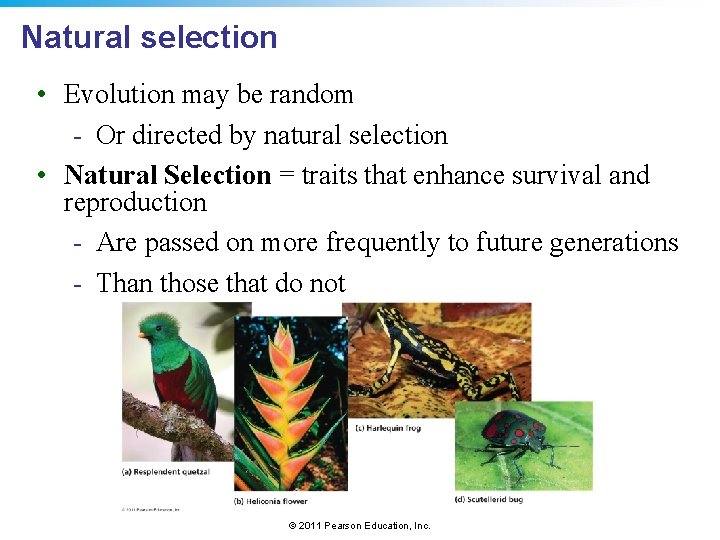
Natural selection • Evolution may be random - Or directed by natural selection • Natural Selection = traits that enhance survival and reproduction - Are passed on more frequently to future generations - Than those that do not © 2011 Pearson Education, Inc.
Evolution by natural selection • It is one of the best-supported and most illuminating concepts in all science – It is the standpoint of modern biology • We must understand it to appreciate environmental science – Knowing ecology and learning the history of life • Evolutionary processes influence pesticide resistance, agriculture, medicine, health, etc. • In 1858, both Darwin and Wallace proposed natural selection as the mechanism of evolution © 2011 Pearson Education, Inc.
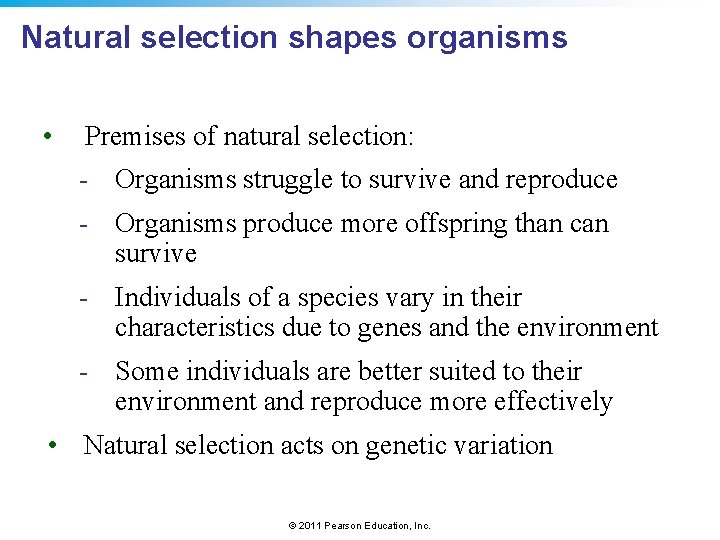
Natural selection shapes organisms • Premises of natural selection: - Organisms struggle to survive and reproduce - Organisms produce more offspring than can survive - Individuals of a species vary in their characteristics due to genes and the environment - Some individuals are better suited to their environment and reproduce more effectively • Natural selection acts on genetic variation © 2011 Pearson Education, Inc.
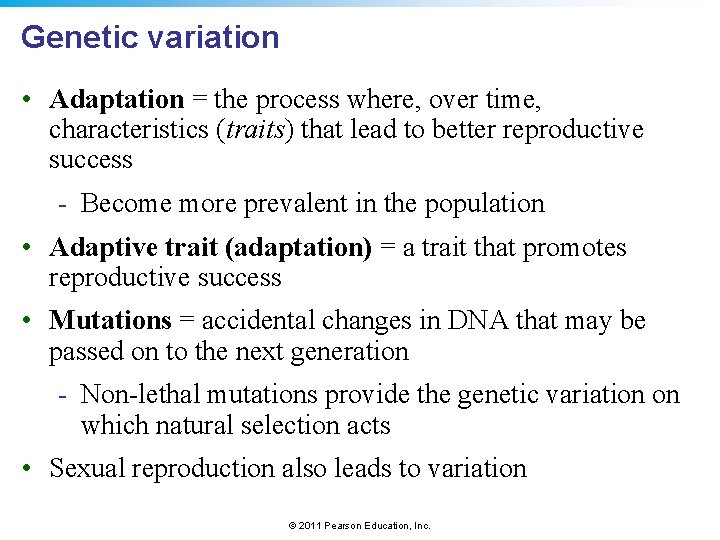
Genetic variation • Adaptation = the process where, over time, characteristics (traits) that lead to better reproductive success - Become more prevalent in the population • Adaptive trait (adaptation) = a trait that promotes reproductive success • Mutations = accidental changes in DNA that may be passed on to the next generation - Non-lethal mutations provide the genetic variation on which natural selection acts • Sexual reproduction also leads to variation © 2011 Pearson Education, Inc.
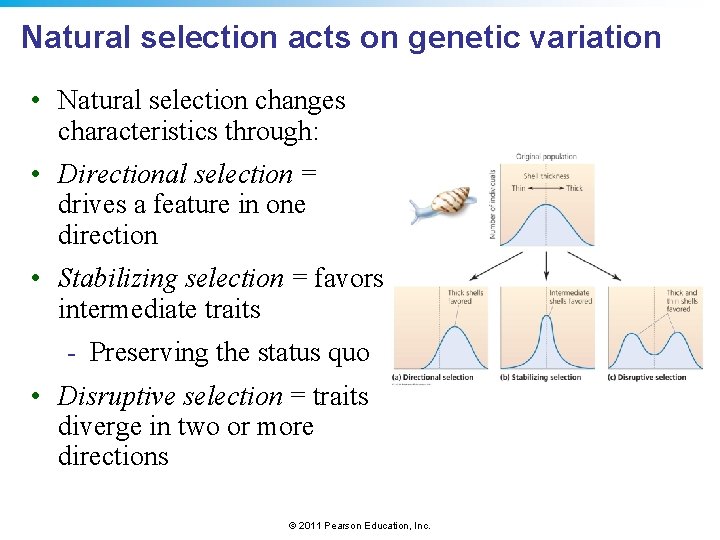
Natural selection acts on genetic variation • Natural selection changes characteristics through: • Directional selection = drives a feature in one direction • Stabilizing selection = favors intermediate traits - Preserving the status quo • Disruptive selection = traits diverge in two or more directions © 2011 Pearson Education, Inc.
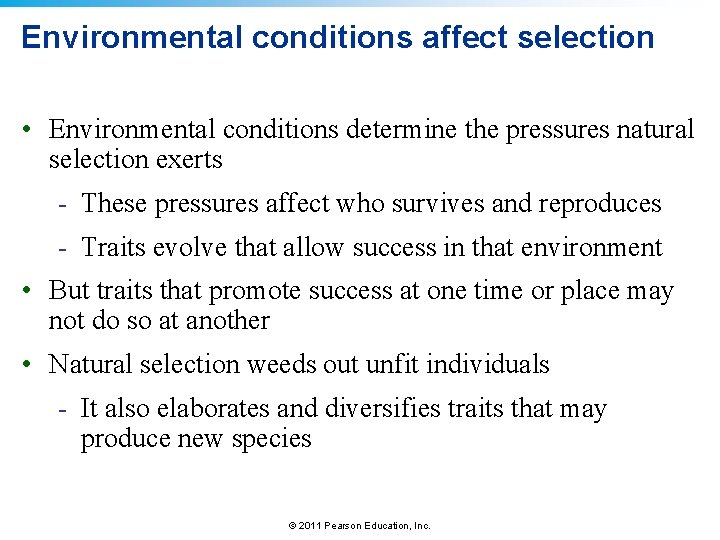
Environmental conditions affect selection • Environmental conditions determine the pressures natural selection exerts - These pressures affect who survives and reproduces - Traits evolve that allow success in that environment • But traits that promote success at one time or place may not do so at another • Natural selection weeds out unfit individuals - It also elaborates and diversifies traits that may produce new species © 2011 Pearson Education, Inc.
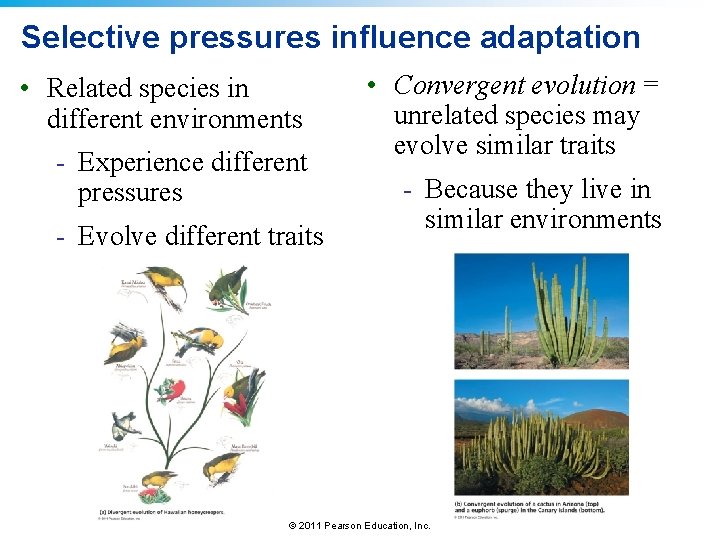
Selective pressures influence adaptation • Related species in different environments - Experience different pressures - Evolve different traits • Convergent evolution = unrelated species may evolve similar traits - Because they live in similar environments © 2011 Pearson Education, Inc.
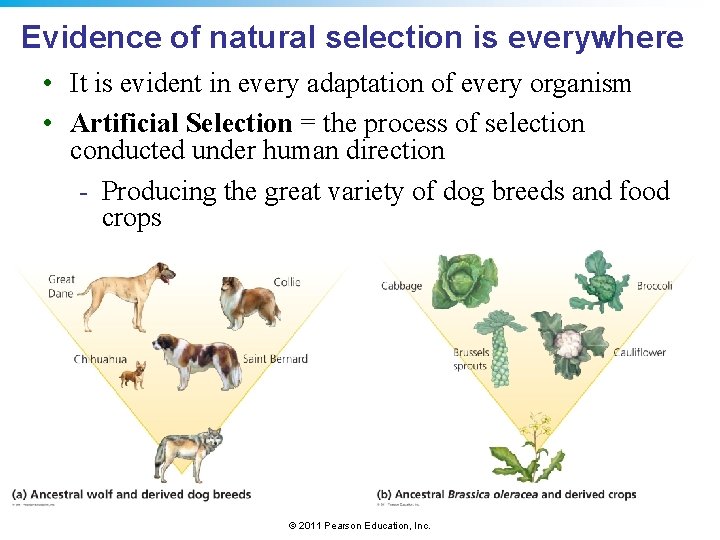
Evidence of natural selection is everywhere • It is evident in every adaptation of every organism • Artificial Selection = the process of selection conducted under human direction - Producing the great variety of dog breeds and food crops © 2011 Pearson Education, Inc.
Evolution generates biological diversity • Biological diversity (biodiversity) = the variety of life across all levels of biological organization - Species - Genes - Populations - Communities • Scientists have described 1. 8 million species - Up to 100 million species may exist - Tropical rainforests are rich in biodiversity © 2011 Pearson Education, Inc.
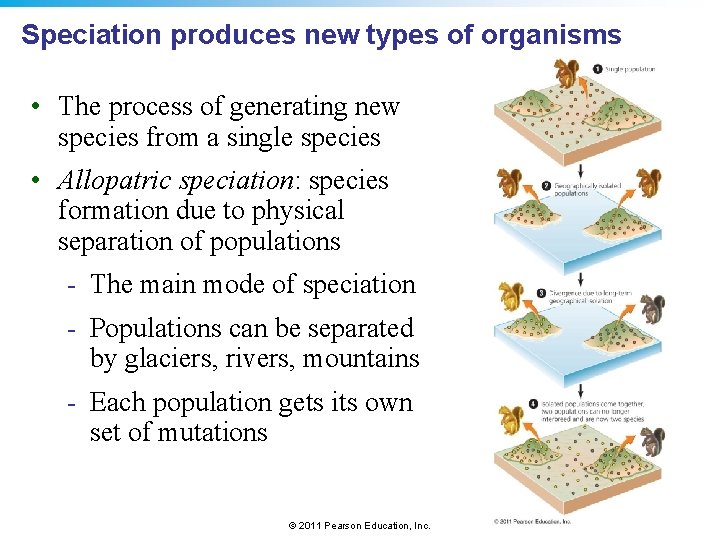
Speciation produces new types of organisms • The process of generating new species from a single species • Allopatric speciation: species formation due to physical separation of populations - The main mode of speciation - Populations can be separated by glaciers, rivers, mountains - Each population gets its own set of mutations © 2011 Pearson Education, Inc.
Another type of speciation • Sympatric speciation = species form from populations that become reproductively isolated within the same area - Feed in different areas - Mate in different seasons - Hybridization between two species - Mutations © 2011 Pearson Education, Inc.
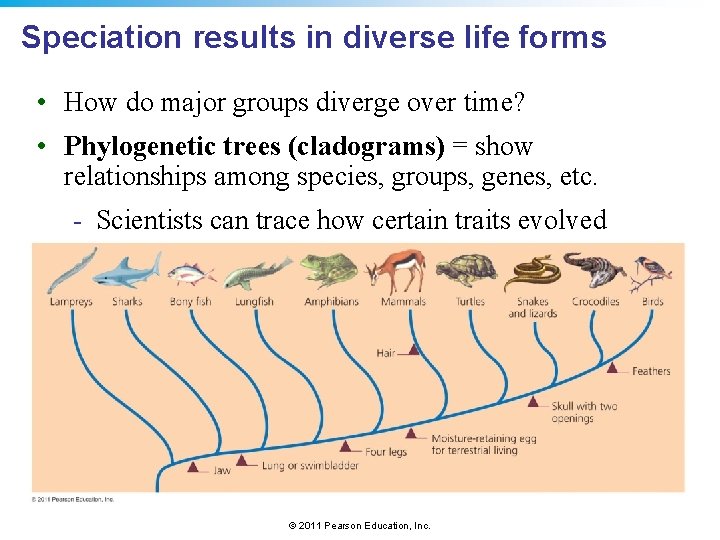
Speciation results in diverse life forms • How do major groups diverge over time? • Phylogenetic trees (cladograms) = show relationships among species, groups, genes, etc. - Scientists can trace how certain traits evolved © 2011 Pearson Education, Inc.
The fossil record • Fossil: an imprint in stone of a dead organism • Fossil record: the cumulative body of fossils worldwide • The fossil record shows: - Life has existed on Earth for at least 3. 5 billion years - Earlier types of organisms evolved into later ones - The number of species has increased over time - Most species have gone extinct - There have been several mass extinctions in the past © 2011 Pearson Education, Inc.
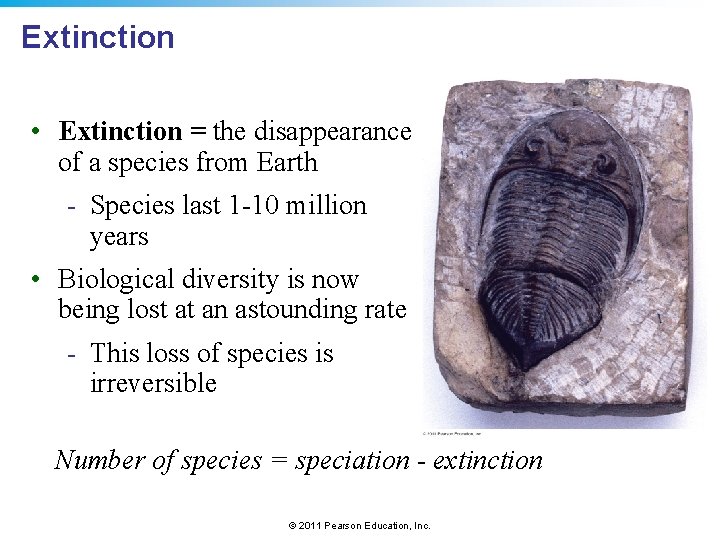
Extinction • Extinction = the disappearance of a species from Earth - Species last 1 -10 million years • Biological diversity is now being lost at an astounding rate - This loss of species is irreversible Number of species = speciation - extinction © 2011 Pearson Education, Inc.
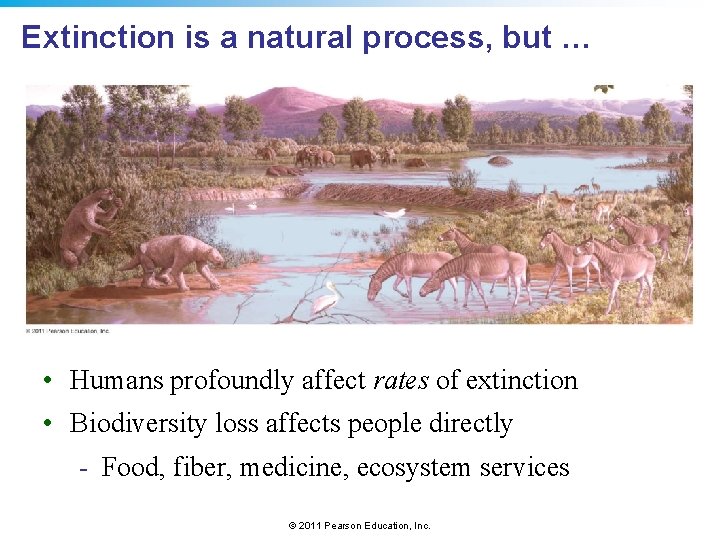
Extinction is a natural process, but … • Humans profoundly affect rates of extinction • Biodiversity loss affects people directly - Food, fiber, medicine, ecosystem services © 2011 Pearson Education, Inc.
Some species are more vulnerable to extinction • Extinction occurs when the environment changes rapidly - Natural selection can not keep up • Many factors cause extinction: - Severe weather, climate change, changing sea levels - New species, small populations - Specialized species • Endemic species = a species only exists in a certain, specialized area - Very susceptible to extinction - These species usually have small populations © 2011 Pearson Education, Inc.
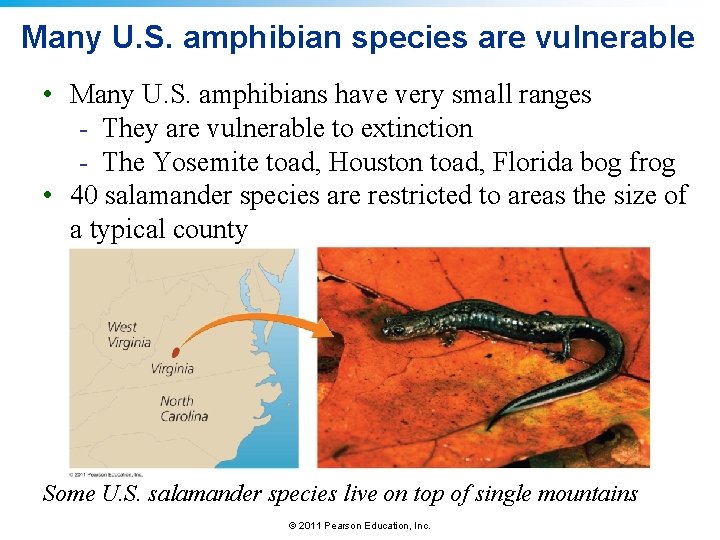
Many U. S. amphibian species are vulnerable • Many U. S. amphibians have very small ranges - They are vulnerable to extinction - The Yosemite toad, Houston toad, Florida bog frog • 40 salamander species are restricted to areas the size of a typical county Some U. S. salamander species live on top of single mountains © 2011 Pearson Education, Inc.
Earth has had several mass extinctions • Background extinction rate = extinction usually occurs one species at a time • Mass extinction events = killed off massive numbers of species at once - Occurred five times in Earth’s history - 50 -95% of all species went extinct at one time • Cretaceous-Tertiary (K-T) event: 65 million years ago - Dinosaurs went extinct • End-Permian event: 250 million years ago - 75 -95% of all species went extinct © 2011 Pearson Education, Inc.
The sixth mass extinction is upon us • Humans are causing the sixth mass extinction event - Resource depletion, population growth, development - Destruction of natural habitats - Hunting and harvesting of species - Introduction of non-native species • It is 100 -1, 000 times higher than the background rate and rising • Amphibians are disappearing the fastest - 170 species have already vanished • It will take millions of years for life to recover © 2011 Pearson Education, Inc.
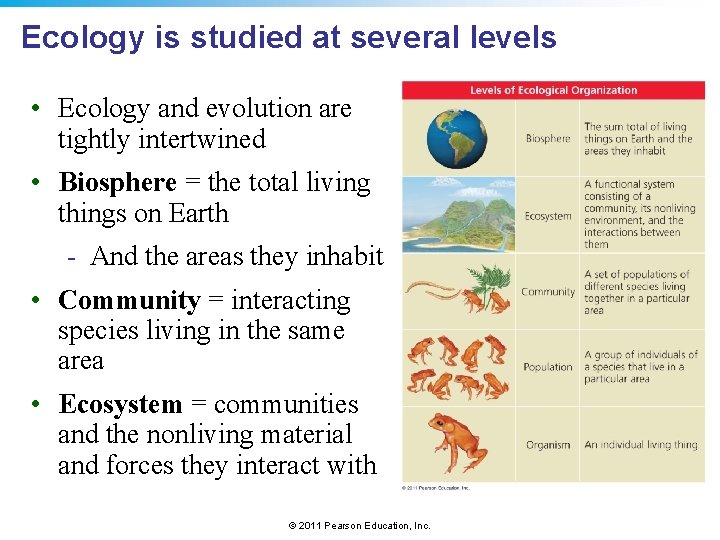
Ecology is studied at several levels • Ecology and evolution are tightly intertwined • Biosphere = the total living things on Earth - And the areas they inhabit • Community = interacting species living in the same area • Ecosystem = communities and the nonliving material and forces they interact with © 2011 Pearson Education, Inc.
Levels of ecological studies • Population ecology = investigates the dynamics of population change - The factors affecting the distribution and abundance of members of a population - Why some populations increase and others decrease • Community ecology = focuses on patterns of species diversity and interactions • Ecosystem ecology = studies living and nonliving components of systems to reveal patterns - Nutrient and energy flows © 2011 Pearson Education, Inc.
Each organism has habitat needs • Habitat = the environment where an organism lives - It includes living and nonliving elements • Habitat use = each organism thrives in certain habitats, but not in others - Results in nonrandom patterns of use • Habitat selection = the process by which organisms actively select habitats in which to live - Availability and quality of habitat are crucial to an organism’s well-being - Human developments conflict with this process © 2011 Pearson Education, Inc.
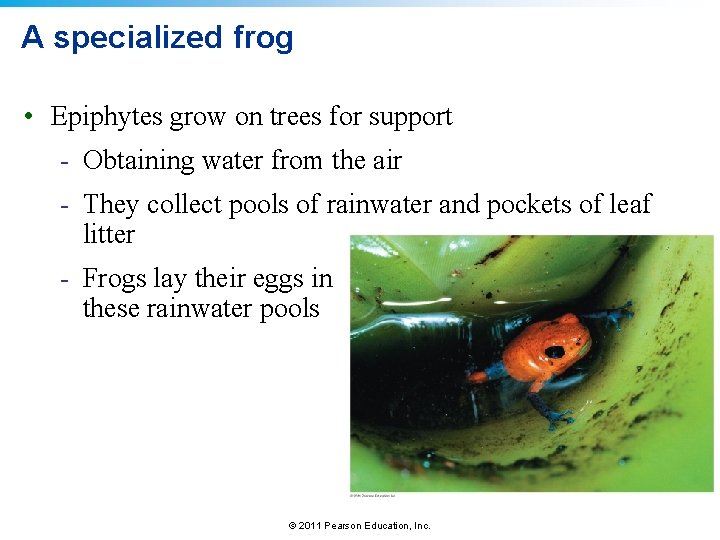
A specialized frog • Epiphytes grow on trees for support - Obtaining water from the air - They collect pools of rainwater and pockets of leaf litter - Frogs lay their eggs in these rainwater pools © 2011 Pearson Education, Inc.
Habitats vary • Habitats vary with the body size and needs of species - A soil mite vs. an elephant • Species have different habitat needs at different times - Migratory birds use different habitats during migration, summer and winter • Species use different criteria to select habitat - Soil, topography, vegetation, other species - Water temperature, salinity, prey • Species survival depends on having suitable habitat © 2011 Pearson Education, Inc.
Organismal ecology: niche • Niche = an organism’s use of resources - Along with its functional role in a community - Habitat use, food selection, role in energy and nutrient flow, interactions with other individuals • Specialists = have narrow niches and specific needs - Extremely good at what they do - But vulnerable when conditions change • Generalists = species with broad niches - They use a wide array of habitats and resources - They can live in many different places © 2011 Pearson Education, Inc.
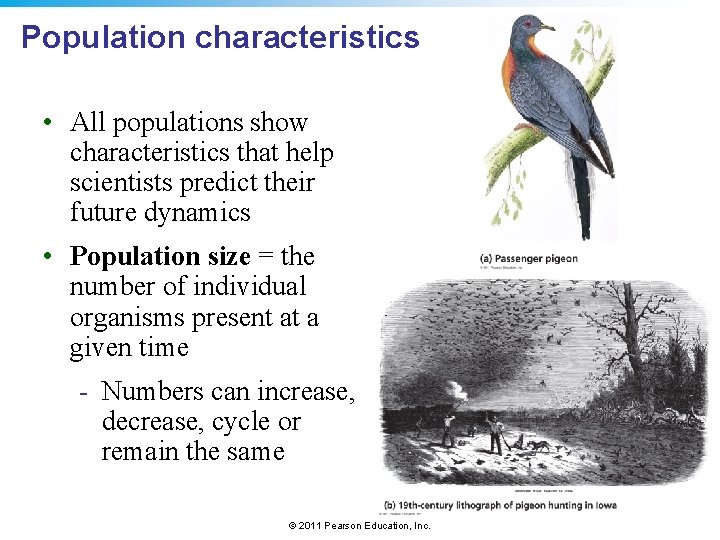
Population characteristics • All populations show characteristics that help scientists predict their future dynamics • Population size = the number of individual organisms present at a given time - Numbers can increase, decrease, cycle or remain the same © 2011 Pearson Education, Inc.
Population characteristics • Population density = the number of individuals in a population per unit area • Large organisms usually have low densities - They need many resources and a large area to survive • High densities make it easier to find mates - But increase competition and vulnerability to predation - Increased transmission of diseases • Low densities make it harder to find mates - But individuals enjoy plentiful resources and space © 2011 Pearson Education, Inc.
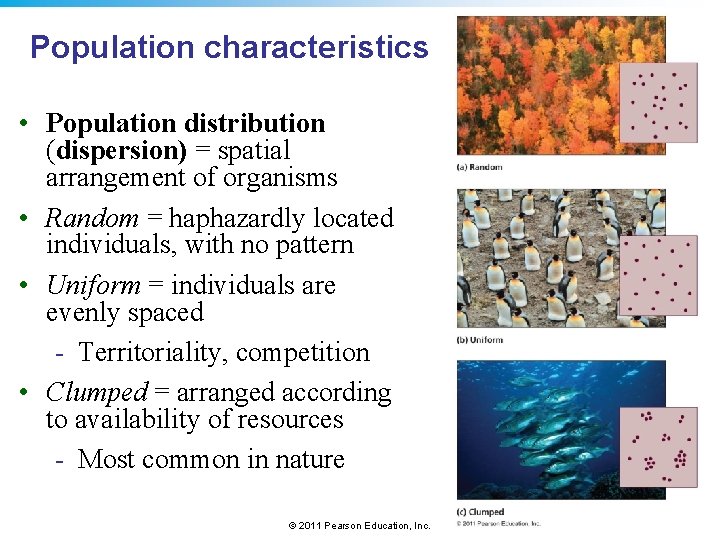
Population characteristics • Population distribution (dispersion) = spatial arrangement of organisms • Random = haphazardly located individuals, with no pattern • Uniform = individuals are evenly spaced - Territoriality, competition • Clumped = arranged according to availability of resources - Most common in nature © 2011 Pearson Education, Inc.
Population characteristics • Sex ratio = proportion of males to females - In monogamous species, a 1: 1 sex ratio maximizes population growth • Age distribution (structure) = the relative numbers of organisms of each age in a population - Age structure diagrams (pyramids) = show the age structure of populations • In species that continue growing as they age - Older individuals reproduce more (i. e. a tree) - Experience makes older individuals better breeders © 2011 Pearson Education, Inc.
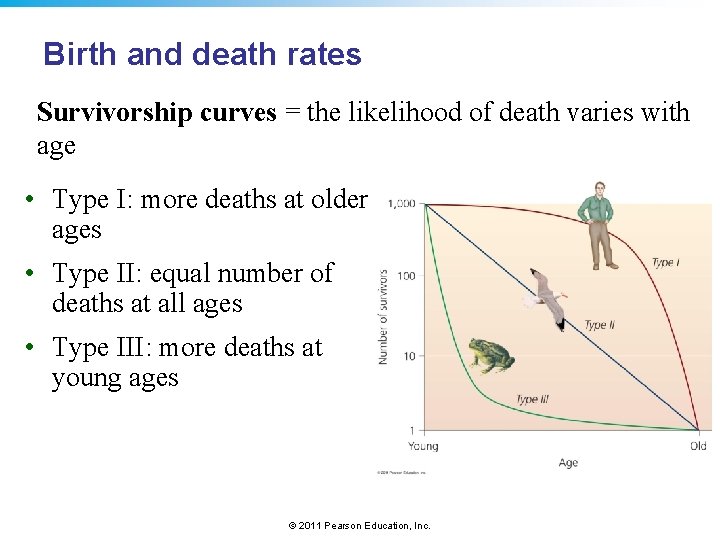
Birth and death rates Survivorship curves = the likelihood of death varies with age • Type I: more deaths at older ages • Type II: equal number of deaths at all ages • Type III: more deaths at young ages © 2011 Pearson Education, Inc.
Four factors of population change • Natality = births within the population • Mortality = deaths within the population • Immigration = arrival of individuals from outside the population • Emigration = departure of individuals from the population • Births and immigration add individuals - Deaths and emigration remove individuals • Crude birth (death) rates: number of births (deaths) per 1000 individuals per year © 2011 Pearson Education, Inc.
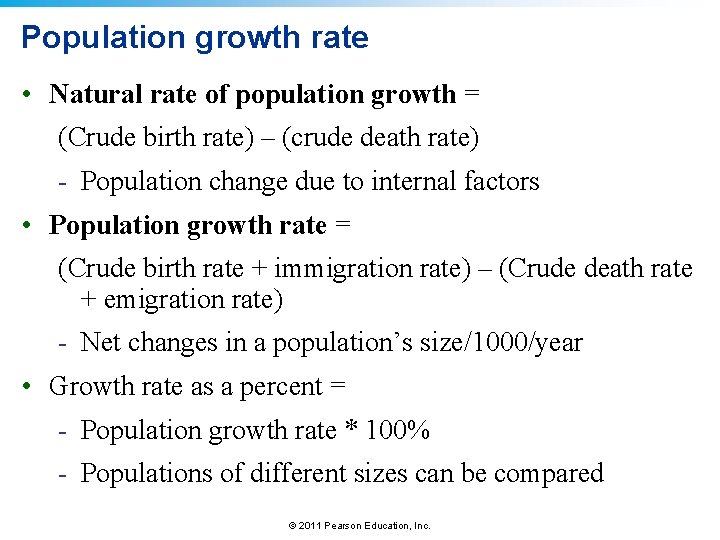
Population growth rate • Natural rate of population growth = (Crude birth rate) – (crude death rate) - Population change due to internal factors • Population growth rate = (Crude birth rate + immigration rate) – (Crude death rate + emigration rate) - Net changes in a population’s size/1000/year • Growth rate as a percent = - Population growth rate * 100% - Populations of different sizes can be compared © 2011 Pearson Education, Inc.
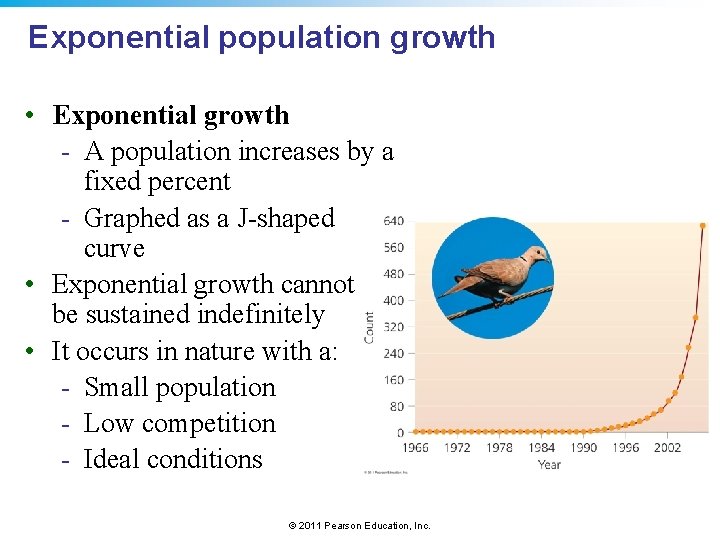
Exponential population growth • Exponential growth - A population increases by a fixed percent - Graphed as a J-shaped curve • Exponential growth cannot be sustained indefinitely • It occurs in nature with a: - Small population - Low competition - Ideal conditions © 2011 Pearson Education, Inc.
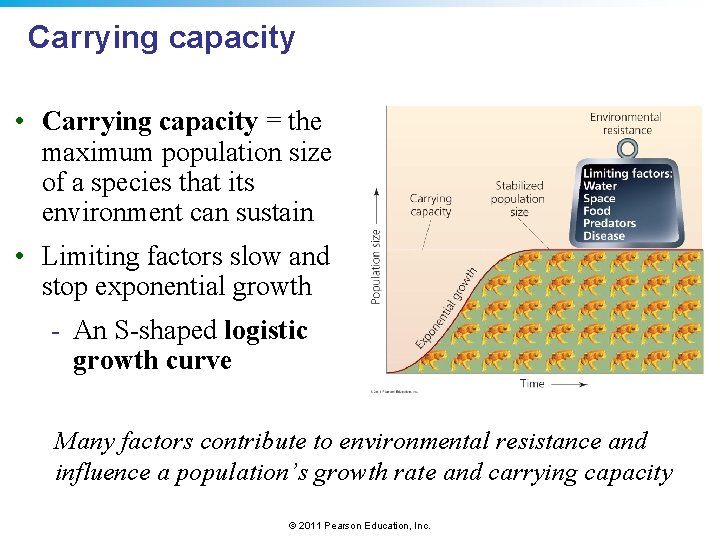
Limiting factors restrain population growth • Limiting factors = physical, chemical and biological attributes of the environment - They restrain population growth • Environmental resistance = all limiting factors taken together - Stabilizes the population size - Space, food, water, mates, shelter, suitable breeding sites, temperature, disease, predators - Aquatic systems: salinity, sunlight, temperature, etc. © 2011 Pearson Education, Inc.
Carrying capacity • Carrying capacity = the maximum population size of a species that its environment can sustain • Limiting factors slow and stop exponential growth - An S-shaped logistic growth curve Many factors contribute to environmental resistance and influence a population’s growth rate and carrying capacity © 2011 Pearson Education, Inc.
Population density impacts limiting factors • Density-dependent factors = limiting factors whose influence is affected by population density - Increased density increases the risk of predation and competition for mates - Results in the logistic growth curve - Larger populations have stronger environmental resistance • Density-independent factors = limiting factors whose influence is not affected by population density - Events such as floods, fires, and landslides © 2011 Pearson Education, Inc.
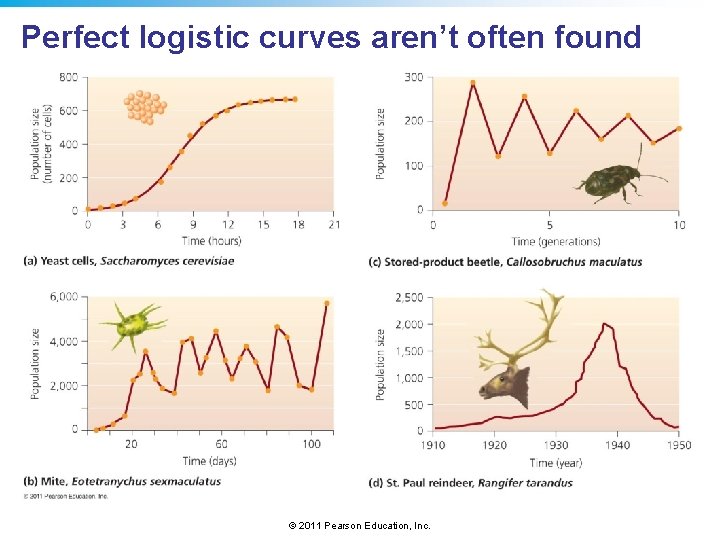
Perfect logistic curves aren’t often found © 2011 Pearson Education, Inc.
Carrying capacities can change • Environments are complex and ever-changing - Changing carrying capacities • Humans lower environmental resistance for themselves - Increasing our carrying capacity - Technologies overcome limiting factors • By increasing carrying capacity for humans - We have reduced the carrying capacity for countless other organisms - Calling into question our own long-term survival © 2011 Pearson Education, Inc.
Reproductive strategies vary among species • Biotic potential = an organism’s capacity to produce offspring • K-selected species = species with long gestation periods and few offspring - Have a low biotic potential - Stabilize at or near carrying capacity - Good competitors • r-selected species = species which reproduce quickly - Have a high biotic potential - Little parental care, populations fluctuate greatly © 2011 Pearson Education, Inc.
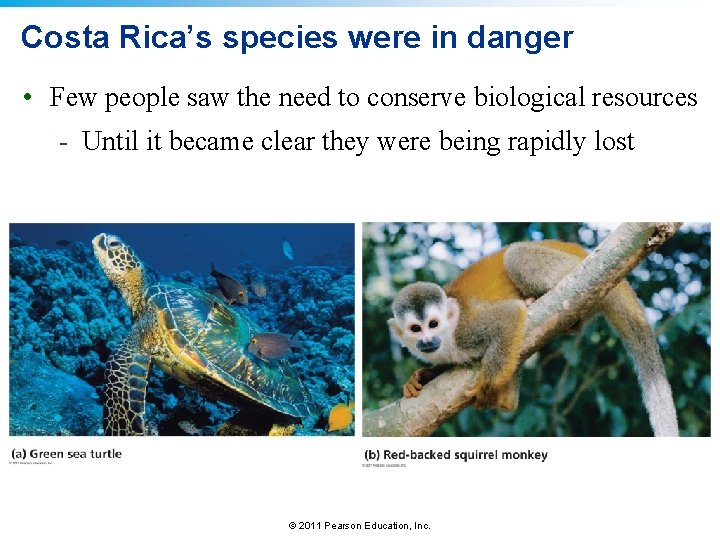
Costa Rica’s species were in danger • Few people saw the need to conserve biological resources - Until it became clear they were being rapidly lost © 2011 Pearson Education, Inc.
Conclusion • The fundamentals of evolution and population ecology are integral to environmental science • Natural selection, speciation and extinction help determine earth’s biodiversity • Understanding how ecological processes function at the population level is crucial to protecting biodiversity © 2011 Pearson Education, Inc.