
Chapter 3 Ethnic and Racial Stratification Understanding Race
- Slides: 31
Chapter 3 Ethnic and Racial Stratification Understanding Race and Ethnic Relations 5 th Edition This multimedia product and its contents are protected under copyright law. The following are prohibited by law: Øany public performance or display, including transmission of any image over a network; Øpreparation of any derivative work, including the extraction, in whole or in part, of any images; Øany rental, lease, or lending of the program. Copyright © Allyn & Bacon 2016
Learning Objectives Understand how social class and social standing effect race relations. Understand the foundation of intergroup conflict in the U. S. Use sociological theories to understand ethnic and gender stratification
Social Structure The organized patterns of behavior among the basic components of a social system that provide orderly, predictable behavior among different peoples in a society.
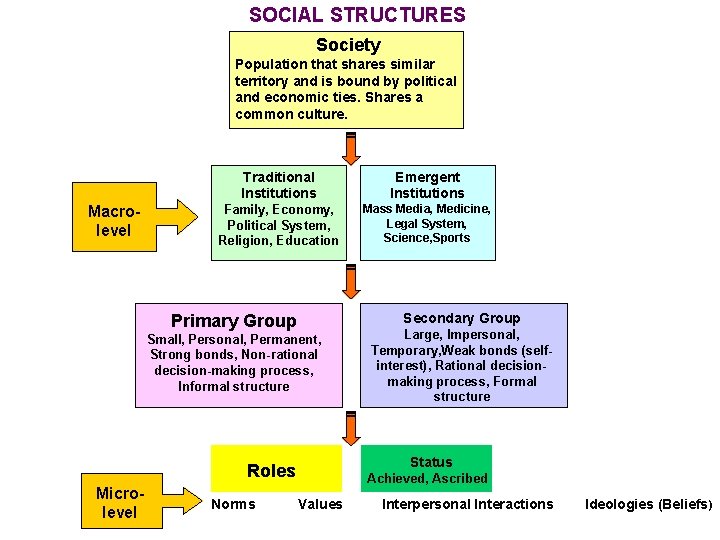
SOCIAL STRUCTURES Society Population that shares similar territory and is bound by political and economic ties. Shares a common culture. Macrolevel Traditional Institutions Emergent Institutions Family, Economy, Political System, Religion, Education Mass Media, Medicine, Legal System, Science, Sports Secondary Group Primary Group Small, Personal, Permanent, Strong bonds, Non-rational decision-making process, Informal structure Roles Microlevel Norms Large, Impersonal, Temporary, Weak bonds (selfinterest), Rational decisionmaking process, Formal structure Status Achieved, Ascribed Values Interpersonal Interactions Ideologies (Beliefs )
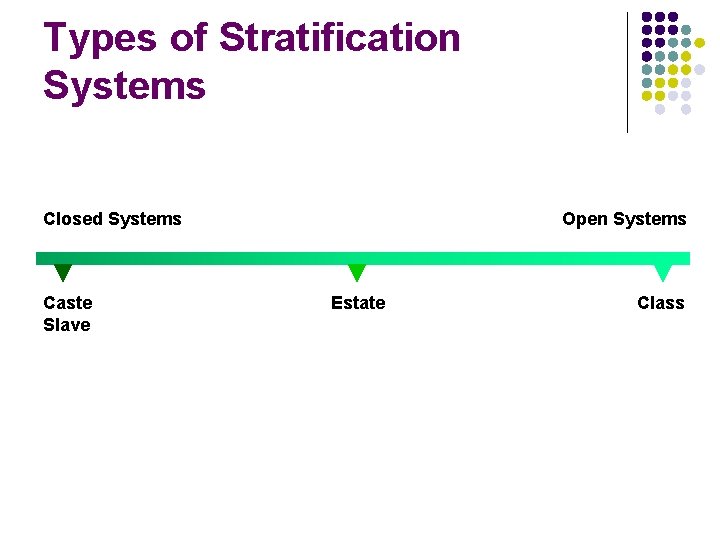
Types of Stratification Systems Closed Systems Caste Slave Open Systems Estate Class
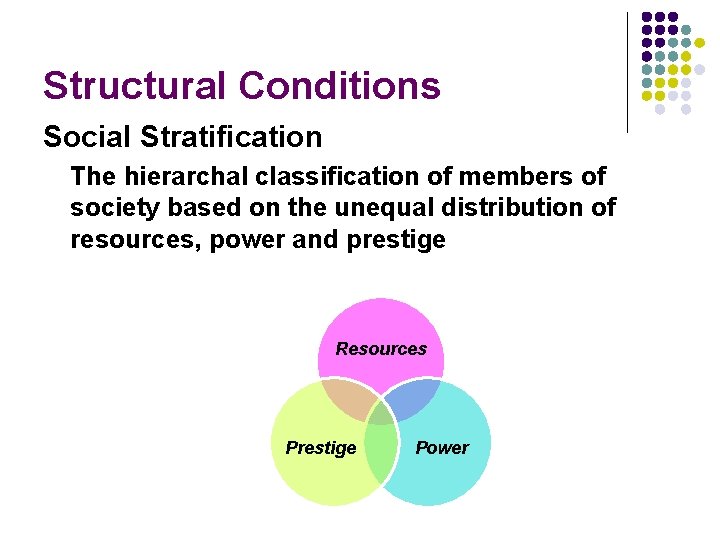
Structural Conditions Social Stratification The hierarchal classification of members of society based on the unequal distribution of resources, power and prestige Resources Prestige Power
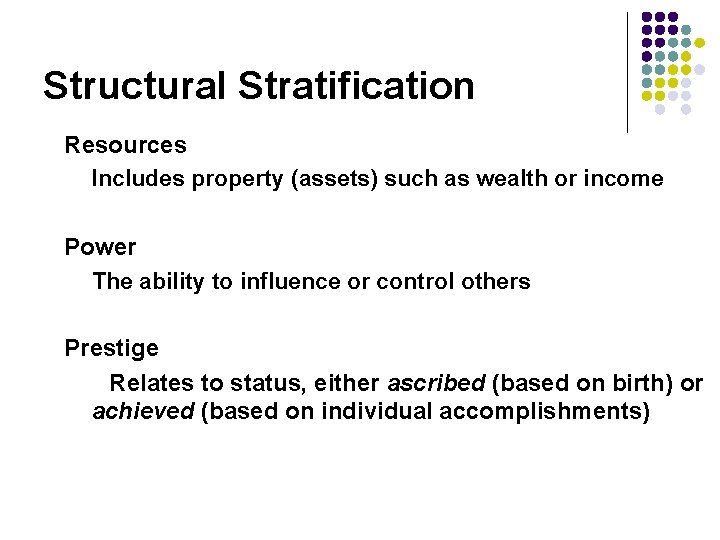
Structural Stratification Resources Includes property (assets) such as wealth or income Power The ability to influence or control others Prestige Relates to status, either ascribed (based on birth) or achieved (based on individual accomplishments)
Social Class People who share a similar level of income, amount of property, degree of power, status, and type of lifestyle.
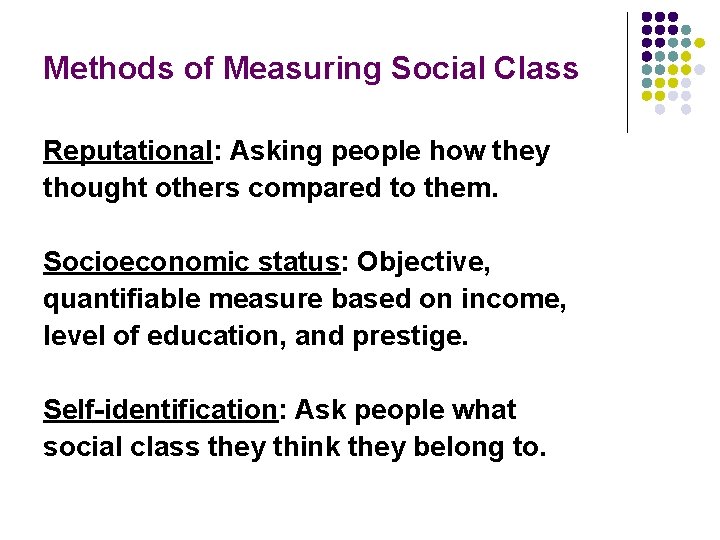
Methods of Measuring Social Class Reputational: Asking people how they thought others compared to them. Socioeconomic status: Objective, quantifiable measure based on income, level of education, and prestige. Self-identification: Ask people what social class they think they belong to.
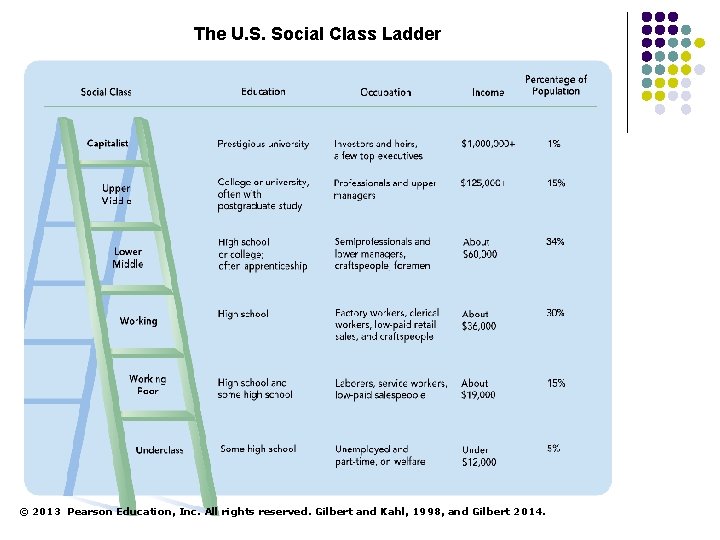
The U. S. Social Class Ladder © 2013 Pearson Education, Inc. All rights reserved. Gilbert and Kahl, 1998, and Gilbert 2014.
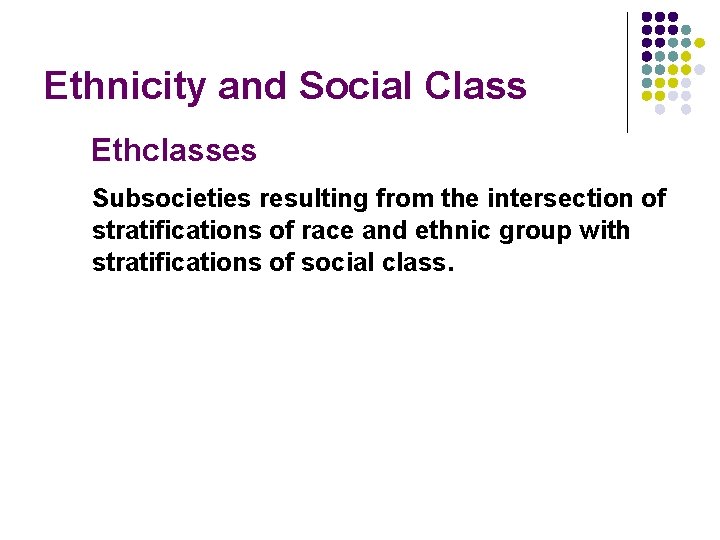
Ethnicity and Social Class Ethclasses Subsocieties resulting from the intersection of stratifications of race and ethnic group with stratifications of social class.
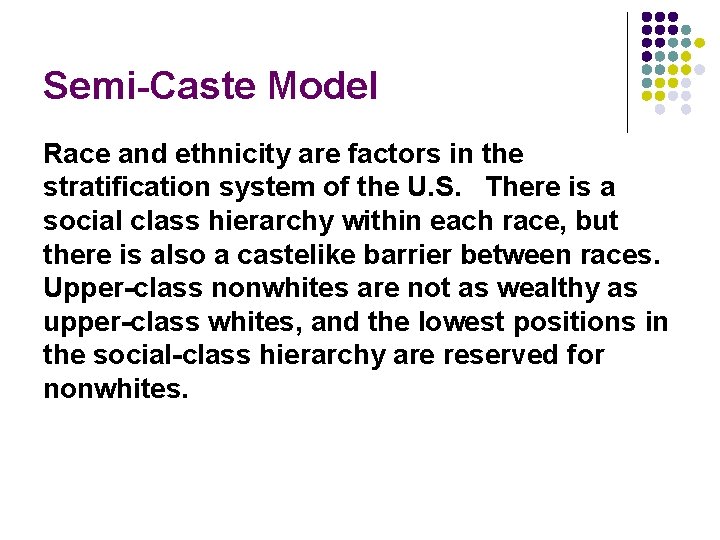
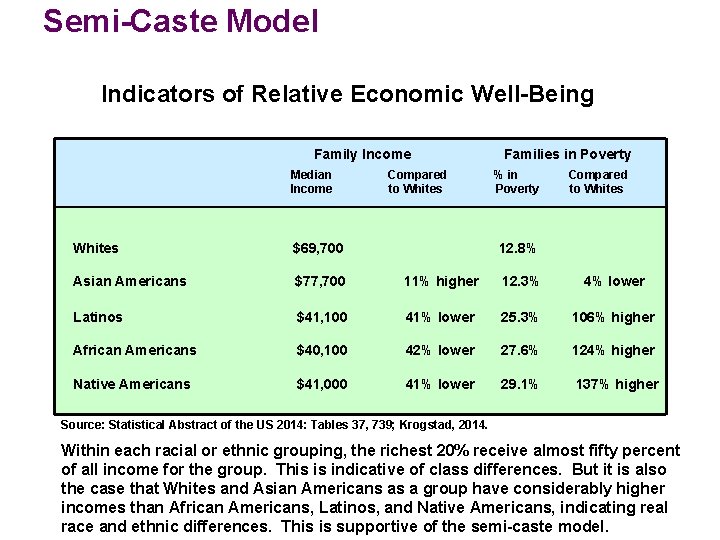
Semi-Caste Model Race and ethnicity are factors in the stratification system of the U. S. There is a social class hierarchy within each race, but there is also a castelike barrier between races. Upper-class nonwhites are not as wealthy as upper-class whites, and the lowest positions in the social-class hierarchy are reserved for nonwhites.
Semi-Caste Model Indicators of Relative Economic Well-Being Family Income Median Income Compared to Whites Families in Poverty % in Poverty Compared to Whites $69, 700 12. 8% Asian Americans $77, 700 11% higher 12. 3% 4% lower Latinos $41, 100 41% lower 25. 3% 106% higher African Americans $40, 100 42% lower 27. 6% 124% higher Native Americans $41, 000 41% lower 29. 1% 137% higher Source: Statistical Abstract of the US 2014: Tables 37, 739; Krogstad, 2014. Within each racial or ethnic grouping, the richest 20% receive almost fifty percent of all income for the group. This is indicative of class differences. But it is also the case that Whites and Asian Americans as a group have considerably higher incomes than African Americans, Latinos, and Native Americans, indicating real race and ethnic differences. This is supportive of the semi-caste model.
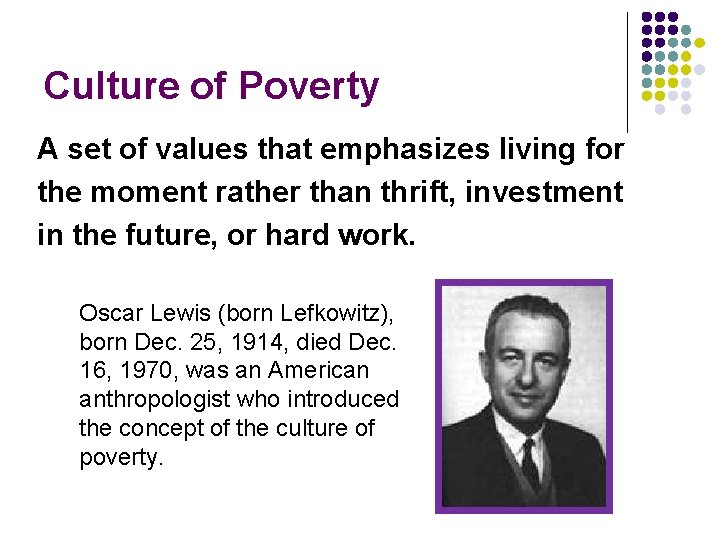
Culture of Poverty A set of values that emphasizes living for the moment rather than thrift, investment in the future, or hard work. Oscar Lewis (born Lefkowitz), born Dec. 25, 1914, died Dec. 16, 1970, was an American anthropologist who introduced the concept of the culture of poverty.
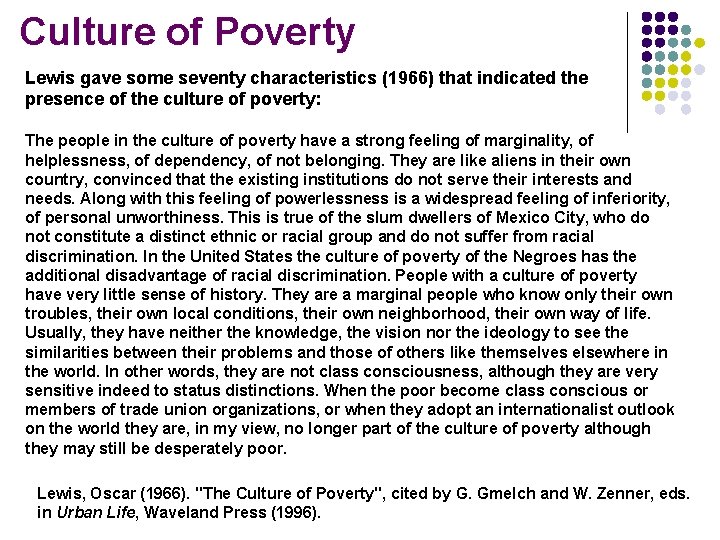
Culture of Poverty Lewis gave some seventy characteristics (1966) that indicated the presence of the culture of poverty: The people in the culture of poverty have a strong feeling of marginality, of helplessness, of dependency, of not belonging. They are like aliens in their own country, convinced that the existing institutions do not serve their interests and needs. Along with this feeling of powerlessness is a widespread feeling of inferiority, of personal unworthiness. This is true of the slum dwellers of Mexico City, who do not constitute a distinct ethnic or racial group and do not suffer from racial discrimination. In the United States the culture of poverty of the Negroes has the additional disadvantage of racial discrimination. People with a culture of poverty have very little sense of history. They are a marginal people who know only their own troubles, their own local conditions, their own neighborhood, their own way of life. Usually, they have neither the knowledge, the vision nor the ideology to see the similarities between their problems and those of others like themselves elsewhere in the world. In other words, they are not class consciousness, although they are very sensitive indeed to status distinctions. When the poor become class conscious or members of trade union organizations, or when they adopt an internationalist outlook on the world they are, in my view, no longer part of the culture of poverty although they may still be desperately poor. Lewis, Oscar (1966). "The Culture of Poverty", cited by G. Gmelch and W. Zenner, eds. in Urban Life, Waveland Press (1996).
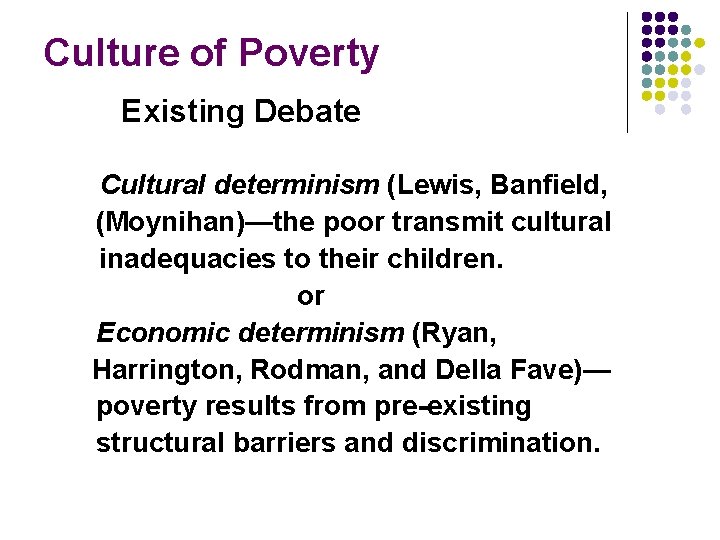
Culture of Poverty Existing Debate Cultural determinism (Lewis, Banfield, (Moynihan)—the poor transmit cultural inadequacies to their children. or Economic determinism (Ryan, Harrington, Rodman, and Della Fave)— poverty results from pre-existing structural barriers and discrimination.
Culture of Poverty Value-Stretch Approach L. Richard Della Fave suggested that the poor adopt such an approach when the gap between ideal value preference and achievement expectation becomes too great. In other words, the poor do not have values that differ greatly from the mainstream in terms of work and success. They have different behaviors that represent different coping mechanisms.
Cultural Differentiation The greater the visible differences between the arriving minority group and the existing indigenous groups in terms of language, religion, clothing, diet, and other cultural factors.
Ethnic Stratification Refers to the clustering of particular ethnic groups at particular levels of the social stratification system. It occurs whenever any distribution of a group other than equal representation in all social classes appears.
Ethnic Stratification How does ethnic stratification continue in a democracy where supposedly all have an equal opportunity for upward mobility? Functionalists Suggest that the ethnocentrism of those in the societal mainstream leads to discrimination of those in out-groups, as determined by racial & ethnic differences Conflict theorists Stress the subordination of minorities by the dominant group because that group benefits from such ethnic stratification
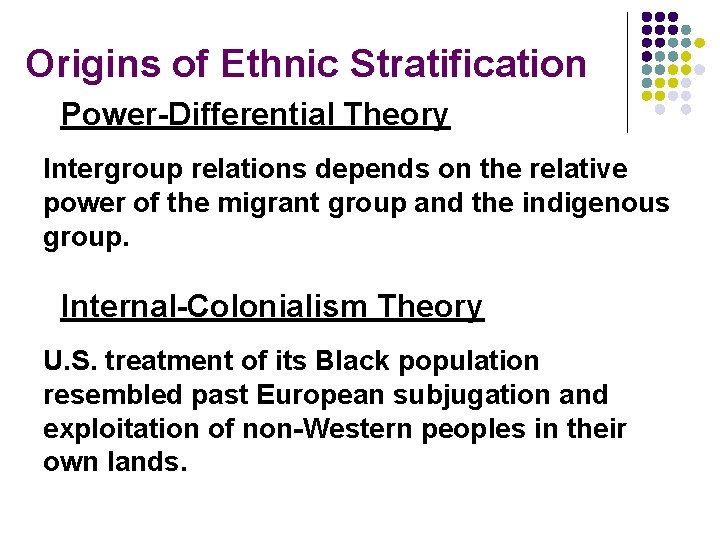
Origins of Ethnic Stratification Power-Differential Theory Intergroup relations depends on the relative power of the migrant group and the indigenous group. Internal-Colonialism Theory U. S. treatment of its Black population resembled past European subjugation and exploitation of non-Western peoples in their own lands.
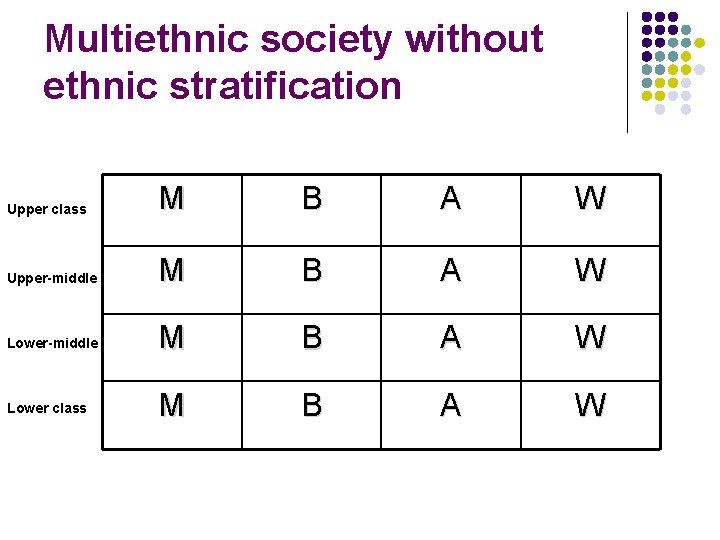
Multiethnic society without ethnic stratification Upper class M B A W Upper-middle M B A W Lower class M B A W
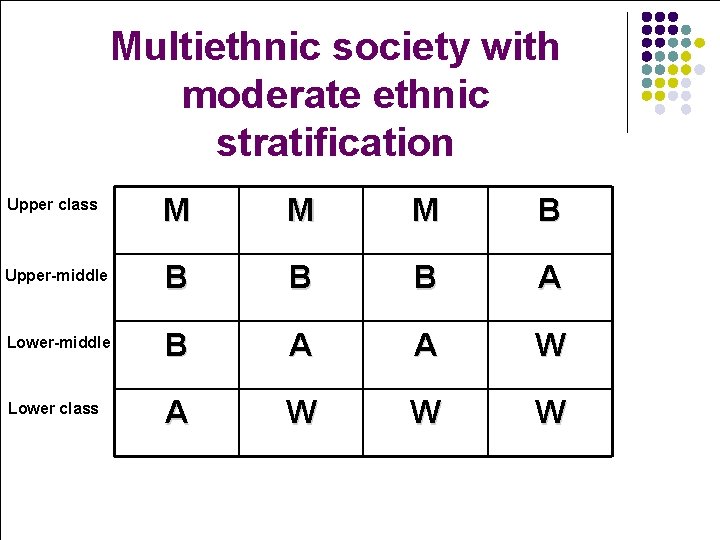
Multiethnic society with moderate ethnic stratification Upper class M M M B Upper-middle B B B A Lower-middle B A A W Lower class A W W W
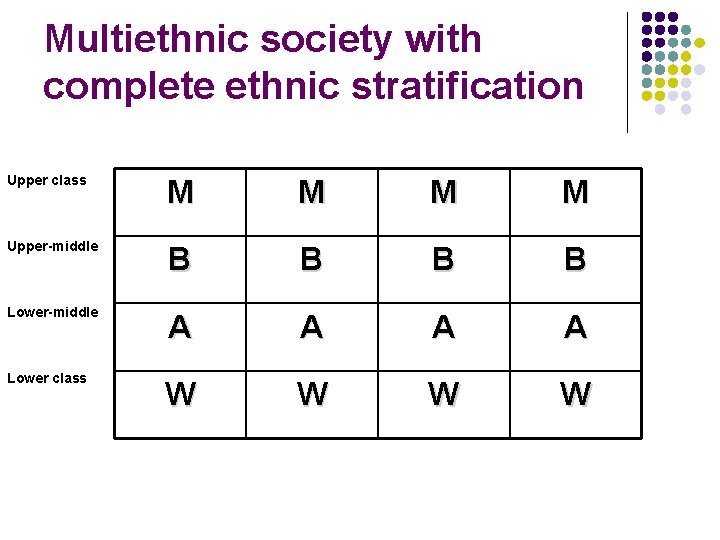
Multiethnic society with complete ethnic stratification Upper class M M Upper-middle B B Lower-middle A A Lower class W W
Supplement: Gender Stratification by Gender Schaefer, Sociology in Modules, ch. 11
Cross-Cultural Perspective █ █ Anthropologists documented highly diverse constructions of gender Gender stratification requires: – Individual socialization into traditional gender roles within family – Promotion and support of traditional roles by other social institutions
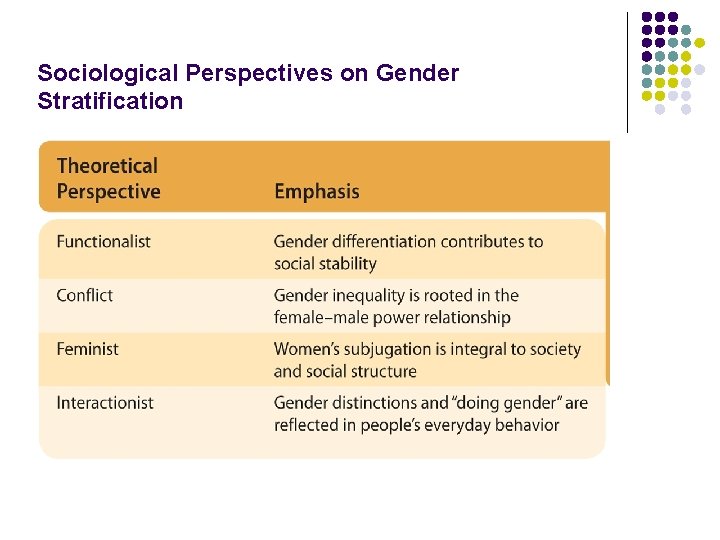
Sociological Perspectives on Gender Stratification █ The functionalist view – Contributes to overall social stability • Instrumentality: Emphasis on tasks • Expressiveness: Maintenance of harmony and internal emotional affairs of family Dividing tasks between spouses was functional for the family as a unit
Sociological Perspectives on Gender Stratification █ Conflict response – Functionalist approach masks underlying power relations between men and women – Relationship between females and males is traditionally one of unequal power – View gender differences as reflection of subjugation of one by another group
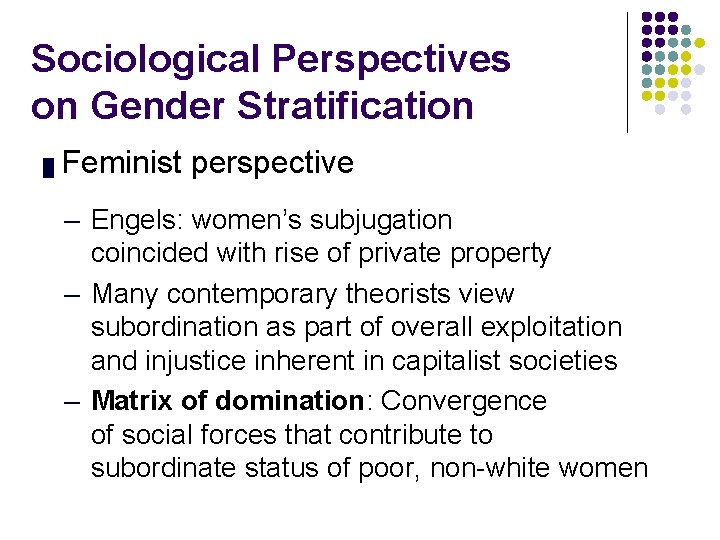
Sociological Perspectives on Gender Stratification █ Feminist perspective – Engels: women’s subjugation coincided with rise of private property – Many contemporary theorists view subordination as part of overall exploitation and injustice inherent in capitalist societies – Matrix of domination: Convergence of social forces that contribute to subordinate status of poor, non-white women
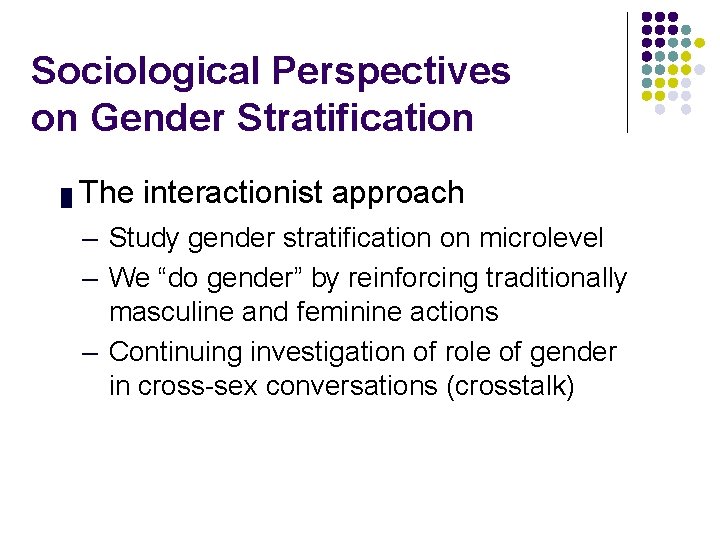
Sociological Perspectives on Gender Stratification █ The interactionist approach – Study gender stratification on microlevel – We “do gender” by reinforcing traditionally masculine and feminine actions – Continuing investigation of role of gender in cross-sex conversations (crosstalk)
Sociological Perspectives on Gender Stratification