
Chapter 3 Ethics and Social Responsibility Copyright 1998
Chapter 3 Ethics and Social Responsibility Copyright 1998 by Prentice Hall, Inc. adapted by Prof. Dr. vom Kolke 1
Learning Objectives l l l Define ethics and understand the importance of ethical behavior for organizations Discuss 4 perspectives on ethics and arguments for ethical relativism and universalism Understand the efficiency and social responsibility perspectives of corporate social responsibility Copyright 1998 by Prentice Hall, Inc. adapted by Prof. Dr. vom Kolke 2
Learning Objectives (cont. ) l l Know how ethics affect individual behavior in organizations Consider ways of scientifically studying organizational ethics Know methods for resolving cross-cultural ethical conflicts Analyze your ethics and how they affect your understanding of management and organizational behavior Copyright 1998 by Prentice Hall, Inc. adapted by Prof. Dr. vom Kolke 3
Unethical Behavior l The Wall Street scandals of the 1980 s (insider trading) Product piracy in China (CDs) l Multinational corporate bribery l Russian Mafia influence in 1990 s l Copyright 1998 by Prentice Hall, Inc. adapted by Prof. Dr. vom Kolke 4
Ethics Moral standards, not governed by law, that focus on the human consequences of behavior (set of beliefs about right and wrong) Copyright 1998 by Prentice Hall, Inc. adapted by Prof. Dr. vom Kolke 5
Relativism Vs. Universalism l Ethical relativism (no absolute principle of right or wrong, good or bad) – individual ethical relativism (individuals determine what’s right or wrong) – cultural ethical relativism (right or wrong depends on one’s culture) l Ethical universalism (universal and objective ethical rules across societies) Copyright 1998 by Prentice Hall, Inc. adapted by Prof. Dr. vom Kolke 6
The Social Responsibility of Corporations l The Efficiency Perspective (corporate responsibility to max. profits for shareholders) l The Social Responsibility Perspective (corporate responsibility to promote wellbeing of stakeholders) l Globalization promotes the stakeholder perspective Copyright 1998 by Prentice Hall, Inc. adapted by Prof. Dr. vom Kolke 7
Approaches to 1) Social Responsibility l Obstructionist response: corporations choose not to be socially responsible. – companies behave illegally and unethically (hide and cover-up problems). l Defensive response: corporations stay within the law but make no attempt to exercise additional social responsibility. – – Shareholder interest above all other stakeholders. Managers say society should make laws if change is needed 1) Copyright 1998 by Prentice Hall, Inc. adapted by Prof. Dr. vom Kolke Jones et al. , Cont. Management, 1998, Ch. 5 8
Approaches to 1) Social Responsibility l Accommodative response: corporations realize the need for social responsibility. – l Try to balance the interests of all stakeholders. Proactive response: corporations actively embrace social responsibility. – Go out of their way to learn about and help stakeholders. 1) Copyright 1998 by Prentice Hall, Inc. adapted by Prof. Dr. vom Kolke Jones et al. , Cont. Management, 1998, Ch. 5 9
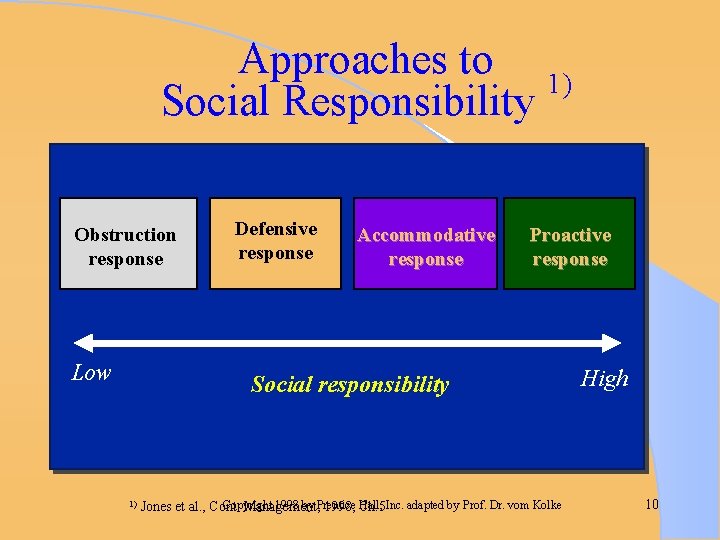
Approaches to 1) Social Responsibility Obstruction response Low Defensive response Accommodative response Proactive response Social responsibility 1) Copyright 1998 by Prentice Hall, Inc. adapted by Prof. Dr. vom Kolke Jones et al. , Cont. Management, 1998, Ch. 5 High 10
Examples of Internal Ethical Issues l Dispersion of harm and benefits among stakeholders If a firm is very profitable for two years, who should receive the profits? Employees, managers and stockholders all want a share. – Should the cash being kept for future slowdowns? What is the ethical decision? – l Layoff policy radical approach (Chrysler laid off 60% of workforce) l spread layoffs over longer terms l Copyright 1998 by Prentice Hall, Inc. adapted by Prof. Dr. vom Kolke 11
Examples of Internal Ethical Issues l Hold payment to suppliers as long as possible to benefit the firm? l l Severance pay to laid off workers? l l harm to suppliers who are stakeholders may decrease the stockholder's return Buy goods from overseas firms that hire children? l If not the children might not earn enough money to eat. Copyright 1998 by Prentice Hall, Inc. adapted by Prof. Dr. vom Kolke 12
Examples of Cross-Cultural Ethical Issues l Theft of intellectual property (some countries don’t honor copyrights/patents, encourage piracy) l bribery and corruption (e. g. lubrication bribes to facilitate/ speed up processes) l intentionally selling dangerous products (Nestle’ instant formula) l environmental pollution (different concerns in different countries) l intentional misrepresentations in negotiations (Bluff, fraud, intimidation) Copyright 1998 by Prentice Hall, Inc. adapted by Prof. Dr. vom Kolke 13
Will Corporations Behave Ethically? l If it is in the corporations (self-) interest – reputation and image loss of reputation (Brent Spar and Shell) l enhancing attractiveness to stakeholders (potential l employees/ managers, investors) – corporate code of ethics (e. g. report illegal/ unethical behavior [whistle-blower], ethical ombudsman) – national/ international law, accompanied by formal punitive sanctions Copyright 1998 by Prentice Hall, Inc. adapted by Prof. Dr. vom Kolke 14
Implications for Managers Develop a Framework for Evaluating Ethical Codes and Determining Personal Ethics l Understand Behaviors and Ethics of Other Societies l Consider Approaches to Resolving Cross -Cultural Ethical Conflicts l Copyright 1998 by Prentice Hall, Inc. adapted by Prof. Dr. vom Kolke 15
- Slides: 15