
Chapter 3 Driver Safety Rules 1 The New





- Slides: 39
Chapter 3 Driver Safety & Rules
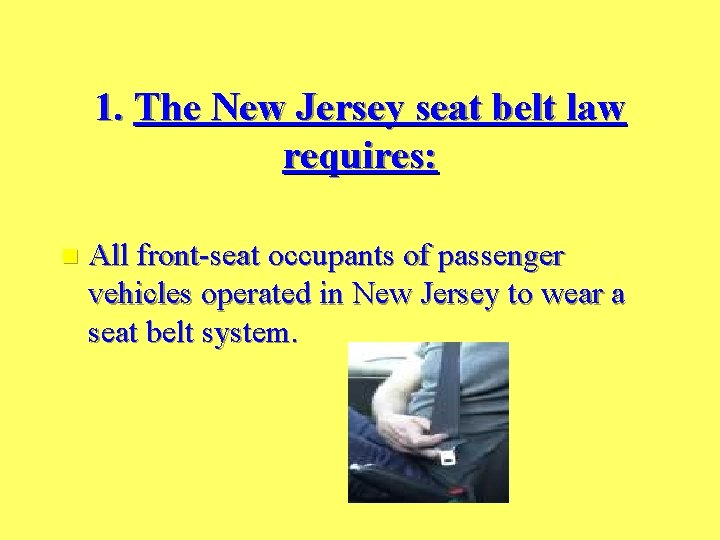
1. The New Jersey seat belt law requires: n All front-seat occupants of passenger vehicles operated in New Jersey to wear a seat belt system.
Traffic accidents are a leading killer of… “CHILDREN”
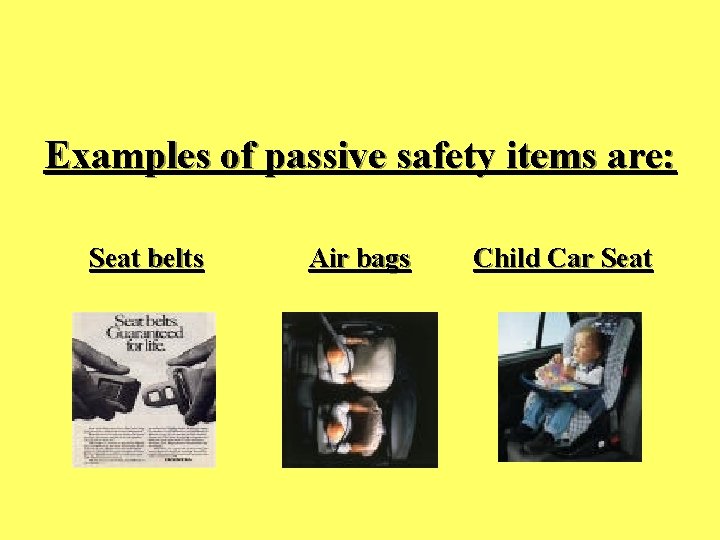
Examples of passive safety items are: Seat belts Air bags Child Car Seat
2. The driver is responsible for: n Enforcing the seat belt law for passengers under 18 years old.
3. Front-seat passengers 18 years old and over are responsible: n For themselves n But what can you do?
4. Additionally, drivers with Graduated Driver License (GDL) permits must: n Require all passengers seated anywhere in the vehicle to use seat belts.
n 5. Seatbelts can help by:
6. The exemptions for the seat belt law are: Any passenger automobile manufactured before July 1, 1966 n Any passenger automobile which is not required to be equipped with seatbelt systems under federal law. n A physical or medical reason, verified in writing by a licensed physician. n
7. When riding in a car, children should: Children should be held in place by a restraint system that meets all Federal Motor Vehicle Safety Standards. n Look for a label on the restraint system that reads: “This child restraint system conforms to all applicable Federal Motor Vehicle Safety Standards. ” n
8. When possible, child car safety seats should be placed: n In the back seat. n If the car does not have a back seat, child car safety seat may be placed in the front seat. But the front seat should be moved as far away as possible from the dashboard
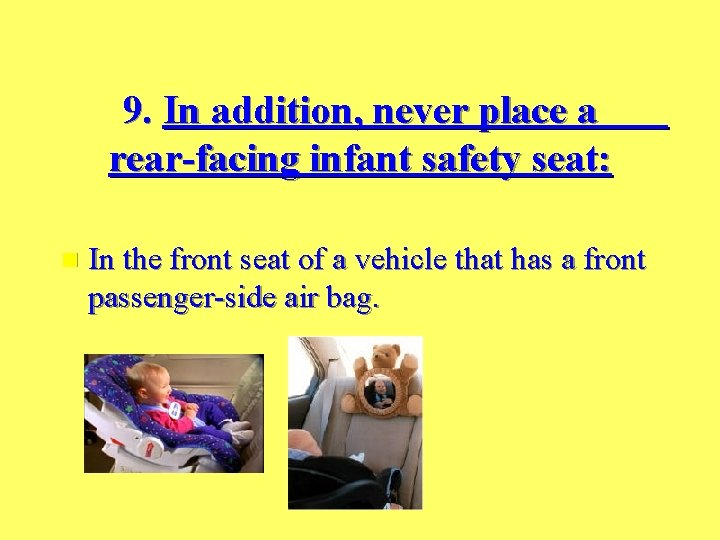
9. In addition, never place a rear-facing infant safety seat: n In the front seat of a vehicle that has a front passenger-side air bag.
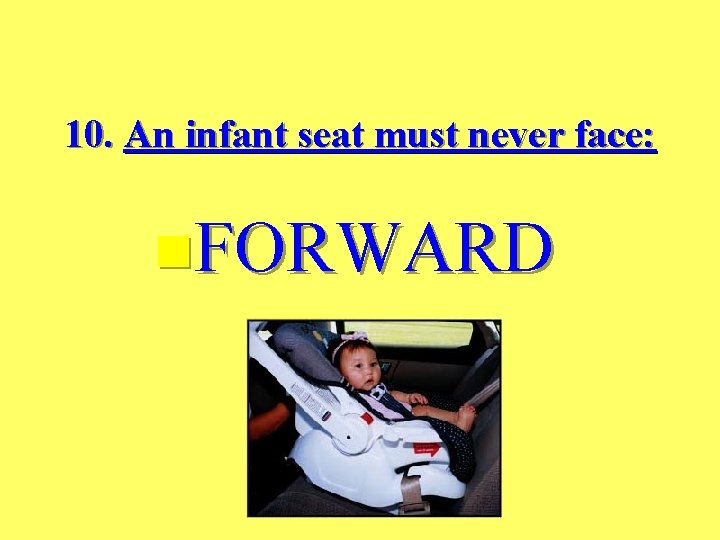
10. An infant seat must never face: n. FORWARD
11. Children 12 should ride: n In the back seat of a vehicle.
12. Passengers under eight years of age who weigh: n More than 80 pounds and all passengers who are at least eight years of age but less than 18 years of age must wear seat belts wherever they sit in a motor vehicle.
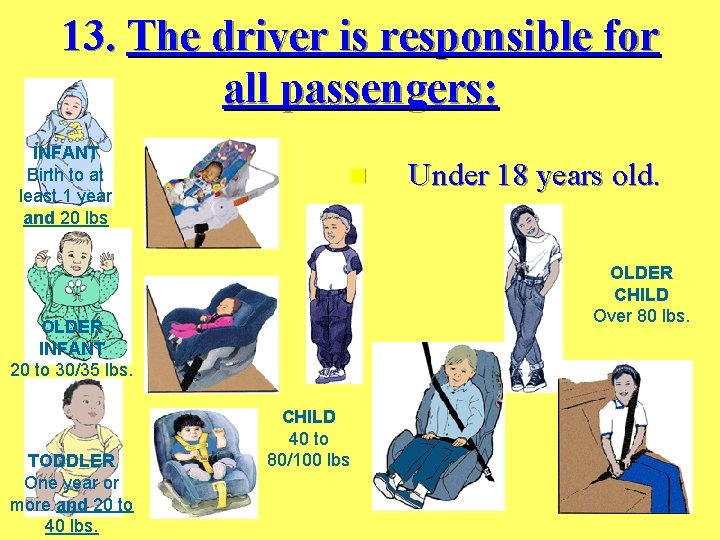
13. The driver is responsible for all passengers: INFANT Birth to at least 1 year and 20 lbs n OLDER CHILD Over 80 lbs. OLDER INFANT 20 to 30/35 lbs. TODDLER One year or more and 20 to 40 lbs. Under 18 years old. CHILD 40 to 80/100 lbs
14. Passengers 18 years old and over are responsible: n For themselves
A police officer can stop a driver solely for a: n Violation of a seat belt law.
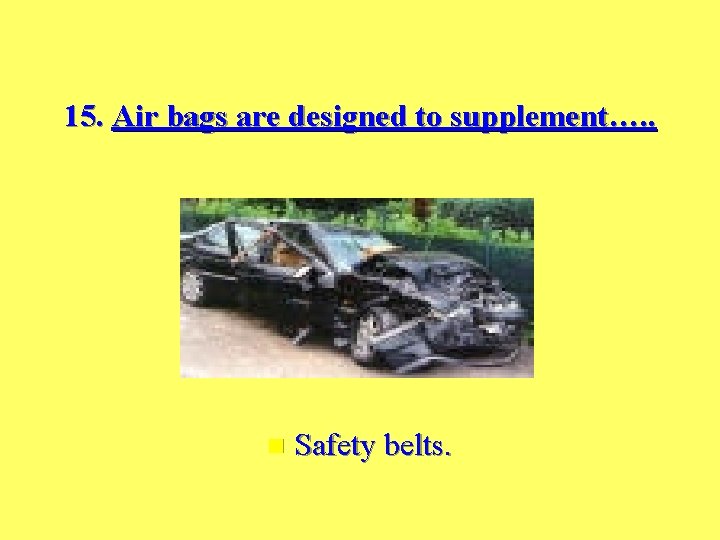
15. Air bags are designed to supplement…. . n Safety belts.
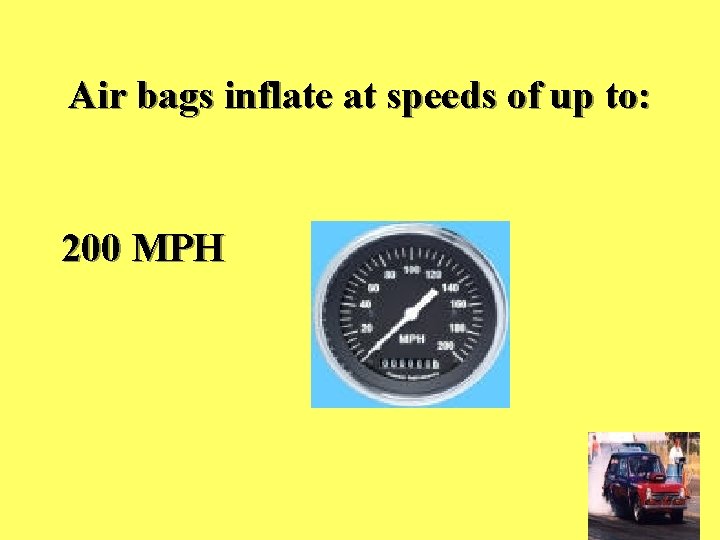
Air bags inflate at speeds of up to: 200 MPH
Air bags could seriously: n Injure or kill children who are sitting in the front seat.
16. Air bag cut-off switches are allowed…. n In automobiles with no back seats.
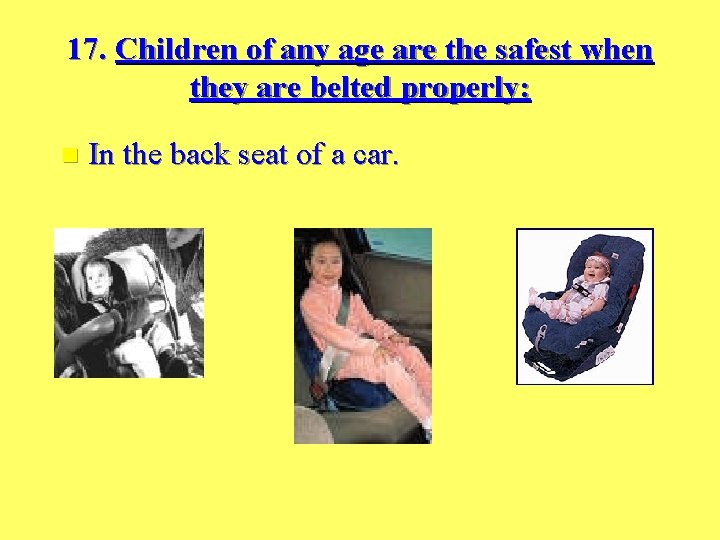
17. Children of any age are the safest when they are belted properly: n In the back seat of a car.
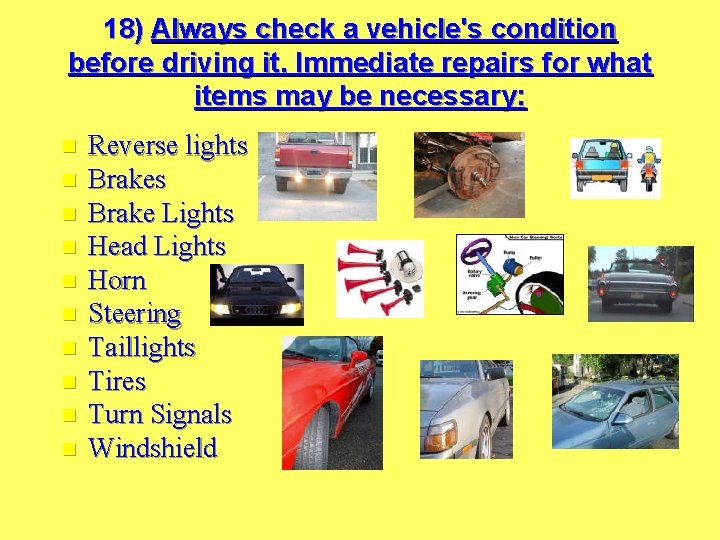
18) Always check a vehicle's condition before driving it. Immediate repairs for what items may be necessary: n n n n n Reverse lights Brake Lights Head Lights Horn Steering Taillights Tires Turn Signals Windshield
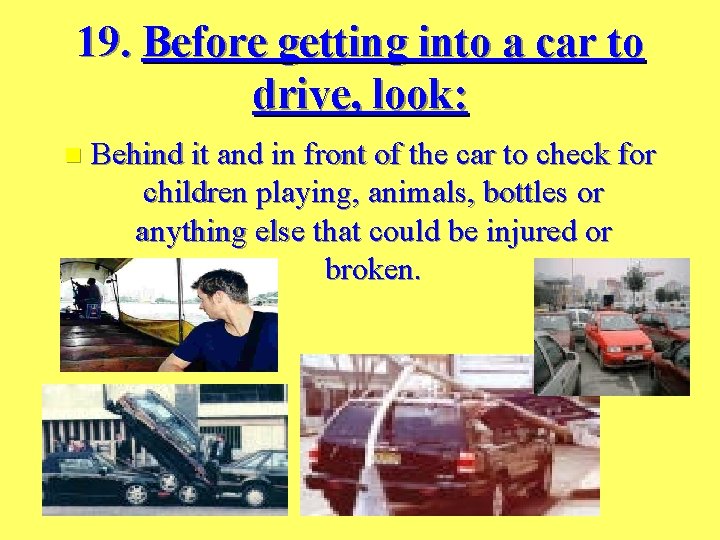
19. Before getting into a car to drive, look: n Behind it and in front of the car to check for children playing, animals, bottles or anything else that could be injured or broken.
20. Also: Make sure all windows are clean and there is nothing blocking lines of sight. n Adjust the seat so all pedals and controls are easily reached. n Adjust inside and outside mirrors to reduce blind spots. n Fasten safety belts and shoulder harnesses, adjusting them for firmness and comfort. n Make sure the car is in park or neutral gear and the parking brake is set. n
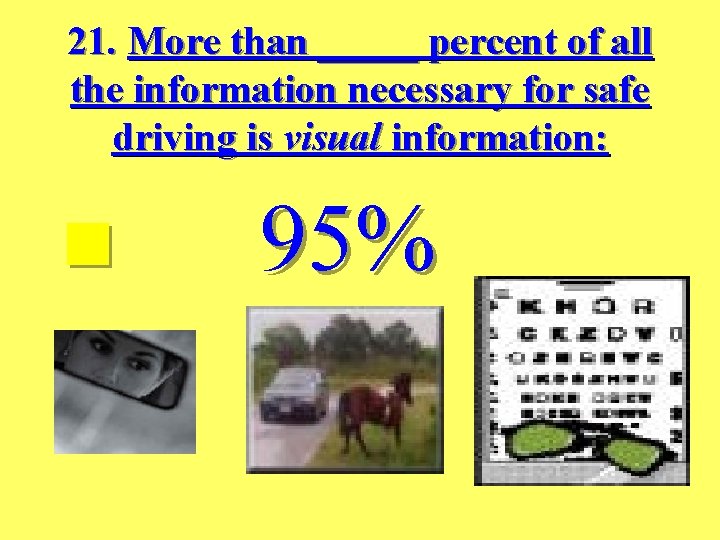
21. More than _____ percent of all the information necessary for safe driving is visual information: n 95%
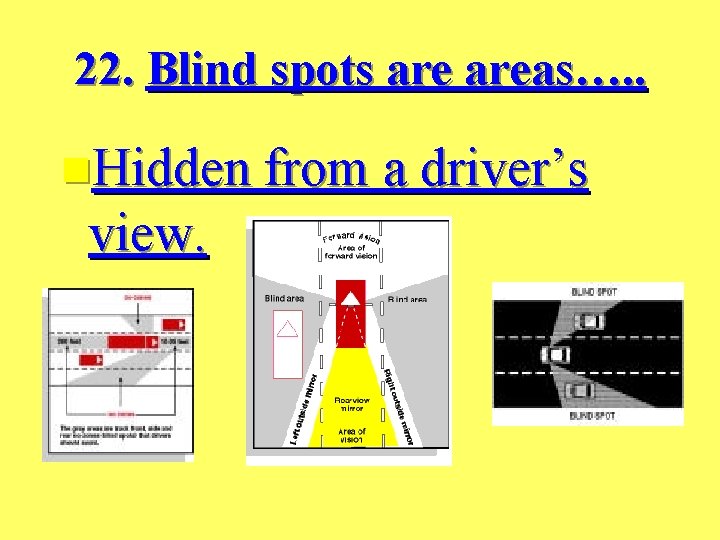
22. Blind spots areas…. . n. Hidden from a driver’s view.
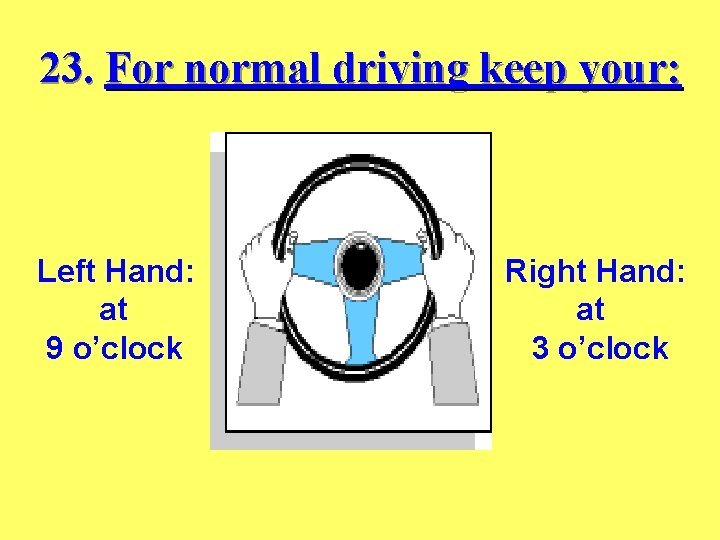
23. For normal driving keep your: Left Hand: at 9 o’clock Right Hand: at 3 o’clock
24. There is no absolute formula to judge stopping distance. It depends on numerous factors, including: Individual reaction time n Weather and road conditions n Vehicle weight n Brakes conditions n Condition and type of tires n Roadway conditions n Speed n
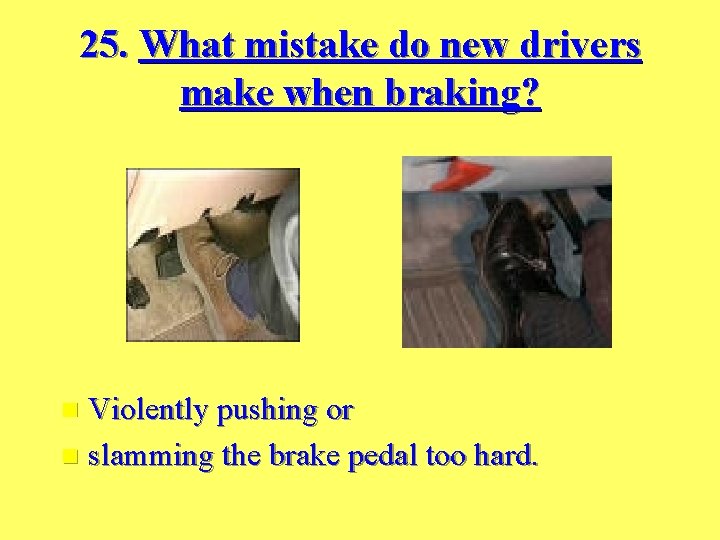
25. What mistake do new drivers make when braking? Violently pushing or n slamming the brake pedal too hard. n
26. What foot should you use for both accelerating and braking? n. The right foot.
27. Turn signals must be given how many feet before you turn? n 100 feet
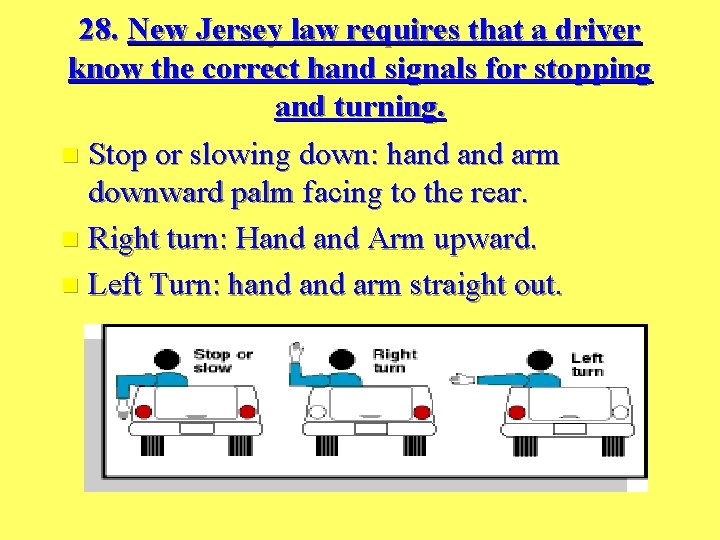
28. New Jersey law requires that a driver know the correct hand signals for stopping and turning. n Stop or slowing down: hand arm downward palm facing to the rear. n Right turn: Hand Arm upward. n Left Turn: hand arm straight out.
29. The horn is a…. . n Warning signal, calling attention to what a driver is doing.
30. Before driving in reverse, what should you do? Be sure the path is clear by checking all mirrors and turning to check
31. In reverse, steering the wheel to the. . . n n RIGHT: moves the car to the right LEFT: moves the car to the left n Use the 12 o'clock position to back your car in a straight line. Turn your head and body to the right until you can see clearly through the back window. Brace yourself by placing your right hand arm over the back of the seat, grasp the top of the steering wheel with your left hand select the point where you want to steer. n When driving in reverse, remember that the front of your car will swing in the opposite direction of your turn. Do not depend on mirrors alone when backing. Back slowly. n When taking the road test for a driver license, you must show that you can drive in reverse properly. You will be asked to back your car about 100 feet. You should be able to back up in a straight line, slowly and smoothly.
32. When parking on a hill, describe the direction you should turn your wheels n Facing Downhill: Turn your wheels toward the curb and shift into reverse gear or park. n Facing Uphill: Turn your wheels away from the curb and shift into low gear or park. n If there are no curbs: Turn your wheel towards the edge of the road.
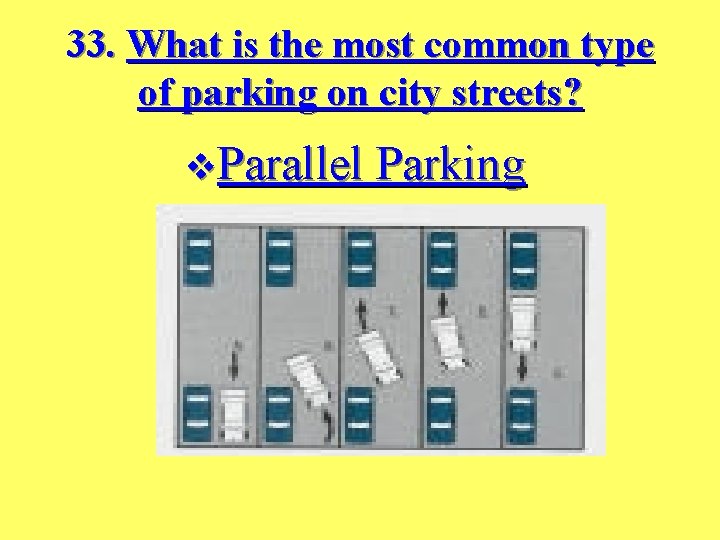
33. What is the most common type of parking on city streets? v. Parallel Parking