
Chapter 3 Drafting the Basic Pattern Set A
Chapter 3 Drafting the Basic Pattern Set A M D 225 Patternmaking I
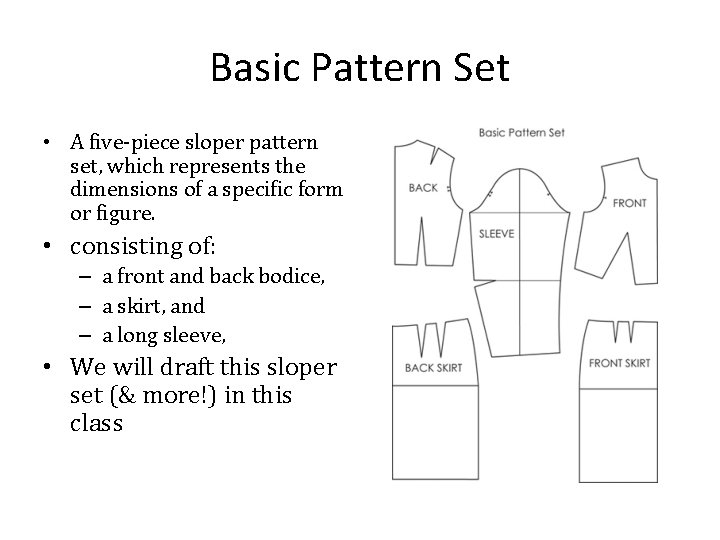
Basic Pattern Set • A five-piece sloper pattern set, which represents the dimensions of a specific form or figure. • consisting of: – a front and back bodice, – a skirt, and – a long sleeve, • We will draft this sloper set (& more!) in this class
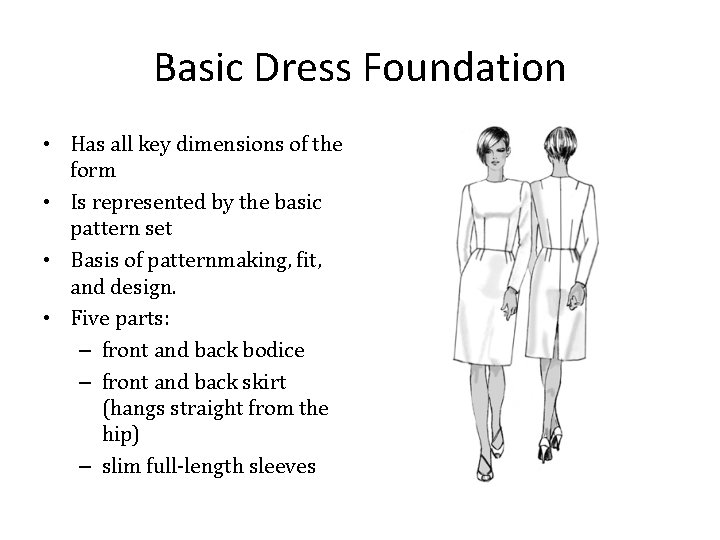
Basic Dress Foundation • Has all key dimensions of the form • Is represented by the basic pattern set • Basis of patternmaking, fit, and design. • Five parts: – front and back bodice – front and back skirt (hangs straight from the hip) – slim full-length sleeves
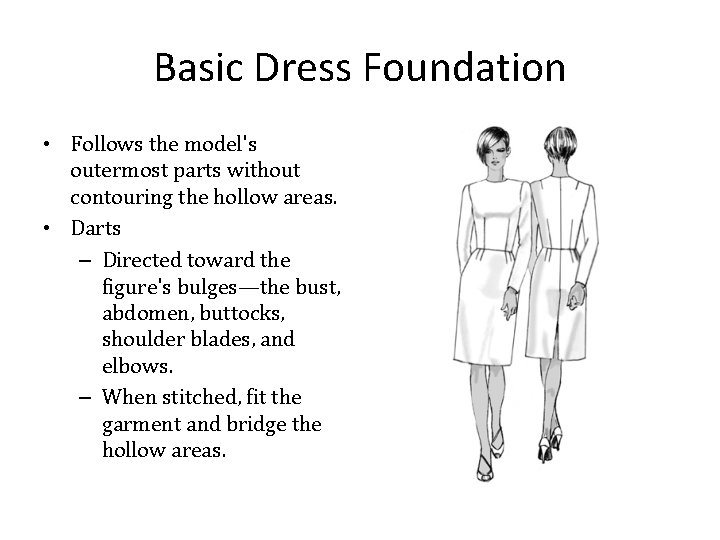
Basic Dress Foundation • Follows the model's outermost parts without contouring the hollow areas. • Darts – Directed toward the figure's bulges—the bust, abdomen, buttocks, shoulder blades, and elbows. – When stitched, fit the garment and bridge the hollow areas.
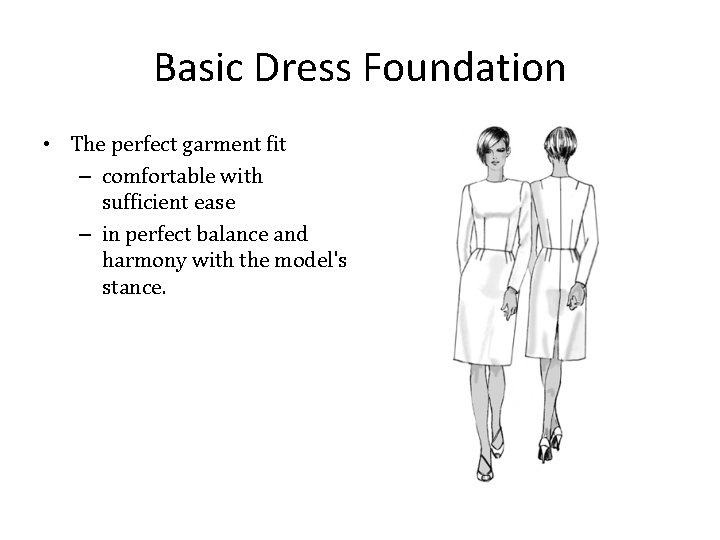
Basic Dress Foundation • The perfect garment fit – comfortable with sufficient ease – in perfect balance and harmony with the model's stance.
Pattern Shape • Patterns confine the dimensions of the figure by a series of – straight lines • Shoulder • side seams • skirt—below hip – curved lines • Necklines • Armholes • skirt—above hip • Wedges that appear at the pattern's edge are directed to the figure's contour: – – apex of the bust shoulder blade abdomen buttocks • Wedges are called darts.
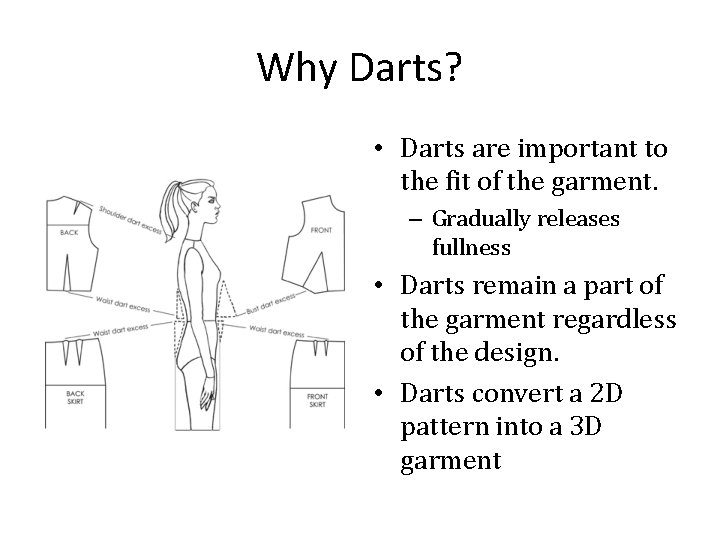
Why Darts? • Darts are important to the fit of the garment. – Gradually releases fullness • Darts remain a part of the garment regardless of the design. • Darts convert a 2 D pattern into a 3 D garment
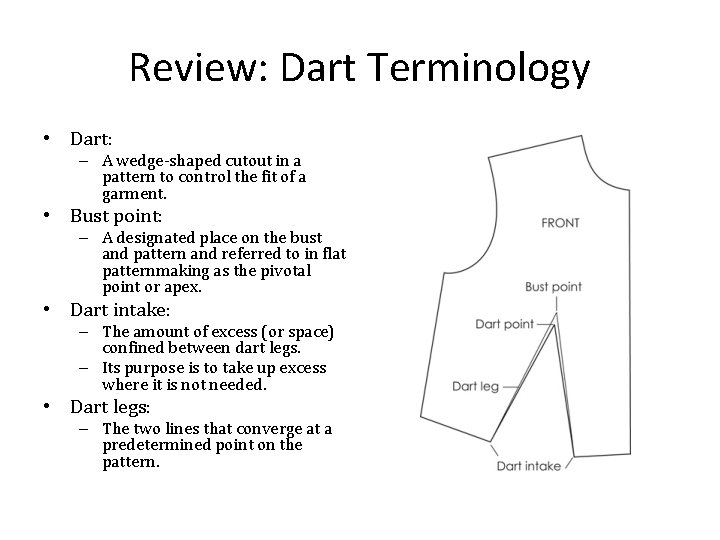
Review: Dart Terminology • Dart: – A wedge-shaped cutout in a pattern to control the fit of a garment. • Bust point: – A designated place on the bust and pattern and referred to in flat patternmaking as the pivotal point or apex. • Dart intake: – The amount of excess (or space) confined between dart legs. – Its purpose is to take up excess where it is not needed. • Dart legs: – The two lines that converge at a predetermined point on the pattern.
Review Question: • Name the basic pattern parts and their relationship to patternmaking.
Drafting the Basic Pattern Set • It is important to follow the exact instructions when drafting patterns. • Draft patterns for the right side of the body. • Measurements must be measured from your assigned dress or pant form. – Reference textbook for measurement locations and procedures. • All sloper assignments must be started in class on the day assigned. – Bring necessary supplies! • Draft and label all patterns NEATLY and ACCURATELY. • Proper use of tools and equipment is essential.
Drafting the Basic Pattern Set Pattern & Fit Muslin (Due at the start of class the following class period) • Pattern Production sloper (NEXT class) • After constructing fit muslin, fitting it, and – On a pattern hook on the dress form with the pattern, making pattern card, and grade corrections sheet. • left and right sides stapled • Fit muslin (1 st sample) together – On your assigned dress form • no seam allowances • Any patterns or muslins presented after the start of • on tag board class will be considered late. • for use in your future classes
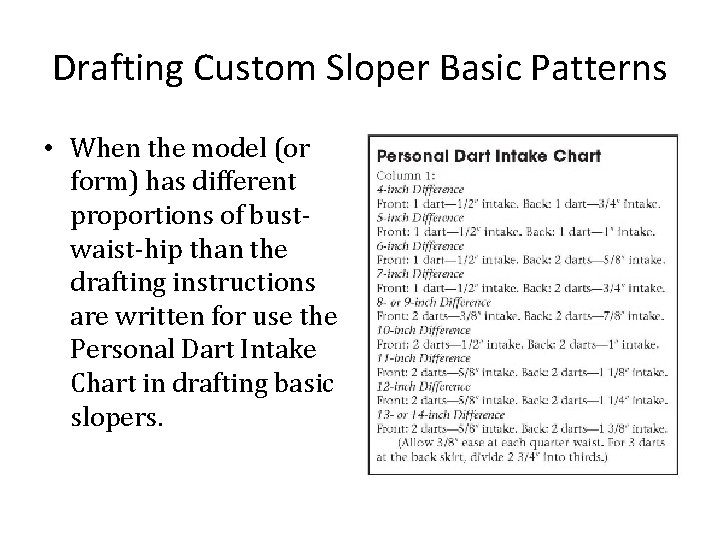
Drafting Custom Sloper Basic Patterns • When the model (or form) has different proportions of bustwaist-hip than the drafting instructions are written for use the Personal Dart Intake Chart in drafting basic slopers.
The Basic Pattern Set BODICE DRAFT
Review: Key Measurements for Drafting Basic Bodice • Back arc: – Center back to plate at the side seam. • Bust arc: – Center front across bust point to the side seam. • Bust span: – Distance from bust point to bust point. • Shoulder slope: – A measure point from shoulder tip to waist at center line. • Strap measurement: – Shoulder/neck to side seam at the bottom of the waist. • Waist arc: – Center lines to side seam.
The Basic Pattern Set SKIRT DRAFT
Key Measurements for Drafting Basic Skirt • Hip depth: – A location of the widest area around the hip. • Hip arc: • Center lines to side seam. • Waist arc: – Center lines to side seam.
The Basic Pattern Set SLEEVE DRAFT
Fitting the Sleeve • We will learn how to: – Identify and correct problems with the fit of the sleeve – Explain sleeve rotation and the correction that would upright the sleeve.
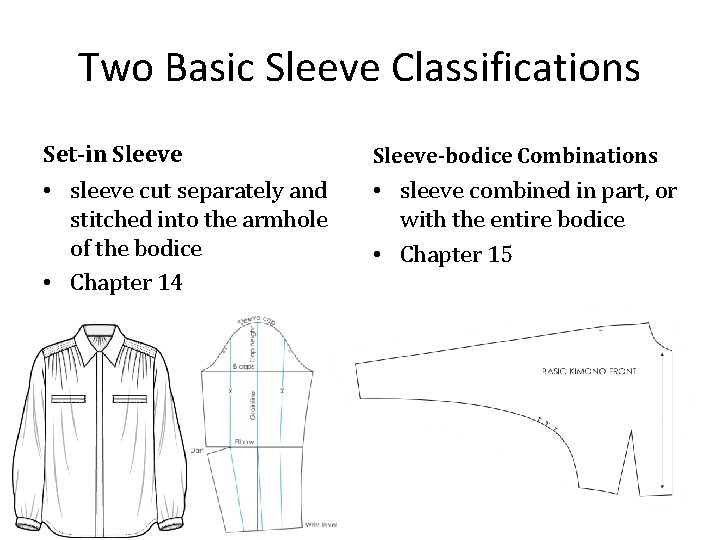
Two Basic Sleeve Classifications Set-in Sleeve-bodice Combinations • sleeve cut separately and stitched into the armhole of the bodice • Chapter 14 • sleeve combined in part, or with the entire bodice • Chapter 15
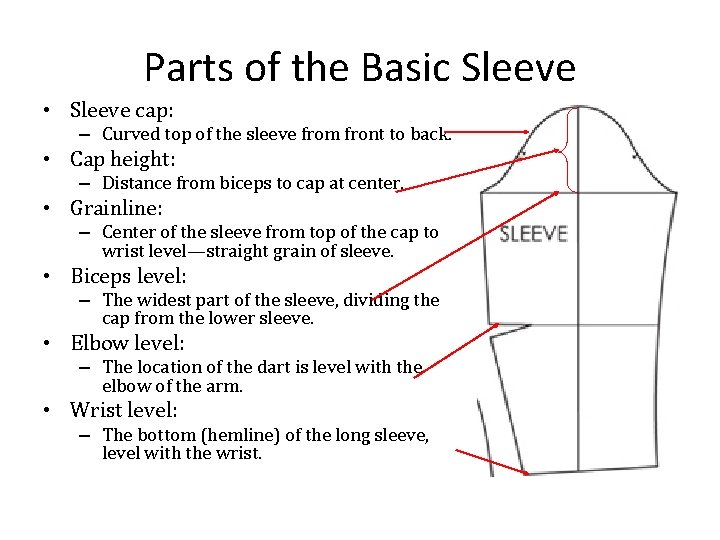
Parts of the Basic Sleeve • Sleeve cap: – Curved top of the sleeve from front to back. • Cap height: – Distance from biceps to cap at center. • Grainline: – Center of the sleeve from top of the cap to wrist level—straight grain of sleeve. • Biceps level: – The widest part of the sleeve, dividing the cap from the lower sleeve. • Elbow level: – The location of the dart is level with the elbow of the arm. • Wrist level: – The bottom (hemline) of the long sleeve, level with the wrist.
Relationship of Sleeve Cap to Torso & Bodice Armscye Cap ease Notches • Difference between the cap • What is the purpose of notching front and back and armhole sleeve cap? measurements • How many notches & – (ranging from 1 to 1 7/8”). where? • Walk the sleeve along the – One notch = front sleeve; armhole to mark the – two notches = back sleeve. location of the notch to – Cap notch indicates where equalize cap ease. the sleeve and the shoulder meet (location can vary from center grainline).
Fitting the Sleeve to the Bodice / Torso • Identify when the sleeve is in need of rotation. • Correct the basic sleeve that hangs away from the side of the garment.
Variations of the Basic Sleeve Additional Sleeve Slopers Sleeve Designs • Dartless sleeve: • • • – A straight sleeve without an elbow dart that is used as a base to create many sleeve designs. • Quartering sleeve: – Sleeve divided into four equal parts from cap to wrist. – Used as guidelines for spreading the sleeve. Bell sleeve Bishop sleeve: Cap sleeve Cowl sleeve Extended cap Lantern sleeve Leg-of-mutton sleeve Petal sleeve Puff sleeve Roll-up sleeve Wedding sleeve
The Basic Pattern Set PATTERN FINISHING, MARKING, & LABELING
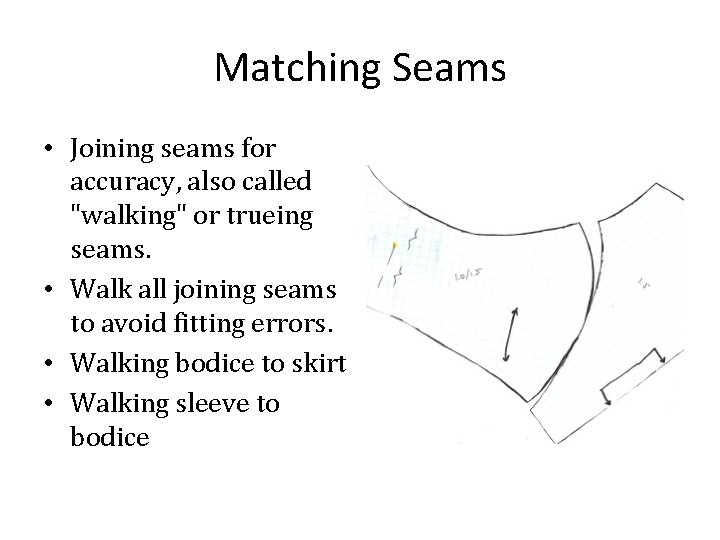
Matching Seams • Joining seams for accuracy, also called "walking" or trueing seams. • Walk all joining seams to avoid fitting errors. • Walking bodice to skirt • Walking sleeve to bodice
Review: Labeling • Name the labels that are recorded on the finished patterns, and state their importance to production. • Grainline • Pattern name – Front bodice, sleeve, etc. • Style number • Pattern size • Pieces cut (circled) – How many? – What fabric?
Seam Allowances • Patterns with and without seam allowances are used in the flat patternmaking system. • Seam allowances are temporarily added so drafts of sloper patterns can be sewn up for a test fit. • Style patterns – Seamed • Sloper patterns – seamless
The Basic Pattern Set FITTING
Fitting the Dress • A perfect fit – achieved through trial and error in testing the muslin. • We will learn corrections to fix the most common problems found in the first test fit of the basic dress – Example: Fitting bust cups that are more or less than a size B cup. • Muslin (1 st sample) – It is very important that: • all key landmarks are transferred from the pattern. • It is sewn accurately • Corrections must NOT be made to the pattern while you are sewing. YOU MUST SEW THE PATTERN THAT YOU HAVE!
Fit Muslin Procedures for AMD 225 • Fit muslins are due at the beginning of class. • Attach the appropriate grade sheet to your work before handing in. • Work coming later than the start of class will be evaluated as late work. • Fit muslins must be fabricated correctly. • Fit muslins must incorporate all the components (facings, closures, collars, cuffs, pockets waistbands etc. ) of the pattern.
Basic Steps when Fitting • 1. Measure 1 st sample & check seams for accurate sewing • 2. Check and correct alignment of key landmarks: – CF and CB seam, Shoulder seams, SS, Neckline, Waist, Darts • 3. Check and correct balance – Bust, Waist, HBL, Hang of sleeve • 4. Check and correct circumferences • 5. Correct any remaining gaps, straining, or pulling • CAUTION: – Sometimes making one correction creates another problem – Multiple fittings may be required. – Be sure to walk all pattern pieces after making corrections for fit.
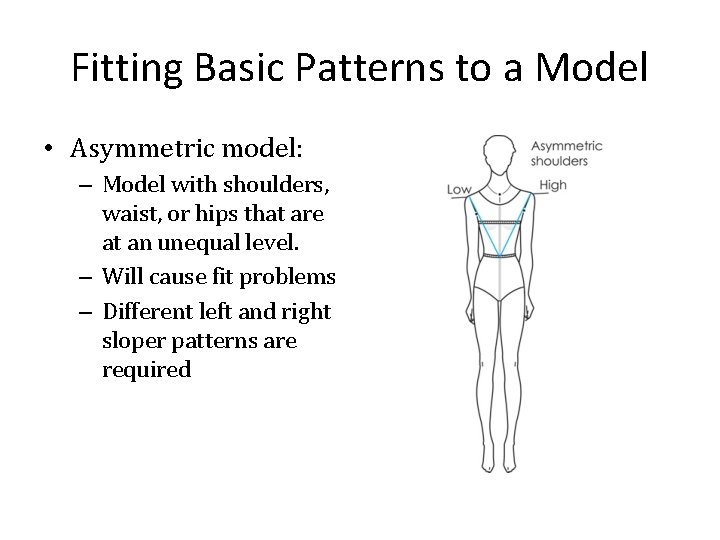
Fitting Basic Patterns to a Model • Asymmetric model: – Model with shoulders, waist, or hips that are at an unequal level. – Will cause fit problems – Different left and right sloper patterns are required
- Slides: 32