
Chapter 3 Digital models The business world is
Chapter 3 Digital models The business world is changing faster than ever before. Old approaches and models are being turned on their head. In this chapter, we show to assess your online marketplace, review new business, revenue and communications models and develop budget models. 1
3. 1 Introduction to digital models MODEL Anything that represents reality There are many different implications of change across a variety of models: • Development of online marketplace models • Change in business and revenue models • “Markets become conversations” (Levine et al, 2000) between customers and customers & employees • Change in value chains and distribution channels, new value networks are formed • New revenue streams through ads and affiliated links • Marketing transparency through open systems and control mechanisms • Interactive brand equity • Shift to virtual businesses 2
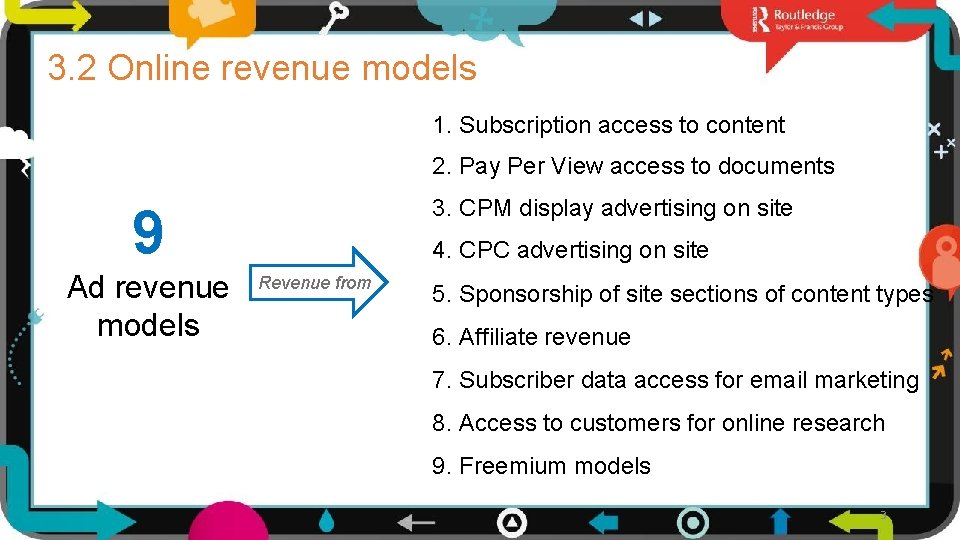
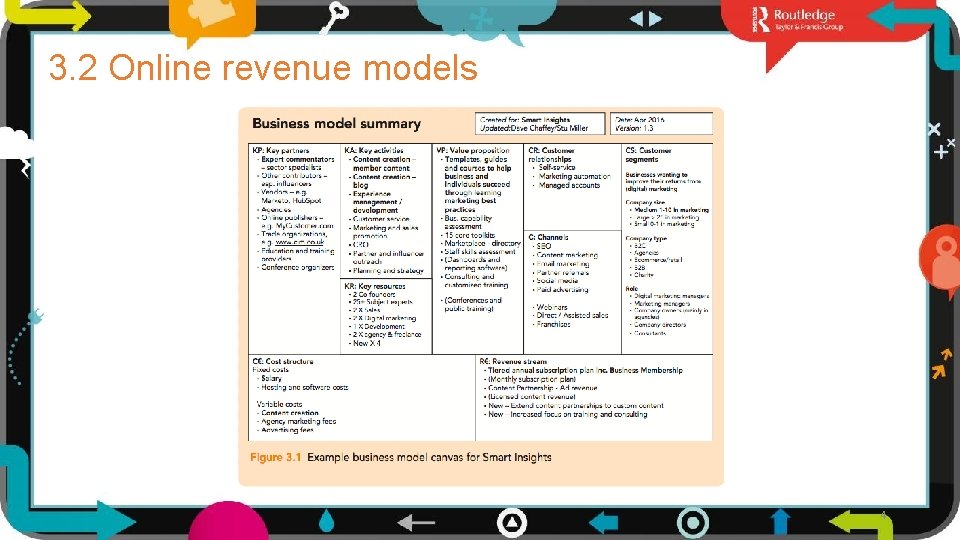
3. 2 Online revenue models 1. Subscription access to content 2. Pay Per View access to documents 3. CPM display advertising on site 9 Ad revenue models 4. CPC advertising on site Revenue from 5. Sponsorship of site sections of content types 6. Affiliate revenue 7. Subscriber data access for email marketing 8. Access to customers for online research 9. Freemium models 3
3. 2 Online revenue models 4
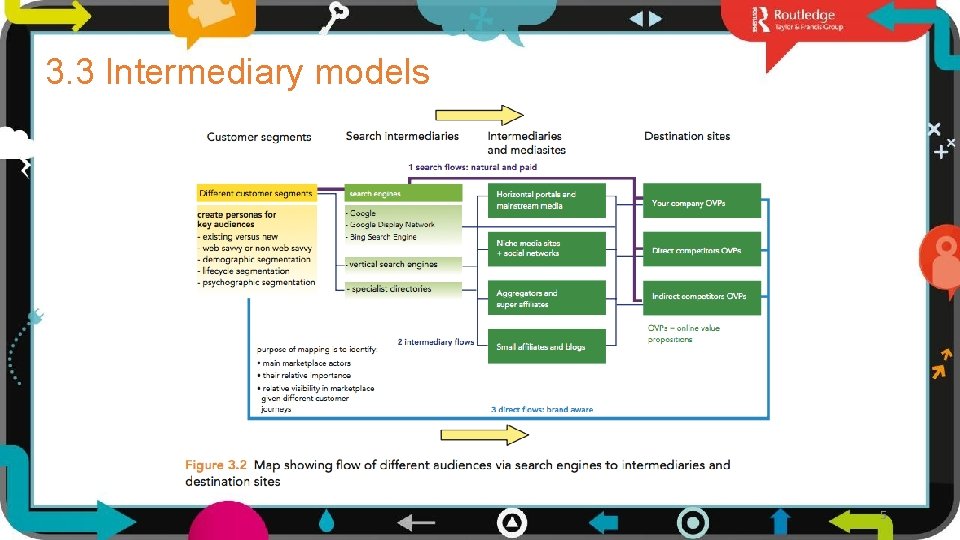
3. 3 Intermediary models 5
3. 3 Intermediary models The long tail marketplace model – Zipf’s law Refers to any large collection of items ordered by size or popularity. Describes how the frequency or popularity of items declines in a regular way. 6
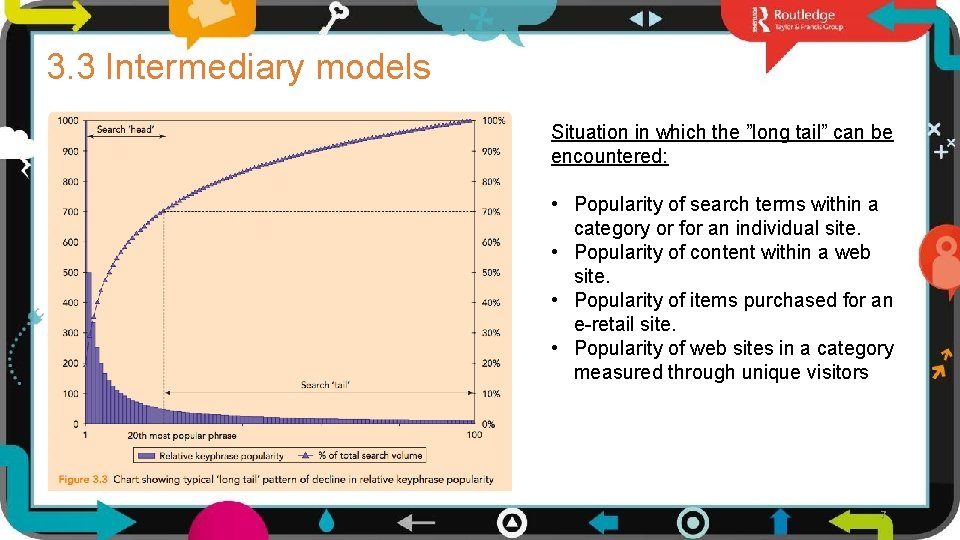
3. 3 Intermediary models Situation in which the ”long tail” can be encountered: • Popularity of search terms within a category or for an individual site. • Popularity of content within a web site. • Popularity of items purchased for an e-retail site. • Popularity of web sites in a category measured through unique visitors 7
3. 4 Attribution models Customers buy in different ways Achieving customer conversion: 1 st step Setting up clear goals in Google Analytics 2 nd step Tagging different media channels It is important to use a unified tracking system 8
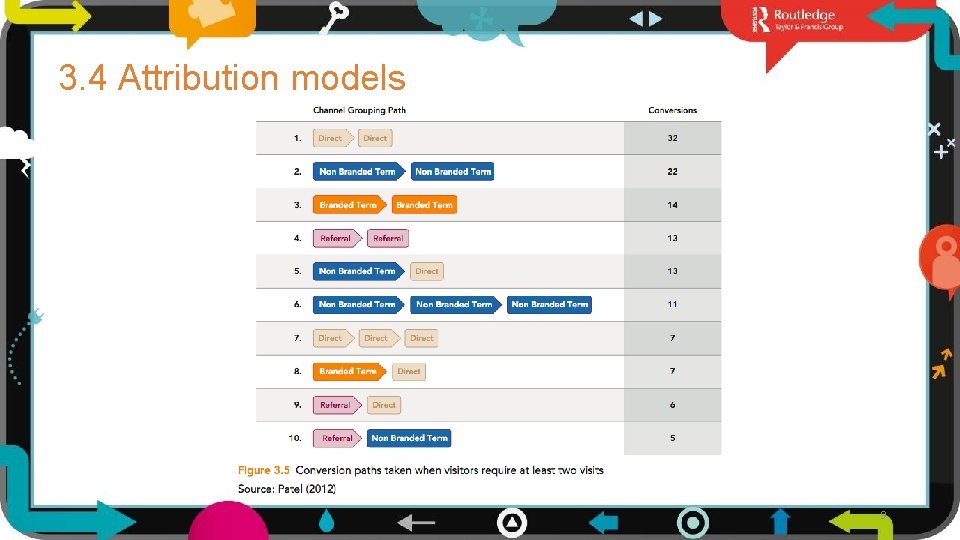
3. 4 Attribution models 9
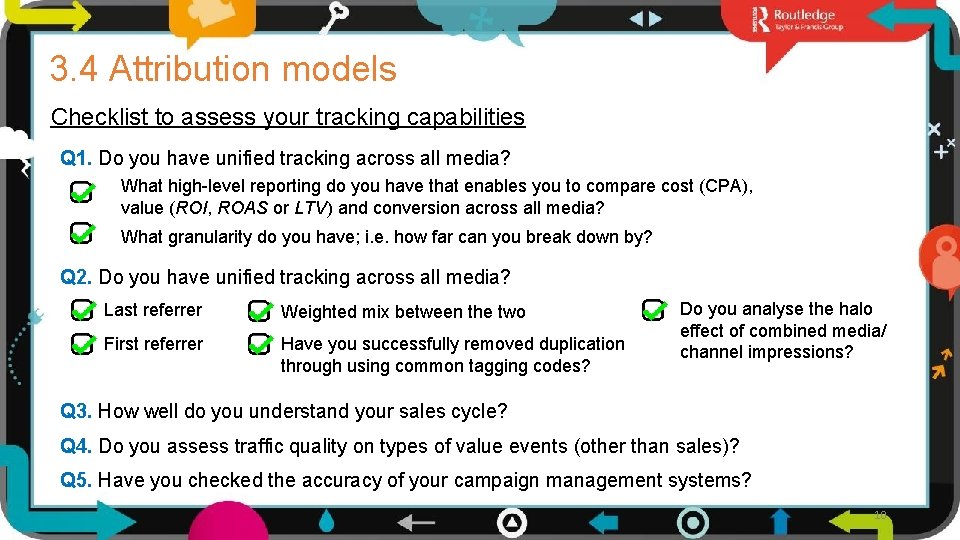
3. 4 Attribution models Checklist to assess your tracking capabilities Q 1. Do you have unified tracking across all media? What high-level reporting do you have that enables you to compare cost (CPA), value (ROI, ROAS or LTV) and conversion across all media? What granularity do you have; i. e. how far can you break down by? Q 2. Do you have unified tracking across all media? Last referrer Weighted mix between the two First referrer Have you successfully removed duplication through using common tagging codes? Do you analyse the halo effect of combined media/ channel impressions? Q 3. How well do you understand your sales cycle? Q 4. Do you assess traffic quality on types of value events (other than sales)? Q 5. Have you checked the accuracy of your campaign management systems? 10

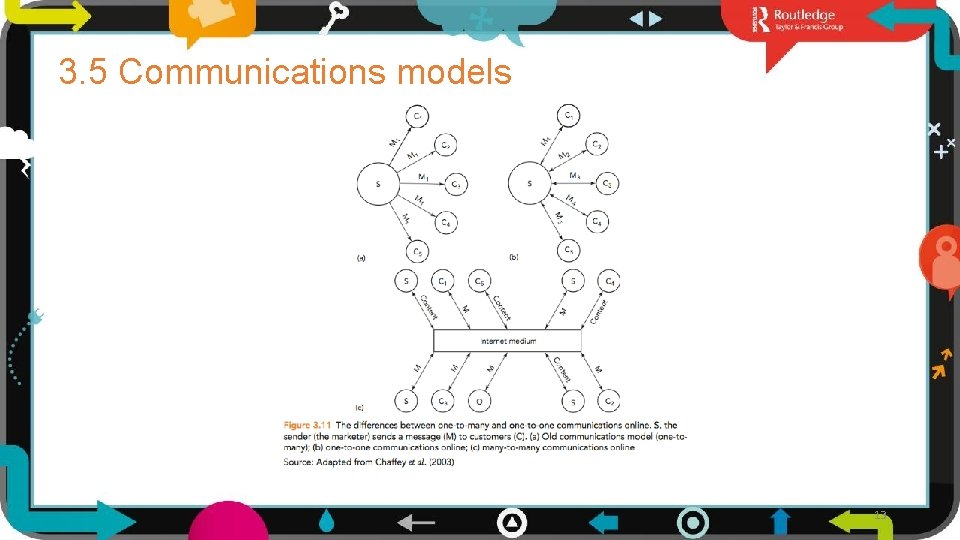
3. 5 Communications models Mass communications model S Sender Former models S Sender S S C Customer (mass audience) OL Opinion Leader OL C Customer (mass audience) C C 11

3. 5 Communications models Affiliate marketing also spreads awareness of a brand amongst a community of relevant customers, who in turn talk to each other and can spread ordinary or clever viral messages within their own communities. Figure 3. 10 A web of conversations – accelerating word of mouth (C=Customer; OL=Opinion Leader) 60
3. 5 Communications models 13
3. 6 Customer information processing models ALEA model Rossiter & Bellman (1999) Hofacker’s model (2001) Attention Learning Emotional responses Acceptance 1. 2. 3. 4. 5. - Sustained attention is related to the evaluative intensity of the consumer’s emotional response to a content node encountered during a visit to a web ad. - Brand attitude is affected by the appropriateness of the sequence of emotions encountered during a visit to an online ad and by the appropriateness of the final emotion experienced. Exposure Attention Comprehension and perception Yielding and acceptance Retention 14
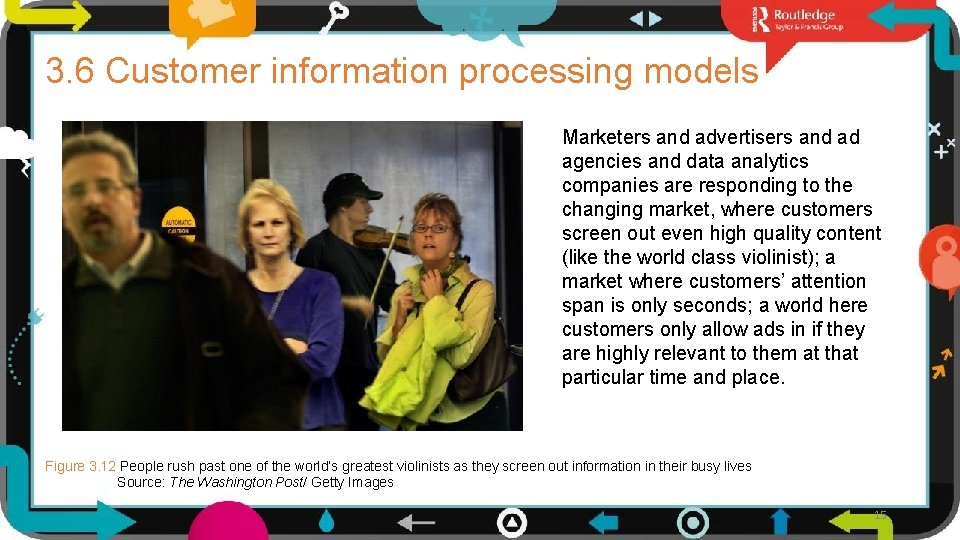
3. 6 Customer information processing models Marketers and advertisers and ad agencies and data analytics companies are responding to the changing market, where customers screen out even high quality content (like the world class violinist); a market where customers’ attention span is only seconds; a world here customers only allow ads in if they are highly relevant to them at that particular time and place. Figure 3. 12 People rush past one of the world’s greatest violinists as they screen out information in their busy lives Source: The Washington Post/ Getty Images 15
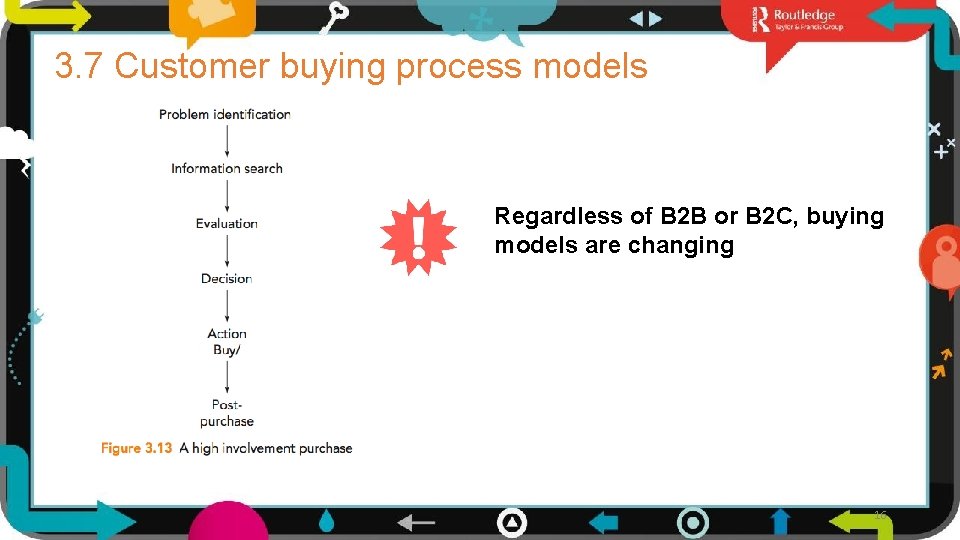
3. 7 Customer buying process models Regardless of B 2 B or B 2 C, buying models are changing 16
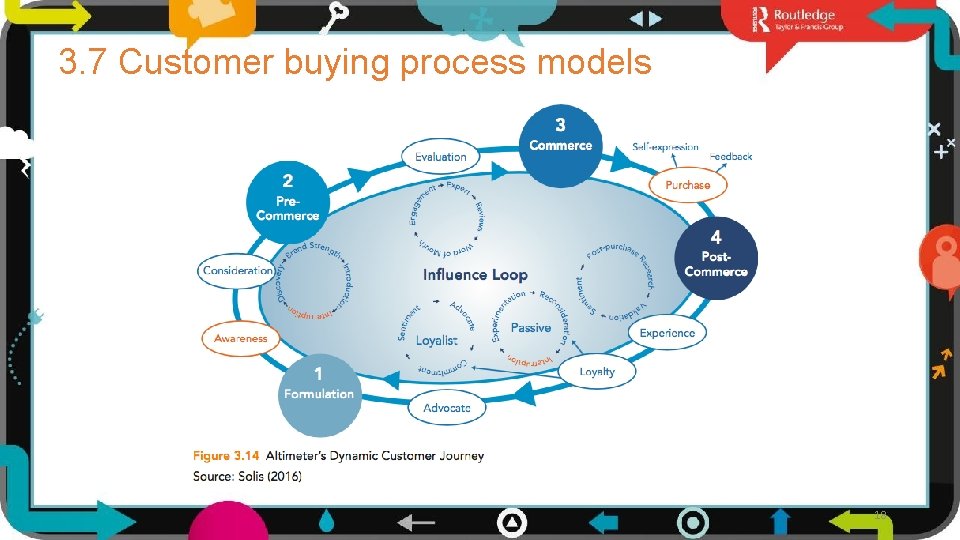
3. 7 Customer buying process models The ‘Butterfly Effect’ is emerging where buyers dip in and out of the buying process. The whole process has become a Dynamic Customer Journey. 17
3. 7 Customer buying process models 18
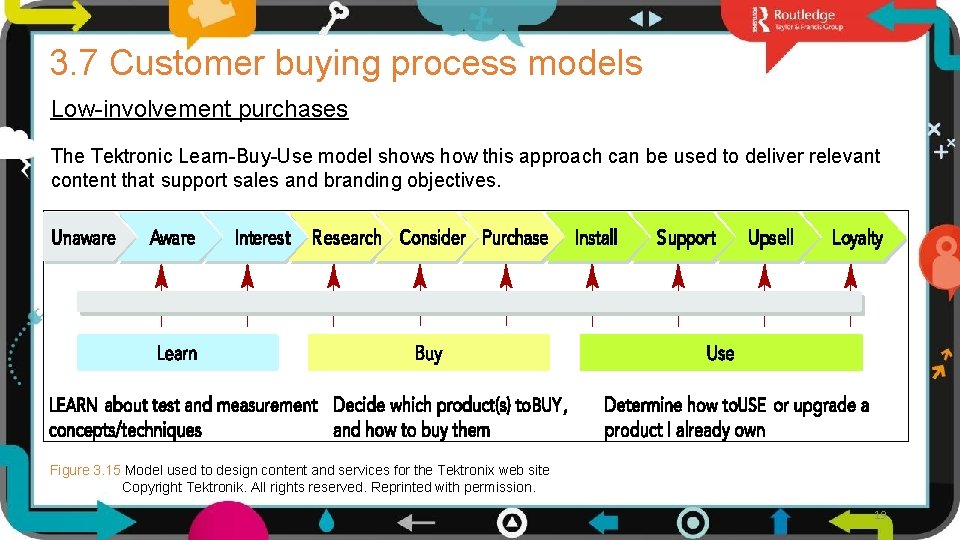
3. 7 Customer buying process models Low-involvement purchases The Tektronic Learn-Buy-Use model shows how this approach can be used to deliver relevant content that support sales and branding objectives. Figure 3. 15 Model used to design content and services for the Tektronix web site Copyright Tektronik. All rights reserved. Reprinted with permission. 19
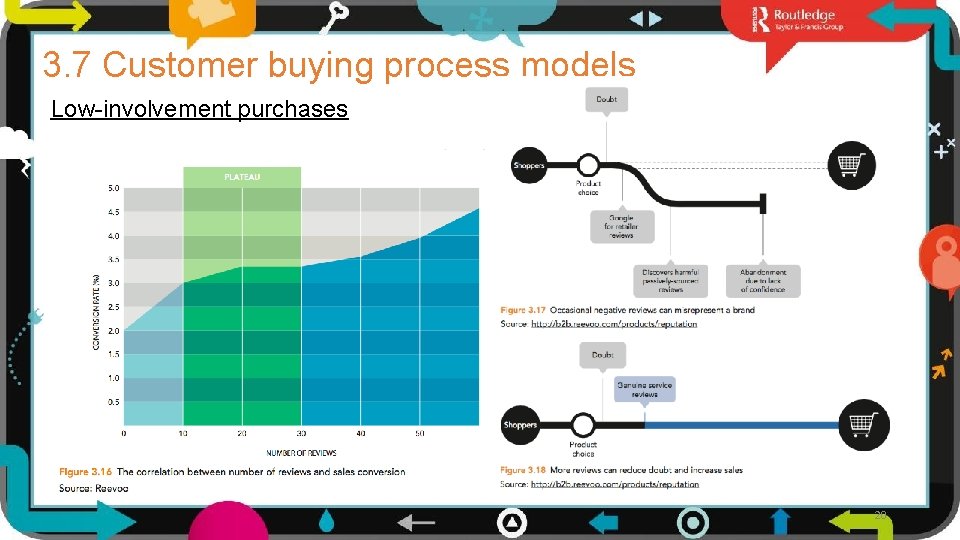
3. 7 Customer buying process models Low-involvement purchases Reviews bump up conversions 20
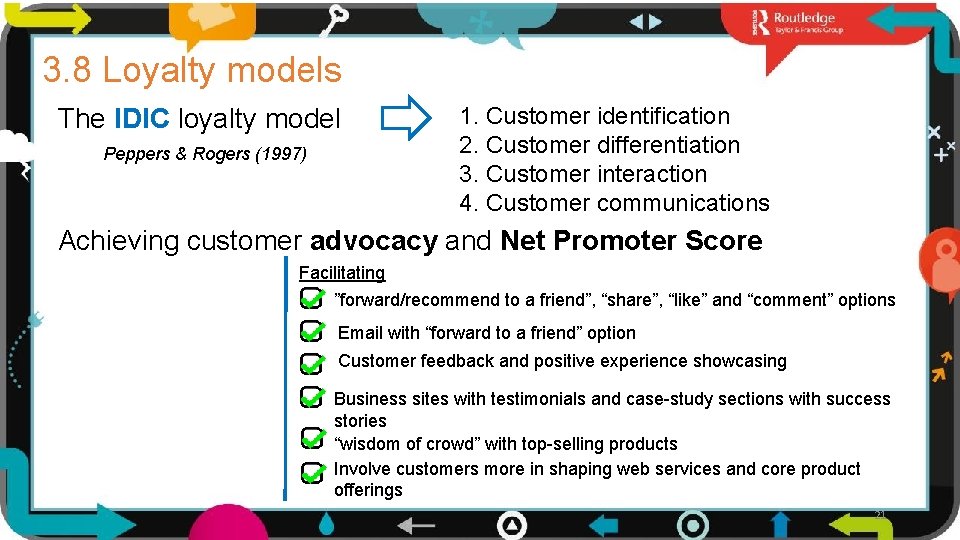
3. 8 Loyalty models The IDIC loyalty model Peppers & Rogers (1997) 1. Customer identification 2. Customer differentiation 3. Customer interaction 4. Customer communications Achieving customer advocacy and Net Promoter Score Facilitating ”forward/recommend to a friend”, “share”, “like” and “comment” options Email with “forward to a friend” option Customer feedback and positive experience showcasing Business sites with testimonials and case-study sections with success stories “wisdom of crowd” with top-selling products Involve customers more in shaping web services and core product offerings 21
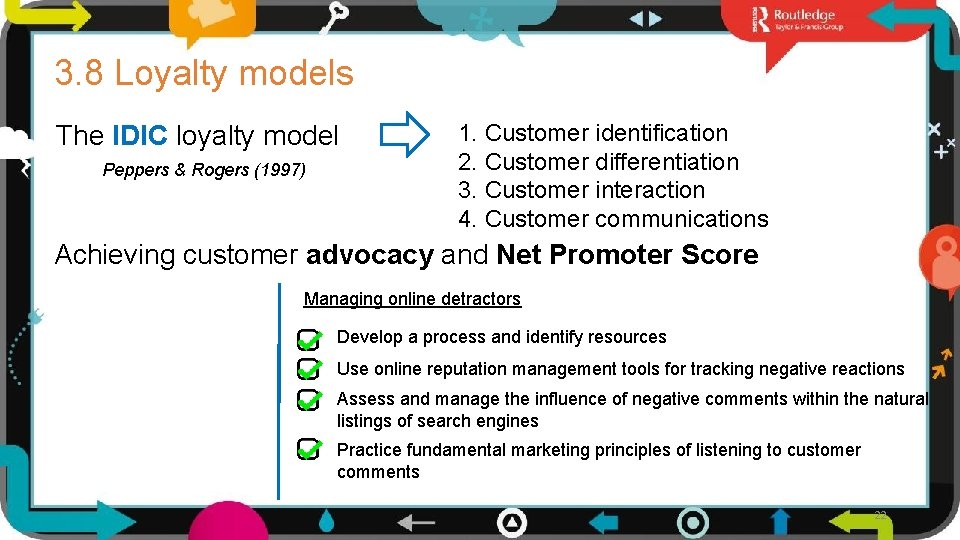
3. 8 Loyalty models The IDIC loyalty model Peppers & Rogers (1997) 1. Customer identification 2. Customer differentiation 3. Customer interaction 4. Customer communications Achieving customer advocacy and Net Promoter Score Managing online detractors Develop a process and identify resources Use online reputation management tools for tracking negative reactions Assess and manage the influence of negative comments within the natural listings of search engines Practice fundamental marketing principles of listening to customer comments 22
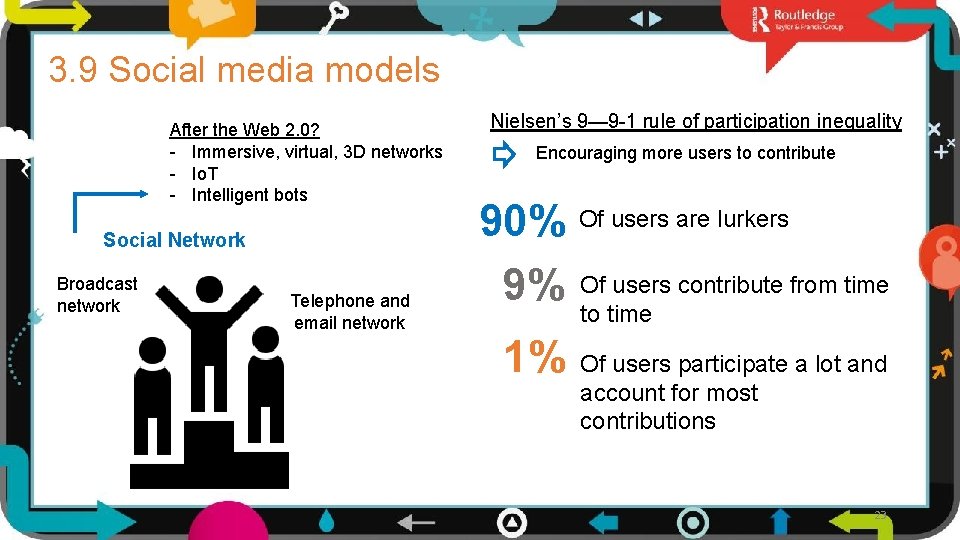
3. 9 Social media models After the Web 2. 0? - Immersive, virtual, 3 D networks - Io. T - Intelligent bots Social Network Broadcast network Telephone and email network Nielsen’s 9— 9 -1 rule of participation inequality Encouraging more users to contribute 90% Of users are lurkers users contribute from time 9% Of to time 1% Of users participate a lot and account for most contributions 23
3. 9 Social media models Guidelines for advertisers in social networks (Microsoft) After the Web 2. 0? - Immersive, virtual, 3 D networks 1. Understand consumer’s motivations for - Io. T using social networks - Intelligent bots 2. Express yourself as a brand 3. Create and maintain good conversations Social Network 4. Empower participants 5. Identify online brand advocates Broadcast Telephone and network The golden rule: behave like a social networker email network • Be creative • Be honest and courteous • Be individual • Be conscious of the audience • Update regularly 24
3. 9 Social media models Metcalfe’s law Refers to the power of an interconnected network to enable collaboration and extend the reach of an organisation Social media models Where communities are created as part of a business proposition, the law shows the importance of supporting the growth of the network through the difficult initial phase until a ’critical mass’ of participants is achieved 25
3. 10 Social business models and the Ladder of Engagement • Customer engagement created stronger brands and more advocates • Identifying engaged customers is important Moving customers up the Ladder of Engagement creates brand loyalty, unleashes brand zealots, and can help improve an organization’s processes, products and services. 26
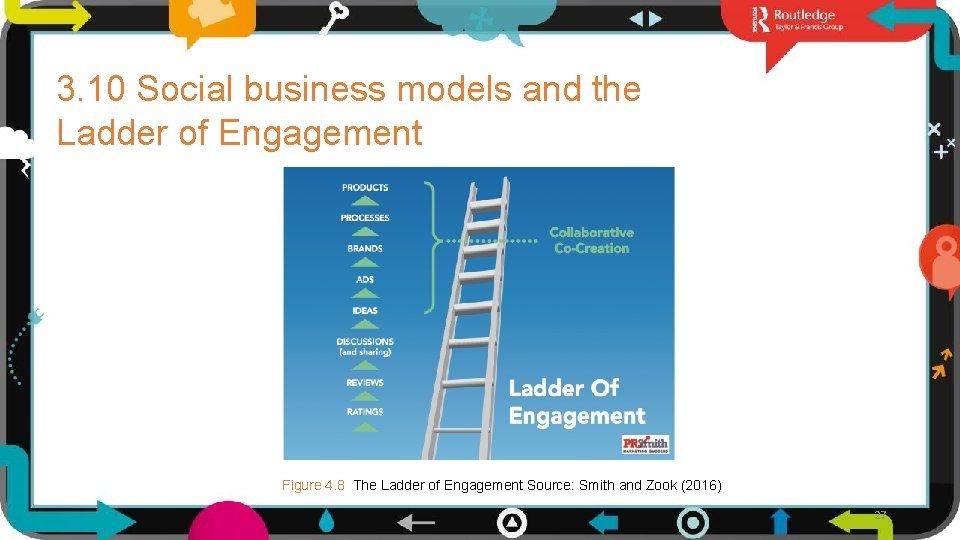
3. 10 Social business models and the Ladder of Engagement Figure 4. 8 The Ladder of Engagement Source: Smith and Zook (2016) 27
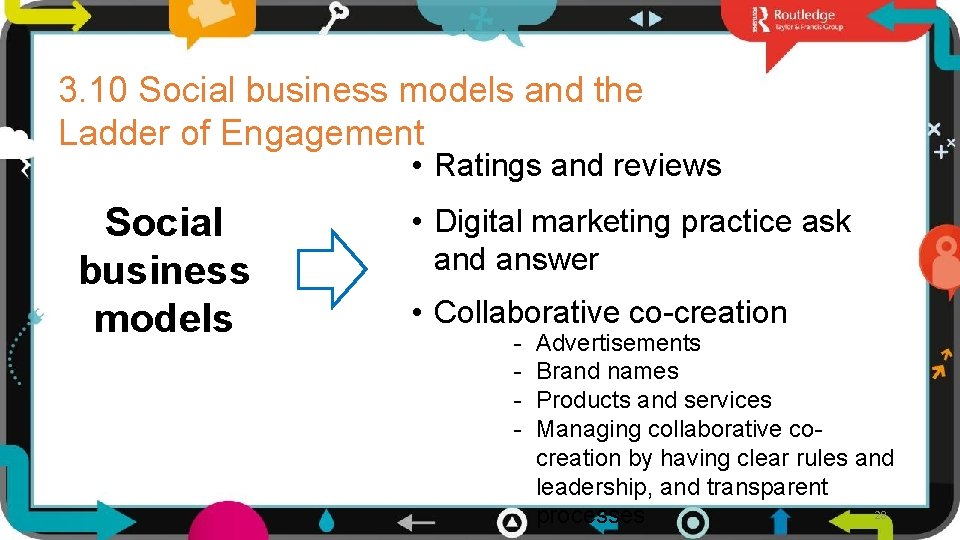
3. 10 Social business models and the Ladder of Engagement • Ratings and reviews Social business models • Digital marketing practice ask and answer • Collaborative co-creation - Advertisements Brand names Products and services Managing collaborative cocreation by having clear rules and leadership, and transparent 28 processes
Chapter summary • Models describe the process by which business is conducted between an organization, its customers, suppliers, distributors and other stakeholders. • Online revenue models include CPM and fixed sponsorships, CPC models and CPA affiliate models. Ads can also be displayed as part of a network. • Online marketplace analysis helps understand customer behaviour to identify search terms to promote companies, partner sites and media buys. • New attribution models ensure that online media spend is allocated to media which are influencing sales. • Communications models have enabled a change from many-to-one, to many-to-some and to one-to-one communication. • Buying models can accommodate the linear process for high-involvement purchases, mixed-method buying and traditional models such as AIDA and low-involvement ATR. • A quality product, service and web site are basic prerequisites to build customer loyalty. The role of the web in advocacy and negative mentions should be assessed and monitored. • The introduction of social media has massively changed business models. • The Ladder of Engagement model demonstrates how selected customers can become more engaged with a brand ultimately how this can create a whole new business model. Social business models are next as employees are empowered to utilize social media. 29
- Slides: 29