
Chapter 3 Differentiation 1 3 1 The Derivative















- Slides: 132
Chapter 3 Differentiation 1
3. 1 The Derivative as a Function 2
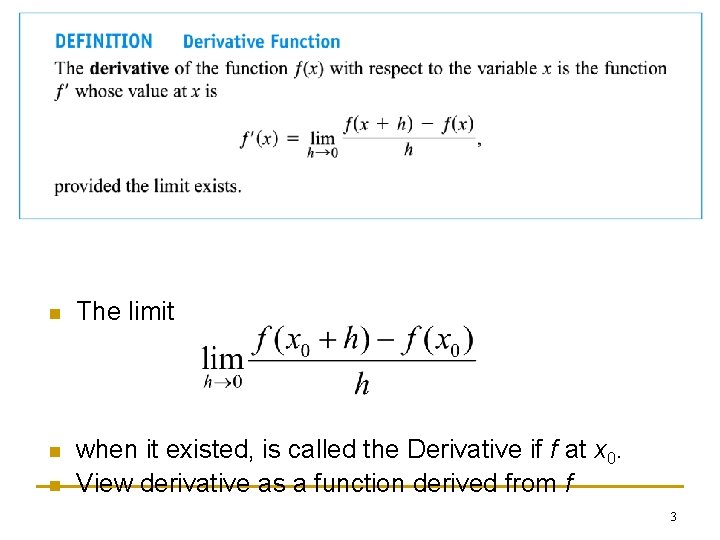
n The limit n when it existed, is called the Derivative if f at x 0. View derivative as a function derived from f n 3
n n If f ' exists at x, f is said to be differentiable (has a derivative) at x If f ' exists at every point in the domain of f, f is said to be differentiable. 4
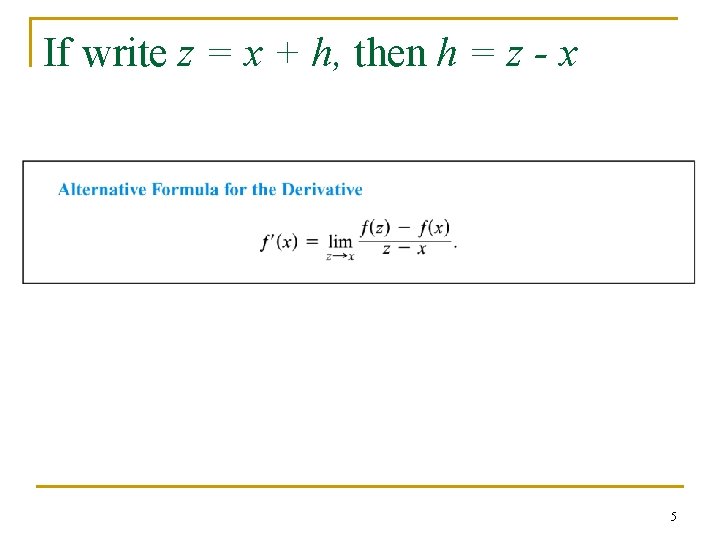
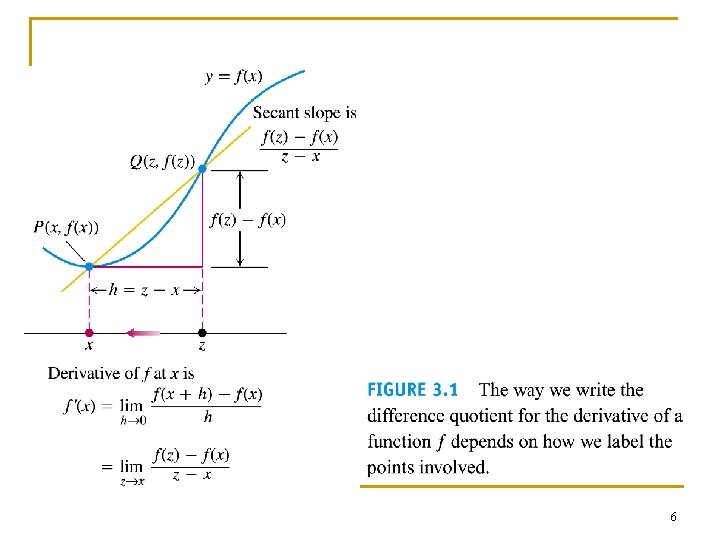
If write z = x + h, then h = z - x 5
6
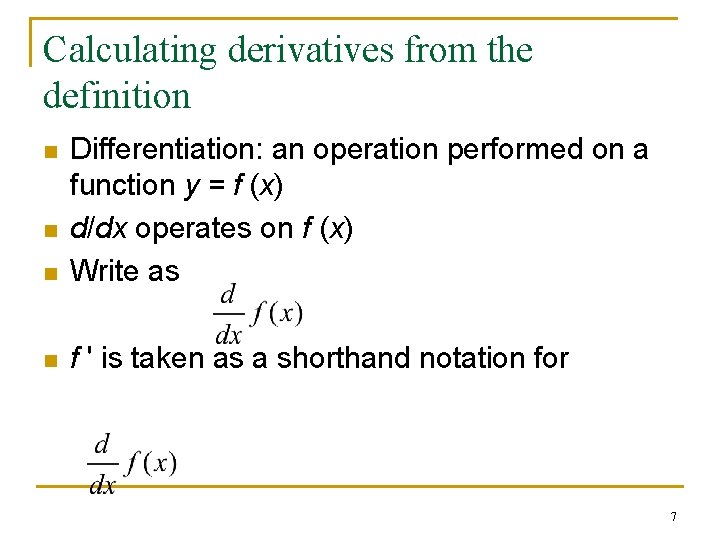
Calculating derivatives from the definition n Differentiation: an operation performed on a function y = f (x) d/dx operates on f (x) Write as n f ' is taken as a shorthand notation for n n 7
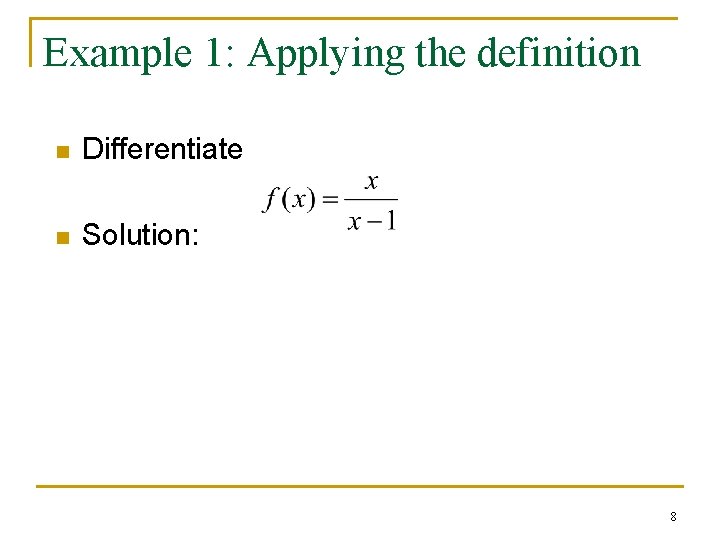
Example 1: Applying the definition n Differentiate n Solution: 8
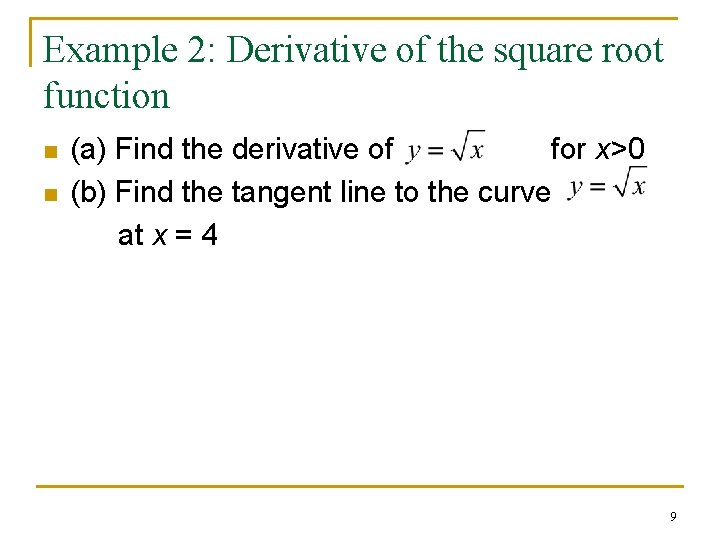
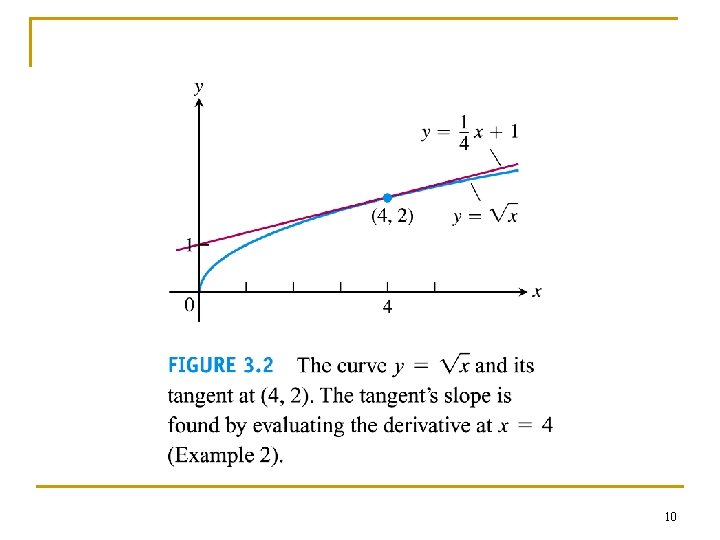
Example 2: Derivative of the square root function n n (a) Find the derivative of for x>0 (b) Find the tangent line to the curve at x = 4 9
10
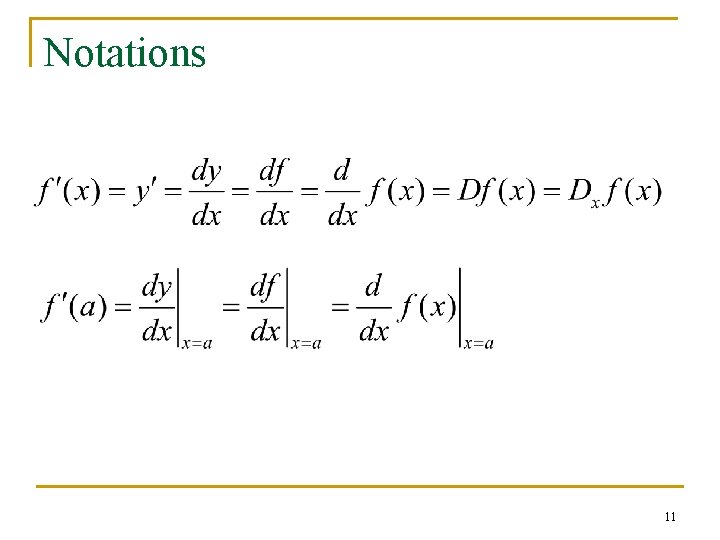
Notations 11
Differentiable on an Interval; One sided derivatives n n A function y = f (x) is differentiable on an open interval (finite or infinite) if it has a derivative at each point of the interval. It is differentiable on a closed interval [a, b] if it is differentiable on the interior (a, b) and if the limits exist at the endpoints 12
n A function has a derivative at a point if an only if it has left-hand right-hand derivatives there, and these one-sided derivatives are equal. 13
14
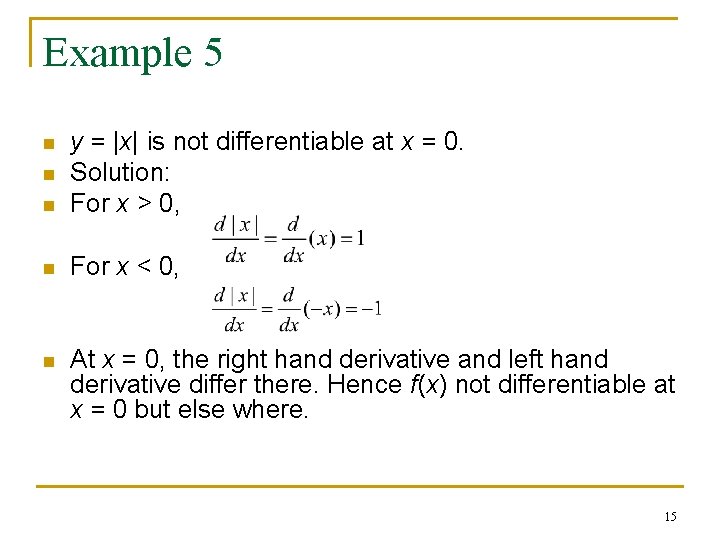
Example 5 n y = |x| is not differentiable at x = 0. Solution: For x > 0, n For x < 0, n At x = 0, the right hand derivative and left hand derivative differ there. Hence f(x) not differentiable at x = 0 but else where. n n 15
16
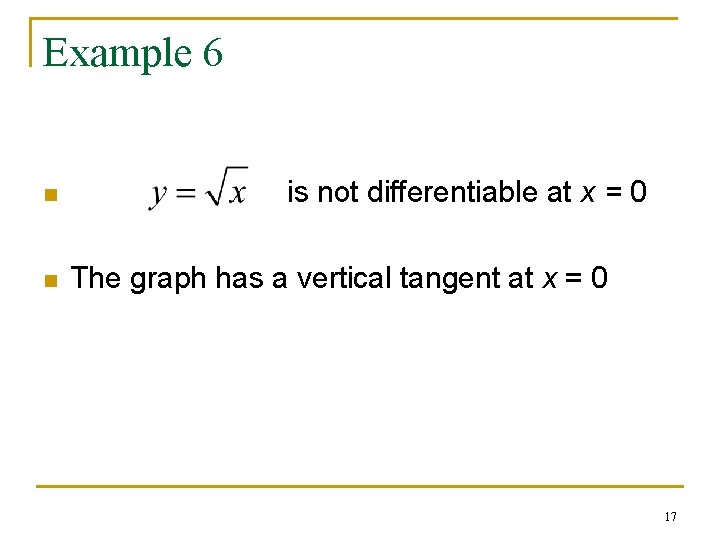
Example 6 n n is not differentiable at x = 0 The graph has a vertical tangent at x = 0 17
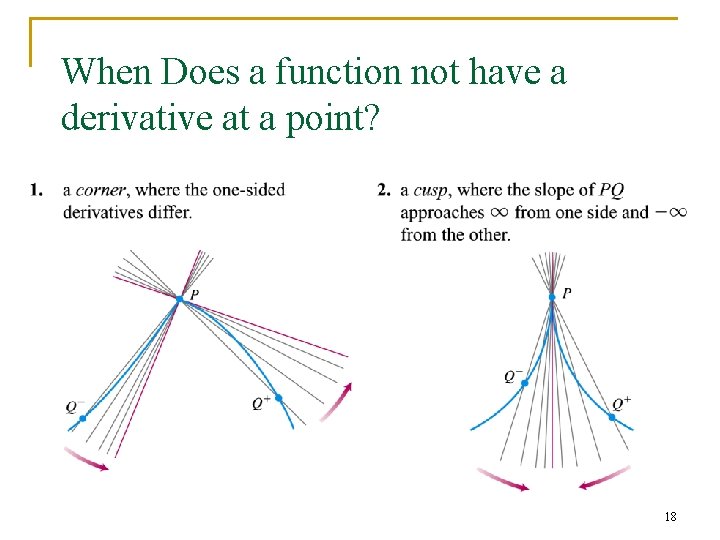
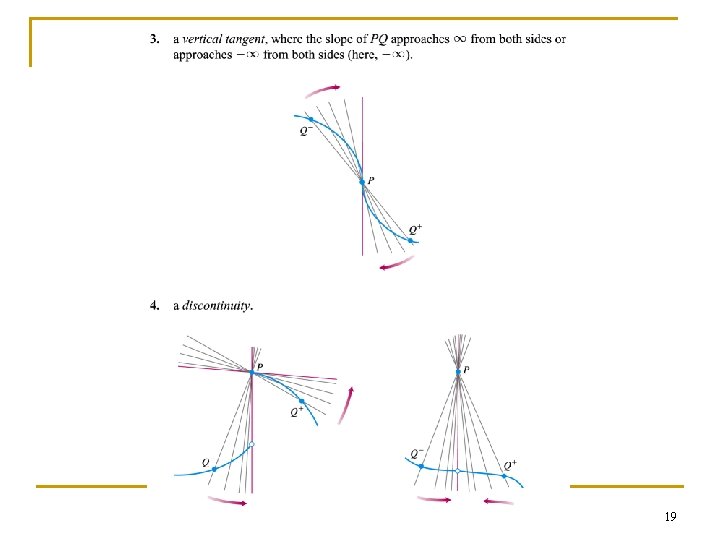
When Does a function not have a derivative at a point? 18
19
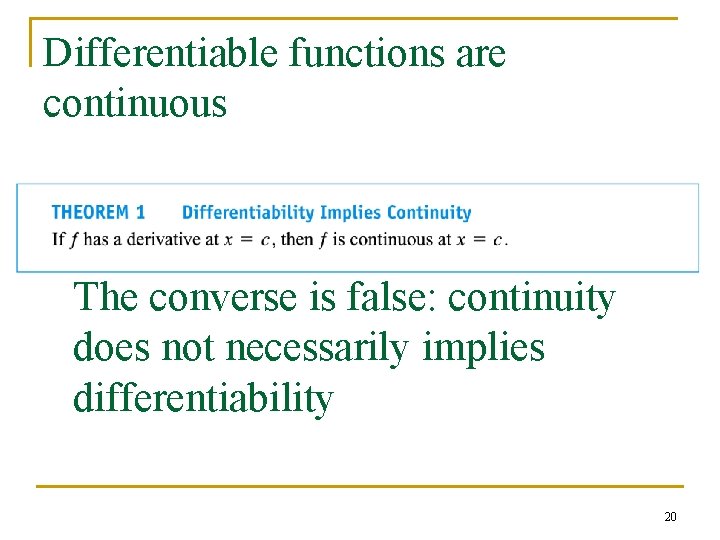
Differentiable functions are continuous The converse is false: continuity does not necessarily implies differentiability 20
Example n y = |x| is continuous everywhere, including x = 0, but it is not differentiable there. 21
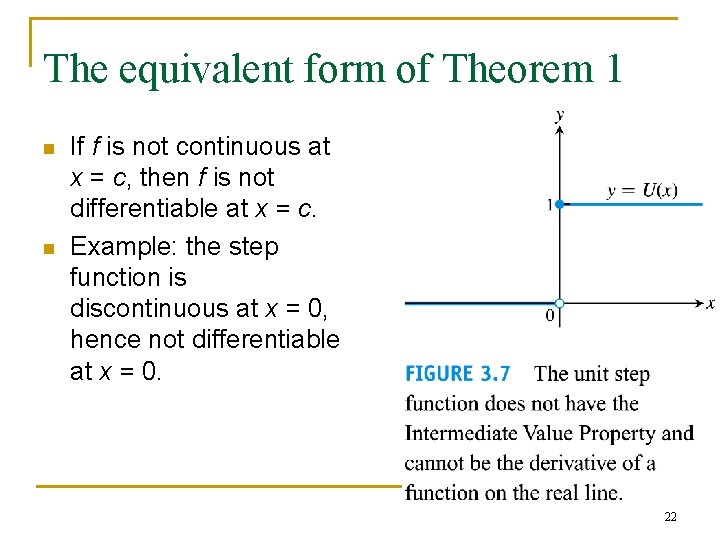
The equivalent form of Theorem 1 n n If f is not continuous at x = c, then f is not differentiable at x = c. Example: the step function is discontinuous at x = 0, hence not differentiable at x = 0. 22
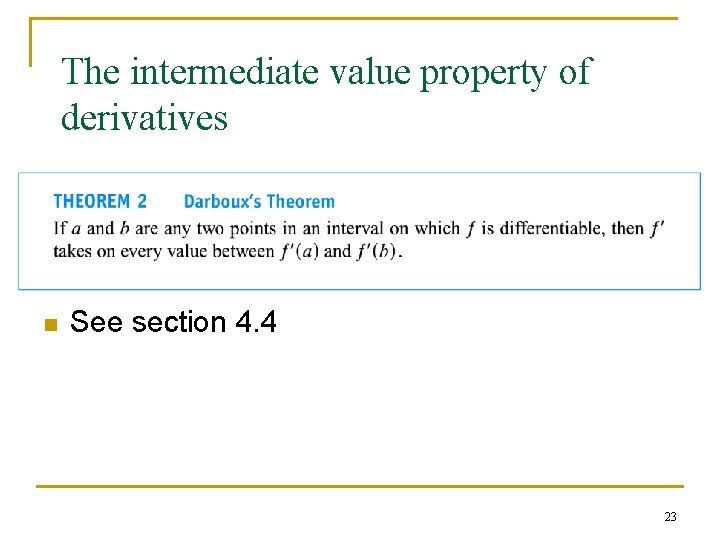
The intermediate value property of derivatives n See section 4. 4 23
3. 2 Differentiation Rules 24
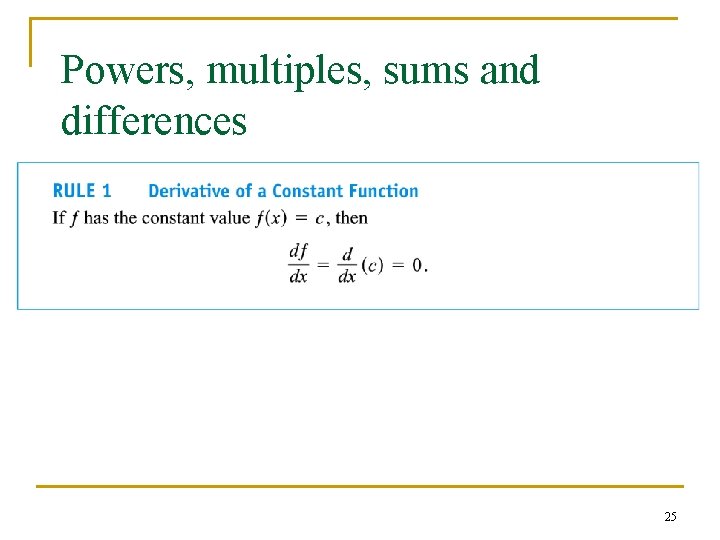
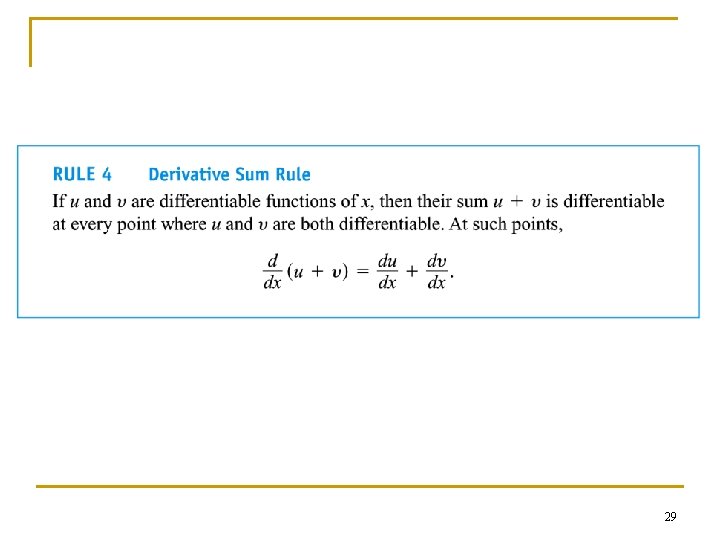
Powers, multiples, sums and differences 25
Example 1 26
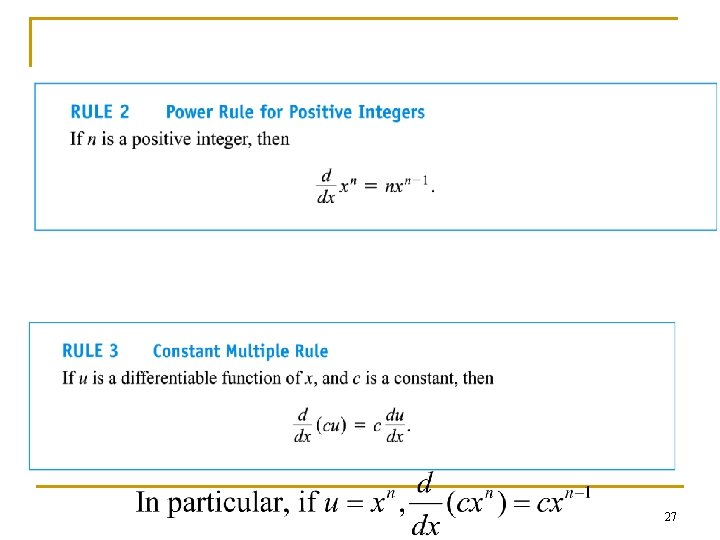
27
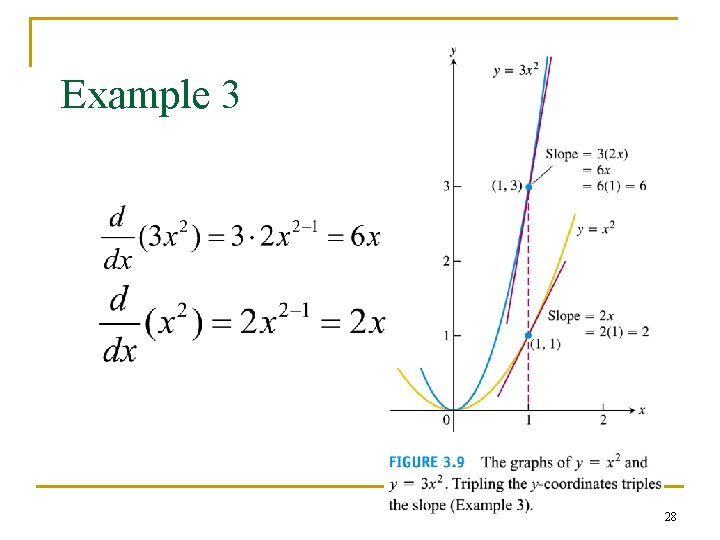
Example 3 28
29
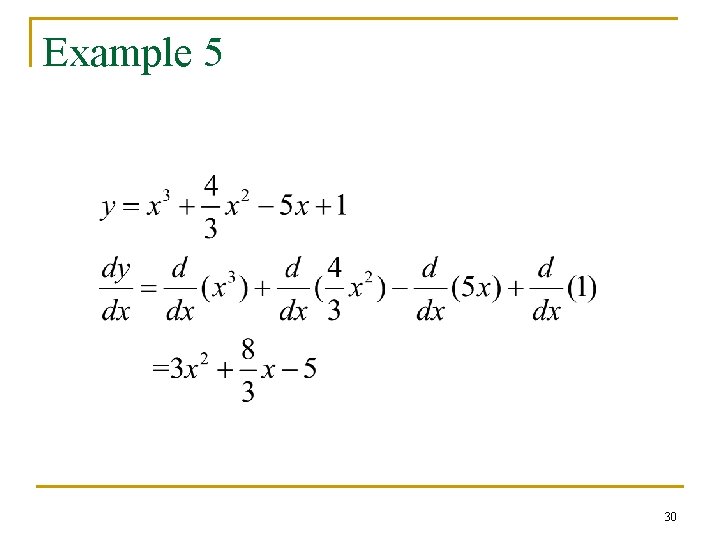
Example 5 30
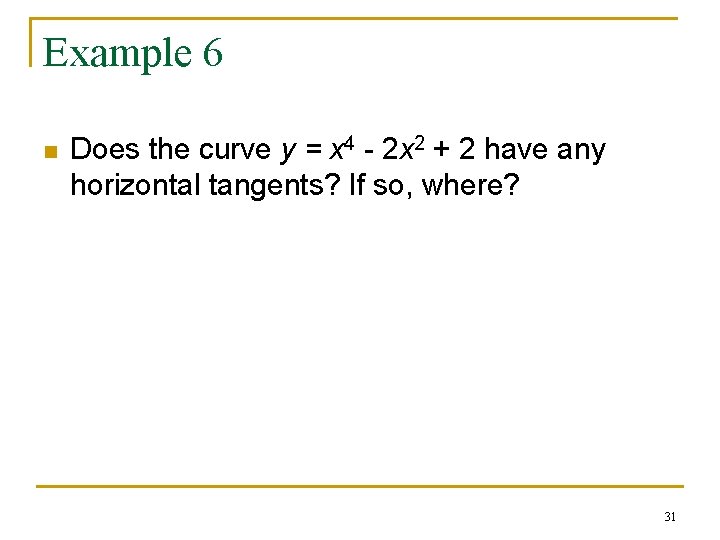
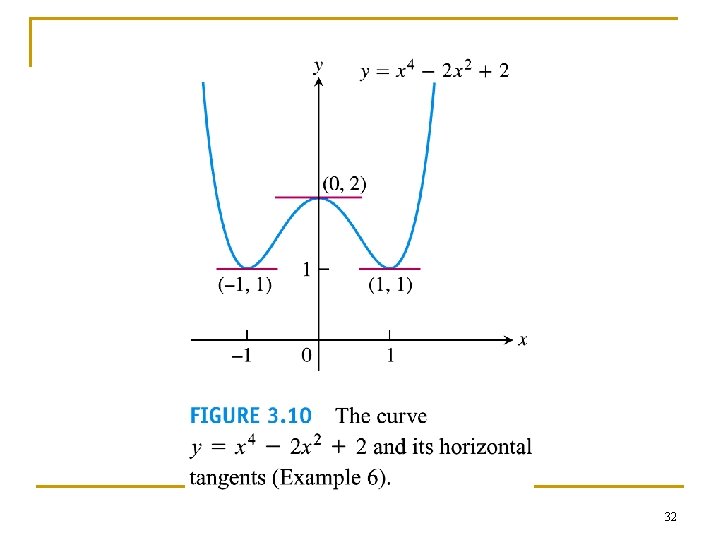
Example 6 n Does the curve y = x 4 - 2 x 2 + 2 have any horizontal tangents? If so, where? 31
32
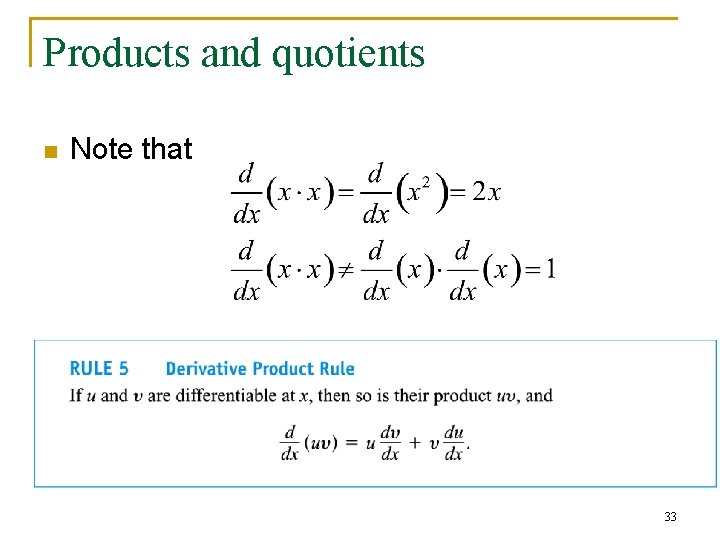
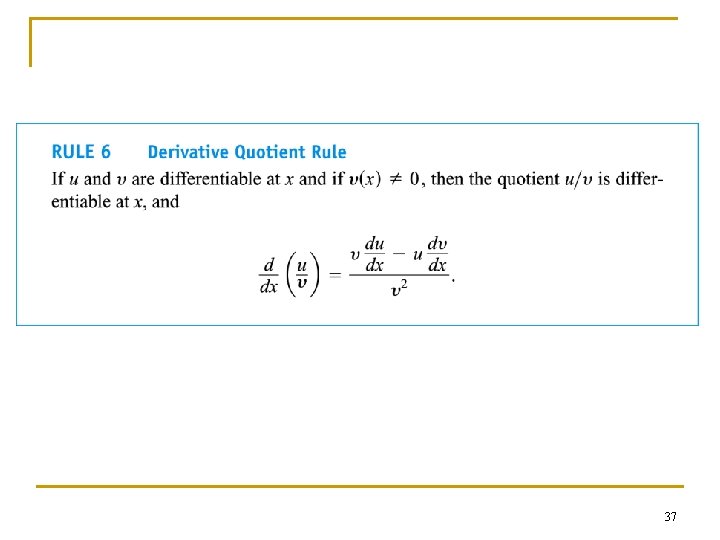
Products and quotients n Note that 33
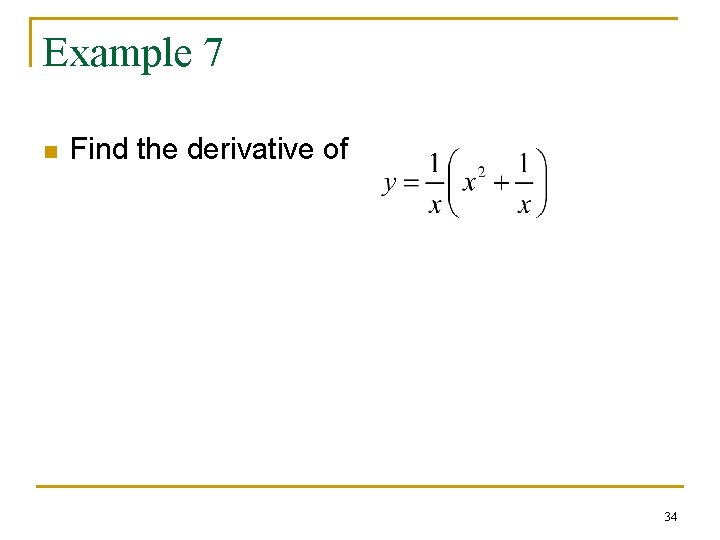
Example 7 n Find the derivative of 34
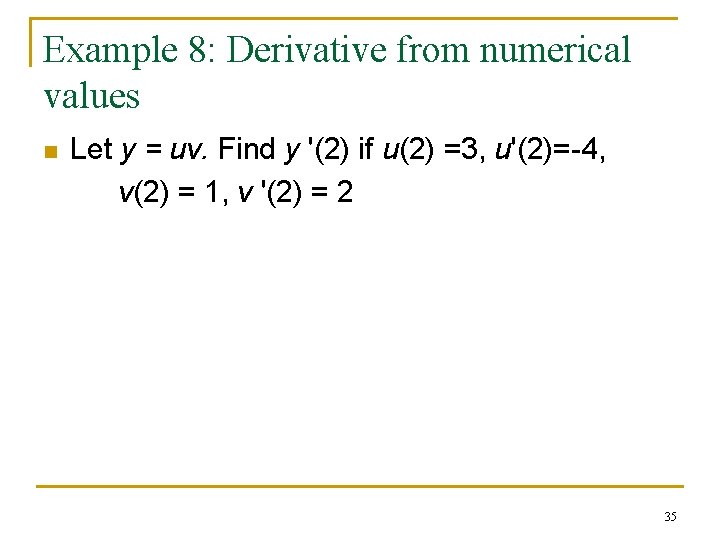
Example 8: Derivative from numerical values n Let y = uv. Find y '(2) if u(2) =3, u'(2)=-4, v(2) = 1, v '(2) = 2 35
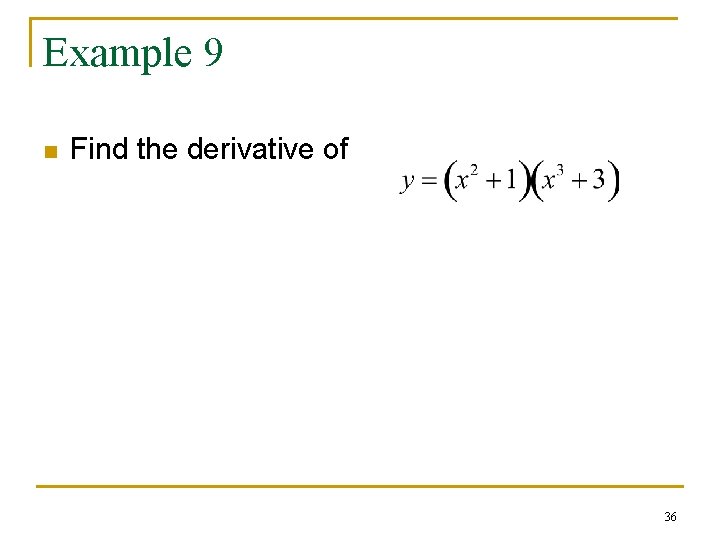
Example 9 n Find the derivative of 36
37
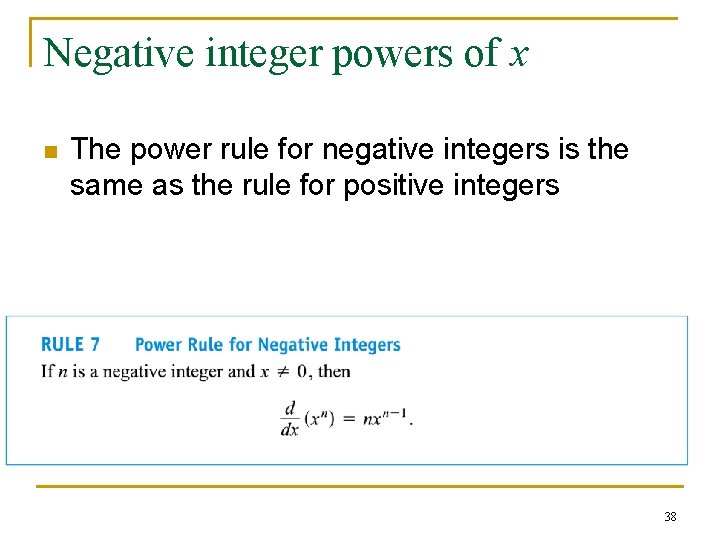
Negative integer powers of x n The power rule for negative integers is the same as the rule for positive integers 38
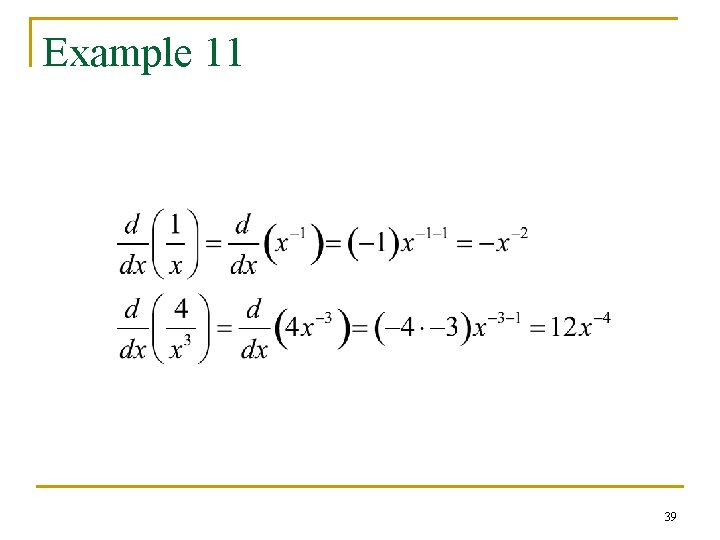
Example 11 39
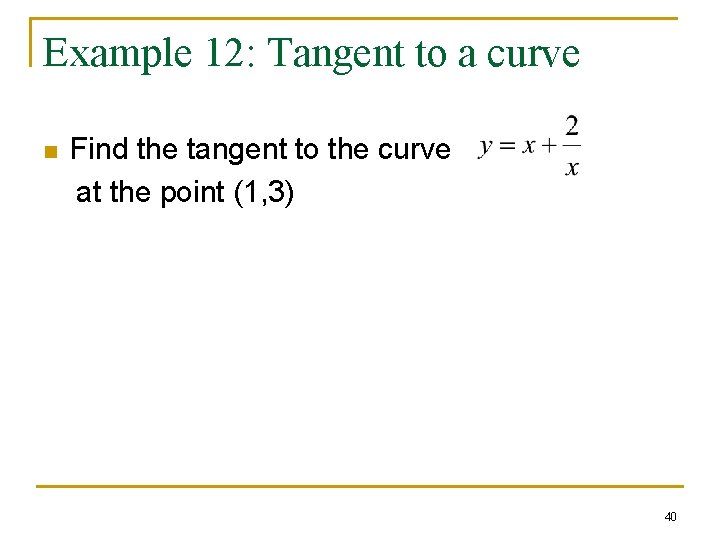
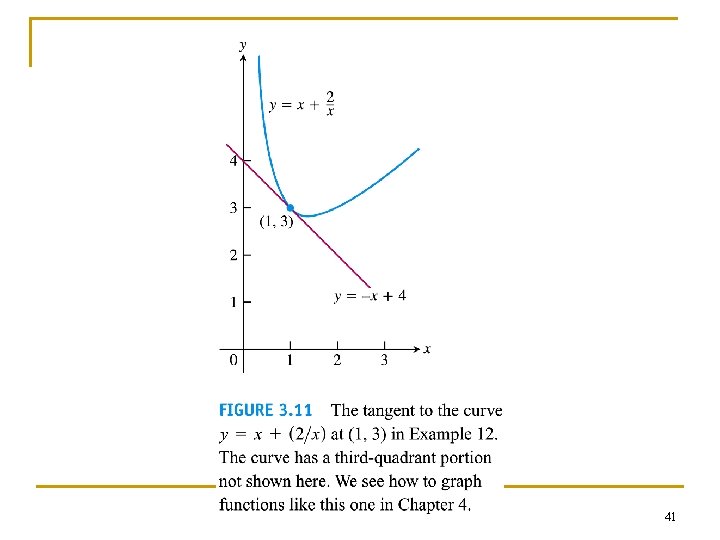
Example 12: Tangent to a curve n Find the tangent to the curve at the point (1, 3) 40
41
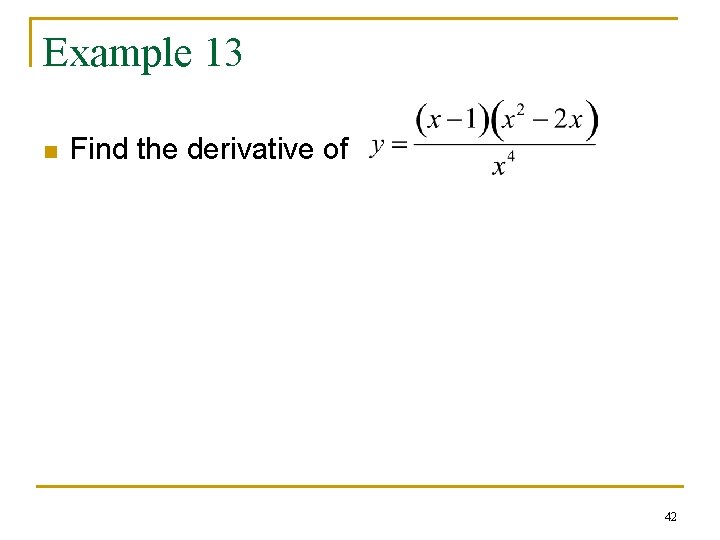
Example 13 n Find the derivative of 42
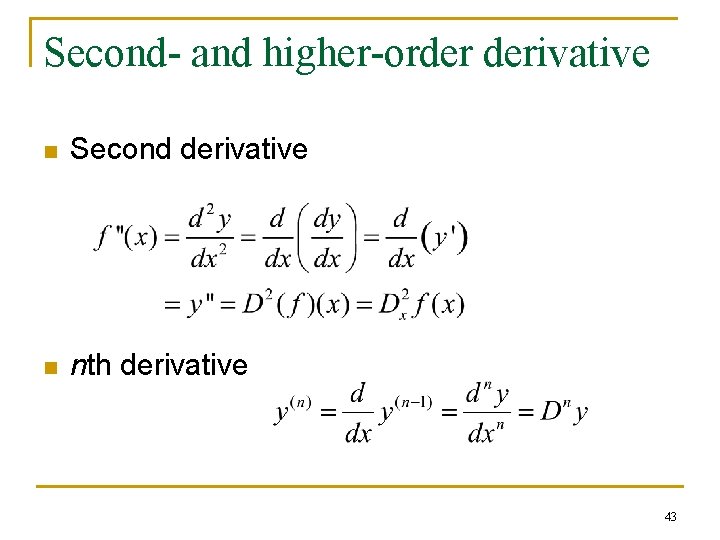
Second- and higher-order derivative n Second derivative n nth derivative 43
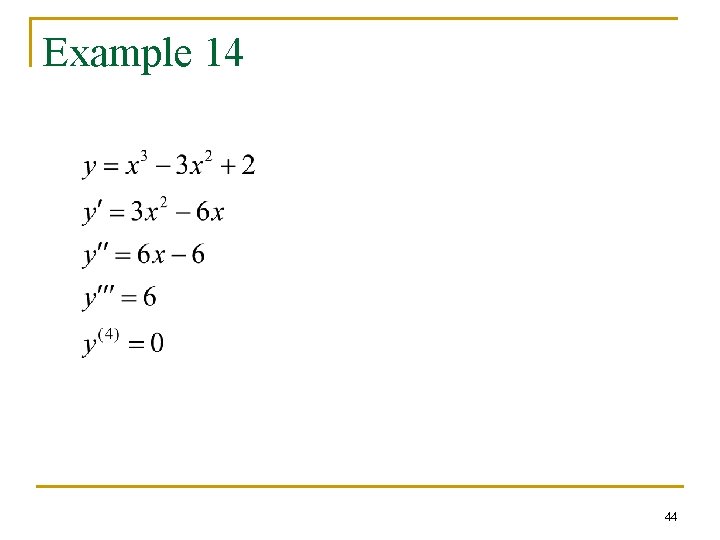
Example 14 44
3. 3 The Derivative as a Rate of Change 45
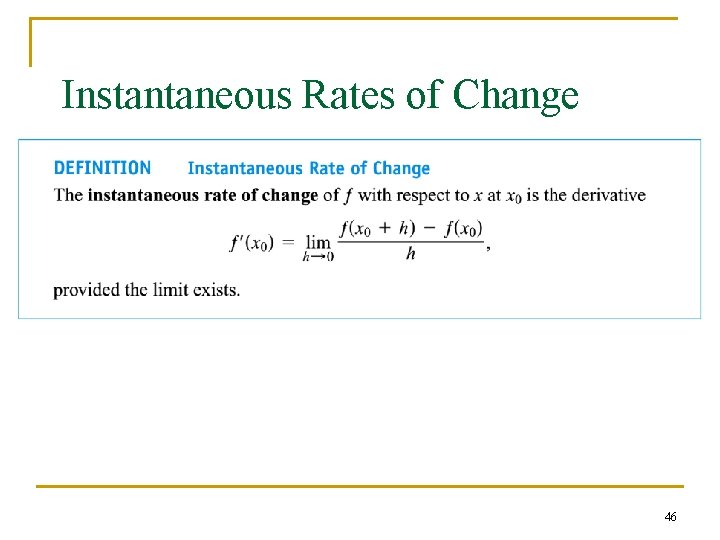
Instantaneous Rates of Change 46
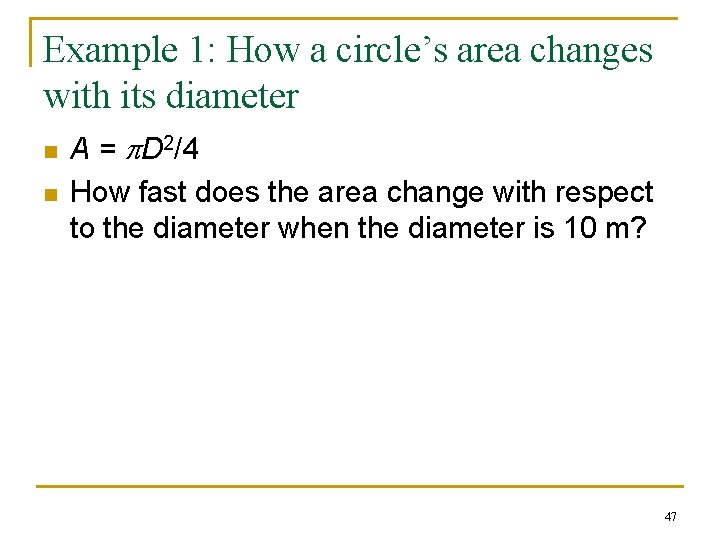
Example 1: How a circle’s area changes with its diameter n n A = p. D 2/4 How fast does the area change with respect to the diameter when the diameter is 10 m? 47
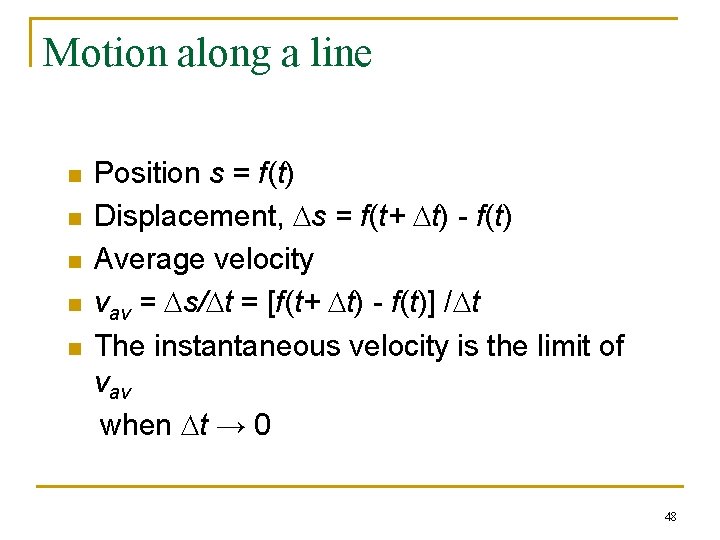
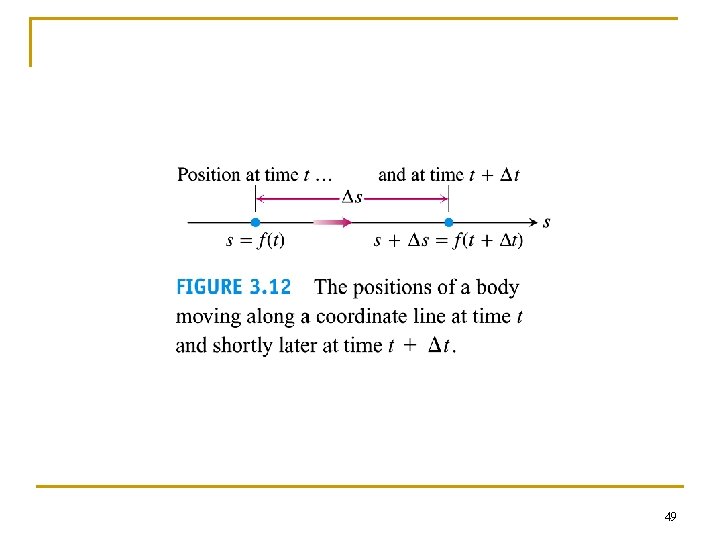
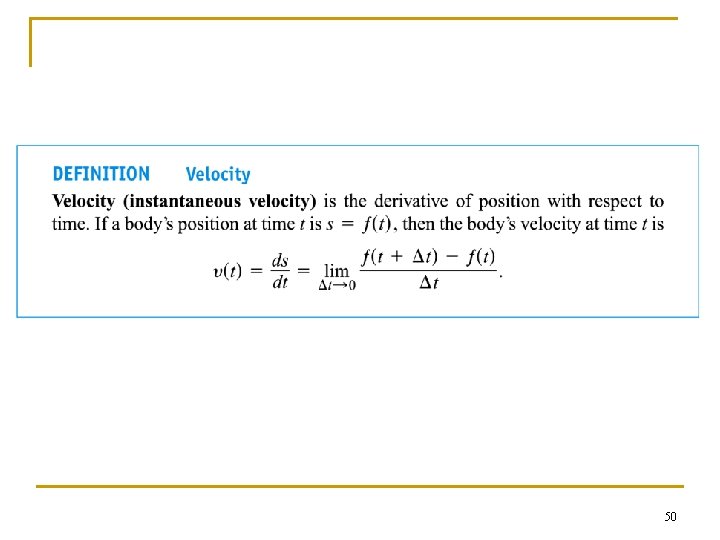
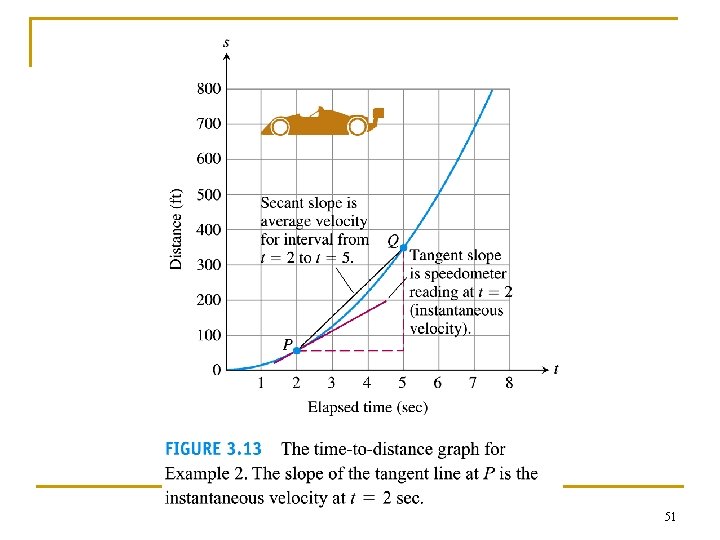
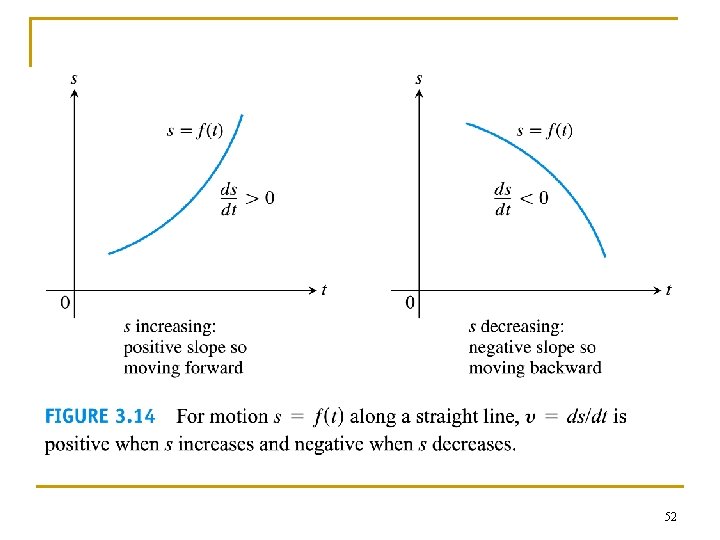
Motion along a line n n n Position s = f(t) Displacement, Ds = f(t+ Dt) - f(t) Average velocity vav = Ds/Dt = [f(t+ Dt) - f(t)] /Dt The instantaneous velocity is the limit of vav when Dt → 0 48
49
50
51
52
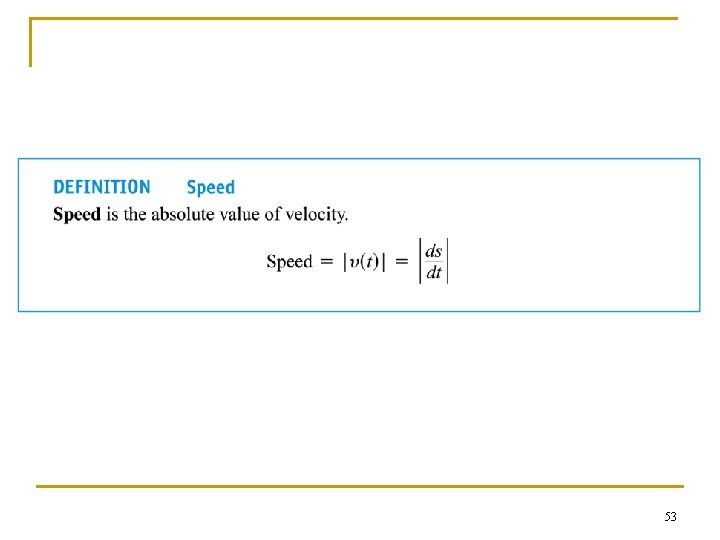
53
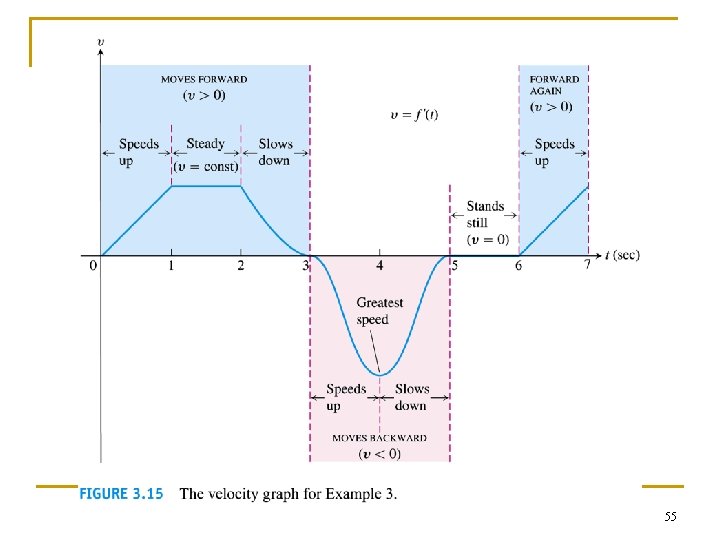
Example 3 n Horizontal motion 54
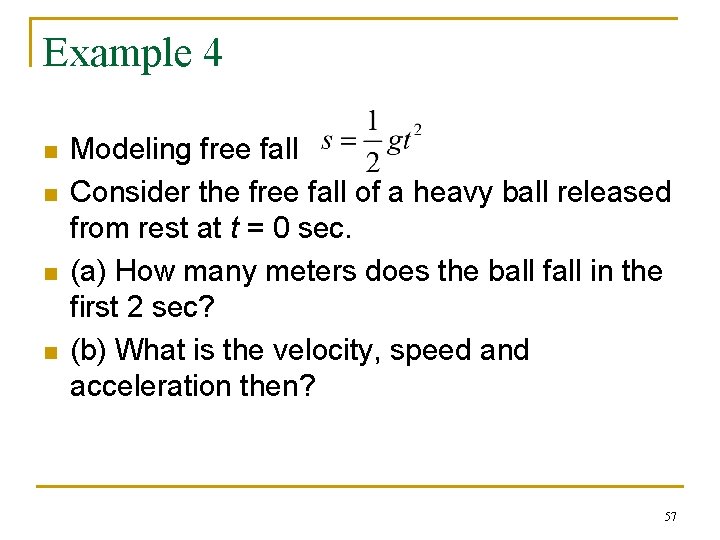
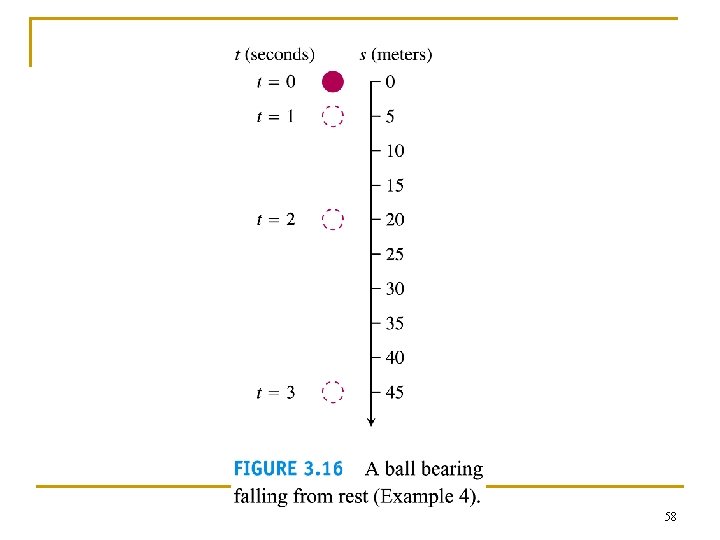
55
56
Example 4 n n Modeling free fall Consider the free fall of a heavy ball released from rest at t = 0 sec. (a) How many meters does the ball fall in the first 2 sec? (b) What is the velocity, speed and acceleration then? 57
58
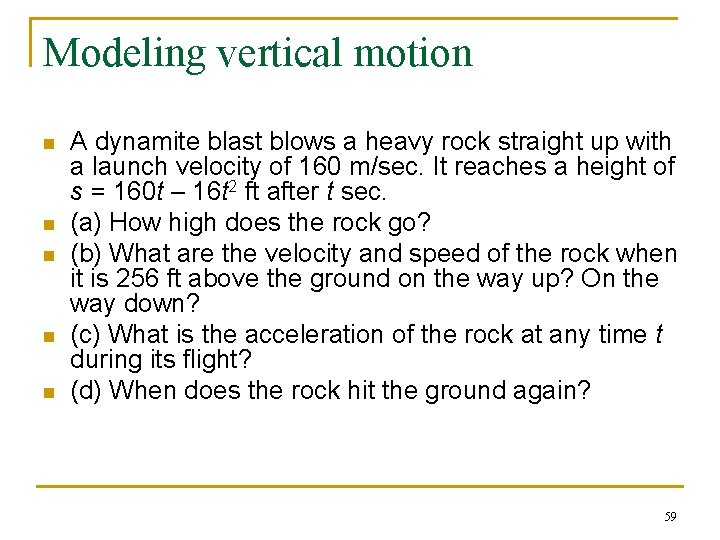
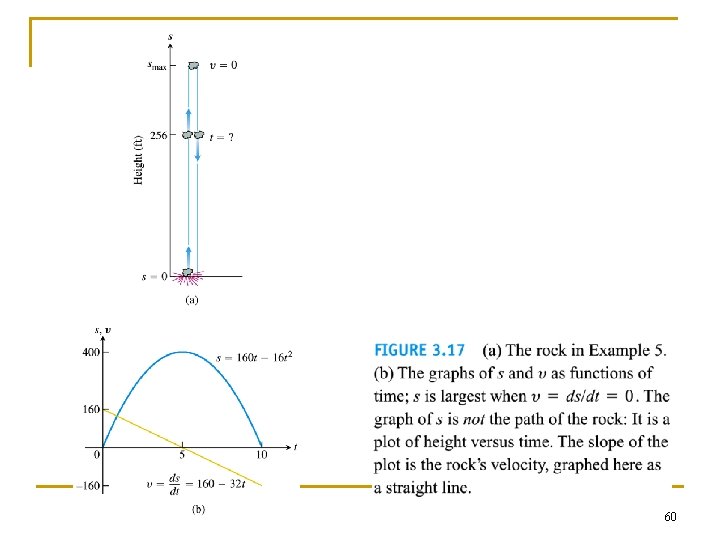
Modeling vertical motion n n A dynamite blast blows a heavy rock straight up with a launch velocity of 160 m/sec. It reaches a height of s = 160 t – 16 t 2 ft after t sec. (a) How high does the rock go? (b) What are the velocity and speed of the rock when it is 256 ft above the ground on the way up? On the way down? (c) What is the acceleration of the rock at any time t during its flight? (d) When does the rock hit the ground again? 59
60
3. 4 Derivatives of Trigonometric Functions 61
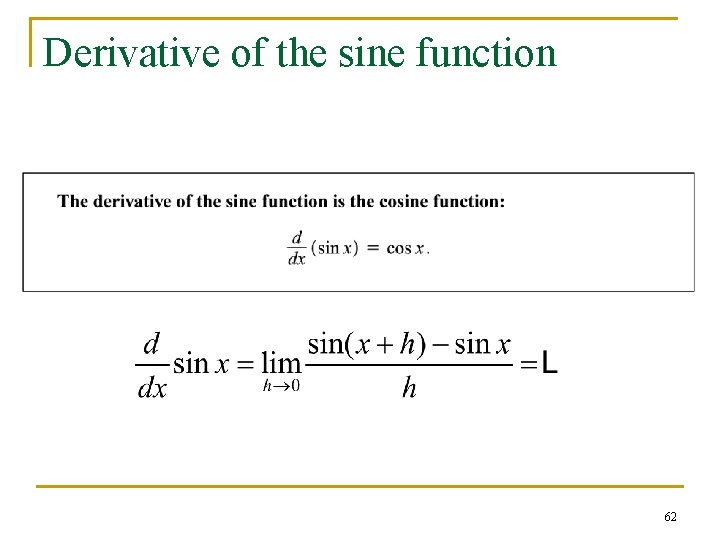
Derivative of the sine function 62
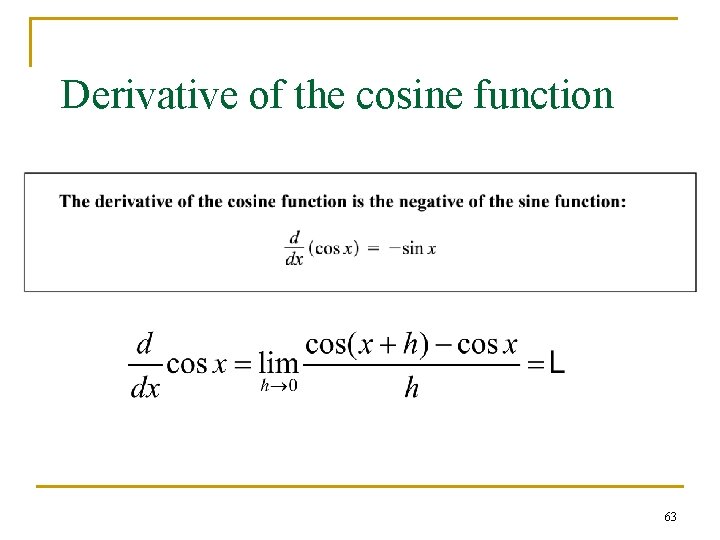
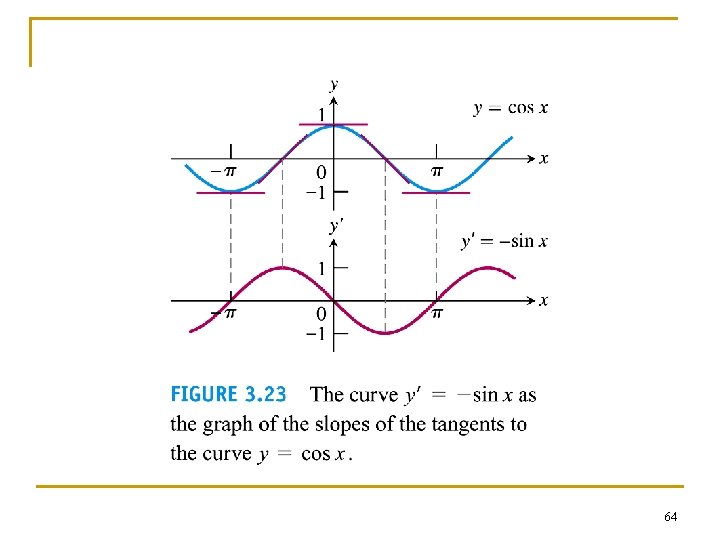
Derivative of the cosine function 63
64
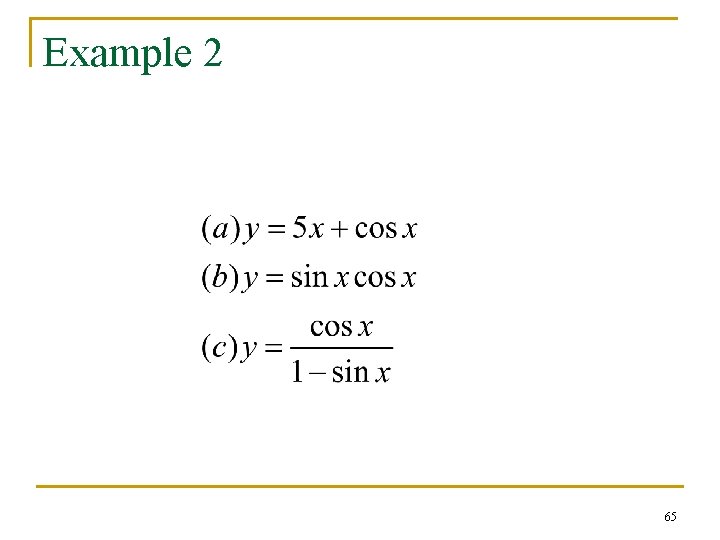
Example 2 65
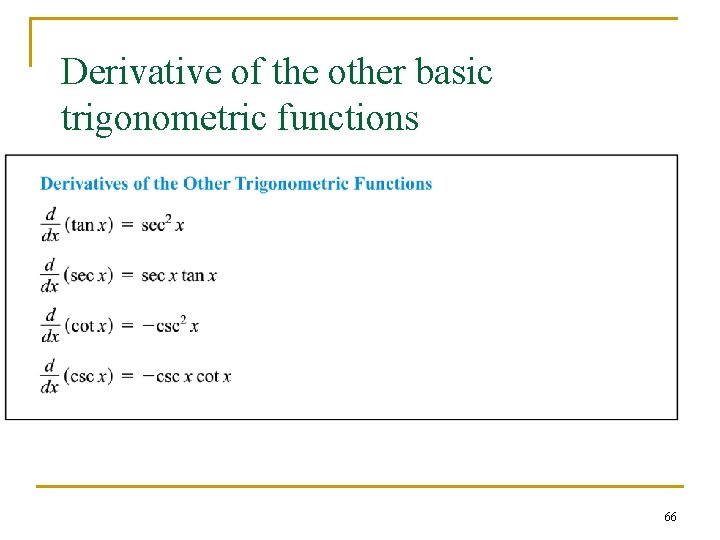
Derivative of the other basic trigonometric functions 66
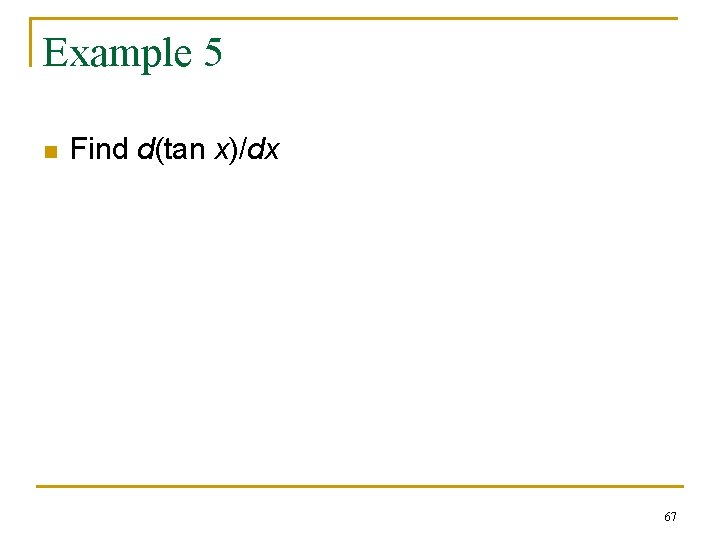
Example 5 n Find d(tan x)/dx 67
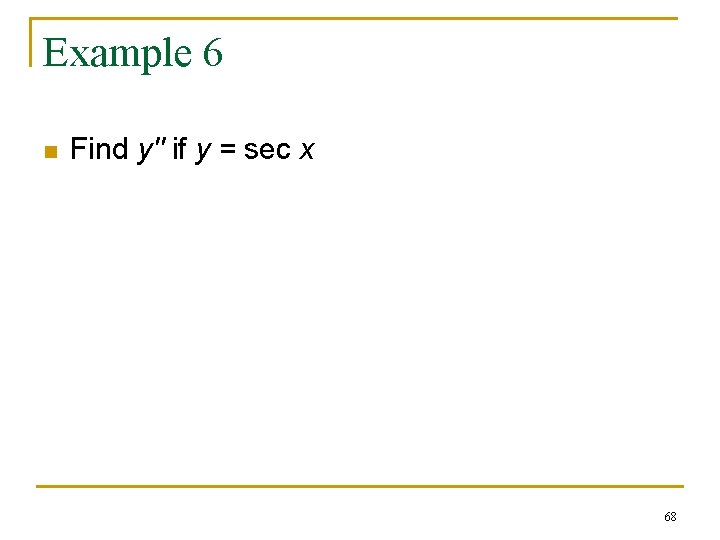
Example 6 n Find y'' if y = sec x 68
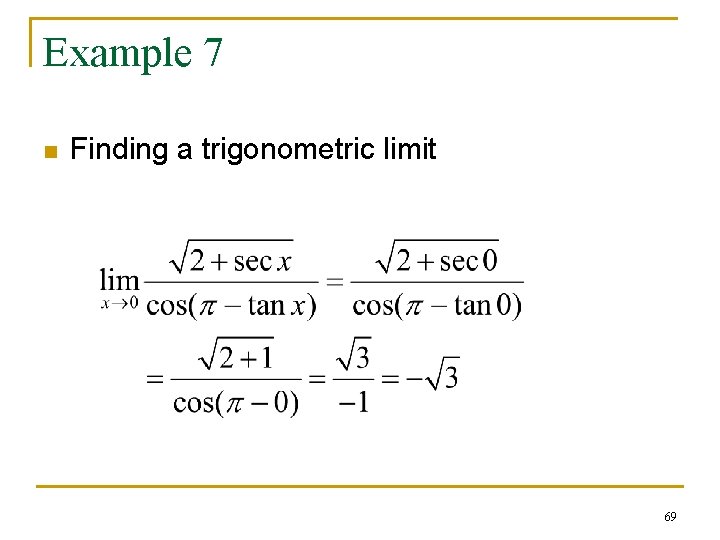
Example 7 n Finding a trigonometric limit 69
3. 5 The Chain Rule and Parametric Equations 70
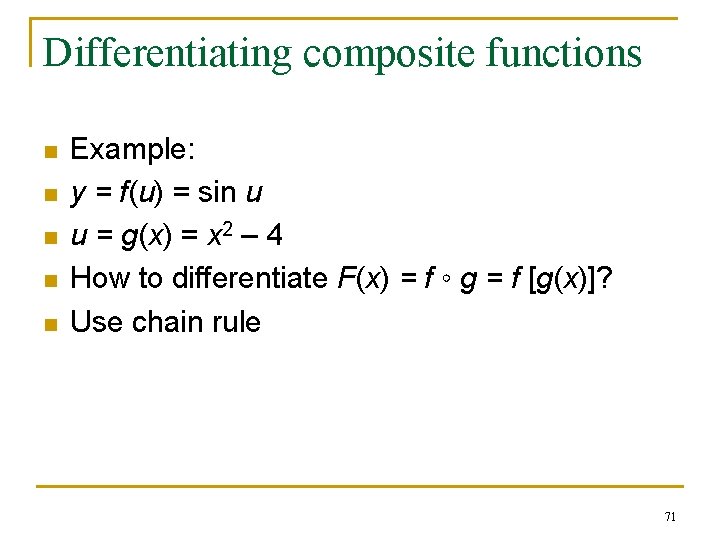
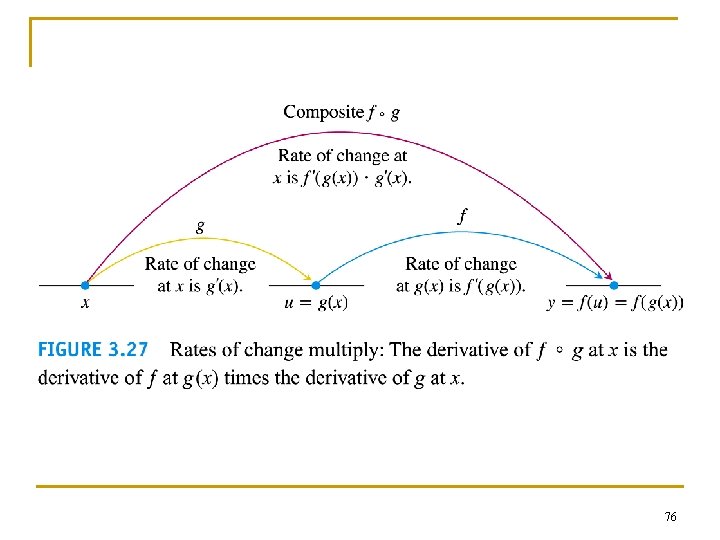
Differentiating composite functions n n n Example: y = f(u) = sin u u = g(x) = x 2 – 4 How to differentiate F(x) = f ◦ g = f [g(x)]? Use chain rule 71
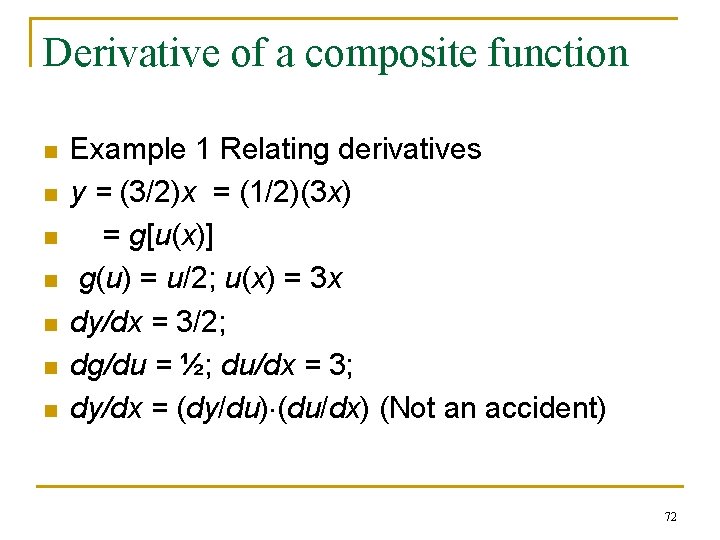
Derivative of a composite function n n n Example 1 Relating derivatives y = (3/2)x = (1/2)(3 x) = g[u(x)] g(u) = u/2; u(x) = 3 x dy/dx = 3/2; dg/du = ½; du/dx = 3; dy/dx = (dy/du) (du/dx) (Not an accident) 72
73
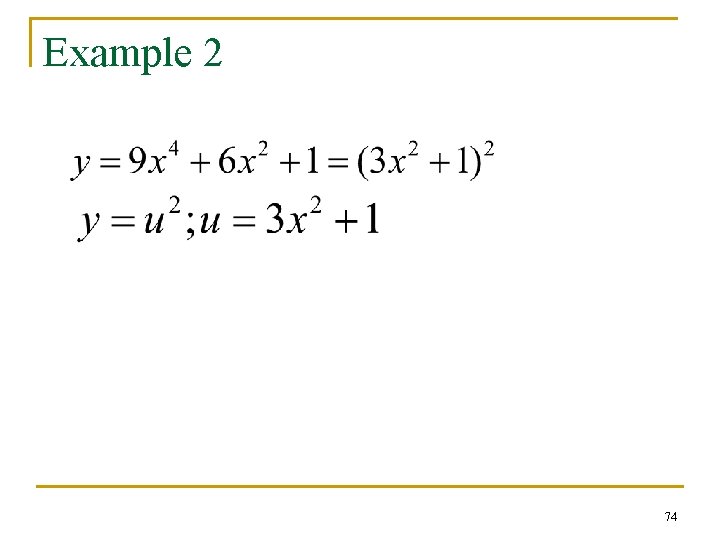
Example 2 74
75
76
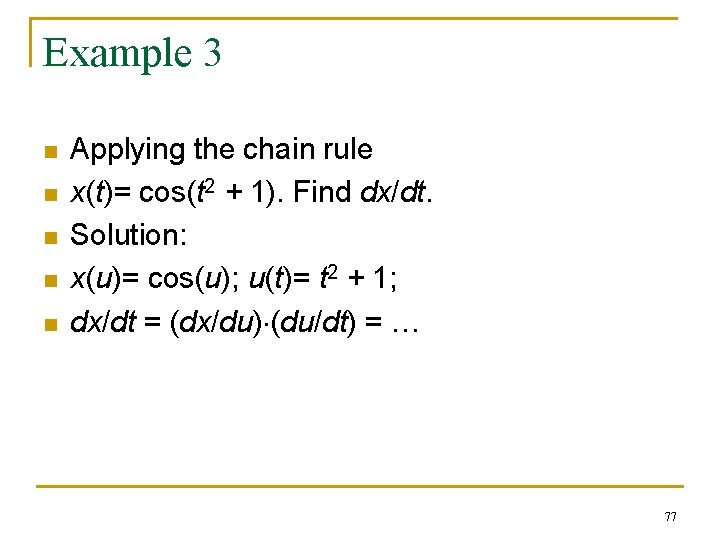
Example 3 n n n Applying the chain rule x(t)= cos(t 2 + 1). Find dx/dt. Solution: x(u)= cos(u); u(t)= t 2 + 1; dx/dt = (dx/du) (du/dt) = … 77
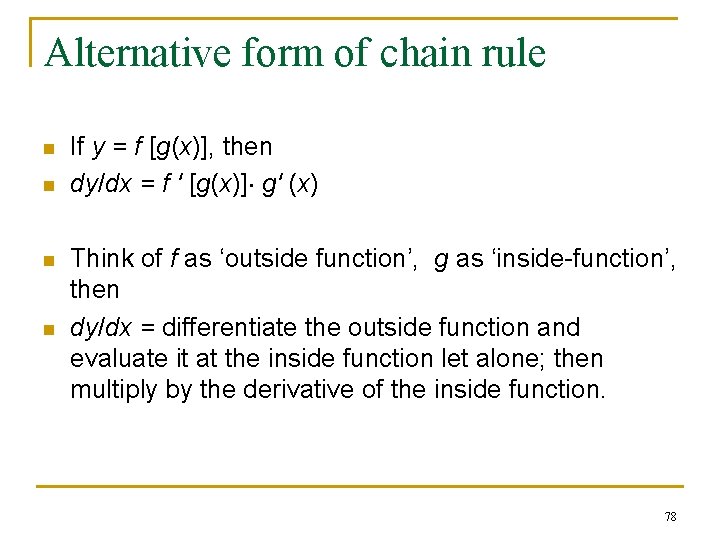
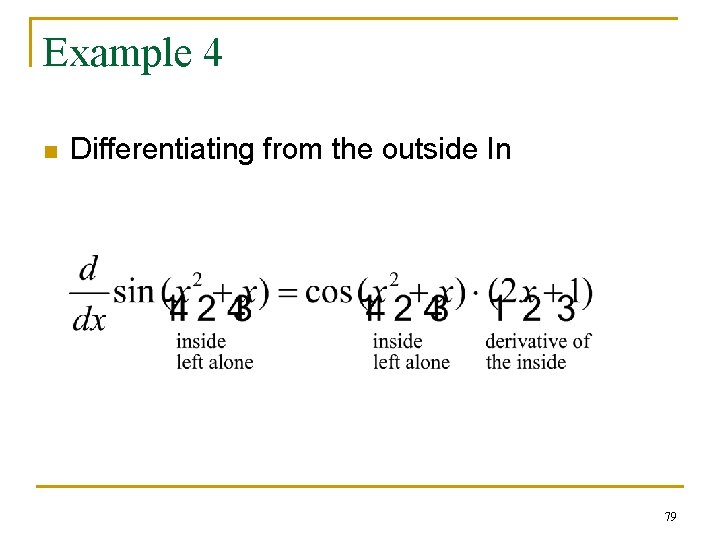
Alternative form of chain rule n n If y = f [g(x)], then dy/dx = f ' [g(x)] g' (x) Think of f as ‘outside function’, g as ‘inside-function’, then dy/dx = differentiate the outside function and evaluate it at the inside function let alone; then multiply by the derivative of the inside function. 78
Example 4 n Differentiating from the outside In 79
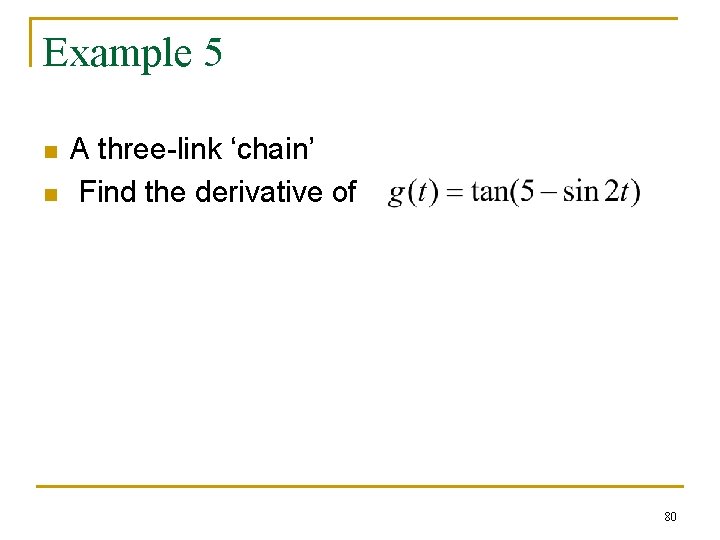
Example 5 n n A three-link ‘chain’ Find the derivative of 80
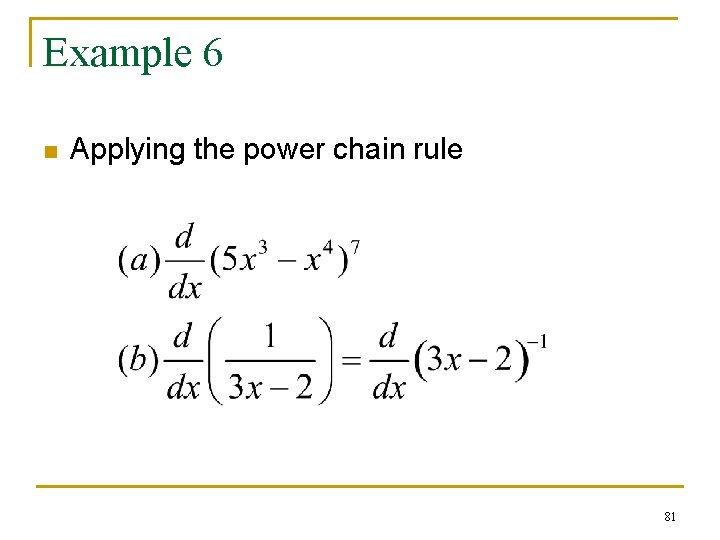
Example 6 n Applying the power chain rule 81
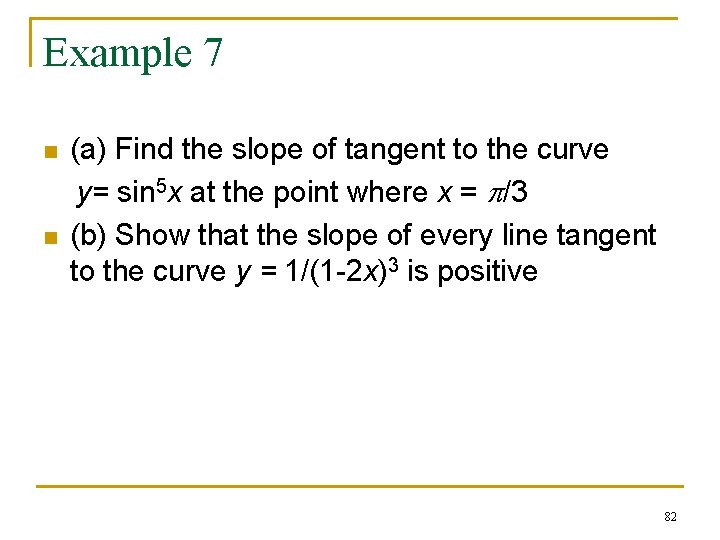
Example 7 n n (a) Find the slope of tangent to the curve y= sin 5 x at the point where x = p/3 (b) Show that the slope of every line tangent to the curve y = 1/(1 -2 x)3 is positive 82
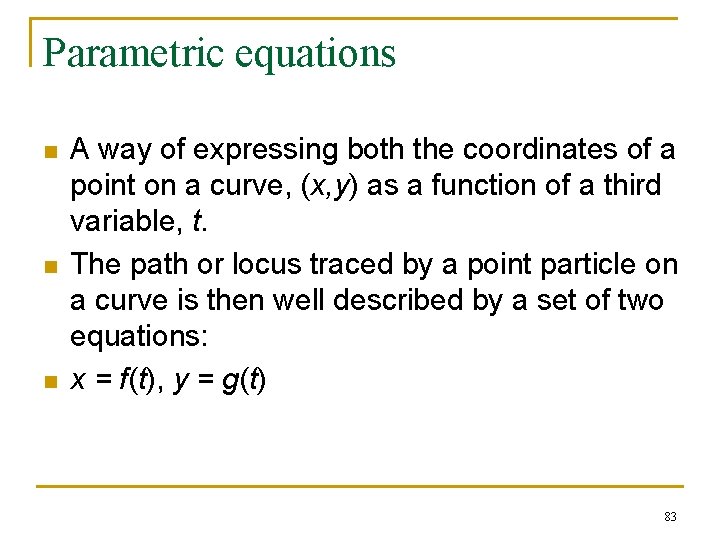
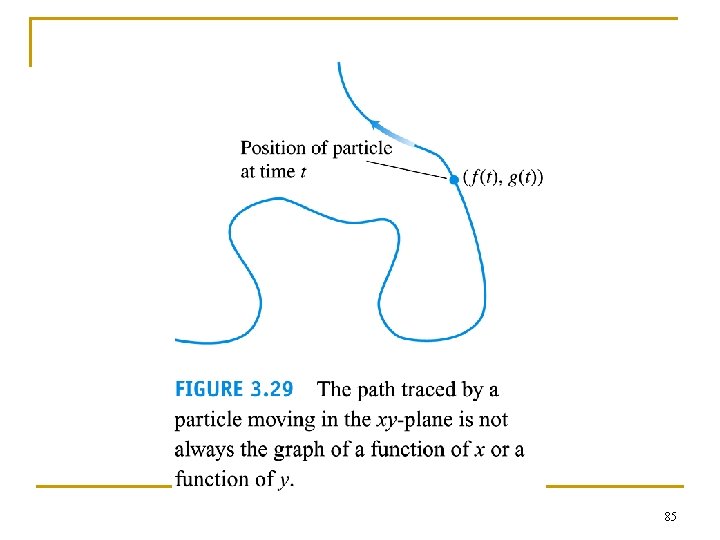
Parametric equations n n n A way of expressing both the coordinates of a point on a curve, (x, y) as a function of a third variable, t. The path or locus traced by a point particle on a curve is then well described by a set of two equations: x = f(t), y = g(t) 83
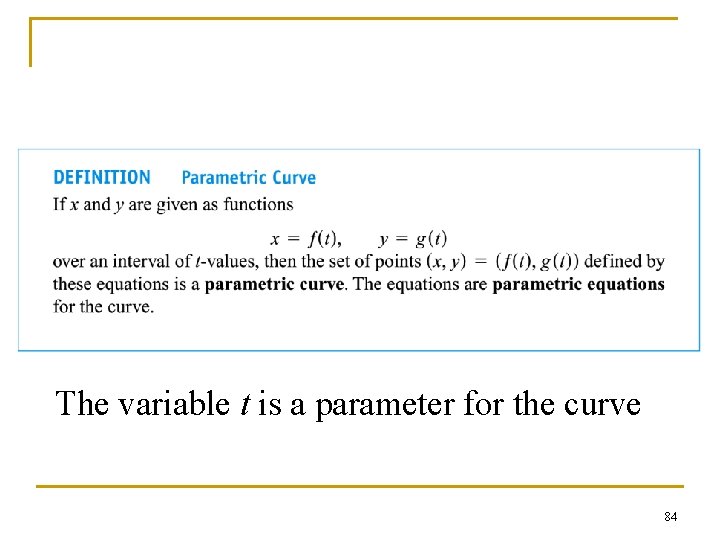
The variable t is a parameter for the curve 84
85
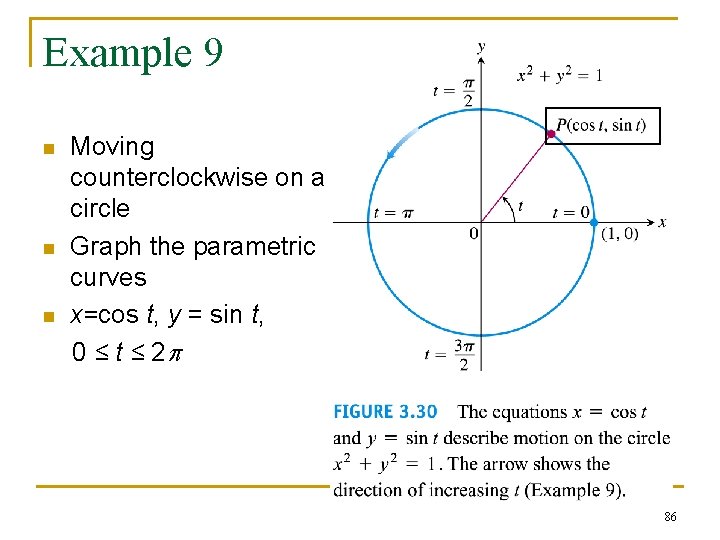
Example 9 n n n Moving counterclockwise on a circle Graph the parametric curves x=cos t, y = sin t, 0 ≤ t ≤ 2 p 86
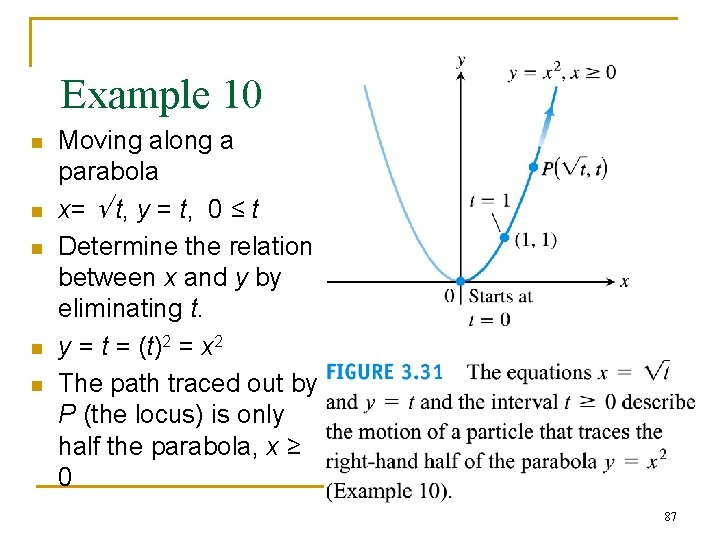
Example 10 n n n Moving along a parabola x= t, y = t, 0 ≤ t Determine the relation between x and y by eliminating t. y = t = (t)2 = x 2 The path traced out by P (the locus) is only half the parabola, x ≥ 0 87
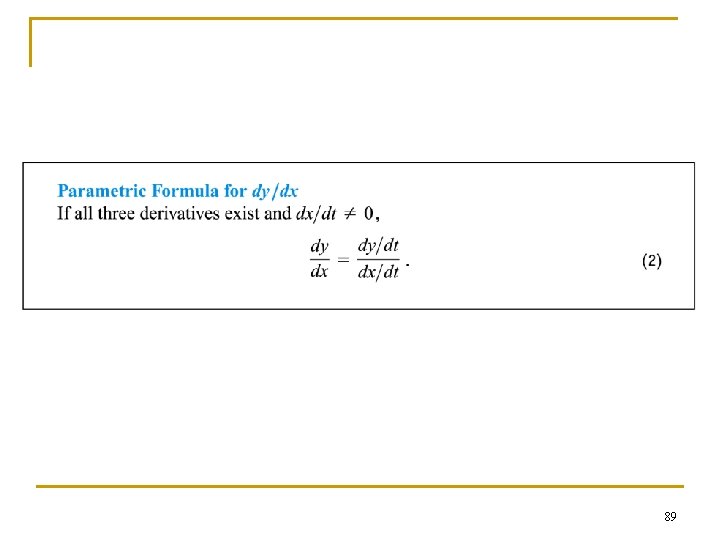
Slopes of parametrized curves n n n A parametrized curved x = f(t), y = g(t) is differentiable at t if f and g are differentiable at t. At a point on a differentiable parametrised curve where y is also a differentiable function of x, i. e. y = y(x) = y[x(t)], chain rule relates dx/dt, dy/dx via 88
89
Example 12 n n Differentiating with a parameter If x = 2 t + 3 and y = t 2 – 1, find the value of dy/dx at t = 6. 90
(3) is just the parametric formula (2) by y → dy/dx 91
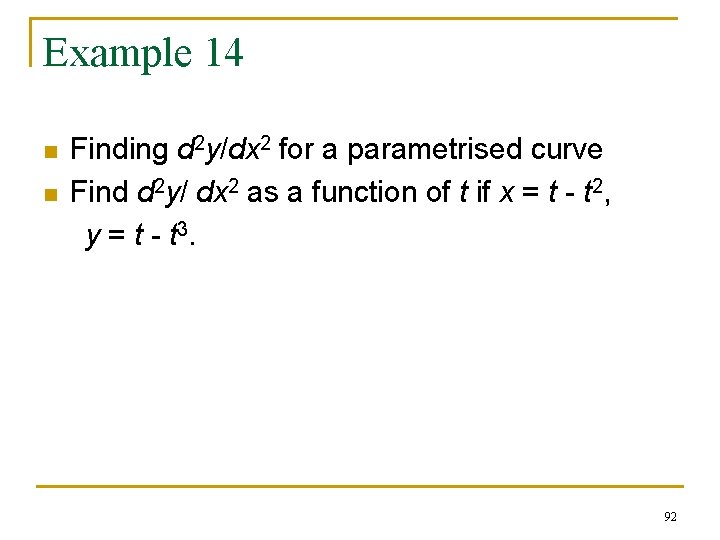
Example 14 n n Finding d 2 y/dx 2 for a parametrised curve Find d 2 y/ dx 2 as a function of t if x = t - t 2, y = t - t 3. 92
3. 6 Implicit Differentiation 93
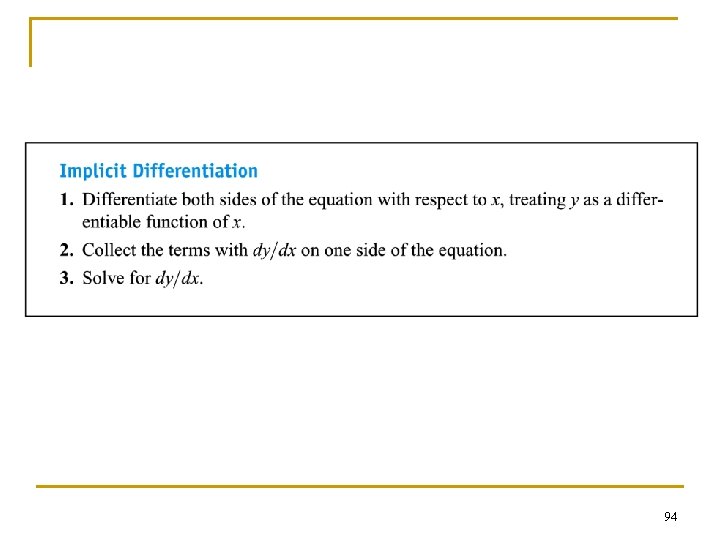
94
Example 1: Differentiating implicitly n Find dy/dx if y 2 = x 95
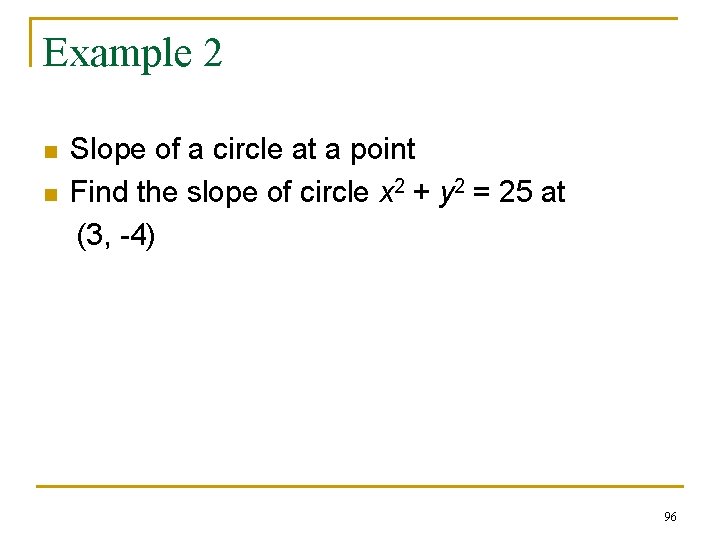
Example 2 n n Slope of a circle at a point Find the slope of circle x 2 + y 2 = 25 at (3, -4) 96
Example 3 n n Differentiating implicitly Find dy/dx if y 2 = x 2 + sin xy 97
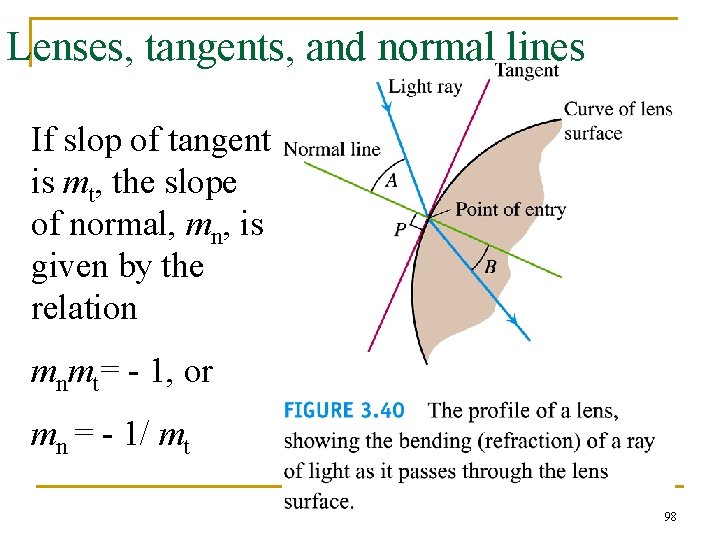
Lenses, tangents, and normal lines If slop of tangent is mt, the slope of normal, mn, is given by the relation mnmt= - 1, or mn = - 1/ mt 98
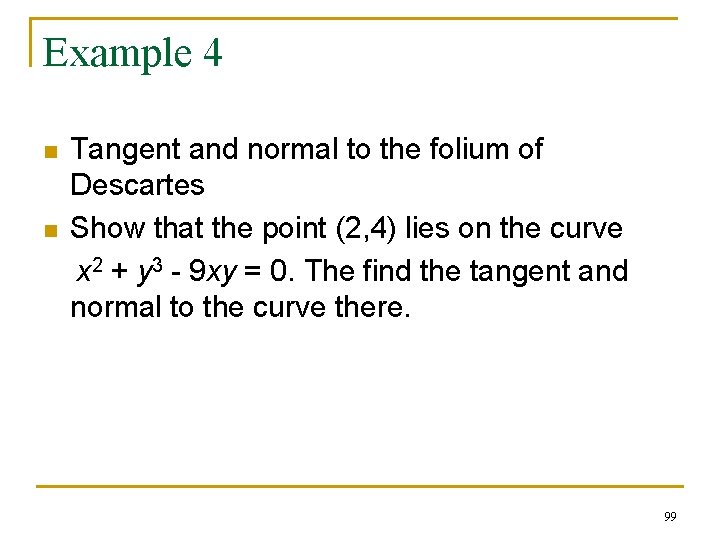
Example 4 n n Tangent and normal to the folium of Descartes Show that the point (2, 4) lies on the curve x 2 + y 3 - 9 xy = 0. The find the tangent and normal to the curve there. 99
100
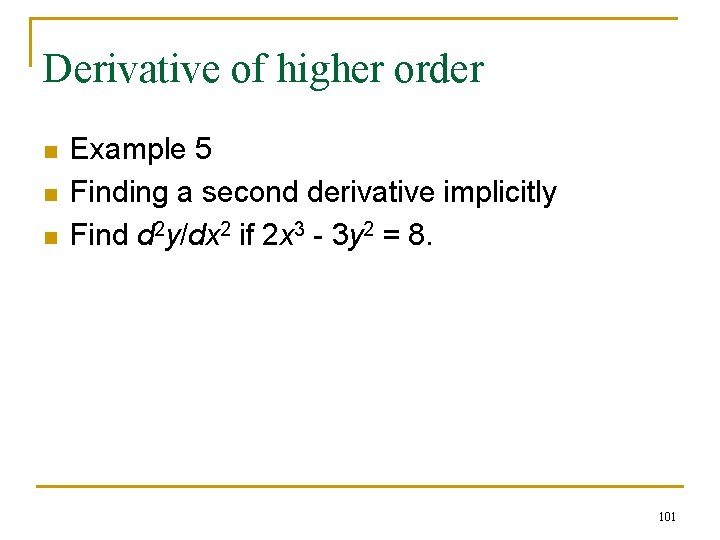
Derivative of higher order n n n Example 5 Finding a second derivative implicitly Find d 2 y/dx 2 if 2 x 3 - 3 y 2 = 8. 101
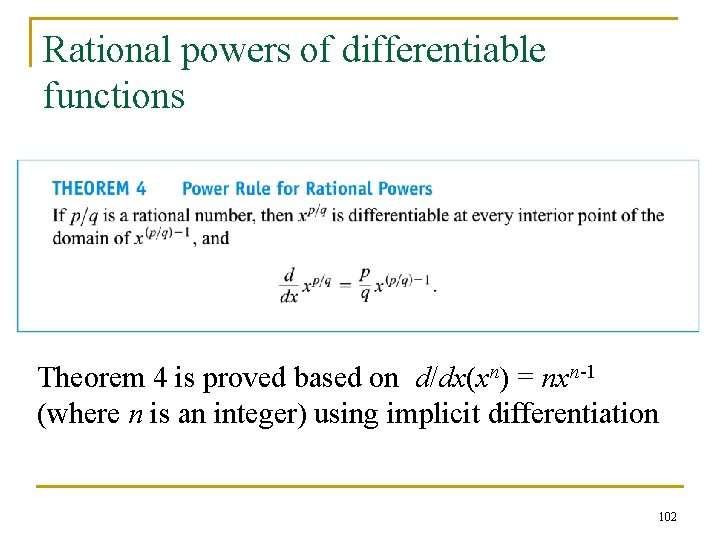
Rational powers of differentiable functions Theorem 4 is proved based on d/dx(xn) = nxn-1 (where n is an integer) using implicit differentiation 102
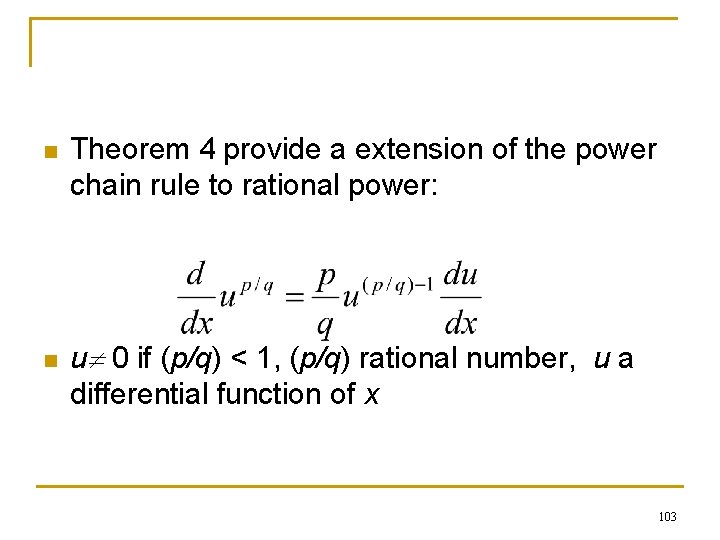
n n Theorem 4 provide a extension of the power chain rule to rational power: u 0 if (p/q) < 1, (p/q) rational number, u a differential function of x 103
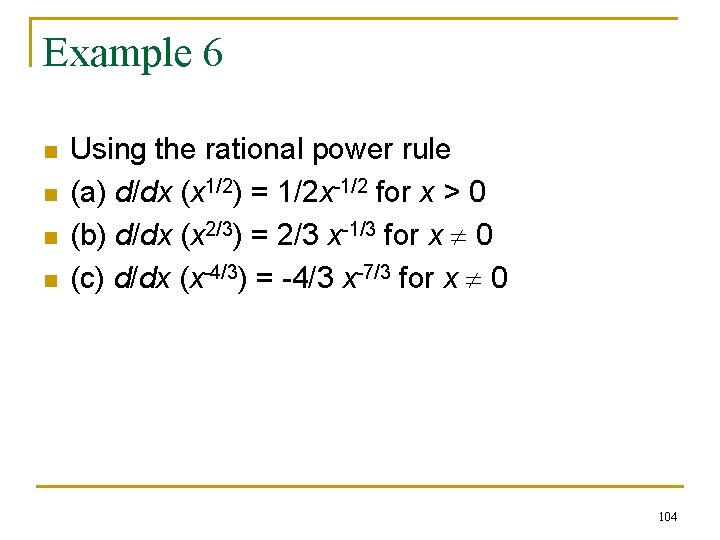
Example 6 n n Using the rational power rule (a) d/dx (x 1/2) = 1/2 x-1/2 for x > 0 (b) d/dx (x 2/3) = 2/3 x-1/3 for x 0 (c) d/dx (x-4/3) = -4/3 x-7/3 for x 0 104
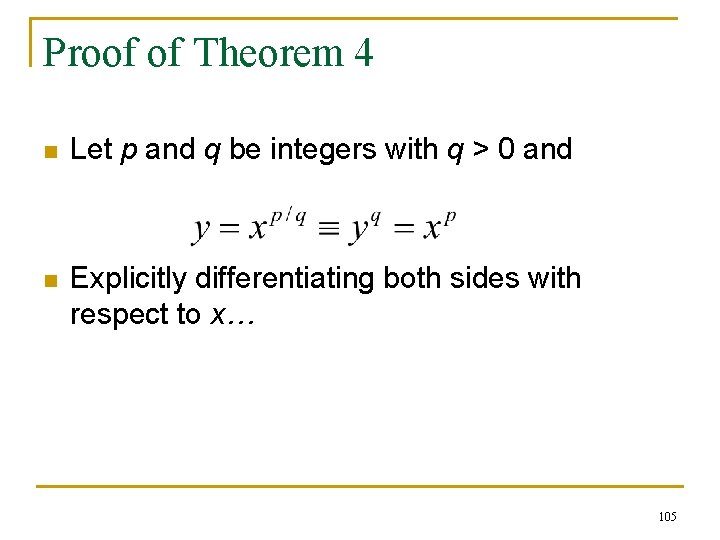
Proof of Theorem 4 n Let p and q be integers with q > 0 and n Explicitly differentiating both sides with respect to x… 105
Example 7 n n n Using the rational power and chain rules (a) Differentiate (1 -x 2)1/4 (b) Differentiate (cos x)-1/5 106
3. 8 Linearization and differentials 107
Linearization n Say you have a very complicated function, f(x)=sin (cot 2 x), and you want to calculate the value of f(x) at x = p /2 + d, where d is a very tiny number. The value sought can be estimated within some accuracy using linearization. 108
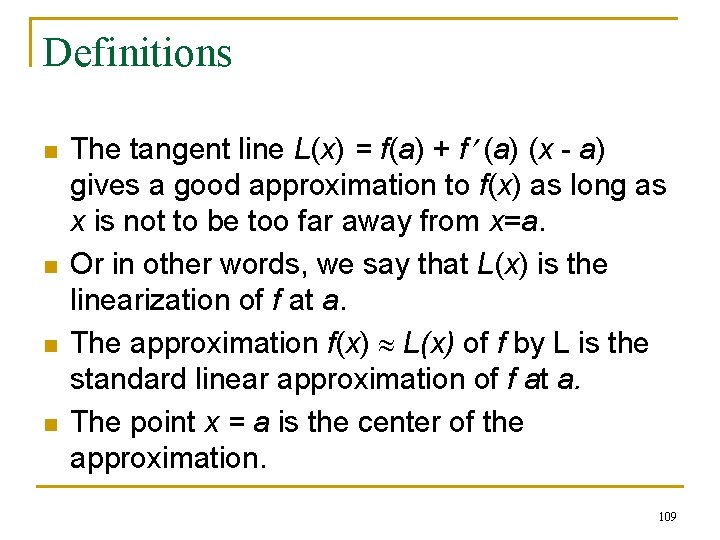
Definitions n n The tangent line L(x) = f(a) + f (a) (x - a) gives a good approximation to f(x) as long as x is not to be too far away from x=a. Or in other words, we say that L(x) is the linearization of f at a. The approximation f(x) L(x) of f by L is the standard linear approximation of f at a. The point x = a is the center of the approximation. 109
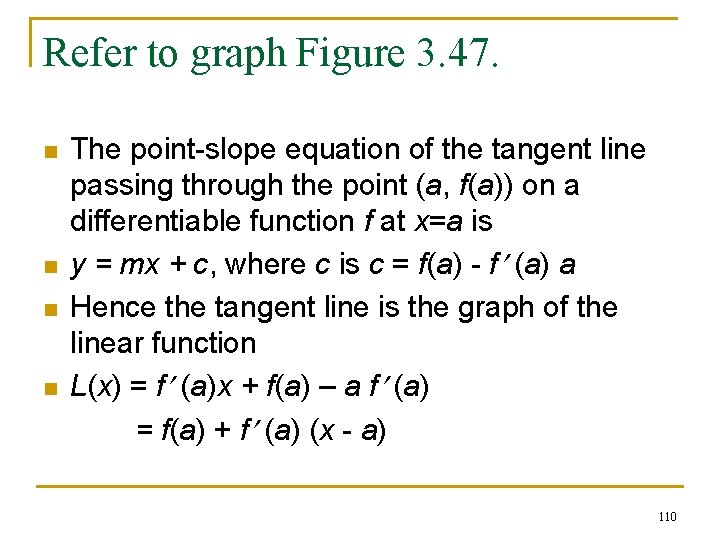
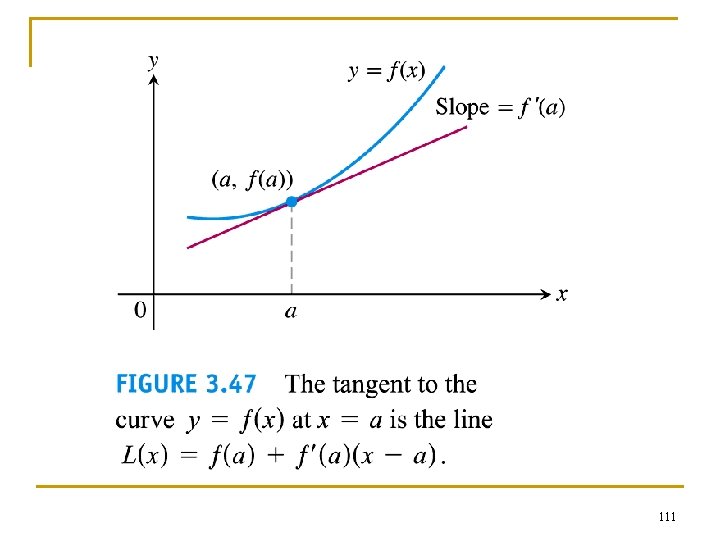
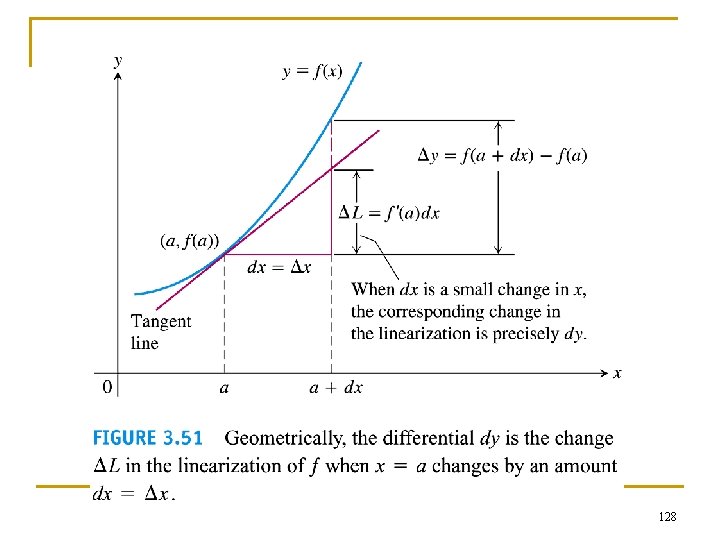
Refer to graph Figure 3. 47. n n The point-slope equation of the tangent line passing through the point (a, f(a)) on a differentiable function f at x=a is y = mx + c, where c is c = f(a) - f (a) a Hence the tangent line is the graph of the linear function L(x) = f (a)x + f(a) – a f (a) = f(a) + f (a) (x - a) 110
111
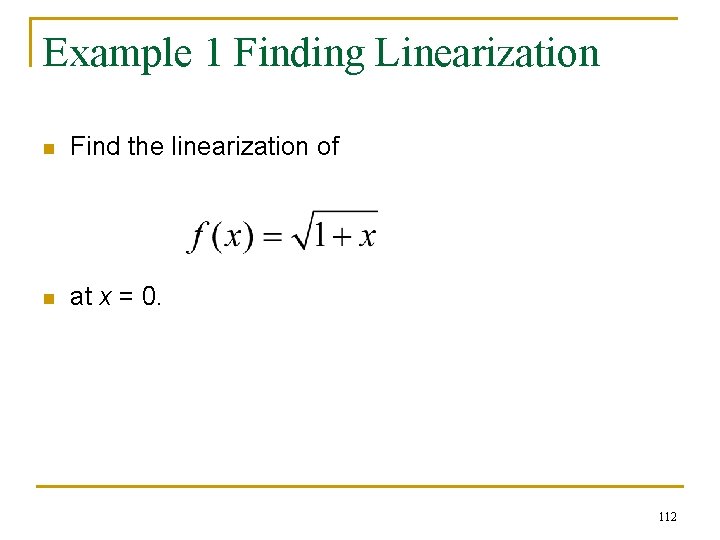
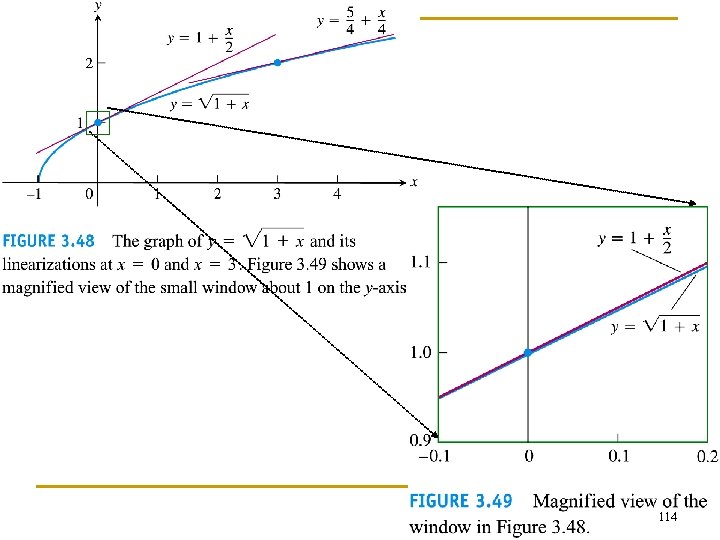
Example 1 Finding Linearization n Find the linearization of n at x = 0. 112
113
114
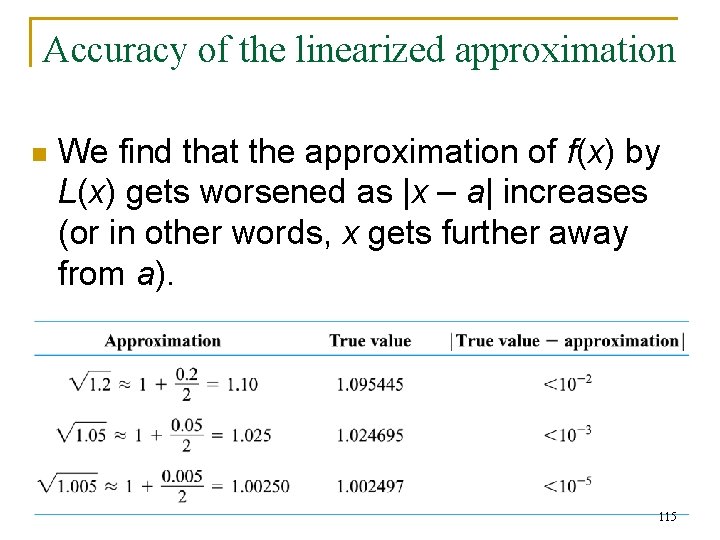
Accuracy of the linearized approximation n We find that the approximation of f(x) by L(x) gets worsened as |x – a| increases (or in other words, x gets further away from a). 115
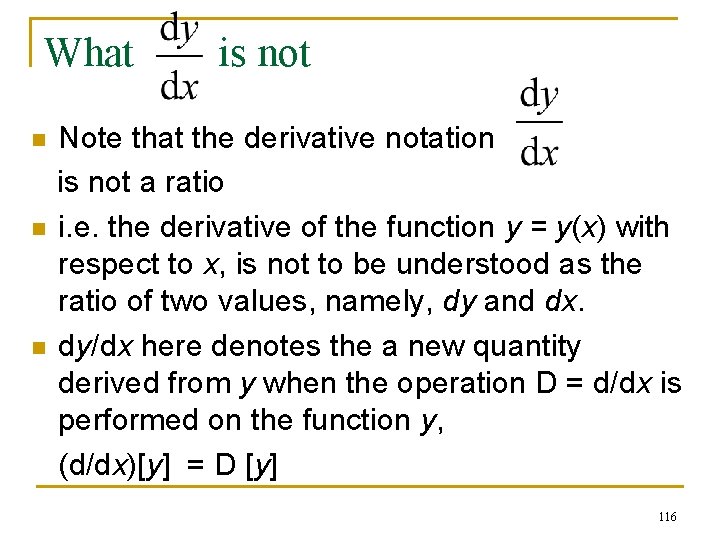
What n n n is not Note that the derivative notation is not a ratio i. e. the derivative of the function y = y(x) with respect to x, is not to be understood as the ratio of two values, namely, dy and dx. dy/dx here denotes the a new quantity derived from y when the operation D = d/dx is performed on the function y, (d/dx)[y] = D [y] 116
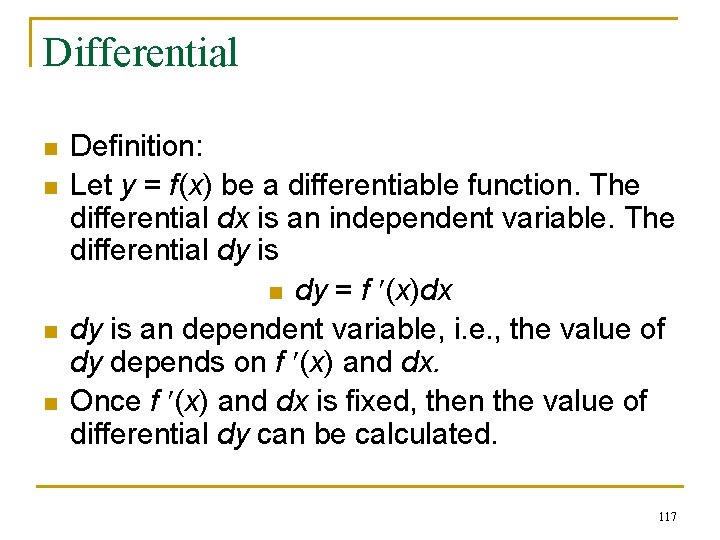
Differential n n Definition: Let y = f(x) be a differentiable function. The differential dx is an independent variable. The differential dy is n dy = f (x)dx dy is an dependent variable, i. e. , the value of dy depends on f (x) and dx. Once f (x) and dx is fixed, then the value of differential dy can be calculated. 117
Example 4 Finding the differential dy n n (a) Find dy if y=x 5 + 37 x. (b) Find the value of dy when x=1 and dx = 0. 2 118
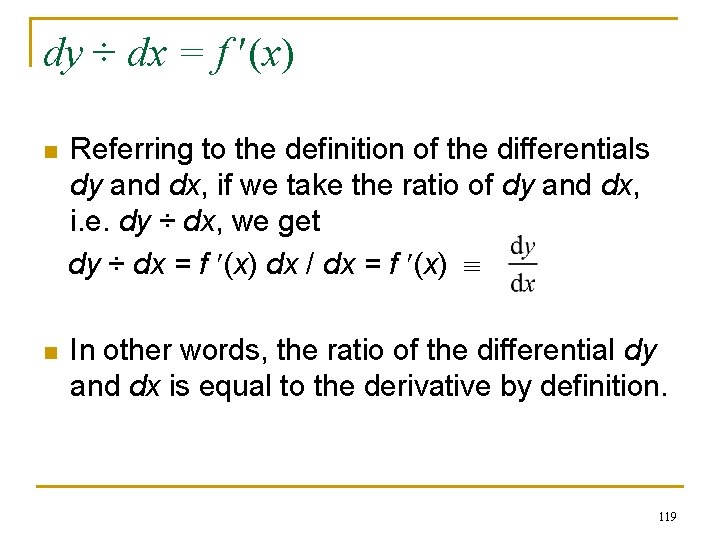
dy ÷ dx = f (x) n Referring to the definition of the differentials dy and dx, if we take the ratio of dy and dx, i. e. dy ÷ dx, we get dy ÷ dx = f (x) dx / dx = f (x) n In other words, the ratio of the differential dy and dx is equal to the derivative by definition. 119
Differential of f, df n n n We sometimes use the notation df in place of dy, so that dy = f (x) dx is now written in terms of n df = f (x) dx df is called the differential of f 120
Example of differential of f n If y = f(x) = 3 x 2 -6, then the differential of f is df = f (x) dx = 6 x dx n Note that in the above expression, if we take the ratio df / dx, we obtain n df / dx = f (x) = 6 x 121
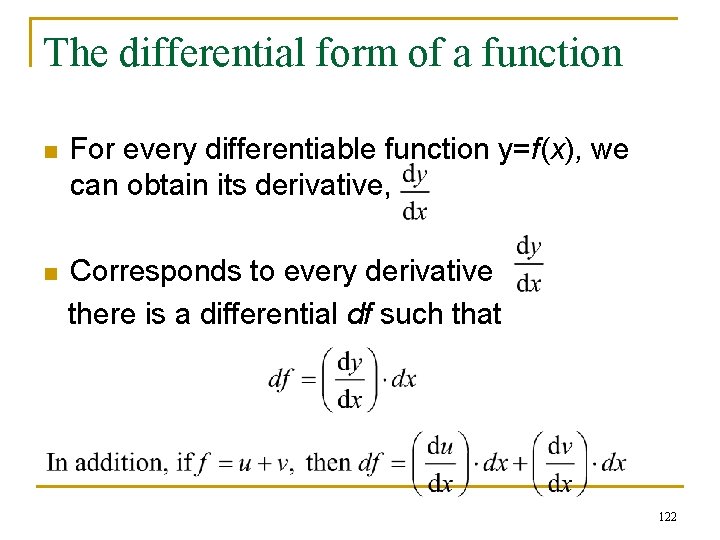
The differential form of a function n For every differentiable function y=f(x), we can obtain its derivative, n Corresponds to every derivative there is a differential df such that 122
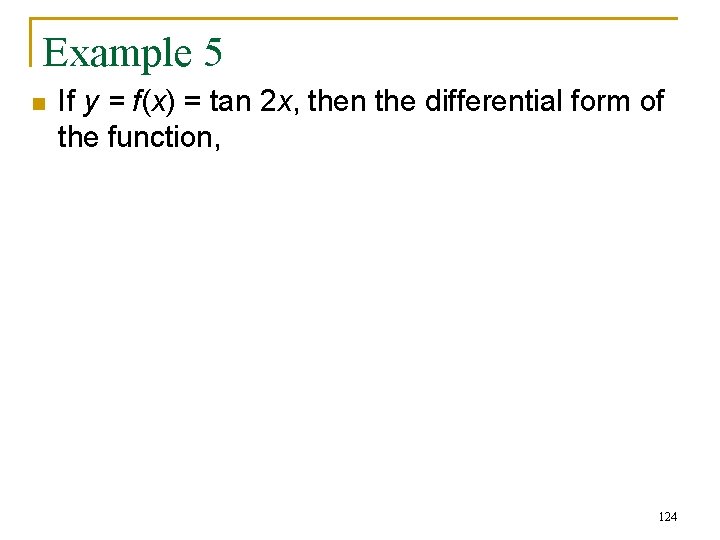
Example 5 n If y = f(x) = tan 2 x, the derivative is n Correspond to the derivative, the differential of the function, df, is given by the product of the derivative dy/dx and the independent differential dx: 123
Example 5 n If y = f(x) = tan 2 x, then the differential form of the function, 124
dy, df : any difference? n n Sometimes for a given function, y = f(x), the notation dy is used in place of the notation df. Operationally speaking, it does not matter whether one uses dy or df. 125
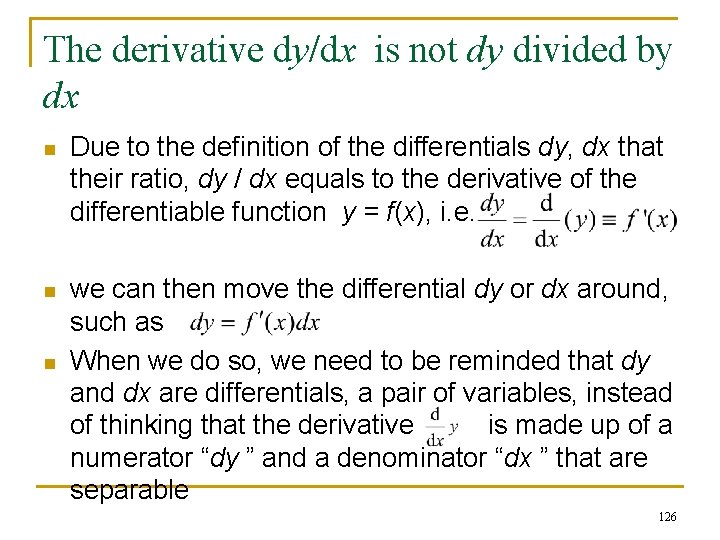
The derivative dy/dx is not dy divided by dx n Due to the definition of the differentials dy, dx that their ratio, dy / dx equals to the derivative of the differentiable function y = f(x), i. e. n we can then move the differential dy or dx around, such as When we do so, we need to be reminded that dy and dx are differentials, a pair of variables, instead of thinking that the derivative is made up of a numerator “dy ” and a denominator “dx ” that are separable n 126
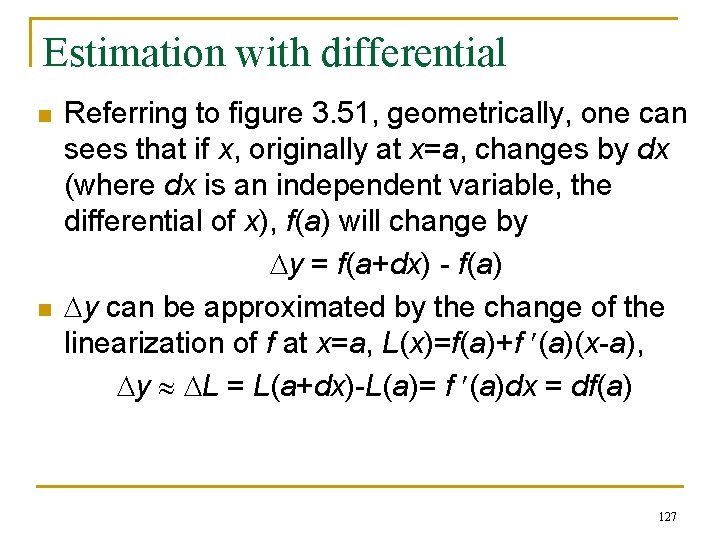
Estimation with differential n n Referring to figure 3. 51, geometrically, one can sees that if x, originally at x=a, changes by dx (where dx is an independent variable, the differential of x), f(a) will change by Dy = f(a+dx) - f(a) Dy can be approximated by the change of the linearization of f at x=a, L(x)=f(a)+f (a)(x-a), Dy DL = L(a+dx)-L(a)= f (a)dx = df(a) 127
128
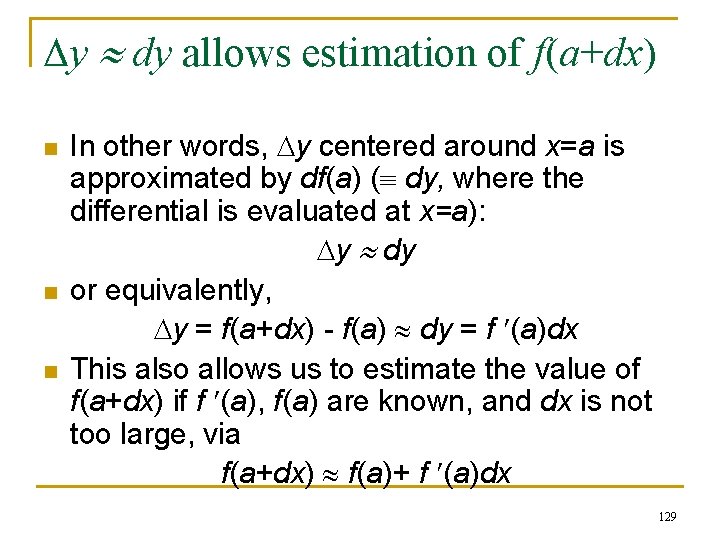
Dy dy allows estimation of f(a+dx) n n n In other words, Dy centered around x=a is approximated by df(a) ( dy, where the differential is evaluated at x=a): Dy dy or equivalently, Dy = f(a+dx) - f(a) dy = f (a)dx This also allows us to estimate the value of f(a+dx) if f (a), f(a) are known, and dx is not too large, via f(a+dx) f(a)+ f (a)dx 129
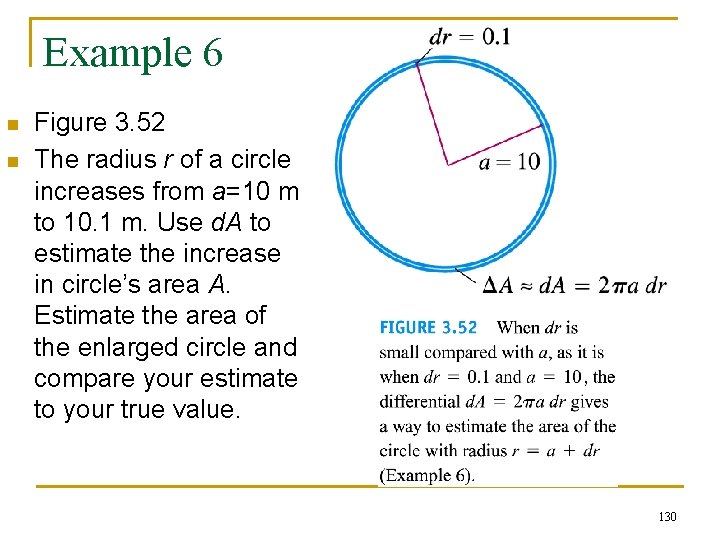
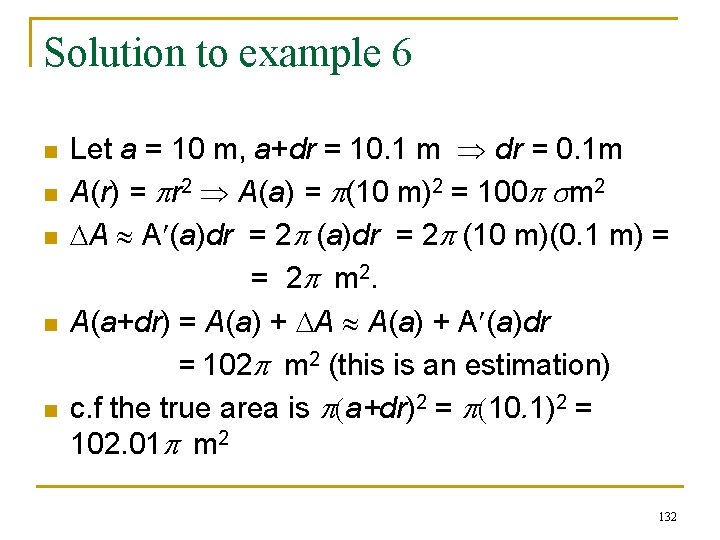
Example 6 n n Figure 3. 52 The radius r of a circle increases from a=10 m to 10. 1 m. Use d. A to estimate the increase in circle’s area A. Estimate the area of the enlarged circle and compare your estimate to your true value. 130
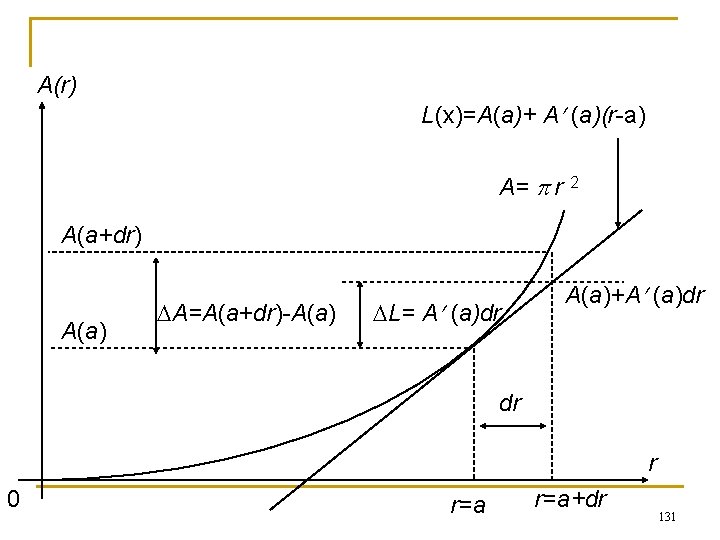
A(r) L(x)=A(a)+ A (a)(r-a) A= p r 2 A(a+dr) A(a) DA=A(a+dr)-A(a) DL= A (a)dr A(a)+A (a)dr dr r 0 r=a+dr 131
Solution to example 6 n n n Let a = 10 m, a+dr = 10. 1 m dr = 0. 1 m A(r) = pr 2 A(a) = p(10 m)2 = 100 p sm 2 DA A (a)dr = 2 p (10 m)(0. 1 m) = = 2 p m 2. A(a+dr) = A(a) + DA A(a) + A (a)dr = 102 p m 2 (this is an estimation) c. f the true area is p(a+dr)2 = p(10. 1)2 = 102. 01 p m 2 132