
CHAPTER 3 Describing Relationships 3 1 Scatterplots and
CHAPTER 3 Describing Relationships 3. 1 Scatterplots and Correlation The Practice of Statistics, 5 th Edition Starnes, Tabor, Yates, Moore Bedford Freeman Worth Publishers
Scatterplots and Correlation Learning Objectives After this section, you should be able to: ü IDENTIFY explanatory and response variables in situations where one variable helps to explain or influences the other. ü MAKE a scatterplot to display the relationship between two quantitative variables. ü DESCRIBE the direction, form, and strength of a relationship displayed in a scatterplot and identify outliers in a scatterplot. ü INTERPRET the correlation. ü UNDERSTAND the basic properties of correlation, including how the correlation is influenced by outliers ü USE technology to calculate correlation. ü EXPLAIN why association does not imply causation. The Practice of Statistics, 5 th Edition 2
Explanatory and Response Variables Most statistical studies examine data on more than one variable. In many of these settings, the two variables play different roles. A response variable measures an outcome of a study. An explanatory variable may help explain or influence changes in a response variable. Note: In many studies, the goal is to show that changes in one or more explanatory variables actually cause changes in a response variable. However, other explanatory-response relationships don’t involve direct causation. The Practice of Statistics, 5 th Edition 3
Displaying Relationships: Scatterplots The most useful graph for displaying the relationship between two quantitative variables is a scatterplot. A scatterplot shows the relationship between two quantitative variables measured on the same individuals. The values of one variable appear on the horizontal axis, and the values of the other variable appear on the vertical axis. Each individual in the data appears as a point on the graph. How to Make a Scatterplot 1. Decide which variable should go on each axis. • Remember, the e. Xplanatory variable goes on the X-axis! 2. Label and scale your axes. 3. Plot individual data values. The Practice of Statistics, 5 th Edition 4
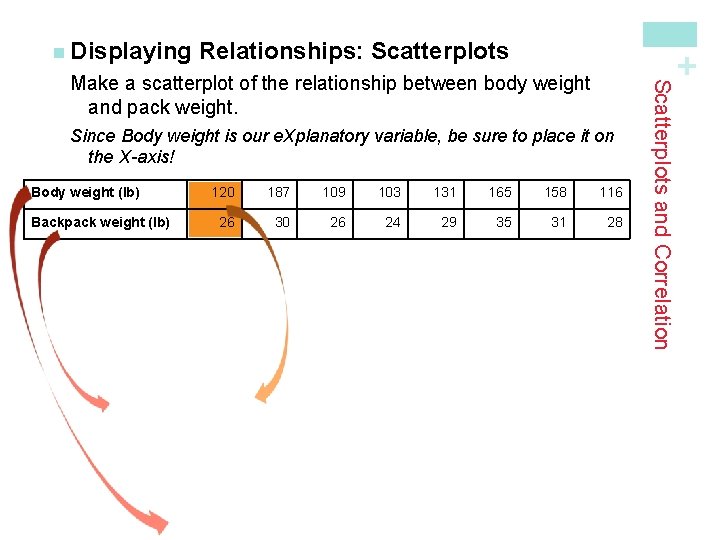
Relationships: Scatterplots + n Displaying Since Body weight is our e. Xplanatory variable, be sure to place it on the X-axis! Body weight (lb) Backpack weight (lb) 120 187 109 103 131 165 158 116 26 30 26 24 29 35 31 28 Scatterplots and Correlation Make a scatterplot of the relationship between body weight and pack weight.

+ USING THE CALCULATOR n USE THIS LINK TO FIND A VIDEO ON HOW TO USE THE CALCULATOR TO CONSTRUCT A SCATTERPLOT n http: //bcs. whfreeman. com/webpub/Statistics/tps 5 e/T ech. Corners/tps 5 e_techcorner_7_84. html n You can use the trace key to move along the points of the graph

Describing Scatterplots To describe a scatterplot, follow the basic strategy of data analysis from Chapters 1 and 2. Look for patterns and important departures from those patterns. How to Examine a Scatterplot As in any graph of data, look for the overall pattern and for striking departures from that pattern. • You can describe the overall pattern of a scatterplot by the direction, form, and strength of the relationship. • An important kind of departure is an outlier, an individual value that falls outside the overall pattern of the relationship. The Practice of Statistics, 5 th Edition 7

Looking at Scatterplots (cont. ) n n When looking at scatterplots, we will look for direction, form, strength, and unusual features. Direction: n A pattern that runs from the upper left to the lower right is said to have a negative direction. n A trend running the other way has a positive direction. Definition: Two variables have a positive association when above-average values of one tend to accompany above-average values of the other, and when below-average values also tend to occur together. Two variables have a negative association when above-average values of one tend to accompany below-average values of the other. Copyright © 2010 Pearson Education, Inc. Slide 7 - 8

Looking at Scatterplots (cont. ) n n Copyright © 2010 Pearson Education, Inc. This example shows a negative association between central pressure and maximum wind speed As the central pressure increases, the maximum wind speed decreases. Slide 7 - 9
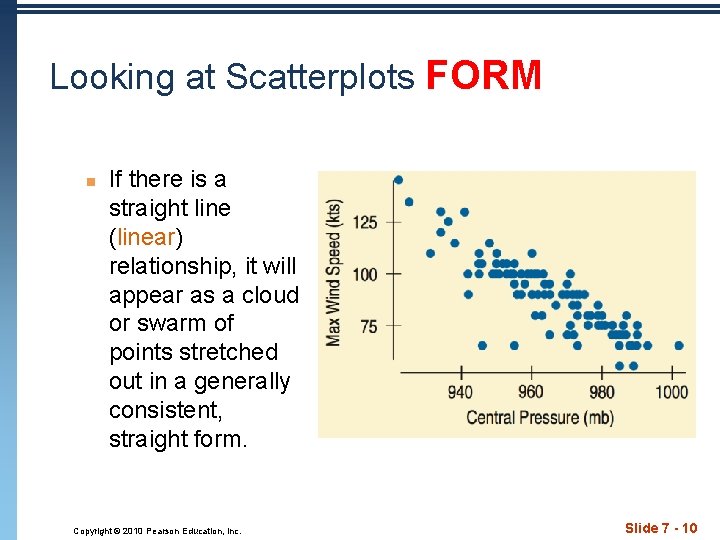
Looking at Scatterplots FORM n If there is a straight line (linear) relationship, it will appear as a cloud or swarm of points stretched out in a generally consistent, straight form. Copyright © 2010 Pearson Education, Inc. Slide 7 - 10

Looking at Scatterplots (cont. ) n Form: n If the relationship isn’t straight, but curves gently, while still increasing or decreasing steadily, we can often find ways to make it more nearly straight. Copyright © 2010 Pearson Education, Inc. Slide 7 - 11
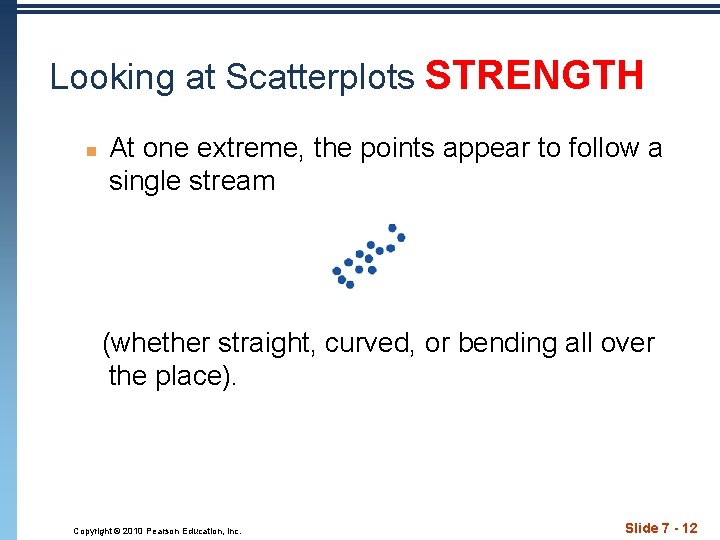
Looking at Scatterplots STRENGTH n At one extreme, the points appear to follow a single stream (whether straight, curved, or bending all over the place). Copyright © 2010 Pearson Education, Inc. Slide 7 - 12
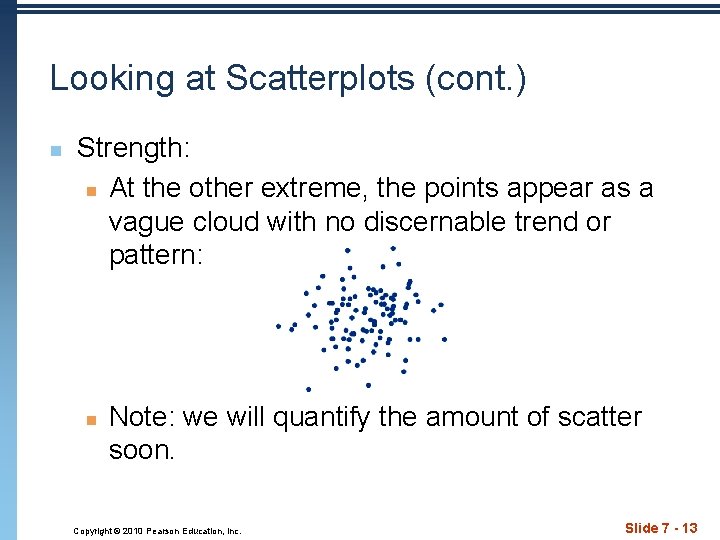
Looking at Scatterplots (cont. ) n Strength: n At the other extreme, the points appear as a vague cloud with no discernable trend or pattern: n Note: we will quantify the amount of scatter soon. Copyright © 2010 Pearson Education, Inc. Slide 7 - 13
Looking at Scatterplots (cont. ) n Unusual features: n Look for the unexpected. n Often the most interesting thing to see in a scatterplot is the thing you never thought to look for. n One example of such a surprise is an outlier standing away from the overall pattern of the scatterplot. n Clusters or subgroups should also raise questions. Copyright © 2010 Pearson Education, Inc. Slide 7 - 14
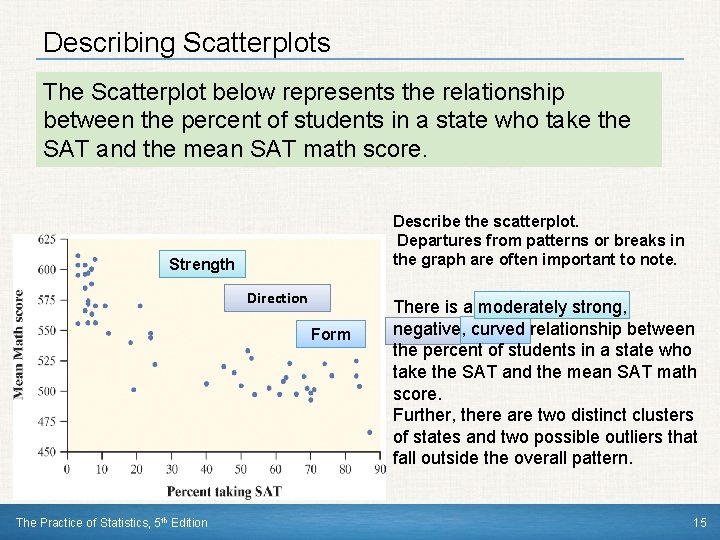
Describing Scatterplots The Scatterplot below represents the relationship between the percent of students in a state who take the SAT and the mean SAT math score. Describe the scatterplot. Departures from patterns or breaks in the graph are often important to note. Strength Direction Form The Practice of Statistics, 5 th Edition There is a moderately strong, negative, curved relationship between the percent of students in a state who take the SAT and the mean SAT math score. Further, there are two distinct clusters of states and two possible outliers that fall outside the overall pattern. 15
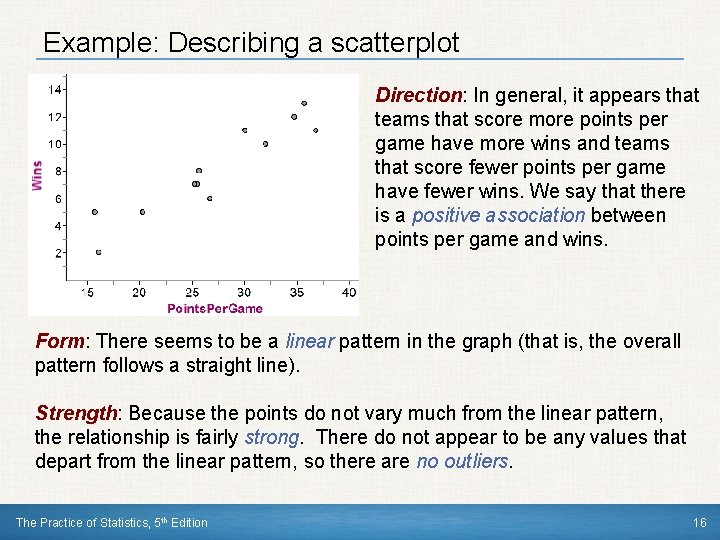
Example: Describing a scatterplot Direction: In general, it appears that teams that score more points per game have more wins and teams that score fewer points per game have fewer wins. We say that there is a positive association between points per game and wins. Form: There seems to be a linear pattern in the graph (that is, the overall pattern follows a straight line). Strength: Because the points do not vary much from the linear pattern, the relationship is fairly strong. There do not appear to be any values that depart from the linear pattern, so there are no outliers. The Practice of Statistics, 5 th Edition 16
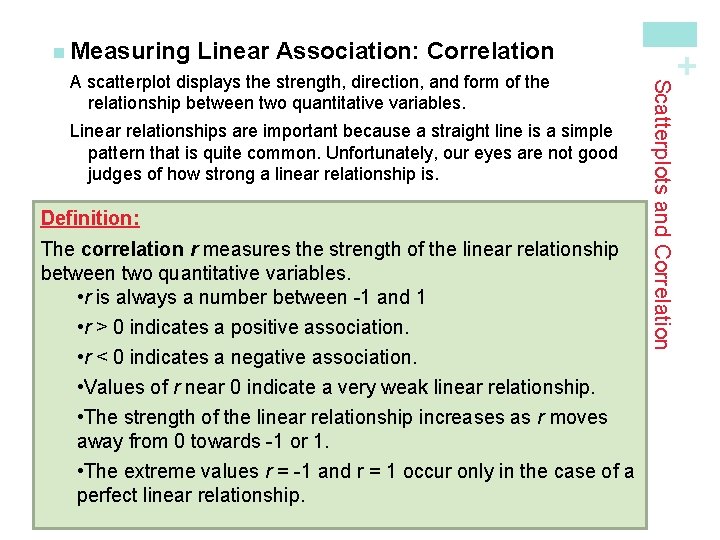
Linear Association: Correlation Linear relationships are important because a straight line is a simple pattern that is quite common. Unfortunately, our eyes are not good judges of how strong a linear relationship is. Definition: The correlation r measures the strength of the linear relationship between two quantitative variables. • r is always a number between -1 and 1 • r > 0 indicates a positive association. • r < 0 indicates a negative association. • Values of r near 0 indicate a very weak linear relationship. • The strength of the linear relationship increases as r moves away from 0 towards -1 or 1. • The extreme values r = -1 and r = 1 occur only in the case of a perfect linear relationship. Scatterplots and Correlation A scatterplot displays the strength, direction, and form of the relationship between two quantitative variables. + n Measuring
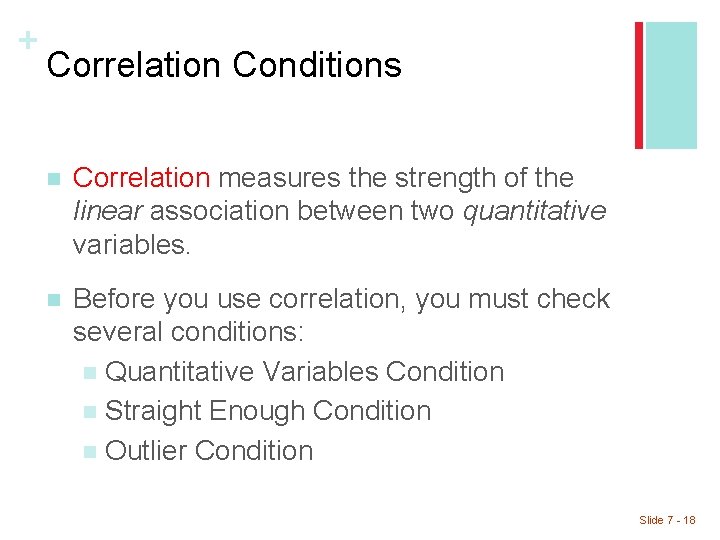
+ Correlation Conditions n Correlation measures the strength of the linear association between two quantitative variables. n Before you use correlation, you must check several conditions: n Quantitative Variables Condition n Straight Enough Condition n Outlier Condition Slide 7 - 18
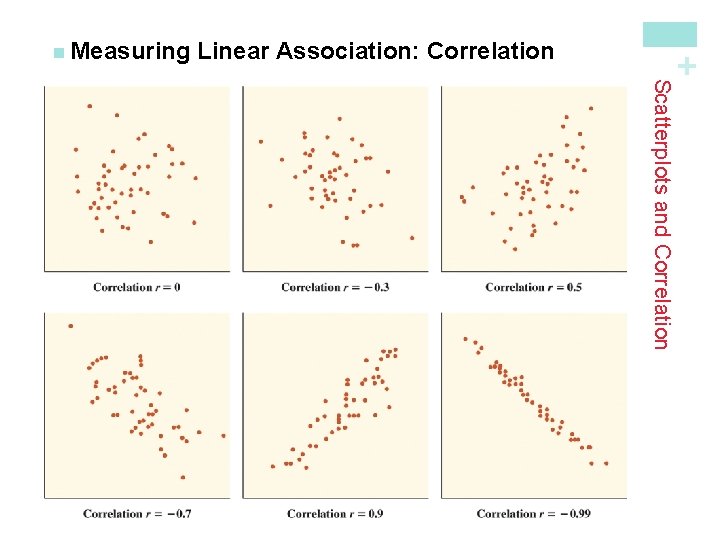
Linear Association: Correlation + n Measuring Scatterplots and Correlation
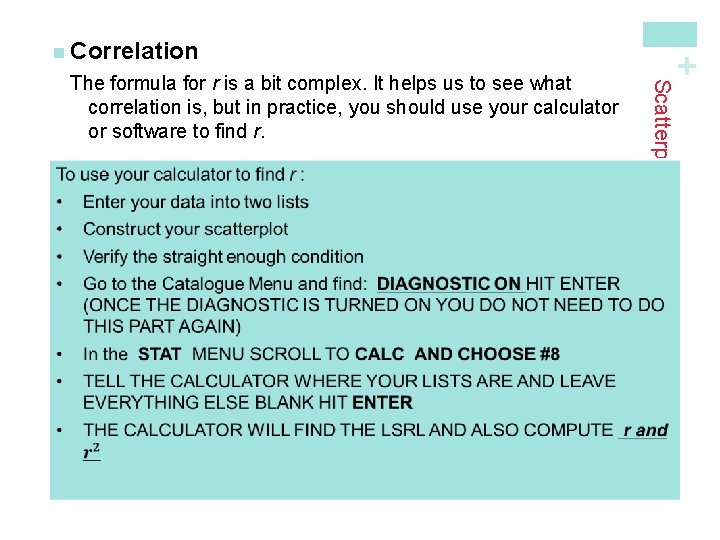
Scatterplots and Correlation The formula for r is a bit complex. It helps us to see what correlation is, but in practice, you should use your calculator or software to find r. + n Correlation
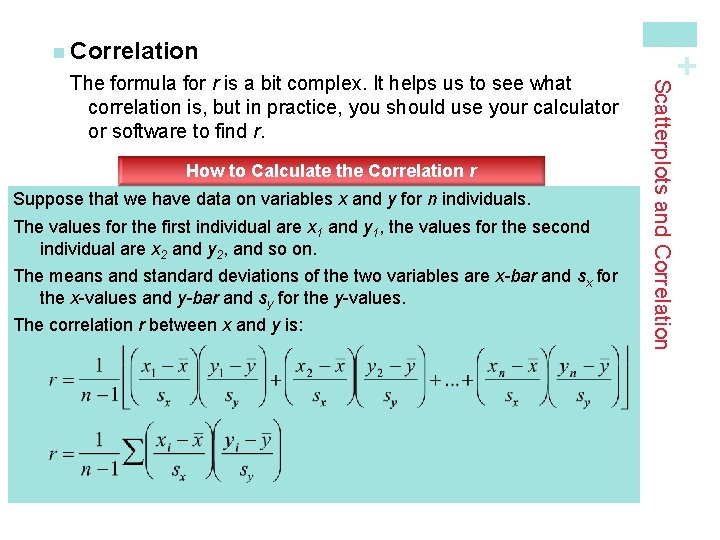
How to Calculate the Correlation r Suppose that we have data on variables x and y for n individuals. The values for the first individual are x 1 and y 1, the values for the second individual are x 2 and y 2, and so on. The means and standard deviations of the two variables are x-bar and sx for the x-values and y-bar and sy for the y-values. The correlation r between x and y is: Scatterplots and Correlation The formula for r is a bit complex. It helps us to see what correlation is, but in practice, you should use your calculator or software to find r. + n Correlation
about Correlation 1. Correlation makes no distinction between explanatory and response variables. 2. r does not change when we change the units of measurement of x, y, or both. 3. The correlation r itself has no unit of measurement. Cautions: • Correlation requires that both variables be quantitative. • Correlation does not describe curved relationships between variables, no matter how strong the relationship is. • Correlation is not resistant. r is strongly affected by a few outlying observations. • Correlation is not a complete summary of two-variable data. Scatterplots and Correlation How correlation behaves is more important than the details of the formula. Here are some important facts about r. + n Facts
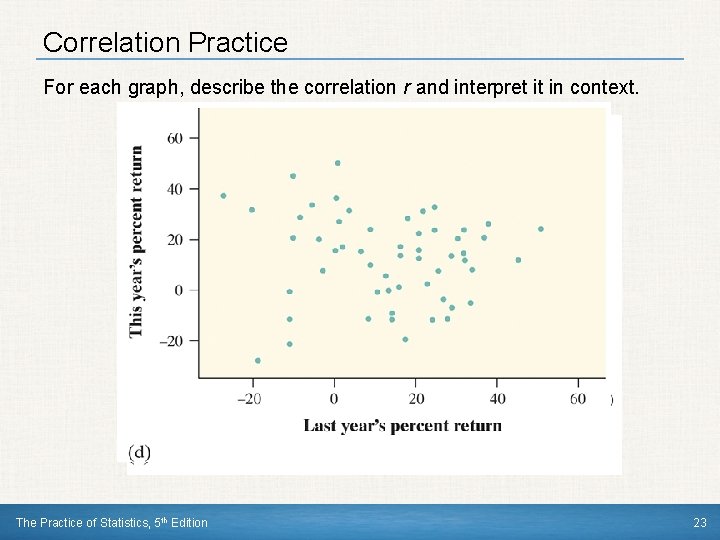
Correlation Practice For each graph, describe the correlation r and interpret it in context. The Practice of Statistics, 5 th Edition 23
ANSWERS TO PREVIOUS SLIDE: • A) Strong positive correlation between registered boats in Florida and manatees killed • B) Weak negative correlation between last year’s percent of return and this years percent of return The Practice of Statistics, 5 th Edition 24
SECTION 3. 1 HOMEWORK: • PAGE 159 # 1 -4, 9, 15 - 18, 21, 26 -32, 34 The Practice of Statistics, 5 th Edition 25
+ Section 3. 1 Scatterplots and Correlation Summary In this section, we learned that… ü A scatterplot displays the relationship between two quantitative variables. ü An explanatory variable may help explain, predict, or cause changes in a response variable. ü When examining a scatterplot, look for an overall pattern showing the direction, form, and strength of the relationship and then look for outliers or other departures from the pattern. ü The correlation r measures the strength and direction of the linear relationship between two quantitative variables.
+ Looking Ahead… In the next Section… We’ll learn how to describe linear relationships between two quantitative variables. We’ll learn üLeast-squares Regression line üPrediction üResiduals and residual plots üThe Role of r 2 in Regression üCorrelation and Regression Wisdom
- Slides: 27