
CHAPTER 3 Describing Relationships 3 1 Scatterplots and
CHAPTER 3 Describing Relationships 3. 1 Scatterplots and Correlation The Practice of Statistics, 5 th Edition Starnes, Tabor, Yates, Moore Bedford Freeman Worth Publishers
Scatterplots and Correlation Learning Objectives After this section, you should be able to: ü IDENTIFY explanatory and response variables in situations where one variable helps to explain or influences the other. ü MAKE a scatterplot to display the relationship between two quantitative variables. ü DESCRIBE the direction, form, and strength of a relationship displayed in a scatterplot and identify outliers in a scatterplot. ü INTERPRET the correlation. ü UNDERSTAND the basic properties of correlation, including how the correlation is influenced by outliers ü USE technology to calculate correlation. ü EXPLAIN why association does not imply causation. The Practice of Statistics, 5 th Edition 2
Explanatory and Response Variables Most statistical studies examine data on more than one variable. In many of these settings, the two variables play different roles. A response variable measures an outcome of a study. An explanatory variable may help explain or influence changes in a response variable. Note: In many studies, the goal is to show that changes in one or more explanatory variables actually cause changes in a response variable. However, other explanatory-response relationships don’t involve direct causation. The Practice of Statistics, 5 th Edition 3
Displaying Relationships: Scatterplots A scatterplot shows the relationship between two quantitative variables measured on the same individuals. The values of one variable appear on the horizontal axis, and the values of the other variable appear on the vertical axis. Each individual in the data appears as a point on the graph. How to Make a Scatterplot 1. Decide which variable should go on each axis. • Remember, the e. Xplanatory variable goes on the X-axis! 2. Label and scale your axes. 3. Plot individual data values. The Practice of Statistics, 5 th Edition 4
Describing Scatterplots To describe a scatterplot, follow the basic strategy of data analysis from Chapters 1 and 2. Look for patterns and important departures from those patterns. How to Examine a Scatterplot As in any graph of data, look for the overall pattern and for striking departures from that pattern. • You can describe the overall pattern of a scatterplot by the direction, form, and strength of the relationship. • An important kind of departure is an outlier, an individual value that falls outside the overall pattern of the relationship. The Practice of Statistics, 5 th Edition 5
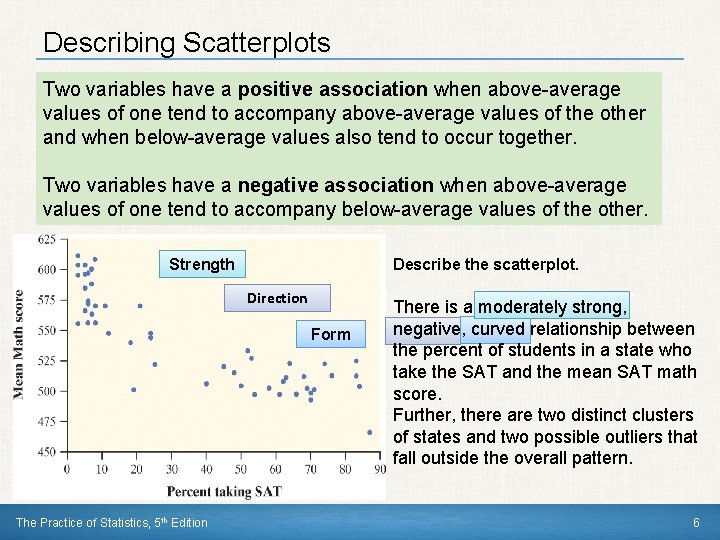
Describing Scatterplots Two variables have a positive association when above-average values of one tend to accompany above-average values of the other and when below-average values also tend to occur together. Two variables have a negative association when above-average values of one tend to accompany below-average values of the other. Describe the scatterplot. Strength Direction Form The Practice of Statistics, 5 th Edition There is a moderately strong, negative, curved relationship between the percent of students in a state who take the SAT and the mean SAT math score. Further, there are two distinct clusters of states and two possible outliers that fall outside the overall pattern. 6

Example: Describing a scatterplot Direction: In general, it appears that teams that score more points per game have more wins and teams that score fewer points per game have fewer wins. We say that there is a positive association between points per game and wins. Form: There seems to be a linear pattern in the graph (that is, the overall pattern follows a straight line). Strength: Because the points do not vary much from the linear pattern, the relationship is fairly strong. There do not appear to be any values that depart from the linear pattern, so there are no outliers. The Practice of Statistics, 5 th Edition 7
- Slides: 7