
CHAPTER 3 DEPOSITORY INSTITUTIONS DEPOSITORY INSTITUTIONS Depository Inst


- Slides: 40
CHAPTER 3 DEPOSITORY INSTITUTIONS
DEPOSITORY INSTITUTIONS • Depository Inst. in U. S. A • Commercial Banks • Savings and Loan Associations • Savings Banks • Credit Unions • Sources of income; • Interest from the loans made and securities invested in. • Non-Interest Income (Fees)
THE ASSET/LIABILITY PROBLEM OF DEPOSITORY INSTITUTIONS • Spread income, margin. • The risks that a depository institution faces include: • Credit Risk (Default Risk) • Regulatory Risk • Funding (Interest rate) Risk • Liquidity Risk
CREDIT RISK (DEFAULT RISK) • The risk that a borrower may default on a loan abligation or that the issuer of a security that they held may default on its obligation.
REGULATORY RISK • Regulaters will change the rules and affect earnings of institutions unfavorably.
FUNDING RISK • Borrowing short-Lending long: This policy benefits from a decline in interest rates however if interest rates rise, it will loose.
LIQUIDITY RISK • Com. Banks must be prepared to satisfy withdrawals and to provide loans. • Options available to manage the liquidity involve; • attracting additional deposits • using securities owned as collateral for borrowing from central bank and other financial institutions • liquidating securities that it currently holds in its portfolio • raising short-term funds in the money market (Repos). • Com. Banks hold liquid assets not only for operational purposes but also for regulatory requirements.
COMMERCIAL BANKS The main role of the commercial banks is taking deposits and making loans. Others; • Carrying out currency exchanges • Providing credits by discounting commercial loans • Safekeeping of customer valuables such as gold, securities etc. • Supporting government activities with credit • Purchasing government securities
COMMERCIAL BANKS In today’s world, banks increase their services and activities, such as providing; • financial advising to customers who use credits and have savings. • equipment leasing services though which the bank buys the equipment and rent it to customers • selling insurance policies such as life and non-life • security brokerage services to their customers though buying bonds and other securities • mutual funds, which usually provide higher returns than that on bank deposits.
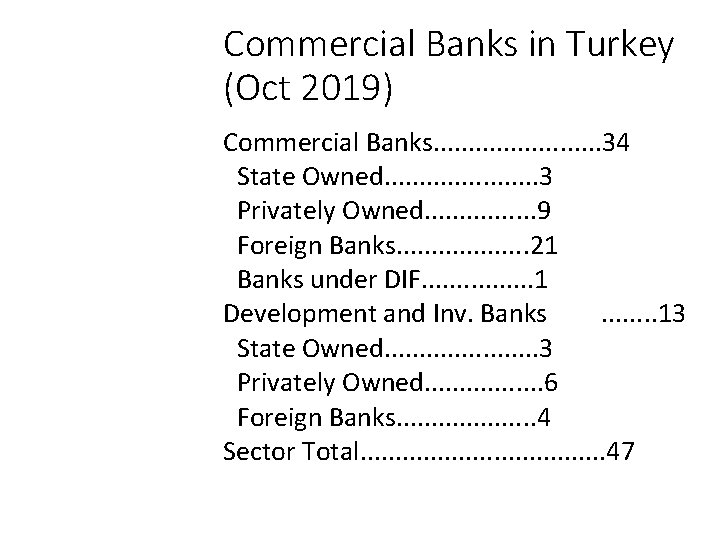
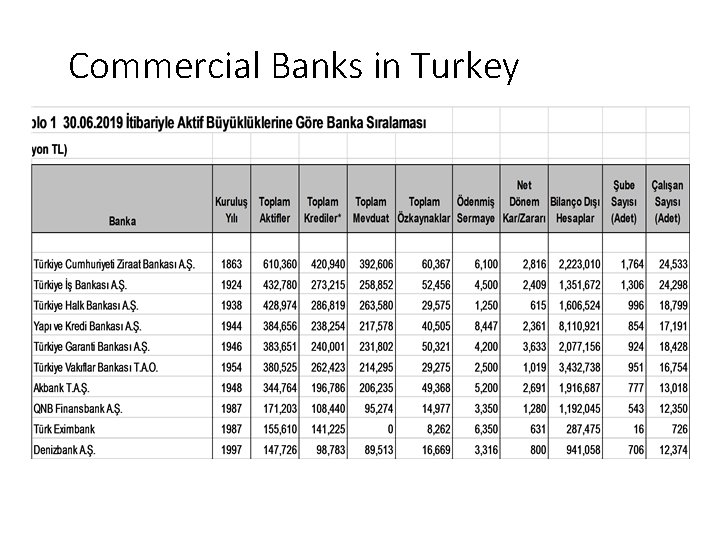
Commercial Banks in Turkey (Oct 2019) Commercial Banks. . . 34 State Owned. . . . . 3 Privately Owned. . . . 9 Foreign Banks. . . . . 21 Banks under DIF. . . . 1 Development and Inv. Banks. . . . 13 State Owned. . . . . 3 Privately Owned. . . . 6 Foreign Banks. . . . . 4 Sector Total. . . . . 47
THE NATURE OF BANKING SERVICES • Broad classification of services: • Individual banking • Institutional banking • Global banking
INDIVIDUAL BANKING • Consumer loans, mortgage loans, credit cards, brokerage services. . etc.
INSTITUTIONAL BANKING • Loans to non-financial institutions, government entities. Commercial real estate financing, leasing, factoring. • Management of assets (mutual funds), check clearing and electronic transfers.
GLOBAL BANKING • Covers corporate finance, capital markets and foreign exchage services, investment banking firms. • Corporate financing; • Underwriting of securities, Banker’s acceptances, L/C. • Advices on obtaining funds, corp. restructuring, divestitures&acquisitions. • Interest rate swaps, currency swaps, forward contracts, interest rate options etc. . .
BALANCE SHEET STRUCTURE OF COMMERCIAL BANKS
ASSETS • Liquid Assets • Cash • Central Bank • Due from Banks • Investment Securities (T-bills, Repos, Debt ad Equity securites and etc) • Bank Loans (Working Cap. Loan- Term Loan) (Leases and Foctoring reveivables) • Commercial Loans • Consumer Loans • Real Estate Loans etc. • Fixed Assets
LIABILITIES AND EQUITY CAPITAL • Deposits • Borrowed Funds • Equity Capital
DEPOSITS • Deposits are the main source of funding. They can be categorized based on; • Maturity • Depositors • Negotiability
DEPOSITS Accoring to maturity, bank deposits are categorized as; • Demand deposits (Checking Account): • Time deposits • One month • Three-month • Six-month • One year
DEPOSITS According to depositors; • Saving deposits • Commercial deposits • Interbank deposits • Official deposits
DEPOSITS • According to negotiability; • Negotiable deposits (Certificate of Deposits, CDs) • Non-negotiable deposits (All others)
BORROWED FUNDS • Borrowed Funds (Non Depository Funds ): • Interbank funds borrowed • Borrowing from; • Central bank • Other banks • Abroad. • Debentures
EQUITY CAPITAL • Common stock • Paid in Capital • Retained Earnings
B/S OF TURKISH BANKS • Assets • Liquid Assets • Cash and Central Bank • Due from banks • Receivables from money market • Financial assets ready to sell • Bank Loans • Loan Reveivables • Factoring receivables • Assets holding up-to maturity • Subsidiaries • Leasing receivables • Derivatives for hedging • Fixed Assets
• Liabilities • Deposits • Financial derivative liab. for buying and selling purposes • Issued securities • Funds • Foreign liabilities • Financial derivative liab. for hedging • Reserves • Tax liabilies • Loans on fixed assets for buying and selling purposes
• Shareholders’ Equity - paid-in capital, - reserves, - net current year income.
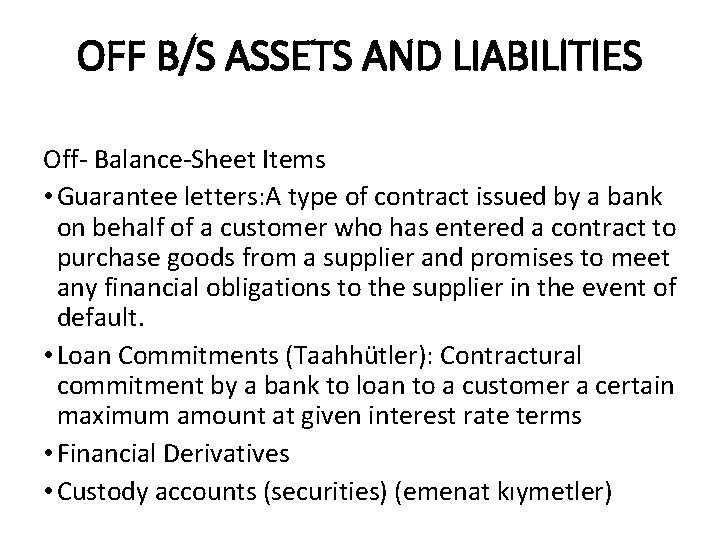
OFF B/S ASSETS AND LIABILITIES Off- Balance-Sheet Items • Guarantee letters: A type of contract issued by a bank on behalf of a customer who has entered a contract to purchase goods from a supplier and promises to meet any financial obligations to the supplier in the event of default. • Loan Commitments (Taahhütler): Contractural commitment by a bank to loan to a customer a certain maximum amount at given interest rate terms • Financial Derivatives • Custody accounts (securities) (emenat kıymetler)
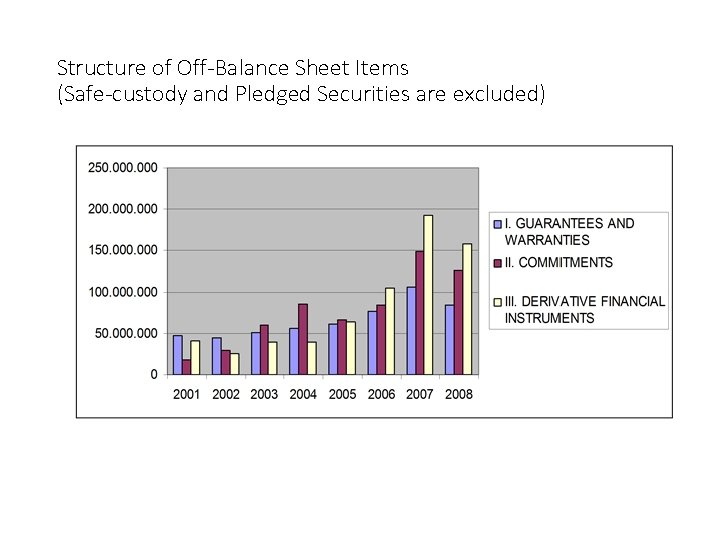
Structure of Off-Balance Sheet Items (Safe-custody and Pledged Securities are excluded)
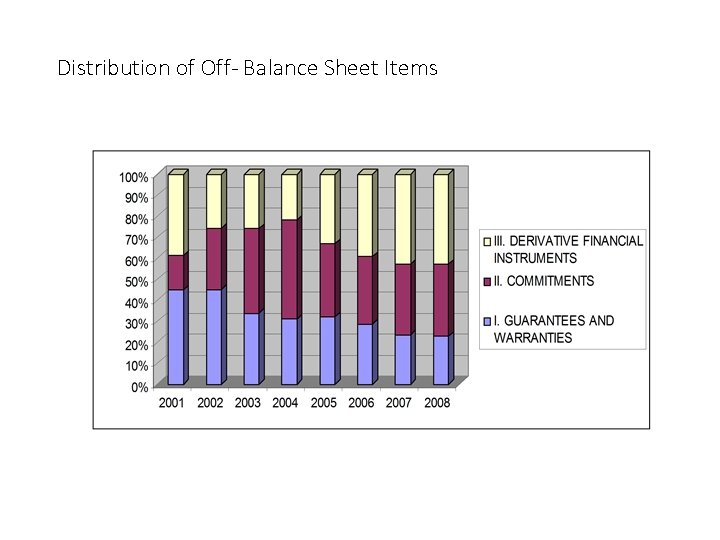
Distribution of Off- Balance Sheet Items
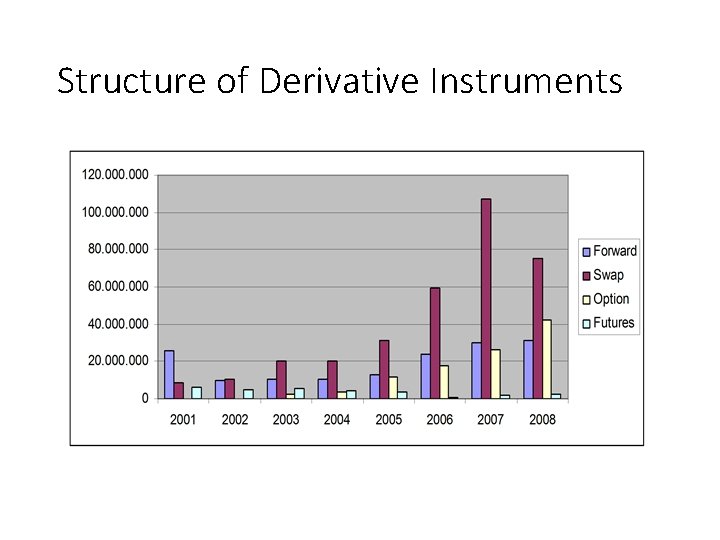
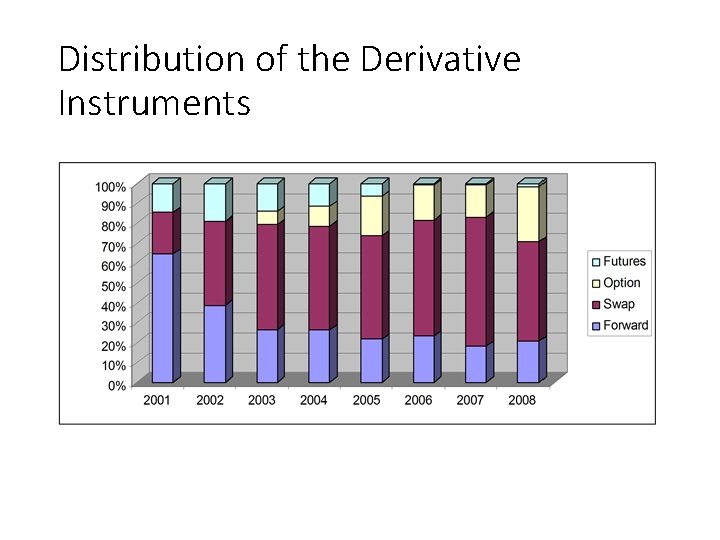
Structure of Derivative Instruments
Distribution of the Derivative Instruments
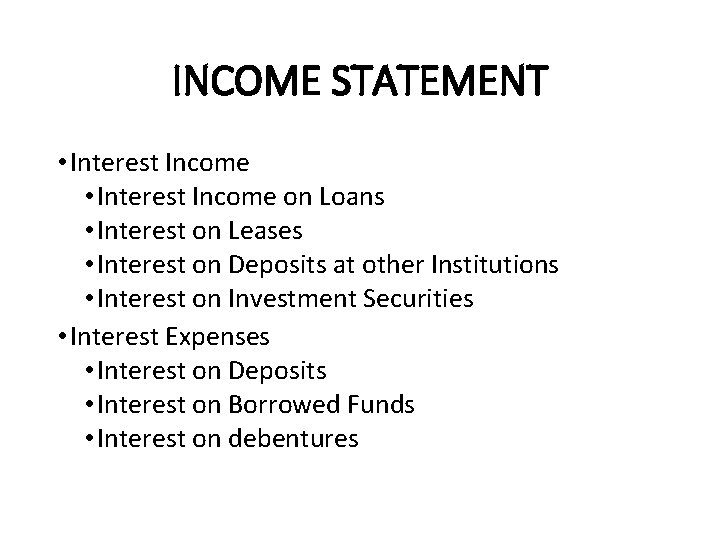
INCOME STATEMENT • Interest Income on Loans • Interest on Leases • Interest on Deposits at other Institutions • Interest on Investment Securities • Interest Expenses • Interest on Deposits • Interest on Borrowed Funds • Interest on debentures
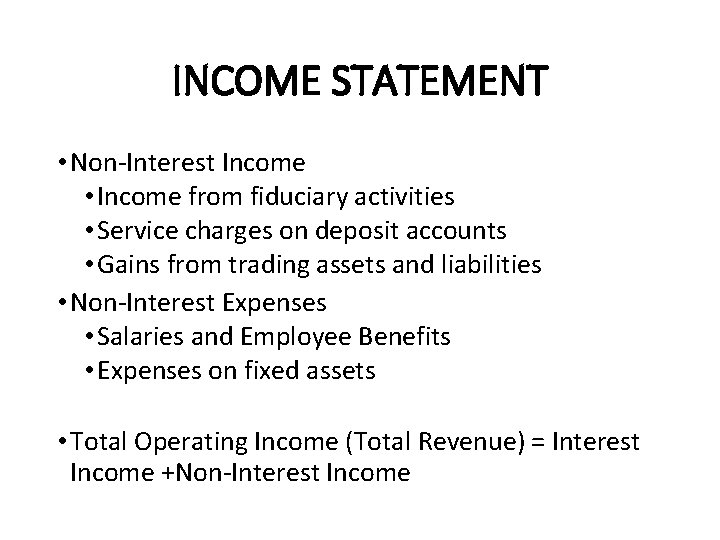
INCOME STATEMENT • Non-Interest Income • Income from fiduciary activities • Service charges on deposit accounts • Gains from trading assets and liabilities • Non-Interest Expenses • Salaries and Employee Benefits • Expenses on fixed assets • Total Operating Income (Total Revenue) = Interest Income +Non-Interest Income
Commercial Banks in Turkey
FINANCIAL STATEMENT ANALYSIS • Financial statement analysis is based on accounting ratios • Time series analysis is the analysis of financial statements over a period of time • Cross-sectional analysis is the analysis of financial statements comparing one firm with others • Most financial statement analyses is a combination of time series analysis and cross-sectional analysis
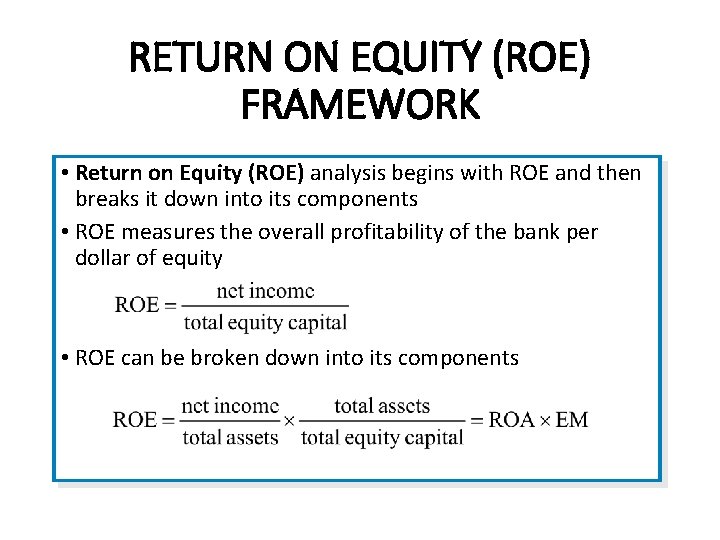
RETURN ON EQUITY (ROE) FRAMEWORK • Return on Equity (ROE) analysis begins with ROE and then breaks it down into its components • ROE measures the overall profitability of the bank per dollar of equity • ROE can be broken down into its components
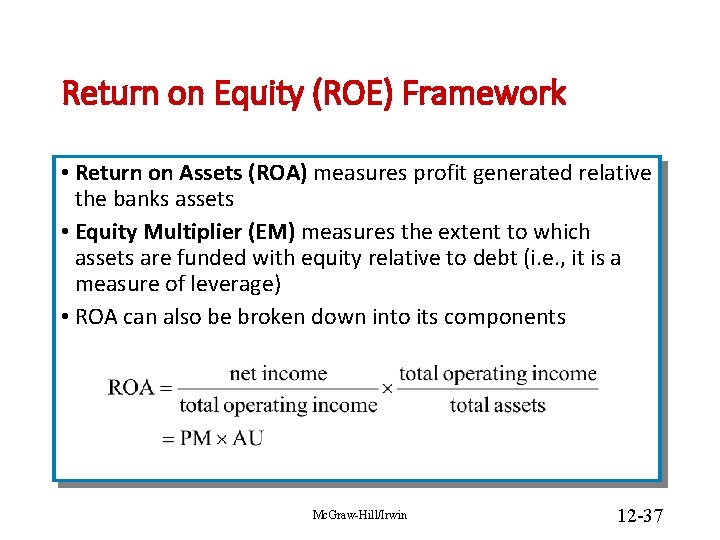
Return on Equity (ROE) Framework • Return on Assets (ROA) measures profit generated relative the banks assets • Equity Multiplier (EM) measures the extent to which assets are funded with equity relative to debt (i. e. , it is a measure of leverage) • ROA can also be broken down into its components Mc. Graw-Hill/Irwin 12 -37
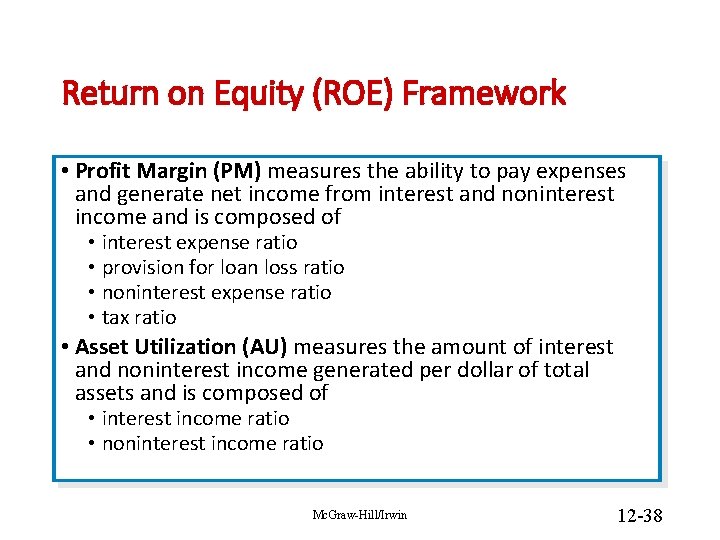
Return on Equity (ROE) Framework • Profit Margin (PM) measures the ability to pay expenses and generate net income from interest and noninterest income and is composed of • interest expense ratio • provision for loan loss ratio • noninterest expense ratio • tax ratio • Asset Utilization (AU) measures the amount of interest and noninterest income generated per dollar of total assets and is composed of • interest income ratio • noninterest income ratio Mc. Graw-Hill/Irwin 12 -38
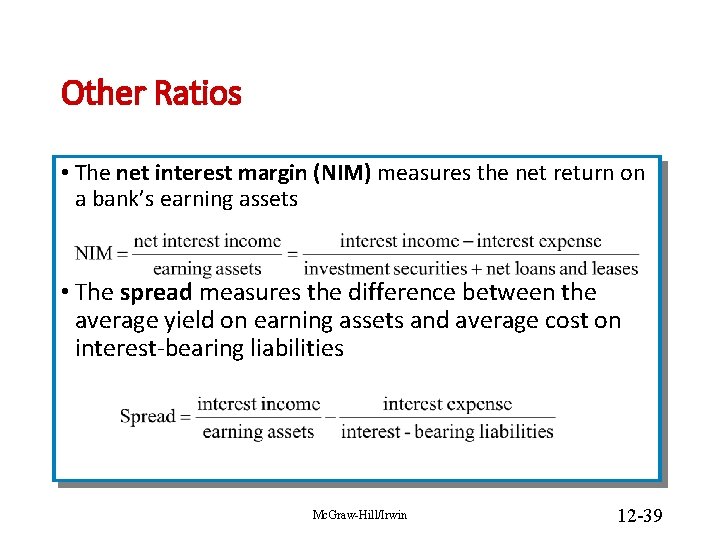
Other Ratios • The net interest margin (NIM) measures the net return on a bank’s earning assets • The spread measures the difference between the average yield on earning assets and average cost on interest-bearing liabilities Mc. Graw-Hill/Irwin 12 -39
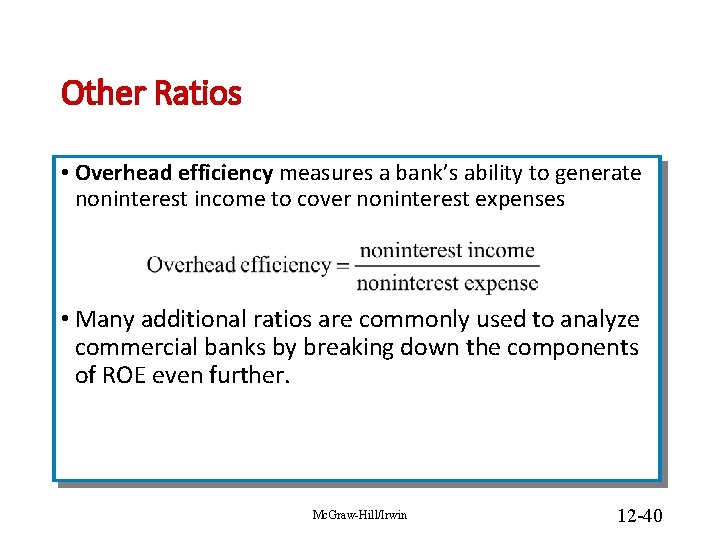
Other Ratios • Overhead efficiency measures a bank’s ability to generate noninterest income to cover noninterest expenses • Many additional ratios are commonly used to analyze commercial banks by breaking down the components of ROE even further. Mc. Graw-Hill/Irwin 12 -40