
Chapter 3 Depository Institutions BA 543 Financial Markets
Chapter 3 – Depository Institutions BA 543 Financial Markets and Institutions
Chapter 3 – Depository Institutions n Types n n Commercial Banks (Check-writing Institutions) Savings and Loans (NOW accounts) Savings Banks (NOW accounts) Credit Units (Share Draft accounts) n Basic Business n n Receive Deposits (Funds Borrowed from Customers) – Demand Deposits Charge Fees for Services Invest: Loans to Customers or Securities Provide Conveniences (Checking or NOW Accounts)
Chapter 3 – Depository Institutions n Commercial Banks n Two major Types n Banking Act of 1863 established National Banks § Office of the Comptroller of Currency Regulation Authority n n n National Banks – Federal Charter and must be insured by Bank Insurance Fund or BIF (administered by FDIC) State Banks – State Chartered each State Regulates State Banks may elect to join Federal System and if they do must insure with BIF (about 15% elect to join) n Federal Reserve Act of 1913 - Established Federal Reserve System n Today about 7, 100 FDIC insured or supervised n http: //www. federalreserve. gov/releases/lbr/current/default. htm n http: //www. fdic. gov/bank/statistical
Chapter 3 – Depository Institutions n Savings and Loan Association n Assets – Traditionally Mortgages and Mortgage Backed Securities n Liabilities (Funding) – Passbook Savings n n Regulation n Today NOW accounts Originally - Home Owners Loan Act of 1933 Now – Federal S&Ls by Office of Thrift Supervisor S&L Crisis of the 1980 s - Disintermediation
Chapter 3 – Depository Institutions n Savings Banks n Similar to S&Ls n Broader Assets and so they weathered the interest changes of the 80 s n Credit Unions n Common Bond among members n Cooperative or Mutual – No Corporate Stock n Numbers bigger than commercial banks but total assets very small compared to commercial banks n Typically strong local player in banking

Chapter 3 – Depository Institutions n Bank Funding n Demand Deposits – Checking and Savings n Regional Banks rely primarily on demand deposits Time Deposits – Certificates of Deposit n Borrowed Funds – Fed Window (Bank of last resort) n Selling of Securities n n Short Term Notes, Bonds, Repos, etc. Money Center Banks rely on this form of funding Reserve Requirement – More Later
Chapter 3 – Depository Institutions n Income Generation n Individual Banking – charges for services n n n Institutional Banking –charges for services n n Fees for checking, mortgage origination, credit cards, trusts, etc. Spread on consumer loans Commercial and Real Estate Financing, Leasing, Factoring Accounts Receivable, etc. Global Banking n n Bond Dealers, Currency Dealers, Banker’s Acceptance, Letters of Credit, etc. Financial Products such as SWAPS
Chapter 3 – Depository Institutions n Asset/Liability Problem n Credit (Default) Risk n n n Regulatory Risk n n Rule changes adversely impact income of bank Interest Rate Risk – Example n n Loans are not fully backed by assets Defaults on personal loans Borrow $1 million for 1 year at 5% Buy $1 million Five year Zero Coupon Bond at 7% Interest rates raise to 8% in year two Liquidity Issues n Ways to pay off demand deposits
Chapter 3 – Depository Institutions n Capital Requirements n Very Low Equity Stake n n Tier One and Tier Two n n Different types of Equity Holdings Risk Weights of Assets n n n Equity Stake is the “risk” position of owners TABLE 3 -3 Page 50 Arrived at on no particular scientific basis Basle Committee on Banking Regulations and Supervisory Practices 1988 (G-10 Countries)
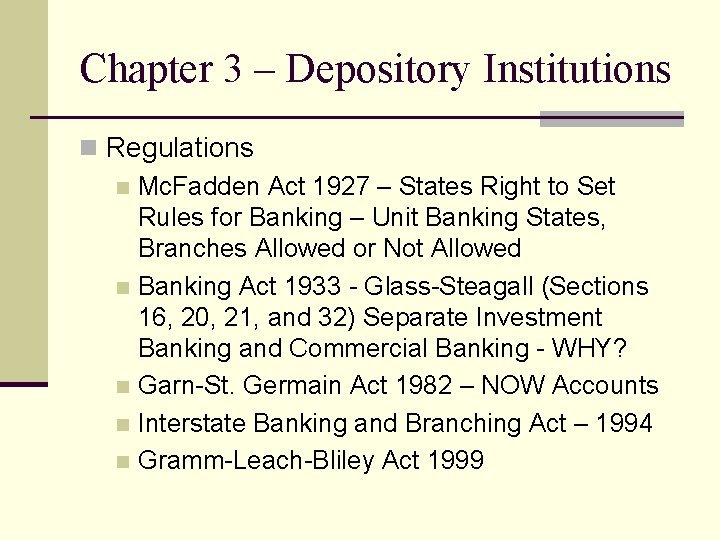
Chapter 3 – Depository Institutions n Regulations n Mc. Fadden Act 1927 – States Right to Set Rules for Banking – Unit Banking States, Branches Allowed or Not Allowed n Banking Act 1933 - Glass-Steagall (Sections 16, 20, 21, and 32) Separate Investment Banking and Commercial Banking - WHY? n Garn-St. Germain Act 1982 – NOW Accounts n Interstate Banking and Branching Act – 1994 n Gramm-Leach-Bliley Act 1999
- Slides: 10