
Chapter 3 David Ricardo and Comparative Advantage David




- Slides: 28
Chapter 3 David Ricardo and Comparative Advantage
David Ricardo • A stock broker, member of parliament and brilliant economic thinker • He read “The Wealth of Nations” while on holiday in 1790 and studied political economy from then on.
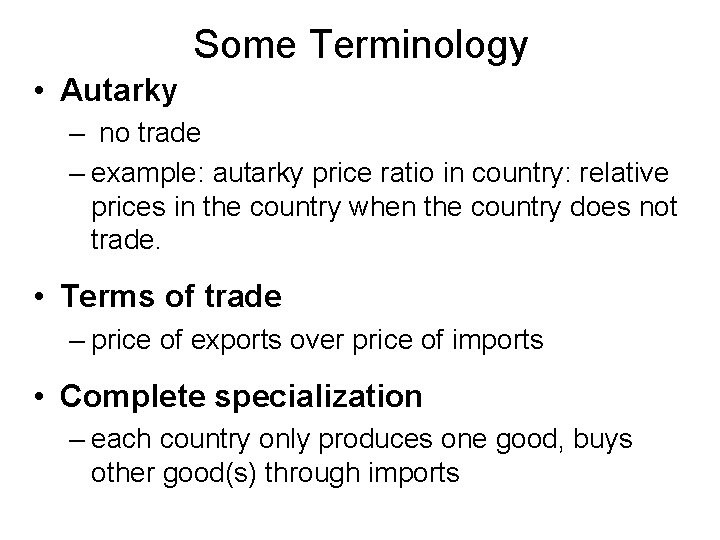
Some Terminology • Autarky – no trade – example: autarky price ratio in country: relative prices in the country when the country does not trade. • Terms of trade – price of exports over price of imports • Complete specialization – each country only produces one good, buys other good(s) through imports
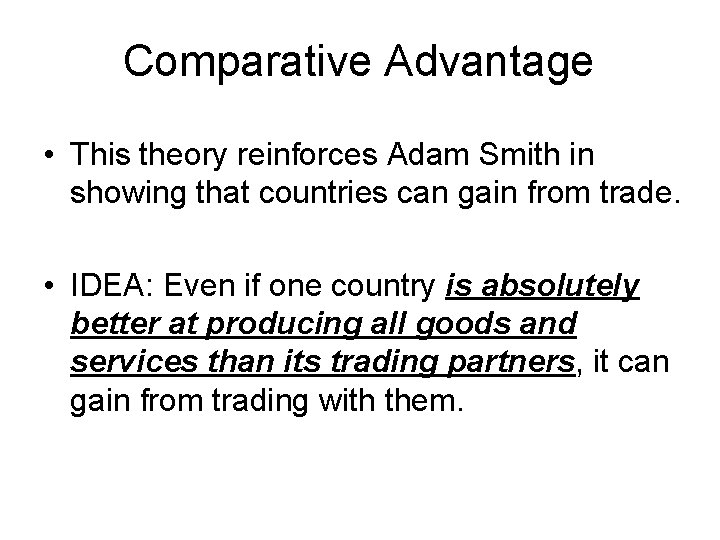
Comparative Advantage • This theory reinforces Adam Smith in showing that countries can gain from trade. • IDEA: Even if one country is absolutely better at producing all goods and services than its trading partners, it can gain from trading with them.
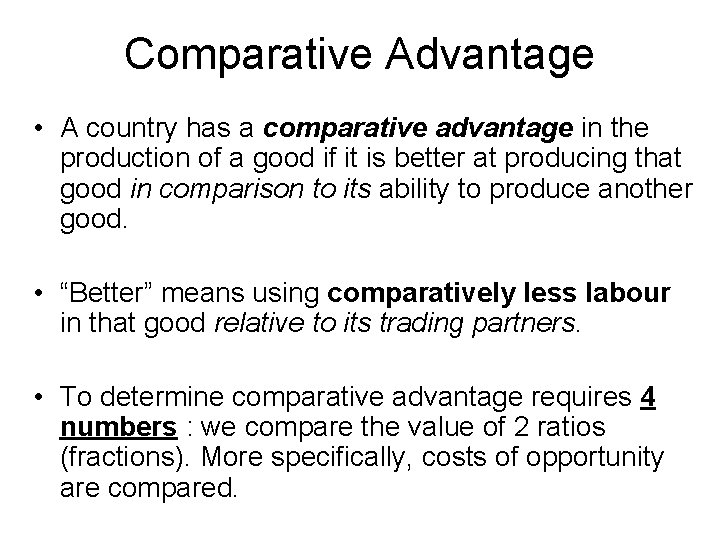
Comparative Advantage • A country has a comparative advantage in the production of a good if it is better at producing that good in comparison to its ability to produce another good. • “Better” means using comparatively less labour in that good relative to its trading partners. • To determine comparative advantage requires 4 numbers : we compare the value of 2 ratios (fractions). More specifically, costs of opportunity are compared.
Ricardo and Trade • Trade can benefit all countries by making goods cheaper for consumers and by allowing more goods to be produced by all countries. • His example: cloth production and wine production between England Portugal.
• barrel (bbl) Unit of volume for crude oil and petroleum products. • One barrel equals 42 US gallons or 35 UK (imperial) gallons, or approximately 159 liters
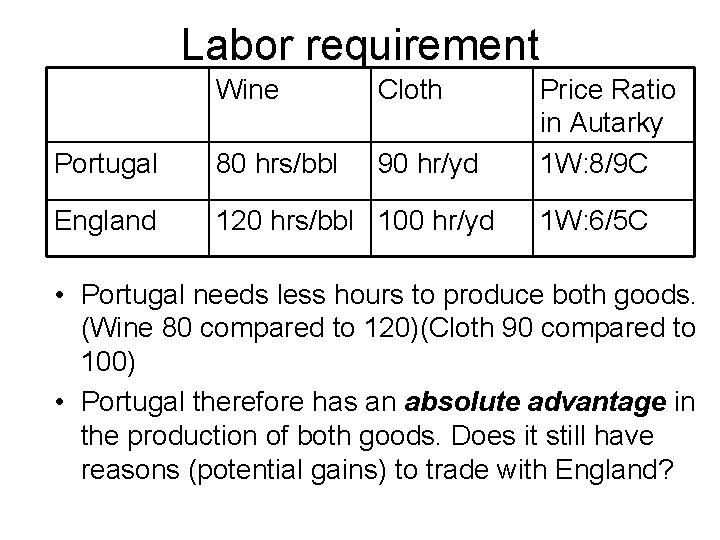
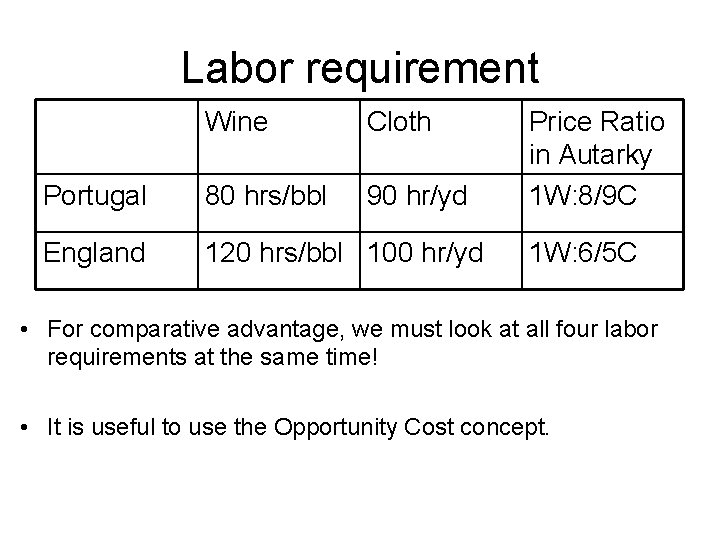
Labor requirement Wine Cloth Portugal 80 hrs/bbl 90 hr/yd England 120 hrs/bbl 100 hr/yd Price Ratio in Autarky 1 W: 8/9 C 1 W: 6/5 C • Portugal needs less hours to produce both goods. (Wine 80 compared to 120)(Cloth 90 compared to 100) • Portugal therefore has an absolute advantage in the production of both goods. Does it still have reasons (potential gains) to trade with England?
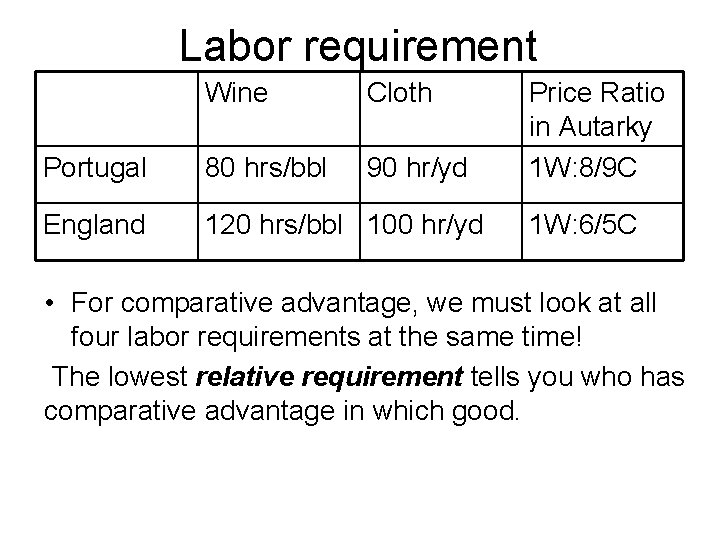
Labor requirement Wine Cloth Portugal 80 hrs/bbl 90 hr/yd England 120 hrs/bbl 100 hr/yd Price Ratio in Autarky 1 W: 8/9 C 1 W: 6/5 C • For comparative advantage, we must look at all four labor requirements at the same time! The lowest relative requirement tells you who has comparative advantage in which good.
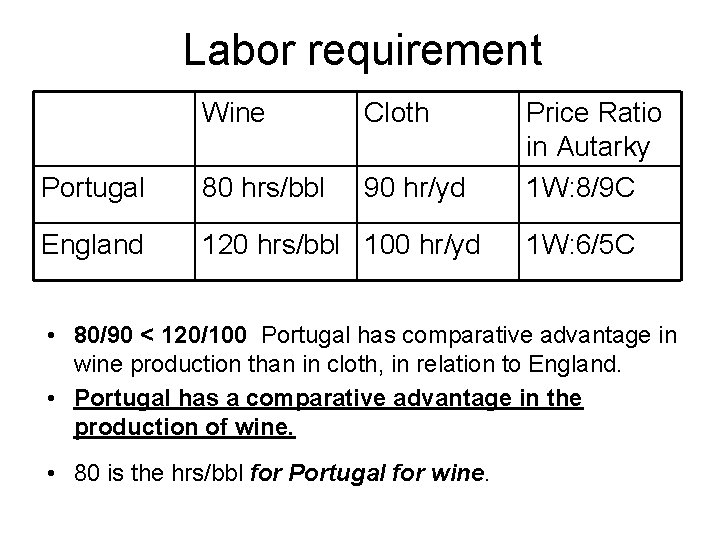
Labor requirement Wine Cloth Portugal 80 hrs/bbl 90 hr/yd England 120 hrs/bbl 100 hr/yd Price Ratio in Autarky 1 W: 8/9 C 1 W: 6/5 C • 80/90 < 120/100 Portugal has comparative advantage in wine production than in cloth, in relation to England. • Portugal has a comparative advantage in the production of wine. • 80 is the hrs/bbl for Portugal for wine.
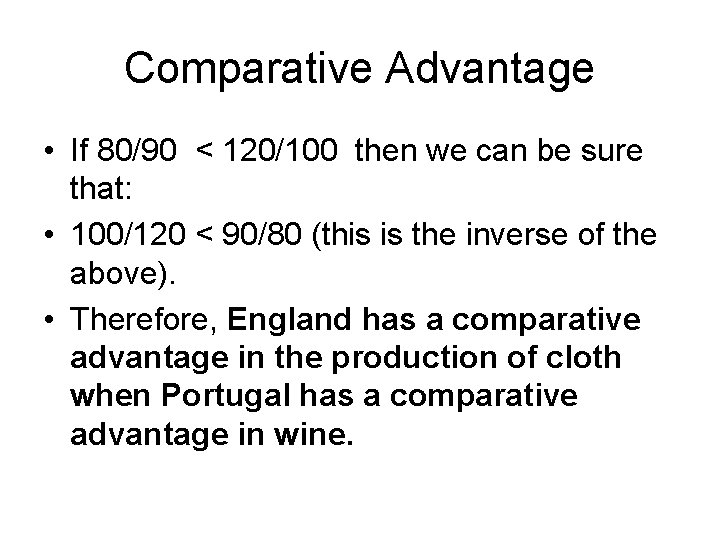
Comparative Advantage • If 80/90 < 120/100 then we can be sure that: • 100/120 < 90/80 (this is the inverse of the above). • Therefore, England has a comparative advantage in the production of cloth when Portugal has a comparative advantage in wine.
Labor requirement Wine Cloth Portugal 80 hrs/bbl 90 hr/yd England 120 hrs/bbl 100 hr/yd Price Ratio in Autarky 1 W: 8/9 C 1 W: 6/5 C • For comparative advantage, we must look at all four labor requirements at the same time! • It is useful to use the Opportunity Cost concept.
Opportunity Cost • Can be defined as how much you must give up of one product in order to obtain the other.
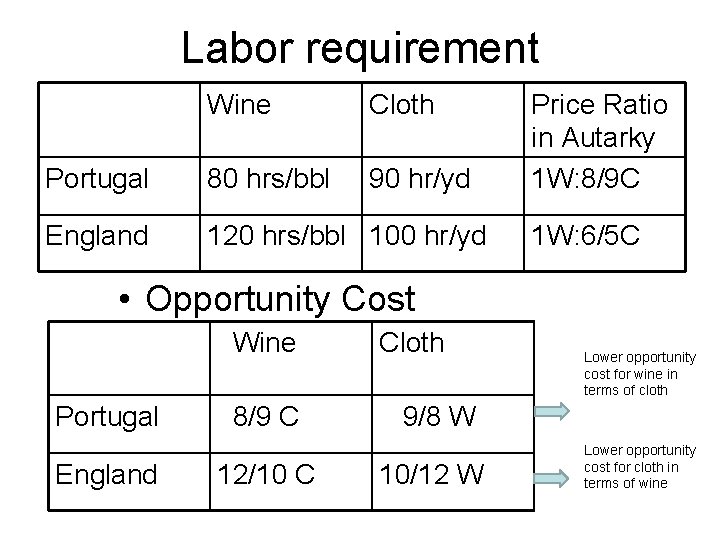
Labor requirement Wine Cloth Portugal 80 hrs/bbl 90 hr/yd England 120 hrs/bbl 100 hr/yd Price Ratio in Autarky 1 W: 8/9 C 1 W: 6/5 C • Opportunity Cost Wine Portugal England 8/9 C 12/10 C Cloth Lower opportunity cost for wine in terms of cloth 9/8 W 10/12 W Lower opportunity cost for cloth in terms of wine
Labor requirement • According to classical trade theory, Portugal should produce only Wine, • England should produce only Cloth • If they specialize in what they have lower opportunity cost and trade for the good for which they have higher opportunity cost, both countries can gain from trade.
Gains from Trade • Ricardo used a different method to discuss gains from trade than we did in the last class (absolute advantage). • He argued that, as long as a country could SAVE time or buy more of a good by trading, there is a gain. • He did not bother with the total production of the country, but illustrated gains from the production of One unit.
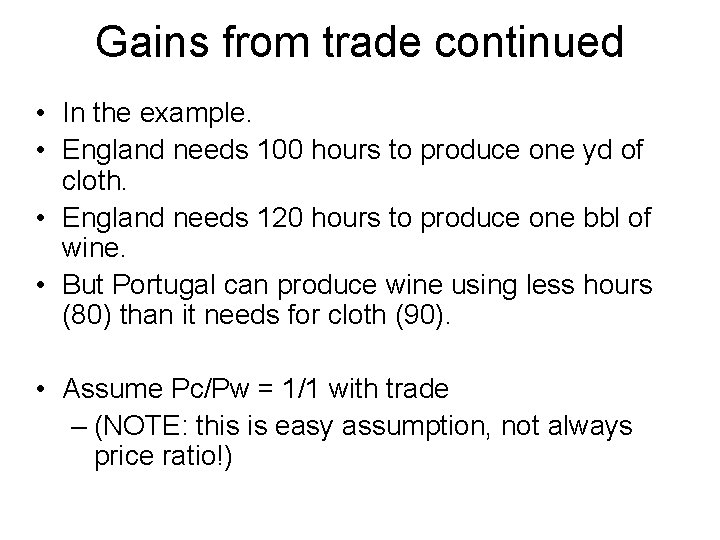
Gains from trade continued • In the example. • England needs 100 hours to produce one yd of cloth. • England needs 120 hours to produce one bbl of wine. • But Portugal can produce wine using less hours (80) than it needs for cloth (90). • Assume Pc/Pw = 1/1 with trade – (NOTE: this is easy assumption, not always price ratio!)
Gains from trade continued • If international prices are 1 C: 1 W • England can use 120 hours to produce one bbl of wine itself (producing wine directly). OR • England can use 100 hours to produce a yard of cloth which it can sell for one bbl of wine (he called this indirectly producing wine). • Therefore it seems to be better producing wine indirectly, which is producing cloth and exchanging for wine.
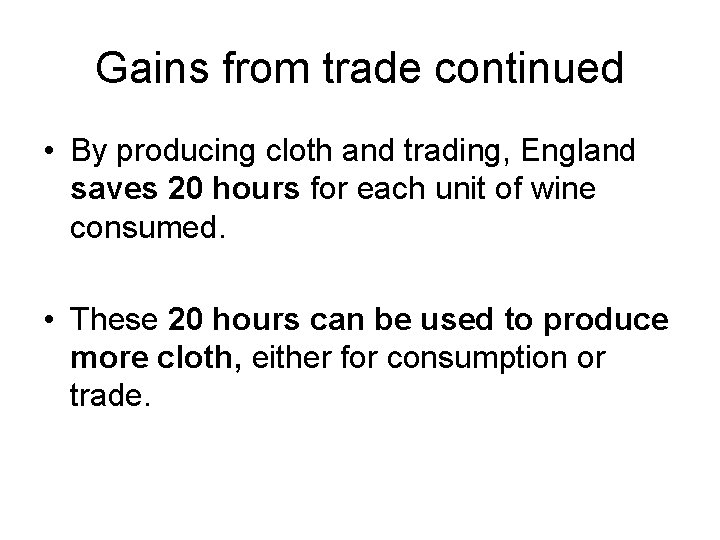
Gains from trade continued • By producing cloth and trading, England saves 20 hours for each unit of wine consumed. • These 20 hours can be used to produce more cloth, either for consumption or trade.
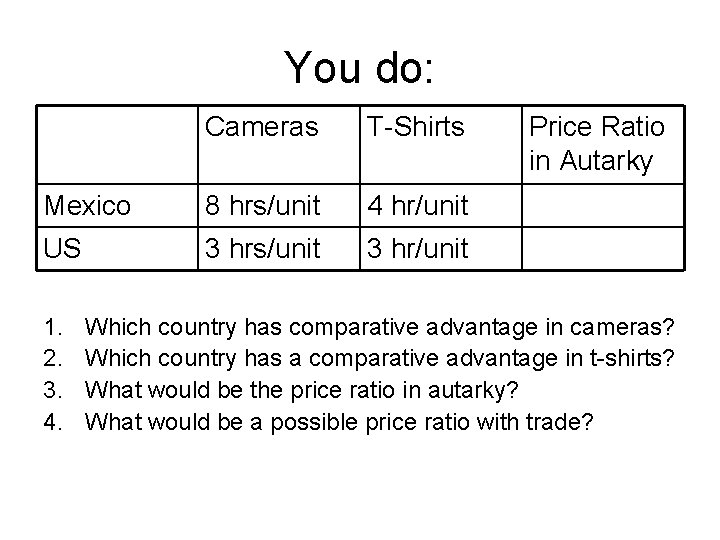
You do: Cameras T-Shirts Mexico 8 hrs/unit 4 hr/unit US 3 hrs/unit 3 hr/unit 1. 2. 3. 4. Price Ratio in Autarky Which country has comparative advantage in cameras? Which country has a comparative advantage in t-shirts? What would be the price ratio in autarky? What would be a possible price ratio with trade?
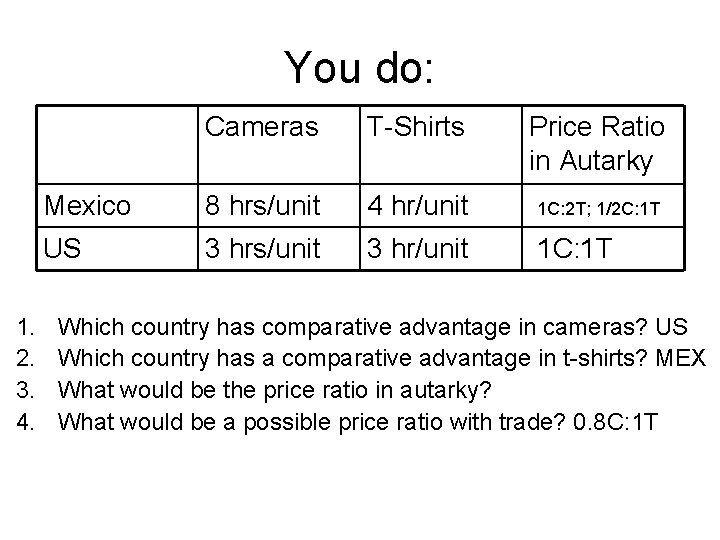
You do: 1. 2. 3. 4. Cameras T-Shirts Price Ratio in Autarky Mexico 8 hrs/unit 4 hr/unit 1 C: 2 T; 1/2 C: 1 T US 3 hrs/unit 3 hr/unit 1 C: 1 T Which country has comparative advantage in cameras? US Which country has a comparative advantage in t-shirts? MEX What would be the price ratio in autarky? What would be a possible price ratio with trade? 0. 8 C: 1 T
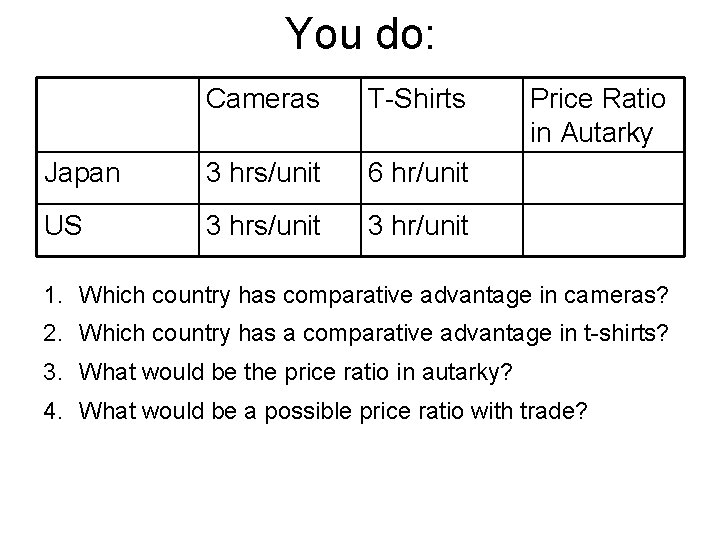
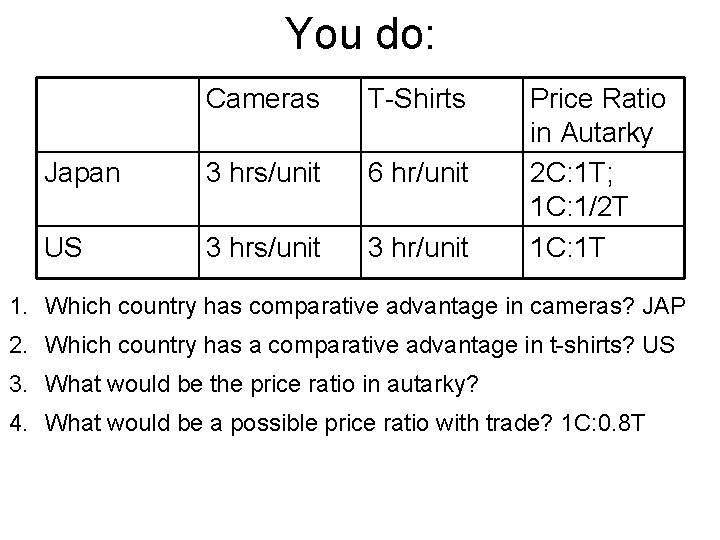
You do: Cameras T-Shirts Japan 3 hrs/unit 6 hr/unit US 3 hrs/unit 3 hr/unit Price Ratio in Autarky 1. Which country has comparative advantage in cameras? 2. Which country has a comparative advantage in t-shirts? 3. What would be the price ratio in autarky? 4. What would be a possible price ratio with trade?
You do: Cameras T-Shirts Japan 3 hrs/unit 6 hr/unit US 3 hrs/unit 3 hr/unit Price Ratio in Autarky 2 C: 1 T; 1 C: 1/2 T 1 C: 1 T 1. Which country has comparative advantage in cameras? JAP 2. Which country has a comparative advantage in t-shirts? US 3. What would be the price ratio in autarky? 4. What would be a possible price ratio with trade? 1 C: 0. 8 T
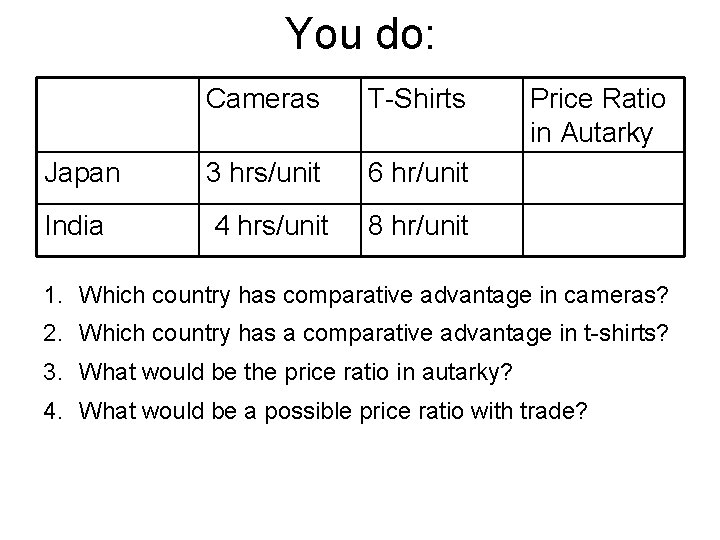
You do: Cameras T-Shirts Japan 3 hrs/unit 6 hr/unit India 4 hrs/unit 8 hr/unit Price Ratio in Autarky 1. Which country has comparative advantage in cameras? 2. Which country has a comparative advantage in t-shirts? 3. What would be the price ratio in autarky? 4. What would be a possible price ratio with trade?
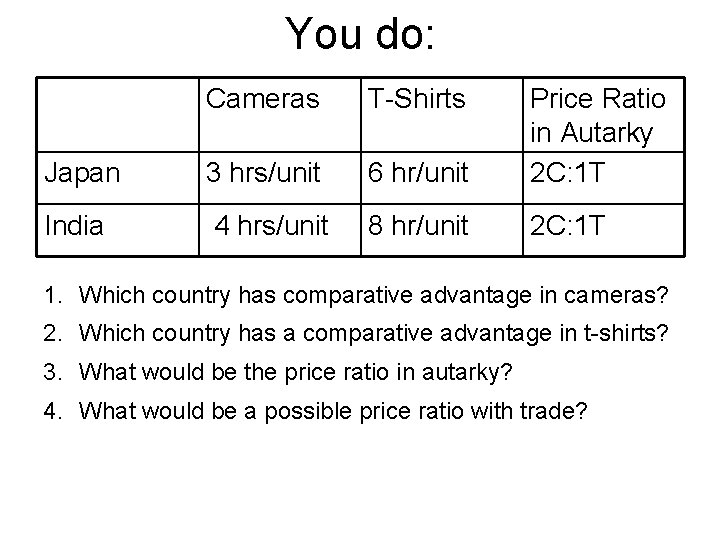
You do: Cameras T-Shirts Japan 3 hrs/unit 6 hr/unit Price Ratio in Autarky 2 C: 1 T India 4 hrs/unit 8 hr/unit 2 C: 1 T 1. Which country has comparative advantage in cameras? 2. Which country has a comparative advantage in t-shirts? 3. What would be the price ratio in autarky? 4. What would be a possible price ratio with trade?
What do we learn from these questions?
Gains from trade (if time permits) • Look at examples 1, 2 and 3. • I will put terms of trade on the board. • Determine how much time each country can save by producing the good in which it has a comparative advantage and trading for the other good. Determine this time saving if the country does this for 1 million units of the good.