
Chapter 3 Data Modeling Using the Entity Relationship
- Slides: 33
Chapter 3 Data Modeling Using the Entity. Relationship (ER) Model Copyright © 2007 Ramez Elmasri and Shamkant B. Navathe
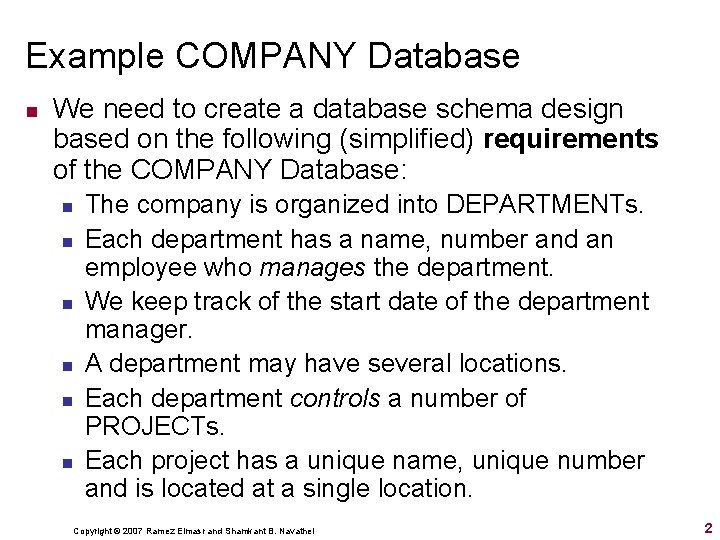
Example COMPANY Database n We need to create a database schema design based on the following (simplified) requirements of the COMPANY Database: n n n The company is organized into DEPARTMENTs. Each department has a name, number and an employee who manages the department. We keep track of the start date of the department manager. A department may have several locations. Each department controls a number of PROJECTs. Each project has a unique name, unique number and is located at a single location. Copyright © 2007 Ramez Elmasr and Shamkant B. Navathei 2
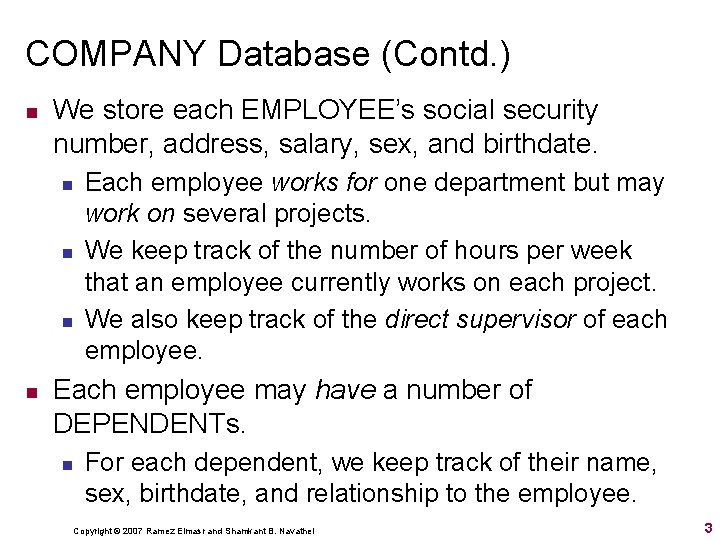
COMPANY Database (Contd. ) n We store each EMPLOYEE’s social security number, address, salary, sex, and birthdate. n n Each employee works for one department but may work on several projects. We keep track of the number of hours per week that an employee currently works on each project. We also keep track of the direct supervisor of each employee. Each employee may have a number of DEPENDENTs. n For each dependent, we keep track of their name, sex, birthdate, and relationship to the employee. Copyright © 2007 Ramez Elmasr and Shamkant B. Navathei 3
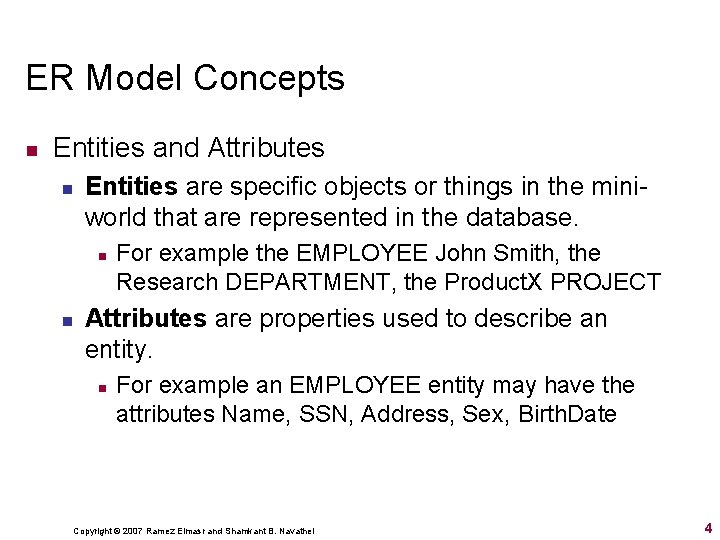
ER Model Concepts n Entities and Attributes n Entities are specific objects or things in the miniworld that are represented in the database. n n For example the EMPLOYEE John Smith, the Research DEPARTMENT, the Product. X PROJECT Attributes are properties used to describe an entity. n For example an EMPLOYEE entity may have the attributes Name, SSN, Address, Sex, Birth. Date Copyright © 2007 Ramez Elmasr and Shamkant B. Navathei 4
Entity Types and Key Attributes (1) n Entities with the same basic attributes are grouped or typed into an entity type. n n For example, the entity type EMPLOYEE and PROJECT. An attribute of an entity type for which each entity must have a unique value is called a key attribute of the entity type. n For example, SSN of EMPLOYEE. Copyright © 2007 Ramez Elmasr and Shamkant B. Navathei 5
Entity Types and Key Attributes (2) n A key can be composite Vehicle. Tag. Number is a key of the CAR entity type with components (Number, State). An entity type may have more than one key. n The CAR entity type may have two keys: n n n Vehicle. Identification. Number (popularly called VIN) Vehicle. Tag. Number (Number, State), aka license plate number. Each key is underlined in ER diagrams Copyright © 2007 Ramez Elmasr and Shamkant B. Navathei 6
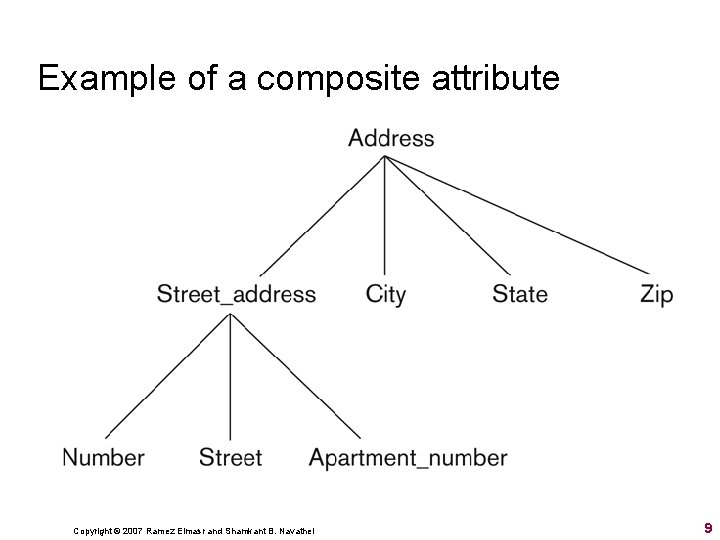
Types of Attributes (1) n n Simple: Each entity has a single atomic value for the attribute. For example, SSN or Sex. Composite: The attribute may be composed of several components. For example: n n Address(Apt#, House#, Street, City, State, Zip. Code, Country) Name(First. Name, Middle. Name, Last. Name). Composition may form a hierarchy where some components are themselves composite. Multi-valued: An entity may have multiple values for that attribute. For example, Color of a CAR or Previous. Degrees of a STUDENT. n Denoted as {Color} or {Previous. Degrees}. Copyright © 2007 Ramez Elmasr and Shamkant B. Navathei 7
Types of Attributes (2) n In general, composite and multi-valued attributes may be nested arbitrarily to any number of levels, although this is rare. n n n For example, Previous. Degrees of a STUDENT is a composite multi-valued attribute denoted by {Previous. Degrees (College, Year, Degree, Field)} Multiple Previous. Degrees values can exist Each has four subcomponent attributes: n College, Year, Degree, Field Copyright © 2007 Ramez Elmasr and Shamkant B. Navathei 8
Example of a composite attribute Copyright © 2007 Ramez Elmasr and Shamkant B. Navathei 9
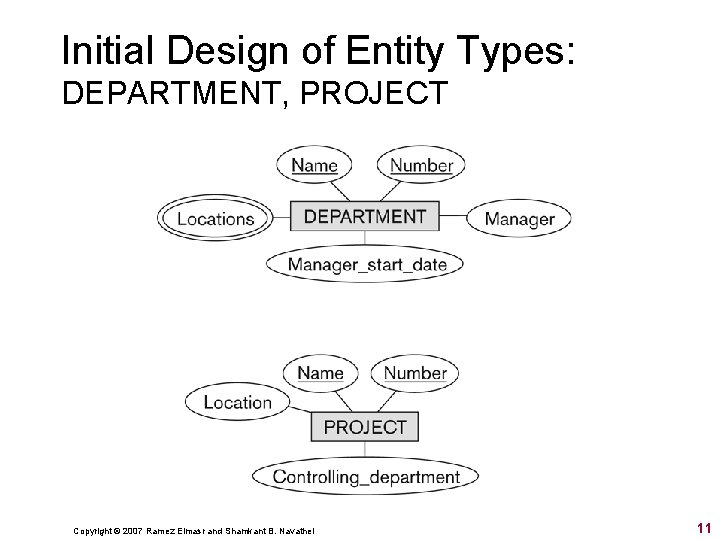
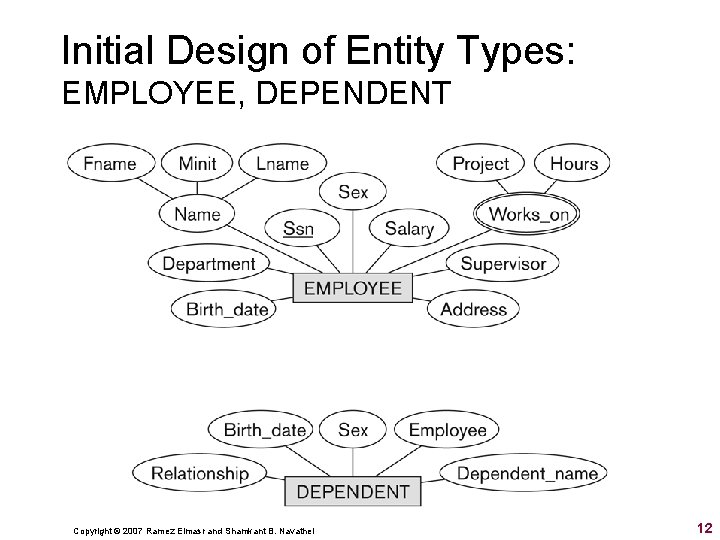
Initial Design of Entity Types for the COMPANY Database Schema n Based on the requirements, we identify four initial entity types in the COMPANY database: n n n DEPARTMENT PROJECT EMPLOYEE DEPENDENT Their initial design is shown on the following slide The initial attributes shown are derived from the requirements description Copyright © 2007 Ramez Elmasr and Shamkant B. Navathei 10
Initial Design of Entity Types: DEPARTMENT, PROJECT Copyright © 2007 Ramez Elmasr and Shamkant B. Navathei 11
Initial Design of Entity Types: EMPLOYEE, DEPENDENT Copyright © 2007 Ramez Elmasr and Shamkant B. Navathei 12
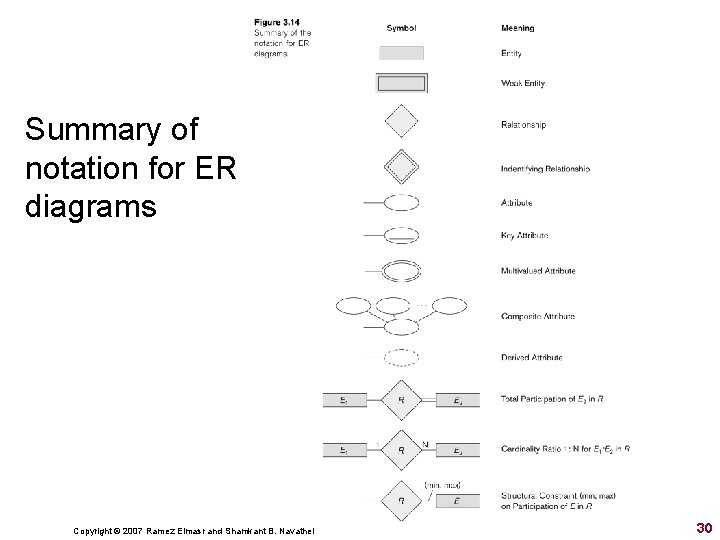
Displaying an Entity type n n In ER diagrams, an entity type is displayed in a rectangular box Attributes are displayed in ovals n n Each attribute is connected to its entity type Components of a composite attribute are connected to the oval representing the composite attribute Each key attribute is underlined Multivalued attributes displayed in double ovals Copyright © 2007 Ramez Elmasr and Shamkant B. Navathei 13
Relationships n A relationship relates two or more distinct entities with a specific meaning. n For example, EMPLOYEE John Smith works on the Product. X PROJECT, or EMPLOYEE Franklin Wong manages the Research DEPARTMENT. Copyright © 2007 Ramez Elmasr and Shamkant B. Navathei 14
Relationship type vs. relationship set (1) n Relationship Type: n n Is the schema description of a relationship Identifies the relationship name and the participating entity types Also identifies certain relationship constraints Relationship Set: n n The current set of relationship instances represented in the database The current state of a relationship type Copyright © 2007 Ramez Elmasr and Shamkant B. Navathei 15
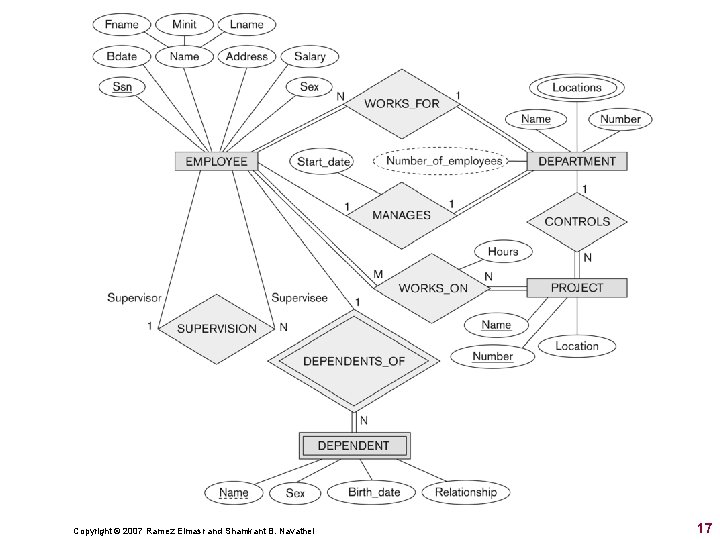
Refining the COMPANY database schema by introducing relationships n Our client identifies six relationship types: n WORKS_FOR (between EMPLOYEE, DEPARTMENT) n MANAGES (also between EMPLOYEE, DEPARTMENT) n CONTROLS (between DEPARTMENT, PROJECT) n WORKS_ON (between EMPLOYEE, PROJECT) n n SUPERVISION (between EMPLOYEE (as subordinate), EMPLOYEE (as supervisor)) DEPENDENTS_OF (between EMPLOYEE, DEPENDENT) Copyright © 2007 Ramez Elmasr and Shamkant B. Navathei 16
Copyright © 2007 Ramez Elmasr and Shamkant B. Navathei 17
Visual Representations of Relationships n In ER diagrams, we represent the relationship as follows: n n Diamond-shaped box is used to display a relationship type Connected to the participating entity types via straight lines Copyright © 2007 Ramez Elmasr and Shamkant B. Navathei 18
The Refinement Process n In the refined design, some attributes from the initial entity types are refined into relationships: n n Manager of DEPARTMENT -> MANAGES Works_on of EMPLOYEE -> WORKS_ON Department of EMPLOYEE -> WORKS_FOR In general, more than one relationship type can exist between the same participating entity types n MANAGES and WORKS_FOR are distinct relationship types between EMPLOYEE and DEPARTMENT Copyright © 2007 Ramez Elmasr and Shamkant B. Navathei 19
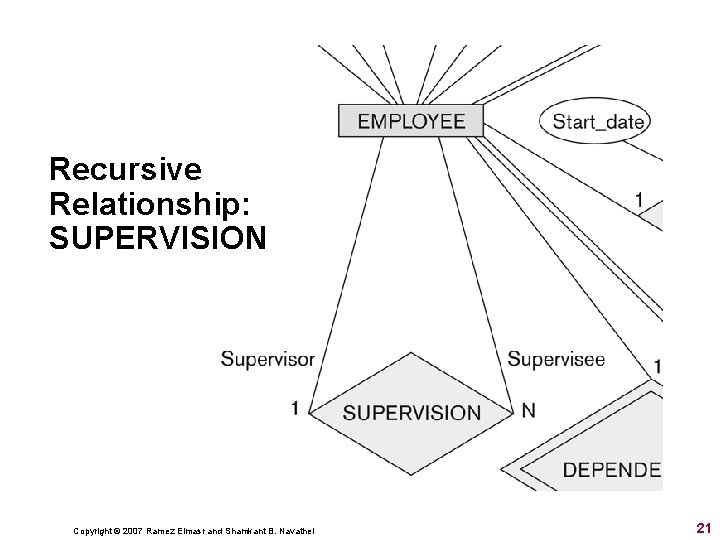
Recursive Relationships n n n An relationship type whose with the same participating entity type in distinct roles Example: the SUPERVISION relationship Each relationship instance relates two distinct EMPLOYEE entities: n n n One employee in supervisor role One employee in supervisee role In ER diagram, need to display role names to distinguish participations. Copyright © 2007 Ramez Elmasr and Shamkant B. Navathei 20
Recursive Relationship: SUPERVISION Copyright © 2007 Ramez Elmasr and Shamkant B. Navathei 21
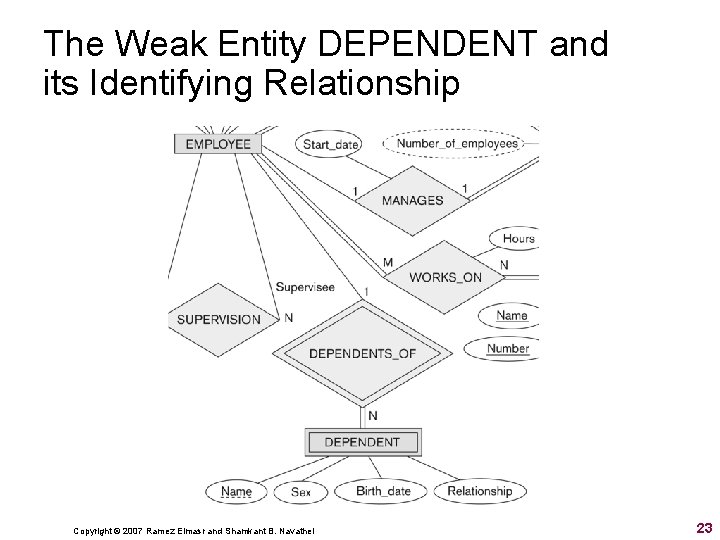
Weak Entity Types n n n An entity that does not have a key attribute (represented by a double rectangles) A weak entity must participate in an identifying relationship type (a double diamond) with an owner or identifying entity type Example: n A DEPENDENT entity is identified by the dependent’s first name, and the specific EMPLOYEE with whom the dependent is related n Name of DEPENDENT is a partial key n DEPENDENT is a weak entity type n EMPLOYEE is its identifying entity type via the identifying relationship type DEPENDENT_OF Copyright © 2007 Ramez Elmasr and Shamkant B. Navathei 22
The Weak Entity DEPENDENT and its Identifying Relationship Copyright © 2007 Ramez Elmasr and Shamkant B. Navathei 23
Constraints on Relationships n Cardinality Ratio Constraint n n One-to-one (1: 1) One-to-many (1: N) or Many-to-one (N: 1) Many-to-many (M: N) Existence Dependency Constraint n n n also called participation constraint zero (optional participation, not existencedependent) one or more (mandatory participation, existencedependent) Copyright © 2007 Ramez Elmasr and Shamkant B. Navathei 24
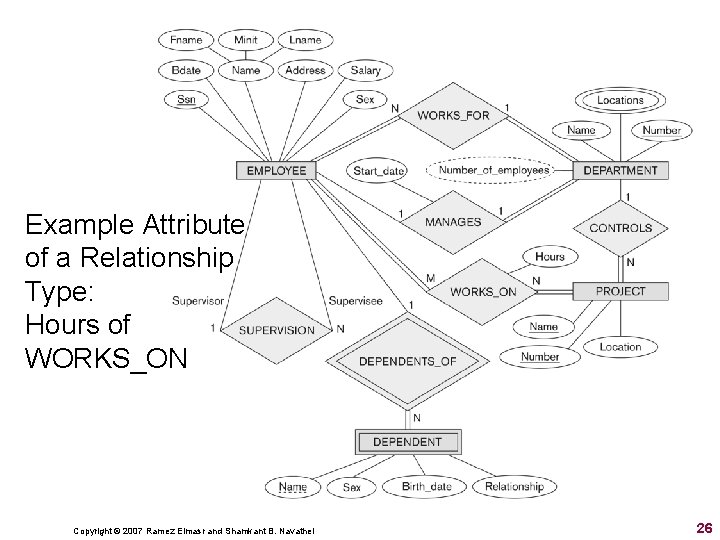
Attributes of Relationships n A relationship type can have attributes: n Example: Hours. Per. Week of WORKS_ON n n n A value of Hours. Per. Week depends on a particular (employee, project) combination Most relationship attributes are used with M: N relationships In 1: N relationships, they can be transferred to the entity type on the N-side of the relationship n Consider the Start_date of the MANAGES relationships Copyright © 2007 Ramez Elmasr and Shamkant B. Navathei 25
Example Attribute of a Relationship Type: Hours of WORKS_ON Copyright © 2007 Ramez Elmasr and Shamkant B. Navathei 26
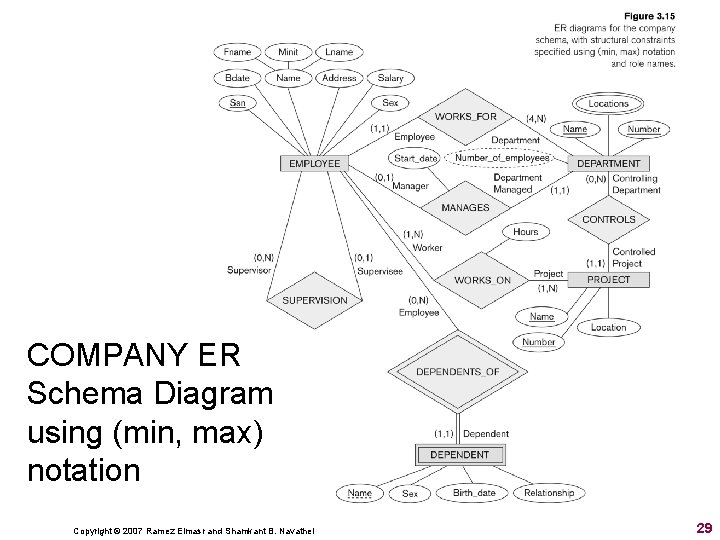
Constraints on Relationships n Cardinality ratio (of a binary relationship): 1: 1, 1: N, N: 1, or M: N n n Participation constraint (on each participating entity type): total (called existence dependency) or partial. n n Shown by placing appropriate numbers on the relationship edges. Total shown by double line, partial by single line. NOTE: These are easy to specify for Binary Relationship Types. Copyright © 2007 Ramez Elmasr and Shamkant B. Navathei 27
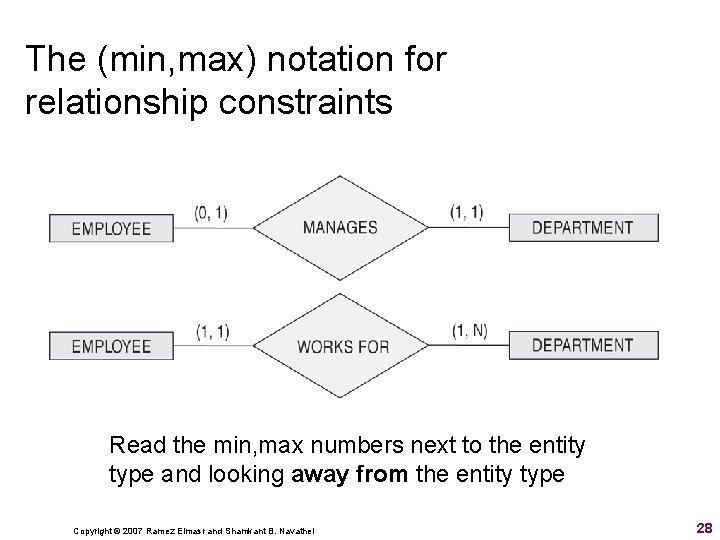
The (min, max) notation for relationship constraints Read the min, max numbers next to the entity type and looking away from the entity type Copyright © 2007 Ramez Elmasr and Shamkant B. Navathei 28
COMPANY ER Schema Diagram using (min, max) notation Copyright © 2007 Ramez Elmasr and Shamkant B. Navathei 29
Summary of notation for ER diagrams Copyright © 2007 Ramez Elmasr and Shamkant B. Navathei 30
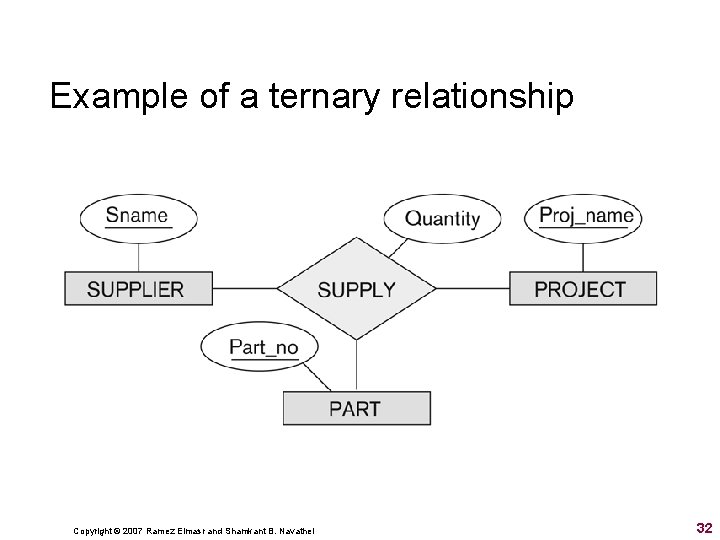
Relationships of Higher Degree n n n Relationship types of degree 2 are called binary Relationship types of degree 3 are called ternary and of degree n are called n-ary A ternary relationship example n SUPPLY: (SUPPLIER, PART, PROJECT) Copyright © 2007 Ramez Elmasr and Shamkant B. Navathei 31
Example of a ternary relationship Copyright © 2007 Ramez Elmasr and Shamkant B. Navathei 32
Chapter Summary n n ER Model Concepts: Entities, attributes, relationships Constraints in the ER model Using ER in step-by-step conceptual schema design for the COMPANY database ER Diagrams - Notation Copyright © 2007 Ramez Elmasr and Shamkant B. Navathei 33