
Chapter 3 Current Trends and Issues in Nursing

- Slides: 28
Chapter 3: Current Trends and Issues in Nursing
Health Care in the United States • Western medicine is proving ineffective, wholly or partially, for a significant proportion of common chronic diseases. • Highly technological health care is too expensive to be universally affordable. • Chronic diseases are the leading causes of death and disability in the United States. • About half of all U. S. adults (117 million people) have one or more chronic health conditions.
Health Care in the United States • Chronic diseases account for 70% of all deaths in the United States, which is 1. 7 million deaths each year. • Healthcare costs have been rising for several years. • Total healthcare expenditures continue to outpace inflation and the growth in national income. • The U. S. healthcare system is the most expensive in the world, but it yields worse results than the systems in Britain, Canada, Germany, France, Japan, Australia, and New Zealand.
Health Care in the United States • There is disparity in the number of Americans insured for health coverage. • The Kaiser Family Foundation identified the following forces driving healthcare costs: – – Technology and prescription drugs Chronic disease Aging of the population Administrative costs
Health Care in the United States • The Kaiser Family Foundation offered the following proposals to contain costs: – Invest in information technology – Improve quality and efficiency – Adjust provider compensation and increase comparative effectiveness research – Increase government regulation in controlling percapita spending – Increase prevention efforts – Increase consumer involvement in purchasing
Health Care in the United States • Use of CAM/CIM in the United States – The American public has pursued alternative, complementary, integrative care at an ever-increasing rate. – The majority of individuals using CAM do so to complement conventional care rather than as an alternative to conventional care. – The most recent survey of consumer use of CAM by AARP found that people 50 years and older tend to be high users of CAM/CIM.
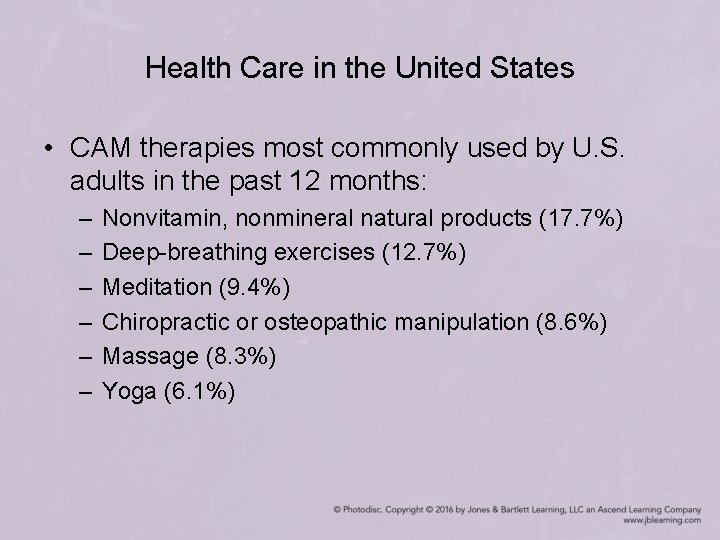
Health Care in the United States • CAM therapies most commonly used by U. S. adults in the past 12 months: – – – Nonvitamin, nonmineral natural products (17. 7%) Deep-breathing exercises (12. 7%) Meditation (9. 4%) Chiropractic or osteopathic manipulation (8. 6%) Massage (8. 3%) Yoga (6. 1%)
Health Care in the United States • Healthcare reform and integrative health care – Patient Protection and Affordable Healthcare Act (HR 3590), signed into law on March 23, 2010: • Focuses on provisions to expand health coverage, control health costs, and improve the healthcare delivery system • Incorporates a more integrative approach to healthcare delivery
Health Care in the United States • Sections of the Patient Protection and Affordable Care Act that will shape policy relative to integrative healthcare practices in the future: – Inclusion of Licensed Practitioners Insurance Coverage – Inclusion of Licensed Complementary and Alternative Medicine Practitioners in Medical Homes – Integrative Health Care and Integrative Practitioners in Prevention Strategies – Dietary Supplements in Individualized Wellness Plans
Health Care in the United States • Sections of Patient Protection and Affordable Care Act that will shape policy relative to integrative healthcare practices in the future (continued): – Licensed Complementary and Alternative Providers and Integrative Practitioners in Workforce Planning – Experts in Integrative Health and State-Licensed Integrative Health Practitioners in Comparative Effectiveness Research
Health Care in the United States • Trends – Workplace clinics: employers promoting health and prevention – Primary care: • • • Focus on primary prevention Continuously improving health Patient/client-provider relationships Primary care team Focus on behavioral change Focus on quality and safety
Health Care in the United States • Trends, continued – Primary care, continued: • • • Genome and epigenetic data use Broadened vital signs Personal and community vital signs Person-centered care Integrative concerns in primary care Healthcare access 24/7 – Health care: • Pricewaterhouse. Coopers identified 10 top healthcare issues of the day (refer to student text).
Health Care in the United States • Trends, continued – Health workforce: • The Bureau of Labor Statistics reports the healthcare sector will have a hiring resurgence. – Holistic health: • Holistic leader Bill Manahan offered “eight transitions that will bring light and balance to healthcare. ” – Refer to the student text.
Health Care in the United States • Recommendations (Robert Wood Johnson Foundation Commission) – Make investments in America’s youngest children a high priority. – Launch major new initiatives to help families and communities build a strong foundation in early years for a lifetime of good health. – Fully integrate health into community development as neighborhoods are revitalized. – Seek a more health-focused approach to healthcare financing and delivery.
Health Care in the United States • White House Commission on CAM – Include more evidence-based teaching about CAM approaches in the conventional health professions schools. – Emphasize the importance of approaches to prevent disease and promote wellness for the long-term health of the American people. – Increase in importance teaching the principles and practices of self-care and provide lifestyle counseling in professional schools so that health professionals can, in turn, provide this guidance to their patients as well as improve their own health.
Health Care in the United States • White House Commission on CAM, continued – Provide those in the greatest need access to the most accurate, up-to-date information about which therapies and products may help and which may harm. – Design the education and training of all practitioners to increase the availability of practitioners knowledgeable in both CAM and conventional practices.
Health Care in the United States • IOM report, Complementary and Alternative Medicine in the United States – Health professionals take into account a patient’s individuality, emotional needs, values, and life issues. – Health professions schools incorporate sufficient information about CAM to enable licensed professionals to competently advise patients about CAM. – National professional organizations of all CAM disciplines ensure the presence of training standards and develop practice guidelines.
Health Care in the United States – Healthcare professional licensing boards and crediting and certifying agencies (for both CAM and conventional medicine) should set competency standards in the appropriate use of both conventional medicine and CAM therapies. – Needed is a moral commitment of openness to diverse interpretations of health and healing, a commitment to finding innovative ways of obtaining evidence, and an expansion of the knowledge base relevant and appropriate to medical practice. – Research aimed at answering questions about outcomes of care is crucial.
Health Care in the United States – NIH and other public and private agencies sponsor research to compare the outcomes and costs of combinations of CAM and conventional medical treatments and develop models that deliver such care. – The U. S. Congress and federal agencies, in consultation with industry, research scientists, consumers, and other stakeholders, amend the current regulatory scheme for dietary supplements.
Health Care in the United States • Wellness Initiative for the Nation (WIN) – Created to proactively prevent disease and illness, promote health and productivity, and encourage the wellbeing and flourishing of the U. S. population • National Prevention Strategy – State, local, and territorial governments, businesses, healthcare, education, and community faith-based organizations work together to improve health and quality of life by focusing on wellness and prevention • IOM and the Bravewell Collaborative – Summit on Integrative Medicine and the Health of the Public
Health Care in the United States • 2009 Summit on Integrative Medicine and the Health of the Public – The progression of many chronic diseases can be reversed and sometimes even completely healed through lifestyle modifications. – Genetics is not destiny. – The environment influences health. – Improving the primary care and chronic disease care systems is paramount. – The reimbursement system must be changed. – Changes in education will fuel changes in practice.
Health Care in the United States • 2009 Summit on Integrative Medicine and the Health of the Public, continued – Evidence-based medicine/health care is the only acceptable standard. – Research must better accommodate multifaceted and interacting factors. – A large demonstration project is recommended.
Health Care in the United States • IOM Global Forum on Innovation in Health Professional Education – Convened a forum on Establishing Transdisciplinary Professionalism for Improving Health Outcome – The forum defined transdisciplinary professionalism (TP) as: • An approach to creating and carrying out a shared social contract ensuring that multiple health disciplines, working in concert, are worthy of the trust of patients and the public in order to improve the health of patients and their communities
Issues in Holistic Nursing • The Task Force on Values, Knowledge, Skills, and Attitudes identified the following core values for all healthcare professional students: – Wholeness and healing: interconnectedness of all people and things with healing as an innate capacity of every individual – Clients/patients/families as the center of practice – Practice as a combined art and science – Self-care of the practitioner and commitment to selfreflection, personal growth, and healing – Interdisciplinary collaboration and integration
Issues in Holistic Nursing • The Task Force on Values, Knowledge, Skills, and Attitudes identified the following core values for all healthcare professional students: – Responsibility to contribute to the improvement of the community, the environment, health promotion, healthcare access, and the betterment of public health – Attitudes and behaviors of all participants in health care demonstrating respect for self and others, humility, and authentic, open, courageous communication
Issues in Holistic Nursing • Educational challenges – IOM recommendations: • Nurses should achieve higher levels of education and training through improved educational systems • Increase proportion of nurses with a baccalaureate degree by 80% by 2020 • Double the number of nurses with a doctorate by 2020 • Ensure that nurses engage in lifelong learning
Issues in Holistic Nursing • Research – – IOM report on CAM in the United States NCCAM’s Third Strategic Plan, 2011 -2015 Patient-Centered Outcomes Research Institute (PCORI) The Journal of Alternative and Complementary Medicine • Clinical Practice – 2012 AHNA Position on the Role of Nurses in the Practice of Complementary and Alternative Therapies describes the necessity for integration of CAM/CIM therapies into a comprehensive holistic nursing practice
Issues in Holistic Nursing • Policy – Four major policy issues face holistic nursing in the future: • • Leadership Reimbursement Regulation Access